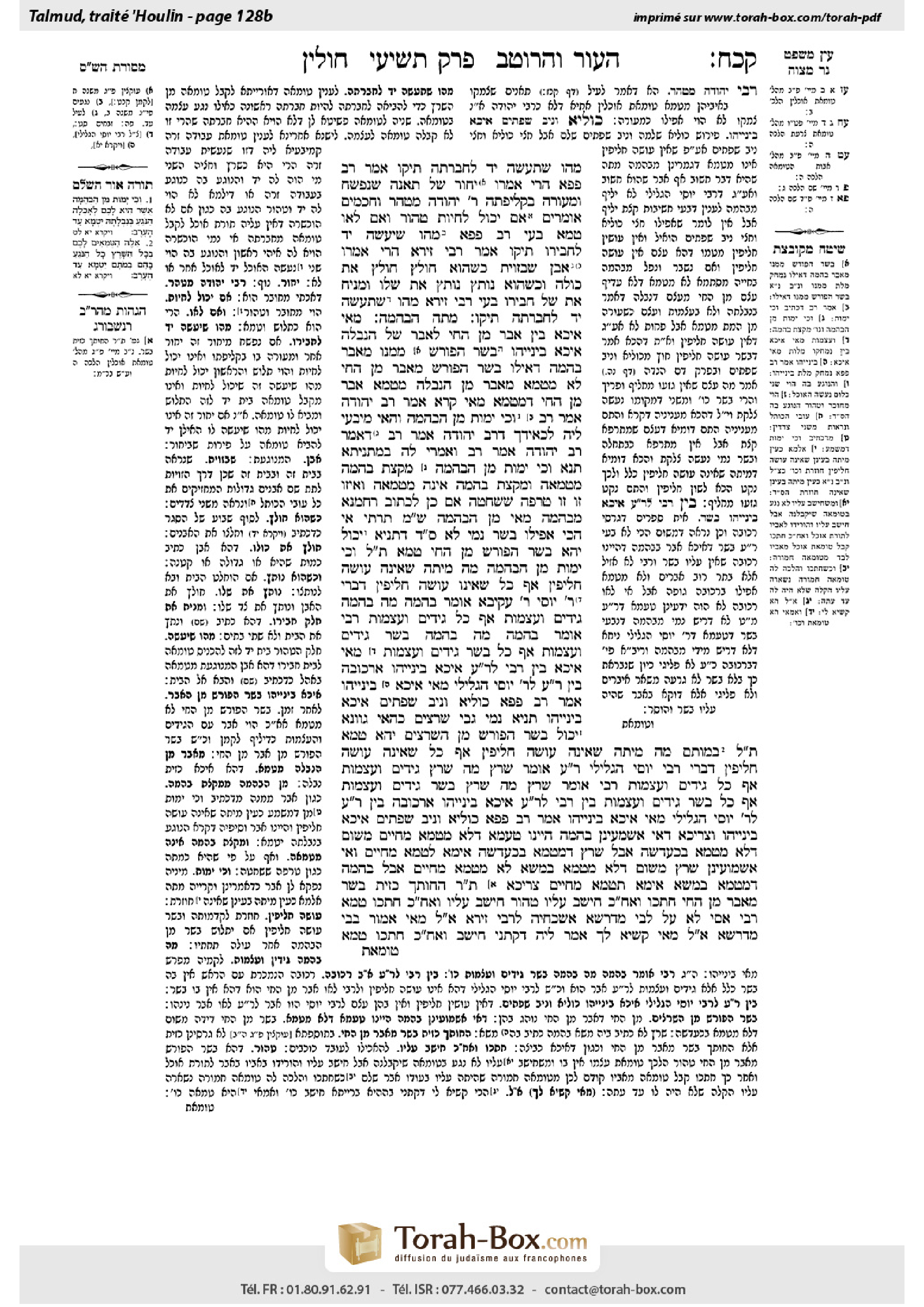
Chullin 128b: Talmud study for Daf Yomi
Study the Talmud for Daf Yomi with scanned pages, Hebrew text, English translations from Sefaria and AI-generated French translations.
Passage selection and English or AI-generated French translation are available where the scan has annotations. Daf Study is independent of Torah-Box and Sefaria.
Browse Chullin · חולין · All tractatesChullin 128b text and translations
This page of Chullin includes the Aramaic text, an English translation and an AI-generated French translation, alongside the scan above.
חולין קכ״ח ב · Aramaic and Hebrew text
מַהוּ שֶׁתֵּעָשֶׂה יָד לַחֲבֶרְתָּהּ? תֵּיקוּ.
אָמַר רַב פָּפָּא: הֲרֵי אָמְרוּ יִחוּר שֶׁל תְּאֵנָה שֶׁנִּפְשַׁח וּמְעוֹרֶה בִּקְלִיפָּתָהּ – רַבִּי יְהוּדָה מְטַהֵר, וַחֲכָמִים אוֹמְרִים: אִם יָכוֹל לִחְיוֹת – טָהוֹר, וְאִם לָאו – טָמֵא.
בָּעֵי רַב פָּפָּא: מַהוּ שֶׁיֵּעָשֶׂה יָד לַחֲבֵירוֹ? תֵּיקוּ.
אָמַר רַבִּי זֵירָא, הֲרֵי אָמְרוּ: אֶבֶן שֶׁבַּזָּוִית, כְּשֶׁהוּא חוֹלֵץ – חוֹלֵץ אֶת כּוּלָּהּ, וּכְשֶׁהוּא נוֹתֵץ – נוֹתֵץ אֶת שֶׁלּוֹ וּמַנִּיחַ אֶת שֶׁל חֲבֵירוֹ.
בָּעֵי רַבִּי זֵירָא: מַהוּ שֶׁתֵּעָשֶׂה יָד לַחֲבֶרְתָּהּ? תֵּיקוּ.
מֵתָה הַבְּהֵמָה. מַאי אִיכָּא בֵּין אֵבֶר מִן הַחַי לְאֵבֶר (שֶׁל) [מִן] הַנְּבֵלָה?
אִיכָּא בֵּינַיְיהוּ בָּשָׂר הַפּוֹרֵשׁ מִמֶּנּוּ (מֵאֵבֶר בְּהֵמָה), דְּאִילּוּ בָּשָׂר הַפּוֹרֵשׁ מֵאֵבֶר מִן הַחַי – לֹא מְטַמֵּא, מֵאֵבֶר מִן הַנְּבֵלָה – מְטַמֵּא.
אֵבֶר מִן הַחַי דִּמְטַמֵּא, מַאי קְרָא? אָמַר רַב יְהוּדָה אָמַר רַב: ״וְכִי יָמוּת מִן הַבְּהֵמָה״.
וְהַאי מִיבְּעֵי לֵיהּ לִכְאִידַּךְ דְּרַב יְהוּדָה אָמַר רַב, דְּאָמַר רַב יְהוּדָה אָמַר רַב, וְאָמְרִי לַהּ בְּמַתְנִיתָא תָּנָא: ״וְכִי יָמוּת מִן הַבְּהֵמָה״ – מִקְצָת בְּהֵמָה מְטַמְּאָה, וּמִקְצָת בְּהֵמָה אֵינָהּ מְטַמְּאָה, וְאֵיזוֹ זוֹ? זוֹ טְרֵפָה שֶׁשְּׁחָטָהּ!
אִם כֵּן, לִכְתּוֹב רַחֲמָנָא ״מִבְּהֵמָה״, מַאי ״מִן הַבְּהֵמָה״? שְׁמַע מִינַּהּ תַּרְתֵּי.
אִי הָכִי, אֲפִילּוּ בָּשָׂר נָמֵי? לָא סָלְקָא דַּעְתָּךְ, דְּתַנְיָא: יָכוֹל יְהֵא בָּשָׂר הַפּוֹרֵשׁ מִן הַחַי טָמֵא? תַּלְמוּד לוֹמַר ״וְכִי יָמוּת מִן הַבְּהֵמָה״ – מָה מִיתָה שֶׁאֵינָהּ עוֹשָׂה חֲלִיפִין, אַף כֹּל שֶׁאֵינוֹ עוֹשֶׂה חֲלִיפִין, דִּבְרֵי רַבִּי יוֹסֵי.
רַבִּי עֲקִיבָא אוֹמֵר: ״בְּהֵמָה״, מָה בְּהֵמָה – גִּידִים וַעֲצָמוֹת, אַף כֹּל – גִּידִים וַעֲצָמוֹת. רַבִּי אוֹמֵר: ״בְּהֵמָה״ מָה בְּהֵמָה – בָּשָׂר גִּידִים וַעֲצָמוֹת, אַף כֹּל – בָּשָׂר גִּידִים וַעֲצָמוֹת.
מַאי אִיכָּא בֵּין רַבִּי לְרַבִּי עֲקִיבָא? אִיכָּא בֵּינַיְיהוּ אַרְכוּבָּה.
בֵּין רַבִּי עֲקִיבָא לְרַבִּי יוֹסֵי הַגְּלִילִי, מַאי אִיכָּא בֵּינַיְיהוּ? אָמַר רַב פָּפָּא: כּוּלְיָא וְנִיב שְׂפָתַיִם אִיכָּא בֵּינַיְיהוּ.
תַּנְיָא נָמֵי גַּבֵּי שְׁרָצִים כְּהַאי גַּוְונָא: יָכוֹל בָּשָׂר הַפּוֹרֵשׁ מִן הַשְּׁרָצִים יְהֵא טָמֵא? תַּלְמוּד לוֹמַר ״בְּמוֹתָם״ – מָה מִיתָה שֶׁאֵינָהּ עוֹשָׂה חֲלִיפִין, אַף כֹּל שֶׁאֵינָהּ עוֹשָׂה חֲלִיפִין. דִּבְרֵי רַבִּי יוֹסֵי הַגְּלִילִי.
רַבִּי עֲקִיבָא אוֹמֵר: ״שֶׁרֶץ״, מָה שֶׁרֶץ – גִּידִים וַעֲצָמוֹת, אַף כֹּל – גִּידִים וַעֲצָמוֹת. רַבִּי אוֹמֵר: ״שֶׁרֶץ״, מָה שֶׁרֶץ – בָּשָׂר גִּידִים וַעֲצָמוֹת, אַף כֹּל – בָּשָׂר גִּידִים וַעֲצָמוֹת.
בֵּין רַבִּי לְרַבִּי עֲקִיבָא אִיכָּא בֵּינַיְיהוּ אַרְכוּבָּה. בֵּין רַבִּי עֲקִיבָא לְרַבִּי יוֹסֵי הַגְּלִילִי מַאי אִיכָּא בֵּינַיְיהוּ? אָמַר רַב פָּפָּא: כּוּלְיָא וְנִיב שְׂפָתַיִם אִיכָּא בֵּינַיְיהוּ.
וּצְרִיכָא, דְּאִי אַשְׁמְעִינַן בְּהֵמָה – הַיְינוּ טַעְמָא דְּלֹא מְטַמֵּא מֵחַיִּים, מִשּׁוּם דְּלֹא מְטַמֵּא בְּכַעֲדָשָׁה, אֲבָל שֶׁרֶץ דִּמְטַמֵּא בְּכַעֲדָשָׁה – אֵימָא לְטַמֵּא מֵחַיִּים.
וְאִי אַשְׁמְועִינַן שֶׁרֶץ, מִשּׁוּם דְּלָא מְטַמֵּא בְּמַשָּׂא – לֹא מְטַמֵּא מֵחַיִּים, אֲבָל בְּהֵמָה, דִּמְטַמֵּא בְּמַשָּׂא – אֵימָא תְּטַמֵּא מֵחַיִּים, צְרִיכָא.
תָּנוּ רַבָּנַן: הַחוֹתֵךְ כְּזַיִת בָּשָׂר מֵאֵבֶר מִן הַחַי, חֲתָכוֹ וְאַחַר כָּךְ חִישֵּׁב עָלָיו – טָהוֹר.
חִישֵּׁב עָלָיו, וְאַחַר כָּךְ חֲתָכוֹ – טָמֵא.
רַבִּי אַסִּי לָא עָל לְבֵי מִדְרְשָׁא, אַשְׁכְּחֵיהּ לְרַבִּי זֵירָא, אֲמַר לֵיהּ: מַאי אֲמוּר בְּבֵי מִדְרְשָׁא? אֲמַר לֵיהּ: מַאי קַשְׁיָא לָךְ? אֲמַר לֵיהּ, דְּקָתָנֵי: חִישֵּׁב וְאַחַר כָּךְ חֲתָכוֹ טָמֵא.
Chullin 128b · English translation
According to Rabbi Shimon, an item that is forbidden due to idol worship is not susceptible to impurity as food (see 129a). What is the halakha if the forbidden part of the gourd comes into contact with a source of impurity? Does the forbidden part constitute a handle for its permitted counterpart and transmit impurity to it? The Gemara concludes: The dilemma shall stand unresolved.
The Gemara discusses a similar dilemma. Rav Pappa says: The Sages said in a mishna (Okatzin 3:8): In the case of a branch of a fig tree that was mainly detached from the tree and which remains attached only to the bark of the tree, Rabbi Yehuda holds that the figs on the branch are considered as if they are still attached to the tree. Therefore, he deems them not susceptible to impurity. And the Rabbis say: If one is able to reattach the branch to the tree such that the branch can continue to live and produce fruit, then it is considered as if it is attached to the tree and the fruit on it is not susceptible to impurity. But if not, then the fruit is susceptible to impurity.
With regard to this mishna, Rav Pappa raises a dilemma: According to the Rabbis, who distinguish between a branch that can be reattached and one that cannot, what is the halakha in the case of a branch that is mainly detached from a tree but can be reattached, and a second branch grows out from that branch, and is mainly detached from it and cannot be reattached? In such a case, the branch that can be reattached to the tree is not susceptible to contracting impurity, but the branch attached to it is. If the branch that is not susceptible to contract impurity comes into contact with a source of impurity, does it constitute a handle for the other branch and transmit impurity to it? The Gemara concludes: The dilemma shall stand unresolved.
The Gemara discusses another similar dilemma. Rabbi Zeira says: The Sages said in a mishna (Nega’im 13:2): In the case of a large stone that is situated in the corner of a wall shared by two houses, where the stone is visible from inside both houses, if a leprous mark appears in one of the houses on the stone, when one extracts the stone he must extract the entire stone, even the part of the stone that is part of the neighbor’s wall. But when one destroys his house, after a reappearance of the leprous mark, he must destroy only the part of a stone that is in his house, and leaves the part of a stone that belongs to his neighbor.
With regard to this mishna Rabbi Zeira raises a dilemma: What is the halakha in such a case with regard to the transmission of impurity from the leprous house to the adjacent house? Does half of the stone in the adjacent house constitute a handle for the other half and impart impurity such that one who enters the neighbor’s house becomes impure just as one who enters the leprous house? Or perhaps there is no halakha of a handle with regard to the impurity of a leprous house. The Gemara concludes: The dilemma shall stand unresolved.
§The mishna teaches: If the animal died, the hanging flesh needs to be rendered susceptible to impurity via contact with a liquid in order to become impure, as its halakhic status is that of flesh severed from a living animal, which is ritually pure and does not have the status of an unslaughtered carcass. The hanging limb imparts impurity as a limb severed from a living animal but does not impart impurity as the limb of an unslaughtered carcass. The Gemara asks: What difference is there between the impurity of a limb from a living animal and the impurity of a limb from a carcass?
The Gemara answers: The difference between them is with regard to flesh that separates from the limb of an animal, as flesh that separates from a limb severed from the living does not impart impurity, just like flesh that separates directly from a living animal. By contrast, an olive-bulk of flesh that separates from the limb of a carcass imparts impurity like the flesh of a carcass.
The Gemara asks: What is the verse from which it is derived that a limb severed from the living imparts impurity? Rav Yehuda says that Rav says: With regard to the impurity of a carcass it is written: “And if some animal [min habehema] of which you may eat dies, he who touches its carcass shall be impure until evening” (Leviticus 11:39). The phrase “some animal [min habehema],” which also means: From an animal, is interpreted as indicating that a limb torn from an animal is included in the impurity discussed in the verse.
The Gemara asks: How can Rav interpret this verse in such a manner? This verse is necessary for another halakha that Rav Yehuda said that Rav said, as Rav Yehuda said that Rav said, and some say it was taught in a baraita: In the verse: “And if some animal [min habehema] of which you may eat dies, he who touches its carcass shall be impure until evening,” the phrase “some animal [min habehema]” indicates that some dead animals impart impurity as a carcass, and some dead animals do not impart impurity as a carcass. And which is that animal that does not impart impurity as a carcass? That is an animal with a wound that will cause it to die within twelve months [tereifa] that one slaughtered. Even though slaughter does not render the animal permitted to be eaten, it removes the animal from the category of a carcass with regard to impurity.
The Gemara answers: If so, if the verse teaches only one of the two halakhot, let the Merciful One write mibehema, in one Hebrew word. What is the verse teaching when it states: “Min habehema,” with two Hebrew words? It is teaching that one should conclude two conclusions from it.
The Gemara challenges: If so, if this verse teaches that a limb from a living animal imparts impurity, one can also derive from it that even flesh from a living animal imparts impurity. The Gemara responds: It should not enter your mind to derive this, as it is taught in a baraita: One might have thought that flesh that separates from a living animal is impure like a carcass. Therefore, the verse states: “And if some animal of which you may eat dies.” Just as death does not generate a replacement, i.e., life is not regenerated from the dead, so too any element of an animal that dies and does not generate a replacement assumes the impurity of a carcass. An animal does not replace a severed limb but it does replace severed flesh; this is the statement of Rabbi Yosei.
Rabbi Akiva says: One can derive this halakha from the word “animal” in the verse. Just as an animal contains sinews and bones, so too, any element of an animal that contains sinews and bones imparts impurity. Therefore, a limb, which contains sinews and bones, imparts impurity, but flesh, which does not contain sinews and bones, does not impart impurity. Rabbi Yehuda HaNasi says: One can derive this halakha from the word “animal” in the verse. Just as an animal contains flesh, sinews, and bones, so too, any element of an animal that contains flesh, sinews, and bones imparts impurity.
The Gemara asks: What difference is there between the opinions of Rabbi Yehuda HaNasi and Rabbi Akiva? The Gemara answers: The practical difference between them is with regard to the leg joint, which contains sinews and bones but no flesh. According to Rabbi Yehuda HaNasi it does not impart impurity when it separates from a living animal, but according to Rabbi Akiva it does.
The Gemara asks: What practical difference is there between the opinions of Rabbi Akiva and Rabbi Yosei HaGelili? Rav Pappa said: The practical difference between them is with regard to the kidney and the upper lip that separate from a living animal. According to Rabbi Yosei these parts of the animal impart impurity because the animal does not generate a replacement for them; according to Rabbi Akiva they do not impart impurity, because they do not contain bones.
The Gemara states a different halakha where these three tanna’im express the same opinions. So too, it is taught in a baraita with regard to creeping animals like this case: One might have thought that flesh that separates from a creeping animal during its lifetime should be impure like a creeping animal carcass. Therefore, the verse states with regard to creeping animal carcasses: “And upon whatever any of them falls when they are dead shall be impure” (Leviticus 11:32). The word “dead” teaches that just as death does not generate a replacement, so too any element of a creeping animal that dies and does not generate a replacement imparts the impurity of a creeping animal carcass, excluding flesh; this is the statement of Rabbi Yosei HaGelili.
Rabbi Akiva says: One can derive this halakha from the term “creeping animal.” Just as a creeping animal contains sinews and bones, so too any element of a creeping animal that contains sinews and bones imparts impurity. Rabbi Yehuda HaNasi says: One can derive this halakha from the term “creeping animal.” Just as a creeping animal contains flesh, sinews, and bones, so too, any element of a creeping animal that contains flesh, sinews, and bones imparts impurity.
The Gemara comments: The practical difference between the opinions of Rabbi Yehuda HaNasi and Rabbi Akiva is with regard to the leg joint, which contains sinews and bones but no flesh. What difference is there between the opinions of Rabbi Akiva and Rabbi Yosei HaGelili? Rav Pappa said: The practical difference between them is with regard to the kidney and the upper lip, which contain no bones and which are not regenerated by the creeping animal.
And it is necessary to teach this halakha both with regard to flesh that separates from a living animal and with regard to flesh that separates from a creeping animal. As if the baraita had taught us this halakha only with regard to an animal, one might have said that this is the reason that flesh that separates from a living animal does not impart impurity: It is because an animal carcass does not impart impurity in the measure of a lentil-bulk, but rather only in the measure of an olive-bulk. But with regard to a creeping animal, which imparts impurity even in the measure of a lentil-bulk, say that flesh that separates from it while it is living should impart impurity.
And if the baraita had taught us this halakha only with regard to a creeping animal, one might have said that flesh that separates from a creeping animal does not impart impurity because a creeping animal does not impart impurity via carrying, and therefore flesh that separates from it while it is living does not impart impurity. But with regard to an animal, which imparts impurity via carrying, say that flesh that separates from it while it is living should impart impurity. Therefore, it is necessary to teach this halakha in both cases.
§The Gemara continues to discuss flesh that separates from a living animal. The Sages taught in a baraita: In the case of one who severs an olive-bulk of flesh from a limb severed from the living, the flesh does not impart the impurity of a carcass but it does impart impurity as food if one designated it as food before it came into contact with a source of impurity. Therefore, if one severed the flesh from the limb and afterward intended it to be used for the consumption of a gentile, the flesh remains pure because at the time he designated the flesh as food it was not in contact with a source of impurity.
But if he intended it to be used for the consumption of a gentile and afterward severed the flesh, the flesh is impure, because it came into contact with a source of impurity, i.e., the limb, after it was designated as food.
One day Rabbi Asi did not go to the study hall. He found Rabbi Zeira, and said to him: What was said today in the study hall? Rabbi Zeira said to him: What matter is difficult for you that you think may have been discussed in the study hall? Rabbi Asi said to him: I find difficult that which is taught in a baraita: If one intended flesh from a limb that was severed from a living animal to be used for the consumption of a gentile, and afterward he severed the flesh from the limb, the flesh is impure.
Chullin 128b · Traduction française (IA)
Selon Rabbi Shimon, un objet interdit en raison de l'idolâtrie n'est pas susceptible de souillure comme aliment (voir 129a). Quelle est la halakha si la partie interdite du melon entre en contact avec une source de souillure ? La partie interdite constitue-t-elle un manche pour son contrepartie permise et transmet-elle la souillure à celle-ci ? La Guemara conclut : Ce dilemme restera sans solution.
La Guemara discute d'un dilemme similaire. Rav Pappa dit : Les Sages ont dit dans une mitsva (Okatzin 3:8) : Dans le cas d'une branche d'un arbre à figues qui est principalement détachée de l'arbre et qui reste attachée uniquement à la couche de l'arbre, Rabbi Yehuda considère que les figues sur la branche sont considérées comme si elles étaient encore attachées à l'arbre. Il considère donc qu'elles ne sont pas susceptibles de souillure. Et les Rabbins disent : Si l'on peut relier la branche à l'arbre de sorte que la branche puisse continuer à vivre et à produire des fruits, alors elle est considérée comme attachée à l'arbre et les fruits sur elle ne sont pas susceptibles de souillure. Mais si ce n'est pas le cas, alors les fruits sont susceptibles de souillure.
Concernant cette mitsva, Rav Pappa soulève un dilemme : Selon les Rabbins, qui distinguent entre une branche qui peut être reattachée et une branche qui ne peut pas l'être, quelle est la halakha dans le cas d'une branche principalement détachée d'un arbre mais pouvant être reattachée, et une seconde branche poussant de cette branche, principalement détachée d'elle et ne pouvant pas être reattachée ? Dans ce cas, la branche pouvant être reattachée à l'arbre n'est pas susceptible de contracter une souillure, mais la branche attachée à celle-ci l'est. Si la branche non susceptible de contracter une souillure entre en contact avec une source de souillure, constitue-t-elle un manche pour l'autre branche et transmet-elle la souillure à celle-ci ? La Guemara conclut : Ce dilemme restera sans solution.
La Guemara discute d'un autre dilemme similaire. Rabbi Zeira dit : Les Sages ont dit dans une mitsva (Nega’im 13:2) : Dans le cas d'une grande pierre située dans le coin d'un mur partagé par deux maisons, où la pierre est visible depuis les deux maisons, si une marque de lépreuse apparaît dans l'une des maisons sur la pierre, lorsqu'on extrait la pierre, on doit extraire toute la pierre, même la partie de la pierre appartenant au mur de la maison voisine. Mais lorsqu'on détruit sa maison, après une réapparition de la marque de lépreuse, on doit détruire uniquement la partie de la pierre qui est dans sa maison, et laisser la partie de la pierre appartenant à son voisin.
Concernant cette mitsva, Rabbi Zeira soulève un dilemme : Quelle est la halakha dans ce cas concernant la transmission de la souillure de la maison lépreuse à la maison adjacente ? La moitié de la pierre dans la maison adjacente constitue-t-elle un manche pour l'autre moitié et transmet-elle la souillure de sorte qu'une personne entrant dans la maison du voisin devienne souillée comme une personne entrant dans la maison lépreuse ? Ou peut-être n'y a-t-il pas de halakha du manche concernant la souillure d'une maison lépreuse. La Guemara conclut : Ce dilemme restera sans solution.
§La mitsva enseigne : Si l'animal est mort, la chair suspendue doit être rendue susceptible de souillure par contact avec un liquide afin de devenir souillante, car son statut halakhique est celui de chair détachée d'un animal vivant, qui est rituellement pure et ne possède pas le statut d'un cadavre non sacrifié. La partie suspendue transmet la souillure comme une partie détachée d'un animal vivant mais ne transmet pas la souillure comme la partie d'un cadavre non sacrifié. La Guemara demande : Quelle est la différence entre la souillure d'une partie d'un animal vivant et la souillure d'une partie d'un cadavre ?
La Guemara répond : La différence entre eux concerne la chair qui se détache d'une partie d'un animal, car la chair qui se détache d'une partie détachée d'un animal vivant ne transmet pas la souillure, tout comme la chair qui se détache directement d'un animal vivant. En revanche, une quantité d'olive de chair qui se détache d'une partie d'un cadavre transmet la souillure comme la chair d'un cadavre.
La Guemara demande : De quel verset tire-t-on que la partie détachée d'un animal vivant transmet la souillure ? Rav Yehuda dit que Rav dit : Concernant la souillure d'un cadavre, il est écrit : « Et si un animal [min habehema] dont vous pouvez manger meurt, celui qui touche son cadavre devient souillé jusqu'au soir » (Lévitique 11:39). La phrase « un animal [min habehema] », qui signifie également : d'un animal, indique que la partie arrachée d'un animal est incluse dans la souillure discutée dans le verset.
La Guemara demande : Comment Rav peut-il interpréter ce verset ainsi ? Ce verset est nécessaire pour une autre halakha que Rav Yehuda a dite que Rav a dite, car Rav Yehuda a dit que Rav a dit, et certains disent qu'il a été enseigné dans une baraïta : Dans le verset : « Et si un animal [min habehema] dont vous pouvez manger meurt, celui qui touche son cadavre devient souillé jusqu'au soir », la phrase « un animal [min habehema] » indique que certains animaux morts transmettent la souillure comme un cadavre, et d'autres animaux morts ne transmettent pas la souillure comme un cadavre. Quel est cet animal qui ne transmet pas la souillure comme un cadavre ? C'est un animal avec une plaie qui le fera mourir dans les douze mois [tereifa] que l'on a sacrifié. Bien que le sacrifice ne rende l'animal permis à manger, il l'ôte de la catégorie de cadavre concernant la souillure.
La Guemara répond : Si c'est ainsi, si le verset enseigne seulement l'une des deux halakhot, que le Miséricordieux écrive mibehema, en un seul mot hébreu. Quel est le sens du verset lorsqu'il dit : « Min habehema », en deux mots hébreux ? Il enseigne que l'on doit en tirer deux conclusions.
La Guemara conteste : Si c'est ainsi, si cette versette enseigne qu'un membre d'un animal vivant transmet l'impureté, on pourrait aussi en déduire que la chair d'un animal vivant transmet l'impureté. La Guemara répond : Ne laissez pas entrer en votre esprit cette déduction, car cela est enseigné dans une baraïta : On pouvait penser que la chair qui se détache d'un animal vivant est impure comme un cadavre. Ainsi, la versette dit : « Et si un animal dont vous pouvez manger meurt. » Comme la mort ne génère pas de remplacement, c'est-à-dire que la vie n'est pas régénérée à partir du mort, de même tout élément d'un animal qui meurt et ne génère pas de remplacement assume l'impureté du cadavre. L'animal ne remplace pas un membre arraché, mais il remplace la chair arrachée ; c'est l'opinion de Rabbi Yosei.
Rabbi Akiva dit : On peut déduire cette halakha du mot « animal » dans la versette. Comme l'animal contient de la chair, des nerfs et des os, de même tout élément de l'animal qui contient de la chair, des nerfs et des os transmet l'impureté. Ainsi, un membre, qui contient de la chair, des nerfs et des os, transmet l'impureté, mais la chair, qui ne contient pas de chair, des nerfs et des os, ne transmet pas l'impureté. Rabbi Yehuda HaNasi dit : On peut déduire cette halakha du mot « animal » dans la versette. Comme l'animal contient de la chair, des nerfs et des os, de même tout élément de l'animal qui contient de la chair, des nerfs et des os transmet l'impureté.
La Guemara demande : Quelle différence y a-t-il entre les opinions de Rabbi Yehuda HaNasi et de Rabbi Akiva ? La Guemara répond : La différence pratique entre eux concerne le coude du membre, qui contient des nerfs et des os mais pas de chair. Selon Rabbi Yehuda HaNasi, il ne transmet pas l'impureté lorsqu'il se détache d'un animal vivant, mais selon Rabbi Akiva, il le transmet.
La Guemara demande : Quelle différence pratique y a-t-il entre les opinions de Rabbi Akiva et de Rabbi Yosei HaGelili ? Rav Pappa dit : La différence pratique entre eux concerne le rein et la lèvre supérieure qui se détachent d'un animal vivant. Selon Rabbi Yosei, ces parties de l'animal transmettent l'impureté, car l'animal ne génère pas de remplacement pour elles ; selon Rabbi Akiva, elles ne transmettent pas l'impureté, car elles ne contiennent pas d'os.
La Guemara évoque une autre halakha où ces trois tannaïm expriment les mêmes opinions. De même, cela est enseigné dans une baraïta concernant les animaux rampants comme dans ce cas : On pouvait penser que la chair qui se détache d'un animal rampant pendant sa vie devrait être impure comme un cadavre d'animal rampant. Ainsi, la versette dit concernant les cadavres d'animaux rampants : « Et sur tout ce que l'un d'eux tombe quand ils sont morts, il y aura de l'impureté » (Lévitique 11:32). Le mot « mort » enseigne que comme la mort ne génère pas de remplacement, de même tout élément d'un animal rampant qui meurt et ne génère pas de remplacement transmet l'impureté du cadavre d'un animal rampant, en excluant la chair ; c'est l'opinion de Rabbi Yosei HaGelili.
Rabbi Akiva dit : On peut déduire cette halakha du terme « animal rampant ». Comme un animal rampant contient de la chair, des nerfs et des os, de même tout élément d'un animal rampant qui contient de la chair, des nerfs et des os transmet l'impureté. Rabbi Yehuda HaNasi dit : On peut déduire cette halakha du terme « animal rampant ». Comme un animal rampant contient de la chair, des nerfs et des os, de même tout élément d'un animal rampant qui contient de la chair, des nerfs et des os transmet l'impureté.
La Guemara commente : La différence pratique entre les opinions de Rabbi Yehuda HaNasi et de Rabbi Akiva concerne le genou du membre, qui contient des nerfs et des os mais pas de chair. Quelle différence y a-t-il entre les opinions de Rabbi Akiva et de Rabbi Yosei HaGelili ? Rav Pappa dit : La différence pratique entre eux concerne le rein et la lèvre supérieure, qui ne contiennent pas d'os et qui ne sont pas régénérés par l'animal rampant.
Il est nécessaire d'enseigner cette halakha à la fois concernant la chair qui se détache d'un animal vivant et concernant la chair qui se détache d'un animal rampant. Car si la baraïta avait enseigné cette halakha uniquement concernant un animal, on pourrait dire que c'est pour cette raison que la chair qui se détache d'un animal vivant ne transmet pas l'impureté : parce qu'un cadavre d'animal ne transmet pas l'impureté dans la mesure d'une quantité de lentilles, mais seulement dans la mesure d'une olive. Mais concernant un animal rampant, qui transmet l'impureté même dans la mesure d'une quantité de lentilles, on dit que la chair qui se détache de lui pendant sa vie devrait transmettre l'impureté.
Et si la baraïta avait enseigné cette halakha uniquement concernant un animal rampant, on pourrait dire que la chair qui se détache d'un animal rampant ne transmet pas l'impureté, car un animal rampant ne transmet pas l'impureté par le port, et donc la chair qui se détache de lui pendant sa vie ne transmet pas l'impureté. Mais concernant un animal, qui transmet l'impureté par le port, on dit que la chair qui se détache de lui pendant sa vie devrait transmettre l'impureté. Ainsi, il est nécessaire d'enseigner cette halakha dans les deux cas.
§ La Guemara continue à discuter de la chair qui se détache d'un animal vivant. Les Sages ont enseigné dans une baraïta : Dans le cas d'une personne qui arrache une quantité d'olive de chair d'un membre arraché d'un animal vivant, la chair ne transmet pas l'impureté du cadavre, mais elle transmet l'impureté comme nourriture si l'on a désigné cette chair comme nourriture avant qu'elle ne se soit mise en contact avec une source d'impureté. Ainsi, si l'on a arraché la chair du membre et ensuite l'a désigné comme nourriture pour un non-juif, la chair reste pure, car au moment où l'on a désigné la chair comme nourriture, elle n'était pas en contact avec une source d'impureté.
Mais si l'on a désigné la chair comme nourriture pour un non-juif et ensuite l'a arrachée, la chair est impure, car elle s'est mise en contact avec une source d'impureté, c'est-à-dire le membre, après qu'elle ait été désignée comme nourriture.
Un jour, le rabbi Asi n'est pas allé à la salle de study. Il a trouvé le rabbi Zeira et lui a dit : Qu'est-ce qui a été dit aujourd'hui en salle de study ? Le rabbi Zeira lui a répondu : Quel sujet te pose difficulté, que tu penses avoir pu être discuté en salle de study ? Le rabbi Asi lui a répondu : Je trouve difficile ce qui est enseigné dans une baraïta : Si une personne avait l'intention d'utiliser de la viande provenant d'une partie séparée d'un animal vivant pour la consommation d'un non-juif, et ensuite il a séparé la viande de la partie, la viande est impure.
Traduction française générée par IA à partir de l’édition anglaise de Sefaria. Vérifie toujours un passage avec le texte source.
Text from Sefaria: William Davidson Edition - Vocalized Aramaic (unknown); William Davidson Edition - English (CC BY NC).