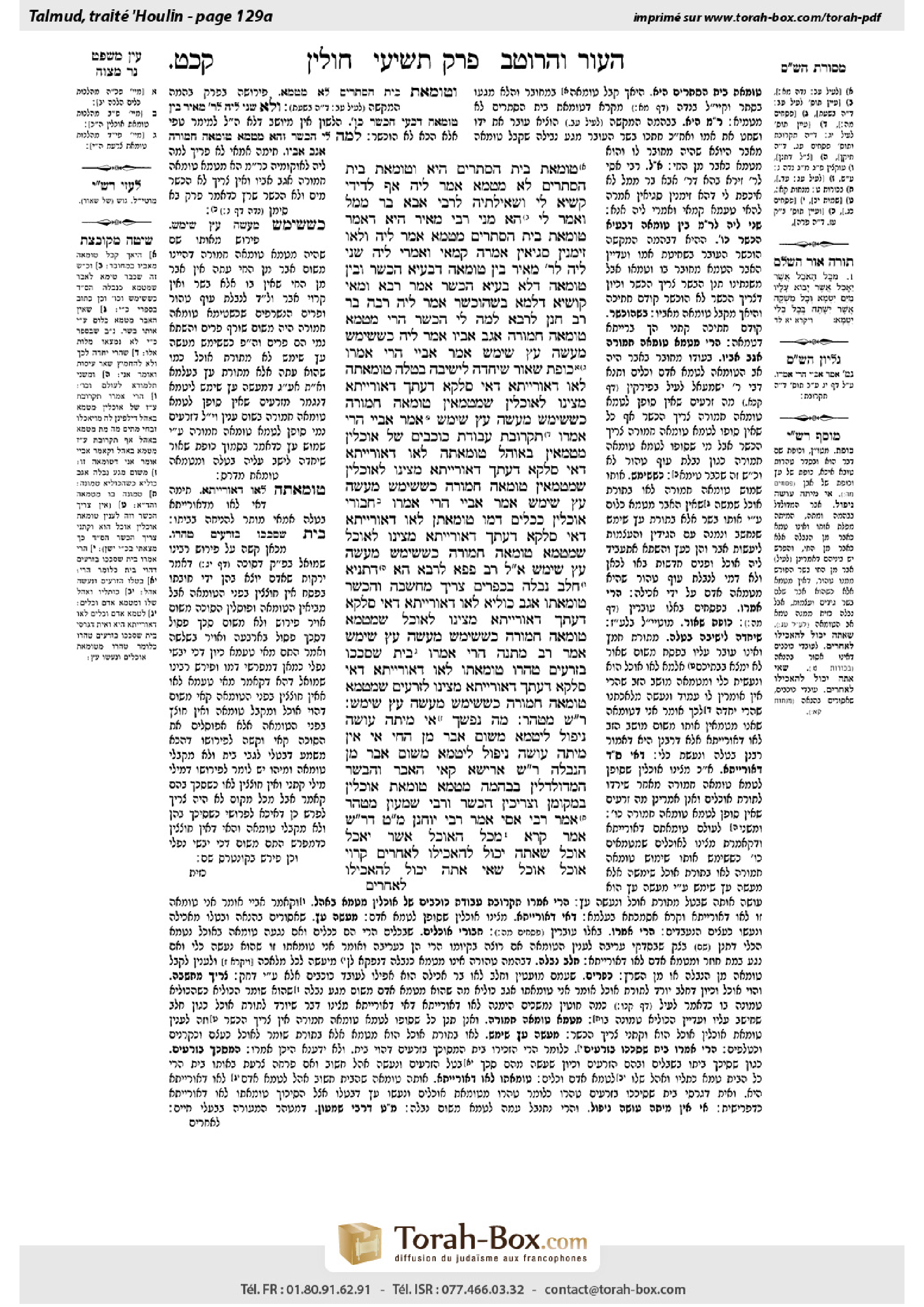
Chullin 129a: Talmud study for Daf Yomi
Study the Talmud for Daf Yomi with scanned pages, Hebrew text, English translations from Sefaria and AI-generated French translations.
Passage selection and English or AI-generated French translation are available where the scan has annotations. Daf Study is independent of Torah-Box and Sefaria.
Browse Chullin · חולין · All tractatesChullin 129a text and translations
This page of Chullin includes the Aramaic text, an English translation and an AI-generated French translation, alongside the scan above.
חולין קכ״ט א · Aramaic and Hebrew text
טוּמְאַת בֵּית הַסְּתָרִים הִיא, וְטוּמְאַת בֵּית הַסְּתָרִים לָא מְטַמְּיָא.
אֲמַר לֵיהּ: אַף לְדִידִי קַשְׁיָא לִי, וּשְׁאֵילְתֵּיהּ לְרַבִּי אַבָּא בַּר מֶמֶל, וְאָמַר לִי: הָא מַנִּי? רַבִּי מֵאִיר הִיא, דְּאָמַר: טוּמְאַת בֵּית הַסְּתָרִים מְטַמְּיָא.
אֲמַר לֵיהּ: וְלָאו זִימְנִין סַגִּיאִין אַמְרַהּ קַמַּאי, וַאֲמַרִי לֵיהּ: שָׁנֵי לֵיהּ לְרַבִּי מֵאִיר בֵּין טוּמְאָה דְּבָעֲיָא הֶכְשֵׁר וּבֵין טוּמְאָה דְּלָא בָּעֲיָא הֶכְשֵׁר.
אָמַר רָבָא: וּמַאי קוּשְׁיָא? דִּלְמָא בְּשֶׁהוּכְשַׁר.
אֲמַר לֵיהּ רַבָּה בַּר רַב חָנָן לְרָבָא: לְמָה לִי הֶכְשֵׁר, הֲרֵי מְטַמֵּא טוּמְאָה חֲמוּרָה אַגַּב אָבִיו?
אֲמַר לֵיהּ: כְּשֶׁשִּׁימֵּשׁ, מַעֲשֵׂה עֵץ שִׁימֵּשׁ.
אָמַר אַבָּיֵי: הֲרֵי אָמְרוּ כּוֹפֶת שְׂאוֹר שֶׁיִּחֲדָהּ לִישִׁיבָה – בָּטְלָה.
טוּמְאָתָהּ לָאו דְּאוֹרָיְיתָא, דְּאִי סָלְקָא דַעְתָּךְ דְּאוֹרָיְיתָא, מָצִינוּ לָאֳכָלִין שֶׁמְּטַמְּאִין טוּמְאָה חֲמוּרָה, כְּשֶׁשִּׁימֵּשׁ – מַעֲשֵׂה עֵץ שִׁימֵּשׁ.
אָמַר אַבָּיֵי: הֲרֵי אָמְרוּ תִּקְרוֹבֶת עֲבוֹדָה זָרָה שֶׁל אֳכָלִין מְטַמְּאִין בְּאוֹהֶל, טוּמְאָתָהּ לָאו דְּאוֹרָיְיתָא, דְּאִי סָלְקָא דַעְתָּךְ דְּאוֹרָיְיתָא – מָצִינוּ לָאֳכָלִין שֶׁמְּטַמְּאִין טוּמְאָה חֲמוּרָה! כְּשֶׁשִּׁימֵּשׁ – מַעֲשֵׂה עֵץ שִׁימֵּשׁ.
אָמַר אַבָּיֵי: הֲרֵי אָמְרוּ חִבּוּרֵי אֳכָלִין כְּכֵלִים דָּמוּ, טוּמְאָתָן לָאו דְּאוֹרָיְיתָא, דְּאִי סָלְקָא דַעְתָּךְ דְּאוֹרָיְיתָא – מָצִינוּ לְאוֹכֶל שֶׁמְּטַמֵּא טוּמְאָה חֲמוּרָה! כְּשֶׁשִּׁימֵּשׁ – מַעֲשֵׂה עֵץ שִׁימֵּשׁ.
אֲמַר לֵיהּ רַב פָּפָּא לְרָבָא: הָא דְּתַנְיָא, חֵלֶב נְבֵלָה בַּכְּפָרִים צָרִיךְ מַחְשָׁבָה וְהֶכְשֵׁר, טוּמְאָתוֹ אַגַּב כּוּלְיָא לָאו דְּאוֹרָיְיתָא, דְּאִי סָלְקָא דַעְתָּךְ דְּאוֹרָיְיתָא, מָצִינוּ לְאוֹכֶל שֶׁמְּטַמֵּא טוּמְאָה חֲמוּרָה!
כְּשֶׁשִּׁימֵּשׁ – מַעֲשֵׂה עֵץ שִׁימֵּשׁ.
אָמַר רַב מַתְנָה: הֲרֵי אָמְרוּ בַּיִת שֶׁסִּכְּכוֹ בִּזְרָעִים – טָהֵרוּ. טוּמְאָתוֹ לָאו דְּאוֹרָיְיתָא, דְּאִי סָלְקָא דַעְתָּךְ דְּאוֹרָיְיתָא – מָצִינוּ לִזְרָעִים שֶׁמְּטַמְּאִין טוּמְאָה חֲמוּרָה! כְּשֶׁשִּׁימֵּשׁ – מַעֲשֵׂה עֵץ שִׁימֵּשׁ.
רַבִּי שִׁמְעוֹן מְטַהֵר.
מָה נַפְשָׁךְ: אִי מִיתָה עוֹשָׂה נִיפּוּל – לִיטַמֵּא מִשּׁוּם אֵבֶר מִן הַחַי, אִי אֵין מִיתָה עוֹשָׂה נִיפּוּל – לִיטַמֵּא מִשּׁוּם אֵבֶר מִן הַנְּבֵלָה!
רַבִּי שִׁמְעוֹן אַרֵישָׁא קָאֵי: הָאֵבֶר וְהַבָּשָׂר הַמְדוּלְדָּלִין בִּבְהֵמָה מְטַמֵּא טוּמְאַת אֳכָלִין בִּמְקוֹמָן, וּצְרִיכִין הֶכְשֵׁר, וְרַבִּי שִׁמְעוֹן מְטַהֵר.
אָמַר רַבִּי אַסִּי, אָמַר רַבִּי יוֹחָנָן: מַאי טַעְמָא דְּרַבִּי שִׁמְעוֹן? אָמַר קְרָא ״מִכׇּל הָאֹכֶל אֲשֶׁר יֵאָכֵל״, אוֹכֶל שֶׁאַתָּה יָכוֹל לְהַאֲכִילוֹ לַאֲחֵרִים – קָרוּי אוֹכֶל, אוֹכֶל שֶׁאִי אַתָּה יָכוֹל לְהַאֲכִילוֹ
Chullin 129a · English translation
Why should the flesh be impure? Since the source of its impurity is the limb, and the location of the contact between the limb and the flesh is hidden and not visible, it constitutes contact with a source of impurity in a concealed part of the body, and the principle is that contact with a source of impurity in a concealed part of the body does not render an item impure.
Rabbi Zeira said to Rabbi Asi: This matter is difficult for me as well, and I asked Rabbi Abba bar Memel, and he said to me: In accordance with whose opinion is this baraita? It is in accordance with the opinion of Rabbi Meir, who said that contact with a source of impurity in a concealed part of the body renders an item impure.
Rabbi Asi said to Rabbi Zeira: But hasn’t Rabbi Abba bar Memel said this answer in my presence many times? And I said to him that this answer does not explain the ruling of the baraita. The reason is that with regard to a concealed part of the body imparting impurity, Rabbi Meir differentiates between a type of impurity that requires an item to be rendered susceptible in order to take effect and a type of impurity that does not require an item to be rendered susceptible. The case in the baraita is one where the flesh was not yet rendered susceptible to impurity when it was severed from the limb, and Rabbi Meir concedes that in such a case impurity should not apply to a concealed part of the body.
Rava was surprised by Rabbi Asi’s statement and said: But what is the difficulty? Perhaps the baraita is discussing a case where the flesh was rendered susceptible to impurity before it was severed from the limb.
Rabba bar Rav Ḥanan said to Rava: Why do I need the flesh severed from the limb to be rendered susceptible to impurity? Flesh that is upon a limb from a living animal imparts a severe form of impurity due to its original limb, as it is considered part of the limb that was severed from a living animal, which imparts the impurity of a carcass, a severe form of impurity that is transmitted even to people and vessels. Therefore, it is not necessary to render this flesh susceptible to impurity after its separation from the limb, because the halakha is that any food item that will eventually impart a severe form of impurity does not require contact with liquid in order to be rendered susceptible to imparting a lesser form of impurity.
Rava said to Rabba bar Rav Ḥanan: This principle applies only when the more severe and more lenient forms of impurity are both impurities of food. But in the case of the baraita, the flesh needs to be rendered susceptible to impurity after it is severed from the limb, because when it initially served as part of the limb, it performed the role of wood, i.e., it had the status of flesh of the limb, which is necessary to give the limb the status of a limb severed from the living (see 128b), but it was not impure due to its status as food.
§Rava said that if a food item serves a function other than food, the principle that if it will eventually contract a severe form of impurity it does not require contact with liquid in order to be rendered susceptible to a lesser form of impurity does not apply. The Gemara now relates a number of matters that are explained with the same reasoning. Abaye said: The Sages said in a baraita: A mass of hardened leaven that one designated for the purpose of sitting upon it, not for consumption, is nullified. The item is no longer considered food and one may possess it in his house during Passover. But the item is now considered a chair, and it is subject to ritual impurity imparted by treading. It therefore is rendered impure if a zav sits on it.
Abaye explained: Its impurity in such a case is clearly not by Torah law but by rabbinic law; as if it enters your mind that it is impure by Torah law, then we have found that food can become susceptible to a severe type of impurity. This cannot be true, because the category of food that requires contact with liquid to be susceptible to impurity is food that will not eventually impart a more severe type of impurity. Based on Rava’s reasoning, the Gemara responds: The seat imparts impurity by Torah law. When the leaven served as a chair it was not considered food, as it performed the role of wood.
Similarly, Abaye said: The Sages said in a baraita: An idolatrous offering of food imparts impurity in a tent. Abaye explained: Its impurity is not by Torah law but by rabbinic law; as if it enters your mind that it is impure by Torah law, then we have found that food can become susceptible to a severe type of impurity. The Gemara responds: The idolatrous offering imparts impurity by Torah law. When the food served as an idolatrous offering it was not considered food, as it performed the role of wood.
Similarly, Abaye said: The Sages said in a baraita: Foods that are connected to vessels are considered like the vessels. For example, if dough is attached to a kneading bowl and the owner wishes for the dough to remain there, the dough is considered part of the bowl. Therefore, if an olive-bulk of a corpse touches that dough, it becomes impure with the more severe impurity of a vessel, which imparts impurity to people and other vessels. Abaye explained: Their impurity is not by Torah law but by rabbinic law; as if it enters your mind that it is impure by Torah law, then we have found that food can become susceptible to a severe type of impurity. The Gemara responds: Food connected to vessels imparts impurity by Torah law. When the food served as a connection to the vessel it was not considered food, as it performed the role of wood.
Similarly, Rav Pappa said to Rava in explanation of that which is taught in a mishna (Okatzin 3:3): Fat forbidden in consumption for a Jew from an animal carcass in the villages, requires designation as food in order for it to become susceptible to contract impurity as food, and it must be rendered susceptible via contact with liquid. Rav Pappa explained: Although the forbidden fat that covers the kidney of a carcass imparts the impurity of a carcass, its impurity due to the impurity of the kidney is not by Torah law but by rabbinic law. As if it enters your mind that it is impure by Torah law, then we have found that food can impart a severe type of impurity and subsequently become susceptible to impurity as food.
The Gemara responds: The fat of a carcass imparts impurity by Torah law. When the fat served the kidney as protection and imparted the impurity of a carcass it did not serve as food, as it performed the role of wood.
Similarly, Rav Mattana said: The Sages said in a baraita: With regard to a house that one roofed with seeds, i.e., vegetation, if those seeds were impure, they are rendered pure when they are used as the roof of the house. The seeds are no longer considered food but rather part of the house. Therefore, if the house becomes leprous, the entire house becomes impure. Rav Mattana explained: Its impurity is not by Torah law but by rabbinic law; as if it enters your mind that it is impure by Torah law, then we have found that seeds can become susceptible to a severe type of impurity. The Gemara responds: The seeds used for the roof of the house impart impurity by Torah law. When the seeds served as the roof of the house they were not considered food, but rather performed the role of wood.
§The mishna teaches with regard to a hanging limb or flesh of a living animal that if the animal died, the hanging flesh needs to be rendered susceptible to impurity, as its halakhic status is that of flesh severed from a living animal, which is ritually pure. Rabbi Meir then states that the hanging limb imparts impurity as a limb severed from a living animal, but not as an unslaughtered carcass. And Rabbi Shimon deems the limb pure.
The Gemara asks: Whichever way you look at it, the ruling of Rabbi Shimon is difficult. If death renders a hanging limb one that has fallen off, i.e., if when the animal died of its own accord the hanging limb is considered to have fallen off its body beforehand, the limb should become impure as a limb from a living animal. If death does not render a hanging limb one that has fallen off, the limb should become impure as a limb from a carcass. How is it possible for Rabbi Shimon to deem the limb pure?
The Gemara answers: Rabbi Shimon is not responding to Rabbi Meir’s statement in the final clause of the mishna. Rather, Rabbi Shimon is referring to the first clause of the mishna, which teaches: The limb and the flesh of an animal that were partially severed and remain hanging from the animal impart impurity as food although they remain in their place attached to the animal. But in order for them to become impure, they need to be rendered susceptible through contact with a liquid. And Rabbi Shimon deems them not susceptible to impurity at all.
Rabbi Asi said that Rabbi Yoḥanan said: What is the reason for the opinion of Rabbi Shimon? The verse states with regard to impurity as food: “From all food which may be eaten, that on which water comes shall be impure” (Leviticus 11:34). The repetitive phrase “food which may be eaten” indicates that only food that you are able to feed to others, including gentiles, is called food with regard to being susceptible to impurity as food, but food that you are not able to feed
Chullin 129a · Traduction française (IA)
Pourquoi la chair est-elle impure ? Parce que la source de son impureté est le membre, et le point de contact entre le membre et la chair est caché et invisible, ce qui constitue un contact avec une source d'impureté dans une partie cachée du corps, et le principe est que le contact avec une source d'impureté dans une partie cachée du corps ne rend pas un objet impur.
Rabbi Zeira dit à Rabbi Asi : Cette question me pose également des difficultés, et j'ai demandé à Rabbi Abba bar Memel, qui m'a répondu : Selon l'opinion de qui est-ce que ce baraïta ? Selon l'opinion de Rabbi Meir, qui a dit que le contact avec une source d'impureté dans une partie cachée du corps rend un objet impur.
Rabbi Asi dit à Rabbi Zeira : Mais n'a-t-il pas dit cela devant moi maintes fois ? Et j'ai dit à lui que cette réponse ne résout pas la décision du baraïta. La raison est que, concernant une partie cachée du corps transmettant l'impureté, Rabbi Meir distingue entre un type d'impureté qui nécessite que l'objet soit rendu susceptible pour prendre effet et un type d'impureté qui ne nécessite pas que l'objet soit rendu susceptible. Le cas du baraïta est celui où la chair n'était pas encore rendue susceptible à l'impureté lorsqu'elle a été séparée du membre, et Rabbi Meir reconnaît que dans ce cas-là, l'impureté ne s'applique pas à une partie cachée du corps.
Rava fut surpris par l'affirmation de Rabbi Asi et dit : Mais quelle est la difficulté ? Peut-être que le baraïta parle d'un cas où la chair était rendue susceptible à l'impureté avant d'être séparée du membre.
Rabba bar Rav Ḥanan dit à Rava : Pourquoi ai-je besoin que la chair séparée du membre soit rendue susceptible à l'impureté ? La chair qui est sur un membre d'un animal vivant transmet une forme grave d'impureté en raison de son membre original, car elle est considérée comme faisant partie du membre séparé d'un animal vivant, qui transmet l'impureté d'un cadavre, une forme grave d'impureté transmise même aux personnes et aux objets. Par conséquent, il n'est pas nécessaire de rendre cette chair susceptible à l'impureté après sa séparation du membre, car la halakha est que tout aliment qui transmettra ultérieurement une forme grave d'impureté n'a pas besoin de contact avec un liquide pour être rendu susceptible à transmettre une forme moindre d'impureté.
Rava dit à Rabba bar Rav Ḥanan : Ce principe s'applique uniquement lorsque les formes graves et lenitives d'impureté sont toutes des impuretés d'aliments. Mais dans le cas du baraïta, la chair a besoin d'être rendue susceptible à l'impureté après sa séparation du membre, car lorsqu'elle remplissait initialement le rôle d'un membre, elle avait le statut de chair du membre, nécessaire pour donner au membre le statut de membre séparé d'un animal vivant (voir 128b), mais elle n'était pas impure en raison de son statut d'aliment.
§Rava dit que si un aliment sert d'autres fonctions que d'aliment, le principe selon lequel si un aliment finira par contracter une forme grave d'impureté, il n'a pas besoin de contact avec un liquide pour être rendu susceptible à transmettre une forme moindre d'impureté ne s'applique pas. La Guemara rapporte maintenant plusieurs questions qui sont expliquées avec la même raison. Abaye dit : Les Sages ont dit dans un baraïta : Une masse de levain durci que l'on a désigné pour s'asseoir dessus, et non pour la consommer, est annulée. L'objet n'est plus considéré comme aliment et l'on peut le posséder dans sa maison pendant la Pâque. Mais l'objet est maintenant considéré comme une chaise, et il est soumis à l'impureté rituelle transmise par la marche. Il devient donc impur si un zav s'y assied.
Abaye expliqua : Son impureté dans ce cas n'est clairement pas selon la Loi juive mais selon la loi rabbinique ; car si cela entre dans votre esprit qu'il est impur selon la Loi juive, alors nous avons trouvé que les aliments peuvent devenir susceptibles d'une forme grave d'impureté. Cela ne peut pas être vrai, car la catégorie d'aliments qui nécessite un contact avec un liquide pour être susceptible d'impureté est celle qui ne finira pas par transmettre une forme plus grave d'impureté. Selon le raisonnement de Rava, la Guemara répond : La chaise transmet l'impureté selon la Loi juive. Lorsque le levain a servi de chaise, il n'était pas considéré comme aliment, car il remplissait le rôle de bois.
De même, Abaye dit : Les Sages ont dit dans un baraïta : Une offrande idolâtre d'aliment transmet l'impureté dans une tente. Abaye expliqua : Son impureté n'est pas selon la Loi juive mais selon la loi rabbinique ; car si cela entre dans votre esprit qu'il est impur selon la Loi juive, alors nous avons trouvé que les aliments peuvent devenir susceptibles d'une forme grave d'impureté. La Guemara répond : L'offrande idolâtre transmet l'impureté selon la Loi juive. Lorsque l'aliment a servi d'offrande idolâtre, il n'était pas considéré comme aliment, car il remplissait le rôle de bois.
De même, Abaye dit : Les Sages ont dit dans un baraïta : Les aliments connectés aux objets sont considérés comme des objets. Par exemple, si la pâte est attachée à un bol de pétrissage et que l'owner souhaite que la pâte reste là, la pâte est considérée comme faisant partie du bol. Par conséquent, si une quantité d'olive d'un cadavre touche cette pâte, elle devient impure avec l'impureté grave d'un objet, qui transmet l'impureté aux personnes et aux autres objets. Abaye explique : Leur impureté n'est pas selon la Loi juive mais selon la loi rabbinique ; car si cela entre dans votre esprit qu'il est impur selon la Loi juive, alors nous avons trouvé que les aliments peuvent devenir susceptibles d'une forme grave d'impureté. La Guemara répond : Les aliments connectés aux objets transmettent l'impureté selon la Loi juive. Lorsque l'aliment a servi de connexion à l'objet, il n'était pas considéré comme aliment, car il remplissait le rôle de bois.
De même, Rav Pappa a dit à Rava en expliquant ce qui est enseigné dans une mitsva (Okatzin 3:3) : La graisse interdite à la consommation par un Juif provenant d'un cadavre dans les villages exige une dédicace comme nourriture afin qu'elle devienne susceptible de contracter une impureté en tant que nourriture, et elle doit être rendue susceptible par contact avec un liquide. Rav Pappa a expliqué : Bien que la graisse interdite qui recouvre le rein d'un cadavre transmette l'impureté d'un cadavre, son impureté due à l'impureté du rein n'est pas selon la Loi divine mais selon la loi rabbinique. Comme si cela entrait dans votre esprit qu'elle est impure selon la Loi divine, alors nous avons trouvé que la nourriture peut transmettre une impureté grave et ensuite devenir susceptible d'impureté en tant que nourriture.
La Guemara répond : La graisse d'un cadavre transmet l'impureté selon la Loi divine. Lorsque la graisse a servi de protection au rein et a transmis l'impureté d'un cadavre, elle n'a pas servi de nourriture, car elle a joué le rôle de bois.
De même, Rav Mattana a dit : Les Sages ont dit dans une baraïta : Concernant une maison dont le toit est fait de grain, c'est-à-dire de végétation, si ces graines étaient impures, elles deviennent pures lorsqu'elles sont utilisées comme toit de la maison. Les graines ne sont plus considérées comme de la nourriture mais plutôt comme faisant partie de la maison. Ainsi, si la maison devient lèpre, toute la maison devient impure. Rav Mattana a expliqué : Son impureté n'est pas selon la Loi divine mais selon la loi rabbinique ; comme si cela entrait dans votre esprit qu'elle est impure selon la Loi divine, alors nous avons trouvé que les graines peuvent devenir susceptibles d'une impureté grave. La Guemara répond : Les graines utilisées comme toit de la maison transmettent l'impureté selon la Loi divine. Lorsque les graines ont servi de toit de la maison, elles n'étaient pas considérées comme de la nourriture, mais plutôt comme ayant joué le rôle de bois.
§ La mitsva enseigne concernant un membre ou une chair pendante d'un animal vivant : si l'animal meurt, la chair pendante doit être rendue susceptible d'impureté, car son statut halakhique est celui de chair séparée d'un animal vivant, qui est rituellement pure. Rabbi Meir affirme alors que le membre pendant transmet l'impureté en tant que membre séparé d'un animal vivant, mais pas en tant que cadavre non sacrifié. Et Rabbi Shimon considère le membre comme pur.
La Guemara pose la question : Quel que soit le point de vue, le jugement de Rabbi Shimon est difficile. Si la mort rend un membre pendant un membre tombé, c'est-à-dire si lorsque l'animal meurt de lui-même le membre pendant est considéré comme ayant déjà tombé du corps, le membre devrait devenir impur en tant que membre d'un animal vivant. Si la mort ne rend pas un membre pendant un membre tombé, le membre devrait devenir impur en tant que membre d'un cadavre. Comment est-il possible que Rabbi Shimon considère le membre comme pur ?
La Guemara répond : Rabbi Shimon ne répond pas à la déclaration de Rabbi Meir dans la dernière partie de la mitsva. Plutôt, Rabbi Shimon fait référence à la première partie de la mitsva, qui enseigne : Le membre et la chair d'un animal qui sont partiellement séparés et restent pendants de l'animal transmettent l'impureté en tant que nourriture, même s'ils restent attachés à l'animal. Mais pour devenir impurs, ils doivent être rendus susceptibles par contact avec un liquide. Et Rabbi Shimon considère qu'ils ne sont pas susceptibles d'impureté du tout.
Rabbi Asi a dit que Rabbi Yoḥanan a dit : Quel est le fondement de l'opinion de Rabbi Shimon ? La Parashah dit concernant l'impureté en tant que nourriture : « De toute nourriture que l'on peut manger, celle sur laquelle vient l'eau devient impure » (Lévitique 11:34). L'expression répétée « nourriture que l'on peut manger » indique que seule la nourriture que l'on peut nourrir aux autres, y compris aux non-Juifs, est appelée nourriture en ce qui concerne la susceptibilité à l'impureté en tant que nourriture, mais la nourriture que l'on ne peut pas nourrir
Traduction française générée par IA à partir de l’édition anglaise de Sefaria. Vérifie toujours un passage avec le texte source.
Text from Sefaria: William Davidson Edition - Vocalized Aramaic (unknown); William Davidson Edition - English (CC BY NC).