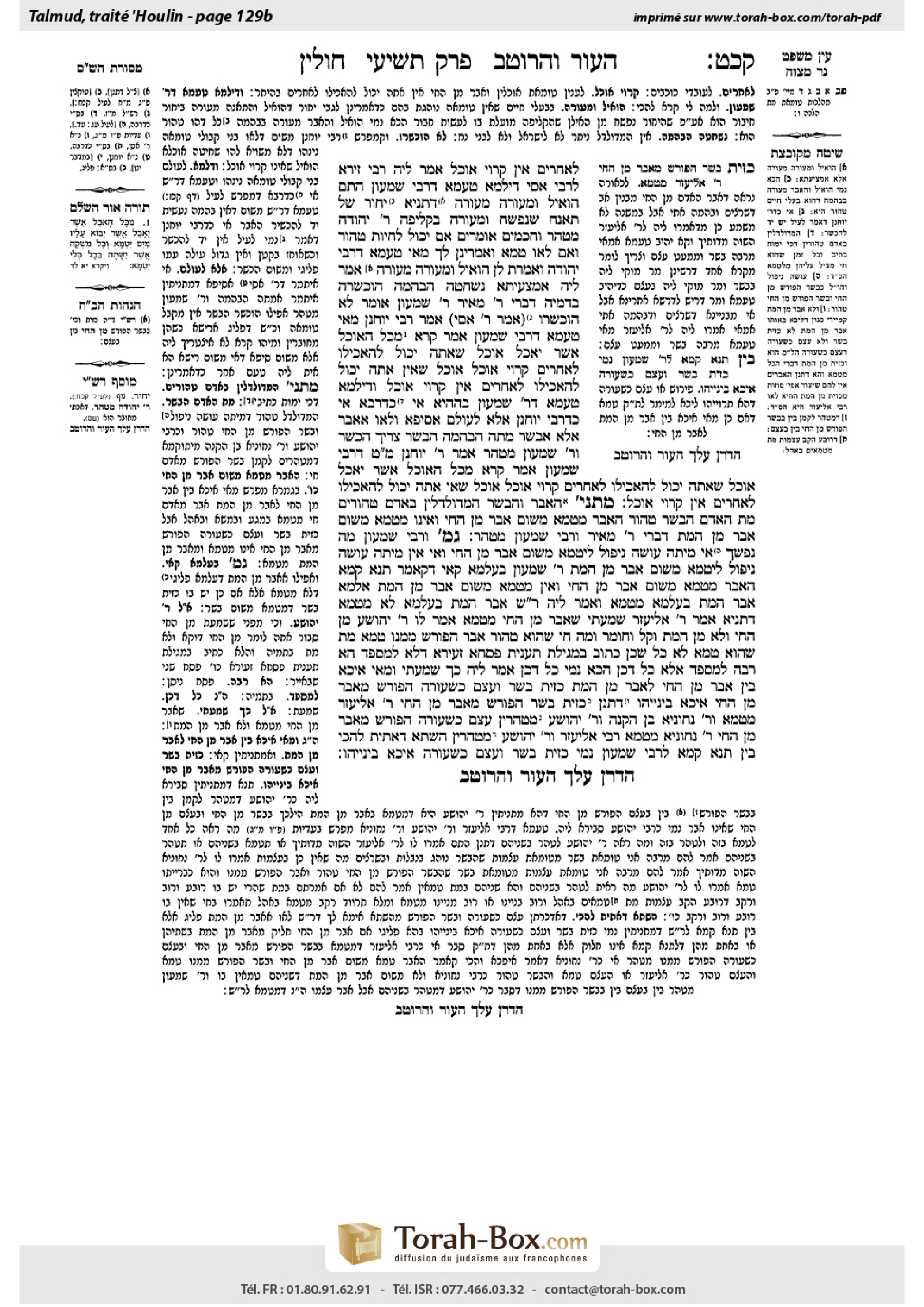
Chullin 129b: Talmud study for Daf Yomi
Study the Talmud for Daf Yomi with scanned pages, Hebrew text, English translations from Sefaria and AI-generated French translations.
Passage selection and English or AI-generated French translation are available where the scan has annotations. Daf Study is independent of Torah-Box and Sefaria.
Browse Chullin · חולין · All tractatesChullin 129b text and translations
This page of Chullin includes the Aramaic text, an English translation and an AI-generated French translation, alongside the scan above.
חולין קכ״ט ב · Aramaic and Hebrew text
לַאֲחֵרִים – אֵין קָרוּי אוֹכֶל.
אֲמַר לֵיהּ רַבִּי זֵירָא לְרַבִּי אַסִּי: דִּילְמָא טַעְמָא דְּרַבִּי שִׁמְעוֹן הָתָם, הוֹאִיל וּמְעוֹרֶה – מְעוֹרֶה.
דְּתַנְיָא: יִחוּר שֶׁל תְּאֵנָה שֶׁנִּפְשַׁח וּמְעוֹרֶה בַּקְּלִיפָּה – רַבִּי יְהוּדָה מְטַהֵר, וַחֲכָמִים אוֹמְרִים: אִם יָכוֹל לִחְיוֹת – טָהוֹר, וְאִם לָאו – טָמֵא. וְאָמְרִינַן לָךְ: מַאי טַעְמָא דְּרַבִּי יְהוּדָה? וְאָמְרַתְּ לַן: הוֹאִיל וּמְעוֹרֶה – מְעוֹרֶה.
אֲמַר לֵיהּ, אַמְּצִיעֲתָא: נִשְׁחֲטָה הַבְּהֵמָה, הוּכְשְׁרָה בְּדָמֶיהָ – דִּבְרֵי רַבִּי מֵאִיר; רַבִּי שִׁמְעוֹן אוֹמֵר: לֹא הוּכְשְׁרוּ.
(אָמַר רַבִּי אַסִּי) אָמַר רַבִּי יוֹחָנָן: מַאי טַעְמָא דְּרַבִּי שִׁמְעוֹן? אָמַר קְרָא ״מִכׇּל הָאֹכֶל אֲשֶׁר יֵאָכֵל״ – אוֹכֶל שֶׁאַתָּה יָכוֹל לְהַאֲכִילוֹ לַאֲחֵרִים – קָרוּי אוֹכֶל, אוֹכֶל שֶׁאֵין אַתָּה יָכוֹל לְהַאֲכִילוֹ לַאֲחֵרִים – אֵין קָרוּי אוֹכֶל.
וְדִילְמָא טַעְמָא דְּרַבִּי שִׁמְעוֹן בְּהָהִיא
אִי כִּדְרָבָא, אִי כִּדְרַבִּי יוֹחָנָן?
אֶלָּא, לְעוֹלָם אַסֵּיפָא, וְלָאו אַאֵבֶר, אֶלָּא אַבָּשָׂר. מֵתָה הַבְּהֵמָה – הַבָּשָׂר צָרִיךְ הֶכְשֵׁר, וְרַבִּי שִׁמְעוֹן מְטַהֵר.
אָמַר רַבִּי יוֹחָנָן: מַאי טַעְמָא דְּרַבִּי שִׁמְעוֹן? אָמַר קְרָא ״מִכׇּל הָאֹכֶל אֲשֶׁר יֵאָכֵל״, אוֹכֶל שֶׁאַתָּה יָכוֹל לְהַאֲכִילוֹ לַאֲחֵרִים – קָרוּי אוֹכֶל, אוֹכֶל שֶׁאִי אַתָּה יָכוֹל לְהַאֲכִילוֹ לַאֲחֵרִים – אֵין קָרוּי אוֹכֶל.
מַתְנִי׳ הָאֵבֶר וְהַבָּשָׂר הַמְדוּלְדָּלִין בְּאָדָם – טְהוֹרִים. מֵת הָאָדָם – הַבָּשָׂר טָהוֹר. הָאֵבֶר מְטַמֵּא מִשּׁוּם אֵבֶר מִן הַחַי, וְאֵינוֹ מְטַמֵּא מִשּׁוּם אֵבֶר מִן הַמֵּת, דִּבְרֵי רַבִּי מֵאִיר. וְרַבִּי שִׁמְעוֹן מְטַהֵר.
גְּמָ׳ וְרַבִּי שִׁמְעוֹן מָה נַפְשָׁךְ? אִי מִיתָה עוֹשָׂה נִיפּוּל – לִיטַמֵּא מִשּׁוּם אֵבֶר מִן הַחַי, וְאִי אֵין מִיתָה עוֹשָׂה נִיפּוּל – לִיטַמֵּא מִשּׁוּם אֵבֶר מִן הַמֵּת!
רַבִּי שִׁמְעוֹן בְּעָלְמָא קָאֵי, דְּקָאָמַר תַּנָּא קַמָּא: הָאֵבֶר מְטַמֵּא מִשּׁוּם אֵבֶר מִן הַחַי וְאֵין מְטַמֵּא מִשּׁוּם אֵבֶר מִן הַמֵּת, אַלְמָא אֵבֶר הַמֵּת בְּעָלְמָא מְטַמֵּא, וַאֲמַר לֵיהּ רַבִּי שִׁמְעוֹן: אֵבֶר הַמֵּת בְּעָלְמָא לֹא מְטַמֵּא.
דְּתַנְיָא: אָמַר רַבִּי אֱלִיעֶזֶר: שָׁמַעְתִּי שֶׁאֵבֶר מִן הַחַי מְטַמֵּא. אָמַר לוֹ רַבִּי יְהוֹשֻׁעַ: מִן הַחַי וְלֹא מִן הַמֵּת? וְקַל וָחוֹמֶר – וּמָה חַי שֶׁהוּא טָהוֹר, אֵבֶר הַפּוֹרֵשׁ מִמֶּנּוּ טָמֵא; מֵת שֶׁהוּא טָמֵא, לֹא כׇּל שֶׁכֵּן?
כָּתוּב בִּמְגִילַּת תַּעֲנִית: ״פִּסְחָא זְעִירָא דְּלָא לְמִסְפַּד״, הָא רַבָּה לְמִסְפַּד?! אֶלָּא כָּל דְּכֵן! הָכָא נָמֵי, כׇּל דְּכֵן! אֲמַר לֵיהּ: כָּךְ שָׁמַעְתִּי.
וּמַאי אִיכָּא בֵּין אֵבֶר מִן הַחַי לְאֵבֶר מִן הַמֵּת? כְּזַיִת בָּשָׂר וְעֶצֶם כִּשְׂעוֹרָה הַפּוֹרֵשׁ מֵאֵבֶר מִן הַחַי אִיכָּא בֵּינַיְיהוּ.
דִּתְנַן: כְּזַיִת בָּשָׂר הַפּוֹרֵשׁ מֵאֵבֶר מִן הַחַי – רַבִּי אֱלִיעֶזֶר מְטַמֵּא, וְרַבִּי נְחוּנְיָא בֶּן הַקָּנָה וְרַבִּי יְהוֹשֻׁעַ מְטַהֲרִין. עֶצֶם כִּשְׂעוֹרָה הַפּוֹרֵשׁ מֵאֵבֶר מִן הַחַי – רַבִּי נְחוּנְיָא מְטַמֵּא, רַבִּי אֱלִיעֶזֶר וְרַבִּי יְהוֹשֻׁעַ מְטַהֲרִין.
הַשְׁתָּא דְּאָתֵית לְהָכִי, בֵּין תַּנָּא קַמָּא לְרַבִּי שִׁמְעוֹן נָמֵי, כְּזַיִת בָּשָׂר וְעֶצֶם כִּשְׂעוֹרָה אִיכָּא בֵּינַיְיהוּ.
הֲדַרַן עֲלָךְ הָעוֹר וְהָרוֹטֶב.
Chullin 129b · English translation
to others, such as the limb and flesh from a living animal, which are forbidden even to gentiles, is not called food.
Rabbi Zeira questioned the explanation of Rabbi Yoḥanan and said to Rabbi Asi: If Rabbi Shimon is discussing the first clause in the mishna, claiming that a hanging limb or flesh is pure during the lifetime of the animal, the reason for his statement is not necessarily that food that is forbidden to all people is not considered food. Perhaps the reason for the opinion of Rabbi Shimon there is that since the flesh or limb is still attached to the animal, it is considered attached.
As it is taught in a mishna (Okatzin 3:8): With regard to a branch of a fig tree that was detached from the tree and remains attached only to the bark of the tree, Rabbi Yehuda deems the figs on the branch not susceptible to impurity, as they are considered attached to the tree. And the Rabbis say: If it is possible to reattach the branch to the tree and the branch can continue to live and produce fruit, then it is considered attached to the tree, and the fruit is not susceptible to impurity. But if not, the fruit is susceptible to impurity. And we said to you, Rabbi Asi: What is the reason for the opinion of Rabbi Yehuda? And you said to us: Since the branch is still attached to the bark of the tree, it is considered attached. Therefore, the same logic applies to the statement of Rabbi Shimon.
Rabbi Asi said to Rabbi Zeira: Rabbi Yoḥanan is explaining the reasoning for Rabbi Shimon’s opinion in the middle clause of the mishna, which teaches: If the animal was slaughtered, the limb and the flesh were rendered susceptible to impurity with the blood of the slaughtered animal; this is the statement of Rabbi Meir. Rabbi Shimon says: They were not rendered susceptible with the blood of the slaughtered animal.
Rabbi Asi said that Rabbi Yoḥanan said: What is the reason for the opinion of Rabbi Shimon? The reason is that the verse states with regard to impurity as food: “From all food which may be eaten, that on which water comes shall be impure” (Leviticus 11:34). The phrase “food which may be eaten” indicates that only food that you can feed to others, including gentiles, is called food in this regard, but food that you cannot feed to others, such as the limb and flesh from a living animal, is not called food.
Rabbi Zeira questioned this explanation of Rabbi Yoḥanan as well, and said to Rabbi Asi: If it is with regard to Rabbi Shimon’s opinion in the middle clause of the mishna, perhaps the reason for the opinion of Rabbi Shimon in that clause is not that food that is forbidden to all is not called food.
Rather, it is either in accordance with the explanation of Rava or in accordance with the explanation of Rabbi Yoḥanan cited earlier (127b–128a). According to both explanations of Rabbi Shimon’s opinion, the mishna is discussing a case where only the body of the animal, but not the partially severed limb, came into contact with the blood of slaughter. According to Rava, the reason for Rabbi Shimon’s opinion is that the body of the animal serves the partially severed limb as a handle, and he holds that a handle of a food item transmits impurity to the attached food, but a handle that comes into contact with liquid does not render the attached food susceptible to impurity. And according to Rabbi Yoḥanan, Rabbi Shimon holds that if one grasps a small part of a large item such that the large part does not ascend with the small part, the small part is not considered part of the item with regard to impurity (see 127b).
Rather, actually, one must explain the statement of Rabbi Shimon as it was explained originally, that he is referring to the latter clause of the mishna. And he is not referring to the case of a partially severed limb, but rather to the case of partially severed flesh. Therefore, the latter clause of the mishna teaches: If the animal died without slaughter, Rabbi Meir holds that the hanging flesh needs to be rendered susceptible to impurity in order to impart impurity as food, and Rabbi Shimon deems the limb not susceptible to impurity even if it came into contact with liquid.
Rabbi Yoḥanan said: What is the reason for the opinion of Rabbi Shimon? The reason is that the verse states with regard to impurity as food: “From all food which may be eaten, that on which water comes shall be impure” (Leviticus 11:34). The phrase “food which may be eaten” indicates that only food that you can feed to others, including gentiles, is called food with regard to being susceptible to impurity as food, but food that you cannot feed to others, such as flesh from a living animal, which is forbidden even to gentiles, is not called food.
MISHNA: The limb and the flesh of a person that were partially severed and remain hanging from a person are ritually pure, although there is no potential for healing. If the person died, the hanging flesh is ritually pure, as its halakhic status is that of flesh severed from a living person. The hanging limb imparts impurity as a limb severed from the living and does not impart impurity as a limb from a corpse; this is the statement of Rabbi Meir. And Rabbi Shimon deems the flesh and the limb ritually pure.
GEMARA: The Gemara challenges the opinion of Rabbi Shimon in the latter clause of the mishna: Whichever way you look at it, the ruling of Rabbi Shimon is difficult. If death renders a hanging limb fallen off, i.e., if after the person dies the hanging limb is considered to have fallen off his body beforehand, the limb should impart impurity as a limb severed from the living. And if death does not render a hanging limb fallen off, and the limb is considered attached to the body at the time of death, then the limb should impart impurity as a limb from a corpse.
The Gemara explains: This statement of Rabbi Shimon is not referring directly to the case in the mishna. Rather, the statement of Rabbi Shimon is referring to the matter of a limb that separates from a corpse in general. Rabbi Shimon inferred from that which the first tanna, Rabbi Meir, said: The hanging limb imparts impurity as a limb severed from the living and does not impart impurity as a limb from a corpse, that evidently, in general the limb of a corpse imparts impurity. And in reference to this Rabbi Shimon said to him: In general, the limb of a corpse does not impart impurity, if it does not contain an olive-bulk of flesh.
Another pair of tanna’im had the same dispute as Rabbi Meir and Rabbi Shimon, as it is taught in a baraita: Rabbi Eliezer says: I heard that a limb severed from the living imparts impurity. Rabbi Yehoshua said to him: May one infer from this statement that a limb from a living person imparts impurity but a limb from a corpse does not? But it can be inferred a fortiori that a limb from a corpse imparts impurity: If with regard to a living person, who is pure and does not impart impurity, nevertheless a limb that separates from him is impure, then with regard to a corpse, which is impure, all the more so is it not clear that the limb that separates from it is impure?
Furthermore, Rabbi Yehoshua adds that it is written in Megillat Ta’anit: On Minor Passover, i.e., the fourteenth of Iyyar, one does not eulogize. Should one infer from here that on Major Passover, i.e., the fourteenth of Nisan, it is permitted to eulogize? Clearly that is not the case. Rather, if one may not eulogize on the fourteenth of Iyyar, all the more so one may not eulogize on the fourteenth of Nisan. Here too, if a limb from a living person is impure, all the more so a limb from a corpse is impure. Rabbi Eliezer said to him: Despite this reasoning, such is the ruling I heard from my teachers.
§The mishna teaches that Rabbi Meir holds that with regard to a partially severed limb of a person, after the person dies the limb imparts impurity as a limb from a living person but not as a limb from a corpse. The Gemara asks: What difference is there between the impurity of a limb from a living person and the impurity of a limb from a corpse? The Gemara answers: The practical difference between them is with regard to the case of an olive-bulk of flesh, or a bone the volume of a barley grain, that separates from the severed limb of a living person.
As we learned in a mishna (Eduyyot 6:3): In the case of an olive-bulk of flesh that separates from a limb severed from a living person, Rabbi Eliezer deems it impure, and Rabbi Neḥunya ben HaKana and Rabbi Yehoshua deem it pure. In the case of a bone the volume of a barley-grain that separates from a limb severed from a living person, Rabbi Neḥunya deems it impure, and Rabbi Eliezer and Rabbi Yehoshua deem it pure.
The Gemara comments: Now that you have arrived at this dispute between tanna’im, it is possible to say that the difference between the first tanna in the mishna, i.e., Rabbi Meir, and Rabbi Shimon is also with regard to the cases of an olive-bulk of flesh and a bone the size of a barley grain. Rabbi Meir states that the partially severed limb of a person imparts the impurity of a limb from a living person but not the impurity of a limb from a corpse. The difference between these two types of impurity is with regard to a case where either an olive-bulk of flesh or a bone the size of a barley grain was separated from the severed limb; Rabbi Neḥunya holds that flesh that separated from a limb of a living person is pure, but a bone that separated from a limb of a living person is impure, and Rabbi Eliezer holds vice versa. Rabbi Meir consequently holds in accordance with one of these two opinions. Rabbi Shimon holds in accordance with the opinion of Rabbi Yehoshua that both a bone and flesh that separated from a limb of a living person are pure.
Chullin 129b · Traduction française (IA)
Ce qui est interdit même aux non-Juifs, comme les membres et la chair d'un animal vivant, n'est pas considéré comme de la nourriture.
Rabbi Zeira a interrogé l'explication de Rabbi Yoḥanan et a dit à Rabbi Asi : Si Rabbi Shimon discute de la première clause de la mitsna, affirmant que le membre ou la chair suspendue est pur pendant la vie de l'animal, la raison de son affirmation n'est pas nécessairement que la nourriture interdite à tous n'est pas considérée comme de la nourriture. Peut-être que la raison de l'opinion de Rabbi Shimon est que, puisque la chair ou le membre est encore attaché à l'animal, il est considéré comme attaché.
Comme il est enseigné dans une mitsna (Okatzin 3:8) : En ce qui concerne une branche d'un arbre à figues détachée de l'arbre et restant attachée seulement à la sève de l'arbre, Rabbi Yehuda considère que les figues sur la branche ne sont pas sujets à la souillure, car elles sont considérées comme attachées à l'arbre. Et les Sages disent : Si la branche peut être rebranchée à l'arbre et que la branche peut continuer à vivre et à produire des fruits, alors elle est considérée comme attachée à l'arbre, et les fruits ne sont pas sujets à la souillure. Mais si ce n'est pas le cas, les fruits sont sujets à la souillure. Et nous avons dit à Rabbi Asi : Quelle est la raison de l'opinion de Rabbi Yehuda ? Et vous avez dit à nous : Puisque la branche est encore attachée à la sève de l'arbre, elle est considérée comme attachée. Ainsi, le même raisonnement s'applique à l'affirmation de Rabbi Shimon.
Rabbi Asi a dit à Rabbi Zeira : Rabbi Yoḥanan explique la raison de l'opinion de Rabbi Shimon dans la clause intermédiaire de la mitsna, qui enseigne : Si l'animal a été tué, le membre et la chair sont rendus sujets à la souillure avec le sang de l'animal tué ; c'est l'opinion de Rabbi Meir. Rabbi Shimon dit : Ils ne sont pas rendus sujets à la souillure avec le sang de l'animal tué.
Rabbi Asi a dit que Rabbi Yoḥanan a dit : Quelle est la raison de l'opinion de Rabbi Shimon ? La raison est que la parole « nourriture qui peut être mangée » indique que seule la nourriture que l'on peut donner aux autres, y compris aux non-Juifs, est considérée comme nourriture à cet égard, mais la nourriture que l'on ne peut pas donner aux autres, comme les membres et la chair d'un animal vivant, n'est pas considérée comme nourriture.
Rabbi Zeira a également interrogé cette explication de Rabbi Yoḥanan et a dit à Rabbi Asi : Si c'est en ce qui concerne l'opinion de Rabbi Shimon dans la clause intermédiaire de la mitsna, peut-être que la raison de l'opinion de Rabbi Shimon dans cette clause n'est pas que la nourriture interdite à tous n'est pas considérée comme nourriture.
Plutôt, c'est soit en conformité avec l'explication de Rava, soit en conformité avec l'explication de Rabbi Yoḥanan citée plus tôt (127b–128a). Selon les deux explications de l'opinion de Rabbi Shimon, la mitsna discute d'un cas où seulement le corps de l'animal, mais pas le membre partiellement séparé, a été en contact avec le sang du sacrifice. Selon Rava, la raison de l'opinion de Rabbi Shimon est que le corps de l'animal sert de manche au membre partiellement séparé, et il considère que le manche d'un aliment transmet la souillure à l'aliment attaché, mais un manche en contact avec un liquide ne rend pas l'aliment attaché sujet à la souillure. Et selon Rabbi Yoḥanan, Rabbi Shimon considère que si l'on saisit une petite partie d'un grand objet de sorte que la grande partie ne monte pas avec la petite partie, la petite partie n'est pas considérée comme faisant partie de l'objet en ce qui concerne la souillure (voir 127b).
En réalité, il faut expliquer l'affirmation de Rabbi Shimon comme elle a été initialement expliquée, c'est-à-dire qu'il fait référence à la dernière clause de la mitsna. Et il ne fait pas référence au cas d'un membre partiellement séparé, mais plutôt au cas de chair partiellement séparée. Ainsi, la dernière clause de la mitsna enseigne : Si l'animal est mort sans être sacrifié, Rabbi Meir considère que la chair suspendue doit être rendue sujette à la souillure afin de transmettre la souillure comme nourriture, et Rabbi Shimon considère que le membre n'est pas sujette à la souillure même s'il a été en contact avec un liquide.
Rabbi Yoḥanan a dit : Quelle est la raison de l'opinion de Rabbi Shimon ? La raison est que la parole « nourriture qui peut être mangée » indique que seule la nourriture que l'on peut donner aux autres, y compris aux non-Juifs, est considérée comme nourriture en ce qui concerne la souillure comme nourriture, mais la nourriture que l'on ne peut pas donner aux autres, comme la chair d'un animal vivant, qui est interdite même aux non-Juifs, n'est pas considérée comme nourriture.
MICHNA : La chair et le membre d'une personne partiellement séparés et restant suspendus d'une personne sont rituellement purs, même s'il n'y a pas de possibilité de guérison. Si la personne est morte, la chair suspendue est rituellement pure, car son statut halakhique est celui de chair séparée d'une personne vivante. Le membre suspendu transmet la souillure comme un membre séparé d'une personne vivante et ne transmet pas la souillure comme un membre d'un cadavre ; c'est l'opinion de Rabbi Meir. Et Rabbi Shimon considère que la chair et le membre sont rituellement purs.
GUEMARA : La Guemara conteste l'opinion de Rabbi Shimon dans la dernière clause de la mitsva : Quel que soit le point de vue, le jugement de Rabbi Shimon est difficile. Si la mort rend un membre suspendu tombé, c'est-à-dire si après la mort de la personne le membre suspendu est considéré comme tombé de son corps avant, le membre devrait transmettre la souillure comme un membre séparé d'une personne vivante. Et si la mort ne rend pas un membre suspendu tombé, et que le membre est considéré comme attaché au corps au moment de la mort, alors le membre devrait transmettre la souillure comme un membre d'un cadavre.
La Guemara explique : Cette déclaration du Rabbi Shimon ne se réfère pas directement au cas mentionné dans la mitsna. En réalité, la déclaration du Rabbi Shimon se réfère à la question d’un membre qui se détache d’un cadavre en général. Le Rabbi Shimon a tiré cette conclusion à partir de ce que le premier tanna, le Rabbi Meir, avait dit : Le membre pendu transmet l’impureté comme un membre séparé du vivant et ne transmet pas l’impureté comme un membre d’un cadavre, ce qui montre clairement que, en général, le membre d’un cadavre transmet l’impureté. Et en référence à cela, le Rabbi Shimon a dit au Rabbi Meir : En général, le membre d’un cadavre ne transmet pas l’impureté, à moins qu’il ne contienne une quantité d’chair égale à une olive.
Une autre paire de tanna’im avait le même débat que le Rabbi Meir et le Rabbi Shimon, comme il est enseigné dans une baraïta : Le Rabbi Eliezer dit : J’ai entendu dire qu’un membre séparé du vivant transmet l’impureté. Le Rabbi Yéhoshua lui répond : Peut-on en déduire de cette déclaration que le membre d’un vivant transmet l’impureté, mais que celui d’un cadavre ne le fait pas ? Mais on peut en déduire à plus forte raison que le membre d’un cadavre transmet l’impureté : Si, concernant un vivant, qui est pur et ne transmet pas l’impureté, un membre séparé de lui est impur, alors concernant un cadavre, qui est impur, il est clair que le membre séparé de lui est impur.
De plus, le Rabbi Yéhoshua ajoute que cela est écrit dans la Megillat Ta’anit : Sur le Petit Pessah, c’est-à-dire le quatorzième d’Iyyar, on ne célèbre pas de funérailles. Peut-on en déduire de cela que sur le Grand Pessah, c’est-à-dire le quatorzième de Nisan, il est permis de célébrer des funérailles ? Évidemment que non. En réalité, si on ne peut pas célébrer de funérailles le quatorzième d’Iyyar, encore plus on ne peut pas le faire le quatorzième de Nisan. De même, si un membre d’un vivant est impur, encore plus un membre d’un cadavre est impur. Le Rabbi Eliezer lui répond : Malgré cette déduction, c’est ainsi que je l’ai entendu dire de la part de mes maîtres.
§ La Michna enseigne que le Rabbi Meir considère que concernant un membre partiellement séparé d’un individu, après la mort de ce dernier, le membre transmet l’impureté comme un membre du vivant mais pas comme un membre d’un cadavre. La Guemara pose la question : Quelle différence y a-t-il entre l’impureté d’un membre du vivant et celle d’un membre d’un cadavre ? La Guemara répond : La différence pratique entre ces deux cas concerne le cas d’une quantité de chair égale à une olive ou d’un os dont le volume est équivalent à une graine de blé, qui se détache d’un membre séparé d’un vivant.
Comme nous l’avons appris dans une Michna (Eduyyot 6:3) : Dans le cas d’une quantité de chair égale à une olive qui se détache d’un membre séparé d’un vivant, le Rabbi Eliezer considère qu’elle est impure, et les Rabbis Néchouna ben HaKana et Yéhoshua la considèrent pure. Dans le cas d’un os dont le volume est équivalent à une graine de blé qui se détache d’un membre séparé d’un vivant, Néchouna considère qu’il est impur, et Eliezer et Yéhoshua le considèrent pur.
La Guemara commente : Maintenant que vous avez atteint ce débat entre les tanna’im, il est possible de dire que la différence entre le premier tanna de la mitsna, c’est-à-dire Rabbi Meir, et Rabbi Shimon est aussi concernant les cas d’une quantité de chair égale à une olive et d’un os dont la taille est équivalente à une graine de blé. Rabbi Meir affirme que le membre partiellement séparé d’un individu transmet l’impureté d’un membre du vivant mais pas celle d’un membre d’un cadavre. La différence entre ces deux types d’impureté concerne le cas où une quantité de chair égale à une olive ou un os dont la taille est équivalente à une graine de blé s’est détaché du membre séparé. Rabbi Néchouna affirme que la chair qui s’est détachée d’un membre d’un vivant est pure, mais l’os qui s’est détaché d’un membre d’un vivant est impur, et Rabbi Eliezer affirme l’inverse. Rabbi Meir adopte donc l’opinion d’un de ces deux. Rabbi Shimon adopte l’opinion de Rabbi Yéhoshua, selon laquelle à la fois l’os et la chair qui s’est détaché d’un membre d’un vivant sont purs.
Traduction française générée par IA à partir de l’édition anglaise de Sefaria. Vérifie toujours un passage avec le texte source.
Text from Sefaria: William Davidson Edition - Vocalized Aramaic (unknown); William Davidson Edition - English (CC BY NC).