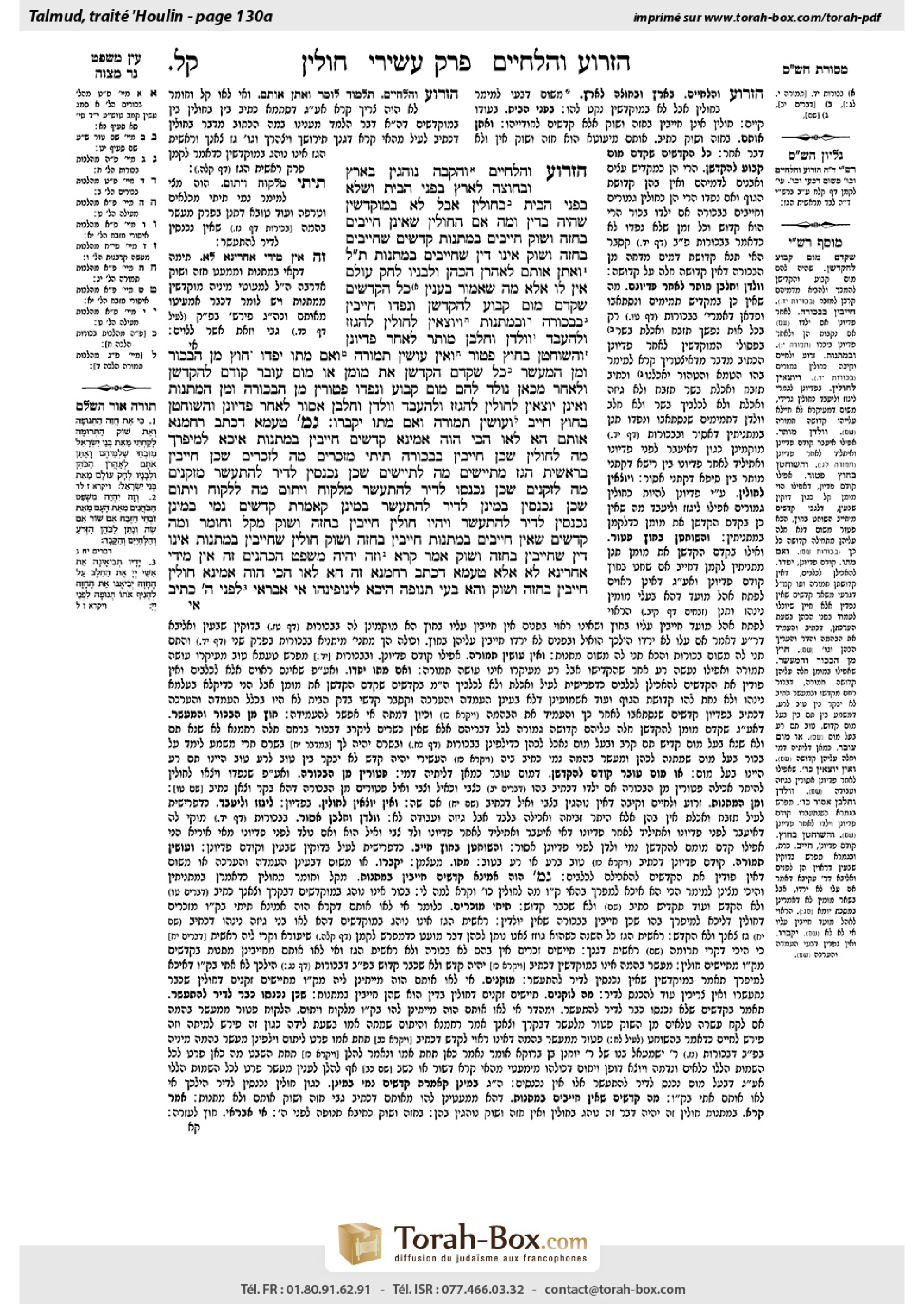
Chullin 130a: Talmud study for Daf Yomi
Study the Talmud for Daf Yomi with scanned pages, Hebrew text, English translations from Sefaria and AI-generated French translations.
Passage selection and English or AI-generated French translation are available where the scan has annotations. Daf Study is independent of Torah-Box and Sefaria.
Browse Chullin · חולין · All tractatesChullin 130a text and translations
This page of Chullin includes the Aramaic text, an English translation and an AI-generated French translation, alongside the scan above.
חולין ק״ל א · Aramaic and Hebrew text
מַתְנִי׳ הַזְּרוֹעַ וְהַלְּחָיַיִם וְהַקֵּבָה נוֹהֲגִין בָּאָרֶץ וּבְחוּצָה לָאָרֶץ, בִּפְנֵי הַבַּיִת וְשֶׁלֹּא בִּפְנֵי הַבַּיִת, בַּחוּלִּין אֲבָל לֹא בַּמּוּקְדָּשִׁין.
שֶׁהָיָה בַּדִּין, וּמָה אִם הַחוּלִּין, שֶׁאֵינָן חַיָּיבִים בְּחָזֶה וָשׁוֹק – חַיָּיבִים בְּמַתָּנוֹת, קָדָשִׁים, שֶׁחַיָּיבִים בְּחָזֶה וָשׁוֹק – אֵינוֹ דִּין שֶׁחַיָּיבִים בְּמַתָּנוֹת?
תַּלְמוּד לוֹמַר: ״וָאֶתֵּן אֹתָם לְאַהֲרֹן הַכֹּהֵן וּלְבָנָיו לְחׇק עוֹלָם״ – אֵין לוֹ אֶלָּא מַה שֶּׁאָמוּר בָּעִנְיָן.
כׇּל הַקֳּדָשִׁים שֶׁקָּדַם מוּם קָבוּעַ לְהֶקְדֵּשָׁן, וְנִפְדּוּ – חַיָּיבִין בַּבְּכוֹרָה וּבַמַּתָּנוֹת, וְיוֹצְאִין לְחוּלִּין לְהִגָּזֵז וּלְהֵעָבֵד, וּוְלָדָן וַחֲלָבָן מוּתָּר לְאַחַר פִּדְיוֹנָן.
וְהַשּׁוֹחֲטָן בַּחוּץ פָּטוּר, וְאֵין עוֹשִׂין תְּמוּרָה, וְאִם מֵתוּ – יִפָּדוּ, חוּץ מִן הַבְּכוֹר וּמִן הַמַּעֲשֵׂר.
כֹּל שֶׁקָּדַם הֶקְדֵּשָׁן אֶת מוּמָן, אוֹ מוּם עוֹבֵר קוֹדֵם לְהֶקְדֵּשָׁן, וּלְאַחַר מִכָּאן נוֹלַד לָהֶם מוּם קָבוּעַ, וְנִפְדּוּ – פְּטוּרִין מִן הַבְּכוֹרָה וּמִן הַמַּתָּנוֹת, וְאֵינָן יוֹצְאִין לְחוּלִּין לְהִגָּזֵז וּלְהֵעָבֵד.
וּוְלָדָן וַחֲלָבָן אָסוּר לְאַחַר פִּדְיוֹנָן, וְהַשּׁוֹחֲטָן בַּחוּץ – חַיָּיב, וְעוֹשִׂין תְּמוּרָה, וְאִם מֵתוּ – יִקָּבֵרוּ.
גְּמָ׳ טַעְמָא דִּכְתַב רַחֲמָנָא ״אוֹתָם״, הָא לָאו הָכִי הֲוָה אָמֵינָא קָדָשִׁים חַיָּיבִין בְּמַתָּנוֹת?
אִיכָּא לְמִיפְרַךְ: מָה לְחוּלִּין שֶׁכֵּן חַיָּיבִין בִּבְכוֹרָה!
תֵּיתֵי מִזְּכָרִים – מָה לִזְכָרִים, שֶׁכֵּן חַיָּיבִין בְּרֵאשִׁית הַגֵּז!
מִתְּיָישִׁים – מָה לִתְיָישִׁים, שֶׁכֵּן נִכְנָסִין לַדִּיר לְהִתְעַשֵּׂר!
מִזְּקֵנִים – מָה לִזְקֵנִים, שֶׁכֵּן נִכְנְסוּ לְדִיר לְהִתְעַשֵּׂר!
מִלָּקוּחַ וְיָתוֹם – מָה לְלָקוּחַ וְיָתוֹם, שֶׁכֵּן נִכְנָסִין בְּמִינָן לַדִּיר לְהִתְעַשֵּׂר!
בְּמִינָן קָאָמְרַתְּ? קֳדָשִׁים נָמֵי, בְּמִינָן נִכְנָסִין לַדִּיר לְהִתְעַשֵּׂר.
וְיִהְיוּ חוּלִּין חַיָּיבִין בְּחָזֶה וָשׁוֹק מִקַּל וָחוֹמֶר: וּמָה קָדָשִׁים, שֶׁאֵין חַיָּיבִים בְּמַתָּנוֹת, חַיָּיבִין בְּחָזֶה וָשׁוֹק; חוּלִּין, שֶׁחַיָּיבִין בְּמַתָּנוֹת, אֵינוֹ דִּין שֶׁחַיָּיבִין בְּחָזֶה וָשׁוֹק?
אָמַר קְרָא: ״וְזֶה יִהְיֶה מִשְׁפַּט הַכֹּהֲנִים״, ״זֶה״ – אִין, מִידֵּי אַחֲרִינָא – לָא.
אֶלָּא טַעְמָא דִּכְתַב רַחֲמָנָא ״זֶה״, הָא לָאו הָכִי הֲוָה אָמֵינָא חוּלִּין חַיָּיבִין בְּחָזֶה וָשׁוֹק? וְהָא בָּעֵי תְּנוּפָה, הֵיכָא לִינוּפִינְהוּ? אִי אַבָּרַאי – ״לִפְנֵי ה׳״ כְּתִיב,
Chullin 130a · English translation
MISHNA: The mitzva to give the foreleg, the jaw, and the maw of slaughtered animals to the priests, known as the gifts of the priesthood, applies both in Eretz Yisrael and outside of Eretz Yisrael, in the presence of the Temple and not in the presence of the Temple, and it applies to non-sacred animals, but not to sacrificial animals.
It is necessary to emphasize that it does not apply to sacrificial animals, as by right it should be inferred a fortiori: If non-sacred animals, which are not obligated to have the breast and thigh taken from them and given to the priest, are obligated to have gifts of the priesthood given from them, then with regard to sacrificial animals, which are obligated to have the breast and thigh given from them, is it not right that they should be obligated to have gifts of the priesthood given from them?
Therefore, the verse states: “For the breast of waving and the thigh of giving I have taken of the children of Israel from the sacrifice of the peace offerings, and have given them to Aaron the priest and to his sons as a due forever from the children of Israel” (Leviticus 7:34), from which it is derived that the priest has only that which is stated with regard to that matter, i.e., the breast and the thigh, and not the foreleg, the jaw and the maw.
All sacrificial animals in which a permanent blemish preceded their consecration do not assume inherent sanctity, and only their value is consecrated. And once they were redeemed, they are obligated in the mitzva of a firstborn, i.e., their offspring are subject to being counted a firstborn, and in the gifts of the priesthood, and they can emerge from their sacred status and assume non-sacred status with regard to being shorn and with regard to being utilized for labor, as it is prohibited to shear animals with sacred status or utilize them for labor. And their offspring and their milk are permitted after their redemption.
And one who slaughters these animals outside the Temple courtyard is exempt from karet, and those animals do not render an animal that was a substitute for them consecrated. And if these animals died before they were redeemed, they may be redeemed and fed to dogs. Although typically sacrificial animals that were redeemed may not be fed to the dogs, in this case it is permitted. This is the halakha with regard to all animals except for the firstborn animal and the animal tithe, whose sanctity is inherent, even when a permanent blemish preceded their consecration.
With regard to all sacrificial animals whose consecration preceded their blemish, or who had a temporary blemish prior to their consecration and afterward developed a permanent blemish and they were redeemed, they are exempt from the mitzva of a firstborn, and from the gifts of the priestood, and they do not emerge from their sacred status and assume non-sacred status with regard to being shorn and with regard to being utilized for labor.
And their offspring, which were conceived prior to redemption, and their milk, are prohibited after their redemption. And one who slaughters them outside the Temple courtyard is liable to receive karet, and those animals render an animal that was a substitute for them consecrated. And if these animals died before they were redeemed, they may not be redeemed and fed to dogs; rather, they must be buried.
GEMARA: The mishna teaches that the verse: “And have given them to Aaron the priest and to his sons” (Leviticus 7:34), indicates that only the breast and thigh, which are the subject of that verse, are given from sacrificial animals to the priest, but gifts of the priesthood are not given from sacrificial animals. The Gemara infers: The reason sacrificial animals are not included in the mitzva of gifts of the priesthood is due to the fact that the Merciful One writes: “Them,” in reference to the breast and the thigh of sacrificial animals. But were it not for this, I would say by a fortiori inference that sacrificial animals are obligated to have gifts of the priesthood given from them.
The Gemara asks: Why is it necessary to derive this halakha from a verse? The a fortiori inference can be refuted as follows: What is unique about non-sacred animals? They are unique in that they are obligated in the mitzva of a firstborn, whereas sacrificial animals are exempt. Therefore, the a fortiori inference stated in the mishna should not apply.
The Gemara responds: One could derive that the mitzva to give the gifts of the priesthood applies to sacrificial animals through an a fortiori inference from non-sacred male animals, which do not give birth to offspring and whose owners are therefore exempt from counting their offspring a firstborn, and nevertheless are subject to the giving of the gifts of the priesthood. The Gemara rejects this suggestion: What is unique about non-sacred male animals? They are unique in that they are obligated to have the first sheared wool given to the priest from them.
The Gemara persists: One can derive that the obligation applies to sacrificial animals by an a fortiori inference from male goats, whose owners are exempt from counting their offspring a firstborn as well as from the first sheared wool, and yet are subject to the obligation of gifts of the priesthood. The Gemara rejects this claim as well: What is unique about male goats? They are unique in that they enter the pen to be tithed for the animal tithe, whereas sacrificial animals are not subject to the animal tithe.
The Gemara further suggests that one can derive the obligation of sacrificial animals having the breast and thigh given from them by a fortiori inference from old male goats, which have already entered the pen in order to be tithed. Consequently, the obligation of the animal tithe, the obligation of counting the offspring a firstborn, and the first sheared wool do not apply. The Gemara rejects this suggestion as well: What is unique about old male goats? They are unique in that they have entered the pen to be tithed, which is not the case with regard to sacrificial animals.
The Gemara again suggests that perhaps one can derive the obligation of giving gifts of the priesthood with regard to sacrificial animals by an a fortiori inference from a purchased animal, to which the obligation of the animal tithe never applies. Or perhaps it can be derived from an orphaned animal, born after the death of its mother, which is also not subject to the obligation of animal tithe. The Gemara rejects this claim: What is unique about a purchased animal or an orphaned animal? They are unique in that although they themselves do not enter the pen, animals of their type enter the pen to be tithed.
The Gemara responds: You say that it is significant that animals of their type enter the pen? With regard to sacrificial animals as well, non-sacred animals of their type enter the pen to be tithed. Accordingly, one can claim a fortiori that the mitzva to give the gifts applies to sacrificial animals, and it is only due to the verse that they are exempt.
§ The Gemara challenges: And now that it has been established that the obligation of the gifts of the priesthood does not apply to sacrificial animals, non-sacred animals should be obligated to have the breast and thigh given from them by an a fortiori inference: If sacrificial animals, which are not obligated to have gifts of the priesthood given from them, are nevertheless obligated to have the breast and thigh given from them, then with regard to non-sacred animals, which are obligated to have gifts of the priesthood given from them, is it not right that they should be obligated to have the breast and thigh given from them?
The Gemara responds that the verse states: “And this shall be the priests’ due from the people, from them that perform a slaughter, whether it be an ox or sheep, that they shall give to the priest the foreleg, and the jaw, and the maw” (Deuteronomy 18:3). The verse indicates that “this,” the foreleg, the jaw, and the maw, yes, is given to the priests, but another item, i.e., the breast and thigh, is not given to the priests from non-sacred slaughtered animals.
The Gemara raises a difficulty: But this derivation indicates that the reason the giving of the breast and thigh does not apply to non-sacred animals is that the Merciful One writes “this,” from which it may be inferred if not for this, I would say that one is obligated to give the breast and thigh from non-sacred animals. But the procedure for giving the breast and thigh requires waving, and where would one wave the breast and thigh of a non-sacred animal? If it is suggested that one wave them outside the Temple, that cannot be done, as it is written: “That the breast may be waved for a wave offering before the Lord” (Leviticus 7:30), indicating that they must be waved inside the Temple.
Chullin 130a · Traduction française (IA)
MICHNA : La mitsva de donner la cuisse, la mâchoire et la gueule des animaux sacrifiés aux prêtres, connues comme les dons du sacerdoce, s'applique à la fois en Terre d'Israël et en dehors de Terre d'Israël, en présence du Temple et non en présence du Temple, et s'applique aux animaux non sacrés, mais pas aux animaux sacrés.
Il est nécessaire de souligner qu'elle ne s'applique pas aux animaux sacrés, car on pourrait en déduire a fortiori : Si les animaux non sacrés, qui ne sont pas obligés de donner la cuisse et la patte au prêtre, sont obligés de donner des dons du sacerdoce, alors concernant les animaux sacrés, qui sont obligés de donner la cuisse et la patte, ne devrait-il pas être obligé de donner des dons du sacerdoce ?
Par conséquent, la Sainte Écriture dit : « Pour la cuisse de l'offrande de paix et la patte de l'offrande de paix, j'ai pris de la part des enfants d'Israël, et je les ai donnés à Aaron le prêtre et à ses fils comme une part éternelle des enfants d'Israël » (Lévitique 7:34), d'où l'on déduit que le prêtre n'a que ce qui est mentionné à ce sujet, c'est-à-dire la cuisse et la patte, et non la cuisse, la mâchoire et la gueule.
Tous les animaux sacrifiés dans lesquels une imperfection permanente a précédé leur consécration ne prennent pas une sanctité inhérente, et seule leur valeur est consacrée. Et une fois qu'ils ont été rachetés, ils sont obligés de la mitsva du premier-né, c'est-à-dire que leurs descendants sont soumis à être comptés comme premier-né, et aux dons du sacerdoce, et ils peuvent sortir de leur statut sacré et prendre un statut non sacré concernant la toison et concernant leur utilisation pour le travail, car il est interdit de toisonner des animaux ayant un statut sacré ou de les utiliser pour le travail. Et leurs descendants et leur lait sont permis après leur rachat.
Et celui qui sacrifie ces animaux en dehors du cour de temple est exempt de la peine de karet, et ces animaux ne rendent pas sacré un animal qui les a remplacés. Et si ces animaux sont morts avant leur rachat, ils peuvent être rachetés et nourris aux chiens. Bien que généralement les animaux sacrés rachetés ne puissent pas être nourris aux chiens, dans ce cas-ci cela est permis. C'est la halakha concernant tous les animaux sauf le premier-né et l'animal d'offrande, dont la sanctité est inhérente, même si une imperfection permanente a précédé leur consécration.
Concernant tous les animaux sacrifiés dont la consécration a précédé leur imperfection, ou qui avaient une imperfection temporaire avant leur consécration et qui ont ensuite développé une imperfection permanente et ont été rachetés, ils sont exemptés de la mitsva du premier-né, et des dons du sacerdoce, et ils ne sortent pas de leur statut sacré et ne prennent pas un statut non sacré concernant la toison et concernant leur utilisation pour le travail.
Et leurs descendants, conçus avant leur rachat, et leur lait, sont interdits après leur rachat. Et celui qui tue ces animaux en dehors du cour du temple est puni de karet, et ces animaux rendent sacré un animal qui les a remplacés. Et si ces animaux sont morts avant leur rachat, ils ne peuvent pas être rachetés et nourris aux chiens ; ils doivent être enterrés.
GUEMARA : La mishna enseigne que la Sainte Écriture : « Et je les ai donnés à Aaron le prêtre et à ses fils » (Lévitique 7:34), indique que seul la cuisse et la patte, qui sont le sujet de cette Sainte Écriture, sont données aux prêtres à partir des animaux sacrés, mais les dons du sacerdoce ne sont pas donnés à partir des animaux sacrés. La Guemara déduit : La raison pour laquelle les animaux sacrés ne sont pas inclus dans la mitsva des dons du sacerdoce est que l'Éternel a écrit : « eux », en référence à la cuisse et à la patte des animaux sacrés. Mais si ce n'était pas le cas, je dirais par une déduction a fortiori que les animaux sacrés sont obligés de donner des dons du sacerdoce à partir d'eux.
La Guemara demande : Pourquoi est-il nécessaire de déduire cette halakha d'une Sainte Écriture ? La déduction a fortiori peut être réfutée comme suit : Qu'est-ce qui est particulier aux animaux non sacrés ? Ils sont particuliers dans le fait qu'ils sont obligés de la mitsva du premier-né, tandis que les animaux sacrés sont exemptés. Par conséquent, la déduction a fortiori énoncée dans la mishna ne devrait pas s'appliquer.
La Guemara répond : On pouvait déduire que la mitsva de donner les dons du sacerdoce s'applique aux animaux sacrifiés par une déduction a fortiori à partir des animaux non sacrés masculins, qui ne donnent pas naissance à des descendants et dont les propriétaires sont donc exemptés de compter leurs descendants comme premier-né, et pourtant sont soumis à la donnation des dons du sacerdoce. La Guemara rejette cette suggestion : Qu'est-ce qui est particulier aux animaux non sacrés masculins ? Ils sont particuliers dans le fait qu'ils sont obligés de donner la première laine tondue au prêtre.
La Guemara persiste : On peut déduire que l'obligation s'applique aux animaux sacrifiés par une déduction a fortiori à partir des boucs masculins, dont les propriétaires sont exemptés de compter leurs descendants comme premier-né ainsi que de la première laine tondue, et pourtant sont soumis à l'obligation des dons du sacerdoce. La Guemara rejette cette affirmation également : Qu'est-ce qui est particulier aux boucs masculins ? Ils sont particuliers dans le fait qu'ils entrent dans l'enclos pour être tithés pour l'animal d'offrande, tandis que les animaux sacrifiés ne sont pas soumis à la tithé de l'animal d'offrande.
La Guemara suggère davantage que l'on peut déduire l'obligation des animaux sacrifiés de donner la cuisse et la patte par une déduction a fortiori à partir des boucs masculins âgés, qui ont déjà entré dans l'enclos pour être tithés. Par conséquent, l'obligation de la tithé de l'animal d'offrande, l'obligation de compter les descendants comme premier-né et la première laine tondue ne s'applique pas. La Guemara rejette cette suggestion également : Qu'est-ce qui est particulier aux boucs masculins âgés ? Ils sont particuliers dans le fait qu'ils ont entré dans l'enclos pour être tithés, ce qui n'est pas le cas des animaux sacrifiés.
La Guemara suggère à nouveau que peut-être l'obligation de donner des présents de la part des prêtres concernant les animaux sacrifiés peut être déduite par un raisonnement a fortiori d'un animal acheté, à l'égard duquel l'obligation de dîme animale ne s'applique jamais. Ou peut-être peut-elle être déduite d'un animal orphelin, né après la mort de sa mère, qui n'est pas non plus soumis à l'obligation de dîme animale. La Guemara rejette cette affirmation : Qu'est-ce qui rend particulier un animal acheté ou un animal orphelin ? Ils sont particuliers dans la mesure où, bien qu'eux-mêmes ne pénètrent pas dans la basse-cour, des animaux de leur espèce pénètrent dans la basse-cour pour être tithés.
La Guemara répond : Vous dites que c'est important que des animaux de leur espèce pénètrent dans la basse-cour ? En ce qui concerne les animaux sacrifiés également, des animaux non sacrés de leur espèce pénètrent dans la basse-cour pour être tithés. Ainsi, on peut affirmer a fortiori que la mitsva de donner les présents s'applique aux animaux sacrifiés, et c'est uniquement en raison de la parole divine qu'ils sont exemptés.
§ La Guemara conteste : Et maintenant que l'on a établi que l'obligation des présents de la part des prêtres ne s'applique pas aux animaux sacrifiés, les animaux non sacrés devraient être obligés de donner le sein et la cuisse d'après un raisonnement a fortiori : Si les animaux sacrifiés, qui ne sont pas obligés de donner des présents de la part des prêtres, sont tout de même obligés de donner le sein et la cuisse, alors, concernant les animaux non sacrés, qui sont obligés de donner des présents de la part des prêtres, ne devrait-il pas être juste qu'ils soient obligés de donner le sein et la cuisse ?
La Guemara répond que la parole du Seigneur dit : « Et cela sera la part des prêtres du peuple, de ceux qui accomplissent un sacrifice, qu'il s'agisse d'un bœuf ou d'une brebis, qu'ils donnent au prêtre la cuisse, la mâchoire et la gueule » (Deutéronome 18:3). La parole indique que « cela », la cuisse, la mâchoire et la gueule, oui, est donnée aux prêtres, mais un autre objet, c'est-à-dire le sein et la cuisse, n'est pas donné aux prêtres à partir d'animaux non sacrés tués.
La Guemara soulève une difficulté : Mais cette déduction indique que la raison pour laquelle la donnation du sein et de la cuisse ne s'applique pas aux animaux non sacrés est que l'Éternel a écrit « cela », d'où on peut déduire que, sans cela, je dirais qu'on est obligé de donner le sein et la cuisse d'animaux non sacrés. Mais la procédure de donnation du sein et de la cuisse exige un balayage, et où pourrait-on balayer le sein et la cuisse d'un animal non sacré ? Si l'on suggère qu'on les balaye en dehors du Temple, cela ne peut pas être fait, car il est écrit : « Que le sein soit balayé pour un sacrifice de balayage devant l'Éternel » (Lévitique 7:30), indiquant qu'ils doivent être balayés à l'intérieur du Temple.
Traduction française générée par IA à partir de l’édition anglaise de Sefaria. Vérifie toujours un passage avec le texte source.
Text from Sefaria: William Davidson Edition - Vocalized Aramaic (unknown); William Davidson Edition - English (CC BY NC).