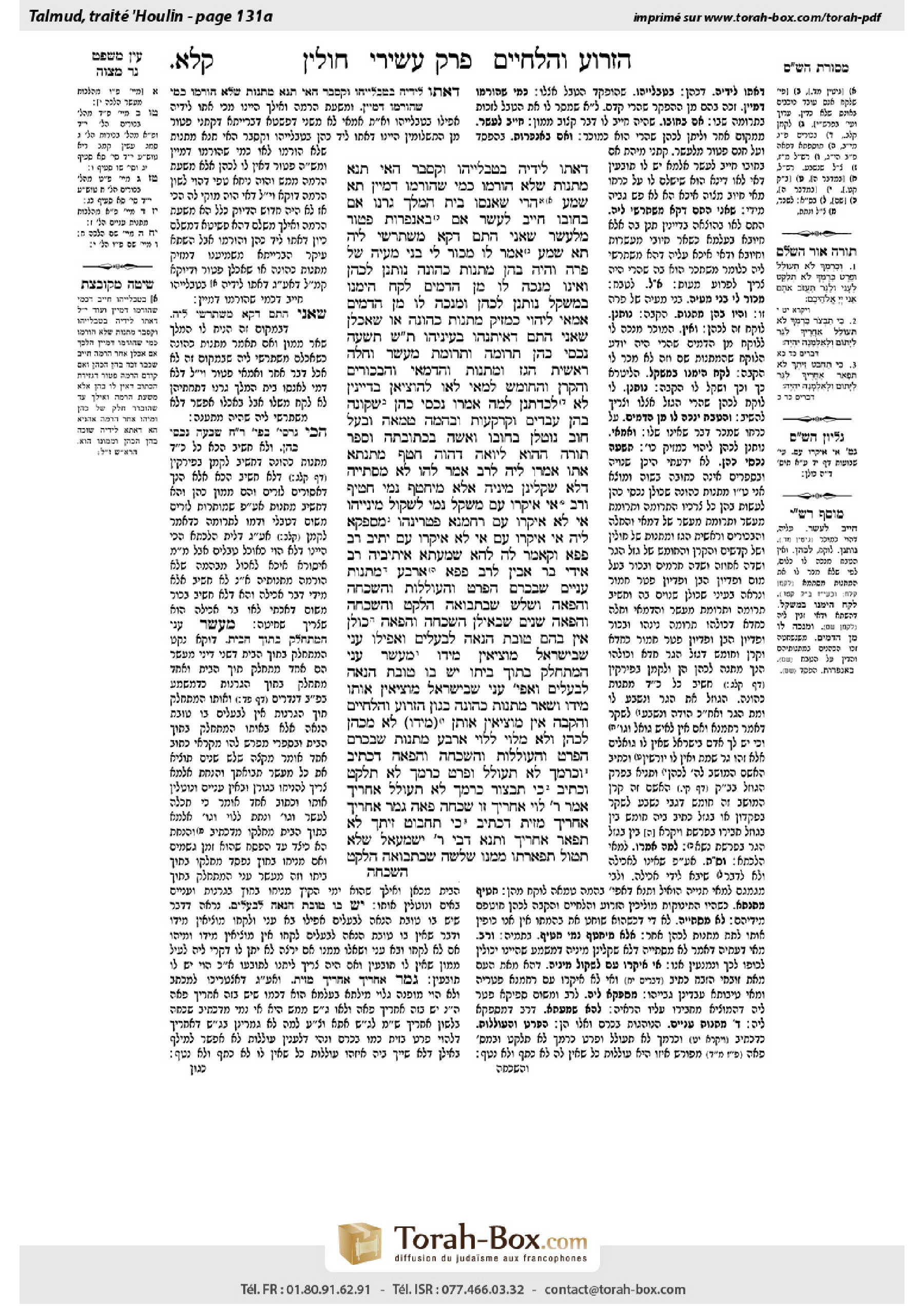
Chullin 131a: Talmud study for Daf Yomi
Study the Talmud for Daf Yomi with scanned pages, Hebrew text, English translations from Sefaria and AI-generated French translations.
Passage selection and English or AI-generated French translation are available where the scan has annotations. Daf Study is independent of Torah-Box and Sefaria.
Browse Chullin · חולין · All tractatesChullin 131a text and translations
This page of Chullin includes the Aramaic text, an English translation and an AI-generated French translation, alongside the scan above.
חולין קל״א א · Aramaic and Hebrew text
דַּאֲתוֹ לִידֵיהּ בְּטִבְלַיְיהוּ, וְקָסָבַר הַאי תַּנָּא: מַתָּנוֹת שֶׁלֹּא הוּרְמוּ – כְּמִי שֶׁהוּרְמוּ דָּמְיָין.
תָּא שְׁמַע: הֲרֵי שֶׁאָנְסוּ בֵּית הַמֶּלֶךְ גׇּרְנוֹ, אִם בְּחוֹבוֹ – חַיָּיב לְעַשֵּׂר, אִם בְּאַנְפָּרוּת – פָּטוּר מִלְּעַשֵּׂר.
שָׁאנֵי הָתָם, דְּקָא מִשְׁתָּרְשִׁי לֵיהּ.
תָּא שְׁמַע, אָמַר לוֹ: מְכוֹר לִי בְּנֵי מֵעֶיהָ שֶׁל פָּרָה, וְהָיָה בָּהֶן מַתְּנוֹת כְּהוּנָּה – נוֹתְנָן לַכֹּהֵן, וְאֵינוֹ מְנַכֶּה לוֹ מִן הַדָּמִים. לָקַח הֵימֶנּוּ בְּמִשְׁקָל – נוֹתְנָן לַכֹּהֵן, וּמְנַכֶּה לוֹ מִן הַדָּמִים.
אַמַּאי? לֶיהֱוֵי כְּמַזִּיק מַתְּנוֹת כְּהוּנָּה אוֹ שֶׁאֲכָלָן! שָׁאנֵי הָתָם, דְּאִיתַנְהוּ בְּעֵינַיְהוּ.
תָּא שְׁמַע: תִּשְׁעָה נִכְסֵי כֹהֵן – תְּרוּמָה, וּתְרוּמַת מַעֲשֵׂר, וְחַלָּה, רֵאשִׁית הַגֵּז, וּמַתָּנוֹת, וְהַדְּמַאי, וְהַבִּכּוּרִים, וְהַקֶּרֶן, וְהַחוֹמֶשׁ.
לְמַאי, לָאו לְהוֹצִיאָן בְּדַיָּינִין? לָא, לִכְדִתְנַן: לָמָה אָמְרוּ נִכְסֵי כֹהֵן? שֶׁקּוֹנֶה בָּהֶן עֲבָדִים וְקַרְקָעוֹת וּבְהֵמָה טְמֵאָה, וּבַעַל חוֹב נוֹטְלָן בְּחוֹבוֹ, וְאִשָּׁה בִּכְתוּבָּתָהּ, וְסֵפֶר תּוֹרָה.
הָהוּא לֵיוָאָה דַּהֲוָה חָטֵף מַתְּנָתָא, אֲתוֹ אֲמַרוּ לֵיהּ לְרַב, אֲמַר לְהוּ: לָא מִסָּתְיֵיהּ דְּלָא שָׁקְלִינַן מִינֵּיהּ, אֶלָּא מִיחְטָף נָמֵי חָטֵיף?!
וְרַב, אִי אִיקְּרוֹ ״עַם״ – מִשְׁקָל נָמֵי לִשְׁקוֹל מִינַּיְיהוּ. אִי לָא אִיקְּרוֹ ״עַם״ – רַחֲמָנָא פַּטְרִינְהוּ!
מְסַפְּקָא לֵיהּ אִי אִיקְּרוֹ ״עַם״ אִי לָא אִיקְּרוֹ ״עַם״.
יָתֵיב רַב פָּפָּא וְקָאָמַר לַהּ לְהָא שְׁמַעְתָּא, אֵיתִיבֵיהּ רַב אִידִי בַּר אָבִין לְרַב פָּפָּא: אַרְבַּע מַתְּנוֹת עֲנִיִּים שֶׁבַּכֶּרֶם – הַפֶּרֶט, וְהָעוֹלֵלוֹת, וְהַשִּׁכְחָה, וְהַפֵּאָה; וְשָׁלֹשׁ שֶׁבַּתְּבוּאָה – הַלֶּקֶט, וְהַשִּׁכְחָה, וְהַפֵּאָה; שְׁנַיִם שֶׁבָּאִילָן – הַשִּׁכְחָה וְהַפֵּאָה.
כּוּלָּן אֵין בָּהֶם טוֹבַת הֲנָאָה לַבְּעָלִים, וַאֲפִילּוּ עָנִי שֶׁבְּיִשְׂרָאֵל מוֹצִיאִין מִיָּדוֹ.
מַעְשַׂר עָנִי הַמִּתְחַלֵּק בְּתוֹךְ בֵּיתוֹ – יֵשׁ בּוֹ טוֹבַת הֲנָאָה לַבְּעָלִים, וַאֲפִילּוּ עָנִי שֶׁבְּיִשְׂרָאֵל מוֹצִיאִין אוֹתוֹ מִיָּדוֹ, וּשְׁאָר מַתְּנוֹת כְּהוּנָּה, כְּגוֹן הַזְּרוֹעַ וְהַלְּחָיַיִם וְהַקֵּבָה – אֵין מוֹצִיאִין אוֹתָן מִיָּדוֹ, לֹא מִכֹּהֵן לְכֹהֵן וְלֹא מִלֵּוִי לְלֵוִי.
אַרְבַּע מַתָּנוֹת שֶׁבַּכֶּרֶם: הַפֶּרֶט, וְהָעוֹלֵלוֹת, וְהַשִּׁכְחָה, וְהַפֵּאָה, דִּכְתִיב: ״וְכַרְמְךָ לֹא תְעוֹלֵל וּפֶרֶט כַּרְמְךָ לֹא תְלַקֵּט״.
וּכְתִיב: ״כִּי תִבְצֹר כַּרְמְךָ לֹא תְעוֹלֵל אַחֲרֶיךָ״, אָמַר רַבִּי לֵוִי: ״אַחֲרֶיךָ״ – זוֹ שִׁכְחָה.
פֵּאָה – גָּמַר ״אַחֲרֶיךָ״ ״אַחֲרֶיךָ״ מִזַּיִת, דִּכְתִיב: ״כִּי תַחְבֹּט זֵיתְךָ לֹא תְפָאֵר אַחֲרֶיךָ״, וְתָנָא דְּבֵי רַבִּי יִשְׁמָעֵאל: שֶׁלֹּא תִּטּוֹל תִּפְאַרְתּוֹ מִמֶּנּוּ.
שְׁלֹשָׁה שֶׁבַּתְּבוּאָה: הַלֶּקֶט,
Chullin 131a · English translation
the baraita is referring to a case where they came into the priest’s possession while they were still untithed, and this tanna holds that gifts that have not been separated are considered as though they have been separated. In such a case, the priest obtained rights to the ownerless gifts by seizing them first. Although when he seized the produce it was still untithed, the portion of the produce that is to be separated has the status of teruma. Accordingly, one who consumes such produce is required to pay the priest.
The Gemara further suggests: Come and hear another proof with regard to the statement of Rav Ḥisda from a baraita: In a case where the household of the king seized one’s threshing floor by force, if they took it as payment of his debt owed to the king, then he is obligated to tithe other grain in accordance with the amount he would have tithed before the grain was seized. Since he was already obligated to tithe the grain before it was seized, it is considered as though the grain was sold in an untithed state. If they took it without reason [anparot], then he is exempt from tithing. The fact that one is required to tithe grain seized as payment of a debt indicates that the tithe is considered money that has claimants, from which it follows that a priest may extract payment of the tithe from him. Again, this apparently contradicts the statement of Rav Ḥisda.
The Gemara rejects this proof: It is different there, since if one is not required to tithe grain seized as payment of a debt, this would mean that the seizure causes benefit for him, as he will be exempt from tithing grain that he was previously obligated to tithe. It is for this reason that the baraita rules that one must tithe other grain instead of the seized grain, not because a priest could have issued a claim against him in court.
The Gemara suggests: Come and hear a proof from a mishna (132a): If an Israelite says to a butcher: Sell me the innards of a particular cow, and there were gifts of the priesthood included with it, i.e., the maw, that were not yet given to the priest, the purchaser must give them to the priest, and the butcher may not deduct the value of the gifts from the money that the purchaser pays him, as it is assumed that the gifts were not included in the sale. If he purchased the innards from the butcher by weight, the purchaser must give the gifts to the priest, and the butcher deducts the value of the gifts from the money that the Israelite pays him.
The Gemara asks: Why must the buyer give the maw to the priest? Let the butcher’s sale of the maw be considered like a case where one causes damage to gifts of the priesthood or consumes them, with regard to which Rav Ḥisda states that one is exempt from payment. This mishna apparently contradicts Rav Ḥisda’s statement. The Gemara rejects this: It is different there, as the gifts are intact, i.e., they are distinct items in their own right. In such a case, the gifts must be given to the priest. By contrast, Rav Ḥisda is discussing cases in which the gifts are not distinguishable objects at the time.
The Gemara suggests: Come and hear another proof: Nine items are the property of a priest: Teruma, teruma of the tithe, ḥalla, the portion of dough given to the priest, the first sheared wool, gifts of the priesthood, doubtfully tithed produce [demai], first fruits, the principal value of the property of a convert, and the additional one-fifth. The two are paid to the priest in a case where the property of a convert was stolen and the thief took an oath that he did not steal it, and after the convert died the thief admitted to taking a false oath.
The Gemara explains the proof: With regard to what matter are these items considered the property of a priest? Is it not with regard to extracting them with judges, which would contradict the opinion of Rav Ḥisda? The Gemara responds: No, it is with regard to that which we learned in a mishna (Bikkurim 3:12): To what end did they say that these items are the property of a priest? It means that a priest may purchase with them slaves and lands and a non-kosher animal; and a lender takes them as payment of his debt; and if the wife of a priest is divorced from him, she takes them as payment of her marriage contract; and a priest may purchase a Torah scroll with them.
§ The Gemara relates: There was a certain Levite who would snatch gifts of the priesthood from children who were delivering them to the priests on their fathers’ behalf. They came and told Rav about this Levite. Rav said to them: Is it not enough that when he slaughters his own animals we do not take the gifts of the priesthood from him, but he also snatches gifts that are being delivered to priests?
Rav’s comment indicates that in his opinion there are grounds to take the gifts from Levites, but nevertheless they are not taken. The Gemara asks: And what does Rav maintain in this regard? If he maintains that Levites are called part of the “people,” then let one take the foreleg, the jaw, and the maw from them as well, as the verse states: “From the people, from them that perform a slaughter, whether it be ox or sheep, they shall give to the priest the foreleg, and the jaw, and the maw” (Deuteronomy 18:3). And if they are not called part of the people, then the Merciful One has exempted them from giving those gifts, and there would be no grounds to take the gifts from them.
The Gemara responds: Rav is uncertain whether or not they are called part of the people. Therefore, he exempts the Levites from giving their own gifts, in accordance with the principle that the burden of proof rests upon the claimant.
The Gemara relates that Rav Pappa was sitting and saying this halakha in the name of Rav. Rav Idi bar Avin raised an objection to Rav Pappa from a baraita, with regard to the uncertainty of Rav: Four gifts are left to the poor from the produce of a vineyard: The individual fallen grapes [peret], and the incompletely formed clusters of grapes [olelot], and the forgotten clusters, and pe’a. And three gifts are left to the poor from grain: The gleanings, i.e., sheaves that fell during the harvest, and the forgotten sheaves, and the pe’a. Two gifts are left to the poor from the fruit of a tree: The forgotten fruits and the pe’a.
The baraita elaborates: With regard to all of these gifts, the owner of the produce does not have the benefit of discretion. This is the benefit accrued from giving a gift to an individual of one’s choice, e.g., giving teruma or tithes to whichever priest or Levite that one chooses. Instead, a poor person who takes possession of these gifts becomes their rightful owner. And even a poor person of Israel who owns a vineyard, field, or tree must leave these gifts for all other poor people; and if he does not do so, the court removes them from his possession.
By contrast, with regard to the poor man’s tithe, which is distributed from within one’s house, unlike other gifts to the poor that are left in the field for them to take, the owner has the benefit of discretion. And even in the case of a poor person in Israel, if he fails to separate the poor man’s tithe from his produce, the court removes it from his possession. And with regard to other gifts of the priesthood, such as the foreleg, and the jaw, and the maw, the court does not remove them, neither from a priest to give to another priest, nor from a Levite to give to another Levite.
Before Rav Idi bar Avin explains his objection, the Gemara cites the sources for the halakhot of the baraita: The baraita teaches that four gifts are left to the poor from the produce of a vineyard: The peret, and the olelot, and the forgotten clusters, and the pe’a, as it is written: “And you shall not glean [te’olel] your vineyard, neither shall you gather the fallen fruit [peret] of your vineyard; you shall leave them for the poor and for the stranger” (Leviticus 19:10).
And it is also written: “When you gather the grapes of your vineyard, you shall not glean it [te’olel] after you; it shall be for the stranger, for the fatherless, and for the widow” (Deuteronomy 24:21). And Rabbi Levi says that with regard to the term “after you,” this is a reference to forgotten clusters, as the halakha is that clusters that were passed over by the harvester have the status of forgotten clusters, whereas those that remain in front of him do not have that status.
The halakha that the mitzva of pe’a applies to one’s vineyard is derived by a verbal analogy between the term “after you” in that verse and the term “after you” from another verse concerning an olive tree. As it is written: “When you beat your olive tree, you shall not go over the boughs [tefa’er] after you; it shall be for the stranger, for the fatherless, and for the widow” (Deuteronomy 24:20); and the school of Rabbi Yishmael taught that the term “You shall not go over the boughs” means that you should not take all of its splendor [tiferet] from it; rather, you should leave a portion of the olives for the poor. So too, one must leave a portion of one’s vineyard as pe’a for the poor.
The Gemara continues: The baraita teaches that three gifts are left to the poor from grain: The gleanings,
Chullin 131a · Traduction française (IA)
La baraïta fait référence à un cas où les offrandes sont tombées en possession du prêtre alors qu'elles étaient encore non séparées, et ce tanna affirme que les offrandes non séparées sont considérées comme si elles avaient été séparées. Dans ce cas, le prêtre a acquis des droits sur les offrandes abandonnées en les s'emparant en premier. Bien que lorsqu'il les a saisies, elles étaient encore non séparées, la part de la production à séparer a le statut de terouma. Ainsi, celui qui consomme de tels produits est tenu de payer le prêtre.
La Guemara suggère ensuite : Viens écouter une autre preuve concernant l'affirmation de Rav Ḥisda, tirée d'une baraïta : Dans un cas où la maison du roi s'empare par la force d'un terrain de meunier, si elle le prend comme paiement de la dette qu'il doit à la royauté, il est tenu de faire la séparation sur d'autres céréales selon la quantité qu'il aurait dû séparer avant que la céréale ne soit saisie. Puisque la céréale était déjà soumise à la séparation avant d'être saisie, on considère qu'elle a été vendue dans un état non séparé. Si elle est saisie sans raison [anparot], il est exempt de séparation. Le fait que l'on doive séparer la céréale saisie comme paiement d'une dette indique que la séparation est considérée comme de l'argent ayant des prétendants, ce qui implique que le prêtre peut exiger un paiement de la séparation de sa part. Cela semble à nouveau contredire l'affirmation de Rav Ḥisda.
La Guemara rejette cette preuve : C'est différent là-bas, car si l'on n'était pas tenu de séparer la céréale saisie comme paiement d'une dette, cela signifierait que la saisie lui apporte un avantage, car il serait exempt de séparer la céréale qu'il devait déjà séparer. C'est pour cette raison que la baraïta stipule qu'il faut séparer d'autres céréales à la place de la céréale saisie, pas parce que le prêtre pouvait présenter une réclamation en justice.
La Guemara suggère : Viens écouter une preuve tirée d'une Michna (132a) : Si un Israélite dit à un boucher : Vends-moi les entrailles d'une certaine vache, et qu'il y avait des offrandes du prêtre incluses avec elles, c'est-à-dire la gueule, qui n'avaient pas encore été données au prêtre, l'acheteur doit les donner au prêtre, et le boucher ne peut pas déduire la valeur des offrandes du prix que l'acheteur lui paie, car on suppose que les offrandes n'étaient pas incluses dans la vente. Si l'acheteur a acheté les entrailles par poids, l'acheteur doit donner les offrandes au prêtre, et le boucher déduit la valeur des offrandes du prix que l'Israélite paie.
La Guemara pose la question : Pourquoi l'acheteur doit-il donner la gueule au prêtre ? Que la vente du boucher de la gueule soit considérée comme un cas où l'on cause un préjudice aux offrandes du prêtre ou qu'on les consomme, selon lequel Rav Ḥisda affirme que l'on est exempt de paiement. Cette mitsna semble contredire l'affirmation de Rav Ḥisda. La Guemara rejette cela : C'est différent là-bas, car les offrandes sont intactes, c'est-à-dire qu'elles sont des objets distincts en eux-mêmes. Dans ce cas, les offrandes doivent être données au prêtre. À l'inverse, Rav Ḥisda discute des cas où les offrandes ne sont pas des objets distincts à ce moment-là.
La Guemara suggère : Viens écouter une autre preuve : Neuf choses sont la propriété du prêtre : la terouma, la terouma de la tithe, la challa, la part de la pâte donnée au prêtre, la première laine, les offrandes du prêtre, les produits douteusement tithés [demai], les premiers fruits, la valeur principale de la propriété d'un converti, et l'excédent d'un cinquième. Deux d'entre elles sont payées au prêtre dans le cas où la propriété d'un converti a été volée et que le voleur a prêté serment qu'il ne l'avait pas volée, et après la mort du converti, le voleur a avoué avoir pris un serment faux.
La Guemara explique la preuve : À propos de quelle matière ces objets sont-ils considérés comme la propriété du prêtre ? N'est-ce pas à propos d'en extraire avec des juges, ce qui contredirait l'opinion de Rav Ḥisda ? La Guemara répond : Non, c'est à propos de ce que nous avons appris dans une mitsva (Bikkurim 3:12) : À quel fin ont-ils dit que ces objets sont la propriété du prêtre ? Cela signifie que le prêtre peut acheter avec eux des esclaves et des terres et un animal non kasher ; et un prêteur peut les prendre comme paiement de sa dette ; et si la femme d'un prêtre est divorcée de lui, elle peut les prendre comme paiement de son contrat de mariage ; et le prêtre peut acheter un rouleau de Torah avec eux.
§ La Guemara rapporte : Il y avait un certain Lévi qui volait les offrandes du prêtre des enfants qui les apportaient aux prêtres en leur nom. Ils vinrent raconter à Rav ce Lévi. Rav dit à ceux-ci : N'est-ce pas suffisant que lorsqu'il sacrifie ses propres bêtes, nous ne prenons pas les offrandes du prêtre de lui, mais il vole aussi les offrandes qui sont apportées aux prêtres ?
Le commentaire de Rav indique qu'il considère qu'il y a des motifs pour prendre les offrandes auprès des Lévites, mais qu'ils ne sont pas pris. La Guemara pose la question : Et qu'entend Rav par là ? Si il maintient que les Lévites sont appelés « le peuple », alors qu'on prenne aussi la cuisse, la mâchoire et la gueule d'eux, comme le dit la parabole : « De la populace, de ceux qui accomplissent un sacrifice, qu'il soit bœuf ou agneau, ils doivent donner au prêtre la cuisse, la mâchoire et la gueule » (Deutéronome 18:3). Et si ils ne sont pas appelés « le peuple », alors l'Éternel a exempté d'offrir ces offrandes, et il n'y aurait pas de motif pour prendre les offrandes d'eux.
La Guemara répond : Rav est incertain quant à ce qu'ils sont appelés « le peuple » ou non. Par conséquent, il exempt les Lévites de donner leurs propres offrandes, conformément au principe que la charge de la preuve incombe au plaignant.
La Guemara rapporte que Rav Pappa était assis et disait cette halakha au nom de Rav. Rav Idi bar Avin a opposé à Rav Pappa une baraïta, concernant l'incertitude de Rav : Quatre dons sont laissés aux pauvres à partir de la production d'un domaine viticole : les rais tombés [peret], et les grappes mal formées [olelot], et les grappes oubliées, et le pe’a. Et trois dons sont laissés aux pauvres à partir du grain : les épis, c'est-à-dire les épis tombés pendant la moisson, et les épis oubliés, et le pe’a. Deux dons sont laissés aux pauvres à partir des fruits d'un arbre : les fruits oubliés et le pe’a.
La baraïta précise : Concernant tous ces dons, le propriétaire des produits n'a pas le droit de choisir. C'est le bénéfice qui vient de donner un don à une personne de son choix, par exemple, donner la terouma ou les dîmes à n'importe quel prêtre ou lévite que l'on choisit. Au contraire, une personne pauvre qui prend possession de ces dons devient leur propriétaire légitime. Et même un pauvre d'Israël qui possède un domaine viticole, un champ ou un arbre doit laisser ces dons pour tous les autres pauvres ; et s'il ne le fait pas, la cour les retire de sa possession.
Par contraste, concernant la dîme du pauvre, qui est distribuée à l'intérieur de sa maison, contrairement à d'autres dons aux pauvres laissés dans le champ pour qu'ils les prennent, le propriétaire a le droit de choisir. Et même dans le cas d'un pauvre d'Israël, si celui-ci néglige de séparer la dîme du pauvre de ses produits, la cour la retire de sa possession. Et concernant d'autres dons de la priesthood, tels que le premier des membres, la mâchoire et la gueule, la cour ne les retire pas, ni d'un prêtre pour un autre prêtre, ni d'un lévite pour un autre lévite.
Avant que Rav Idi bar Avin n'explique son objection, la Guemara cite les sources des halakhot de la baraïta : La baraïta enseigne que quatre dons sont laissés aux pauvres à partir de la production d'un domaine viticole : la peret, les olelot, les grappes oubliées et le pe’a, comme il est écrit : « Et tu ne devras pas recueillir [te'olel] ton domaine de vigne, ni rassembler les fruits tombés [peret] de ton domaine de vigne ; tu laisseras cela aux pauvres et aux étrangers » (Lévitique 19:10).
Et il est aussi écrit : « Quand tu as recueilli les rais de ton domaine de vigne, tu ne devras pas recueillir [te'olel] après toi ; cela sera pour l'étranger, pour l'orphelin et pour la veuve » (Dt 24:21). Et Rabbi Levi dit que concernant le terme « après toi », cela fait référence aux grappes oubliées, car la halakha est que les grappes passées sous le harceleur ont le statut de grappes oubliées, tandis que celles qui restent devant lui n'ont pas ce statut.
La halakha que la mitsva du pe’a s'applique à son domaine viticole est dérivée par une analogie verbale entre le terme « après toi » dans cette verset et le terme « après toi » d'un autre verset concernant un arbre d'olivier. Comme il est écrit : « Quand tu frappes ton arbre d'olivier, tu ne devras pas passer les branches [tefa'ér] après toi ; cela sera pour l'étranger, pour l'orphelin et pour la veuve » (Dt 24:20) ; et la maison de Rabbi Yishmael enseigna que le terme « tu ne devras pas passer les branches » signifie que tu ne devrais pas prendre toute la splendeur [tiferet] de lui ; plutôt, tu devrais laisser une partie des olives pour les pauvres. De même, il faut laisser une partie de son domaine viticole comme pe’a pour les pauvres.
La Guemara continue : La baraïta enseigne que trois dons sont laissés aux pauvres à partir du grain : les épis,
Traduction française générée par IA à partir de l’édition anglaise de Sefaria. Vérifie toujours un passage avec le texte source.
Text from Sefaria: William Davidson Edition - Vocalized Aramaic (unknown); William Davidson Edition - English (CC BY NC).