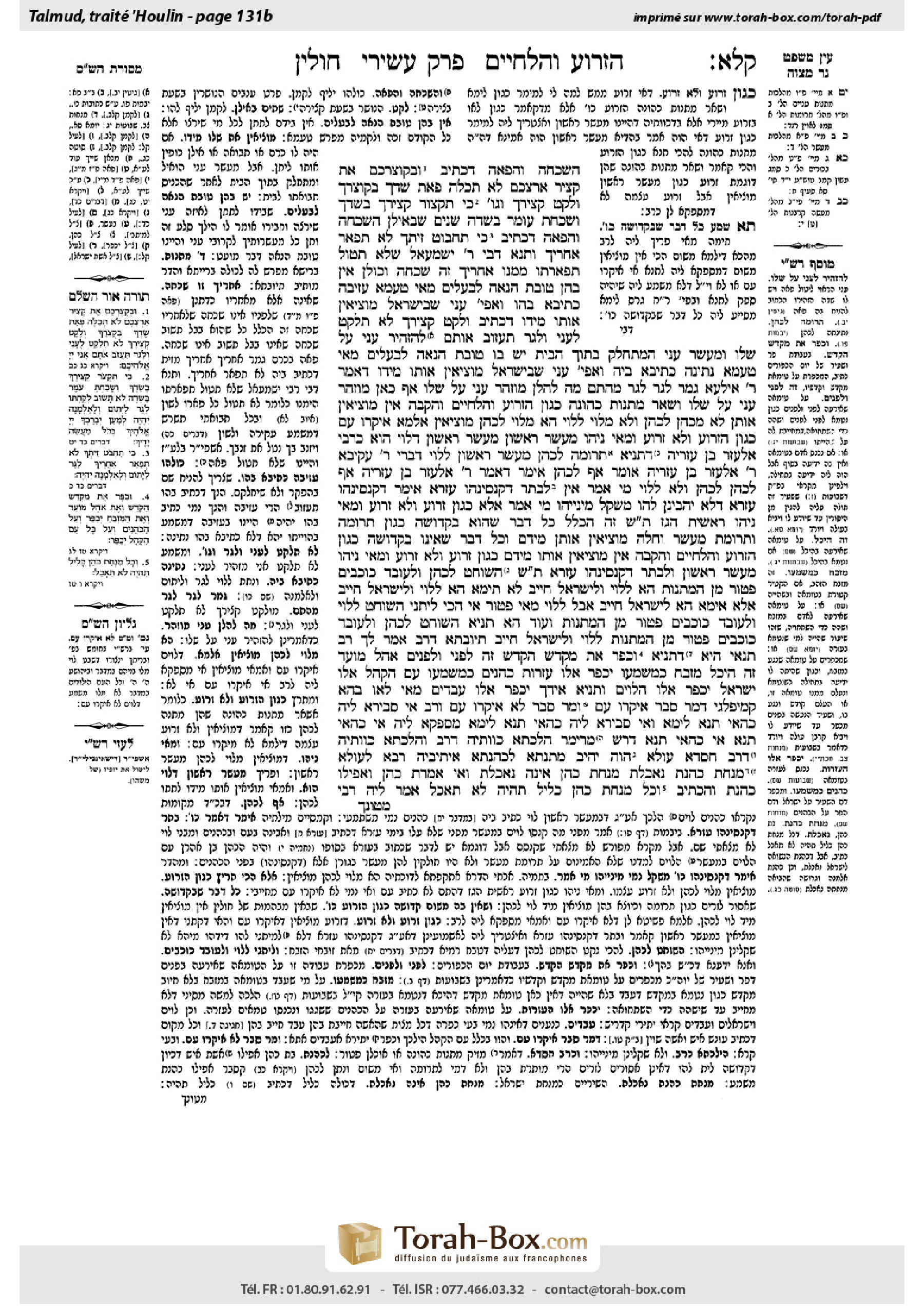
Chullin 131b: Talmud study for Daf Yomi
Study the Talmud for Daf Yomi with scanned pages, Hebrew text, English translations from Sefaria and AI-generated French translations.
Passage selection and English or AI-generated French translation are available where the scan has annotations. Daf Study is independent of Torah-Box and Sefaria.
Browse Chullin · חולין · All tractatesChullin 131b text and translations
This page of Chullin includes the Aramaic text, an English translation and an AI-generated French translation, alongside the scan above.
חולין קל״א ב · Aramaic and Hebrew text
הַשִּׁכְחָה, וְהַפֵּאָה, דִּכְתִיב: ״וּבְקֻצְרְכֶם אֶת קְצִיר אַרְצְכֶם לֹא תְכַלֶּה פְּאַת שָׂדְךָ בְּקֻצְרֶךָ וְלֶקֶט קְצִירְךָ וְגוֹ׳״, ״כִּי תִקְצֹר קְצִירְךָ בְשָׂדֶךָ וְשָׁכַחְתָּ עֹמֶר בַּשָּׂדֶה״.
שְׁנַיִם שֶׁבָּאִילָן: הַשִּׁכְחָה וְהַפֵּאָה, דִּכְתִיב ״כִּי תַחְבֹּט זֵיתְךָ לֹא תְפָאֵר אַחֲרֶיךָ״, וְתָנָא דְּבֵי רַבִּי יִשְׁמָעֵאל: שֶׁלֹּא תִּטּוֹל תִּפְאַרְתּוֹ מִמֶּנּוּ, ״אַחֲרֶיךָ״ – זוֹ שִׁכְחָה.
וְכוּלָּן אֵין בָּהֶן טוֹבַת הֲנָאָה לִבְעָלִים, מַאי טַעְמָא? ״עֲזִיבָה״ כְּתִיבָא בְּהוּ.
וַאֲפִילּוּ עָנִי שֶׁבְּיִשְׂרָאֵל, מוֹצִיאִין אוֹתוֹ מִיָּדוֹ, דִּכְתִיב: ״וְלֶקֶט קְצִירְךָ לֹא תְלַקֵּט לֶעָנִי וְלַגֵּר תַּעֲזֹב אֹתָם״, לְהַזְהִיר עָנִי עַל שֶׁלּוֹ.
וּמַעְשַׂר עָנִי הַמִּתְחַלֵּק בְּתוֹךְ הַבַּיִת יֵשׁ בּוֹ טוֹבַת הֲנָאָה לַבְּעָלִים, מַאי טַעְמָא? ״נְתִינָה״ כְּתִיבָא בֵּיהּ.
וַאֲפִילּוּ עָנִי שֶׁבְּיִשְׂרָאֵל מוֹצִיאִין אוֹתוֹ מִיָּדוֹ, דְּאָמַר רַבִּי אִילְעָא: גָּמַר ״לַגֵּר״ ״לַגֵּר״ מֵהָתָם, מָה לְהַלָּן מוּזְהָר עָנִי עַל שֶׁלּוֹ, אַף כָּאן מוּזְהָר עָנִי עַל שֶׁלּוֹ.
וּשְׁאָר מַתְּנוֹת כְּהוּנָּה, כְּגוֹן הַזְּרוֹעַ וְהַלְּחָיַיִם וְהַקֵּבָה, אֵין מוֹצִיאִין אוֹתָן לֹא מִכֹּהֵן לְכֹהֵן וְלֹא מִלֵּוִי לְלֵוִי. הָא מִלֵּוִי לְכֹהֵן מוֹצִיאִין, אַלְמָא אִיקְּרוּ ״עַם״.
כְּגוֹן הַזְּרוֹעַ וְלֹא זְרוֹעַ, וּמַאי נִיהוּ – מַעֲשֵׂר רִאשׁוֹן.
מַעֲשֵׂר רִאשׁוֹן דְּלֵוִי הוּא? כְּרַבִּי אֶלְעָזָר בֶּן עֲזַרְיָה, דְּתַנְיָא: תְּרוּמָה לַכֹּהֵן, מַעֲשֵׂר רִאשׁוֹן לַלֵּוִי, דִּבְרֵי רַבִּי עֲקִיבָא. רַבִּי אֶלְעָזָר בֶּן עֲזַרְיָה אוֹמֵר: אַף לַכֹּהֵן.
אֵימַר דְּאָמַר רַבִּי אֶלְעָזָר בֶּן עֲזַרְיָה אַף לַכֹּהֵן, לַכֹּהֵן וְלֹא לַלֵּוִי מִי אָמַר? אִין, לְבָתַר דְּקַנְסִינְהוּ עֶזְרָא.
אֵימַר דְּקַנְסִינְהוּ עֶזְרָא – דְּלָא יָהֲבִינַן לְהוּ מִשְׁקַל מִינַּיְיהוּ מִי אָמַר?! אֶלָּא, כְּגוֹן זְרוֹעַ וְלֹא זְרוֹעַ, וּמַאי נִיהוּ – רֵאשִׁית הַגֵּז.
תָּא שְׁמַע, זֶה הַכְּלָל: כׇּל דָּבָר שֶׁהוּא בִּקְדוּשָּׁה, כְּגוֹן תְּרוּמָה וּתְרוּמַת מַעֲשֵׂר וְחַלָּה – מוֹצִיאִין אוֹתָן מִיָּדָם, וְכׇל דָּבָר שֶׁאֵינוֹ בִּקְדוּשָּׁה, כְּגוֹן הַזְּרוֹעַ וְהַלְּחָיַיִם וְהַקֵּבָה – אֵין מוֹצִיאִין אוֹתוֹ מִיָּדָם.
כְּגוֹן זְרוֹעַ וְלֹא זְרוֹעַ, וּמַאי נִיהוּ – מַעֲשֵׂר רִאשׁוֹן, וּלְבָתַר דְּקַנְסִינְהוּ עֶזְרָא.
תָּא שְׁמַע: הַשּׁוֹחֵט לְכֹהֵן וּלְגוֹי – פָּטוּר מִן הַמַּתָּנוֹת, הָא לְלֵוִי וּלְיִשְׂרָאֵל – חַיָּיב? לָא תֵּימָא הָא לְלֵוִי וּלְיִשְׂרָאֵל חַיָּיב, אֶלָּא אֵימָא: הָא לְיִשְׂרָאֵל – חַיָּיב.
אֲבָל לְלֵוִי מַאי פָּטוּר? אִי הָכִי, לִיתְנֵי ״הַשּׁוֹחֵט לַלֵּוִי וְלַגּוֹי פָּטוּר מִן הַמַּתָּנוֹת״. וְעוֹד, הָא תַּנְיָא: הַשּׁוֹחֵט לַכֹּהֵן וְלַגּוֹי – פָּטוּר מִן הַמַּתָּנוֹת, לַלֵּוִי וּלְיִשְׂרָאֵל – חַיָּיב! תְּיוּבְתָּא דְּרַב.
אָמַר לְךָ רַב: תַּנָּאֵי הִיא, דְּתַנְיָא: ״וְכִפֶּר אֶת מִקְדַּשׁ הַקֹּדֶשׁ״ – זֶה לִפְנַי וְלִפְנִים.
״אֹהֶל מוֹעֵד״ – זֶה הֵיכָל, ״מִזְבֵּחַ״ – כְּמַשְׁמָעוֹ, ״יְכַפֵּר״ – אֵלּוּ עֲזָרוֹת, ״כֹּהֲנִים״ – כְּמַשְׁמָעוֹ, ״עַם הַקָּהָל״ – אֵלּוּ יִשְׂרָאֵל, ״יְכַפֵּר״ – אֵלּוּ הַלְוִיִּם.
וְתַנְיָא אִידַּךְ: ״יְכַפֵּר״ – אֵלּוּ עֲבָדִים. מַאי לָאו בְּהָא קָמִיפַּלְגִי, דְּמָר סָבַר אִיקְּרוֹ ״עַם״, וּמָר סָבַר לָא אִיקְּרוֹ ״עַם״.
וְרַב, אִי סְבִירָא לֵיהּ כְּהַאי תַּנָּא – לֵימָא, וְאִי סְבִירָא לֵיהּ כְּהַאי תַּנָּא – לֵימָא! מְסַפְּקָא לֵיהּ אִי כְּהַאי תַּנָּא אִי כְּהַאי תַּנָּא.
דְּרַשׁ מָרִימָר: הִלְכְתָא כְּוָותֵיהּ דְּרַב, וְהִלְכְתָא כְּוָותֵיהּ דְּרַב חִסְדָּא.
עוּלָּא הֲוָה יָהֵיב מַתְּנָתָא לְכָהַנְתָּא, אֵיתִיבֵיהּ רָבָא לְעוּלָּא: מִנְחַת כֹּהֶנֶת – נֶאֱכֶלֶת, מִנְחַת כֹּהֵן – אֵינָהּ נֶאֱכֶלֶת.
וְאִי אָמְרַתְּ ״כֹּהֵן״ וַאֲפִילּוּ כֹּהֶנֶת, וְהָכְתִיב: ״וְכׇל מִנְחַת כֹּהֵן כָּלִיל תִּהְיֶה לֹא תֵאָכֵל״! אֲמַר לֵיהּ: רַבִּי,
Chullin 131b · English translation
and the forgotten sheaves, and the pe’a. As it is written: “And when you reap the harvest of your land, you shall not wholly reap the corner of [pe’at] your field, neither shall you gather the gleaning of your harvest; you shall leave them for the poor, and for the stranger” (Leviticus 23:22). And it is also written: “When you reap your harvest in your field and have forgotten a sheaf in the field, you shall not go back to fetch it; it shall be for the stranger, for the fatherless, and for the widow” (Deuteronomy 24:19).
The baraita taught that two gifts are left to the poor from the produce of a tree: The forgotten fruits and the pe’a, as it is written: “When you beat your olive tree, you shall not go over the boughs [tefa’er] after you; it shall be for the stranger, for the fatherless, and for the widow” (Deuteronomy 24:20), and the school of Rabbi Yishmael taught that the phrase: “You shall not go over the boughs,” means that you should not take all of its splendor [tiferet] from it; rather, you should leave a portion of the olives for the poor as pe’a. Additionally, when the verse states: “After you,” this is a reference to forgotten fruits.
The Gemara continues its analysis of the baraita. And with regard to all of the gifts left to the poor, the owner of the produce does not have the benefit of discretion, i.e., the right to distribute the gifts to poor people of his choosing. Instead, any poor person who takes possession of these gifts becomes their rightful owner. What is the reason for this halakha? It is because the requirement of leaving is written with regard to them, e.g., in the verse that states: “You shall leave them” (Leviticus 23:22).
The baraita also stated: And even a poor person of Israel who owns a vineyard, field, or tree must leave these gifts for all poor people, and if he does not, the court removes them from his possession. This is derived from a verse, as it is written: “Neither the gleaning of your harvest shall you gather; for the poor you shall leave them, and for the stranger” (Leviticus 23:22). Since the verse juxtaposes the words “the poor” to the mitzva in the previous clause, this serves to warn a poor person that he must also separate these gifts from his own produce.
And the baraita teaches with regard to the poor man’s tithe that is distributed from within his house that the owner has the benefit of discretion. The Gemara asks: What is the reason for this halakha? It is because the requirement of giving is written with regard to it, as the verse states: “When you have made an end of tithing all the tithe of your increase in the third year, which is the year of tithing, and you shall give it to the Levite, to the stranger, to the fatherless, and to the widow, that they may eat within your gates, and be satisfied” (Deuteronomy 26:12). Consequently, in this case it is not left for the poor but is actively given to them.
The baraita states: And even in the case of a poor person in Israel, if he fails to separate the poor man’s tithe from his produce, the court removes it from his possession. The Gemara explains that this is as Rabbi Ile’a said: This is derived from a verbal analogy between the term “to the stranger” stated with regard to the poor man’s tithe in the verse cited previously, and the term “to the stranger” from there, the mitzva to leave gleanings for the poor. Just as there, with regard to the mitzva to leave gleanings, a poor person is warned that he must leave gleanings from the produce of his own fields, so too here, with regard to the mitzva to separate the poor man’s tithe, a poor person is warned to separate it from his own fields.
The baraita taught: And with regard to other gifts of the priesthood, such as the foreleg, and the jaw, and the maw, the court does not remove them, neither from a priest to give to another priest nor from a Levite to give to another Levite. Rav Idi bar Avin now explains his objection: It may be inferred that the court does remove the gifts from a Levite to give to a priest. Evidently, Levites are called part of the “people.” Accordingly, since the verse states: “And this shall be the priests’ due from the people” (Deuteronomy 18:3), the gifts of the priesthood may be removed from the possession of Levites. Why, then, was Rav uncertain with regard to their status?
The Gemara responds: The baraita is not referring to the actual gifts of the foreleg, the jaw, and the maw themselves. Rather, it is referring to a gift that is like the foreleg, the jaw, and the maw, but not the foreleg, the jaw, and the maw themselves. And what is this? It is the first tithe.
The Gemara asks: But the first tithe is given to the Levite. Why would it be removed from his possession? The Gemara responds: The baraita is in accordance with the opinion of Rabbi Elazar ben Azarya, as it is taught in another baraita: Teruma is given to the priest, whereas the first tithe is given to the Levite; this is the statement of Rabbi Akiva. Rabbi Elazar ben Azarya says: The first tithe is given to the priest as well, despite the fact that the Torah states that it is given to the Levite, as priests are often called Levites in the Torah.
The Gemara asks: Say that Rabbi Elazar ben Azarya said that the first tithe is given to the priest as well; but did he say that it is given exclusively to the priest and not to the Levite? The Gemara responds: Yes; although generally the first tithe is not removed from the possession of a Levite and given to a priest, the baraita is referring to first tithe in the period after Ezra penalized the Levites for their unwillingness to return to Eretz Yisrael from Babylonia, as he decreed that they should no longer be given the first tithe.
The Gemara persists: One can say that Ezra penalized them and decreed that we should not give them first tithe, but did he say that first tithe should even be taken from them and given to the priests? Rather, explain instead that the baraita is referring to a gift that is like the foreleg, the jaw, and the maw, but is not actually the foreleg, the jaw, or the maw. And what is this? It is the first sheared wool, with regard to which the verse states: “And the first of the fleece of your sheep, you shall give him” (Deuteronomy 18:4). Since the verse does not state that the first fleece is taken from the “people,” even Levites are obligated to give their first shearing to the priest, and it may be removed from their possession to that end.
The Gemara suggests: Come and hear a proof with regard to the uncertainty of Rav from a baraita. This is the principle: With regard to any item that is of sanctity, i.e., that may not be consumed by a non-priest, such as teruma, and teruma of the tithe, and ḥalla, the court removes it from the possession of a Levite in order to give it to the priests. And with regard to any item that is not of sanctity, such as the foreleg, and the jaw, and the maw, which are given from a non-sacred animal, the court does not remove it from the possession of the Levites to give to the priests. Evidently, Levites are not called part of the “people,” and therefore they are exempt from giving the foreleg, the jaw, and the maw.
The Gemara rejects this proof: The baraita is referring to a gift that is like the foreleg, the jaw, and the maw, but is not actually the foreleg, the jaw, and the maw themselves. And what is this? It is first tithe, and the baraita is dealing with first tithe in the period after Ezra penalized the Levites and decreed that the first tithe should be given to the priests rather than the Levites. Nevertheless, if a Levite received the first tithe it may not be removed from his possession, since this penalty was not included in Ezra’s decree.
The Gemara further suggests: Come and hear a proof from a baraita: An Israelite who slaughters an animal for a priest or for a gentile is exempt from giving the gifts, as priests and gentiles are exempt from this obligation. The Gemara infers: This indicates that if an Israelite slaughtered an animal for a Levite or for an Israelite, he is obligated to give the gifts, and they may be removed from his possession to that end. Evidently, Levites are called part of the “people,” and Rav should not have been uncertain with regard to their status. The Gemara rejects this proof: Do not say that one should infer that if an Israelite slaughtered an animal for a Levite or for an Israelite he is obligated to give the gifts. Rather, say merely that if an Israelite slaughtered an animal for another Israelite, he is obligated to give the gifts.
The Gemara asks: But if so, when one slaughters an animal for a Levite, what is the halakha? Is one exempt? If so, let the baraita teach: One who slaughters an animal for a Levite or for a gentile is exempt from giving the gifts, and it would be obvious that this is also the halakha when one slaughters for a priest. And furthermore, isn’t it taught explicitly in a baraita that one who slaughters for a priest or for a gentile is exempt from giving the gifts, whereas one who slaughters for a Levite or for an Israelite is obligated to give the gifts? This baraita apparently constitutes a conclusive refutation of the uncertainty of Rav.
The Gemara responds: Rav could say to you that although this baraita is in fact contrary to his opinion, the question of whether or not Levites are called part of the “people” is a dispute between tanna’im. As it is taught in a baraita that the verse states with regard to the Yom Kippur Temple service: “And he shall make atonement for the most holy place, and he shall make atonement for the Tent of Meeting and for the altar; and he shall make atonement for the priests and for all the people of the assembly” (Leviticus 16:33). The baraita explains: “And he shall make atonement for the most holy place”; this is referring to the innermost sanctum, i.e., the bull and goat offerings brought on Yom Kippur atone for ritual impurity occurring inside the Holy of Holies.
The baraita continues: “Tent of Meeting”; this is referring to the Sanctuary, i.e., the offerings atone for impurity occurring inside the Sanctuary. “Altar”; this is understood in accordance with its plain meaning, i.e., the offerings atone for one who performs sacrificial rites on the altar in a state of ritual impurity. “He shall make atonement”; this is referring to the Temple courtyards, i.e., the offerings atone for impurity occurring there. “For the priests”; this is understood in accordance with its plain meaning, indicating that the offerings atone for a priest who unwittingly enters the courtyard while impure. “And for all the people of the assembly”; these are the Israelites. “He shall make atonement”; this is referring to the Levites.
And it is taught in another baraita: “He shall make atonement”; this is referring to Canaanite slaves in the possession of Jews. These slaves are obligated in certain mitzvot and are therefore in need of atonement. The Gemara analyzes these sources: Why doesn’t the tanna of this baraita interpret the term “He shall make atonement” as a reference to Levites? What, is it not that they disagree about this, as one Sage, the tanna of the second baraita, holds that Levites are called part of the “people” and are therefore included in the clause “the people of the assembly,” and consequently, the term “he shall make atonement” is not required to include the Levites but instead serves to include Canaanite slaves. And by contrast, one Sage, the tanna of the first baraita, holds that they are not called part of the “people,” which means that the term “He shall make atonement” is required to include Levites.
The Gemara asks: But if this is a dispute between tanna’im, why is Rav uncertain with regard to the status of Levites? If he holds in accordance with this tanna, let him say that the halakha is in accordance with him, and if he holds in accordance with that tanna, let him say that the halakha is in accordance with him. The Gemara responds: Rav is uncertain whether the halakha is in accordance with this tanna or in accordance with that tanna.
Mareimar taught: The halakha is in accordance with the opinion of Rav that it is uncertain whether or not Levites are called part of the “people.” Consequently, the court may not compel Levites to give the foreleg, the jaw, and the maw to the priests. And the halakha is in accordance with the opinion of Rav Ḥisda, who said that one who damages or consumes gifts of the priesthood is exempt from payment.
§ With regard to the gifts of the priesthood, the Gemara relates that Ulla would give gifts of the priesthood to a female priest, i.e., the daughter of a priest, even if she was married to an Israelite. Rava raised an objection to the practice of Ulla from a baraita: The remainder of a meal offering of a female priest is consumed, just like the remainder of the meal offering of an Israelite. But the remainder of a meal offering of a priest is not consumed, as the verse states: “And every meal offering of the priest shall be wholly made to smoke; it shall not be eaten” (Leviticus 6:16).
Rava explains his objection: And if you say that one may give gifts of a priest even to a female priest, because when the verse mentions a priest it is referring even to the daughter of a priest, but isn’t it written: “And every meal offering of the priest shall be wholly made to smoke; it shall not be eaten”? Why, then, is the remainder of a meal offering of the daughter of a priest consumed? Ulla said to him in response: My teacher,
Chullin 131b · Traduction française (IA)
et les épis oubliés, et la pe’a. Comme il est écrit : « Et lorsque tu moissonneras la moisson de ton champ, tu ne devras pas récolter entièrement la bordure [pe’a] de ton champ, ni rassembler le fruit de la moisson ; tu laisseras cela aux pauvres et aux étrangers » (Lévitique 23:22). Il est également écrit : « Lorsque tu moissonneras ta moisson dans ton champ et que tu as oublié une gerbe dans le champ, tu ne devras pas retourner pour la ramasser ; elle sera pour l’étranger, pour l’orphelin et pour la veuve » (Dt 24:19).
La baraïta enseignait que deux dons sont laissés aux pauvres à partir de la production d’un arbre : les fruits oubliés et la pe’a, comme il est écrit : « Lorsque tu frappes ton olivier, tu ne devras pas dépasser les branches [tefa’er] après toi ; cela sera pour l’étranger, pour l’orphelin et pour la veuve » (Dt 24:20), et l’école de Rabbi Yishmael enseignait que la phrase : « Tu ne devras pas dépasser les branches », signifie que tu ne devrais pas prendre toute la splendeur [tiferet] de l’arbre ; plutôt, tu devrais laisser une partie des olives aux pauvres comme pe’a. De plus, lorsque la parole dit : « Après toi », cela fait référence aux fruits oubliés.
La Guemara continue son analyse de la baraïta. Et concernant tous les dons laissés aux pauvres, le propriétaire des produits n’a pas le droit de discernement, c’est-à-dire le droit de distribuer les dons aux pauvres de son choix. Au contraire, tout pauvre qui s’approprie ces dons devient leur propriétaire légitime. Quelle est la raison de cette halakha ? C’est parce que la nécessité de laisser est écrite à leur sujet, c’est-à-dire dans la parole qui dit : « Tu laisseras cela » (Lévitique 23:22).
La baraïta a également dit : Même un pauvre d’Israël qui possède un vignoble, un champ ou un arbre doit laisser ces dons pour tous les pauvres, et s’il ne le fait pas, la cour les retire de son possession. Cela est tiré d’une parole, comme il est écrit : « Ni le fruit de ta moisson ne devras-tu rassembler ; pour le pauvre tu laisseras cela, et pour l’étranger » (Lévitique 23:22). Puisque la parole juxtapose les mots « le pauvre » à la mitsva dans la clause précédente, cela sert à avertir un pauvre qu’il doit aussi séparer ces dons de sa propre production.
Et la baraïta enseigne concernant la dîme du pauvre distribuée à l’intérieur de sa maison que le propriétaire a le droit de discernement. La Guemara demande : Quelle est la raison de cette halakha ? C’est parce que la nécessité de donner est écrite à son sujet, comme la parole dit : « Lorsque tu as terminé de dîmer toutes les dîmes de ton revenu dans la troisième année, qui est l’année de la dîme, et que tu donneras cela au lévite, à l’étranger, à l’orphelin et à la veuve, afin qu’ils mangent à tes portes et soient rassasiés » (Dt 26:12). Ainsi, dans ce cas, ce n’est pas laissé pour les pauvres mais est activement donné à ceux-ci.
La baraïta dit : Et même dans le cas d’un pauvre d’Israël, s’il néglige de séparer la dîme du pauvre de sa production, la cour la retire de sa possession. La Guemara explique que cela est comme Rabbi Ile’a a dit : Cela est tiré d’une analogie verbale entre le terme « à l’étranger » mentionné concernant la dîme du pauvre dans la parole citée précédemment, et le terme « à l’étranger » de là, la mitsva de laisser les récoltes pour les pauvres. Aussi bien que là, concernant la mitsva de laisser les récoltes, un pauvre est averti qu’il doit laisser les récoltes de sa propre production, ainsi ici, concernant la mitsva de séparer la dîme du pauvre, un pauvre est averti de la séparer de sa propre production.
La baraïta enseignait : Et concernant d’autres dons de la priesthood, tels que le premier avant-train, la mâchoire et la gueule, la cour ne les retire pas, ni d’un prêtre pour donner à un autre prêtre, ni d’un lévite pour donner à un autre lévite. Rav Idi bar Avin explique maintenant son objection : On peut en déduire que la cour retire les dons d’un lévite pour les donner à un prêtre. Évidemment, les lévites sont appelés partie du « peuple ». Ainsi, puisque la parole dit : « Et cela sera la récompense des prêtres du peuple » (Dt 18:3), les dons de la priesthood peuvent être retirés de la possession des lévites. Pourquoi alors Rav était-il incertain concernant leur statut ?
La Guemara répond : La baraïta ne fait pas référence aux dons réels du premier avant-train, de la mâchoire et de la gueule eux-mêmes. Elle fait référence à un don semblable au premier avant-train, à la mâchoire et à la gueule, mais pas aux premiers avant-train, à la mâchoire et à la gueule eux-mêmes. Et qu’est-ce que cela ? C’est la première dîme.
La Guemara demande : Mais la première dîme est donnée au lévite. Pourquoi serait-elle retirée de sa possession ? La Guemara répond : La baraïta est selon l’opinion de Rabbi Elazar ben Azarya, comme il est enseigné dans une autre baraïta : La terouma est donnée au prêtre, tandis que la première dîme est donnée au lévite ; c’est la déclaration de Rabbi Akiva. Rabbi Elazar ben Azarya dit : La première dîme est donnée au prêtre également, malgré le fait que la Torah stipule qu’elle est donnée au lévite, comme les prêtres sont souvent appelés lévites dans la Torah.
La Guemara demande : Disons que Rabbi Elazar ben Azarya a dit que la première dîme est donnée au prêtre également ; mais a-t-il dit qu’elle est donnée exclusivement au prêtre et non au lévite ? La Guemara répond : Oui ; bien que généralement la première dîme ne soit pas retirée de la possession d’un lévite et donnée à un prêtre, la baraïta fait référence à la première dîme pendant la période après que l’homme Ezra ait puni les lévites pour leur refus de retourner en Eretz Yisrael depuis Babylone, comme il a décrété qu’ils ne devraient plus recevoir la première dîme.
La Guemara persiste : On peut dire que Ezra a sanctionné cela et a décrété que nous ne devions pas leur donner la première dîme, mais a-t-il dit que la première dîme devait même être prise d'eux et donnée aux prêtres ? Plutôt, expliquez plutôt que la baraïta fait référence à un don semblable à la cuisse, à la mâchoire et à la gueule, mais qui n'est pas en réalité la cuisse, la mâchoire ou la gueule. Et qu'est-ce que cela ? C'est la première laine rasée, dont la parabole dit : « Et la première de la laine de tes brebis, tu la donneras à lui » (Deutéronome 18 : 4). Puisque la parabole ne dit pas que la première laine est prise du « peuple », même les Lévites sont tenus de donner leur première laine rasée au prêtre, et elle peut être retirée de leur possession à cet effet.
La Guemara suggère : Viens écouter une preuve concernant l'incertitude de Rava d'une baraïta. C'est le principe : concernant toute chose qui est de sanctité, c'est-à-dire que cela ne peut pas être consommé par un non-prêtre, comme la terouma, la terouma de la dîme et la challa, la cour retire cela de la possession d'un Lévite afin de le donner aux prêtres. Et concernant toute chose qui n'est pas de sanctité, comme la cuisse, la mâchoire et la gueule, qui sont données d'un animal non sacré, la cour ne retire pas cela de la possession des Lévites pour le donner aux prêtres. Évidemment, les Lévites ne sont pas appelés partie du « peuple », et par conséquent ils sont exemptés de donner la cuisse, la mâchoire et la gueule.
La Guemara rejette cette preuve : la baraïta fait référence à un don semblable à la cuisse, à la mâchoire et à la gueule, mais qui n'est pas en réalité la cuisse, la mâchoire ou la gueule elle-même. Et qu'est-ce que cela ? C'est la première dîme, et la baraïta traite de la première dîme durant la période après que Ezra a sanctionné les Lévites et a décrété que la première dîme devait être donnée aux prêtres plutôt qu'aux Lévites. Cependant, si un Lévite a reçu la première dîme, elle ne peut pas être retirée de sa possession, puisque cette sanction n'était pas incluse dans le décret d'Ezra.
La Guemara suggère davantage : viens écouter une preuve d'une baraïta : un Israélite qui sacrifie un animal pour un prêtre ou pour un gentil est exempt de donner les dons, car les prêtres et les gentils sont exemptés de cette obligation. La Guemara déduit : cela indique que si un Israélite sacrifie un animal pour un Lévite ou pour un Israélite, il est tenu de donner les dons, et ils peuvent être retirés de sa possession à cet effet. Évidemment, les Lévites sont appelés partie du « peuple », et Rava ne devrait pas être incertain concernant leur statut. La Guemara rejette cette preuve : ne dis pas que l'on devrait déduire que si un Israélite sacrifie un animal pour un Lévite ou pour un Israélite il est tenu de donner les dons. Plutôt, dis simplement que si un Israélite sacrifie un animal pour un autre Israélite, il est tenu de donner les dons.
La Guemara pose la question : Mais si c'est ainsi, quand on sacrifie un animal pour un Lévite, quelle est la halakha ? Est-on exempt ? Si oui, que la baraïta enseigne : celui qui sacrifie un animal pour un Lévite ou pour un gentil est exempt de donner les dons, et cela serait évident que c'est aussi la halakha quand on sacrifie pour un prêtre. Et de plus, n'est-il pas enseigné explicitement dans une baraïta que celui qui sacrifie pour un prêtre ou pour un gentil est exempt de donner les dons, tandis que celui qui sacrifie pour un Lévite ou pour un Israélite est tenu de donner les dons ? Cette baraïta semble constituer une réfutation conclusive de l'incertitude de Rava.
La Guemara répond : Rava pourrait dire que bien que cette baraïta soit effectivement contraire à son avis, la question de savoir si les Lévites sont appelés partie du « peuple » est un débat entre les tannaïm. Comme il est enseigné dans une baraïta que la parabole dit concernant le service du Temple le Yom Kippour : « Et il fera l'atonement pour le lieu saint le plus saint, et il fera l'atonement pour le Tabernacle et pour l'autel ; et il fera l'atonement pour les prêtres et pour tout le peuple de l'assemblée » (Lévitique 16 : 33). La baraïta explique : « Et il fera l'atonement pour le lieu saint le plus saint » ; cela fait référence au sanctuaire le plus intime, c'est-à-dire que les offrandes de bœuf et de bouc apportées le Yom Kippour expient l'impureté qui s'est produite à l'intérieur du Saint des Saints.
La baraïta continue : « Tabernacle » ; cela fait référence au Sanctuaire, c'est-à-dire que les offrandes expient l'impureté qui s'est produite à l'intérieur du Sanctuaire. « Autel » ; cela est compris selon son sens littéral, c'est-à-dire que les offrandes expient celui qui effectue des rites sacrificiels sur l'autel dans un état d'impureté rituelle. « Il fera l'atonement » ; cela fait référence aux courtyards du Temple, c'est-à-dire que les offrandes expient l'impureté qui s'est produite là. « Pour les prêtres » ; cela est compris selon son sens littéral, indiquant que les offrandes expient un prêtre qui entre accidentellement dans le courtil en état d'impureté. « Et pour tout le peuple de l'assemblée » ; ce sont les Israélites. « Il fera l'atonement » ; cela fait référence aux Lévites.
Et il est enseigné dans une autre baraïta : « Il fera l'atonement » ; cela fait référence aux esclaves cananéens en possession des Juifs. Ces esclaves sont tenus de certaines mitsvot et sont donc en besoin d'atone. La Guemara analyse ces sources : pourquoi le tanna de cette baraïta ne comprend-il pas le terme « il fera l'atonement » comme faisant référence aux Lévites ? Qu'est-ce que cela, n'est-ce pas que l'un des Sages, le tanna de la deuxième baraïta, considère que les Lévites sont appelés partie du « peuple » et sont donc inclus dans la clause « le peuple de l'assemblée », et par conséquent, le terme « il fera l'atonement » n'est pas nécessaire pour inclure les Lévites mais sert plutôt à inclure les esclaves cananéens. Et par contraste, un autre Sage, le tanna de la première baraïta, considère qu'ils ne sont pas appelés partie du « peuple », ce qui signifie que le terme « il fera l'atonement » est nécessaire pour inclure les Lévites.
La Guemara pose la question : Mais si c'est un désaccord entre des tannaïm, pourquoi Rav est-il incertain quant au statut des Lévites ? S'il adopte l'opinion de ce tanna, qu'il dise que la halakha suit son avis, et s'il adopte l'opinion de cet autre tanna, qu'il dise que la halakha suit son avis. La Guemara répond : Rav est incertain quant à savoir si la halakha suit ce tanna ou cet autre tanna.
Mareimar enseigna : La halakha suit l'opinion de Rav selon laquelle il est incertain quant à savoir si les Lévites sont considérés comme faisant partie du « peuple » ou non. Ainsi, la cour ne peut pas obliger les Lévites à donner la cuisse, la mâchoire et la gueule aux prêtres. Et la halakha suit l'opinion de Rav Ḥisda, qui affirmait qu'une personne qui endommage ou consomme des dons des prêtres est exemptée de paiement.
§ En ce qui concerne les dons des prêtres, la Guemara rapporte que Ulla donnait des dons des prêtres à une prêtre féminine, c'est-à-dire la fille d'un prêtre, même si elle était mariée à un Israélite. Rava opposa un argument tiré d'une baraïta à la pratique d'Ulla : Le reste d'une offrande de table d'une prêtre féminine est consommé, tout comme le reste d'une offrande de table d'un Israélite. Mais le reste d'une offrande de table d'un prêtre n'est pas consommé, car la Parashia dit : « Et toute offrande de table du prêtre sera entièrement brûlée ; elle ne sera pas mangée » (Lévitique 6:16).
Rava explique son objection : Et si vous dites qu'on peut donner des dons d'un prêtre même à une prêtre féminine, car lorsque la Parashia mentionne un prêtre, elle désigne même la fille d'un prêtre, mais n'est-il pas écrit : « Et toute offrande de table du prêtre sera entièrement brûlée ; elle ne sera pas mangée » ? Pourquoi, alors, le reste d'une offrande de table de la fille d'un prêtre est-il consommé ? Ulla répondit à lui en disant : Mon maître,
Traduction française générée par IA à partir de l’édition anglaise de Sefaria. Vérifie toujours un passage avec le texte source.
Text from Sefaria: William Davidson Edition - Vocalized Aramaic (unknown); William Davidson Edition - English (CC BY NC).