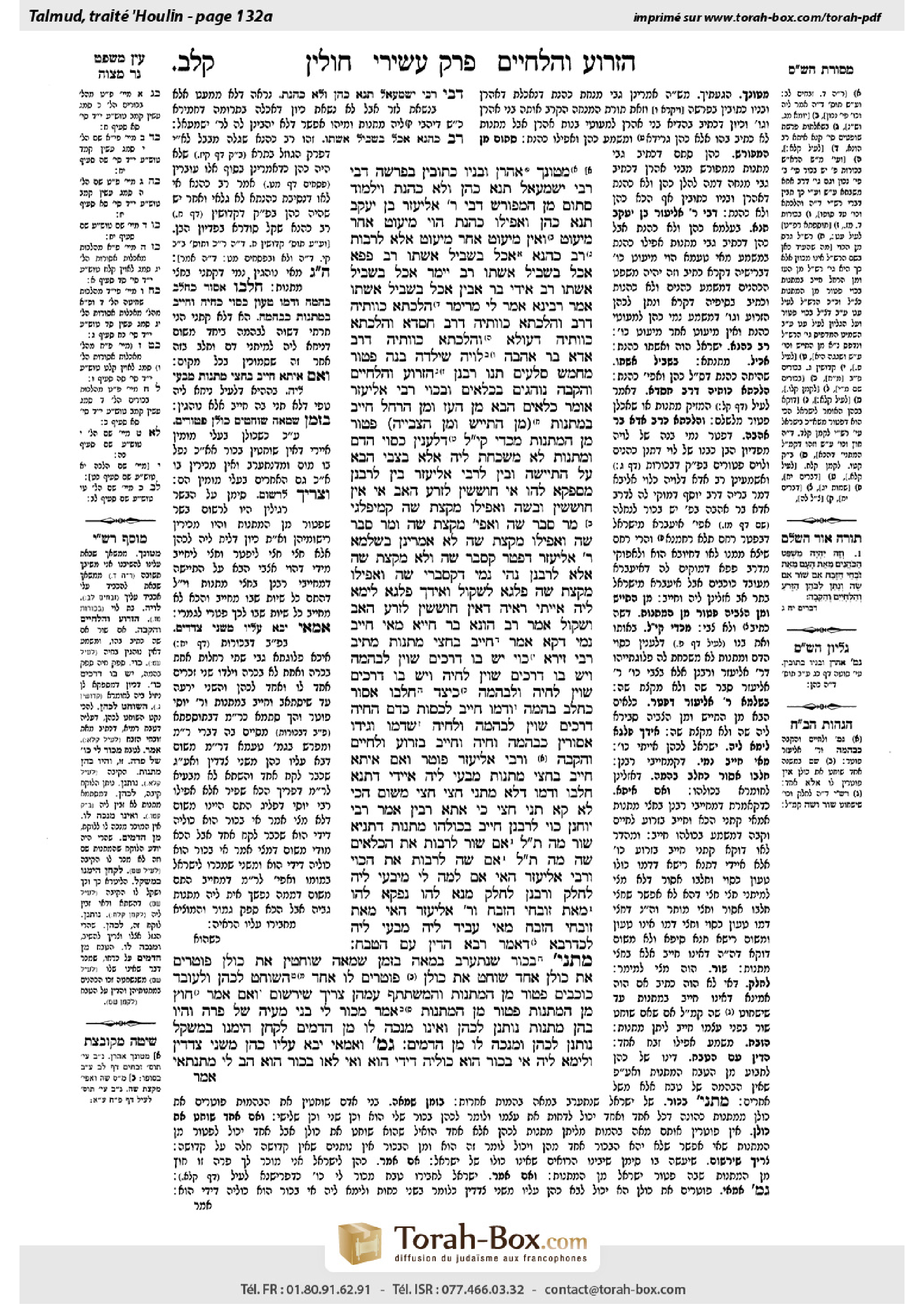
Chullin 132a: Talmud study for Daf Yomi
Study the Talmud for Daf Yomi with scanned pages, Hebrew text, English translations from Sefaria and AI-generated French translations.
Passage selection and English or AI-generated French translation are available where the scan has annotations. Daf Study is independent of Torah-Box and Sefaria.
Browse Chullin · חולין · All tractatesChullin 132a text and translations
This page of Chullin includes the Aramaic text, an English translation and an AI-generated French translation, alongside the scan above.
חולין קל״ב א · Aramaic and Hebrew text
מִטּוּנָךְ: ״אַהֲרֹן וּבָנָיו״ כְּתוּבִין בַּפָּרָשָׁה.
דְּבֵי רַבִּי יִשְׁמָעֵאל תָּנָא: ״כֹּהֵן״ – וְלֹא כֹּהֶנֶת, וְיִלְמוֹד סָתוּם מִן הַמְפוֹרָשׁ.
דְּבֵי רַבִּי אֱלִיעֶזֶר בֶּן יַעֲקֹב תָּנָא: ״כֹּהֵן״, וַאֲפִילּוּ כֹּהֶנֶת – הָוֵי מִיעוּט אַחַר מִיעוּט, וְאֵין מִיעוּט אַחַר מִיעוּט אֶלָּא לְרַבּוֹת.
רַב כָּהֲנָא אָכַל בִּשְׁבִיל אִשְׁתּוֹ, רַב פָּפָּא אָכַל בִּשְׁבִיל אִשְׁתּוֹ, רַב יֵימַר אָכַל בִּשְׁבִיל אִשְׁתּוֹ, רַב אִידִי בַּר אָבִין אָכַל בִּשְׁבִיל אִשְׁתּוֹ.
אָמַר רָבִינָא: אֲמַר לִי מָרִימָר, הִלְכְתָא כְּוָותֵיהּ דְּרַב, וְהִלְכְתָא כְּוָותֵיהּ דְּרַב חִסְדָּא, וְהִלְכְתָא כְּוָותֵיהּ דְּעוּלָּא.
וְהִלְכְתָא כְּוָותֵיהּ דְּרַב אַדָּא בַּר אַהֲבָה: לְוִיָּה שֶׁיָּלְדָה – בְּנָהּ פָּטוּר מֵחֲמֵשׁ סְלָעִים.
תָּנוּ רַבָּנַן: הַזְּרוֹעַ וְהַלְּחָיַיִם וְהַקֵּבָה נוֹהֲגִים בְּכִלְאַיִם וּבְכוֹי. רַבִּי אֱלִיעֶזֶר אוֹמֵר: כִּלְאַיִם הַבָּא מִן הָעֵז וּמִן הָרָחֵל – חַיָּיב בְּמַתָּנוֹת, מִן הַתַּיִישׁ וּמִן הַצְּבִיָּיה – פָּטוּר מִן הַמַּתָּנוֹת.
מִכְּדֵי קַיְימָא לַן דִּלְעִנְיַן כִּסּוּי הַדָּם וּמַתָּנוֹת לָא מַשְׁכַּחַתְּ לֵיהּ אֶלָּא בִּצְבִי הַבָּא עַל הַתְּיָישָׁה, וּבֵין לְרַבִּי אֱלִיעֶזֶר בֵּין לְרַבָּנַן מְסַפְּקָא לְהוּ אִי חוֹשְׁשִׁין לְזֶרַע הָאָב, אִי אֵין חוֹשְׁשִׁין.
וּבְשֶׂה וַאֲפִילּוּ מִקְצָת שֶׂה קָמִיפַּלְגִי: מָר סָבַר: ״שֶׂה״ – וַאֲפִילּוּ מִקְצָת שֶׂה, וּמָר סָבַר: ״שֶׂה״ וַאֲפִילּוּ מִקְצָת שֶׂה לָא אָמְרִינַן.
בִּשְׁלָמָא רַבִּי אֱלִיעֶזֶר דְּפָטַר, קָסָבַר ״שֶׂה״ וְלֹא מִקְצָת שֶׂה, אֶלָּא לְרַבָּנַן, נְהִי נָמֵי דְּקָסָבְרִי ״שֶׂה״ וַאֲפִילּוּ מִקְצָת שֶׂה, פַּלְגָא לִשְׁקוֹל, וְאִידָּךְ פַּלְגָא לֵימָא לֵיהּ: אַיְיתִי רְאָיָה דְּאֵין חוֹשְׁשִׁין לְזֶרַע הָאָב וּשְׁקוֹל! אָמַר רַב הוּנָא בַּר חִיָּיא: מַאי חַיָּיב נָמֵי דְּקָא אָמַר – חַיָּיב בַּחֲצִי מַתָּנוֹת.
מֵתִיב רַבִּי זֵירָא: כּוֹי – יֵשׁ בּוֹ דְּרָכִים שָׁוִין לַבְּהֵמָה, וְיֵשׁ בּוֹ דְּרָכִים שָׁוִין לַחַיָּה, וְיֵשׁ בּוֹ דְּרָכִים שָׁוִין לַחַיָּה וְלַבְּהֵמָה.
כֵּיצַד? חֶלְבּוֹ אָסוּר כַּחֲלֵב בְּהֵמָה, וְדָמוֹ חַיָּיב לְכַסּוֹת כְּדַם הַחַיָּה, דְּרָכִים שָׁוִין לַבְּהֵמָה וְלַחַיָּה – שֶׁדָּמוֹ וְגִידוֹ אֲסוּרִין כִּבְהֵמָה וְחַיָּה, וְחַיָּיב בִּזְרוֹעַ וּלְחָיַיִם וְהַקֵּבָה, וְרַבִּי אֱלִיעֶזֶר פּוֹטֵר.
וְאִם אִיתָא, חַיָּיב בַּחֲצִי מַתָּנוֹת מִבְּעֵי לֵיהּ! אַיְּידֵי דִּתְנָא חֶלְבּוֹ וְדָמוֹ, דְּלָא מִתְּנֵי ״חֲצִי״ ״חֲצִי״, מִשּׁוּם הָכִי לָא קָא תָנֵי ״חֲצִי״.
כִּי אֲתָא רָבִין, אָמַר רַבִּי יוֹחָנָן: כּוֹי לְרַבָּנַן חַיָּיב בְּכוּלְּהוּ מַתָּנוֹת, דְּתַנְיָא: ״שׁוֹר״, מָה תַּלְמוּד לוֹמַר ״אִם שׁוֹר״ – לְרַבּוֹת אֶת הַכִּלְאַיִם. ״שֶׂה״, מָה תַּלְמוּד לוֹמַר ״אִם שֶׂה״ – לְרַבּוֹת אֶת הַכּוֹי.
וְרַבִּי אֱלִיעֶזֶר, הַאי ״אִם״ לְמָה לִי? מִיבְּעֵי לֵיהּ לְחַלֵּק. וְרַבָּנַן, לְחַלֵּק מְנָא לְהוּ? נָפְקָא לְהוּ מֵ״אֵת זוֹבְחֵי הַזֶּבַח״.
וְרַבִּי אֱלִיעֶזֶר, הַאי ״מֵאֵת זוֹבְחֵי הַזֶּבַח״ מַאי עָבֵיד לֵיהּ? מִבְּעֵי לֵיהּ לְכִדְרָבָא, דְּאָמַר רָבָא: הַדִּין עִם הַטַּבָּח.
מַתְנִי׳ בְּכוֹר שֶׁנִּתְעָרֵב בְּמֵאָה, בִּזְמַן שֶׁמֵּאָה שׁוֹחֲטִין אֶת כּוּלָּן – פּוֹטְרִים אֶת כּוּלָּן, אֶחָד שׁוֹחֵט אֶת כּוּלָּן – פּוֹטְרִים לוֹ אֶחָד.
הַשּׁוֹחֵט לַכֹּהֵן וְלַגּוֹי – פָּטוּר מִן הַמַּתָּנוֹת, וְהַמִּשְׁתַּתֵּף עִמָּהֶן – צָרִיךְ שֶׁיִּרְשׁוֹם, וְאִם אָמַר: ״חוּץ מִן הַמַּתָּנוֹת״ – פָּטוּר מִן הַמַּתָּנוֹת.
אָמַר: ״מְכוֹר לִי בְּנֵי מֵעֶיהָ שֶׁל פָּרָה״, וְהָיוּ בָּהֶן מַתָּנוֹת – נוֹתְנָן לַכֹּהֵן, וְאֵינוֹ מְנַכֶּה לוֹ מִן הַדָּמִים. לְקָחָן הֵימֶנּוּ בְּמִשְׁקָל – נוֹתְנָן לַכֹּהֵן, וּמְנַכֶּה לוֹ מִן הַדָּמִים.
גְּמָ׳ וְאַמַּאי? יָבֹא עָלָיו כֹּהֵן מִשְּׁנֵי צְדָדִין, וְלֵימָא לֵיהּ: אִי בְּכוֹר הוּא – כּוּלֵּיהּ דִּידִי הוּא, וְאִי לָאו בְּכוֹר הוּא – הַב לִי מַתְּנָתַאי.
Chullin 132a · English translation
from your burden [mitunakh], i.e., from that which you raise your objection, I can cite a proof for my practice: With regard to the meal offering of a priest, both Aaron and his sons are written in the passage discussing this offering: “And this is the law of the meal offering: The sons of Aaron shall offer it before the Lord, in front of the altar” (Leviticus 6:7). The verse emphasizes that these halakhot apply only to male priests and not to their daughters. This indicates that when the verse refers merely to priests, even their daughters are included. Accordingly, one may give gifts of the priesthood to the daughter of a priest.
The Gemara cites the opinions of various tanna’im with regard to the practice of Ulla: The school of Rabbi Yishmael taught: Anywhere that the Torah mentions a priest with regard to gifts of the priesthood, it is referring specifically to a priest and not a female priest, and let one derive the meaning of an unspecified reference to a priest from the explicit verse that states with regard to meal offerings: “Aaron and his sons.” This verse indicates that any reference to a priest excludes a priest’s daughter.
The school of Rabbi Eliezer ben Yaakov taught: In general, the reference to a priest in a verse serves to exclude a priest’s daughter. But when the verse mentions a priest with regard to gifts of the priesthood, it means to include even a female priest. This is because the verse mentions priests twice: “And this shall be the priests’ due from the people, from them that perform a slaughter, whether it be ox or sheep, that they shall give to the priest the foreleg, and the jaw, and the maw” (Deuteronomy 18:3). Since each reference to a priest excludes the daughter of a priest, this verse is a case of a restrictive expression following a restrictive expression, and there is a hermeneutical principle that a restrictive expression following a restrictive expression serves only to amplify the halakha and include additional cases, in this instance, the daughter of a priest.
The Gemara relates that Rav Kahana, who was an Israelite, partook of gifts of the priesthood on account of his wife, who was the daughter of a priest. Similarly, Rav Pappa partook of gifts of the priesthood on account of his wife, Rav Yeimar partook of gifts on account of his wife, and Rav Idi bar Avin partook of them on account of his wife.
Ravina said: Mareimar said to me that the halakha is in accordance with the opinion of Rav that it is uncertain whether or not Levites are obligated to give the gifts of the priesthood, and consequently, gifts are not removed from their possession to be given to the priests. And the halakha is in accordance with the opinion of Rav Ḥisda that one who damages or consumes gifts of the priesthood is exempt from payment. And the halakha is in accordance with the opinion of Ulla that gifts of the priesthood may be given to the daughter of a priest.
And in a case not previously discussed but related to the opinion of Ulla, the halakha is in accordance with the opinion of Rav Adda bar Ahava with regard to a female Levite, i.e., the daughter of a Levite, who gave birth to a firstborn boy, even if she is married to an Israelite, that her son is exempt from the obligation to give five sela to the priest for his redemption, as the child is considered the son of a Levite, and Levites are exempt from this obligation.
§ The Gemara cites a dispute with regard to the gifts of the foreleg, the jaw, and the maw. The Sages taught in a baraita: The obligation to give the foreleg, the jaw, and the maw applies even to a hybrid animal and to the animal known as a koy. Rabbi Eliezer says: A hybrid that results from the mating of a goat and a ewe is obligated to have gifts of the priesthood given from it, while a hybrid that results from the mating of a goat and a doe is exempt from having gifts of the priesthood given from it. This is because the verse states with regard to gifts of the priesthood: “Whether it be an ox or sheep” (Deuteronomy 18:3), i.e., a domesticated animal, and a doe is not a domesticated animal.
The Gemara asks: Now, we maintain (see 79b–80a) with regard to the mitzvot of covering the blood and giving the gifts of the priesthood that you do not find that Rabbi Eliezer and the Rabbis disagree except in the case of an animal born from a deer that mates with a female goat. And both Rabbi Eliezer and the Rabbis are uncertain whether one needs to be concerned with its paternity when determining the species of a hybrid animal, which would mean that this animal is part domesticated and part undomesticated, or whether one does not need to be concerned with paternity and the species of an animal is determined entirely by the species of its mother, in which case it is a domesticated animal.
And they disagree with regard to whether the obligation of the gifts applies to a sheep and even an animal that is partially a sheep, i.e., partially domesticated. One Sage, the Rabbis, holds that the obligation applies to a sheep and even an animal that is partially a sheep; and one Sage, Rabbi Eliezer, holds that we do not say that the obligation applies to a sheep and even an animal that is partially a sheep.
The Gemara concludes its question: Granted, it is understandable that Rabbi Eliezer deems the owner of a hybrid exempt from the mitzva to give the priestly gifts, as he holds that only in the case of a sheep is one obligated to give gifts of the priesthood, but not with regard to animals that are only partially sheep. But according to the opinion of the Rabbis, though indeed they hold that sheep and even animals that are partially sheep are subject to the obligation of giving gifts of the priesthood, let the priest take only half of the gifts. And with regard to the other half, let the owner of the animal say to him: Bring proof that one need not be concerned with its paternity and then you may take the other half. Rav Huna bar Ḥiyya said in response: What do the Rabbis mean when they say that the owner of this animal is obligated? They mean that he is obligated in half of the gifts.
Rabbi Zeira raises an objection to this response from a baraita: In the case of a koy, with regard to which it is uncertain whether it is a domesticated animal or an undomesticated one, there are ways in which its halakhot correspond to those of a domesticated animal, and there are ways in which its halakhot correspond to those of an undomesticated animal. And there are ways in which its halakhot correspond to those of both an undomesticated animal and a domesticated animal.
The baraita elaborates: How so? Its fat is forbidden like the forbidden fat of a domesticated animal, unlike that of an undomesticated one. And one is obligated to cover its blood from slaughter with dirt, like the blood of an undomesticated animal. And there are ways in which its halakhot correspond to both those of a domesticated animal and an undomesticated animal, as its blood and its sciatic nerve are forbidden like those of a domesticated animal and an undomesticated animal. And its owner is obligated to give the foreleg, the jaw, and the maw from it to the priest, as in the case of domesticated animals. And Rabbi Eliezer deems the owner of a koy exempt from the mitzva to give the gifts.
Rabbi Zeira asks: And if it is so that the Rabbis mean that the owner of a koy is obligated to give half of the gifts, then the baraita should have said that he is obligated to give half of the gifts from it. The Gemara responds: Since the tanna taught that its fat and its blood are forbidden, with regard to which it could not teach that half of its blood or half of its fat are forbidden, as it is impossible that half of it is forbidden while the other half is permitted, due to that reason the tanna did not teach that the owner of a koy is obligated in half of the gifts.
The Gemara relates that when Ravin came from Eretz Yisrael to Babylonia, he said that Rabbi Yoḥanan said: According to the Rabbis, a koy is obligated to have all of the gifts of the priesthood given from it. As it is taught in a baraita: The verse states with regard to the gifts of the priesthood: “Whether it be an ox or sheep” (Deuteronomy 18:3). Since the verse needed to state only “ox,” why must the verse state: “Whether it be an ox”? This phrase serves to include a hybrid in the obligation to give the gifts of the priesthood. And since the verse needed to state only “sheep,” why must the verse state: “Or sheep”? This phrase serves to include the koy in the obligation to give the gifts.
The Gemara asks: And according to the opinion of Rabbi Eliezer, who deems the owners of a koy and the offspring of a hybrid exempt from giving gifts of the priesthood from these animals, why do I need this phrase: “Whether it be an ox or sheep”? The Gemara responds: He requires it to divide between an ox and a sheep, indicating that one is obligated with regard to either animal alone. Were it not for this phrase, one might have concluded that he is obligated to give the gifts only after slaughtering both an ox and a sheep. The Gemara asks: And the Rabbis, who derive other halakhot from this phrase, from where do they derive to divide between an ox and a sheep? The Gemara responds: They derive it from the phrase: “From them that perform a slaughter” (Deuteronomy 18:3), which indicates that the obligation to give the gifts applies even to one animal.
The Gemara asks: And Rabbi Eliezer, what does he do with this phrase: “From them that perform a slaughter,” i.e., what does he derive from it? The Gemara responds: He requires it for a statement of Rava, as Rava said: If a priest seeks to claim gifts of the priesthood in court, the priest issues his demand with the butcher, even if the animal itself belongs to another individual.
MISHNA: With regard to a blemished firstborn animal, which one may slaughter and eat without being required to give the foreleg, jaw, and maw to the priest, that was intermingled with one hundred non-sacred animals, from which one is required to give those gifts, in a case when one hundred different people slaughter all of them, each slaughtering one animal, one exempts them all from giving the gifts, as each could claim that the animal that he slaughtered was the firstborn. If one person slaughtered them all, one exempts one of the animals for him.
One who slaughters the animal of a priest for the priest or the animal of a gentile for the gentile is exempt from the obligation to give the gifts of the foreleg, the jaw, and the maw. And an Israelite who enters into partnership with a priest or a gentile must mark the animal to indicate that it is jointly owned and exempt from the obligation to give the gifts. And if a priest sold his animal to an Israelite and said: The animal is sold except for the gifts with it, the Israelite is exempt from the obligation to give the gifts, as they are not his.
If the Israelite said to the one slaughtering the animal: Sell me the innards of a cow, and there were gifts included with it, i.e., the maw, the purchaser gives them to the priest and he does not deduct the value of the gifts from the money that he pays him. If he bought the innards from the slaughterer by weight, the purchaser gives the gifts, i.e., the maw, to the priest and deducts the value of the gifts from the money that he pays him.
GEMARA: The mishna teaches that if a firstborn animal was intermingled with one hundred non-sacred animals, each belonging to a different person, all of the animals are excluded from the obligation to give the gifts, due to the uncertainty of which animal is the firstborn. The Gemara asks: But why is this the halakha? Let the priest come upon each slaughterer with a claim from two sides, i.e., let the priest say to him: If this animal is a firstborn, it is completely mine; and if it is not a firstborn but is instead a non-sacred animal, then give me my gifts.
Chullin 132a · Traduction française (IA)
Du fardeau [mitunakh], c'est-à-dire de ce à quoi tu t'opposes, je puis établir une preuve pour ma pratique : En ce qui concerne l'offrande de pain d'un prêtre, à la fois Aaron et ses fils sont mentionnés dans la passation concernant cette offrande : « Et c'est la loi de l'offrande de pain : les fils d'Aaron offriront cela devant l'Éternel, devant l'autel » (Lévitique 6:7). La versette souligne que ces halakhot s'appliquent uniquement aux prêtres masculins et non aux filles des prêtres. Cela indique que lorsque la versette mentionne simplement les prêtres, même leurs filles sont incluses. Ainsi, on peut donner des dons de la prêtrise à la fille d'un prêtre.
Le Guemara cite les opinions des différents tannaïm concernant la pratique d'Ulla : La maison de Rabbi Yishmael enseignait : Partout où la Torah mentionne un prêtre en ce qui concerne les dons de la prêtrise, elle fait référence spécifiquement à un prêtre et non à une prêtre-femme, et l'on doit déduire le sens d'une mention non spécifiée d'un prêtre à partir de la versette explicite qui mentionne les offrandes de pain : « Aaron et ses fils ». Cette versette indique que toute mention d'un prêtre exclut la fille d'un prêtre.
La maison de Rabbi Eliezer ben Yaakov enseignait : En général, la mention d'un prêtre dans une versette sert à exclure la fille d'un prêtre. Mais lorsque la versette mentionne un prêtre en ce qui concerne les dons de la prêtrise, cela signifie inclure même une prêtre-femme. Cela est dû au fait que la versette mentionne les prêtres deux fois : « Et c'est la part des prêtres du peuple, de ceux qui accomplissent un sacrifice, qu'il s'agisse d'un bœuf ou d'une brebis, qu'ils donnent au prêtre la cuisse, la mâchoire et la gorge » (Dt 18:3). Puisque chaque mention d'un prêtre exclut la fille d'un prêtre, cette versette est un cas d'une expression restrictive suivant une expression restrictive, et il existe un principe herméneutique selon lequel une expression restrictive suivant une expression restrictive sert uniquement à amplifier la halakha et à inclure des cas supplémentaires, dans ce cas précis, la fille d'un prêtre.
Le Guemara rapporte que Rav Kahana, qui était un Israélite, a participé aux dons de la prêtrise en raison de sa femme, qui était la fille d'un prêtre. De même, Rav Pappa a participé aux dons de la prêtrise en raison de sa femme, Rav Yeimar a participé aux dons en raison de sa femme, et Rav Idi bar Avin a participé aux dons en raison de sa femme.
Ravina dit : Mareimar m'a dit que la halakha suit l'opinion de Rav selon laquelle il est incertain si les Lévites sont tenus de donner les dons de la prêtrise, et par conséquent, les dons ne sont pas retirés de leur possession pour être donnés aux prêtres. Et la halakha suit l'opinion de Rav Ḥisda selon laquelle celui qui endommage ou consomme des dons de la prêtrise est exempt de paiement. Et la halakha suit l'opinion d'Ulla selon laquelle les dons de la prêtrise peuvent être donnés à la fille d'un prêtre.
Et dans un cas non discuté auparavant mais lié à l'opinion d'Ulla, la halakha suit l'opinion de Rav Adda bar Ahava concernant une Levite féminine, c'est-à-dire la fille d'un Levite, qui a donné naissance à un premier-né, même si elle est mariée à un Israélite, que son fils est exempt de l'obligation de donner cinq sela au prêtre pour son rachat, car l'enfant est considéré comme le fils d'un Levite, et les Lévites sont exemptés de cette obligation.
§ Le Guemara cite un débat concernant les dons de la cuisse, de la mâchoire et de la gorge. Les Sages enseignèrent dans une baraïta : L'obligation de donner la cuisse, la mâchoire et la gorge s'applique même à un animal hybride et à l'animal appelé koy. Rabbi Eliezer dit : Un hybride résultant de la monte d'une chèvre et d'une brebis est tenu de donner des dons de la prêtrise, tandis qu'un hybride résultant de la monte d'une chèvre et d'une chienne est exempt de l'obligation de donner des dons de la prêtrise. Cela est dû au fait que la versette stipule concernant les dons de la prêtrise : « Qu'il s'agisse d'un bœuf ou d'une brebis » (Dt 18:3), c'est-à-dire un animal domestique, et une chienne n'est pas un animal domestique.
Le Guemara pose la question : Maintenant, nous maintenons (voir 79b–80a) concernant les mitsvot de couvrir le sang et de donner les dons de la prêtrise que vous ne trouvez pas que Rabbi Eliezer et les Rabbins divergent que dans le cas d'un animal né d'une cerf qui monte une brebis femelle. Et à la fois Rabbi Eliezer et les Rabbins sont incertains quant à savoir si l'on doit s'inquiéter de son paternité lors de la détermination de l'espèce d'un animal hybride, ce qui signifierait que cet animal est à la fois domestique et sauvage, ou si l'on ne doit pas s'inquiéter de la paternité et que l'espèce de l'animal est déterminée entièrement par l'espèce de sa mère, dans ce cas, il s'agit d'un animal domestique.
Et ils divergent sur le fait que l'obligation des dons s'applique à une brebis et même à un animal partiellement brebis, c'est-à-dire partiellement domestiqué. Un Sage, les Rabbins, affirme que l'obligation s'applique à une brebis et même à un animal partiellement brebis ; et un Sage, Rabbi Eliezer, affirme que nous ne disons pas que l'obligation s'applique à une brebis et même à un animal partiellement brebis.
Le Guemara conclut sa question : Admettons, c'est compréhensible que Rabbi Eliezer considère que le propriétaire d'un hybride est exempt de la mitsva de donner les dons de la prêtrise, car il considère que seul le cas d'une brebis est obligatoire pour donner des dons de la prêtrise, mais pas concernant les animaux qui sont seulement partiellement brebis. Mais selon l'opinion des Rabbins, bien qu'ils affirment que les brebis et même les animaux partiellement brebis sont soumis à l'obligation de donner des dons de la prêtrise, que le prêtre prenne seulement la moitié des dons. Et concernant l'autre moitié, que le propriétaire de l'animal dise à lui : Apporte une preuve que l'on ne doit pas s'inquiéter de son paternité et alors tu pourras prendre l'autre moitié. Rav Huna bar Ḥiyya répondit en réponse : Que veulent dire les Rabbins lorsqu'ils disent que le propriétaire de cet animal est tenu ? Ils veulent dire qu'il est tenu de la moitié des dons.
Rabbi Zeira émet un contre-argument à cette réponse, tiré d'une baraïta : Dans le cas d'un koy, dont on ne sait pas s'il s'agit d'un animal domestiqué ou d'un animal sauvage, il existe des manières dont ses halakhot correspondent à celles d'un animal domestiqué, et des manières dont ses halakhot correspondent à celles d'un animal sauvage. Et il existe des manières dont ses halakhot correspondent à celles à la fois d'un animal domestiqué et d'un animal sauvage.
La baraïta précise : Comment cela se passe-t-il ? Sa graisse est interdite comme la graisse interdite d'un animal domestiqué, contrairement à celle d'un animal sauvage. Et l'on est tenu de recouvrir sa sang de la bête tuée avec de la boue, comme le sang d'un animal sauvage. Et il existe des manières dont ses halakhot correspondent à celles à la fois d'un animal domestiqué et d'un animal sauvage, car son sang et son nerf sciatique sont interdits comme ceux d'un animal domestiqué et d'un animal sauvage. Et son propriétaire est tenu de donner la cuisse, la mâchoire et la gueule à l'homme sacré, comme dans le cas des animaux domestiques. Et Rabbi Eliezer considère que le propriétaire d'un koy est exempt de la mitsva de donner les présents.
Rabbi Zeira demande : Et si c'est ainsi que les Rabbins veulent dire que le propriétaire d'un koy est tenu de donner la moitié des présents, alors la baraïta aurait dû dire qu'il est tenu de donner la moitié des présents. La Guemara répond : Puisque le tanna a enseigné que sa graisse et son sang sont interdits, il ne pouvait pas enseigner que la moitié de son sang ou la moitié de sa graisse sont interdits, car il est impossible que la moitié soit interdite et l'autre moitié permise, pour cette raison le tanna n'a pas enseigné que le propriétaire d'un koy est tenu de la moitié des présents.
La Guemara rapporte que lorsqu'Ravin est venu de la Terre d'Israël vers Babylone, il a dit que Rabbi Yoḥanan a dit : Selon les Rabbins, un koy est tenu de donner tous les présents de la sainteté à partir de lui. Comme il est enseigné dans une baraïta : La parole stipule concernant les présents de la sainteté : « Qu'il soit un bœuf ou une brebis » (Deutéronome 18:3). Puisque la parole n'avait besoin de dire que « bœuf », pourquoi doit-elle dire : « Qu'il soit un bœuf » ? Cette expression sert à inclure un hybride dans l'obligation de donner les présents de la sainteté. Et puisque la parole n'avait besoin de dire que « brebis », pourquoi doit-elle dire : « Ou une brebis » ? Cette expression sert à inclure le koy dans l'obligation de donner les présents.
La Guemara demande : Et selon l'opinion de Rabbi Eliezer, qui considère que les propriétaires d'un koy et les descendants d'un hybride sont exemptés de donner les présents de la sainteté à partir de ces animaux, pourquoi ai-je besoin de cette expression : « Qu'il soit un bœuf ou une brebis » ? La Guemara répond : Il faut la diviser entre un bœuf et une brebis, indiquant que l'on est tenu concernant l'un ou l'autre seul. S'il n'y avait pas cette expression, on aurait pu conclure qu'on est tenu de donner les présents seulement après avoir sacrifié à la fois un bœuf et une brebis. La Guemara demande : Et les Rabbins, qui dérivent d'autres halakhot de cette expression, d'où dérivent-ils de la diviser entre un bœuf et une brebis ? La Guemara répond : Ils dérivent cela de l'expression : « De ceux qui accomplissent un sacrifice » (Deutéronome 18:3), qui indique que l'obligation de donner les présents s'applique même à un seul animal.
La Guemara demande : Et Rabbi Eliezer, que fait-il avec cette expression : « De ceux qui accomplissent un sacrifice », c'est-à-dire, de quoi dérive-t-il cela ? La Guemara répond : Il le nécessite pour une déclaration de Rava, comme Rava a dit : Si un prêtre veut revendiquer des présents de la sainteté en cour, le prêtre formule sa réclamation avec le boucher, même si l'animal lui-même appartient à un autre individu.
MICHNA : Concernant un premier-né blemi, qui peut être sacrifié et mangé sans être tenu de donner la cuisse, la mâchoire et la gueule à l'homme sacré, qui était mélangé avec cent animaux non sacrés, à partir desquels l'on est tenu de donner ces présents, dans le cas où cent personnes sacrifient tous d'eux, chacun sacrifiant un animal, l'on exempt tous d'offrir les présents, car chacun pouvait affirmer que l'animal qu'il a sacrifié était le premier-né. Si une seule personne a sacrifié tous d'eux, l'on exempt un des animaux pour lui.
Celui qui sacrifie l'animal du prêtre pour le prêtre ou l'animal du gentil pour le gentil est exempt de l'obligation de donner les présents de la cuisse, de la mâchoire et de la gueule. Et un Israélite qui entre en partage avec un prêtre ou un gentil doit marquer l'animal pour indiquer qu'il est partagé et exempt de l'obligation de donner les présents. Et si un prêtre a vendu son animal à un Israélite et a dit : L'animal est vendu sauf les présents avec lui, l'Israélite est exempt de l'obligation de donner les présents, car ils ne sont pas les siens.
Si l'Israélite a dit au boucher qui sacrifie l'animal : Vends-moi les entrailles d'une vache, et il y avait des présents avec lui, c'est-à-dire la gueule, l'acheteur donne ceux-ci au prêtre et ne déduit pas la valeur des présents de l'argent qu'il paie. Si il a acheté les entrailles du boucher par poids, l'acheteur donne les présents, c'est-à-dire la gueule, au prêtre et déduit la valeur des présents de l'argent qu'il paie.
GUEMARA : La mishna enseigne que si un premier-né est mêlé à un cent d'animaux non sacrés, chacun appartenant à un individu différent, tous les animaux sont exclus de l'obligation de donner les présents, en raison de l'incertitude de savoir quel animal est le premier-né. La Guemara demande : Mais pourquoi est-ce la halakha ? Que le prêtre vienne auprès de chaque boucher avec une réclamation provenant de deux côtés, c'est-à-dire que le prêtre dise à lui : Si cet animal est un premier-né, il est entièrement mien ; et si ce n'est pas un premier-né mais un animal non sacré, alors donne-moi mes présents.
Traduction française générée par IA à partir de l’édition anglaise de Sefaria. Vérifie toujours un passage avec le texte source.
Text from Sefaria: William Davidson Edition - Vocalized Aramaic (unknown); William Davidson Edition - English (CC BY NC).