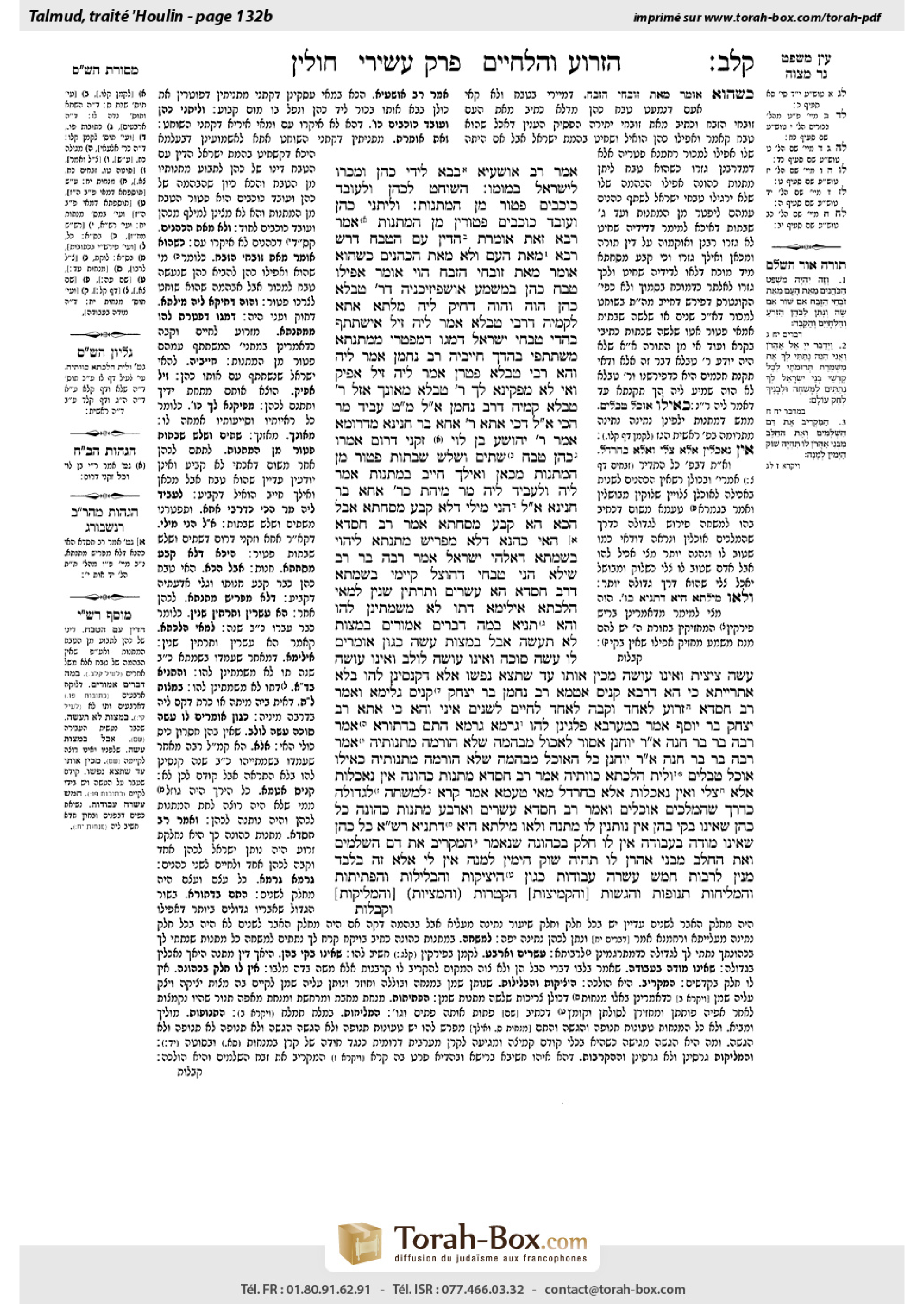
Chullin 132b: Talmud study for Daf Yomi
Study the Talmud for Daf Yomi with scanned pages, Hebrew text, English translations from Sefaria and AI-generated French translations.
Passage selection and English or AI-generated French translation are available where the scan has annotations. Daf Study is independent of Torah-Box and Sefaria.
Browse Chullin · חולין · All tractatesChullin 132b text and translations
This page of Chullin includes the Aramaic text, an English translation and an AI-generated French translation, alongside the scan above.
חולין קל״ב ב · Aramaic and Hebrew text
אָמַר רַב אוֹשַׁעְיָא: בְּבָא לִידֵי כֹּהֵן וּמְכָרוֹ לְיִשְׂרָאֵל בְּמוּמוֹ.
הַשּׁוֹחֵט לַכֹּהֵן וְלַגּוֹי, פָּטוּר מִן הַמַּתָּנוֹת. וְלִיתְנֵי: כֹּהֵן וְגוֹי פְּטוּרִין מִן הַמַּתָּנוֹת? אָמַר רָבָא: זֹאת אוֹמֶרֶת, הַדִּין עִם הַטַּבָּח.
דָּרֵשׁ רָבָא: ״מֵאֵת הָעָם״ – וְלֹא מֵאֵת הַכֹּהֲנִים, כְּשֶׁהוּא אוֹמֵר ״מֵאֵת זוֹבְחֵי הַזֶּבַח״ – הֱוֵי אוֹמֵר אֲפִילּוּ טַבָּח כֹּהֵן בַּמַּשְׁמָע.
אוּשְׁפִּיזְכָנֵיהּ דְּרַבִּי טַבְלָא כֹּהֵן הֲוָה, וַהֲוָה דְּחִיק לֵיהּ מִלְּתָא. אֲתָא לְקַמֵּיהּ דְּרַבִּי טַבְלָא, אֲמַר לֵיהּ: זִיל אִישְׁתַּתַּף בַּהֲדֵי טַבָּחֵי יִשְׂרָאֵל, דְּמִגּוֹ דְּמִפַּטְרִי מִמַּתְּנָתָא, מִשְׁתַּתְּפִי בַּהֲדָךְ.
חַיְּיבֵיהּ רַב נַחְמָן, אֲמַר לֵיהּ: וְהָא רַבִּי טַבְלָא פַּטְרַן! אֲמַר לֵיהּ: זִיל אַפֵּיק, וְאִי לָא – מַפֵּיקְנָא לָךְ רַבִּי טַבְלָא מֵאוּנָּךְ.
אֲזַל רַבִּי טַבְלָא קַמֵּיהּ דְּרַב נַחְמָן, אֲמַר לֵיהּ: מַאי טַעְמָא עָבֵיד מָר הָכִי? אֲמַר לֵיהּ: דְּכִי אֲתָא רַבִּי אַחָא בַּר חֲנִינָא מִדָּרוֹמָא, אָמַר רַבִּי יְהוֹשֻׁעַ בֶּן לֵוִי, זִקְנֵי דָרוֹם אָמְרוּ: כֹּהֵן טַבָּח – שְׁתַּיִם וְשָׁלֹשׁ שַׁבָּתוֹת פָּטוּר מִן הַמַּתָּנוֹת, מִכָּאן וְאֵילָךְ חַיָּיב בְּמַתָּנוֹת.
אֲמַר לֵיהּ: וְלַעֲבֵיד לֵיהּ מָר מִיהַת כְּרַבִּי אַחָא בַּר חֲנִינָא! אֲמַר לֵיהּ: הָנֵי מִילֵּי דְּלָא קְבַע מְסַחְתָּא, אֲבָל הָכָא הָא קְבַע מְסַחְתָּא.
אָמַר רַב חִסְדָּא: הַאי כָּהֲנָא דְּלָא מַפְרֵישׁ מַתְּנָתָא – לֶיהֱוֵי בְּשַׁמְתָּא דֶּאֱלָהֵי יִשְׂרָאֵל. אָמַר רַבָּה בַּר רַב שֵׁילָא: הָנֵי טַבָּחֵי דְּהוּצָל קָיְימִי בְּשַׁמְתָּא דְּרַב חִסְדָּא הָא עֶשְׂרִים וְתַרְתֵּי שְׁנִין.
לְמַאי הִלְכְתָא? אִילֵּימָא דְּתוּ לָא מְשַׁמְּתִינַן לְהוּ – וְהָא תַּנְיָא: בַּמֶּה דְּבָרִים אֲמוּרִים? בְּמִצְוַת לֹא תַעֲשֶׂה, אֲבָל בְּמִצְוַת עֲשֵׂה, כְּגוֹן אוֹמְרִים לוֹ ״עֲשֵׂה סוּכָּה״ וְאֵינוֹ עוֹשֶׂה, ״לוּלָב״ וְאֵינוֹ עוֹשֶׂה, ״עֲשֵׂה צִיצִית״ וְאֵינוֹ עוֹשֶׂה – מַכִּין אוֹתוֹ עַד שֶׁתֵּצֵא נַפְשׁוֹ!
אֶלָּא, דְּקָנְסִינַן לְהוּ בְּלָא אַתְרַיְיתָא, כִּי הָא דְּרָבָא קָנֵיס אַטְמָא, רַב נַחְמָן בַּר יִצְחָק קָנֵיס גְּלִימָא.
וְאָמַר רַב חִסְדָּא: זְרוֹעַ לְאֶחָד, וְקֵבָה לְאֶחָד, לְחָיַיִם לִשְׁנַיִים. אִינִי? וְהָא כִּי אֲתָא רַב יִצְחָק בַּר יוֹסֵף אָמַר: בְּמַעְרְבָא פָּלְגִינַן לְהוּ גַּרְמָא גַּרְמָא!
הָתָם בִּדְתוֹרָא.
אָמַר רַבָּה בַּר בַּר חָנָה, אָמַר רַבִּי יוֹחָנָן: אָסוּר לֶאֱכוֹל מִבְּהֵמָה שֶׁלֹּא הוּרְמָה מַתְּנוֹתֶיהָ. אָמַר רַבָּה בַּר בַּר חָנָה, אָמַר רַבִּי יוֹחָנָן: כׇּל הָאוֹכֵל מִבְּהֵמָה שֶׁלֹּא הוּרְמָה מַתְּנוֹתֶיהָ – כְּאִילּוּ אוֹכֵל טְבָלִים, וְלֵית הִלְכְתָא כְּוָותֵיהּ.
אָמַר רַב חִסְדָּא: מַתְּנוֹת כְּהוּנָּה אֵין נֶאֱכָלוֹת אֶלָּא צָלִי, וְאֵין נֶאֱכָלוֹת אֶלָּא בְּחַרְדָּל. מַאי טַעְמָא? אָמַר קְרָא: ״לְמׇשְׁחָה״ – לִגְדוּלָּה, כְּדֶרֶךְ שֶׁהַמְּלָכִים אוֹכְלִים.
וְאָמַר רַב חִסְדָּא: עֶשְׂרִים וְאַרְבַּע מַתְּנוֹת כְּהוּנָּה, כׇּל כֹּהֵן שֶׁאֵינוֹ בָּקִי בָּהֶן – אֵין נוֹתְנִין לוֹ מַתָּנָה. וְלָאו מִילְּתָא הִיא, דְּתַנְיָא: רַבִּי שִׁמְעוֹן אוֹמֵר: כׇּל כֹּהֵן שֶׁאֵינוֹ מוֹדֶה בָּעֲבוֹדָה – אֵין לוֹ חֵלֶק בַּכְּהוּנָּה, שֶׁנֶּאֱמַר: ״הַמַּקְרִיב אֶת דַּם הַשְּׁלָמִים וְאֶת הַחֵלֶב מִבְּנֵי אַהֲרֹן לוֹ תִהְיֶה שׁוֹק הַיָּמִין לְמָנָה״.
אֵין לִי אֶלָּא זֶה בִּלְבַד, מִנַּיִן לְרַבּוֹת חֲמֵשׁ עֶשְׂרֵה עֲבוֹדוֹת, כְּגוֹן: הַיְּצִיקוֹת, וְהַבְּלִילוֹת, וְהַפְּתִיתוֹת, וְהַמְּלִיחוֹת, תְּנוּפוֹת, וְהַגָּשׁוֹת, [וְהַקְּמִיצוֹת], הַקְטָרוֹת, (וְהַמְּצִיּוֹת), [וְהַמְּלִיקוֹת],
Chullin 132b · English translation
Rav Oshaya says in response: In general, a priest may issue such a claim. But the mishna is dealing with a case where the firstborn came into the possession of the priest when it was unblemished and thereafter it developed a permanent blemish, and the priest sold it to an Israelite in its blemished state. In such a case, the priest may not demand that the owner give him the entire animal with the claim that it is a firstborn, as he already received it once as a firstborn.
§ The mishna teaches that one who slaughters the animal of a priest for the priest or the animal of a gentile for the gentile is exempt from the obligation to give the gifts of the foreleg, the jaw, and the maw. The Gemara suggests: And let the tanna simply teach that a priest and a gentile are exempt from the obligation to give the gifts. Rava says in explanation: That is to say, i.e., the wording of the mishna indicates, that the demand of a priest who seeks to claim gifts of the priesthood is with the butcher, not with the owner of the animal. Even if the butcher is himself a priest, if he slaughters an animal on behalf of an Israelite he is obligated to give the gifts.
The Gemara adds: Rava also interpreted the verse in such a manner. The verse states: “This shall be the priests’ due from the people, from them that perform a slaughter, whether it be ox or sheep, that they shall give to the priest the foreleg, and the jaw, and the maw” (Deuteronomy 18:3). The verse specifies that the gifts are taken “from the people,” and not from the priests. When the verse states: “From them that perform a slaughter,” indicating that the gifts are given by anyone who slaughters an animal, you must say that this teaches that even a butcher who is a priest is included in the obligation to give the gifts.
§ The mishna teaches that the obligation to give the gifts of the priesthood does not apply to an animal jointly owned by an Israelite and a priest. The Gemara relates that the host [ushpizikhnei] of Rabbi Tavla was a priest and he was hard-pressed for money. He came before Rabbi Tavla to ask for advice. Rabbi Tavla said to him: Go and enter into a partnership with those Israelite butchers, to obtain part ownership of their animals, as since they will be exempt from the obligation to give the gifts on account of this partnership, they will agree to enter into a business partnership with you free of charge.
The priest heeded the advice of Rabbi Tavla and entered into a partnership with an Israelite butcher. Nevertheless, Rav Naḥman obligated the butcher to give the gifts of the priesthood from the animals he slaughtered. The priest said to Rav Naḥman: But Rabbi Tavla exempted us from this obligation. Rav Naḥman said to him: Go remove the gifts of the priesthood that are in your possession and give them to a priest, and if you will not do so, I will remove Rabbi Tavla from your ear [me’unakh], i.e., I will refute his basis for deeming you exempt.
Rabbi Tavla came before Rav Naḥman and said to him: What is the reason that the Master has done this and ruled in contradiction to the mishna? Rav Naḥman said to him: I ruled in this manner, as when Rabbi Aḥa bar Ḥanina of the south came from Eretz Yisrael to Babylonia, he said that Rabbi Yehoshua ben Levi and all the elders of the south said: With regard to a priest who becomes a butcher, for the first two or three weeks he is exempt from the obligation to give the gifts, as he has not yet established himself in the community as a butcher. But from this point forward he is obligated to give the gifts, as he is now known as a butcher.
Rabbi Tavla said to Rav Naḥman: And let the Master at least do for the priest in accordance with the opinion of Rabbi Aḥa bar Ḥanina and exempt him from giving the gifts for the first three weeks of his partnership. Rav Naḥman said to him: This statement of Rabbi Aḥa bar Ḥanina applies only when the priest did not immediately establish a butcher shop. In such a case, the priest is exempt until he becomes known as a recognized butcher. But here, he has already established a butcher shop and is therefore obligated to give the gifts without delay.
§ Rav Ḥisda said: With regard to a priest who slaughters an animal and does not separate gifts of the priesthood from them for another priest, let him be under the excommunication of the God of Israel. Rabba bar Rav Sheila said: These butchers of the city of Huzal have remained under the excommunication of Rav Ḥisda these last twenty-two years, as they have continuously refused to separate gifts of the priesthood for this period.
The Gemara asks: With regard to what halakha did Rabba bar Rav Sheila state that the butchers of Huzal have been under excommunication for twenty-two years? If we say that we do not excommunicate them for a period any longer than twenty-two years, but isn’t it taught in a baraita: In what case is this statement, that one is not excommunicated for committing a transgression, said? It is said with regard to a prohibition, for which one is liable to receive a relatively severe punishment, e.g., death or karet. But with regard to one who refuses to perform a positive mitzva, e.g., the court says to him: Perform the mitzva of sukka, and he does not do so, or: Perform the mitzva of taking the lulav, and he does not do so, or: Prepare ritual fringes for your garments, and he does not do so, the court strikes him an unlimited number of times, even until his soul departs. Accordingly, the butchers of Huzal should remain under excommunication indefinitely until they separate the gifts.
Rather, Rabba bar Rav Sheila means that because the butchers of Huzal have refused to give the gifts for so many years, we fine them even without forewarning. There was a case like this of a person who refused to give the gifts of the priesthood to a priest, where Rava fined him by taking the entire thigh of his animal and giving it to a priest. Similarly, Rav Naḥman bar Yitzḥak fined an individual who refused to give the gifts of the priesthood to a priest by taking his cloak and giving it to a priest.
§ And Rav Ḥisda also says with regard to gifts of the priesthood: The foreleg is given to one priest and the maw is given to one priest, while the jaw is given to two priests. The Gemara asks: Is that so? But when Rav Yitzḥak bar Yosef came to Babylonia from Eretz Yisrael he said: In the West, Eretz Yisrael, we divide the gifts bone by bone, each of which is given to two priests.
The Gemara explains: There, in the case dealt with in Eretz Yisrael, the gifts were of a large bull. The Torah states: “That they shall give to the priest” (Deuteronomy 18:3). The use of the term “give” indicates that the gift given should be a substantial one. Even when one limb of the large bull was divided between two priests, each received a substantial portion. This is not the case with regard to the gifts of smaller animals, where each limb is not large enough to provide two substantial portions.
§ Rabba bar bar Ḥana says that Rabbi Yoḥanan says: It is prohibited to partake of a slaughtered animal whose gifts have not yet been separated. Furthermore, Rabba bar bar Ḥana says that Rabbi Yoḥanan says: Anyone who partakes of an animal whose gifts have not yet been separated is considered as though he consumes untithed produce. But the Gemara states: The halakha is not in accordance with the opinion of Rabbi Yoḥanan.
Rav Ḥisda says: Gifts of the priesthood may be consumed only when they are roasted, and they may be consumed only with mustard seasoning. What is the reason for this halakha? The verse states: “And the Lord spoke to Aaron: And I, behold, I have given you the charge of My gifts; of all the consecrated items of the children of Israel to you have I given them for prominence, and to your sons, as an eternal portion” (Numbers 18:8). The term “for prominence” means that the portions were given to the priests as a mark of greatness. Accordingly, they should be eaten in a manner that kings eat, i.e., roasted and with mustard.
And Rav Ḥisda says: One may not give a gift to any priest who is not an expert in the halakhot pertaining to all twenty-four gifts of the priesthood. The Gemara notes: But this is not correct, as it is taught in a baraita that Rabbi Shimon says: Any priest who does not believe in the validity of the Temple service has no portion in any of the gifts given to the priesthood, as it is stated: “He among the sons of Aaron, who offers [hamakriv] the blood of the peace offerings, and the fat, shall have the right thigh for a portion” (Leviticus 7:33). The word “hamakriv,” which literally means: Who brings it close, indicates that only one who believes in the validity of conveying the blood to the altar is entitled to receive the right thigh of the offering, as only one who believes in the rite would perform it.
The baraita continues: I have derived only that a priest does not have a share in the priestly gifts if he does not believe in this rite of conveying of the blood alone. From where do I derive to include fifteen additional sacrificial rites, such as the rites of a meal offering, i.e., the pouring of the oil and the mixing of the oil and the subsequent pouring of the oil; and the crumbling of meal offerings prepared in a shallow or deep pan or in an oven, whose handfuls are removed after they are baked and subsequently crumbled; and the salting of meal offerings (see Leviticus 2:13); and the waving of certain meal offerings; and the bringing of certain meal offerings to the southwestern corner of the altar before a handful is removed; and the removal of the handful; and the burning of offerings on the altar; and the squeezing of a bird offering to extract its blood; and the pinching of the nape of the neck of a bird offering;
Chullin 132b · Traduction française (IA)
Rav Oshaya répond : En général, un prêtre peut présenter une telle réclamation. Mais la Michna traite d'un cas où le premier-né est tombé entre les mains du prêtre lorsqu'il était sans tache et, par la suite, a développé une tache permanente, et le prêtre l'a vendu à un Israélite dans son état taché. Dans ce cas, le prêtre ne peut pas exiger que l'propriétaire lui donne l'animal entier en affirmant qu'il s'agit d'un premier-né, car il l'a déjà reçu une fois comme premier-né.
§ La Michna enseigne que celui qui sacrifie un animal du prêtre pour le prêtre ou un animal d'un non-juif pour le non-juif est exempt de l'obligation de donner les offrandes de la tête, de la mâchoire et de la gueule. La Guemara suggère : Et que le tanna enseigne simplement que le prêtre et le non-juif sont exemptés de l'obligation de donner les offrandes. Rava dit en expliquant : Cela signifie, c'est-à-dire, selon le texte de la Michna, que la réclamation du prêtre qui cherche à revendiquer les offrandes de la prêtrise est dirigée contre le boucher, pas contre l'propriétaire de l'animal. Même si le boucher est lui-même un prêtre, s'il sacrifie un animal à la place d'un Israélite, il est tenu de donner les offrandes.
La Guemara ajoute : Rava a également interprété la parole de cette manière. La parole dit : « Cela sera la part des prêtres du peuple, de ceux qui accomplissent un sacrifice, qu'il s'agisse d'un bœuf ou d'une brebis, qu'ils donnent au prêtre la tête, la mâchoire et la gueule » (Deutéronome 18:3). La parole précise que les offrandes sont prises « du peuple », et non des prêtres. Lorsque la parole dit : « De ceux qui accomplissent un sacrifice », cela indique que les offrandes sont données par quiconque sacrifie un animal, vous devez dire que cela enseigne que même un boucher qui est un prêtre est inclus dans l'obligation de donner les offrandes.
§ La mitsva enseigne que l'obligation de donner les offrandes de la prêtrise ne s'applique pas à un animal partagé entre un Israélite et un prêtre. La Guemara rapporte que l'hôte [ushpizikhnei] de Rabbi Tavla était un prêtre et il manquait d'argent. Il est venu devant Rabbi Tavla pour demander des conseils. Rabbi Tavla lui a dit : Allez entrer en partenariat avec ces bouchers israélites, pour obtenir une part de propriété sur leurs animaux, car puisqu'ils seront exemptés de l'obligation de donner les offrandes en raison de ce partenariat, ils accepteront de vous entrer en partenariat sans frais.
Le prêtre a suivi le conseil de Rabbi Tavla et a entré en partenariat avec un boucher israélite. Cependant, Rav Naḥman a imposé à l'abattage du boucher de donner les offrandes de la prêtrise provenant des animaux qu'il sacrifiait. Le prêtre a dit à Rav Naḥman : Mais Rabbi Tavla nous a exemptés de cette obligation. Rav Naḥman a répondu au prêtre : Allez retirer les offrandes de la prêtrise que vous possédez et donnez-les à un prêtre, et si vous ne le faites pas, je retirerai Rabbi Tavla de votre oreille [me’unakh], c'est-à-dire que je réfuterai sa base pour considérer que vous êtes exempt.
Rabbi Tavla est venu devant Rav Naḥman et lui a dit : Quelle est la raison que le Maître a fait cela et a rendu un jugement contraire à la Michna ? Rav Naḥman a répondu à Rabbi Tavla : J'ai rendu ce jugement ainsi, car lorsque Rabbi Aḥa bar Ḥanina du sud est venu de la Terre d'Israël en Babylone, il a dit que Rabbi Yehoshua ben Levi et tous les anciens du sud ont dit : Concernant un prêtre qui devient boucher, pendant les deux ou trois premières semaines, il est exempt de l'obligation de donner les offrandes, car il n'a pas encore établi sa présence dans la communauté comme boucher. Mais à partir de ce moment, il est tenu de donner les offrandes, car il est désormais connu comme boucher.
Rabbi Tavla a dit à Rav Naḥman : Et que le Maître au moins fasse pour le prêtre selon l'opinion de Rabbi Aḥa bar Ḥanina et l'exempte de donner les offrandes pendant les trois premières semaines de son partenariat. Rav Naḥman a dit à Rabbi Tavla : Cette déclaration de Rabbi Aḥa bar Ḥanina s'applique uniquement lorsque le prêtre n'a pas immédiatement établi un boucherat. Dans ce cas, le prêtre est exempt jusqu'à ce qu'il devienne un boucher reconnu. Mais ici, il a déjà établi un boucherat et est donc tenu de donner les offrandes sans délai.
§ Rav Ḥisda a dit : Concernant un prêtre qui sacrifie un animal et ne sépare pas les offrandes de la prêtrise pour un autre prêtre, qu'il soit sous l'excommunication du Royaume des Cieux. Rabba bar Rav Sheila a dit : Ces bouchers de la ville de Huzal sont restés sous l'excommunication de Rav Ḥisda pendant vingt-deux ans, car ils ont continuellement refusé de séparer les offrandes de la prêtrise pendant cette période.
La Guemara pose la question : Concernant quelle halakha Rabba bar Rav Sheila a-t-il dit que les bouchers de Huzal sont sous excommunication depuis vingt-deux ans ? Si nous disons que nous n'excommunions pas pendant une période plus longue que vingt-deux ans, mais n'est-ce pas enseigné dans une baraïta : Dans quel cas cette déclaration, que l'on n'excommunie pas pour avoir commis une transgression, est-elle dite ? Elle est dite concernant une interdiction, pour laquelle on est puni relativement sévèrement, par exemple la mort ou la karet. Concernant celui qui refuse de faire une mitsva positive, par exemple le tribunal lui dit : Fais la mitsva de la hutte, et il ne le fait pas, ou : Fais la mitsva de prendre la lulav, et il ne le fait pas, ou : Prépare des franges rituelles pour tes vêtements, et il ne le fait pas, le tribunal frappe indéfiniment, même jusqu'à ce que son âme s'échappe. Ainsi, les bouchers de Huzal devraient rester sous excommunication indéfiniment jusqu'à ce qu'ils séparent les offrandes.
Plutôt, Rabba bar Rav Sheila veut dire que parce que les bouchers de Huzal ont refusé de donner les offrandes pendant si longtemps, nous leur imposons même sans avertissement. Il y a eu un cas similaire d'une personne qui a refusé de donner les offrandes de la prêtrise à un prêtre, où Rava a imposé une amende en prenant la cuisse entière de son animal et en la donnant à un prêtre. De même, Rav Naḥman bar Yitzḥak a imposé une amende à un individu qui a refusé de donner les offrandes de la prêtrise à un prêtre en prenant son manteau et en le donnant à un prêtre.
§ Rav Ḥisda dit aussi concernant les dons du sacerdoce : La cuisse est donnée à un prêtre, la gueule à un prêtre, tandis que la mâchoire est donnée à deux prêtres. La Guemara demande : C’est ainsi ? Mais lorsque Rav Yitzḥak bar Yosef est venu en Babylone d’Eretz Yisrael, il a dit : En Occident, en Eretz Yisrael, nous divisons les dons os par os, chacun étant donné à deux prêtres.
La Guemara explique : Là, dans le cas traité en Eretz Yisrael, les dons étaient d’un taureau grand. La Torah dit : « Que l’on donne au prêtre » (Deutéronome 18:3). L’emploi du terme « donner » indique que le don doit être substantiel. Même lorsque l’un des membres du taureau grand était divisé entre deux prêtres, chacun recevait une portion substantielle. Cela n’est pas le cas des dons d’animaux plus petits, où chaque membre n’est pas suffisamment grand pour fournir deux portions substantielles.
§ Rabba bar bar Ḥana dit que Rabbi Yoḥanan dit : Il est interdit de manger un animal sacrifié dont les dons n’ont pas encore été séparés. De plus, Rabba bar bar Ḥana dit que Rabbi Yoḥanan dit : Celui qui mange un animal dont les dons n’ont pas encore été séparés est considéré comme s’il mangeait des produits non titrés. Mais la Guemara dit : La halakha n’est pas en conformité avec l’opinion de Rabbi Yoḥanan.
Rav Ḥisda dit : Les dons du sacerdoce peuvent être consommés uniquement lorsqu’ils sont grillés, et uniquement avec de la moutarde. Quelle est la raison de cette halakha ? La Parashah dit : « Et l’Eternel parla à Aaron : Et voici, j’ai donné à toi la charge de mes dons ; de tous les objets consacrés des enfants d’Israël, je t’ai donné pour honneur, et à tes fils, comme portion éternelle » (Nombres 18:8). Le terme « pour honneur » signifie que les portions ont été données aux prêtres comme marque de grandeur. Ainsi, ils doivent être mangés de la manière dont les rois mangent, c’est-à-dire grillés et avec de la moutarde.
Et Rav Ḥisda dit : On ne peut pas donner un don à un prêtre qui n’est pas expert dans les halakhot concernant les vingt-quatre dons du sacerdoce. La Guemara note : Mais cela n’est pas correct, car il est enseigné dans une baraïta que Rabbi Shimon dit : Tout prêtre qui ne croit pas en la validité du service du Temple n’a pas de part dans aucun des dons donnés au sacerdoce, car il est dit : « Celui parmi les fils d’Aaron, qui présente [hamakriv] le sang des offrandes de paix et la graisse, aura le droit du cuisse pour une part » (Lévitique 7:33). Le mot « hamakriv », qui littéralement signifie : Celui qui approche, indique que seul celui qui croit en la validité de conduire le sang à l’autel est dû à recevoir le cuisse de l’offrande, car seul celui qui croit en la cérémonie le ferait.
La baraïta continue : J’ai déduit seulement que le prêtre n’a pas de part dans les dons du sacerdoce s’il ne croit pas en cette cérémonie de conduite du sang seul. D’où déduis-je inclure quinze autres cérémonies sacrificielles, telles que les cérémonies d’offrande de pain, c’est-à-dire le versement de l’huile, le mélange de l’huile et le versement ultérieur de l’huile ; et la réduction des offrandes de pain préparées dans une poêle peu profonde ou profonde ou dans un four, dont les poignées sont retirées après cuisson et ensuite réduites ; et le salage des offrandes de pain (voir Lévitique 2:13) ; et le balayage de certaines offrandes de pain ; et l’apport de certaines offrandes de pain au coin sud-ouest de l’autel avant que la poignée ne soit retirée ; et le retrait de la poignée ; et la combustion des offrandes sur l’autel ; et l’expression du sang d’une offrande d’oiseau ; et l’arrachement du cou de l’oiseau offrant ;
Traduction française générée par IA à partir de l’édition anglaise de Sefaria. Vérifie toujours un passage avec le texte source.
Text from Sefaria: William Davidson Edition - Vocalized Aramaic (unknown); William Davidson Edition - English (CC BY NC).