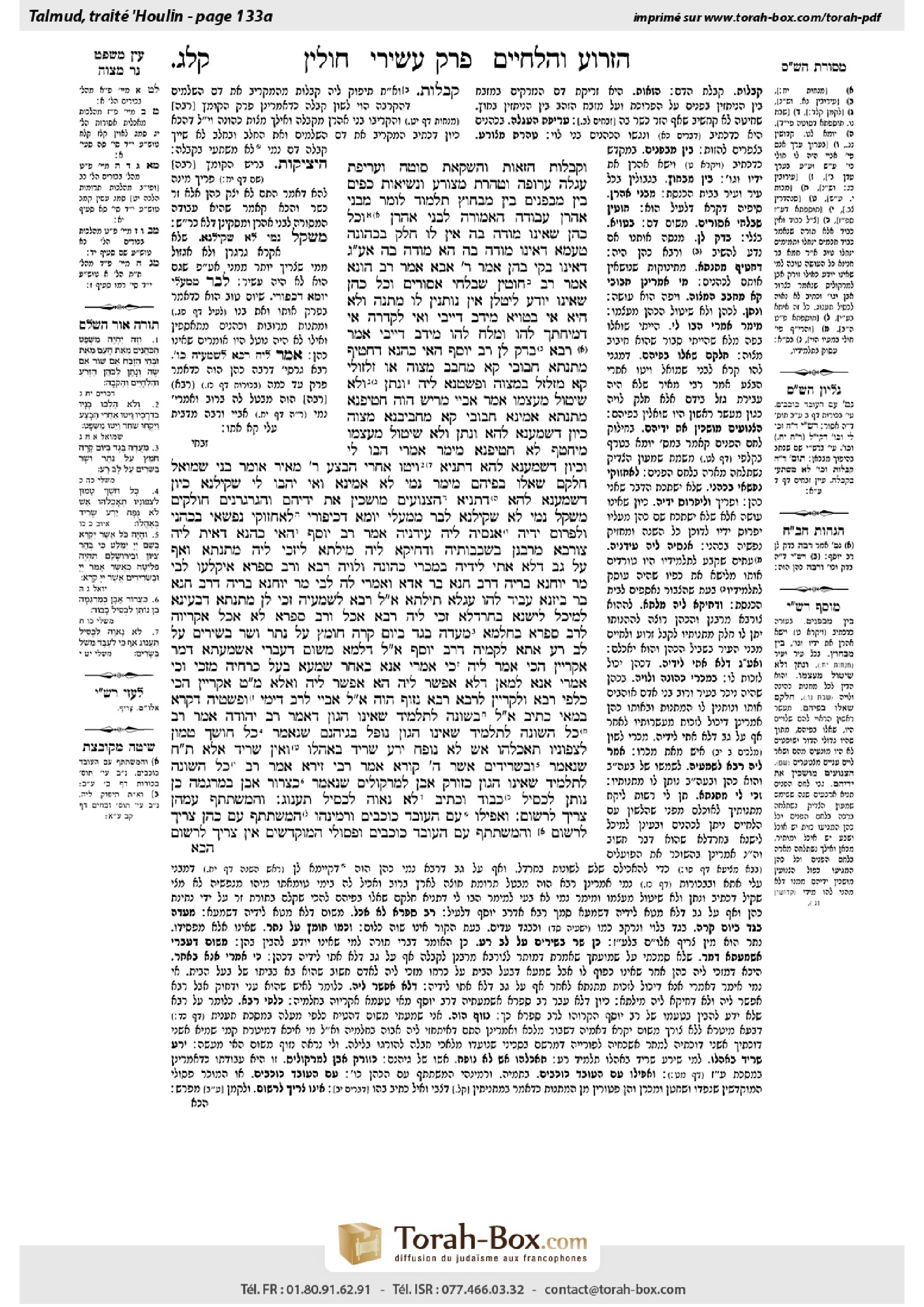
Chullin 133a: Talmud study for Daf Yomi
Study the Talmud for Daf Yomi with scanned pages, Hebrew text, English translations from Sefaria and AI-generated French translations.
Passage selection and English or AI-generated French translation are available where the scan has annotations. Daf Study is independent of Torah-Box and Sefaria.
Browse Chullin · חולין · All tractatesChullin 133a text and translations
This page of Chullin includes the Aramaic text, an English translation and an AI-generated French translation, alongside the scan above.
חולין קל״ג א · Aramaic and Hebrew text
וְקַבָּלוֹת, הַזָּאוֹת, וְהַשְׁקָאַת סוֹטָה, וַעֲרִיפַת עֶגְלָה עֲרוּפָה, וְטׇהֳרַת מְצוֹרָע, וּנְשִׂיאוּת כַּפַּיִם – בֵּין מִבִּפְנִים בֵּין מִבַּחוּץ, תַּלְמוּד לוֹמַר ״מִבְּנֵי אַהֲרֹן״ – עֲבוֹדָה הָאֲמוּרָה לִבְנֵי אַהֲרֹן.
וְכׇל כֹּהֵן שֶׁאֵינוֹ מוֹדֶה בָּהּ – אֵין לוֹ חֵלֶק בַּכְּהוּנָּה. טַעְמָא דְּאֵינוֹ מוֹדֶה בָּהּ, הָא מוֹדֶה בָּהּ – אַף עַל גַּב דְּאֵינוֹ בָּקִי בָּהֶן.
אָמַר רַבִּי אַבָּא, אָמַר רַב הוּנָא, אָמַר רַב: חוּטִין שֶׁבַּלְּחִי אֲסוּרִים, וְכׇל כֹּהֵן שֶׁאֵינוֹ יוֹדֵעַ לִיטְּלָן – אֵין נוֹתְנִין לוֹ מַתָּנָה.
וְלָא הִיא, אִי בְּטַוְיָא – מֵידָב דָּיְיבִי, וְאִי לְקִדְרָה – אִי דִּמְיחַתֵּךְ לְהוּ וּמָלַח לְהוּ – מֵידָב דָּיְיבִי.
אָמַר רָבָא: בָּדַק לַן רַב יוֹסֵף, הַאי כָּהֲנָא דְּחָטֵיף מַתְּנָתָא – חַבּוֹבֵי קָא מְחַבֵּב מִצְוָה, אוֹ זַלְזוֹלֵי קָא מְזַלְזֵל בְּמִצְוָה? וּפְשַׁטְנָא לֵיהּ ״וְנָתַן״ – וְלֹא שֶׁיִּטּוֹל מֵעַצְמוֹ.
אָמַר אַבָּיֵי: מֵרֵישׁ הֲוָה חָטֵיפְנָא מַתְּנָתָא, אָמֵינָא: חַבּוֹבֵי קָא מְחַבֵּיבְנָא מִצְוָה. כֵּיוָן דִּשְׁמַעְנָא לְהָא ״וְנָתַן״ – וְלֹא שֶׁיִּטּוֹל מֵעַצְמוֹ, מִיחְטָף לָא חָטֵיפְנָא, מֵימָר (אֲמַרִי) [אָמֵינָא]: הַבוּ לִי. וְכֵיוָן דִּשְׁמַעְנָא לְהָא דְּתַנְיָא: ״וַיִּטּוּ אַחֲרֵי הַבָּצַע״, רַבִּי מֵאִיר אוֹמֵר: בְּנֵי שְׁמוּאֵל חֶלְקָם שָׁאֲלוּ בְּפִיהֶם, מֵימָר נָמֵי לָא אָמֵינָא, וְאִי יָהֲבוּ לִי – שָׁקֵילְנָא.
כֵּיוָן דִּשְׁמַעְנָא לְהָא דְּתַנְיָא: הַצְּנוּעִים מוֹשְׁכִין אֶת יְדֵיהֶם, וְהַגַּרְגְּרָנִים חוֹלְקִים – מִשְׁקָל נָמֵי לָא שָׁקֵילְנָא, לְבַר מִמַּעֲלֵי יוֹמָא דְכִיפּוּרֵי, לְאַחְזוֹקֵי נַפְשַׁאי בְּכָהֲנֵי.
וְלִפְרוֹס יְדֵיהּ! אַנְסֵיהּ לֵיהּ עִידָּנֵיהּ.
אָמַר רַב יוֹסֵף: הַאי כָּהֲנָא דְּאִית לֵיהּ צוּרְבָּא מֵרַבָּנַן בְּשִׁבָבוּתֵיהּ, וּדְחִיקָא לֵיהּ מִילְּתָא – לִיזַכֵּי לֵיהּ מַתְּנָתָא, וְאַף עַל גַּב דְּלָא אָתֵי לִידֵיהּ, בְּמַכָּרֵי כְּהוּנָּה וּלְוִיָּה.
רָבָא וְרַב סָפְרָא אִיקְּלַעוּ לְבֵי מָר יוֹחָנָא בְּרֵיהּ דְּרַב חָנָא בַּר אַדָּא, וְאָמְרִי לַהּ לְבֵי מָר יוֹחָנָא בְּרֵיהּ דְּרַב חָנָא בַּר בִּיזְנָא. עָבֵיד לְהוּ עִגְלָא תִּילְתָּא, אֲמַר לֵיהּ רָבָא לְשַׁמָּעֵיהּ: זַכִּי לַן מַתְּנָתָא, דִּבְעֵינָא לְמֵיכַל לִישָּׁנָא בְּחַרְדְּלָא.
זַכִּי לֵיהּ. רָבָא אֲכַל, וְרַב סָפְרָא לָא אֲכַל. אַקְרְיוּהּ לְרַב סָפְרָא בְּחֶלְמָא: ״מַעֲדֶה בֶּגֶד בְּיוֹם קָרָה חֹמֶץ עַל נָתֶר וְשָׁר בַּשִּׁירִים עַל לֶב רָע״.
אֲתָא לְקַמֵּיהּ דְּרַב יוֹסֵף, אֲמַר לֵיהּ: דִּלְמָא מִשּׁוּם דַּעֲבַרִי אַשְּׁמַעְתָּא דְּמָר אַקְרְיֻין הָכִי? אֲמַר לֵיהּ: כִּי אֲמַרִי אֲנָא – בְּאַחֵר, שַׁמָּעָא – בְּעַל כֻּרְחֵיהּ מְזַכֵּי, וְכִי אֲמַרִי אֲנָא – לְמַאן דְּלָא אֶפְשָׁר לֵיהּ, הָא אֶפְשָׁר לֵיהּ.
וְאֶלָּא מַאי טַעְמָא אַקְרְיֻין הָכִי? כְּלַפֵּי רָבָא! וְלַקְרְיוּהּ לְרָבָא? רָבָא נָזוּף הֲוָה.
אֲמַר לֵיהּ אַבָּיֵי לְרַב דִּימִי: וּפְשָׁטֵיהּ דִּקְרָא בְּמַאי כְּתִיב? אֲמַר לֵיהּ: בְּשׁוֹנֶה לְתַלְמִיד שֶׁאֵינוֹ הָגוּן.
דְּאָמַר רַב יְהוּדָה אָמַר רַב: כׇּל הַשּׁוֹנֶה לְתַלְמִיד שֶׁאֵינוֹ הָגוּן – נוֹפֵל בְּגֵיהִנָּם, שֶׁנֶּאֱמַר ״כׇּל חֹשֶׁךְ טָמוּן לִצְפּוּנָיו תְּאׇכְלֵהוּ אֵשׁ לֹא נֻפָּח יֵרַע שָׂרִיד בְּאׇהֳלוֹ״, וְאֵין ״שָׂרִיד״ אֶלָּא תַּלְמִיד חָכָם, שֶׁנֶּאֱמַר ״וּבַשְּׂרִידִים אֲשֶׁר ה׳ קֹרֵא״.
אָמַר רַבִּי זֵירָא אָמַר רַב: כׇּל הַשּׁוֹנֶה לְתַלְמִיד שֶׁאֵינוֹ הָגוּן – כְּזוֹרֵק אֶבֶן לְמֶרְקוּלִיס, שֶׁנֶּאֱמַר: ״כִּצְרוֹר אֶבֶן בְּמַרְגֵּמָה כֵּן נוֹתֵן לִכְסִיל כָּבוֹד״, וּכְתִיב: ״לֹא נָאוֶה לִכְסִיל תַּעֲנוּג״.
וְהַמִּשְׁתַּתֵּף עִמָּהֶן צָרִיךְ לִרְשׁוֹם, וַאֲפִילּוּ עִם הַגּוֹי. וּרְמִינְהוּ: הַמִּשְׁתַּתֵּף עִם כֹּהֵן – צָרִיךְ לִרְשׁוֹם, וְהַמִּשְׁתַּתֵּף עִם הַגּוֹי וּפְסוּלֵי הַמּוּקְדָּשִׁים – אֵין צָרִיךְ לִרְשׁוֹם!
Chullin 133a · English translation
and the receiving of the blood in a vessel; and its sprinkling upon the altar, each offering according to its halakha; and the giving of water to a woman suspected by her husband of having been unfaithful [sota]; and the ritual of breaking a heifer’s neck in an untilled valley when a corpse is discovered and the murderer is unknown; and the purification of a leper; and the lifting of the hands for the Priestly Benediction, whether inside or outside the Temple; from where are these derived? The verse states: “Among the sons of Aaron,” indicating that this is the halakha with regard to any sacrificial rite that is stated to the sons of Aaron.
And the Gemara explains the proof: The baraita teaches that any priest who does not believe in the validity of these rites has no portion in the gifts of the priesthood. It may be inferred that the reason the priest has no portion is that he does not believe in it, whereas if he does believe in it, even though he is not an expert in its halakhot, he receives a portion. This contradicts the opinion of Rav Ḥisda.
With regard to priests who should not be given gifts of the priesthood, Rabbi Abba says that Rav Huna says that Rav says: The veins that are contained in the jaw of an animal are prohibited for consumption, due to the blood they contain. And one does not give the gift of the jaw to any priest who does not know how to remove the veins, as the priest might eat them.
The Gemara notes: But that is not so, i.e., one need not be concerned that the priest might consume the blood within the veins, as any method of preparing the jaw will remove the blood: If the priest prepares the jaw by roasting it, the blood will drain from the jaw due to the fire. And if he intends to place the jaws in a pot to cook them, if he cuts them and salts them, as one is required to do before cooking any meat, the blood will drain from them, and they will be permitted for consumption.
§ With regard to the manner in which a priest takes gifts of the priesthood from their owners, Rava said: Rav Yosef examined us, his students, with the following question: A priest who seizes gifts of the priesthood from their owners, is he demonstrating fondness for the mitzva or is he demonstrating contempt for the mitzva? And I resolved this question for him from the verse: “That they shall give to the priest the foreleg, and the jaw, and the maw” (Deuteronomy 18:3). The term “that they shall give” indicates that the owner should give the gifts, and not that a priest should take them by himself. Accordingly, a priest who seizes the gifts from their owners is demonstrating contempt for the mitzva.
Abaye, who was a priest, said: At first, I would seize gifts of the priesthood, as I said to myself that I am demonstrating fondness for the mitzva in this manner. Once I heard this interpretation: “That they shall give,” and not that he should take by himself, I did not seize them anymore. Instead, I would say to the owners of the gifts: Give me. And once I heard that which is taught in a baraita: The verse states with regard to the sons of Samuel, who were Levites: “But turned aside after wealth” (I Samuel 8:3), and Rabbi Meir says: The sons of Samuel sinned when they asked for their portion, the first tithe given to the Levite, with their mouths, i.e., they demanded that the owners give them the first tithe. Abaye continued: After I heard that, I also did not say anything to the owners, but if they would give me gifts I would take them.
Abaye said further: Once I heard that which is taught in a baraita with regard to the distribution of the shewbread among the priests: The modest ones [hatzenu’im] withdraw their hands and do not take, and the gluttons divide all the bread; I also did not take gifts even when they were offered to me, except for when they were given on the eve of Yom Kippur, when there was an abundance of gifts due to the many animals that were slaughtered, as it is a mitzva to eat that day. In that instance, I took the gifts in order to affirm myself among the priests, i.e., if I would never take gifts then my status as a priest might be called into question.
The Gemara challenges: But let him spread his hands for the Priestly Benediction throughout the year, as this will make it clear to all that he is in fact a priest. The Gemara responds: His schedule constrained him, as he was constantly involved in teaching Torah to his students, so much so that he would miss the time during which the community gathered in the synagogue for the Priestly Benediction.
Rav Yosef said: In a case where a priest who has a Torah scholar [tzurva merabbanan] living in his neighborhood and that Torah scholar is hard-pressed for money, let the priest grant his gifts to him, i.e., the priest may declare that those gifts he is destined to receive should be given to the poor Torah scholar. And even though the gifts have not yet come into his possession, he may grant them to the Torah scholar in a case where there are associates of the priesthood and the Levites, i.e., if that specific priest or Levite was well known in his neighborhood and has a standard arrangement with many people that they give him their gifts, as he is certain that he will be given them.
With regard to the statement of Rav Yosef, the Gemara relates that Rava and Rav Safra visited the house of Mar Yoḥana, son of Rav Ḥana bar Adda, and some say they visited the house of Mar Yoḥana, son of Rav Ḥana bar Bizna. Mar Yoḥana prepared for them a third-born calf. Rava said to the attendant of Mar Yoḥana, who was a priest and would normally receive gifts of the priesthood from Mar Yoḥana: Grant us the gifts, as I wish to eat tongue with mustard, and the tongue along with the jaw is one of the gifts.
The attendant granted the gifts to him; Rava ate from them but Rav Safra did not eat. Following this incident, they read the following verse to Rav Safra in a dream: “As one that takes off a garment in cold weather, and as vinegar upon niter, so is he that sings songs to a heavy heart” (Proverbs 25:20). The verse can be interpreted allegorically as a chastisement of one who studies Torah but fails to understand it.
Rav Safra came before Rav Yosef and said to him: Perhaps because I transgressed the halakha of the Master they read this verse to me in chastisement. Rav Yosef said to him: No, you acted appropriately by refraining from consuming the gifts. When I said that a priest may grant the gifts to a Torah scholar, that was only with regard to a priest who grants them to another person of his own choosing. I did not permit this in the case of an attendant who grants the gifts to a dignified guest of the homeowner. The reason is that he grants the gifts against his will, as he feels pressured by the homeowner to acquiesce. And furthermore, when I said this halakha, it was only for one who cannot eat under another circumstance, as he is hard-pressed for money. In this incident, it was possible for Rava to consume his own meat with mustard, since Rava was not poor.
Rav Safra asked Rav Yosef: But if so, what is the reason that they read this verse to me? Rav Yosef responded: The reading was directed not toward you but toward Rava, who ate from the gifts against my ruling. The Gemara objects: But let them read this verse to Rava himself in a dream. The Gemara responds: Rava was rebuked as a result of this incident and therefore was not granted heavenly communication. The verse was therefore proclaimed to Rav Safra instead.
In the preceding incident, the Gemara related that the verse: “As one that takes off a garment in cold weather, and as vinegar upon niter, so is he that sings songs to a heavy heart” (Proverbs 25:20), was proclaimed to Rav Safra in a dream. Abaye said to Rav Dimi: And with regard to what matter is the plain meaning of the verse written? Rav Dimi said to him: It is referring to one who teaches an unworthy student. In other words, just as one should remove a worn garment that has no use in cold weather, or just as vinegar upon niter ruins the niter, rendering it unusable, so too, there is no use in singing songs, i.e., teaching Torah, to an unworthy student who has a heavy heart, i.e., who does not intend to adhere to the halakhot he is taught.
As Rav Yehuda said that Rav said: Anyone who teaches Torah to an unworthy student falls into Gehenna, as it is stated: “All darkness is laid up for his treasures; a fire not blown by man shall consume him; it shall go ill with him that remains [yera sarid] in his tent” (Job 20:26), and sarid means nothing other than a Torah scholar, as it is stated: “And among the remnant [sarid] those whom the Lord shall call” (Joel 3:5). The word yera shares a root with the word ra, evil, and “yera sarid” is therefore understood to be referring to an unworthy student.
On a similar note, Rabbi Zeira says that Rav says: Anyone who teaches Torah to an unworthy student is considered like one who throws a stone to Markulis, as it is stated: “As a small stone in a heap of stones, so is he that gives honor to a fool” (Proverbs 26:8), and it is written: “Luxury is not seemly for a fool” (Proverbs 19:10).
§ The mishna teaches that one who enters into partnership with a priest or a gentile must mark the animal. The Gemara asks: And is one obligated to mark the animal even if he enters into partnership with a gentile? And the Gemara raises a contradiction from a baraita: One who enters into partnership with a priest must mark the animal, but one who enters into partnership with a gentile and one who slaughters disqualified consecrated animals does not need to mark the animal.
Chullin 133a · Traduction française (IA)
et la réception du sang dans un récipient ; et son aspersion sur l'autel, chaque offrande selon sa halakha ; et la donnée d'eau à une femme soupçonnée par son mari d'avoir été infidèle [sota] ; et la cérémonie de briser le cou d'une vache dans un champ non cultivé lorsqu'un cadavre est découvert et que l'assassin est inconnu ; et la purification du lépreux ; et le levé des mains pour la Bénédiction des Prêtres, qu'il soit à l'intérieur ou à l'extérieur du Temple ; d'où sont-ils issus ? La Parashah dit : « Parmi les fils d'Aaron », ce qui indique que c'est la halakha concernant toute cérémonie sacrificielle mentionnée aux fils d'Aaron.
Et la Guemara explique la preuve : La baraïta enseigne que tout prêtre qui ne croit pas à la validité de ces rites n'a pas sa part dans les dons du sacerdoce. On peut en déduire que la raison pour laquelle le prêtre n'a pas sa part est qu'il ne croit pas en ces rites, alors que s'il y croit, même s'il n'est pas expert dans leurs halakhot, il reçoit sa part. Cela contredit l'opinion de Rav Ḥisda.
Concernant les prêtres qui ne devraient pas recevoir des dons du sacerdoce, Rabbi Abba dit que Rav Huna dit que Rav dit : Les veines contenues dans la mâchoire d'un animal sont interdites à la consommation, en raison du sang qu'elles contiennent. Et on ne donne pas la mâchoire à un prêtre qui ne sait pas comment enlever les veines, car le prêtre pourrait en manger.
La Guemara note : Mais cela n'est pas vrai, c'est-à-dire qu'on ne doit pas s'inquiéter que le prêtre consume le sang contenu dans les veines, car toute méthode de préparation de la mâchoire enlèvera le sang : Si le prêtre prépare la mâchoire en la grillant, le sang s'écoulera de la mâchoire à cause du feu. Et si l'on veut placer les mâchoires dans une marmite pour les cuire, s'il les coupe et les sale, comme on est tenu de le faire avant de cuire toute viande, le sang s'écoulera d'elles et elles seront permises à la consommation.
§ Concernant la manière dont un prêtre reçoit des dons du sacerdoce de leurs propriétaires, Rava dit : Rav Yosef nous a interrogés avec la question suivante : Un prêtre qui s'empare des dons du sacerdoce de leurs propriétaires, montre-t-il son affection pour la mitsva ou montre-t-il son mépris pour la mitsva ? Et j'ai résolu cette question pour lui à partir de la Parashah : « Que l'on donne au prêtre la cuisse, la mâchoire et la gueule » (Lévitique 18:3). Le terme « que l'on donne » indique que le propriétaire devrait donner les dons, et non que le prêtre devrait les prendre lui-même. Ainsi, un prêtre qui s'empare des dons de leurs propriétaires montre son mépris pour la mitsva.
Abaye, qui était un prêtre, dit : D'abord, je prenais les dons du sacerdoce, car je me disais que je montrais mon affection pour la mitsva de cette manière. Une fois que j'ai entendu cette interprétation : « Que l'on donne », et non que l'on doive le prendre lui-même, je n'ai plus pris les dons. Au contraire, je disais aux propriétaires des dons : Donnez-moi. Et une fois que j'ai entendu ce qui est enseigné dans une baraïta : La Parashah dit concernant les fils de Samuel, qui étaient des Lévites : « Mais ils se sont détournés après la richesse » (I Samuel 8:3), et Rabbi Meir dit : Les fils de Samuel ont péché lorsqu'ils ont demandé leur part, la première dîme donnée au Lévitique, avec leur bouche, c'est-à-dire qu'ils ont exigé que les propriétaires leur donnent la première dîme. Abaye continua : Après que j'ai entendu cela, je n'ai plus dit quoi que ce soit aux propriétaires, mais si ils m'offraient des dons, je les prenais.
Abaye dit encore : Une fois que j'ai entendu ce qui est enseigné dans une baraïta concernant la distribution du pain de proposition parmi les prêtres : Les modestes [hatzenu’im] retirent leurs mains et ne prennent pas, et les gourmands divisent tout le pain ; je n'ai plus pris les dons même lorsqu'ils m'étaient offerts, sauf lorsqu'ils étaient donnés la veille de Yom Kippur, lorsqu'il y avait une abondance de dons en raison des nombreux animaux sacrifiés, car il est une mitsva de manger ce jour-là. Dans ce cas, j'ai pris les dons afin d'affirmer ma position parmi les prêtres, c'est-à-dire si je ne prenais jamais de dons, mon statut de prêtre pourrait être mis en doute.
La Guemara conteste : Mais qu'il étende ses mains pour la Bénédiction des Prêtres toute l'année, car cela fera comprendre à tous qu'il est effectivement un prêtre. La Guemara répond : Son emploi du temps le contraint, car il était constamment occupé à enseigner la Torah à ses élèves, à tel point qu'il manquait le moment où la communauté se réunissait dans la synagogue pour la Bénédiction des Prêtres.
Rav Yosef dit : Dans un cas où un prêtre a un savant de la Torah [tzurva merabbanan] vivant dans son quartier et que ce savant est à court de fonds, que le prêtre lui donne ses dons, c'est-à-dire que le prêtre peut déclarer que les dons qu'il est destiné à recevoir devraient être donnés au savant de la Torah pauvre. Et même si les dons n'ont pas encore été en son possession, il peut les donner au savant de la Torah dans un cas où il y a des associés du sacerdoce et des Lévites, c'est-à-dire si ce prêtre ou ce Lévitique était bien connu dans son quartier et avait un arrangement standard avec beaucoup de personnes qui lui donnent leurs dons, car il est certain qu'il les recevra.
Concernant l'affirmation de Rav Yosef, la Guemara rapporte que Rava et Rav Safra ont visité la maison de Mar Yoḥana, fils de Rav Ḥana bar Adda, et on dit aussi qu'ils ont visité la maison de Mar Yoḥana, fils de Rav Ḥana bar Bizna. Mar Yoḥana a préparé pour eux un veau troisième. Rava a dit à l'attendant de Mar Yoḥana, qui était un prêtre et qui recevait normalement des dons du sacerdoce de Mar Yoḥana : Donnez-nous les dons, car je veux manger la langue avec du moutarde, et la langue avec la mâchoire est l'un des dons.
L'employé a donné les offrandes à lui ; Rava en a mangé, mais Rav Safra n'en a pas mangé. Après cet incident, on a lu à Rav Safra la suivante verset dans un rêve : « Comme celui qui enlève une robe dans le froid, et comme le vinaigre sur la cire, ainsi est celui qui chante des chansons à un cœur lourd » (Proverbes 25:20). Ce verset peut être interprété allegoriquement comme une punition pour celui qui étudie la Torah mais ne la comprend pas.
Rav Safra est venu devant Rav Yosef et lui a dit : Peut-être parce que j'ai transgressé la halakha du Maître, ils ont lu ce verset à moi en punition. Rav Yosef lui a répondu : Non, tu as agi correctement en refusant de consommer les offrandes. Quand j'ai dit qu'un prêtre peut donner les offrandes à un savant de la Torah, cela était uniquement concernant un prêtre qui les donne à une autre personne de son choix. Je n'ai pas permis cela dans le cas d'un employé qui donne les offrandes à un invité distingué du propriétaire. La raison est qu'il donne les offrandes contre sa volonté, car il se sent pressé par le propriétaire de s'y conformer. Et de plus, quand j'ai dit cette halakha, c'était uniquement pour celui qui ne peut manger dans d'autres circonstances, car il est en difficulté financière. Dans cet incident, Rava pouvait manger sa propre viande avec du moutarde, car Rava n'était pas pauvre.
Rav Safra a demandé à Rav Yosef : Mais si c'est ainsi, quelle est la raison qu'ils ont lu ce verset à moi ? Rav Yosef a répondu : La lecture était destinée à Rava, qui a mangé des offrandes contre mon ordonnance. La Guemara s'oppose : Mais qu'ils lissent ce verset à Rava lui-même dans un rêve. La Guemara répond : Rava a été réprimandé à cause de cet incident et n'a donc pas été accordé la communication céleste. Le verset a donc été proclamé à Rav Safra à la place.
Dans l'incident précédent, la Guemara rapporte que le verset : « Comme celui qui enlève une robe dans le froid, et comme le vinaigre sur la cire, ainsi est celui qui chante des chansons à un cœur lourd » (Proverbes 25:20), a été proclamé à Rav Safra dans un rêve. Abaye a dit à Rav Dimi : Et à propos de quelle affaire est écrit le sens littéral du verset ? Rav Dimi lui a répondu : Il s'agit de celui qui enseigne à un étudiant indigne. En d'autres termes, tout comme on doit retirer une robe usée qui n'a plus d'utilité dans le froid, ou tout comme le vinaigre sur la cire détruit la cire, la rendant inutilisable, ainsi aussi, il n'y a pas d'utilité à chanter des chansons, c'est-à-dire à enseigner la Torah, à un étudiant indigne qui a un cœur lourd, c'est-à-dire qui n'a pas l'intention de suivre les halakhot qu'il apprend.
Comme Rav Yehuda a dit que Rav a dit : Quiconque enseigne la Torah à un étudiant indigne tombe en Gehenna, car il est dit : « Toute l'obscurité est réservée à ses trésors ; un feu non soufflé par l'homme le consumera ; il ira mal à celui qui reste [yera sarid] dans son tenture » (Job 20:26), et sarid ne signifie rien d'autre qu'un savant de la Torah, car il est dit : « Et parmi le reste [sarid] ceux que l'Éternel appellerait » (Joel 3:5). Le mot yera partage une racine avec le mot ra, mal, et « yera sarid » est donc compris comme désignant un étudiant indigne.
Sur un plan similaire, Rabbi Zeira dit que Rav dit : Quiconque enseigne la Torah à un étudiant indigne est considéré comme celui qui jette une pierre à Markulis, car il est dit : « Comme une petite pierre dans un tas de pierres, ainsi est celui qui accorde l'honneur à un fou » (Proverbes 26:8), et il est écrit : « La luxure n'est pas convenable pour un fou » (Proverbes 19:10).
§ La mitsva enseigne que celui qui entre en partenariat avec un prêtre ou un non-Juif doit marquer l'animal. La Guemara demande : Et est-on tenu de marquer l'animal même si l'on entre en partenariat avec un non-Juif ? Et la Guemara soulève une contradiction à partir d'une baraïta : Celui qui entre en partenariat avec un prêtre doit marquer l'animal, mais celui qui entre en partenariat avec un non-Juif et celui qui sacrifie des animaux consacrés non conformes n'a pas besoin de marquer l'animal.
Traduction française générée par IA à partir de l’édition anglaise de Sefaria. Vérifie toujours un passage avec le texte source.
Text from Sefaria: William Davidson Edition - Vocalized Aramaic (unknown); William Davidson Edition - English (CC BY NC).