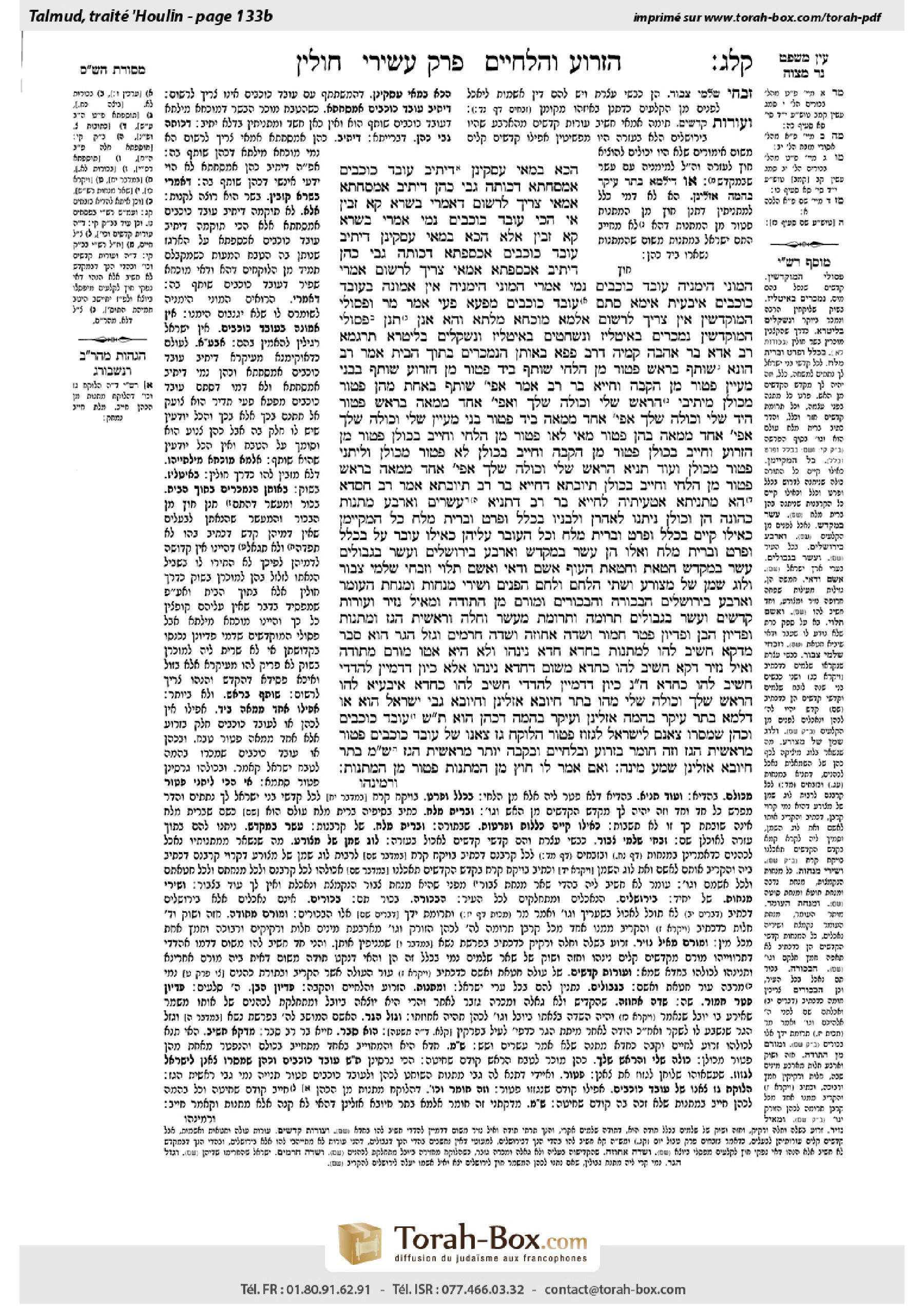
Chullin 133b: Talmud study for Daf Yomi
Study the Talmud for Daf Yomi with scanned pages, Hebrew text, English translations from Sefaria and AI-generated French translations.
Passage selection and English or AI-generated French translation are available where the scan has annotations. Daf Study is independent of Torah-Box and Sefaria.
Browse Chullin · חולין · All tractatesChullin 133b text and translations
This page of Chullin includes the Aramaic text, an English translation and an AI-generated French translation, alongside the scan above.
חולין קל״ג ב · Aramaic and Hebrew text
הָכָא בְּמַאי עָסְקִינַן – דְּיָתֵיב גּוֹי אַמְּסַחְתָּא.
דִּכְוָתַהּ גַּבֵּי כֹהֵן, דְּיָתֵיב אַמְּסַחְתָּא, אַמַּאי צָרִיךְ לִרְשׁוֹם? דְּאָמְרִי: בִּשְׂרָא קָא זָבֵין. אִי הָכִי, גּוֹי נָמֵי אָמְרִי: בִּשְׂרָא קָא זָבֵין!
אֶלָּא הָכָא בְּמַאי עָסְקִינַן, דְּיָתֵיב גּוֹי אַכַּסְפְּתָא. דִּכְוָתַהּ גַּבֵּי כֹּהֵן דְּיָתֵיב אַכַּסְפְּתָא, אַמַּאי צָרִיךְ לִרְשׁוֹם? אָמְרִי: הֵמוֹנֵי הֵימְנֵיהּ, גּוֹי נָמֵי אָמְרִי: הֵמוֹנֵי הֵימְנֵיהּ!
אֵין אֱמוּנָה בְּגוֹי. אִיבָּעֵית אֵימָא: סְתַם גּוֹי מִפְּעָא פָּעֵי.
אָמַר מָר: וּפְסוּלֵי הַמּוּקְדָּשִׁין אֵין צָרִיךְ לִרְשׁוֹם. אַלְמָא מוֹכְחָא מִלְּתָא, וְהָא אֲנַן תְּנַן: פְּסוּלֵי הַמּוּקְדָּשִׁין נִמְכָּרִים בָּאִיטְלִיז, וְנִשְׁחָטִים בָּאִיטְלִיז, וְנִשְׁקָלִים בְּלִיטְרָא!
תַּרְגְּמָא רַב אַדָּא בַּר אַהֲבָה קַמֵּיהּ דְּרַב פָּפָּא, בְּאוֹתָן הַנִּמְכָּרִים בְּתוֹךְ הַבַּיִת.
אָמַר רַב הוּנָא: שׁוּתָּף בָּרֹאשׁ – פָּטוּר מִן הַלֶּחִי, שׁוּתָּף בַּיָּד – פָּטוּר מִן הַזְּרוֹעַ, שׁוּתָּף בִּבְנֵי מֵעַיִין – פָּטוּר מִן הַקֵּבָה. וְחִיָּיא בַּר רַב אָמַר: אֲפִילּוּ שׁוּתָּף בְּאַחַת מֵהֶן – פָּטוּר מִכּוּלָּן.
מֵיתִיבִי: ״הָרֹאשׁ שֶׁלִּי וְכוּלָּהּ שֶׁלָּךְ״, וַאֲפִילּוּ אֶחָד מִמֵּאָה בָּרֹאשׁ – פָּטוּר. ״הַיָּד שֶׁלִּי וְכוּלָּהּ שֶׁלָּךְ״, אֲפִילּוּ אֶחָד מִמֵּאָה בַּיָּד – פָּטוּר. ״בְּנֵי מֵעַיִין שֶׁלִּי וְכוּלָּהּ שֶׁלָּךְ״, אֲפִילּוּ אֶחָד מִמֵּאָה בָּהֶן – פָּטוּר.
מַאי לָאו: פָּטוּר מִן הַלֶּחִי וְחַיָּיב בְּכוּלָּן, פָּטוּר מִן הַזְּרוֹעַ וְחַיָּיב בְּכוּלָּן, פָּטוּר מִן הַקֵּבָה וְחַיָּיב בְּכוּלָּן? לָא, פָּטוּר מִכּוּלָּן.
וְלִיתְנֵי פָּטוּר מִכּוּלָּן! וְעוֹד, תַּנְיָא: הָרֹאשׁ שֶׁלִּי וְכוּלָּהּ שֶׁלָּךְ – אֲפִילּוּ אֶחָד מִמֵּאָה בָּרֹאשׁ פָּטוּר מִן הַלֶּחִי וְחַיָּיב בְּכוּלָּן. תְּיוּבְתָּא דְּחִיָּיא בַּר רַב, תְּיוּבְתָּא!
אָמַר רַב חִסְדָּא: הָא מַתְנִיתָא אַטְעִיתֵיהּ לְחִיָּיא בַּר רַב, דְּתַנְיָא: עֶשְׂרִים וְאַרְבַּע מַתְּנוֹת כְּהוּנָּה הֵן, וְכוּלָּן נִיתְּנוּ לְאַהֲרֹן וּלְבָנָיו בִּכְלָל וּפְרָט וּבְרִית מֶלַח.
כָּל הַמְקַיְּימָן – כְּאִילּוּ קִיֵּים בִּכְלָל וּפְרָט וּבְרִית מֶלַח, וְכׇל הָעוֹבֵר עֲלֵיהֶן – כְּאִילּוּ עוֹבֵר עַל בִּכְלָל וּפְרָט וּבְרִית מֶלַח.
וְאֵלּוּ הֵן: עֶשֶׂר בַּמִּקְדָּשׁ, וְאַרְבַּע בִּירוּשָׁלַיִם, וְעֶשֶׂר בַּגְּבוּלִים. עֶשֶׂר בַּמִּקְדָּשׁ: חַטָּאת, וְחַטַּאת הָעוֹף, אָשָׁם וַדַּאי, וְאָשָׁם תָּלוּי, וְזִבְחֵי שַׁלְמֵי צִבּוּר, וְלוֹג שֶׁמֶן שֶׁל מְצוֹרָע, וּשְׁתֵּי הַלֶּחֶם, וְלֶחֶם הַפָּנִים, וּשְׁיָרֵי מְנָחוֹת, וּמִנְחַת הָעוֹמֶר.
וְאַרְבַּע בִּירוּשָׁלַיִם: הַבְּכוֹרָה, וְהַבִּכּוּרִים, וּמוּרָם מִן הַתּוֹדָה וּמֵאֵיל נָזִיר, וְעוֹרוֹת קָדָשִׁים.
וְעֶשֶׂר בַּגְּבוּלִים: תְּרוּמָה, וּתְרוּמַת מַעֲשֵׂר, וְחַלָּה, וְרֵאשִׁית הַגֵּז, וּמַתָּנוֹת, וּפִדְיוֹן הַבֵּן, וּפִדְיוֹן פֶּטֶר חֲמוֹר.
וּשְׂדֵה אֲחוּזָּה, וּשְׂדֵה חֲרָמִים, וְגֶזֶל הַגֵּר.
הוּא סָבַר: מִדְּקָא חָשֵׁיב לְהוּ לְמַתָּנוֹת בַּחֲדָא – חֲדָא נִינְהוּ, וְלָא הִיא! אַטּוּ מוּרָם מִתּוֹדָה וְאֵיל נָזִיר דְּקָא חָשֵׁיב לְהוּ כַּחֲדָא – מִשּׁוּם דַּחֲדָא נִינְהוּ?! אֶלָּא, כֵּיוָן דְּדָמְיָין לַהֲדָדֵי – חָשֵׁיב לְהוּ כַּחֲדָא, הָכִי נָמֵי: כֵּיוָן דְּדָמְיָין לַהֲדָדֵי – חֲשִׁיב לְהוּ כַּחֲדָא.
אִיבַּעְיָא לְהוּ: הָרֹאשׁ שֶׁלְּךָ וְכוּלָּהּ שֶׁלִּי, מַהוּ? בָּתַר חִיּוּבָא אָזְלִינַן, וְחִיּוּבָא גַּבֵּי יִשְׂרָאֵל הוּא, אוֹ דִלְמָא בָּתַר עִיקַּר בְּהֵמָה אָזְלִינַן, וְעִיקַּר בְּהֵמָה דְּכֹהֵן הוּא?
תָּא שְׁמַע: גּוֹי וְכֹהֵן שֶׁמָּסְרוּ צֹאנָם לְיִשְׂרָאֵל לִגְזוֹז – פָּטוּר, הַלּוֹקֵחַ גֵּז צֹאנוֹ שֶׁל גּוֹי – פָּטוּר מֵרֵאשִׁית הַגֵּז.
וְזֶה חוֹמֶר בִּזְרוֹעַ וּבַלְּחָיַיִם וּבְקֵבָה, יוֹתֵר מֵרֵאשִׁית הַגֵּז. שְׁמַע מִינַּהּ בָּתַר חִיּוּבָא אָזְלִינַן, שְׁמַע מִינַּהּ.
וְאִם אָמַר לוֹ ״חוּץ מִן הַמַּתָּנוֹת״ – פָּטוּר מִן הַמַּתָּנוֹת.
Chullin 133b · English translation
The Gemara responds: Here, we are dealing with a case where the gentile is sitting in the butcher shop of the Israelite. In such a situation, it is evident that the gentile is in partnership with the Israelite and the animal need not be marked. By contrast, the mishna is referring to a case where the gentile does not sit in the shop.
The Gemara asks: If so, then in the corresponding situation involving a priest, where the baraita teaches that one who enters into partnership with a priest must mark the animal, this must also be referring to a case where the priest sits in the butcher shop. Why, then, must one mark the animal? The Gemara responds: The fact that the priest sits in the shop does not indicate that he is in partnership with the Israelite, as people will say: He is in the shop because he is purchasing meat. The Gemara objects: If so, then in the case of the gentile as well, they will say that he is in the shop because he is purchasing meat.
Rather, here we are dealing with a case where the gentile sits by the safe into which the butcher places money received from his customers. In such a situation, it is evident that the gentile is in partnership with the Israelite, and therefore the animal need not be marked. The Gemara asks: If so, then the corresponding situation in the baraita involving a priest must also be a case where the priest sits by the safe. Why, then, must one mark the animal? The Gemara responds: The fact that the priest sits by the safe does not indicate that he is in partnership with the Israelite, as people will say: The butcher trusts him to protect the safe from theft. The Gemara asks: If so, then in the case of the gentile as well, they will say that he sits by the safe because the butcher trusts him.
The Gemara responds: It is not common for a Jew to place his trust in a gentile. If you wish, say instead that in both cases of the baraita the priest and the gentile sit in the butcher shop, not by the safe. It is evident that the gentile is in partnership with the Israelite, as an ordinary gentile partner yells at the seller, saying, for example: Do not sell an item for this price but for a different price. By contrast, a priest, even if he sits in the shop, would not question the practices of the salesman, due to his modesty, but would defer to the seller’s expertise. Accordingly, it is not evident that the priest is a partner, and the animal must therefore be marked.
§ The Master said in the baraita: And the owner of disqualified consecrated animals, which were slaughtered after they were redeemed and became non-sacred, is exempt from the obligation to give the gifts, and one does not need to mark the animal. The Gemara objects: Apparently, it is an evident matter that this is a disqualified consecrated animal, and therefore one need not mark it. But didn’t we learn in a mishna (Bekhorot 31a): All disqualified consecrated animals are sold in the meat market [be’itliz], and are slaughtered in the meat market, and are weighed and sold by the litra, in the manner of non-sacred meat? Since disqualified consecrated animals are treated in the same manner as ordinary non-sacred animals, how is it evident that this is a disqualified consecrated animal?
The Gemara responds: Rav Adda bar Ahava interpreted the baraita before Rav Pappa as referring to those disqualified consecrated animals that are sold from inside the house, i.e., a firstborn animal and an animal tithe, whose redemption payments belong to their owners, as their value has no sanctity. Since no gain would accrue to the Temple, the Sages prohibited one from selling these animals in the market, despite the fact one could have obtained a higher sale price there due to the high concentration of customers.
§ With regard to gifts of the priesthood from animals owned in partnership, Rav Huna says: If an Israelite is a partner with a priest or gentile in only the head of the animal, he is exempt merely from the obligation to give the jaw, which is part of the head. He remains obligated to give the foreleg and the maw. If he is a partner with a priest or gentile in the leg and hoof of the animal, he is exempt only from the obligation to give the foreleg. If he is a partner with a priest or gentile in the innards, he is exempt merely from the obligation to give the maw. And Ḥiyya bar Rav says that even if the priest or gentile is a partner in only one of them, the Israelite is exempt from all of the gifts.
The Gemara raises an objection to the opinion of Ḥiyya bar Rav from a baraita: If a priest says to an Israelite butcher: Let us enter into a partnership in which the head of the animal is mine and the entire remainder is yours, even if the priest proposes that only one-hundredth of the head should be his, the Israelite is exempt. Similarly, if the priest offers: Let us enter into a partnership in which the leg and hoof of the animal are mine and the entire remainder is yours, even if the priest suggests that only one-hundredth of the leg and hoof will be his, the Israelite is exempt. And likewise, if the priest says: Let us enter into a partnership in which the innards of the animal are mine and the entire remainder is yours, even if the priest offers to take only one-hundredth of the innards, the Israelite is exempt.
The Gemara explains the objection: What, is it not correct that the baraita is teaching that when the priest owns the head the butcher is exempt from giving the jaw, but obligated in giving all the rest, and likewise when the priest owns the leg and hoof, he is exempt from giving the foreleg but obligated in all the rest, and when the priest owns the innards, he is exempt from the maw and obligated in all the rest? This would contradict the opinion of Ḥiyya bar Rav. The Gemara responds: No; in each case the baraita means that he is exempt from all the gifts.
The Gemara suggests: But if so, let the baraita teach explicitly that he is exempt from all the gifts, rather than simply stating that he is exempt. And furthermore, it is taught in another baraita that if a priest says to an Israelite butcher: Let us enter into a partnership in which the head of the animal is mine and the entire remainder is yours, even if the priest suggests that only one-hundredth of the head will be his, the butcher is exempt from the obligation to give the jaw but is obligated in giving all the rest. This baraita explicitly contradicts the opinion of Ḥiyya bar Rav. The Gemara concludes: The refutation of the opinion of Ḥiyya bar Rav is indeed a conclusive refutation.
Rav Ḥisda said in explanation of the opinion of Ḥiyya bar Rav: This baraita misled Ḥiyya bar Rav, as it is taught in a baraita: There are twenty-four gifts of the priesthood, and all of them were given in the Torah to Aaron and his sons by a generalization and a detail, and with a covenant of salt. The verse states: “And the Lord spoke to Aaron: And I, behold, I have given you the charge of My gifts; of all the consecrated items of the children of Israel to you have I given them for prominence, and to your sons, as an eternal portion” (Numbers 18:8). After this generalization, the Torah proceeds to list the gifts in detail. Finally, after delineating all the gifts of the priesthood, the verse states: “It is an everlasting covenant of salt” (Numbers 18:19), assuring Aaron that just as a covenant of salt is unbreakable, so too, the gifts of the priesthood are eternal.
The baraita continues: Therefore, anyone who fulfills the mitzva of giving the gifts of the priesthood is considered as though he fulfills all these mitzvot that are derived using the principle of a generalization and a detail, and as though he has upheld the covenant of salt. And anyone who violates the mitzva of giving the gifts of the priesthood is considered as though he violates all of the mitzvot derived by the principle of a generalization and a detail, and as though he has not upheld the covenant of salt.
And these are the twenty-four gifts: Ten are consumed in the Temple, and four in Jerusalem, and ten in the boundaries of Eretz Yisrael. The ten gifts consumed only in the Temple are an animal sin offering; and a bird sin offering; and a definite guilt offering; and a provisional guilt offering; and communal peace offerings, i.e., the lambs that accompany the two loaves brought on Shavuot and which are considered offerings of the most sacred order; and the remainder of the log of oil that accompanies the guilt offering of a recovered leper; and the two loaves offering from the new wheat brought on Shavuot; and the shewbread; and the leftovers of meal offerings; and the omer meal offering, i.e., the measure of barley brought as a communal offering on the sixteenth of Nisan.
And these are the four gifts that the priests consume anywhere in Jerusalem: The unblemished firstborn of kosher animals; and the first fruits; and the portions separated for the priests from the thanks offering, i.e., the breast and thigh and one loaf from each of the four types of loaves brought with a thanks offerings: Cakes, wafers, cakes of fine flour, and leavened bread, and the portions separated from the nazirite’s ram, i.e., the boiled shoulder, a cake, and a wafer, in addition to the breast and thigh of any peace offering; and the hides of sacrificial animals brought as burnt offerings, sin offerings, and guilt offerings.
And these are the ten gifts that the priests consume anywhere in the boundaries of Eretz Yisrael: Teruma, i.e., the portion of the produce designated for the priest; and teruma of the tithe; and ḥalla; and the first sheared wool; and the gifts of the foreleg, the jaw, and the maw; and the five sela given as redemption of the firstborn son; and a sheep or goat given as redemption of the firstborn donkey.
The baraita continues the list: And a consecrated ancestral field that one did not redeem, which was sold to another by the Temple treasurer and is therefore given to the members of the priestly watch serving during the Jubilee Year; and a dedicated field; and payment for the robbery of a convert who died without heirs. If one takes an oath that he did not rob from a convert, and after the death of the convert he admits to having taken a false oath, he must pay the principal value of the stolen item and an additional one-fifth of the value, all of which is given to the priests.
Rav Ḥisda explains how the baraita misled Ḥiyya bar Rav: He thought that from the fact that the tanna of the baraita counts the gifts of the foreleg, the jaw, and the maw as one gift, they are treated as one gift, which means that if one is exempt from one of them he is exempt from all of them. But it is not so, as is that to say that the portions separated for the priests from the thanks offering and from the nazirite’s ram, which the tanna counts as one, are counted this way because they are one? Obviously, these are independent gifts. Rather, since they are similar to one another the tanna counts them as one. So too, with regard to the foreleg, the jaw, and the maw, since they are similar to one another he counts them as one.
§ With regard to animals owned in partnership with a priest, the Gemara relates that a dilemma was raised before the Sages: If a priest says to an Israelite butcher: Let us enter into partnership in ownership of a live animal, in which the head is yours and the entire remainder is mine, what is the halakha? Is the Israelite obligated to give the jaw to a priest when it is slaughtered? The Gemara explains the sides of the dilemma: Do we follow the obligation, i.e., the limbs of the animal which contain the gifts, and since the obligation is owned by the Israelite he is obligated? Or perhaps, we follow the principal part of the animal, and since the principal of the animal is in the possession of the priest, the Israelite is exempt?
The Gemara suggests: Come and hear a proof from a baraita: With regard to a gentile or a priest who transferred his sheep to an Israelite to act as his agent to shear it, the Israelite is exempt from giving the first sheared wool to a priest. Similarly, one who purchases the shearing of the sheep of a gentile, even before the sheep was actually sheared, is exempt from giving the first sheared wool.
The baraita adds: And this, the halakha in a case where one purchases an item before the obligation of a certain gift of the priesthood takes effect, is a stringency that applies in the case of the foreleg, the jaw, and the maw more so than in the case of the first sheared wool. In other words, one who purchases wool from a priest before it is shorn is exempt from giving first sheared wool, whereas one who purchases part of an animal from a priest before its slaughter is obligated to give any gifts contained within the purchased portion. Since this is the halakha even if the portion he purchased is not the principal part, similar to the stated case of one who purchases only the shearing of the sheep of a gentile, one can conclude from this baraita that we follow the obligation, i.e., the limbs of the animal that contain the gifts. The Gemara concludes: Indeed, conclude from it that this is correct.
§ The mishna teaches: And if a priest sold his animal to an Israelite and said that he is selling everything except for the gifts with it, the Israelite is exempt from the obligation to give the gifts, because they are not his.
Chullin 133b · Traduction française (IA)
La Guemara répond : Ici, nous parlons d’un cas où le gentil est assis dans la boucherie de l’Israélite. Dans de tels cas, il est évident que le gentil est associé à l’Israélite et que l’animal n’a pas besoin d’être marqué. À l’inverse, la mitsva fait référence à un cas où le gentil ne siège pas dans la boucherie.
La Guemara pose la question : Si c’est ainsi, alors dans le cas correspondant concernant le prêtre, où la baraïta enseigne que celui qui entre en partenariat avec un prêtre doit marquer l’animal, cela doit aussi concerner un cas où le prêtre est assis dans la boucherie. Pourquoi, alors, doit-on marquer l’animal ? La Guemara répond : Le fait que le prêtre soit assis dans la boucherie ne montre pas qu’il est en partenariat avec l’Israélite, car les gens diront : Il est dans la boucherie parce qu’il achète de la viande. La Guemara objecte : Si c’est ainsi, alors dans le cas du gentil également, ils diront qu’il est dans la boucherie parce qu’il achète de la viande.
Au contraire, ici nous parlons d’un cas où le gentil est près du coffre dans lequel le boucher place l’argent reçu de ses clients. Dans de tels cas, il est évident que le gentil est en partenariat avec l’Israélite, et par conséquent l’animal n’a pas besoin d’être marqué. La Guemara pose la question : Si c’est ainsi, alors le cas correspondant dans la baraïta concernant le prêtre doit aussi être un cas où le prêtre est près du coffre. Pourquoi, alors, doit-on marquer l’animal ? La Guemara répond : Le fait que le prêtre soit près du coffre ne montre pas qu’il est en partenariat avec l’Israélite, car les gens diront : Le boucher lui fait confiance pour protéger le coffre contre le vol. La Guemara pose la question : Si c’est ainsi, alors dans le cas du gentil également, ils diront qu’il est près du coffre parce que le boucher lui fait confiance.
La Guemara répond : Il n’est pas courant qu’un Juif fasse confiance à un gentil. Si vous le souhaitez, dites plutôt que dans les deux cas de la baraïta, le prêtre et le gentil sont assis dans la boucherie, pas près du coffre. Il est évident que le gentil est en partenariat avec l’Israélite, car un gentil ordinaire en partenariat crie au vendeur, disant par exemple : Ne vends pas cet article à ce prix mais à un autre prix. À l’inverse, un prêtre, même s’il est assis dans la boucherie, ne contesterait pas les pratiques du vendeur, en raison de sa modestie, mais se fierait à l’expertise du vendeur. Par conséquent, il n’est pas évident que le prêtre soit un partenaire, et l’animal doit donc être marqué.
§ Le Maître a dit dans la baraïta : Et l’propriétaire des animaux consacrés disqualifiés, qui ont été sacrifiés après leur rachat et sont devenus non sacrés, est exempt de l’obligation de donner les présents, et l’animal n’a pas besoin d’être marqué. La Guemara objecte : Apparemment, il s’agit d’une évidence que c’est un animal consacré disqualifié, et par conséquent l’animal n’a pas besoin d’être marqué. Mais n’avons-nous pas appris dans une mitsva (Bekhorot 31a) : Tous les animaux consacrés disqualifiés sont vendus sur le marché [be’itliz], sont sacrifiés sur le marché, sont pesés et vendus par la litra, comme la viande non sacrée ? Puisque les animaux consacrés disqualifiés sont traités de la même manière que les animaux ordinaires non sacrés, comment est-il évident que c’est un animal consacré disqualifié ?
La Guemara répond : Rav Adda bar Ahava a interprété la baraïta avant Rav Pappa comme faisant référence à ceux des animaux consacrés disqualifiés qui sont vendus à l’intérieur de la maison, c’est-à-dire un animal premier-né et un animal d’offrande, dont les paiements de rachat appartiennent à leurs propriétaires, car leur valeur n’a pas de sanctité. Puisque aucun bénéfice ne revenait au Temple, les Sages ont interdit de vendre ces animaux sur le marché, malgré le fait qu’on aurait pu obtenir un prix plus élevé là-bas en raison de la concentration d’acheteurs.
§ Concernant les présents du clergé provenant d’animaux possédés en partenariat, Rav Huna dit : Si un Israélite est partenaire avec un prêtre ou un gentil uniquement dans la tête de l’animal, il est exempt seulement de l’obligation de donner la mâchoire, qui est partie de la tête. Il reste obligé de donner la cuisse et la mâchoire. Si il est partenaire avec un prêtre ou un gentil dans la cuisse et la corne de l’animal, il est exempt seulement de l’obligation de donner la cuisse. Si il est partenaire avec un prêtre ou un gentil dans les entrailles, il est exempt seulement de l’obligation de donner la mâchoire. Et Ḥiyya bar Rav dit que même si le prêtre ou le gentil est partenaire dans seulement l’un d’eux, l’Israélite est exempt de tous les présents.
La Guemara soulève une objection contre l’opinion de Ḥiyya bar Rav à partir d’une baraïta : Si un prêtre dit à un boucher israélite : Faisons un partenariat où la tête de l’animal est à moi et le reste est à toi, même si le prêtre propose que seulement un centième de la tête lui appartienne, l’Israélite est exempt. De même, si le prêtre propose : Faisons un partenariat où la cuisse et la corne de l’animal sont à moi et le reste est à toi, même si le prêtre suggère que seulement un centième de la cuisse et de la corne lui appartienne, l’Israélite est exempt. Et de même, si le prêtre dit : Faisons un partenariat où les entrailles de l’animal sont à moi et le reste est à toi, même si le prêtre propose de prendre seulement un centième des entrailles, l’Israélite est exempt.
La Guemara explique l’objection : Qu’est-ce que cela signifie ? N’est-ce pas correct que la baraïta enseigne que lorsque le prêtre possède la tête, le boucher est exempt de donner la mâchoire, mais obligé de donner tout le reste, et de même lorsque le prêtre possède la cuisse et la corne, il est exempt de donner la cuisse mais obligé de donner tout le reste, et lorsque le prêtre possède les entrailles, il est exempt de la mâchoire et obligé de donner tout le reste ? Cela contredirait l’opinion de Ḥiyya bar Rav. La Guemara répond : Non ; dans chaque cas, la baraïta signifie qu’il est exempt de tous les présents.
La Guemara suggère : Mais si c’est ainsi, la baraïta devrait explicitement enseigner qu’il est exempt de tous les dons, plutôt que simplement indiquer qu’il est exempt. Et de plus, il est enseigné dans une autre baraïta que si un prêtre dit à un boucher israélite : Entrons en partage où la tête de l’animal est à moi et tout le reste est à toi, même si le prêtre suggère que seulement un centième de la tête lui appartient, le boucher est exempt de l’obligation de donner la mâchoire mais est tenu de donner tout le reste. Cette baraïta contredit explicitement l’opinion de Chiyah bar Rav. La Guemara conclut : La réfutation de l’opinion de Chiyah bar Rav est effectivement une réfutation concluante.
Rav Hisda a expliqué l’opinion de Chiyah bar Rav ainsi : Cette baraïta a trompé Chiyah bar Rav, car il est enseigné dans une baraïta : Il y a vingt-quatre dons de la prêtrise, et tous ont été donnés dans la Torah à Aaron et à ses fils par une généralisation et un détail, et par un pacte de sel. La parole dit : « Et l’Eternel parla à Aaron : Et voici, j’ai donné à toi la charge de mes dons ; de tous les objets consacrés des enfants d’Israël, tu as reçu pour honneur, et à tes fils, comme portion éternelle » (Nombres 18:8). Après cette généralisation, la Torah passe à l’énumération des dons en détail. Enfin, après avoir décrit tous les dons de la prêtrise, la parole dit : « C’est un pacte éternel de sel » (Nombres 18:19), assurant à Aaron que tout comme un pacte de sel est indestructible, ainsi les dons de la prêtrise sont éternels.
La baraïta continue : Ainsi, celui qui accompli la mitsva de donner les dons de la prêtrise est considéré comme s’il accomplissait toutes ces mitsvot dérivées par le principe de généralisation et de détail, et comme s’il avait maintenu le pacte de sel. Et celui qui viole la mitsva de donner les dons de la prêtrise est considéré comme s’il violait toutes les mitsvot dérivées par le principe de généralisation et de détail, et comme s’il n’avait pas maintenu le pacte de sel.
Et voici les vingt-quatre dons : Dix sont consommés dans le Temple, quatre à Jérusalem, et dix dans les limites de la Terre d’Israël. Les dix dons consommés uniquement dans le Temple sont un sacrifice expiatoire d’animaux, un sacrifice expiatoire d’oiseaux, un sacrifice de culpabilité déterminé, un sacrifice de culpabilité provisoire, des offrandes de paix communautaires, c’est-à-dire les agnels qui accompagnent les deux pains apportés pendant la fête des Pâques et qui sont considérés comme des offrandes de l’ordre le plus sacré ; et le reste du litre d’huile qui accompagne le sacrifice expiatoire d’un lépreux guéri ; et l’offrande des deux pains de blé apportés pendant la fête des Pâques ; et le pain de présentation ; et les restes des offrandes de farine ; et l’offrande de l’omer, c’est-à-dire la mesure de blé apportée comme offrande communautaire le seizième du Nisan.
Et voici les quatre dons que les prêtres consomment partout à Jérusalem : Le premier-né non blemi d’animaux kasher ; les premiers fruits ; les portions séparées pour les prêtres des offrandes de remerciement, c’est-à-dire la poitrine et la cuisse et un pain de chaque type de pains apportés avec une offrande de remerciement : des galettes, des gaufres, des galettes de farine fine et du pain levé, et les portions séparées du ram de l’homme consacré, c’est-à-dire le couvert de bœuf, une galette, et une gaufre, en plus de la poitrine et la cuisse de toute offrande de paix ; et les peaux des animaux sacrés apportés comme offrandes brûlantes, sacrifices expiatoires et sacrifices de culpabilité.
Et voici les dix dons que les prêtres consomment partout dans les limites de la Terre d’Israël : La terouma, c’est-à-dire la part de la récolte désignée pour le prêtre ; la terouma de la dîme ; la halla ; la première laine rasée ; les dons de la cuisse, de la mâchoire et de la gueule ; les cinq sela donnés comme rançon du premier-né masculin ; et un agneau ou une chèvre donnés comme rançon du premier-né de bœuf.
La baraïta continue la liste : Et un champ ancestral consacré qui n’a pas été racheté, qui a été vendu à un autre par le trésorier du Temple et est donc donné aux membres du service des prêtres pendant l’année du Jubilé ; et un champ dédié ; et le paiement pour le vol d’un converti mort sans héritiers. Si l’on prend un serment affirmant n’avoir pas volé un converti, et après la mort du converti il admet avoir pris un serment faux, il doit payer la valeur principale de l’objet volé et un cinquième supplémentaire de la valeur, toutes ces choses étant données aux prêtres.
Rav Hisda explique comment la baraïta a trompé Chiyah bar Rav : Il pensait que du fait que le tanna de la baraïta compte les dons de la cuisse, de la mâchoire et de la gueule comme un seul don, ils sont traités comme un seul don, ce qui signifie que si l’on est exempt d’un d’entre eux, on est exempt de tous. Mais ce n’est pas ainsi, car ce n’est pas dire que les portions séparées pour les prêtres des offrandes de remerciement et du ram de l’homme consacré, que le tanna compte comme un seul, sont comptés ainsi parce qu’ils sont un seul. Évidemment, ces sont des dons indépendants. Plutôt, puisqu’ils sont semblables les uns aux autres, le tanna les compte comme un seul. De même, concernant la cuisse, la mâchoire et la gueule, puisqu’ils sont semblables les uns aux autres, il les compte comme un seul.
§ En ce qui concerne les animaux possédés en partage avec un prêtre, la Guemara rapporte qu’un dilemme a été soulevé devant les Sages : Si un prêtre dit à un boucher israélite : Entrons en partage en matière de propriété d’un animal vivant, la tête étant à toi et le reste à moi, quelle est la halakha ? Le boucher est-il tenu de donner la mâchoire à un prêtre lorsqu’il est tué ? La Guemara explique les deux côtés du dilemme : Doit-on suivre l’obligation, c’est-à-dire les membres de l’animal qui contiennent les dons, et puisque l’obligation appartient au boucher, il est tenu ? Ou bien, devons-nous suivre la partie principale de l’animal, et puisque la principale de l’animal est en possession du prêtre, le boucher est exempt ?
La Guemara suggère : Viens entendre une preuve tirée d'une baraïta : En ce qui concerne un non-Juif ou un prêtre qui a transféré son mouton à un Israélite pour qu'il agisse en son nom afin de le tondre, l'Israélite est exempt de donner la laine première à un prêtre. De même, celui qui achète la tonte du mouton d'un non-Juif, même avant que le mouton ne soit effectivement tondu, est exempt de donner la laine première.
La baraïta ajoute : Et cela, c'est la halakha dans le cas où l'on achète un objet avant que l'obligation d'un certain don au prêtre ne s'applique, est une stricte application dans le cas des membres, de la mâchoire et de la gueule, plus encore que dans le cas de la laine première. En d'autres termes, celui qui achète de la laine d'un prêtre avant qu'elle ne soit tondu est exempt de donner la laine première, tandis que celui qui achète une partie d'un animal d'un prêtre avant sa mise à mort est tenu de donner tout don contenu dans la portion achetée. Puisque c'est la halakha même si la portion qu'il a achetée n'est pas la partie principale, semblable au cas mentionné de celui qui achète seulement la tonte du mouton d'un non-Juif, on peut conclure à partir de cette baraïta que nous suivons l'obligation, c'est-à-dire les membres de l'animal contenant les dons. La Guemara conclut : En effet, concluez-en qu'il s'agit de cela.
§ La mitsna enseigne : Et si un prêtre vend son animal à un Israélite et dit qu'il vend tout sauf les dons qui y sont attachés, l'Israélite est exempt de l'obligation de donner les dons, car ils ne sont pas à lui.
Traduction française générée par IA à partir de l’édition anglaise de Sefaria. Vérifie toujours un passage avec le texte source.
Text from Sefaria: William Davidson Edition - Vocalized Aramaic (unknown); William Davidson Edition - English (CC BY NC).