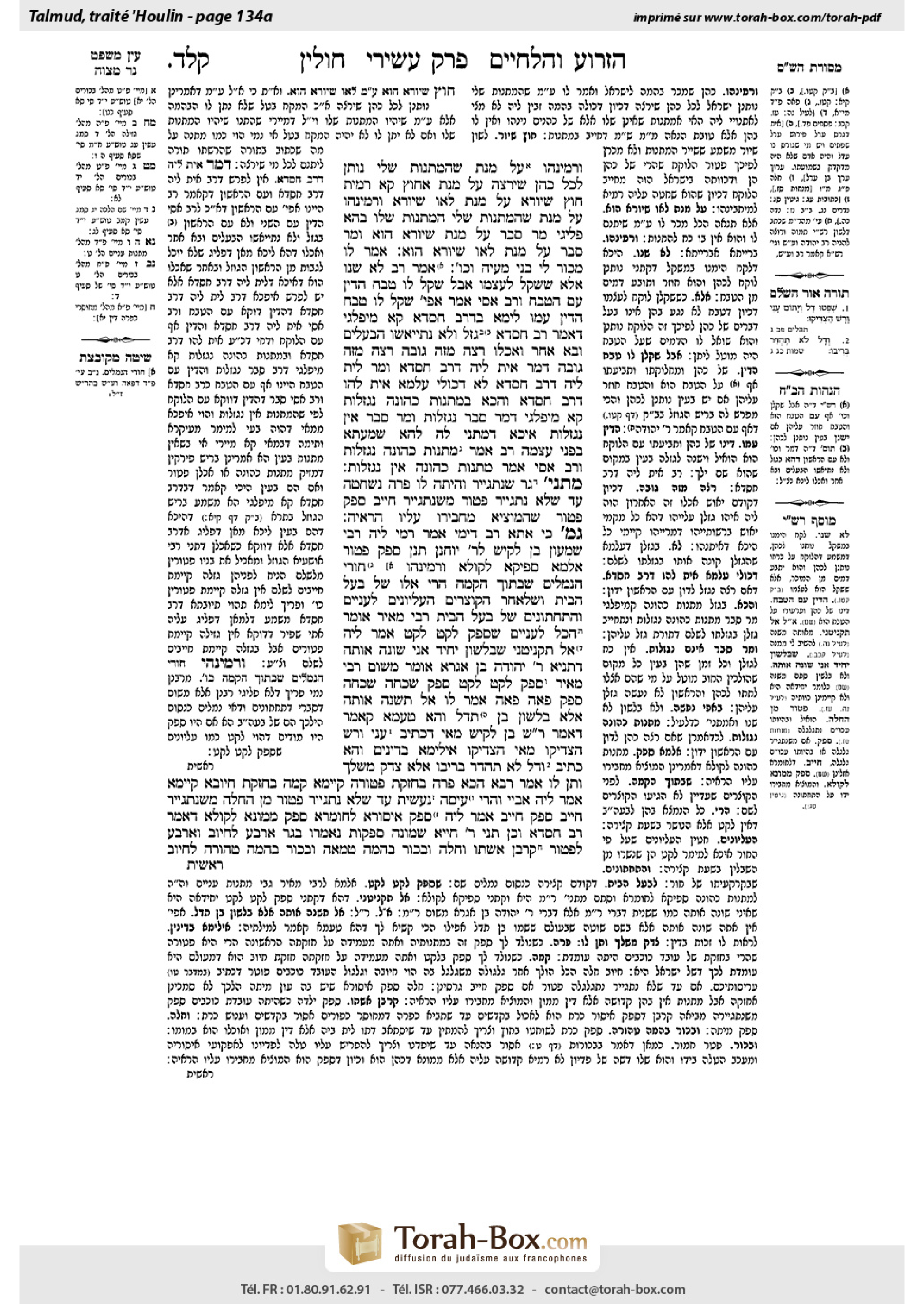
Chullin 134a: Talmud study for Daf Yomi
Study the Talmud for Daf Yomi with scanned pages, Hebrew text, English translations from Sefaria and AI-generated French translations.
Passage selection and English or AI-generated French translation are available where the scan has annotations. Daf Study is independent of Torah-Box and Sefaria.
Browse Chullin · חולין · All tractatesChullin 134a text and translations
This page of Chullin includes the Aramaic text, an English translation and an AI-generated French translation, alongside the scan above.
חולין קל״ד א · Aramaic and Hebrew text
וּרְמִינְהוּ: ״עַל מְנָת שֶׁהַמַּתָּנוֹת שֶׁלִּי״ – נוֹתֵן לְכׇל כֹּהֵן שֶׁיִּרְצֶה!
״עַל מְנָת״ אַ״חוּץ״ קָא רָמֵית? ״חוּץ״ – שִׁיּוּרָא, ״עַל מְנָת״ – לָאו שִׁיּוּרָא.
וּרְמִינְהוּ: ״עַל מְנָת שֶׁהַמַּתָּנוֹת שֶׁלִּי״ – הַמַּתָּנוֹת שֶׁלּוֹ! בְּהָא פְּלִיגִי: מָר סָבַר ״עַל מְנָת״ – שִׁיּוּרָא הוּא, וּמָר סָבַר ״עַל מְנָת״ – לָאו שִׁיּוּרָא הוּא.
אָמַר לוֹ: מְכוֹר לִי בְּנֵי מֵעֶיהָ וְכוּ׳. אָמַר רַב: לֹא שָׁנוּ אֶלָּא שֶׁשָּׁקַל לְעַצְמוֹ, אֲבָל שָׁקַל לוֹ טַבָּח – הַדִּין עִם הַטַּבָּח. וְרַב אַסִּי אָמַר: אֲפִילּוּ שָׁקַל לוֹ טַבָּח – הַדִּין עִמּוֹ.
לֵימָא בִּדְרַב חִסְדָּא קָא מִיפַּלְגִי, דְּאָמַר רַב חִסְדָּא: גָּזַל וְלֹא נִתְיָיאֲשׁוּ הַבְּעָלִים, וּבָא אַחֵר וַאֲכָלוֹ – רָצָה מִזֶּה גּוֹבֶה, רָצָה מִזֶּה גּוֹבֶה. דְּמָר אִית לֵיהּ דְּרַב חִסְדָּא, וּמָר לֵית לֵיהּ דְּרַב חִסְדָּא.
לָא, דְּכוּלֵּי עָלְמָא אִית לְהוּ דְּרַב חִסְדָּא, וְהָכָא בְּמַתְּנוֹת כְּהוּנָּה נִגְזָלוֹת קָא מִיפַּלְגִי, דְּמָר סָבַר נִגְזָלוֹת, וּמַר סָבַר אֵין נִגְזָלוֹת.
אִיכָּא דְּמַתְנֵי לַהּ לְהָא שְׁמַעְתָּא בִּפְנֵי עַצְמָהּ: רַב אָמַר: מַתְּנוֹת כְּהוּנָּה נִגְזָלוֹת, וְרַב אַסִּי אָמַר: מַתְּנוֹת כְּהוּנָּה אֵין נִגְזָלוֹת.
מַתְנִי׳ גֵּר שֶׁנִּתְגַּיֵּיר וְהָיְתָה לוֹ פָּרָה, נִשְׁחֲטָה עַד שֶׁלֹּא נִתְגַּיֵּיר – פָּטוּר, מִשֶּׁנִּתְגַּיֵּיר – חַיָּיב, סָפֵק – פָּטוּר, שֶׁהַמּוֹצִיא מֵחֲבֵירוֹ עָלָיו הָרְאָיָה.
גְּמָ׳ כִּי אֲתָא רַב דִּימִי אֲמַר: רָמֵי לֵיהּ רַבִּי שִׁמְעוֹן בֶּן לָקִישׁ לְרַבִּי יוֹחָנָן – תְּנַן: ״סָפֵק פָּטוּר״, אַלְמָא סְפֵיקָא לְקוּלָּא.
וּרְמִינְהוּ: חוֹרֵי הַנְּמָלִים שֶׁבְּתוֹךְ הַקָּמָה – הֲרֵי אֵלּוּ שֶׁל בַּעַל הַבַּיִת, וְשֶׁלְּאַחַר הַקּוֹצְרִים – הָעֶלְיוֹנִים לַעֲנִיִּים, וְהַתַּחְתּוֹנִים שֶׁל בַּעַל הַבַּיִת.
רַבִּי מֵאִיר אוֹמֵר: הַכֹּל לַעֲנִיִּים, שֶׁסְּפֵק לֶקֶט – לֶקֶט.
אֲמַר לֵיהּ: אַל תַּקְנִיטֵנִי, שֶׁבִּלְשׁוֹן יָחִיד אֲנִי שׁוֹנֶה אוֹתָהּ, דְּתַנְיָא: רַבִּי יְהוּדָה בֶּן אַגְרָא אוֹמֵר מִשּׁוּם רַבִּי מֵאִיר: סְפֵק לֶקֶט – לֶקֶט, סְפֵק שִׁכְחָה – שִׁכְחָה, סְפֵק פֵּאָה – פֵּאָה.
אָמַר לוֹ אַל תִּשְׁנֶה אוֹתָהּ אֶלָּא בִּלְשׁוֹן בֶּן תַּדָּל, וְהָא טַעְמָא קָאָמַר, דְּאָמַר רַבִּי שִׁמְעוֹן בֶּן לָקִישׁ: מַאי דִּכְתִיב ״עָנִי וָרָשׁ הַצְדִּיקוּ״? מַאי ״הַצְדִּיקוּ״?
אִילֵּימָא בְּדִינִים, וְהָא כְּתִיב ״וְדָל לֹא תֶהְדַּר בְּרִיבוֹ״? אֶלָּא, צַדֵּק מִשֶּׁלְּךָ וְתֵן לוֹ.
אָמַר רָבָא: הָכָא, פָּרָה בְּחֶזְקַת פְּטוּרָה קָיְימָא, קָמָה בְּחֶזְקַת חִיּוּבָא קָיְימָא.
אֲמַר לֵיהּ אַבָּיֵי: וַהֲרֵי עִיסָּה נַעֲשֵׂית עַד שֶׁלֹּא נִתְגַּיֵּיר – פָּטוּר מִן הַחַלָּה, מִשֶּׁנִּתְגַּיֵּיר – חַיָּיב, סָפֵק – חַיָּיב.
אֲמַר לֵיהּ: סְפֵק אִיסּוּרָא לְחוּמְרָא, סְפֵק מָמוֹנָא לְקוּלָּא.
דַּאֲמַר רַב חִסְדָּא, וְכֵן תָּנֵי רַבִּי חִיָּיא: שְׁמוֹנָה סְפֵקוֹת נֶאֶמְרוּ בַּגֵּר, אַרְבַּע לְחִיּוּב וְאַרְבַּע לִפְטוּר.
קׇרְבַּן אִשְׁתּוֹ, וְחַלָּה, וּבְכוֹר בְּהֵמָה טְמֵאָה, וּבְכוֹר בְּהֵמָה טְהוֹרָה – לְחִיּוּב.
Chullin 134a · English translation
The Gemara objects: But one can raise a contradiction from a baraita: If a priest sells his animal to an Israelite and stipulates: I am selling it on the condition that the gifts are mine, the Israelite is not obligated to give the gifts to that priest. Rather, he gives the gifts to any priest that he wants. Since the priest sold his animal, the priest cannot issue a condition involving the gifts, as they no longer belong to him but to the entire tribe of priests. The baraita indicates that the Israelite is nevertheless obligated to give the gifts, which apparently contradicts the ruling of the mishna.
The Gemara responds: Do you raise a contradiction from a baraita that discusses a case where the priest states: On the condition that the gifts are mine, with regard to the case of the mishna, where the priest states: Except for the gifts? That is not a contradiction, as the word except is a term of retention, i.e., the priest retains the gifts and does not sell them to the Israelite. By contrast, the term: On the condition, is not one of retention, as the priest does not keep the gifts for himself but instead stipulates that the buyer must give the gifts to him. The priest is not authorized to issue such a stipulation and it is therefore disregarded entirely, and because the Israelite owns the gifts he must give them to a priest.
The Gemara objects: But one may raise a contradiction against the previous baraita from another baraita: If a priest sells his animal to an Israelite and stipulates: I am selling it on the condition that the gifts are mine, the gifts are his and the Israelite must give the gifts to that priest. The Gemara responds: There is a dispute between the tanna’im of these baraitot, and they disagree with regard to this matter: One Sage, the tanna of the second baraita, holds that the term: On the condition, is one of retention, and the priest therefore retains possession of the gifts. And one Sage, the tanna of the first baraita, holds that: On the condition, is not a term of retention, and the priest is not authorized to stipulate that the buyer must give the gifts to him.
§ The mishna teaches that if one said to a butcher: Sell me the innards of a cow that you slaughtered, and there were gifts, i.e., the maw, included with it, the buyer gives the gifts to the priest and does not deduct its value from the money that he pays to the butcher. If he bought the innards by weight, the buyer gives the maw to the priest and deducts its value from the money he pays to the butcher. With regard to innards purchased by weight, Rav says: The Sages taught that the buyer gives the maw to the priest only when the buyer weighed the innards for himself when purchasing them. In such a case, the priest claims the maw from the buyer. But if the butcher weighed the innards for the buyer, the judgment is also with the butcher, i.e., the priest may claim the maw from either the butcher or the buyer. And Rav Asi says: Even if the butcher weighed the innards for the buyer, the judgment is with the buyer alone.
The Gemara suggests: Let us say that they disagree with regard to a statement of Rav Ḥisda, as Rav Ḥisda said: In a case where one robbed another of an item, and the owners had not despaired of retrieving it, and another person came and consumed the stolen item, if the owner wants, he may collect the value of the stolen item from this one, the robber, and if he wants, he may collect from that one who consumed it. The suggestion is that one Sage, Rav, holds in accordance with the opinion of Rav Ḥisda, and he therefore holds that the priest may claim the maw from either the buyer or the butcher; and one Sage, Rav Asi, does not hold in accordance with the opinion of Rav Ḥisda, and the priest may therefore claim the maw from the buyer alone.
The Gemara rejects this suggestion: No; everyone holds in accordance with the opinion of Rav Ḥisda, and here they disagree with regard to whether or not gifts of the priesthood can be stolen. As one Sage, Rav, holds that they can be stolen, and accordingly the robber remains responsible for them even if they are consumed by another. Consequently, if the butcher weighed the innards, the priest may claim the gifts from either the butcher or the buyer. And one Sage, Rav Asi, holds that gifts of the priesthood cannot be stolen. Since technically one cannot steal the gifts, the obligation to return them to the priest rests solely on the one in physical possession of them. Accordingly, the priest may claim the gifts from the buyer alone, as the gifts are in his custody.
The Gemara notes that some teach this halakha, that there is a dispute between Rav and Rav Asi as to whether or not gifts of the priesthood can be stolen, by itself, i.e., as an independent dispute between them rather than in explanation of another dispute: Rav says that gifts of the priesthood can be stolen, and Rav Asi says that gifts of the priesthood cannot be stolen.
MISHNA: In the case of a convert who converted and he had a cow, if the cow was slaughtered before he converted, he is exempt from giving the gifts to the priest. If the animal was slaughtered after he converted, the convert is obligated to give the gifts. If there is uncertainty whether it was slaughtered before or after the conversion, the convert is exempt, as the burden of proof rests upon the claimant.
GEMARA: The mishna teaches that if there is an uncertainty whether an individual is obligated to give gifts of the priesthood, he is exempt from giving them. In this regard, the Gemara relates that when Rav Dimi came from Eretz Yisrael to Babylonia, he said that Rabbi Shimon ben Lakish raised a contradiction to Rabbi Yoḥanan: We learned in the mishna that when there is an uncertainty one is exempt from giving the gifts. Evidently, in cases of uncertainty the halakha is to be lenient.
But one can raise a contradiction from that which is taught in another mishna (Pe’a 4:11) with regard to gleanings left for the poor: In a case of grain found in ant holes that are inside the standing crop in an area of the field that was not harvested, these are the property of the owner of the field, as this grain does not have the status of gleanings. And in the case of grain found in ant holes that are behind the harvesters in an already harvested area, the upper wheat stalks, i.e., those stalks found at the mouth of the holes, belong to the poor, as they are assumed to be gleanings that fell from the bundles when that area was harvested, and the lower wheat inside the holes are the property of the owner, since it is possible that they were collected by the ants before the harvest and are not gleanings.
Rabbi Meir says: Everything goes to the poor, as grain whose status as gleanings is uncertain is considered gleanings. According to Rabbi Meir, the halakha is stringent in the case of an uncertainty with regard to gifts left for the poor. This apparently contradicts the mishna’s statement that one is lenient in the case of an uncertainty with regard to gifts of the priesthood, as these gifts are similar in this regard to gifts left for the poor. Since any unattributed mishna is considered to be in accordance with the opinion of Rabbi Meir, this is apparently a contradiction with regard to the opinion of Rabbi Meir.
Rabbi Yoḥanan said to Rabbi Shimon ben Lakish: Do not trouble me with this contradiction, as I teach that baraita in the singular, i.e., it is not certain that this is the opinion of Rabbi Meir; rather, it is merely the claim of one Sage that this is Rabbi Meir’s opinion. As it is taught in a baraita that Rabbi Yehuda ben Agra says in the name of Rabbi Meir: Grain whose status as gleanings is uncertain is considered gleanings; grain whose status as forgotten sheaves is uncertain is considered forgotten sheaves; and grain whose status as pe’a is uncertain is considered pe’a. Therefore, one should not raise a contradiction to the mishna from the statement of a single Sage claiming to represent the opinion of Rabbi Meir.
Rabbi Shimon ben Lakish said to Rabbi Yoḥanan: Even if you teach that baraita only in a language whereby a certain imbecile named ben Tedal states that this is the opinion of Rabbi Meir, a question remains, as isn’t there a stated reason for stringency in cases of uncertainties with regard to gifts left for the poor? As Rabbi Shimon ben Lakish said: What is the meaning of that which is written: “Do justice to the afflicted and destitute” (Psalms 82:3)? Specifically, what is the meaning of “do justice”?
If we say that it means that one should do justice in judgments, i.e., a judge should sway judgments in favor of the afflicted and destitute, but isn’t it written: “Neither shall you favor a poor man in his cause” (Exodus 23:3)? Rather, the verse is teaching that in cases of uncertainty with regard to gifts left for the poor, be righteous with that which is yours and give it to the poor. Why, then, is the halakha stringent in the case of gifts left for the poor but lenient with regard to gifts to priests?
Rava said in response: Here, in the case of gifts of the priesthood, the halakha is lenient because the cow of a convert maintains the presumptive status of exemption, as the obligation of the gifts did not apply to the cow before the convert converted. By contrast, the halakha is stringent in the case of the gifts left for the poor, as the standing crop maintains the presumptive status of obligation.
Abaye said to Rava: But with regard to the dough of a convert, the halakha is that if it was prepared before he converted he is exempt from separating ḥalla from this dough, and if it was prepared after he converted, he is obligated to separate ḥalla from it. And if there is an uncertainty as to whether the dough was prepared before or after his conversion, he is obligated, despite the fact that dough prepared by a gentile is exempt from ḥalla. Why isn’t the convert exempt from separating ḥalla just as he is exempt from giving gifts of the priesthood in the case of an uncertainty, as both the dough and the cow maintain a presumptive status of exemption?
Rava said to Abaye: There is a difference between ḥalla and gifts of the priesthood. Although the dough maintains the presumptive status of exemption, here there is also uncertainty with regard to a prohibition, as a non-priest who consumes ḥalla is liable to receive the punishment of death at the hand of Heaven. And whenever there is an uncertainty with regard to a prohibition, the halakha is to be stringent. Conversely, uncertainties with regard to gifts of the priesthood involve no prohibition and are strictly monetary, and whenever there is an uncertainty with regard to monetary matters, the halakha is to be lenient. Consequently, one relies on the presumptive status of exemption in the case of a cow, and the convert is exempt from giving the gifts to the priest.
As Rav Ḥisda said, and Rabbi Ḥiyya teaches likewise: Eight instances of uncertainties were stated with regard to the convert; in four instances the halakha is that there is an obligation, and in the other four instances the halakha is that there is an exemption.
These are the four instances where the halakha is stringent: The first is an uncertainty with regard to the offering of one’s wife who gave birth, where it is uncertain whether she gave birth before her conversion and she is exempt from bringing an offering, or after her conversion and she is obligated. This case involves a prohibition, as a woman who does not bring her atonement offering is liable to receive karet for consuming sanctified items. And the second case is an uncertainty with regard to the obligation to separate ḥalla from his dough, which also involves a prohibition, as explained above. And the third case is an uncertainty with regard to a male firstborn non-kosher animal, i.e., a firstborn donkey, where it is uncertain if it was born before or after the owner’s conversion, which involves the prohibition against deriving benefit from it before its redemption. And the fourth case of an uncertainty is with regard to a male firstborn of a kosher animal, where it is uncertain if it was born before or after the owner’s conversion, where one can be liable to receive karet for slaughtering it outside the Temple courtyard. In these four cases, the halakha is that there is an obligation.
Chullin 134a · Traduction française (IA)
La Guemara s'oppose à cela : On peut élever une contradiction à partir d'une baraïta : Si un prêtre vend son animal à un Israélite et stipule : Je vends cela sous condition que les offrandes sont à moi, l'Israélite n'est pas tenu de donner les offrandes à ce prêtre. Plutôt, il doit les donner à tout prêtre qu'il veut. Puisque le prêtre a vendu son animal, le prêtre ne peut pas émettre une condition concernant les offrandes, car elles n'appartiennent plus à lui mais à toute la tribu des prêtres. La baraïta indique que l'Israélite est toutefois tenu de donner les offrandes, ce qui semble contredire la décision de la mitsva.
La Guemara répond : Est-ce que vous élevez une contradiction à partir d'une baraïta qui discute d'un cas où le prêtre dit : Sous condition que les offrandes sont à moi, concernant le cas de la mitsva, où le prêtre dit : À l'exception des offrandes ? Ce n'est pas une contradiction, car le mot « à l'exception de » est un terme de conservation, c'est-à-dire que le prêtre conserve les offrandes et ne les vend pas à l'Israélite. En revanche, le terme « sous condition » n'est pas un terme de conservation, car le prêtre ne conserve pas les offrandes pour lui-même mais stipule que l'acheteur doit les donner à lui. Le prêtre n'est pas autorisé à émettre une telle stipulation et celle-ci est donc entièrement ignorée, et puisque l'Israélite possède les offrandes, il doit les donner à un prêtre.
La Guemara s'oppose à cela : Mais on peut élever une contradiction contre la baraïta précédente à partir d'une autre baraïta : Si un prêtre vend son animal à un Israélite et stipule : Je vends cela sous condition que les offrandes sont à moi, les offrandes sont à lui et l'Israélite doit donner les offrandes à ce prêtre. La Guemara répond : Il y a un désaccord entre les tannaïm de ces baraitot, et ils divergent sur ce point : Un Sage, le tanna de la deuxième baraïta, considère que le terme « sous condition » est un terme de conservation, et le prêtre conserve donc possession des offrandes. Et un autre Sage, le tanna de la première baraïta, considère que le terme « sous condition » n'est pas un terme de conservation, et le prêtre n'est pas autorisé à stipuler que l'acheteur doit lui donner les offrandes.
§ La mitsva enseigne que si l'on dit à un boucher : Vends-moi les entrailles d'une vache que tu as sacrifiée, et qu'il y avait des offrandes, c'est-à-dire la gueule, incluses, l'acheteur donne les offrandes au prêtre et ne déduit pas leur valeur du prix qu'il paie au boucher. Si l'acheteur achète les entrailles par poids, l'acheteur donne la gueule au prêtre et déduit sa valeur du prix qu'il paie au boucher. Concernant les entrailles achetées par poids, Rav dit : Les Sages ont enseigné que l'acheteur donne la gueule au prêtre uniquement si l'acheteur a pesé les entrailles lui-même lors de l'achat. Dans ce cas, le prêtre réclame la gueule à l'acheteur. Mais si le boucher a pesé les entrailles pour l'acheteur, la décision est également en faveur du boucher, c'est-à-dire que le prêtre peut réclamer la gueule soit au boucher soit à l'acheteur. Et Rav Asi dit : Même si le boucher a pesé les entrailles pour l'acheteur, la décision est en faveur de l'acheteur seul.
La Guemara suggère : Disons qu'ils divergent concernant une déclaration de Rav Ḥisda, car Rav Ḥisda a dit : Dans un cas où l'on a volé un objet à un autre, et que les propriétaires n'ont pas perdu espoir de le récupérer, et qu'un autre a consommé l'objet volé, si l'owner le veut, il peut récupérer la valeur de l'objet volé auprès de ce dernier, le voleur, et si il le veut, auprès de celui qui a consommé l'objet. La suggestion est que l'un des Sages, Rav, suit l'opinion de Rav Ḥisda, et qu'il considère donc que le prêtre peut réclamer la maw soit auprès de l'acheteur soit auprès du boucher ; et l'un des Sages, Rav Asi, ne suit pas l'opinion de Rav Ḥisda, et le prêtre peut donc réclamer la maw uniquement auprès de l'acheteur.
La Guemara rejette cette suggestion : Non ; tout le monde suit l'opinion de Rav Ḥisda, et ici ils divergent concernant la possibilité de voler les offrandes du prêtre. Comme un Sage, Rav, considère qu'elles peuvent être volées, et qu'en conséquence le voleur reste responsable d'elles même si elles sont consommées par un autre. Ainsi, si le boucher a pesé les entrailles, le prêtre peut réclamer les offrandes auprès du boucher ou de l'acheteur. Et un Sage, Rav Asi, considère que les offrandes du prêtre ne peuvent pas être volées. Puisque techniquement on ne peut pas voler les offrandes, l'obligation de les rendre au prêtre repose uniquement sur celui qui les possède physiquement. Ainsi, le prêtre peut réclamer les offrandes uniquement auprès de l'acheteur, car les offrandes sont en son possession.
La Guemara note que certains enseignent cette halakha, qu'il y a un désaccord entre Rav et Rav Asi concernant la possibilité de voler les offrandes du prêtre, de manière indépendante, c'est-à-dire comme un désaccord entre eux plutôt que comme une explication d'un autre désaccord : Rav dit que les offrandes du prêtre peuvent être volées, et Rav Asi dit que les offrandes du prêtre ne peuvent pas être volées.
MICHNA : Dans le cas d'un converti qui s'est converti et qui possédait une vache, si la vache a été sacrifiée avant sa conversion, il est exempt de donner les offrandes au prêtre. Si l'animal a été sacrifié après sa conversion, le converti est tenu de donner les offrandes. Si l'on est incertain quant à l'ordre de la conversion et du sacrifice, le converti est exempt, car la charge de la preuve repose sur le plaignant.
GUEMARA : La mitsva enseigne que si l'on est incertain quant à l'obligation d'un individu de donner les offrandes du prêtre, il est exempt de les donner. À ce sujet, la Guemara rapporte que lorsque Rav Dimi est venu de la Terre d'Israël vers Babylone, il a dit que Rabbi Shimon ben Lakish a élevé une contradiction contre Rabbi Yoḥanan : Nous avons appris dans la mitsva que lorsqu'il y a une incertitude, on est exempt de donner les offrandes. Évidemment, dans les cas d'incertitude, la halakha est de laisser faire.
Mais on peut élever une contradiction à partir de ce qui est enseigné dans une autre mésorah (Pe’a 4:11) concernant les épis laissés aux pauvres : Dans le cas de grains trouvés dans des terriers qui sont à l'intérieur des cultures non récoltées d'une parcelle de champ, ces grains appartiennent à l'owner du champ, car ces grains n'ont pas le statut d'épis. Et dans le cas de grains trouvés dans des terriers qui sont derrière les récolteurs dans une parcelle déjà récoltée, les tiges de blé supérieures, c'est-à-dire celles trouvées à l'entrée des terriers, appartiennent aux pauvres, car on les considère comme des épis tombés des ballots lors de la récolte de cette parcelle, et les grains de blé inférieurs à l'intérieur des terriers appartiennent à l'owner, car il est possible qu'ils aient été collectés par les fourmis avant la récolte et ne sont pas des épis.
Rabbi Meïr dit : Tout va aux pauvres, car les grains dont le statut d'épis est incertain sont considérés comme des épis. Selon Rabbi Meïr, la halakha est stricte dans le cas d'une incertitude concernant les offrandes laissées aux pauvres. Cela semble contredire la mésorah qui affirme que l'on est clément dans le cas d'une incertitude concernant les offrandes du clergé, car ces offrandes sont semblables à celles laissées aux pauvres en ce sens. Puisque toute mésorah non attribuée est considérée comme suivant l'opinion de Rabbi Meïr, cela semble être une contradiction concernant l'opinion de Rabbi Meïr.
Rabbi Yoḥanan dit à Rabbi Shimon ben Lakish : Ne me dérange pas avec cette contradiction, car je t'enseigne que cette baraïta est au singulier, c'est-à-dire qu'il n'est pas certain que cela soit l'opinion de Rabbi Meïr ; plutôt, c'est simplement l'affirmation d'un Sage que cela est l'opinion de Rabbi Meïr. Comme il est enseigné dans une baraïta que Rabbi Yéhouda ben Agar dit au nom de Rabbi Meïr : Les grains dont le statut d'épis est incertain sont considérés comme des épis ; les grains dont le statut de tontes oubliées est incertain sont considérés comme des tontes oubliées ; et les grains dont le statut de pe’a est incertain sont considérés comme des pe’a. Ainsi, on ne doit pas élever de contradiction contre la mésorah à partir de l'affirmation d'un seul Sage prétendant représenter l'opinion de Rabbi Meïr.
Rabbi Shimon ben Lakish dit à Rabbi Yoḥanan : Même si tu enseignes que cette baraïta n'est qu'avec une certaine imbécile nommée ben Tedal qui affirme que cela est l'opinion de Rabbi Meïr, une question reste, car n'y a-t-il pas une raison établie pour la stricteur dans les cas d'incertitude concernant les offrandes laissées aux pauvres ? Comme Rabbi Shimon ben Lakish dit : Quelle est la signification de ce qui est écrit : « Faites justice aux opprimés et aux pauvres » (Psaumes 82:3) ? Spécifiquement, quelle est la signification de « faites justice » ?
Si nous disons que cela signifie qu'on doit faire justice dans les jugements, c'est-à-dire qu'un juge doit pencher les jugements en faveur des opprimés et des pauvres, mais n'est-il pas écrit : « Vous ne favoriserez pas le pauvre dans son affaire » (Exode 23:3) ? Plutôt, la parole enseigne que dans les cas d'incertitude concernant les offrandes laissées aux pauvres, on doit être juste avec ce qui est à vous et le donner aux pauvres. Pourquoi alors la halakha est-elle stricte dans le cas des offrandes laissées aux pauvres mais clémente concernant les offrandes aux prêtres ?
Rava répondit en disant : Ici, dans le cas des offrandes du clergé, la halakha est clémente car la vache d'un converti maintient le statut présomptif d'exemption, car l'obligation des offrandes ne s'appliquait pas à la vache avant la conversion du converti. À l'inverse, la halakha est stricte dans le cas des offrandes laissées aux pauvres, car la culture maintient le statut présomptif d'obligation.
Abaye dit à Rava : Mais concernant la pâte d'un converti, la halakha est que si elle a été préparée avant sa conversion, il est exempt de séparer la challa de cette pâte, et si elle a été préparée après sa conversion, il est tenu de séparer la challa de celle-ci. Et si l'on est incertain quant à la date de préparation de la pâte, il est tenu, malgré le fait que la pâte préparée par un non-juif est exemptée de challa. Pourquoi la conversion n'est-elle pas exemptée de séparer la challa, tout comme elle est exemptée de donner les offrandes au prêtre dans le cas d'une incertitude, car à la fois la pâte et la vache maintiennent un statut présomptif d'exemption ?
Rava dit à Abaye : Il y a une différence entre la challa et les offrandes du clergé. Bien que la pâte maintienne le statut présomptif d'exemption, ici il y a aussi une incertitude concernant une interdiction, car un non-prêtre qui consomme la challa est puni de mort à la main du Ciel. Et chaque fois qu'il y a une incertitude concernant une interdiction, la halakha est stricte. À l'inverse, les incertitudes concernant les offrandes du clergé ne comportent pas d'interdiction et sont strictement monétaires, et chaque fois qu'il y a une incertitude concernant des affaires monétaires, la halakha est clémente. Ainsi, on s'appuie sur le statut présomptif d'exemption dans le cas de la vache, et le converti est exempt de donner les offrandes au prêtre.
Comme Rav Ḥisda l'a dit, et Rabbi Ḥiyya enseigne de même : Huit cas d'incertitude ont été énoncés concernant le converti ; dans quatre cas la halakha est que l'obligation existe, et dans les quatre autres cas la halakha est que l'obligation est dispensée.
Ces quatre cas sont ceux où la halakha est stricte : le premier concerne l'incertitude concernant l'offrande d'une épouse qui a donné naissance, où il est incertain si elle a donné naissance avant sa conversion et est exempte d'apporter une offrande, ou après sa conversion et est tenu d'apporter une offrande. Ce cas implique une interdiction, car une femme qui ne présente pas son offrande expiatoire est punie de karet pour la consommation d'objets sanctifiés. Le deuxième cas concerne l'incertitude concernant l'obligation de séparer la challa de sa pâte, ce qui implique également une interdiction, comme expliqué ci-dessus. Le troisième cas concerne l'incertitude concernant un animal non-kosher mâle premier-né, c'est-à-dire un âne premier-né, où il est incertain s'il a été né avant ou après la conversion du propriétaire, ce qui implique l'interdiction de tirer profit de lui avant son rachat. Le quatrième cas d'incertitude concerne un mâle premier-né d'un animal kosher, où il est incertain s'il a été né avant ou après la conversion du propriétaire, où l'on peut être puni de karet pour l'abattre en dehors du cortège du Temple. Dans ces quatre cas, la halakha est que l'obligation existe.
Traduction française générée par IA à partir de l’édition anglaise de Sefaria. Vérifie toujours un passage avec le texte source.
Text from Sefaria: William Davidson Edition - Vocalized Aramaic (unknown); William Davidson Edition - English (CC BY NC).