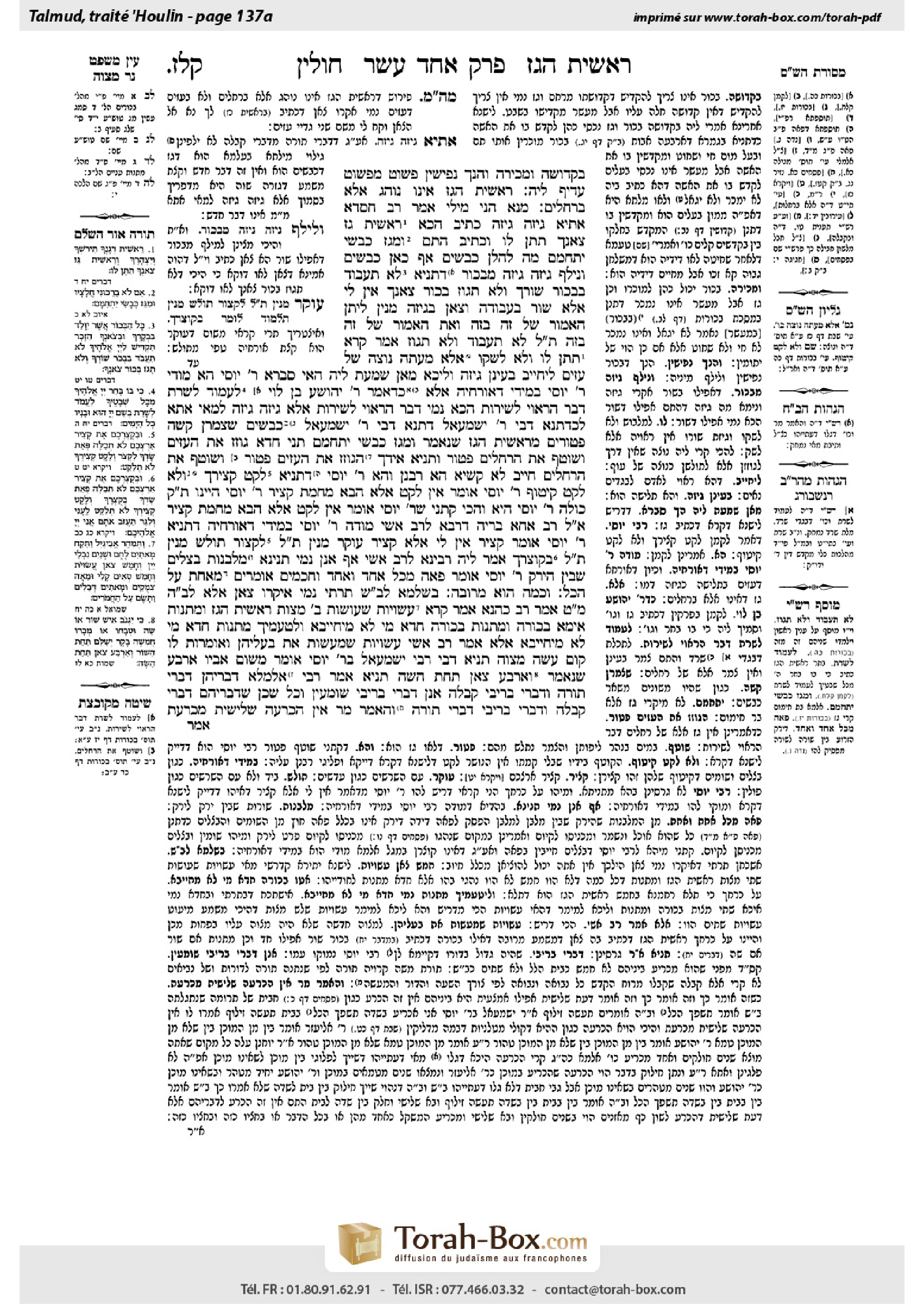
Chullin 137a: Talmud study for Daf Yomi
Study the Talmud for Daf Yomi with scanned pages, Hebrew text, English translations from Sefaria and AI-generated French translations.
Passage selection and English or AI-generated French translation are available where the scan has annotations. Daf Study is independent of Torah-Box and Sefaria.
Browse Chullin · חולין · All tractatesChullin 137a text and translations
This page of Chullin includes the Aramaic text, an English translation and an AI-generated French translation, alongside the scan above.
חולין קל״ז א · Aramaic and Hebrew text
בִּקְדוּשָּׁה, וּמְכִירָה – וְהָנָךְ נְפִישִׁין!
פָּשׁוּט מִפָּשׁוּט עֲדִיף לֵיהּ.
רֵאשִׁית הַגֵּז אֵינוֹ נוֹהֵג אֶלָּא בִּרְחֵלִים. מְנָא הָנֵי מִילֵּי? אָמַר רַב חִסְדָּא: אָתְיָא גִּיזָּה גִּיזָּה, כְּתִיב הָכָא ״רֵאשִׁית גֵּז צֹאנְךָ תִּתֶּן לוֹ״, וּכְתִיב הָתָם ״וּמִגֵּז כְּבָשַׂי יִתְחַמָּם״, מָה לְהַלָּן כְּבָשִׂים, אַף כָּאן כְּבָשִׂים.
וְנֵילַף ״גִּיזָּה״ ״גִּיזָּה״ מִבְּכוֹר, דְּתַנְיָא: ״לֹא תַעֲבֹד בִּבְכֹר שׁוֹרֶךָ וְלֹא תָגֹז בְּכוֹר צֹאנֶךָ״ – אֵין לִי אֶלָּא שׁוֹר בַּעֲבוֹדָה וְצֹאן בְּגִיזָּה.
מִנַּיִן לִיתֵּן הָאָמוּר שֶׁל זֶה בָּזֶה, וְאֶת הָאָמוּר שֶׁל זֶה בָּזֶה? תַּלְמוּד לוֹמַר ״לֹא תַעֲבוֹד וְלֹא תָגוֹז״.
אָמַר קְרָא: ״תִּתֵּן לוֹ״, וְלֹא לְשַׂקּוֹ.
אֶלָּא מֵעַתָּה, נוֹצָה שֶׁל עִזִּים לִיחַיַּיב? בָּעֵינַן גִּיזָּה, וְלֵיכָּא!
מַאן שָׁמְעַתְּ לֵיהּ הַאי סְבָרָא? רַבִּי יוֹסֵי – הָא מוֹדֵי רַבִּי יוֹסֵי בְּמִידֵּי דְּאוֹרְחֵיהּ!
אֶלָּא, כִּדְאָמַר רַבִּי יְהוֹשֻׁעַ בֶּן לֵוִי: ״לַעֲמוֹד לְשָׁרֵת״ – דָּבָר הָרָאוּי לְשֵׁירוּת, הָכָא נָמֵי – דָּבָר הָרָאוּי לְשֵׁירוּת.
אֶלָּא ״גִּיזָּה״ ״גִּיזָּה״ לְמַאי אֲתָא? לְכִדְתָנָא דְּבֵי רַבִּי יִשְׁמָעֵאל, דְּתָנָא דְּבֵי רַבִּי יִשְׁמָעֵאל: כְּבָשִׂים שֶׁצַּמְרָן קָשֶׁה פְּטוּרִים מֵרֵאשִׁית הַגֵּז, שֶׁנֶּאֱמַר ״וּמִגֵּז כְּבָשַׂי יִתְחַמָּם״.
תָּנֵי חֲדָא: גּוֹזֵז אֶת הָעִזִּים וְשׁוֹטֵף אֶת הָרְחֵלִים – פָּטוּר, וְתַנְיָא אִידַּךְ: הַגּוֹזֵז אֶת הָעִזִּים – פָּטוּר, וְשׁוֹטֵף אֶת הָרְחֵלִים – חַיָּיב. לָא קַשְׁיָא: הָא רַבָּנַן, וְהָא רַבִּי יוֹסֵי.
דְּתַנְיָא: ״לֶקֶט קְצִירְךָ״ – וְלֹא לֶקֶט קִיטּוּף. רַבִּי יוֹסֵי אוֹמֵר: אֵין לֶקֶט אֶלָּא הַבָּא מֵחֲמַת קָצִיר.
רַבִּי יוֹסֵי הַיְינוּ תַּנָּא קַמָּא? כּוּלָּהּ רַבִּי יוֹסֵי הִיא, וְהָכִי קָתָנֵי: שֶׁרַבִּי יוֹסֵי אוֹמֵר, אֵין לֶקֶט אֶלָּא הַבָּא מֵחֲמַת קָצִיר.
אֲמַר לֵיהּ רַב אַחָא בְּרֵיהּ דְּרָבָא לְרַב אָשֵׁי: מוֹדֶה רַבִּי יוֹסֵי בְּמִידֵּי דְּאוֹרְחֵיהּ, דְּתַנְיָא: רַבִּי יוֹסֵי אוֹמֵר: ״קָצִיר״ – אֵין לִי אֶלָּא קָצִיר, עוֹקֵר מִנַּיִן?
תַּלְמוּד לוֹמַר ״לִקְצוֹר״, תּוֹלֵשׁ מִנַּיִן? תַּלְמוּד לוֹמַר ״בְּקוּצְרֶךָ״.
אֲמַר לֵיהּ רָבִינָא לְרַב אָשֵׁי: אַף אֲנַן נָמֵי תְּנֵינָא: מַלְבְּנוֹת בְּצָלִים שֶׁבֵּין הַיָּרָק, רַבִּי יוֹסֵי אוֹמֵר: פֵּאָה מִכׇּל אֶחָד וְאֶחָד, וַחֲכָמִים אוֹמְרִים: מֵאַחַת עַל הַכֹּל.
וְכַמָּה הוּא מְרוּבֶּה? בִּשְׁלָמָא לְבֵית שַׁמַּאי – תַּרְתֵּי נָמֵי אִיקְּרוֹ ״צֹאן״, אֶלָּא לְבֵית הִלֵּל – מַאי טַעְמָא?
אָמַר רַב כָּהֲנָא: אָמַר קְרָא ״עֲשׂוּיוֹת״, שֶׁעוֹשׂוֹת שְׁתֵּי מִצְוֹת: רֵאשִׁית הַגֵּז וּמַתָּנוֹת. אֵימָא בְּכוֹרָה וּמַתָּנוֹת?
בְּכוֹרָה, חֲדָא מִי לָא מִיחַיְּיבָא? וּלְטַעְמָיךְ, מַתָּנוֹת, חֲדָא מִי לָא מִיחַיְּיבָא? אֶלָּא אָמַר רַב אָשֵׁי: ״עֲשׂוּיוֹת״ – שֶׁמְּעַשּׂוֹת אֶת בַּעֲלֵיהֶן, וְאוֹמְרוֹת לוֹ: ״קוּם עֲשֵׂה מִצְוָה״.
תַּנְיָא דְּבֵי רַבִּי יִשְׁמָעֵאל בְּרַבִּי יוֹסֵי אוֹמֵר מִשּׁוּם אָבִיו: אַרְבַּע, שֶׁנֶּאֱמַר: ״וְאַרְבַּע צֹאן תַּחַת הַשֶּׂה״.
תַּנְיָא, אָמַר רַבִּי: אִלְמָלֵא דִּבְרֵיהֶן דִּבְרֵי תוֹרָה, וְדִבְרֵי בְּרִיבִּי קַבָּלָה – אֲנַן דִּבְרֵי בְּרִיבִּי שׁוֹמְעִין, וְכׇל שֶׁכֵּן שֶׁדִּבְרֵיהֶם דִּבְרֵי קַבָּלָה, וְדִבְרֵי בְּרִיבִּי דִּבְרֵי תוֹרָה.
וְהָאָמַר מָר: אֵין הַכְרָעָה שְׁלִישִׁית מַכְרַעַת!
Chullin 137a · English translation
The Gemara further states that the matter of consecration applies neither to the mitzva of the first sheared wool nor to the firstborn animal. The firstborn is consecrated from the womb, while the first sheared wool is non-sacred. By contrast, the animal tithe is consecrated by the owner when passed under the rod. And finally, the option of sale by the priest applies to the first sheared wool and the firstborn animal after the priest receives them, whereas the animal tithe may not be sold. The Gemara adds: And these halakhot common to the first sheared wool and the firstborn are more numerous than the halakhot shared by the first sheared wool and the animal tithe. Therefore, Rabbi Shimon should derive the verbal analogy between the first sheared wool and the firstborn.
The Gemara answers: Even so, Rabbi Shimon prefers to derive the halakhot of the first sheared wool, which apply to an ordinary non-firstborn animal, from those of animal tithe, which also apply to an ordinary animal. Rabbi Shimon maintains that the shared factor that the first sheared wool and the animal tithe apply to all animals, not only the first to emerge from the womb, is decisive and overrides the other shared halakhot.
§ The mishna states: The first sheared wool is in effect only with regard to sheep. The Gemara asks: From where are these matters derived? Rav Ḥisda said: It is derived by means of a verbal analogy between shearing mentioned in this context and shearing mentioned elsewhere. It is written here: “The first sheared wool of your flock [tzonekha], shall you give him” (Deuteronomy 18:4), and it is written there that Job says concerning the needy: “And he was warmed with the shearing of my sheep [kevasai]” (Job 31:20). Just as there, the verse is referring specifically to the shearing of sheep, as the term keves is used only with regard to a sheep, so too here, with regard to the first sheared wool, the verse is referring to sheep, despite the fact that the term tzon can be interpreted as referring also to goats.
The Gemara objects: But derive instead a verbal analogy concerning shearing mentioned in this context from shearing mentioned in the case of the firstborn animal: Just as the prohibition against shearing the firstborn also applies to a firstborn ox, so too, the halakhot of the first sheared wool should also apply to oxen. It is prohibited to shear a firstborn ox, as it is taught in a baraita: The verse states: “You shall do no work with the firstborn of your ox, and you shall not shear the firstborn of your flock” (Deuteronomy 15:19). From a straightforward reading of the verse, I have derived only that a firstborn ox may not be used for labor and that a firstborn of an animal from the flock may not be used for shearing.
The baraita continues: From where is it derived to apply the prohibition that was stated about that animal to this one, and the prohibition that was stated about this animal to that one? The verse states: “You shall do no work…and you shall not shear.” The conjunction “and” indicates that the two parts of the verse apply to both animals.
The Gemara explains: One cannot say that oxen are subject to the mitzva of first sheared wool, as the verse states with regard to this mitzva: “Shall you give him,” which indicates that the shearing is given to the priest himself, i.e., for him to wear, and not for use as his sack. The shearing of oxen is fit for use only as sackcloth, not as clothing.
The Gemara objects: If that is so, let one be obligated in the mitzva of the first sheared wool in the case of goats’ hair, as it too can be used for clothing. The Gemara explains: To be obligated in the first sheared wool we require an act of shearing, and goats’ hair is plucked, not sheared.
The Gemara asks: Who did you hear who accepts this reasoning that only an act of shearing renders one obligated in the mitzva of the first sheared wool? This is the opinion of Rabbi Yosei, which the Gemara will soon cite. But Rabbi Yosei concedes that the obligation does exist without the act of shearing in a case where the usual manner of removing the wool is not by shearing. Since goats’ hair is not commonly shorn, the obligation of the first sheared wool should apply.
Rather, the Gemara provides a different source for the mishna’s statement. The reason that the mitzva of first sheared wool applies only to sheep is as Rabbi Yehoshua ben Levi said: It is stated in the verse following the source for the mitzva of first sheared wool: “For the Lord your God has chosen him out of all your tribes, to stand to serve in the name of the Lord, he and his sons forever” (Deuteronomy 18:5). The term “to serve” indicates that the first sheared wool that is given to the priest must consist of a matter fit for the Temple service, i.e., its size must be large enough for use for the priestly garments. Here too, the first sheared wool must be of a matter fit for Temple service, i.e., sheep’s wool, from which the priestly garments are woven.
The Gemara asks: But if so, for what purpose does the verbal analogy between shearing mentioned with regard to the first sheared wool and shearing mentioned with regard to the flock come? The Gemara answers: It is necessary for that which was taught in the school of Rabbi Yishmael. As the school of Rabbi Yishmael taught: In the case of sheep whose wool is hard, the owner is exempt from the first sheared wool, as it is stated: “And he was warmed with the shearing of my sheep” (Job 31:20). Since hard wool does not provide warmth, the mitzva of the first sheared wool does not apply to this wool.
§ It is taught in one baraita: If one shears goats, or washes sheep, which causes some of their wool to be detached, he is exempt from the obligation of first sheared wool with regard to this wool. And it is taught in another baraita: One who shears goats is exempt but one who washes the sheep is obligated to separate the first sheared wool from the wool that was washed off. The Gemara resolves this apparent contradiction: It is not difficult, as this baraita, which requires one to separate the first sheared wool from the washed-off wool, is in accordance with the opinion of the Rabbis, and that baraita, which exempts the washed off wool, is in accordance with the opinion of Rabbi Yosei.
The Gemara cites the source of this dispute. As it is taught in a baraita with regard to the verse: “And when you reap the harvest of your land, you shall not completely remove the corner of your field when you reap, and you shall not gather the gleaning of your harvest; you shall leave them for the poor” (Leviticus 23:22). The phrase “the gleaning of your harvest” indicates that only such a gleaning is included, and not gleaning from picking. If one picks the crop by hand rather than harvesting it using agricultural tools, he is exempt from the mitzva to leave the gleanings for the poor. Rabbi Yosei says: Gleanings are only those that come due to harvesting using agricultural tools.
The Gemara expresses puzzlement at this baraita: The opinion of Rabbi Yosei is identical to the opinion of the first tanna. The Gemara explains: The entire baraita is in accordance with the opinion of Rabbi Yosei, and this is what the baraita is teaching: The phrase “the gleaning of your harvest” teaches that crops picked by hand are exempt from the mitzva, as Rabbi Yosei says: Gleanings are only those that come due to harvesting. The Gemara infers that just as Rabbi Yosei interprets the term “harvest” as exempting crops that were picked by hand, so too he derives from the term “shearing” that the mitzva of the first sheared wool does not apply to fleece that was washed off. The Rabbis, who disagree with Rabbi Yosei with regard to the gleanings, likewise disagree with regard to the first sheared wool.
Rav Aḥa, son of Rava, said to Rav Ashi: Rabbi Yosei concedes that the mitzva of gleanings applies to a case where the usual manner of harvesting is by picking, as it is taught in a baraita with regard to the verse cited above that Rabbi Yosei says: From the term “harvest” I have derived only the obligation of gleanings with regard to harvest. From where do I derive the obligation of gleanings with regard to one who uproots the crop?
The verse states: “And when you reap the harvest of your land, you shall not completely remove the corner of your field by reaping, and you shall not gather the gleaning of your harvest” (Leviticus 19:9). The superfluous term “by reaping” includes uprooting the crop. From where is it derived that the obligation extends to one who picked the crop by hand? The verse states: “When you reap” (Leviticus 23:22), which is also superfluous. It is derived from here that the mitzva applies to all ways of gathering the crop, provided they are the usual manner of harvesting that particular crop.
Ravina said to Ravi Ashi: We learn as well in a mishna (Pe’a 3:4) that discusses the mitzva to leave produce in the corner of the field for the poor [pe’a]: If one has garden beds of onions that are among the vegetables, Rabbi Yosei says that one leaves separate pe’a from each and every one of the beds. And the Rabbis say that one leaves pe’a from one garden bed for all of them. This indicates that Rabbi Yosei concedes that one is obligated to leave pe’a and gleanings from onions, despite the fact that they are picked by hand rather than harvested with tools. The reason is that this is the usual manner of gathering onions.
§ The mishna states: And how many is numerous? Beit Shammai say: It is at least two sheep, and Beit Hillel say: It is at least five sheep. The Gemara objects: Granted, according to the opinion of Beit Shammai, two sheep are also called tzon, as in the verse cited by Beit Shammai: “That a man shall rear a young cow and two sheep [tzon]” (Isaiah 7:21). Since the mitzva of the first sheared wool is written with regard to tzon, it is logical that it applies to two sheep. But what is the reasoning of Beit Hillel, who hold that the mitzva applies only to five sheep, due to the verse: “And five sheep [tzon] made” (I Samuel 25:18)? Why do they not apply the obligation using the broader criterion of two sheep, as the verse quoted by Beit Shammai clearly indicates that two sheep are also called tzon?
Rav Kahana said: The verse states: “Five sheep made [asuyot],” in plural. The plural form indicates that two mitzvot have been made, i.e., performed, with them. The two mitzvot are the first sheared wool and the gifts of the priesthood, a mitzva that applies to a single animal. If the two mitzvot have been performed only when there are five sheep, evidently the mitzva of the first sheared wool applies only to five sheep. The Gemara asks: Why can’t one say that the two mitzvot are the firstborn animal and the gifts of the priesthood?
The Gemara answers: The other mitzva cannot be the firstborn animal, as with regard to the firstborn, isn’t one animal obligated, i.e., doesn’t one animal render its owner obligated? Yet the verse states that one performs the two mitzvot only with five sheep. The Gemara asks: And according to your reasoning, with regard to the gifts of the priesthood, isn’t one animal obligated, i.e., doesn’t one animal render its owner obligated?Rather, Rav Ashi says: The term “made” should be understood as meaning that five sheep make their owner perform the first sheared wool and figuratively say to him: Stand and fulfill a mitzva, whereas less than five sheep do not obligate their owner in the mitzva of first sheared wool.
It was taught in a baraita of the school of Rabbi Yishmael, son of Rabbi Yosei, that he says in the name of his father: The obligation of the first sheared wool applies to one who owns four sheep, since a verse calls four sheep tzon, as it is stated: “If a man steals an ox or a sheep, and kills it or sells it, he shall pay five oxen for the ox, and four sheep [tzon] for a sheep” (Exodus 21:37).
It is taught in a baraita that Rabbi Yehuda HaNasi says: Had their statements, i.e., the opinions of Beit Shammai and Beit Hillel, been based on statements of the Torah, and the statement of the Distinguished One [Beribbi], Rabbi Yosei, based on the texts of the tradition [kabbala], the Prophets and Writings, even so we would listen to the statement of the Distinguished One, Rabbi Yosei. All the more so now that their statements are based on texts of the tradition, as both Beit Shammai and Beit Hillel derived their rulings from verses from the Prophets, while the statement of the Distinguished One, Rabbi Yosei, is based on the statements of the Torah.
The Gemara objects: But didn’t the Master say: The decision of a third opinion that compromises between the first two opinions is not considered decisive if it is based on considerations that were not mentioned by the other two opinions. Although Rabbi Yosei’s opinion is a compromise between the opinions of Beit Shammai and Beit Hillel, it is based on a different source.
Chullin 137a · Traduction française (IA)
La Guemara ajoute que la question de la consécration ne s'applique ni à la Mitsva du premier laine dégagée, ni à l'animal premier. L'animal premier est consacré dès le sein, tandis que la première laine dégagée n'est pas sacrée. En revanche, l'offrande d'animal est consacrée par le propriétaire lorsqu'il est passé sous le bâton. Enfin, l'option de vente par le prêtre s'applique à la première laine dégagée et à l'animal premier après que le prêtre les a reçus, tandis que l'offrande d'animal ne peut pas être vendue. La Guemara ajoute : Et ces halakhot communes à la première laine dégagée et à l'animal premier sont plus nombreuses que celles partagées par la première laine dégagée et l'offrande d'animal. Par conséquent, Rabbi Shimon devrait tirer l'analogie verbale entre la première laine dégagée et l'animal premier.
La Guemara répond : Même ainsi, Rabbi Shimon préfère tirer les halakhot de la première laine dégagée, qui s'appliquent à un animal ordinaire non premier, de celles de l'offrande d'animal, qui s'appliquent également à un animal ordinaire. Rabbi Shimon maintient que le facteur commun qui est que la première laine dégagée et l'offrande d'animal s'appliquent à tous les animaux, pas seulement celui qui sort le premier du sein, est décisif et supprime les autres halakhot partagées.
§ La Michna stipule : La première laine dégagée est valable uniquement en ce qui concerne les moutons. La Guemara pose la question : D'où sont issus ces enseignements ? Rav Ḥisda répond : Cela provient d'une analogie verbale entre la dégagement mentionnée dans ce contexte et la dégagement mentionnée ailleurs. Il est écrit ici : « La première laine dégagée de votre troupeau [tzonekha], tu lui donneras » (Deutéronome 18:4), et il est écrit là que Job parle du pauvre : « Et il fut réchauffé avec la dégagement de mes moutons [kevasai] » (Job 31:20). Tout comme là, la versette fait référence spécifiquement à la dégagement des moutons, car le terme keves est utilisé uniquement en ce qui concerne un mouton, de même ici, en ce qui concerne la première laine dégagée, la versette fait référence aux moutons, malgré le fait que le terme tzon peut être interprété comme concernant aussi les chèvres.
La Guemara s'oppose : Mais dérive plutôt une analogie verbale concernant la tondeuse mentionnée dans ce contexte de la tondeuse mentionnée dans le cas de l'animal premier : Tout comme l'interdiction de tondre l'animal premier s'applique aussi à un premier taureau, de même, les halakhot de la première laine tondue devraient s'appliquer aussi aux taureaux. Il est interdit de tondre un premier taureau, comme il est enseigné dans une baraïta : La versette dit : « Tu ne feras aucun travail avec le premier de ton taureau, et tu ne tondras pas le premier de ton troupeau » (Deutéronome 15:19). À partir d'une lecture directe de la versette, j'ai dérivé seulement que le premier taureau ne peut pas être utilisé pour le travail et que le premier d'un animal du troupeau ne peut pas être utilisé pour la tonte.
La baraïta continue : D'où est-il dérivé appliquer l'interdiction qui a été énoncée à cet animal à celui-ci, et l'interdiction qui a été énoncée à cet animal à celui-là ? La versette dit : « Tu ne feras aucun travail… et tu ne tondras pas. » Le conjonction « et » indique que les deux parties de la versette s'appliquent aux deux animaux.
La Guemara explique : On ne peut pas dire que les taureaux sont soumis à la Mitsva de la première laine dégagée, car la versette concernant cette Mitsva dit : « Tu lui donneras », ce qui indique que la laine dégagée est donnée au prêtre lui-même, c'est-à-dire pour qu'il la porte, et non pour l'utiliser comme son sac. La laine dégagée des taureaux est adaptée uniquement à l'utilisation comme tissu de sac, pas comme vêtements.
La Guemara s'oppose : Si c'est ainsi, pourquoi serait-on tenu de la Mitsva de la première laine dégagée dans le cas des cheveux de chèvre, car ils peuvent aussi être utilisés pour la confection de vêtements. La Guemara explique : Pour être tenu de la première laine dégagée, on exige un acte de dégagement, et les cheveux de chèvre sont arrachés, pas dégagés.
La Guemara demande : Qui as-tu entendu qui accepte cette raison que seul un acte de dégagement rend tenu de la Mitsva de la première laine dégagée ? C'est l'opinion de Rabbi Yosei, que la Guemara citera bientôt. Mais Rabbi Yosei reconnaît que l'obligation existe sans l'acte de dégagement dans le cas où la manière habituelle de retirer la laine n'est pas par dégagement. Puisque les cheveux de chèvre ne sont pas habituellement dégagés, l'obligation de la première laine dégagée devrait s'appliquer.
Plutôt, la Guemara fournit une autre source pour l'affirmation de la Misha'na. La raison pour laquelle la Mitsva de la première laine dégagée s'applique uniquement aux moutons est, selon Rabbi Yehoshua ben Levi, comme il est dit dans la versette suivant la source de la Mitsva de la première laine dégagée : « Car l'Éternel votre Dieu a choisi celui-ci parmi tous vos tribus, pour qu'il demeure pour servir en nom de l'Éternel, lui et ses fils pour toujours » (Deutéronome 18:5). Le terme « pour servir » indique que la première laine dégagée donnée au prêtre doit être une matière adaptée au service du Temple, c'est-à-dire qu'elle doit être suffisamment grande pour être utilisée pour les vêtements sacrés. Ici aussi, la première laine dégagée doit être une matière adaptée au service du Temple, c'est-à-dire la laine des moutons, à partir de laquelle sont tissés les vêtements sacrés.
La Guemara demande : Mais si c'est ainsi, à quel effet sert l'analogie verbale entre la dégagement mentionné concernant la première laine dégagée et la dégagement mentionné concernant le troupeau ? La Guemara répond : C'est nécessaire pour ce qui a été enseigné dans l'école de Rabbi Yishmael. Comme l'école de Rabbi Yishmael a enseigné : Dans le cas des moutons dont la laine est dure, l'propriétaire est exempt de la première laine dégagée, car il est dit : « Et il fut réchauffé avec la dégagement de mes moutons » (Job 31:20). Puisque la laine dure ne procure pas de chaleur, la Mitsva de la première laine dégagée ne s'applique pas à cette laine.
§ Il est enseigné dans une baraïta : Si l'on tond les chèvres ou lave les moutons, ce qui provoque le détachement de certaines touffes de laine, on est exempt de l'obligation de séparer la première laine tondue concernant cette laine. Et il est enseigné dans une autre baraïta : Celui qui tond les chèvres est exempt, mais celui qui lave les moutons est tenu de séparer la première laine tondue de la laine qui a été lavée. La Guemara résout cette contradiction apparente : Ce n'est pas difficile, car cette baraïta, qui exige de séparer la première laine tondue de la laine lavée, est selon l'opinion des Rabbins, et cette baraïta, qui exempt la laine lavée, est selon l'opinion de Rabbi Yosei.
La Guemara cite la source de ce débat. Comme il est enseigné dans une baraïta concernant la parole : « Et quand tu moissonneras la récolte de ton champ, tu ne devras pas enlever entièrement la bordure de ton champ quand tu moissonneras, et tu ne devras pas réunir la récolte de ton champ ; tu la laisseras pour les pauvres » (Lévitique 23:22). La phrase « la récolte de ton champ » indique que seule cette récolte est incluse, et non la récolte provenant de la cueillette. Si l'on cueille les récoltes à la main plutôt que de les moissonner avec des outils agricoles, on est exempt de la mitsva de laisser les récoltes pour les pauvres. Rabbi Yosei dit : Les récoltes sont seulement celles qui proviennent de la moisson avec des outils agricoles.
La Guemara exprime son perplexité face à cette baraïta : L'opinion de Rabbi Yosei est identique à celle du premier tanna. La Guemara explique : L'ensemble de la baraïta est selon l'opinion de Rabbi Yosei, et c'est ce que la baraïta enseigne : La phrase « la récolte de ton champ » enseigne que les récoltes cueillies à la main sont exemptes de la mitsva, comme Rabbi Yosei dit : Les récoltes sont seulement celles qui proviennent de la moisson. La Guemara déduit que tout comme Rabbi Yosei interprète le terme « moisson » comme exemptant les récoltes cueillies à la main, ainsi il dérive du terme « tondage » que la mitsva de la première laine tondue ne s'applique pas à la laine lavée. Les Rabbins, qui s'opposent à Rabbi Yosei concernant les récoltes, s'opposent également concernant la première laine tondue.
Rav Acha, fils de Rava, dit à Rav Ashi : Rabbi Yosei reconnaît que la mitsva des récoltes s'applique à un cas où la méthode habituelle de moisson est la cueillette, comme il est enseigné dans une baraïta concernant la parole citée ci-dessus que Rabbi Yosei dit : De la parole « moisson », j'ai déduit seulement l'obligation des récoltes concernant la moisson. D'où déduit-on l'obligation des récoltes concernant celui qui arrache la récolte ?
La parole dit : « Et quand tu moissonneras la récolte de ton champ, tu ne devras pas enlever entièrement la bordure de ton champ par la moisson, et tu ne devras pas réunir la récolte de ton champ » (Lévitique 19:9). Le terme superflu « par la moisson » inclut l'arrachage de la récolte. D'où déduit-on que l'obligation s'étend à celui qui a cueilli la récolte à la main ? La parole dit : « Quand tu moissonneras » (Lévitique 23:22), qui est aussi superflu. On en déduit ici que la mitsva s'applique à toutes les manières de récolter la récolte, à condition qu'elles soient la méthode habituelle de récolte de cette récolte particulière.
Ravina dit à Rav Ashi : Nous apprenons également dans une mitsva (Pe’a 3:4) concernant l'obligation de laisser des produits dans la bordure du champ pour les pauvres [pe’a] : Si l'on a des lits d'oignons qui sont parmi les légumes, Rabbi Yosei dit qu'on laisse une pe’a séparée de chaque lit. Et les Rabbins disent qu'on laisse une pe’a d'un seul lit pour tous. Cela indique que Rabbi Yosei reconnaît que l'on est tenu de laisser une pe’a et des récoltes d'oignons, malgré le fait qu'ils sont cueillis à la main plutôt que récoltés avec des outils. La raison est que c'est la méthode habituelle de récolte des oignons.
§ La mitsva dit : Et combien est nombreux ? Beit Shammai dit : C'est au moins deux brebis, et Beit Hillel dit : C'est au moins cinq brebis. La Guemara s'interroge : D'accord, selon l'opinion de Beit Shammai, deux brebis sont aussi appelées tzon, comme dans la parole citée par Beit Shammai : « Que l'homme élève une jeune vache et deux brebis [tzon] » (Yézra 7:21). Puisque la Mitsva de la première laine tondue est écrite concernant tzon, il est logique qu'elle s'applique à deux brebis. Mais quelle est la raison de Beit Hillel, qui affirme que la Mitsva s'applique seulement à cinq brebis, d'après la parole : « Et cinq brebis [tzon] ont été faites » (1 Samuel 25:18) ? Pourquoi ne pas appliquer l'obligation avec le critère plus large de deux brebis, comme la parole citée par Beit Shammai indique clairement que deux brebis sont aussi appelées tzon ?
Rav Kahana dit : La parole dit : « Cinq brebis ont été faites [asuyot] », au pluriel. La forme plurielle indique que deux mitsvot ont été accomplies, c'est-à-dire exécutées, avec elles. Les deux mitsvot sont la première laine tondue et les offrandes du sanctuaire, une mitsva qui s'applique à un seul animal. Si les deux mitsvot ont été accomplies seulement lorsqu'il y a cinq brebis, évidemment la mitsva de la première laine tondue s'applique seulement à cinq brebis. La Guemara demande : Pourquoi ne pas dire que les deux mitsvot sont l'animal premier-né et les offrandes du sanctuaire ?
La Guemara répond : L'autre mitsva ne peut pas être l'animal premier-né, car concernant l'animal premier-né, n'est-ce pas un seul animal qui rend son propriétaire obligé, c'est-à-dire qu'un seul animal rend son propriétaire obligé ? Cependant la parole dit que l'on accomplit les deux mitsvot seulement avec cinq brebis. La Guemara demande : Et selon votre raisonnement, concernant les offrandes du sanctuaire, n'est-ce pas un seul animal qui rend son propriétaire obligé, c'est-à-dire qu'un seul animal rend son propriétaire obligé ? Plutôt, Rav Ashi dit : Le terme « faites » doit être compris comme signifiant que cinq brebis font leur propriétaire exécuter la première laine tondue et figurativement lui disent : Debout et accomplis une mitsva, tandis que moins de cinq brebis ne rendent leur propriétaire obligé à la mitsva de la première laine tondue.
Il a été enseigné dans une baraïta de la maison de Rabbi Yishmael, fils de Rabbi Yosei, qu'il dit en nom de son père : L'obligation de la laine première s'applique à celui qui possède quatre brebis, puisqu'un verset appelle quatre brebis tzon, comme il est dit : « Si un homme vole un bœuf ou une brebis, et le tue ou le vend, il devra payer cinq bœufs pour le bœuf, et quatre brebis [tzon] pour une brebis » (Exode 21:37).
Il a été enseigné dans une baraïta que Rabbi Yehuda HaNasi dit : Si leurs déclarations, c'est-à-dire les opinions de Beit Shammai et de Beit Hillel, avaient été basées sur les déclarations de la Torah, et la déclaration du Distingué [Beribbi], Rabbi Yosei, sur les textes de la tradition [kabbala], des Prophètes et des Ecritures, même ainsi nous aurions écouté la déclaration du Distingué, Rabbi Yosei. Et encore davantage maintenant que leurs déclarations sont basées sur des textes de la tradition, puisque Beit Shammai et Beit Hillel ont tiré leurs décisions de versets des Prophètes, tandis que la déclaration du Distingué, Rabbi Yosei, est basée sur les déclarations de la Torah.
La Guemara s'oppose en disant : Mais n'a-t-il pas dit le Maître : La décision d'une troisième opinion qui s'interpose entre les deux premières opinions n'est pas considérée comme décisive si elle est basée sur des considérations non mentionnées par les deux autres opinions. Bien que l'opinion de Rabbi Yosei soit un compromis entre les opinions de Beit Shammai et de Beit Hillel, elle est basée sur une source différente.
Traduction française générée par IA à partir de l’édition anglaise de Sefaria. Vérifie toujours un passage avec le texte source.
Text from Sefaria: William Davidson Edition - Vocalized Aramaic (unknown); William Davidson Edition - English (CC BY NC).