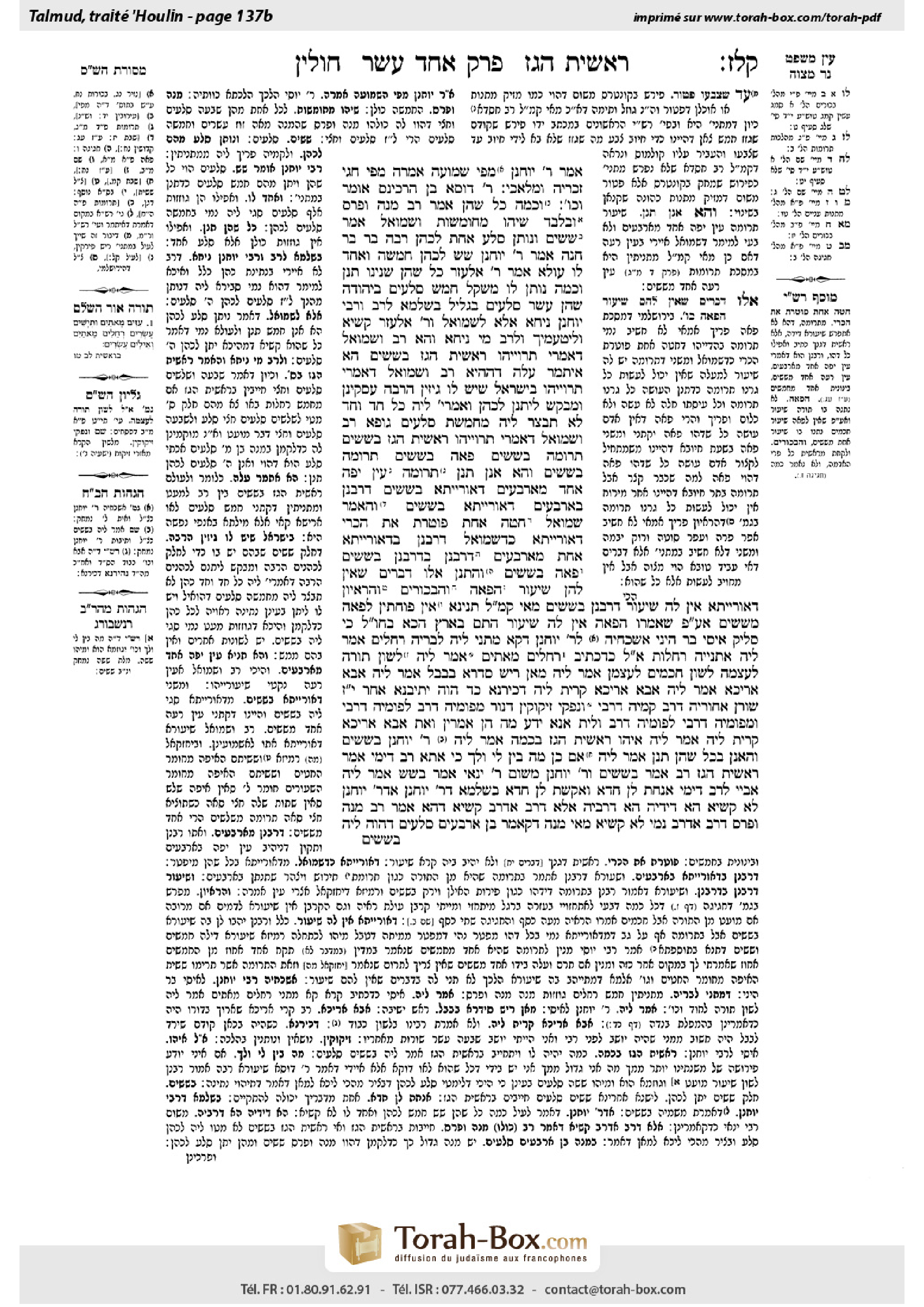
Chullin 137b: Talmud study for Daf Yomi
Study the Talmud for Daf Yomi with scanned pages, Hebrew text, English translations from Sefaria and AI-generated French translations.
Passage selection and English or AI-generated French translation are available where the scan has annotations. Daf Study is independent of Torah-Box and Sefaria.
Browse Chullin · חולין · All tractatesChullin 137b text and translations
This page of Chullin includes the Aramaic text, an English translation and an AI-generated French translation, alongside the scan above.
חולין קל״ז ב · Aramaic and Hebrew text
אָמַר רַבִּי יוֹחָנָן: מִפִּי שְׁמוּעָה אָמְרָה, מִפִּי חַגַּי זְכַרְיָה וּמַלְאָכִי.
רַבִּי דּוֹסָא בֶּן הַרְכִּינָס אוֹמֵר וְכוּ׳. וְכַמָּה ״כׇּל שֶׁהֵן״? אָמַר רַב: מָנֶה וּפְרָס, וּבִלְבַד שֶׁיְּהוּ מְחוּמָּשׁוֹת, וּשְׁמוּאֵל אָמַר: שִׁשִּׁים, וְנוֹתֵן סֶלַע אַחַת לְכֹהֵן.
רַבָּה בַּר בַּר חָנָה אָמַר רַבִּי יוֹחָנָן: שֵׁשׁ – לְכֹהֵן חָמֵשׁ, וְאַחַת לוֹ. עוּלָּא אָמַר רַבִּי אֶלְעָזָר: ״כׇּל שֶׁהֵן״ שָׁנִינוּ.
תְּנַן: וְכַמָּה נוֹתֵן לוֹ? מִשְׁקַל חֲמֵשׁ סְלָעִים בִּיהוּדָה, שֶׁהֵן עֶשֶׂר סְלָעִים בַּגָּלִיל. בִּשְׁלָמָא לְרַב וְרַבִּי יוֹחָנָן – נִיחָא, אֶלָּא לִשְׁמוּאֵל וְרַבִּי אֶלְעָזָר – קַשְׁיָא!
וְלִיטַעְמָיךְ, וּלְרַב מִי נִיחָא? וְהָא רַב וּשְׁמוּאֵל דְּאָמְרִי תַּרְוַיְיהוּ: רֵאשִׁית הַגֵּז בְּשִׁשִּׁים!
הָא אִיתְּמַר עֲלַהּ דְּהַהִיא, רַב וּשְׁמוּאֵל דְּאָמְרִי תַּרְוַיְיהוּ: בְּיִשְׂרָאֵל שֶׁיֵּשׁ לוֹ גִּיזִּין הַרְבֵּה עָסְקִינַן, וּמְבַקֵּשׁ לִיתְּנָן לְכֹהֵן, וְאָמְרִינַן לֵיהּ: כֹּל חַד וְחַד לָא תְּבַצַּר לֵיהּ מֵחֲמֵשֶׁת סְלָעִים.
גּוּפָא: רַב וּשְׁמוּאֵל דְּאָמְרִי תַּרְוַיְיהוּ: רֵאשִׁית הַגֵּז בְּשִׁשִּׁים, תְּרוּמָה בְּשִׁשִּׁים, פֵּאָה בְּשִׁשִּׁים.
תְּרוּמָה בְּשִׁשִּׁים? וְהָא אֲנַן תְּנַן: תְּרוּמָה עַיִן יָפָה – אֶחָד מֵאַרְבָּעִים! דְּאוֹרָיְיתָא – בְּשִׁשִּׁים, דְּרַבָּנַן – בְּאַרְבָּעִים.
דְּאוֹרָיְיתָא בְּשִׁשִּׁים? וְהָאָמַר שְׁמוּאֵל: חִטָּה אַחַת פּוֹטֶרֶת אֶת הַכְּרִי! דְּאוֹרָיְיתָא – כְּדִשְׁמוּאֵל, דְּרַבָּנַן בִּדְאוֹרָיְיתָא – אַחַת מֵאַרְבָּעִים, דְּרַבָּנַן בִּדְרַבָּנַן – בְּשִׁשִּׁים.
פֵּאָה בְּשִׁשִּׁים, וְהָתְנַן: אֵלּוּ דְּבָרִים שֶׁאֵין לָהֶן שִׁיעוּר: הַפֵּאָה, וְהַבִּכּוּרִים, וְהָרֵאָיוֹן. דְּאוֹרָיְיתָא – אֵין לָהּ שִׁיעוּר, דְּרַבָּנַן – בְּשִׁשִּׁים.
מַאי קָא מַשְׁמַע לַן? תְּנֵינָא: אֵין פּוֹחֲתִין לַפֵּאָה מִשִּׁשִּׁים, אַף עַל פִּי שֶׁאָמְרוּ הַפֵּאָה אֵין לָהּ שִׁיעוּר! הָתָם בָּאָרֶץ, הָכָא בְּחוּצָה לָאָרֶץ.
כִּי סְלֵיק אִיסִי בַּר הִינִי, אַשְׁכְּחֵיהּ (לְרַבִּי) [רַבִּי] יוֹחָנָן דְּקָא מַתְנֵי לֵיהּ לִבְרֵיהּ ״רְחֵלִים״, אֲמַר לֵיהּ: אַתְנְיֵיהּ ״רְחֵלוֹת״, אֲמַר לֵיהּ: כְּדִכְתִיב ״רְחֵלִים מָאתַיִם״, אֲמַר לֵיהּ: לְשׁוֹן תּוֹרָה לְעַצְמָהּ, לְשׁוֹן חֲכָמִים לְעַצְמָן.
אֲמַר לֵיהּ: מַאן רֵישׁ סִדְרָא בְּבָבֶל? אֲמַר לֵיהּ: אַבָּא אֲרִיכָא. אֲמַר לֵיהּ: אַבָּא אֲרִיכָא קָרֵית לֵיהּ?! דְּכִירְנָא כַּד הֲוָה יָתֵיבְנָא אַחַר שְׁבַע עֶשְׂרֵה שׁוּרָן אֲחוֹרֵיהּ דְּרַב קַמֵּיהּ דְּרַבִּי, וְנָפְקִי זִיקּוּקִין דְּנוּר מִפּוּמֵּיהּ דְּרַב לְפוּמֵּיהּ דְּרַבִּי, וּמִפּוּמֵּיהּ דְּרַבִּי לְפוּמֵּיהּ דְּרַב, וְלֵית אֲנָא יָדַע מָה הֵן אָמְרִין, וְאַתְּ ״אַבָּא אֲרִיכָא״ קָרֵית לֵיהּ?!
אֲמַר לֵיהּ אִיהוּ: רֵאשִׁית הַגֵּז בְּכַמָּה? אֲמַר לֵיהּ רַבִּי יוֹחָנָן: בְּשִׁשִּׁים. וְהָאֲנַן ״בְּכׇל שֶׁהֵן״ תְּנַן! אֲמַר לֵיהּ: אִם כֵּן, מָה בֵּין לִי וְלָךְ?
כִּי אֲתָא רַב דִּימִי, אָמַר: רֵאשִׁית הַגֵּז – רַב אָמַר בְּשִׁשִּׁים, וְרַבִּי יוֹחָנָן מִשּׁוּם רַבִּי יַנַּאי אָמַר בְּשֵׁשׁ. אֲמַר לֵיהּ אַבָּיֵי לְרַב דִּימִי: אַנַּחְתְּ לַן חֲדָא וְאַקְשֵׁת לַן חֲדָא.
בִּשְׁלָמָא דְּרַבִּי יוֹחָנָן אַדְּרַבִּי יוֹחָנָן לָא קַשְׁיָא: הָא דִידֵיהּ, הָא דְרַבֵּיהּ.
אֶלָּא דְּרַב אַדְּרַב קַשְׁיָא, דְּהָא אָמַר רַב מָנֶה וּפְרָס! דְּרַב אַדְּרַב נָמֵי לָא קַשְׁיָא, מַאי מָנֶה דְּקָאָמַר? בֶּן אַרְבָּעִים סְלָעִים, דַּהֲוָה לֵיהּ
Chullin 137b · English translation
Rabbi Yoḥanan says in response: Rabbi Yehuda HaNasi accepted Rabbi Yosei’s opinion not because it was a compromise, but rather because he said it according to a tradition he had from the prophets Haggai, Zechariah, and Malachi.
§ The mishna states: Rabbi Dosa ben Harkinas says that the mitzva of the first sheared wool applies to five sheep, each of whose shearing weighs one hundred and fifty dinars, whereas the Rabbis say: Five sheep, each of whose shearing is any amount. The Gemara asks: And how much is signified by the phrase: Any amount? Rav says: It is a total weight of one hundred dinars [maneh] and half of one hundred dinars [peras], provided that they are divided equally between the five sheep. And Shmuel says: It is a total weight of sixty sela, of which he gives the weight of one sela to the priest.
Rabba bar bar Ḥana says that Rabbi Yoḥanan says: It is a total weight of six sela, of which he gives to the priest the weight of five sela, and he leaves one sela for himself. Ulla says that Rabbi Elazar says: We learned in the mishna that according to the Rabbis the obligation of the first sheared wool applies to any amount, even if the total weight is only one sela.
We learned in the mishna (135a): And how much does one give to the priest? One gives him sheared wool of the weight of five sela in Judea, which are the equivalent of ten sela in the Galilee. Granted, according to the opinions of Rav and Rabbi Yoḥanan, the mishna works out well, as their statements do not contradict the mishna. Rav does not discuss the amount one is required to give the priest, and Rabbi Yoḥanan states that one gives the priest five sela. But according to Shmuel and Rabbi Elazar, the mishna is difficult, as Shmuel states that one is required to give one sela, while Rabbi Elazar states that the obligation of the first sheared wool applies even for a weight of less than five sela.
The Gemara responds: And according to your reasoning, does it work out well according to the opinion of Rav? But Rav and Shmuel both say that the first sheared wool given to the priest is one part in sixty. Rav holds that the weight of one hundred and fifty dinars renders one obligated in the first sheared wool, and one-sixtieth of this weight is less than one sela. Therefore, Rav’s opinion is also not in accordance with the mishna.
The Gemara answers: It was stated with regard to that mishna that Rav and Shmuel both say: The five sela stated in the mishna is not referring to the total amount given from the sheared wool. Rather, in the mishna we are dealing with a Jew who has a large amount of shearing, and he wishes to give them to the priest, i.e., to several priests. And we say to him: With regard to each and every one of the priests, do not give him less than five sela. But if one has only a small amount of shearing, he gives the priest one-sixtieth of the shearing, even if it is less than five sela.
§ The Gemara mentioned a ruling of Rav and Shmuel with regard to the amount that one is required to give as the first sheared wool. The Gemara discusses the matter itself. Rav and Shmuel both say: The first sheared wool given to the priest is one part of sixty. Likewise, the amount one is required to separate as teruma is one part of sixty, and the amount one must leave in his field as pe’a is one part of sixty.
The Gemara asks: Is the amount one is required to separate as teruma one part of sixty? But didn’t we learn in a mishna (Terumot 4:3): With regard to the measure one should separate as teruma, if one is of generous disposition he gives one-fortieth. The Gemara answers: By Torah law, it is sufficient to give one part of sixty; by rabbinic law the requisite amount is one part of forty.
The Gemara asks: Is the measure of teruma by Torah law one part of sixty? But doesn’t Shmuel say: By Torah law, even one grain of wheat given as teruma exempts the entire pile [keri] of grain? The Gemara answers: By Torah law the measure is as stated by Shmuel, that even one grain of wheat is sufficient. By rabbinic law, with regard to produce that is obligated in teruma by Torah law the measure is one-fortieth, whereas by rabbinic law, with regard to produce obligated in teruma by rabbinic law the measure is one part of sixty.
Rav and Shmuel said above that the amount one is required to leave in his field as pe’a is one part out of sixty. The Gemara raises a difficulty: But didn’t we learn in a mishna (Pe’a 1:1): These are the matters, i.e., mitzvot, that have no measure: Pe’a, and the first fruits, and the burnt offering of appearance sacrificed on the pilgrimage Festivals. The Gemara answers: By Torah law, pe’a has no fixed measure; by rabbinic law the measure is one part of sixty.
The Gemara asks: What is the statement of Rav and Shmuel teaching us? We already learn in the subsequent mishna (Pe’a 1:2): One should not give for pe’a less than one part of sixty, even though they said that the mitzva of pe’a has no measure. The Gemara answers: The mishna there is referring to the obligation to leave pe’a in Eretz Yisrael, whereas here, the statement of Rav and Shmuel is referring to the obligation of pe’a outside of Eretz Yisrael.
§ When Isi bar Hini ascended from Babylonia to Eretz Yisrael, Rabbi Yoḥanan found him teaching the mishna to his son. Isi taught that the obligation of the first sheared wool applies only in the case of sheep [reḥelim], the masculine plural form of raḥel, meaning a sheep. Rabbi Yoḥanan said to Isi: You should teach him using the term reḥelot, the feminine plural form. Isi said to him in reply: I teach the mishna in accordance with that which is written: “Two hundred reḥelim” (Genesis 32:15). Rabbi Yoḥanan said to Isi: The language of the Torah is distinct and the language of the Sages is distinct, i.e., these are like two separate languages, and the Sages do not always use the same forms that appear in the Bible. In this case, they use reḥelot rather than reḥelim.
Rabbi Yoḥanan said to Isi: Who is the head of the yeshiva [reish sidra] in Babylonia? Isi said to Rabbi Yoḥanan: It is Abba the tall, i.e., the amora Rav. Rabbi Yoḥanan said to Isi: You call him Abba the tall, in such a familiar manner? I remember when I sat seventeen rows behind Rav, who sat before Rabbi Yehuda HaNasi, and fiery sparks emerged from the mouth of Rav to the mouth of Rabbi Yehuda HaNasi, and from the mouth of Rabbi Yehuda HaNasi to the mouth of Rav, and I did not know what they said, due to the profundity of their discussion. And yet you call him Abba the tall?
Isi said to Rabbi Yoḥanan: With regard to the first sheared wool, to how much fleece does the mitzva apply? Rabbi Yoḥanan said to him: The first sheared wool applies to fleece weighing sixty sela. Isi asked: But didn’t we learn in the mishna (135a) that the first sheared wool applies to any amount of fleece? Rabbi Yoḥanan said to him in reply: If so, i.e., if the halakha could be understood by a simple reading of the mishna, what is the difference between my knowledge and yours? In fact, you know only the mishna’s statement, whereas I know the halakhic conclusion in this matter.
§ When Rav Dimi came from Eretz Yisrael to Babylonia, he said: With regard to the first sheared wool, Rav says that the mitzva applies to sixty sela, and Rabbi Yoḥanan in the name of Rabbi Yannai says that the mitzva applies to six sela. Abaye said to Rav Dimi: You have made one statement work out well for us, but you have made another statement difficult for us.
Abaye elaborates: Granted, you have resolved a contradiction between two statements of Rabbi Yoḥanan. Rabbi Yoḥanan said above that the amount of fleece to which the obligation of the first sheared wool applies is six sela, whereas in his answer to Isi he stated that the amount is sixty sela. According to Rav Dimi, the apparent contradiction between one statement of Rabbi Yoḥanan and the other statement of Rabbi Yoḥanan is not difficult, as this statement is his and that statement is his teacher’s. Rabbi Yoḥanan holds that the obligation applies to sixty sela, whereas his teacher Rabbi Yannai maintains that it applies to six sela.
But the contradiction between one statement of Rav and another statement of Rav poses a difficulty, as Rav said that fleece weighing one hundred dinars [maneh] and half of one hundred dinars [maneh] is obligated in the first sheared wool, whereas Rav Dimi stated that according to Rav the obligation applies to sixty sela, which are 240 dinars. The Gemara answers: The apparent contradiction between the one statement of Rav and the other statement of Rav is also not difficult, as what is the maneh of which Rav said that a maneh and a half are obligated? Rav was referring not to a maneh of one hundred dinars but to a maneh of forty sela, i.e., 160 dinars, a maneh and a half of which is
Chullin 137b · Traduction française (IA)
Rabbi Yoḥanan dit en réponse : Rabbi Yehuda HaNasi a adopté l'opinion de Rabbi Yosei non pas par compromis, mais parce qu'il disait qu'elle était fondée sur une tradition qu'il avait reçue des prophètes Haggai, Zacharie et Malachie.
§ La mitsva stipule : Rabbi Dosa ben Harkinas dit que la mitsva du premier laine tondue s'applique à cinq brebis, chacune dont la tonte pèse cent cinquante dinars, tandis que les Rabbins disent : cinq brebis, chacune dont la tonte a une quantité quelconque. La Guemara pose la question : Et quelle quantité signifie l'expression « quantité quelconque » ? Rav dit : C'est un poids total de cent dinars [maneh] et la moitié de cent dinars [peras], à condition qu'ils soient divisés également entre les cinq brebis. Et Shmuel dit : C'est un poids total de soixante sela, dont on donne un sela au prêtre.
Rabba bar bar Ḥana dit que Rabbi Yoḥanan dit : C'est un poids total de six sela, dont on donne au prêtre un poids de cinq sela, et on garde un sela pour soi. Ulla dit que Rabbi Elazar dit : Nous avons appris dans la mitsva que selon les Rabbins, l'obligation du premier laine tondue s'applique à toute quantité, même si le poids total est seulement un sela.
Nous avons appris dans la Michna (135a) : Et combien doit-on donner au prêtre ? On lui donne de la laine tondue dont le poids est de cinq sela en Judée, ce qui équivaut à dix sela en Galilée. Cela est conforme aux opinions de Rav et de Rabbi Yoḥanan, car leurs déclarations ne contredisent pas la Michna. Rav ne discute pas la quantité à donner au prêtre, et Rabbi Yoḥanan dit que l'on doit donner au prêtre cinq sela. Mais selon Shmuel et Rabbi Elazar, la Michna est difficile, car Shmuel dit que l'on doit donner un sela, tandis que Rabbi Elazar dit que l'obligation du premier laine tondue s'applique même pour un poids inférieur à cinq sela.
La Guemara répond : Et selon votre raisonnement, cela est-il conforme à l'opinion de Rav ? Mais Rav et Shmuel disent tous deux que la laine tondue donnée au prêtre est une part sur soixante. Rav considère que le poids de cent cinquante dinars rend l'individu obligé de donner la laine tondue, et que la sixième partie de ce poids est inférieure à un sela. Ainsi, l'opinion de Rav ne correspond pas non plus à la Michna.
La Guemara répond : Il a été dit concernant cette Michna que Rav et Shmuel disent tous deux : Les cinq sela mentionnés dans la Michna ne se réfèrent pas au total à donner de la laine tondue. En réalité, dans la Michna nous parlons d'un Juif qui a une grande quantité de tonte, et qui souhaite la donner au prêtre, c'est-à-dire à plusieurs prêtres. Et nous disons à lui : Concernant chaque prêtre, ne lui donnez pas moins de cinq sela. Mais si l'on a seulement une petite quantité de tonte, on donne au prêtre une part sur soixante, même si cela est inférieur à cinq sela.
§ La Guemara mentionne un jugement de Rav et de Shmuel concernant la quantité à donner comme première laine tondue. La Guemara discute la question elle-même. Rav et Shmuel disent tous deux : La première laine tondue donnée au prêtre est une part sur soixante. De même, la quantité à séparer comme terouma est une part sur soixante, et la quantité à laisser dans son champ comme pe’a est une part sur soixante.
La Guemara pose la question : La quantité à séparer comme terouma est-elle une part sur soixante ? Mais n'avons-nous pas appris dans une mitsna (Terumot 4:3) : Concernant la mesure à séparer comme terouma, si l'on est généreux, on donne un quart. La Guemara répond : Par la loi divine, il suffit de donner une part sur soixante ; par la loi rabbinique, la quantité requise est une part sur quarante.
La Guemara pose la question : La mesure de terouma par la loi divine est-elle une part sur soixante ? Mais n'a-t-on pas dit que Shmuel dit : Par la loi divine, même une graine de blé donnée comme terouma exempt l'ensemble [keri] du blé ? La Guemara répond : Par la loi divine, la mesure est celle que dit Shmuel, à savoir que même une graine de blé suffit. Par la loi rabbinique, concernant les produits obligés en terouma par la loi divine, la mesure est une part sur quarante, tandis que par la loi rabbinique, concernant les produits obligés en terouma par la loi rabbinique, la mesure est une part sur soixante.
Rav et Shmuel dirent ci-dessus que la quantité à laisser dans son champ comme pe’a est une part sur soixante. La Guemara soulève une difficulté : Mais n'avons-nous pas appris dans une mitsna (Pe’a 1:1) : Ces sont les choses, c'est-à-dire les mitsvot, qui n'ont pas de mesure : la pe’a, et les premiers fruits, et l'holocauste de présentation sacrifié aux fêtes de pèlerinage. La Guemara répond : Par la loi divine, la pe’a n'a pas de mesure fixe ; par la loi rabbinique, la mesure est une part sur soixante.
La Guemara pose la question : Qu'enseignent les déclarations de Rav et de Shmuel ? Nous apprenons déjà dans la mitsna suivante (Pe’a 1:2) : On ne doit pas donner pour la pe’a moins d'une part sur soixante, même si l'on dit que la mitsva de la pe’a n'a pas de mesure. La Guemara répond : La mitsna là est concernant l'obligation de laisser la pe’a en Terre d'Israël, tandis que l'affirmation de Rav et de Shmuel est concernant l'obligation de la pe’a en dehors de la Terre d'Israël.
§ Quand Isi bar Hini est monté de Babylone vers la Terre d'Israël, Rabbi Yoḥanan l'a trouvé enseignant la mitsna à son fils. Isi enseignait que l'obligation de la première laine tondue s'applique uniquement aux brebis [reḥelim], le pluriel masculin de raḥel, signifiant une brebis. Rabbi Yoḥanan a dit à Isi : Tu devrais enseigner à l'enfant en utilisant le terme reḥelot, le pluriel féminin. Isi a répondu à lui : Je fais enseigner la mitsna selon ce qui est écrit : « Deux cents reḥelim » (Genèse 32:15). Rabbi Yoḥanan a dit à Isi : La langue de la Torah est distincte et la langue des Sages est distincte, c'est-à-dire que ces deux langues sont distinctes, et les Sages n'utilisent pas toujours les mêmes formes que dans la Bible. Dans ce cas, ils utilisent reḥelot plutôt que reḥelim.
Rabbi Yoḥanan a dit à Isi : Qui est la tête de la yeshiva [reish sidra] en Babylone ? Isi a dit à Rabbi Yoḥanan : C'est Abba le grand, c'est-à-dire l'amora Rav. Rabbi Yoḥanan a dit à Isi : Vous l'appellez Abba le grand, avec une telle familiarité ? Je me souviens lorsque j'étais assis dix-sept rangs derrière Rav, qui était assis devant Rabbi Yehuda HaNasi, et des étincelles fiévreuses sortaient de la bouche de Rav jusqu'à la bouche de Rabbi Yehuda HaNasi, et de la bouche de Rabbi Yehuda HaNasi jusqu'à la bouche de Rav, et je ne savais pas ce qu'ils disaient, à cause de la profondeur de leur discussion. Et pourtant vous l'appellez Abba le grand ?
Isi a dit à Rabbi Yoḥanan : En ce qui concerne la première laine dégagée, à quelle quantité de laine la mitsva s'applique-t-elle ? Rabbi Yoḥanan a dit à lui : La première laine dégagée s'applique à une laine pesant soixante sela. Isi a demandé : Mais n'avons-nous pas appris dans la mishna (135a) que la première laine dégagée s'applique à toute quantité de laine ? Rabbi Yoḥanan a répondu à lui : Si c'est ainsi, c'est-à-dire si la halakha pouvait être comprise par une lecture simple de la mishna, quelle est la différence entre ma connaissance et la vôtre ? En réalité, vous connaissez seulement l'affirmation de la mishna, tandis que je connais la conclusion halakhique dans cette matière.
§ Lorsque Rav Dimi est venu de la Terre d'Israël vers Babylone, il a dit : En ce qui concerne la première laine dégagée, Rav dit que la mitsva s'applique à soixante sela, et Rabbi Yoḥanan en nom de Rabbi Yannai dit que la mitsva s'applique à six sela. Abaye a dit à Rav Dimi : Vous avez fait sortir une déclaration s'appliquer bien pour nous, mais vous avez rendu une autre déclaration difficile pour nous.
Abaye développe : C'est certain, vous avez résolu une contradiction entre deux déclarations de Rabbi Yoḥanan. Rabbi Yoḥanan a dit ci-dessus que la quantité de laine à laquelle l'obligation de la première laine dégagée s'applique est six sela, tandis qu'en répondant à Isi il a affirmé que la quantité est soixante sela. Selon Rav Dimi, la contradiction apparente entre une déclaration de Rabbi Yoḥanan et l'autre déclaration de Rabbi Yoḥanan n'est pas difficile, car cette déclaration est la sienne et celle-ci est celle de son maître. Rabbi Yoḥanan considère que l'obligation s'applique à soixante sela, tandis que son maître Rabbi Yannai maintient qu'elle s'applique à six sela.
Mais la contradiction entre une déclaration de Rav et une autre déclaration de Rav pose un problème, car Rav a dit que la laine pesant un maneh [cent dinars] et la moitié d'un maneh [cent dinars] est obligatoire en matière de première laine dégagée, tandis que Rav Dimi a affirmé que selon Rav l'obligation s'applique à soixante sela, ce qui équivaut à 240 dinars. La Guemara répond : La contradiction apparente entre la déclaration de Rav et l'autre déclaration de Rav n'est pas non plus difficile, car à quoi fait référence le maneh dont Rav a dit que un maneh et demi sont obligatoires ? Rav faisait référence non pas à un maneh de cent dinars, mais à un maneh de quarante sela, c'est-à-dire 160 dinars, un maneh et demi de quoi
Traduction française générée par IA à partir de l’édition anglaise de Sefaria. Vérifie toujours un passage avec le texte source.
Text from Sefaria: William Davidson Edition - Vocalized Aramaic (unknown); William Davidson Edition - English (CC BY NC).