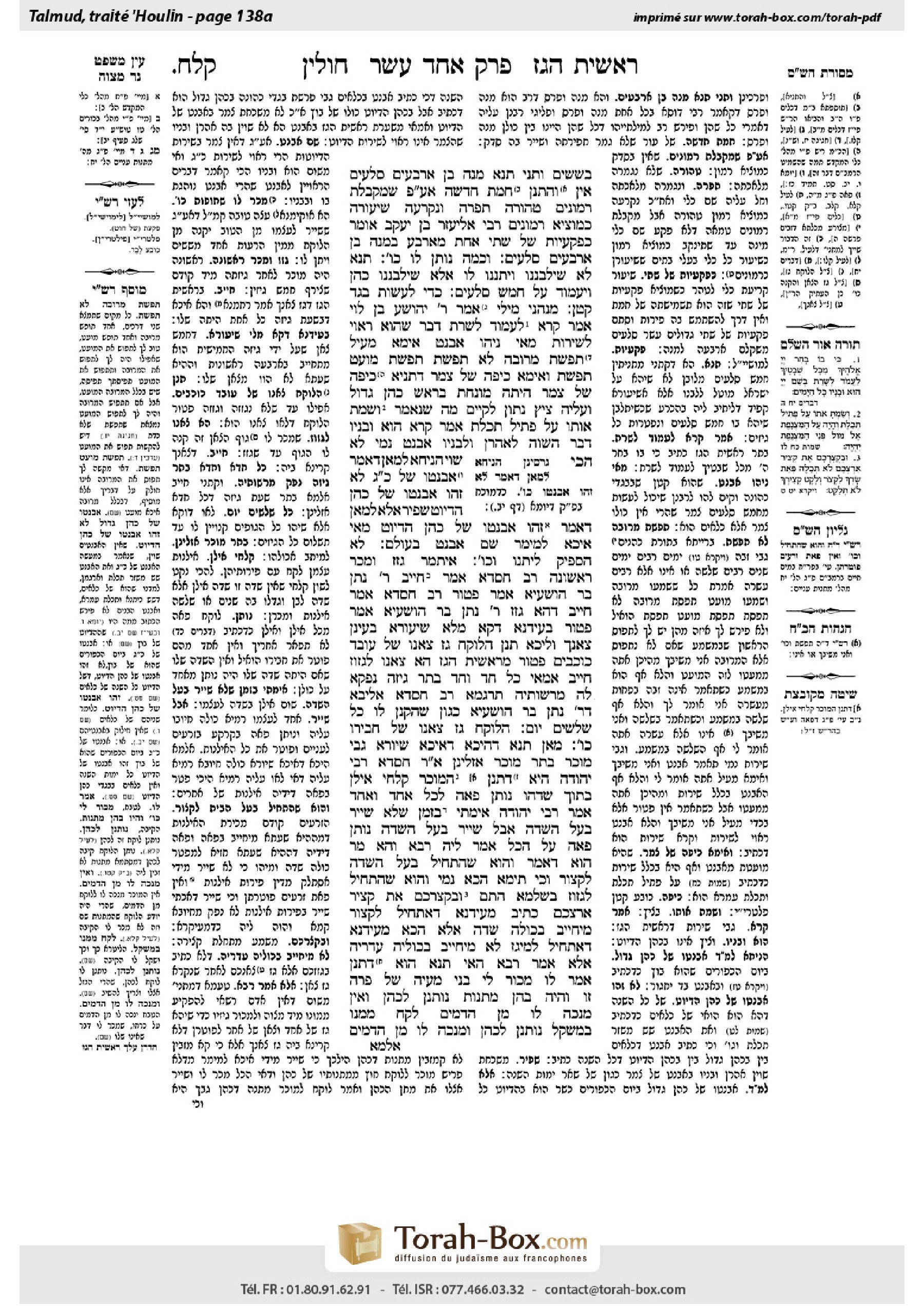
Chullin 138a: Talmud study for Daf Yomi
Study the Talmud for Daf Yomi with scanned pages, Hebrew text, English translations from Sefaria and AI-generated French translations.
Passage selection and English or AI-generated French translation are available where the scan has annotations. Daf Study is independent of Torah-Box and Sefaria.
Browse Chullin · חולין · All tractatesChullin 138a text and translations
This page of Chullin includes the Aramaic text, an English translation and an AI-generated French translation, alongside the scan above.
חולין קל״ח א · Aramaic and Hebrew text
בְּשִׁשִּׁים, וְתָנֵי תַּנָּא: מָנֶה בֶּן אַרְבָּעִים סְלָעִים. אִין! וְהָתְנַן: חֵמֶת חֲדָשָׁה, אַף עַל פִּי שֶׁמְּקַבֶּלֶת רִמּוֹנִים – טְהוֹרָה.
תְּפָרָהּ וְנִקְרְעָה – שִׁיעוּרָהּ כְּמוֹצִיא רִמּוֹנִים. רַבִּי אֱלִיעֶזֶר בֶּן יַעֲקֹב אוֹמֵר: כְּפַקְעִיּוֹת שֶׁל שְׁתִי, אַחַת מֵאַרְבַּע, בְּמָנֶה בֶּן אַרְבָּעִים סְלָעִים.
וְכַמָּה נוֹתֵן לוֹ כּוּ׳. תָּנָא – לֹא שֶׁיְּלַבְּנֶנּוּ וְיִתְּנֶנּוּ לוֹ, אֶלָּא שֶׁיְּלַבְּנֶנּוּ כֹּהֵן וְיַעֲמוֹד עַל חֲמֵשׁ סְלָעִים.
כְּדֵי לַעֲשׂוֹת בֶּגֶד קָטָן. מְנָהָנֵי מִילֵּי? אָמַר רַבִּי יְהוֹשֻׁעַ בֶּן לֵוִי: אָמַר קְרָא ״לַעֲמֹד לְשָׁרֵת״ – דָּבָר שֶׁהוּא רָאוּי לְשֵׁירוּת. מַאי נִיהוּ? אַבְנֵט.
אֵימָא מְעִיל! תָּפַשְׂתָּ מְרוּבֶּה – לֹא תָּפַשְׂתָּ, תָּפַשְׂתָּ מוּעָט – תָּפַשְׂתָּ.
וְאֵימָא כִּיפָּה שֶׁל צֶמֶר, דְּתַנְיָא: כִּיפָּה שֶׁל צֶמֶר הָיְתָה מוּנַּחַת בְּרֹאשׁ כֹּהֵן גָּדוֹל, וְעָלֶיהָ צִיץ נָתוּן, לְקַיֵּים מַה שֶּׁנֶּאֱמַר: ״וְשַׂמְתָּ אֹתוֹ עַל פְּתִיל תְּכֵלֶת״.
אָמַר קְרָא ״הוּא וּבָנָיו״, דָּבָר הַשָּׁוֶה לְאַהֲרֹן וּלְבָנָיו.
אַבְנֵט נָמֵי לָא שָׁוֵי. הָנִיחָא לְמַאן דְּאָמַר אַבְנֵטוֹ שֶׁל כֹּהֵן גָּדוֹל לֹא זֶהוּ אַבְנֵטוֹ שֶׁל כֹּהֵן הֶדְיוֹט – שַׁפִּיר.
אֶלָּא לְמַאן דְּאָמַר זֶהוּ אַבְנֵטוֹ שֶׁל כֹּהֵן הֶדְיוֹט, מַאי אִיכָּא לְמֵימַר? שֵׁם אַבְנֵט בָּעוֹלָם.
לֹא הִסְפִּיק לִיתְּנוֹ וְכוּ׳. אִיתְּמַר: גָּזַז וּמָכַר רִאשׁוֹנָה, רַב חִסְדָּא אָמַר: חַיָּיב, רַבִּי נָתָן בַּר הוֹשַׁעְיָא אָמַר: פָּטוּר.
רַב חִסְדָּא אֲמַר חַיָּיב, דְּהָא גָּזַז. רַבִּי נָתָן בַּר הוֹשַׁעְיָא אָמַר פָּטוּר, בְּעִידָּנָא דְּקָא מָלֵא שִׁיעוּרָא בָּעֵינַן ״צֹאנְךָ״, וְלֵיכָּא.
תְּנַן: הַלּוֹקֵחַ גֵּז צֹאנוֹ שֶׁל גּוֹי, פָּטוּר מֵרֵאשִׁית הַגֵּז. הָא צֹאנוֹ לִגְזוֹז – חַיָּיב. אַמַּאי? כֹּל חַד וְחַד בָּתַר גִּיזָּה נָפְקָא לַהּ מֵרְשׁוּתֵיהּ!
תַּרְגְּמַאּ רַב חִסְדָּא אַלִּיבָּא דְּרַבִּי נָתָן בַּר הוֹשַׁעְיָא: כְּגוֹן שֶׁהִקְנָן לוֹ כׇּל שְׁלֹשִׁים יוֹם.
הַלּוֹקֵחַ גֵּז צֹאנוֹ שֶׁל חֲבֵירוֹ כּוּ׳. מַאן תַּנָּא דְּהֵיכָא דְּאִיכָּא שִׁיּוּרָא גַּבֵּי מוֹכֵר, בָּתַר מוֹכֵר אָזְלִינַן?
אָמַר רַב חִסְדָּא: רַבִּי יְהוּדָה הִיא, דִּתְנַן: הַמּוֹכֵר קִלְחֵי אִילָן בְּתוֹךְ שָׂדֵהוּ – נוֹתֵן פֵּאָה לְכׇל אֶחָד וְאֶחָד.
אָמַר רַבִּי יְהוּדָה: אֵימָתַי? בִּזְמַן שֶׁלֹּא שִׁיֵּיר בַּעַל הַשָּׂדֶה, אֲבָל שִׁיֵּיר בַּעַל הַשָּׂדֶה – נוֹתֵן פֵּאָה עַל הַכֹּל.
אֲמַר לֵיהּ רָבָא: וְהָא מָר הוּא דְּאָמַר, וְהוּא שֶׁהִתְחִיל בַּעַל הַשָּׂדֶה לִקְצוֹר!
וְכִי תֵּימָא הָכִי נָמֵי וְהוּא שֶׁהִתְחִיל לִגְזוֹז – בִּשְׁלָמָא הָתָם, ״וּבְקֻצְרְכֶם אֶת קְצִיר אַרְצְכֶם״ כְּתִיב, מֵעִידָּנָא דְּאַתְחֵיל לִקְצוֹר מִיחַיַּיב בְּכוּלַּהּ שָׂדֶה, אֶלָּא הָכָא, מֵעִידָּנָא דְּאַתְחֵיל לְמֵיגַז לָא מִיחַיַּיב בְּכוּלֵּיהּ עֶדְרֵיהּ!
אֶלָּא אָמַר רָבָא: הַאי תַּנָּא הוּא, דִּתְנַן: אָמַר לוֹ ״מְכוֹר לִי בְּנֵי מֵעֶיהָ שֶׁל פָּרָה זוֹ״, וְהָיוּ בָּהֶן מַתָּנוֹת – נוֹתְנָן לַכֹּהֵן, וְאֵין מְנַכֶּה לוֹ מִן הַדָּמִים. לָקַח מִמֶּנּוּ בְּמִשְׁקָל – נוֹתְנָן לַכֹּהֵן וּמְנַכֶּה לוֹ מִן הַדָּמִים.
Chullin 138a · English translation
equivalent to the weight of sixty sela, as stated by Rav Dimi. The Gemara asks: But does a tanna teach that a maneh is of forty sela? The Gemara answers: Yes; and we learned in the Tosefta (Kelim, Bava Metzia 6:2): With regard to a new leather flask that is not yet completely sewn together, even though it can contain pomegranates, nevertheless, because it cannot contain liquids it is considered unfinished and is not susceptible to ritual impurity.
If one sewed the flask together and it tore, the measure of the tear that renders the flask no longer susceptible to impurity is a hole large enough to enable pomegranates to go out, as then it ceases to serve as a vessel. Rabbi Eliezer ben Ya’akov says: The tear must be like the measure of balls of a warp, the weight of each of which is one-quarter of a maneh of forty sela. This tanna explicitly mentions a maneh of forty sela.
§ The mishna states: And how much of the sheared wool does one give to the priest? One gives him the weight of five sela in Judea, which are ten sela in the Galilee, once laundered and not when sullied. The Sages taught: The mishna does not mean that one must launder the wool and then give it to the priest; rather, the meaning is that one must give him enough wool for the priest to launder it and it will amount to five sela.
The mishna states: The measure that must be given to the priest is enough to fashion a small garment from it. The Gemara asks: From where are these matters derived? Rabbi Yehoshua ben Levi said: The verse that follows the mention of the first sheared wool states: “For the Lord your God has chosen him out of all your tribes, to stand to serve in the name of the Lord, he and his sons forever” (Deuteronomy 18:5). The term “to serve” indicates that the first sheared wool given to the priest must be a matter that is fitting for service in the Temple, i.e., an amount of wool sufficient to fashion one of the priestly garments. What is the garment in question? It is the belt, which is made from wool weighing five sela.
The Gemara asks: Is the garment in question necessarily the belt? Say that it is the robe, which is fashioned from a far greater amount of wool. The Gemara answers: This inference is based on the principle that if you grasped a lot you did not grasp anything; if you grasped a little, you grasped something. Since a belt meets the condition of “to serve,” as it is one of the priestly vestments, one cannot say that the obligation is any greater than the amount of wool needed to fashion a belt.
But say that the garment in question is the cap of wool that the High Priest wears, which is smaller than the belt. As it is taught in a baraita: A cap of wool was placed on the High Priest’s head, and the frontplate was placed upon it, to fulfill that which is stated with regard to the frontplate: “And you shall put it on a thread of sky blue, and it shall be upon the mitre; upon the forefront of the mitre it shall be” (Exodus 28:37). The term “thread of sky blue” is referring to the cap of sky-blue wool.
The Gemara answers that the verse states: “To stand to serve in the name of the Lord, he and his sons” (Deuteronomy 18:5), which indicates that the verse is referring to a matter, i.e., a garment, that is equal for Aaron and for his sons. The wool given to the priest must be of sufficient size for fashioning a garment worn both by the High Priest and by common priests, whereas the woolen cap is worn only by the High Priest.
The Gemara objects: But the belt is also not equal for all priests. The Gemara elaborates: This works out well according to the one who said that the linen belt of the High Priest worn on Yom Kippur is not the same as the belt of an ordinary priest. According to this opinion, both the belt of common priests and the belt worn by the High Priest during the rest of the year were fashioned from a mixture of wool and linen. This belt is therefore equal for all priests, and it works out well.
But according to the one who said that the linen belt worn by the High Priest on Yom Kippur is the same as the belt of an ordinary priest, what can be said? According to this opinion, the belt fashioned from wool and linen is worn only by the High Priest during the rest of the year. The Gemara answers: Although the belts are different, the term belt in general applies to all priests, whereas no type of cap is worn by common priests.
§ The mishna states: If the owner of the shearing did not manage to give it to the priest until he dyed it, he is exempt from the obligation of giving the first sheared wool. The mishna further teaches that one who purchases the fleece of the sheep of a gentile is exempt from the obligation of the first sheared wool. It was stated that amora’im disagreed with regard to one who owned five sheep and he sheared and sold the first sheep before shearing the second, and in this manner sold each sheep after shearing it. When he finished shearing he owned the requisite five fleeces, to which the obligation of the first sheared wool applies, but he no longer owned the sheep. Rav Ḥisda says: He is obligated in the mitzva of the first sheared wool; and Rabbi Natan bar Hoshaya says: He is exempt from the mitzva of the first sheared wool.
The Gemara clarifies the two opinions. Rav Ḥisda says that he is obligated, as he sheared five sheep that he owned at the time of shearing, and therefore the term: “Your flock” (Deuteronomy 18:4), applies to this case. Rabbi Natan bar Hoshaya says that he is exempt, as at the time that the measure of five fleeces is completed, we require the term “your flock” to apply, since the obligation takes effect at that stage, and in this case it does not apply.
The Gemara raises a challenge: We learned in the mishna (135a): One who purchases the fleece of the sheep of a gentile is exempt from the obligation of the first sheared wool, as he purchased only the fleece but not the sheep. One can infer from here that if he purchased the gentile’s sheep themselves in order to shear them and then return them to the gentile, he is obligated, because the sheep belonged to him at the time of shearing. But why is he obligated, according to the opinion of Rabbi Natan bar Hoshaya? Each and every one of the sheep, after the shearing is completed, leaves his possession, and when he has sheared five sheep, the term “your flock” no longer applies to them.
Rav Ḥisda interpreted the mishna according to the opinion of Rabbi Natan bar Hoshaya: The mishna is referring to a case where the gentile transferred ownership to him for the entire period of thirty days during which the Jew sheared the sheep. Therefore, he retained ownership after he completed shearing, and the term “your flock” does apply to the sheep at the time when the obligation of the first sheared wool took effect.
§ The mishna teaches: With regard to one who purchases the fleece of the sheep of another Jew, if the seller kept some of the wool, then he is obligated to give the first sheared wool to the priest. If the seller did not keep any of the wool, the buyer is obligated to give it. The Gemara asks: Who is the tanna who taught that in a case where there is residual wool in the possession of the seller, we follow the seller in determining who is obligated in the mitzva of first sheared wool?
Rav Ḥisda said: The tanna who taught the mishna is Rabbi Yehuda, as we learned in a mishna (Pe’a 3:5): With regard to one who sells a few fruit-bearing tree stalks within his field, without selling the field itself, for the buyer to uproot them and plant them in his own field, the buyer gives separate pe’a for each and every one of the trees. The field does not combine the trees into a single unit for pe’a, as the land is not owned by the buyer.
Rabbi Yehuda said: When is it the buyer’s obligation to give pe’a? It is when the owner of the field did not leave any of the trees in his possession. But if the owner of the field left some of the trees in his possession, the owner gives pe’a for all the trees. Just as in the case of pe’a, if the seller left trees for himself then the obligation applies to him, so too, with regard to the first sheared wool, if the seller left some of the wool for himself, the obligation applies to him.
Rava said to Rav Ḥisda: But wasn’t it you, Master, who said with regard to Rabbi Yehuda’s ruling that the owner gives pe’a for all the trees: This is the halakha only when the owner of the field began to harvest the fruit before he sold the trees, as the obligation to give pe’a had already applied to him. By contrast, with regard to the first sheared wool, the obligation came into effect only after he sold his sheep.
And if you would say that so too, with regard to the first sheared wool, this halakha that the seller gives the first sheared wool applies only if the seller began to shear the sheep before he sold them, that explanation is difficult. The Gemara elaborates: Granted, there, with regard to pe’a, it is written: “And when you reap the harvest of your land” (Leviticus 19:9), which indicates that from the time that he began to harvest he is obligated in the mitzva of pe’a with regard to the entire field. But here, in the case of the first sheared wool, he is not obligated with regard to the entire flock from the time that he began to shear his sheep. Therefore, even if he began shearing before he sold the sheep, the obligation to give the first sheared wool should not apply to the seller.
Rather, Rava said: It is this tanna who taught the mishna, as we learned in a different mishna (132a): If one said to a butcher: Sell me the innards of this cow, and there were gifts of the priesthood included in them, i.e., the maw, the purchaser must give them to the priest, and he may not deduct the value of the gifts from the money that he pays the butcher, as it is assumed that the gifts were not included in the sale. If he purchased the innards from the butcher by weight, the buyer must give the gifts to a priest and he may deduct the value of the gifts from the money that he pays the butcher. If the priestly gifts have not yet been separated from the animal, the price by weight includes the price of these gifts. But since the priests had the right to their gifts from the time of the slaughter, the buyer does not need to pay for them and may therefore deduct their value from his payment.
Chullin 138a · Traduction française (IA)
équivalent au poids de soixante sela, comme l’a dit Rav Dimi. La Guemara pose la question : Mais un tanna enseigne-t-il que un maneh est de quarante sela ? La Guemara répond : Oui ; et nous avons appris dans la Tosefta (Kelim, Bava Metzia 6:2) : En ce qui concerne une outre en cuir nouveau qui n’est pas encore complètement cousue, même si elle peut contenir des grenades, néanmoins, puisqu’elle ne peut pas contenir des liquides, elle est considérée comme inachevée et n’est pas susceptible de souillure rituelle.
Si l’on a cousu l’outre et qu’elle a été déchirée, la mesure de la déchirure qui rend l’outre insusceptible de souillure est un trou suffisamment grand pour permettre aux grenades de sortir, car alors elle cesse de servir de récipient. Rabbi Eliezer ben Ya’akov dit : La déchirure doit être égale à la mesure des boules de fil, le poids de chacune étant un quart de maneh de quarante sela. Ce tanna mentionne explicitement un maneh de quarante sela.
§ La Michna stipule : Et combien de laine dépouillée doit-on donner au prêtre ? On lui donne le poids de cinq sela en Judée, ce qui équivaut à dix sela en Galilée, une fois lavée et non lorsqu’elle est souillée. Les Sages enseignent : La Michna ne signifie pas qu’on doit laver la laine avant de la donner au prêtre ; plutôt, elle signifie qu’on doit lui donner suffisamment de laine pour qu’il la lave et qu’elle atteigne cinq sela.
La Michna stipule : La mesure à donner au prêtre est suffisante pour fabriquer une petite robe. La Guemara pose la question : D’où ces choses sont-elles déduites ? Rabbi Yehoshua ben Levi dit : La verset qui suit la mention de la première laine dépouillée dit : « Car l’Eternel votre Dieu a choisi celui-ci parmi tous vos tribus, pour qu’il se lève et serve en votre nom l’Eternel, lui et ses fils pour toujours » (Deutéronome 18:5). Le terme « pour servir » indique que la première laine dépouillée donnée au prêtre doit être une chose adaptée au service dans le Temple, c’est-à-dire une quantité de laine suffisante pour fabriquer l’un des vêtements sacerdotaux. Quel est ce vêtement ? C’est la ceinture, qui est faite de laine pesant cinq sela.
La Guemara pose la question : Ce vêtement est-il nécessairement la ceinture ? Disons qu’il s’agit de la robe, qui est faite d’une quantité bien plus importante de laine. La Guemara répond : Cette déduction s’appuie sur le principe que si tu as saisi beaucoup, tu n’as saisi rien ; si tu as saisi peu, tu as saisi quelque chose. Puisque la ceinture remplit la condition de « pour servir », car elle est l’un des vêtements sacerdotaux, on ne peut pas dire que l’obligation soit plus grande que la quantité de laine nécessaire pour fabriquer une ceinture.
Mais disons que le vêtement en question est la coiffe en laine que le Grand Prêtre porte, qui est plus petite que la ceinture. Comme il est enseigné dans une baraïta : Une coiffe en laine fut placée sur la tête du Grand Prêtre, et la plaque fut placée dessus, pour accomplir ce qui est dit concernant la plaque : « Et tu placeras celle-ci sur un fil bleu ciel, et elle sera sur la mitre ; sur la face de la mitre, elle sera » (Exode 28:37). Le terme « fil bleu ciel » fait référence à la coiffe en laine bleue ciel.
La Guemara répond que le verset dit : « Pour se lever et servir en votre nom l’Eternel, lui et ses fils » (Deutéronome 18:5), ce qui indique que le verset fait référence à une chose, c’est-à-dire un vêtement, égale pour Aaron et pour ses fils. La laine donnée au prêtre doit être suffisante pour fabriquer un vêtement porté à la fois par le Grand Prêtre et par les prêtres ordinaires, alors que la coiffe en laine est portée uniquement par le Grand Prêtre.
La Guemara s’oppose à cela : Mais la ceinture n’est pas non plus égale pour tous les prêtres. La Guemara explique : Cela fonctionne bien selon celui qui a dit que la ceinture en lin du Grand Prêtre portée le Jour du Pardon n’est pas la même que celle du prêtre ordinaire. Selon cette opinion, à la fois la ceinture des prêtres ordinaires et la ceinture portée par le Grand Prêtre pendant l’année normale étaient faites d’un mélange de laine et de lin. Cette ceinture est donc égale pour tous les prêtres, et cela fonctionne bien.
Mais selon celui qui a dit que la ceinture en lin portée par le Grand Prêtre le Jour du Pardon est la même que celle du prêtre ordinaire, que peut-on dire ? Selon cette opinion, la ceinture faite de laine et de lin est portée uniquement par le Grand Prêtre pendant l’année normale. La Guemara répond : Bien que les ceintures soient différentes, le terme « ceinture » en général s’applique à tous les prêtres, alors que aucun type de coiffe n’est porté par les prêtres ordinaires.
§ La Michna stipule : Si l’propriétaire de la laine n’a pas réussi à donner la laine au prêtre jusqu’à ce qu’il l’ait teint, il est exempt de l’obligation de donner la première laine dépouillée. La Michna enseigne également que celui qui achète la laine d’un non-Juif est exempt de l’obligation de la première laine dépouillée. Il a été dit que les amora’im s’opposaient sur celui qui possédait cinq brebis et avait dépouillé et vendu la première avant de dépouiller la deuxième, et ainsi de suite, vendant chaque brebis après l’avoir dépouillée. Lorsqu’il avait fini de dépouiller, il possédait les cinq laines nécessaires, à laquelle l’obligation de la première laine dépouillée s’applique, mais il ne possédait plus les brebis. Rav Ḥisda dit : Il est obligé de la mitsva de la première laine dépouillée ; et Rabbi Natan bar Hoshaya dit : Il est exempt de la mitsva de la première laine dépouillée.
La Guemara clarifie les deux opinions. Rav Ḥisda dit qu’il est obligé, car il a dépouillé cinq brebis qu’il possédait au moment de la dépouillement, et donc le terme : « Votre troupeau » (Deutéronome 18:4) s’applique à ce cas. Rabbi Natan bar Hoshaya dit qu’il est exempt, car au moment où la mesure de cinq laines est achevée, nous exigeons que le terme « votre troupeau » s’applique, puisque l’obligation prend effet à ce stade, et dans ce cas, il ne s’applique pas.
La Guemara soulève un défi : Nous avons appris dans la michna (135a) : Celui qui achète la laine d'une brebis appartenant à un non-Juif est exempt de l'obligation de la première laine, car il a acheté seulement la laine et non la brebis. On peut en déduire que si l'on achète les brebis du non-Juif afin de les tondre et de les rendre ensuite au non-Juif, il est tenu, car la brebis lui appartenait au moment de la tonte. Mais pourquoi est-il tenu, selon l'opinion de Rabbi Natan bar Hoshaya ? Chaque brebis, après la tonte, quitte sa possession, et lorsqu'il a tondu cinq brebis, le terme « votre troupeau » ne s'applique plus à elles.
Rav Ḥisda interprète la michna selon l'opinion de Rabbi Natan bar Hoshaya : La michna fait référence à un cas où le non-Juif a transféré la propriété à l'acheteur pour une période de trente jours durant laquelle le Juif a tondu les brebis. Ainsi, il conservait la propriété après avoir terminé la tonte, et le terme « votre troupeau » s'applique aux brebis au moment où l'obligation de la première laine s'est imposée.
§ La michna enseigne : En ce qui concerne celui qui achète la laine d'une brebis appartenant à un autre Juif, si le vendeur a gardé de la laine, il est tenu de donner la première laine au prêtre. Si le vendeur n'a pas gardé de laine, l'acheteur est tenu de la donner. La Guemara pose la question : Quel est le tanna qui a enseigné que, dans le cas où il y a de la laine résiduelle en possession du vendeur, nous suivons le vendeur pour déterminer qui est tenu de l'obligation de la première laine ?
Rav Ḥisda dit : Le tanna qui a enseigné la michna est Rabbi Yehuda, comme nous l'avons appris dans une michna (Pe’a 3:5) : En ce qui concerne celui qui vend quelques tiges fruitières de son champ sans vendre le champ lui-même, afin que l'acheteur les arrache et les plante dans son propre champ, l'acheteur donne une portion de premier fruit (pe’a) pour chaque arbre. Le champ ne combine pas les arbres en une seule unité pour la pe’a, car la terre n'appartient pas à l'acheteur.
Rabbi Yehuda dit : Dans quel cas l'obligation de donner la pe’a incombe à l'acheteur ? C'est lorsque l'propriétaire du champ n'a pas laissé d'arbres en son possession. Mais si l'propriétaire du champ a laissé certains arbres en son possession, l'propriétaire donne la pe’a pour tous les arbres. Tout comme dans le cas de la pe’a, si le vendeur a laissé des arbres pour lui-même, l'obligation incombe à lui, de même, en ce qui concerne la première laine tondue, si le vendeur a laissé de la laine pour lui-même, l'obligation incombe à lui.
Rava dit à Rav Ḥisda : N'étais-tu pas toi-même, Maître, qui a dit concernant la décision de Rabbi Yehuda que l'propriétaire donne la pe’a pour tous les arbres : C'est la halakha seulement lorsque l'propriétaire a commencé à récolter les fruits avant de vendre les arbres, car l'obligation de donner la pe’a s'était déjà imposée à lui. À l'inverse, concernant la première laine tondue, l'obligation est entrée en vigueur seulement après qu'il ait vendu ses brebis.
Et si l'on disait que de même, concernant la première laine tondue, cette halakha selon laquelle le vendeur doit donner la première laine s'applique seulement si le vendeur a commencé à tondre les brebis avant de les vendre, cette explication est difficile. La Guemara développe : C'est évident, là, concernant la pe’a, il est écrit : « Et quand tu récoltes la récolte de ton champ » (Lévitique 19:9), ce qui indique que dès le moment où il a commencé à récolter, l'obligation de la mitsva de la pe’a s'applique à l'ensemble du champ. Mais ici, concernant la première laine tondue, il n'est pas tenu envers l'ensemble du troupeau dès qu'il a commencé à tondre ses brebis. Par conséquent, même s'il a commencé à tondre avant de vendre les brebis, l'obligation de donner la première laine ne devrait pas s'appliquer au vendeur.
Plutôt, Rava dit : C'est ce tanna qui a enseigné la michna, comme nous l'avons appris dans une autre michna (132a) : Si l'on dit à un boucher : Vends-moi les entrailles de cette vache, et s'il y avait des présents sacrés parmi elles, c'est-à-dire la rate, l'acheteur doit les donner au prêtre, et il ne peut pas déduire la valeur des présents du prix qu'il paie au boucher, car on suppose que les présents n'étaient pas inclus dans la vente. Si l'acheteur a acheté les entrailles par poids, l'acheteur doit donner les présents au prêtre et il peut déduire la valeur des présents du prix qu'il paie au boucher. Si les présents sacrés n'ont pas encore été séparés de l'animal, le prix par poids inclut le prix de ces présents. Mais puisque les prêtres avaient le droit à leurs présents dès le moment de la boucherie, l'acheteur n'a pas besoin de les payer et peut donc déduire leur valeur de son paiement.
Traduction française générée par IA à partir de l’édition anglaise de Sefaria. Vérifie toujours un passage avec le texte source.
Text from Sefaria: William Davidson Edition - Vocalized Aramaic (unknown); William Davidson Edition - English (CC BY NC).