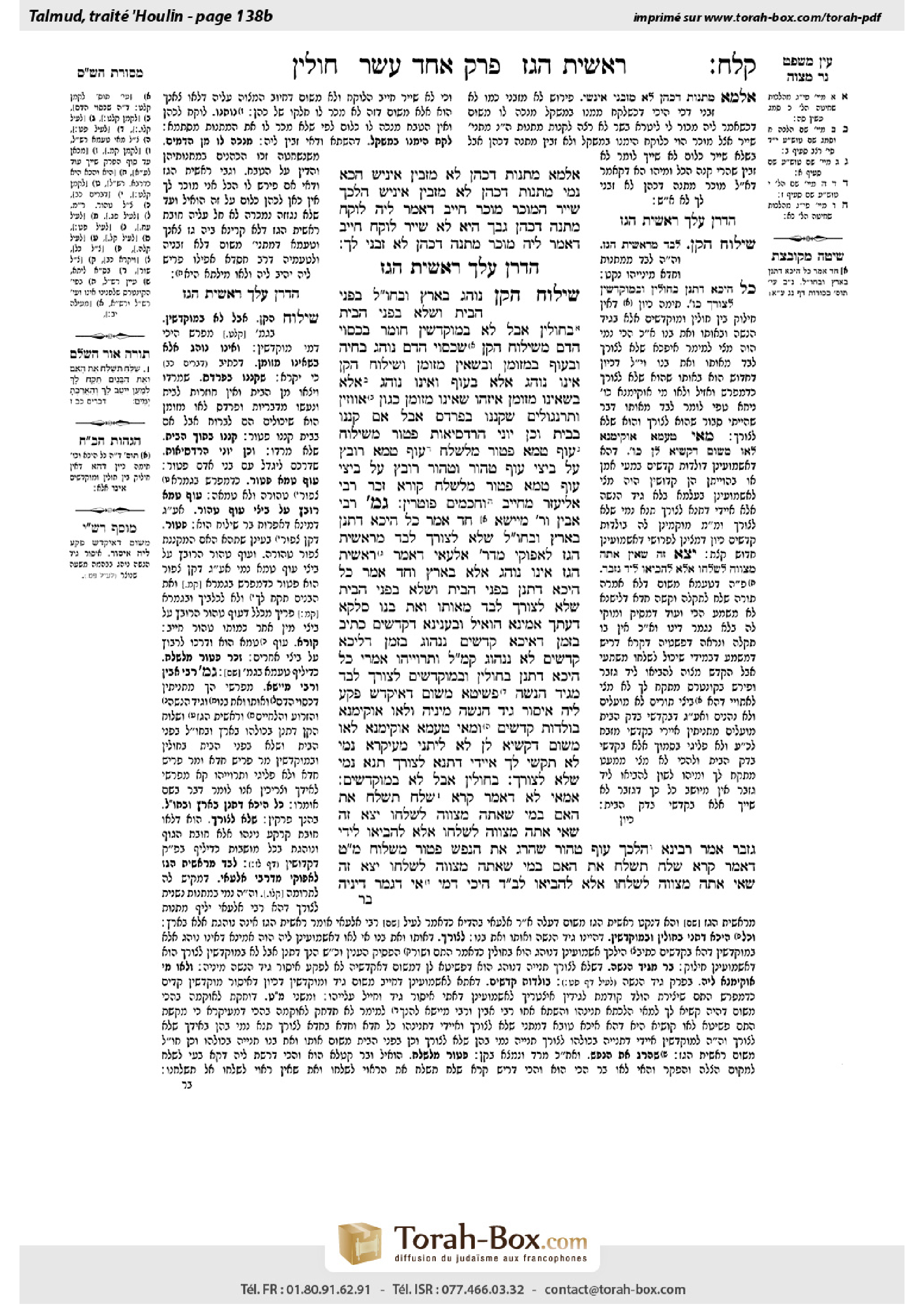
Chullin 138b: Talmud study for Daf Yomi
Study the Talmud for Daf Yomi with scanned pages, Hebrew text, English translations from Sefaria and AI-generated French translations.
Passage selection and English or AI-generated French translation are available where the scan has annotations. Daf Study is independent of Torah-Box and Sefaria.
Browse Chullin · חולין · All tractatesChullin 138b text and translations
This page of Chullin includes the Aramaic text, an English translation and an AI-generated French translation, alongside the scan above.
חולין קל״ח ב · Aramaic and Hebrew text
אַלְמָא מַתָּנוֹת דְּכֹהֵן לָא מְזַבֵּין אִינִישׁ, הָכָא נָמֵי מַתָּנוֹת דְּכֹהֵן לָא מְזַבֵּין אִינִישׁ. הִלְכָּךְ: שִׁיֵּיר הַמּוֹכֵר – מוֹכֵר חַיָּיב, דְּאָמַר לֵיהּ לוֹקֵחַ: ״מַתָּנָה דְּכֹהֵן גַּבָּךְ הִיא״. לֹא שִׁיֵּיר – לוֹקֵחַ חַיָּיב, דְּאָמַר לֵיהּ מוֹכֵר: ״מַתָּנָה דְּכֹהֵן לָא זַבֵּנִי לָךְ״.
הֲדַרַן עֲלָךְ רֵאשִׁית הַגֵּז.
מַתְנִי׳ שִׁילּוּחַ הַקֵּן נוֹהֵג בָּאָרֶץ וּבְחוּצָה לָאָרֶץ, בִּפְנֵי הַבַּיִת וְשֶׁלֹּא בִּפְנֵי הַבַּיִת, בְּחוּלִּין אֲבָל לֹא בְּמוּקְדָּשִׁין. חוֹמֶר בְּכִסּוּי הַדָּם מִשִּׁילּוּחַ הַקֵּן, שֶׁכִּסּוּי הַדָּם נוֹהֵג בַּחַיָּה וּבָעוֹף, בִּמְזוּמָּן וּבְשֶׁאֵין מְזוּמָּן, וְשִׁילּוּחַ הַקֵּן אֵינוֹ נוֹהֵג אֶלָּא בָּעוֹף, וְאֵינוֹ נוֹהֵג אֶלָּא בְּשֶׁאֵינוֹ מְזוּמָּן.
אֵיזֶהוּ שֶׁאֵינוֹ מְזוּמָּן? כְּגוֹן אֲוָוזִין וְתַרְנְגוֹלִים שֶׁקִּנְּנוּ בַּפַּרְדֵּס, אֲבָל אִם קִנְּנוּ בַּבַּיִת, וְכֵן יוֹנֵי הַרְדָּסִיָּאוֹת – פָּטוּר מִשִּׁילּוּחַ. עוֹף טָמֵא – פָּטוּר מִלְּשַׁלֵּחַ, עוֹף טָמֵא רוֹבֵץ עַל בֵּיצֵי עוֹף טָהוֹר, וְטָהוֹר רוֹבֵץ עַל בֵּיצֵי עוֹף טָמֵא – פָּטוּר מִלְּשַׁלֵּחַ. קוֹרֵא זָכָר – רַבִּי אֱלִיעֶזֶר מְחַיֵּיב, וַחֲכָמִים פּוֹטְרִין.
גְּמָ׳ רַבִּי אָבִין וְרַבִּי מְיָישָׁא, חַד אָמַר: כֹּל הֵיכָא דִּתְנַן ״בָּאָרֶץ וּבְחוּצָה לָאָרֶץ״ שֶׁלֹּא לְצוֹרֶךְ, לְבַד מֵרֵאשִׁית הַגֵּז, לְאַפּוֹקֵי מִדְּרַבִּי אִלְעַאי דְּאָמַר: ״רֵאשִׁית הַגֵּז אֵינוֹ נוֹהֵג אֶלָּא בָּאָרֶץ״.
וְחַד אָמַר: כֹּל הֵיכָא דִּתְנַן ״בִּפְנֵי הַבַּיִת וְשֶׁלֹּא בִּפְנֵי הַבַּיִת״ – שֶׁלֹּא לְצוֹרֶךְ, לְבַד מֵ״אוֹתוֹ וְאֶת בְּנוֹ״. סָלְקָא דַּעְתָּךְ אָמֵינָא: הוֹאִיל וּבְעִנְיָנָא דְּקָדָשִׁים כְּתִיב, בִּזְמַן דְּאִיכָּא קָדָשִׁים – נִנְהוֹג, בִּזְמַן דְּלֵיכָּא קֳדָשִׁים – לָא נִנְהוֹג, קָא מַשְׁמַע לַן.
וְתַרְוַיְיהוּ אָמְרִי: כֹּל הֵיכָא דִּתְנַן ״בְּחוּלִּין וּבְמוּקְדָּשִׁים״ – לְצוֹרֶךְ, לְבַד מִגִּיד הַנָּשֶׁה, פְּשִׁיטָא! מִשּׁוּם דְּאִיקַּדַּשׁ פְּקַע לֵיהּ אִיסּוּר גִּיד הַנָּשֶׁה מִינֵּיהּ?
וְלָאו אוֹקֵימְנָא בְּוַלְדוֹת קָדָשִׁים?
וּמַאי טַעְמָא אוֹקֵימְנָא? לָאו מִשּׁוּם דְּקַשְׁיָא לַן לָא לִיתְנֵי? מֵעִיקָּרָא נָמֵי לָא תִּקְשֵׁי לָךְ, אַיְּידֵי דִּתְנָא לְצוֹרֶךְ, תְּנָא נָמֵי שֶׁלֹּא לְצוֹרֶךְ.
בְּחוּלִּין אֲבָל לֹא בְּמוּקְדָּשִׁים. אַמַּאי לָא? דְּאָמַר קְרָא: ״שַׁלֵּחַ תְּשַׁלַּח אֶת הָאֵם״ – בְּמִי שֶׁאַתָּה מְצוֶּּוה לְשַׁלְּחוֹ, יָצָא זֶה שֶׁאִי אַתָּה מְצוֶּּוה לְשַׁלְּחוֹ אֶלָּא לַהֲבִיאוֹ לִידֵי גִּזְבָּר.
אָמַר רָבִינָא: הִלְכָּךְ, עוֹף טָהוֹר שֶׁהָרַג אֶת הַנֶּפֶשׁ פָּטוּר מִשִּׁלּוּחַ, מַאי טַעְמָא? דְּאָמַר קְרָא: ״שַׁלֵּחַ תְּשַׁלַּח אֶת הָאֵם״ – בְּמִי שֶׁאַתָּה מְצוֶּּוה לְשַׁלְּחוֹ, יָצָא זֶה שֶׁאִי אַתָּה מְצוֶּּוה לְשַׁלְּחוֹ אֶלָּא לַהֲבִיאוֹ לְבֵית דִּין. הֵיכִי דָמֵי? אִי דִּגְמַר דִּינֵיהּ –
Chullin 138b · English translation
Evidently, a person does not sell the gifts belonging to the priest, and therefore they are not included in the sale of the innards unless they were sold by weight. Here too, with regard to the first sheared wool, a person does not sell the gifts belonging to the priest. Therefore, if the seller left wool in his possession, the seller is obligated to give the first sheared wool from the remaining wool for that which he sold, as the buyer can say to the seller: The gift of the priest is in your possession, since you did not sell me everything. If the seller did not leave any wool in his possession, the buyer is obligated to give the first sheared wool and he does not deduct its value from the price, as the seller can say to him: I did not sell the gift of the priest to you, i.e., there was no obligation to give the gifts to a priest when I sold the wool to you, and therefore the buyer is required to give the gifts to the priest.
MISHNA: The mitzva of sending away the mother bird from the nest applies both in Eretz Yisrael and outside of Eretz Yisrael, and in the presence of the Temple and not in the presence of the Temple. It applies to non-sacred birds, but it does not apply to sacrificial birds. There are more stringent elements in the covering of the blood than in the sending away of the mother bird from the nest, as the covering of the blood applies to undomesticated animals and birds, to animals and birds that are readily available in one’s home, and to animals and birds that are not readily available and are hunted in the wild; and the sending of the mother bird from the nest applies only to birds, and applies only to birds that are not readily available.
What are considered birds that are not readily available? They are any birds, even domesticated, that may fly away at any time, such as geese or chickens that nested in the orchard [pardes]. But if geese or chickens nested in the house, and likewise, with regard to domesticated pigeons [yonei hardisei’ot], one is exempt from sending away the mother bird. With regard to the nest of a non-kosher bird, one is exempt from sending away the mother bird. In a case where a non-kosher bird is resting upon the eggs of a kosher bird, or a kosher bird is resting upon the eggs of a non-kosher bird, one is exempt from sending away the bird. With regard to a male pheasant [korei], which is known to sit upon the eggs like the female of its species, Rabbi Eliezer deems one obligated to send it away, and the Rabbis deem one exempt from sending it away.
GEMARA: The mishna contains several phrases related to the mitzva of sending away the mother bird from the nest that also appear in the first mishna of several other chapters of this tractate. With regard to this, Rabbi Avin and Rabbi Meyasha made the following statements. One of them said: Anywhere in this tractate that we learned in a mishna that a particular mitzva applies both in Eretz Yisrael and outside of Eretz Yisrael, it is stated needlessly, as those mitzvot are not related to land, such that there is no need to teach that they apply outside of Eretz Yisrael as well. This is true except for the mitzva of the first shearing of wool, which one must give to a priest. It was necessary to teach that that mitzva applies even outside of Eretz Yisrael, to exclude the opinion of Rabbi Ilai, who said: The first shearing is in effect only in Eretz Yisrael.
And the other one said: Anywhere in this tractate that we learned in a mishna that a particular mitzva applies both in the presence of the Temple and not in the presence of the Temple, it is stated needlessly, as these mitzvot are requirements of the object itself, and there is no need to teach that they apply even after the destruction of the Temple. This is true except for the prohibition against slaughtering an animal itself and its offspring on the same day. It was necessary to teach that this mitzva applies even after the destruction of the Temple, because it might enter your mind to say: Since this prohibition is written in a passage in the Torah discussing the matter of sacrificial animals (see Leviticus, chapter 22), at a time when there are sacrificial animals, i.e., when the Temple is standing, we will abide by it, but at a time when there are no sacrificial animals, after the destruction of the Temple, we will not abide by it. Therefore, that mishna teaches us that this is not so.
And both of them said: Anywhere in this tractate that we learned in a mishna that a particular mitzva applies both to non-sacred animals and to sacrificial animals, it is stated necessarily. This is the case except for the mishna discussing the sciatic nerve, as it is obvious that the prohibition applies to sacrificial animals as well. Can it enter one’s mind to say that because it was consecrated, the prohibition of eating the sciatic nerve is abrogated from the animal?
The Gemara asks: But didn’t we establish that the mishna there (89b) is referring to offspring of sacrificial animals? Without the mishna, one might have thought that since the offspring was already prohibited as a sacrificial animal before its sciatic nerve was even formed, the prohibition with regard to the latter does not take effect where the former prohibition already exists. If so, it was in fact necessary to teach this halakha.
The Gemara responds: But what is the reason we interpreted that mishna as referring to offspring of sacrificial animals? Is it not due to the fact that the question: Let the mishna not teach that the prohibition applies to both non-sacred and sacrificial animals, is difficult for us? It is in response to this question that Rabbi Avin and Rabbi Meyasha stated that even from the outset, this should not pose a difficulty for you. Rather, since the phrase: Applies to both non-sacred and sacrificial animals, is taught necessarily with regard to the prohibition against slaughtering an animal itself and its offspring, it is also taught needlessly with regard to the prohibition against eating the sciatic nerve, to parallel the formula of the other mishna.
§ The mishna states that the mitzva of sending away the mother bird from the nest applies to non-sacred birds, but not to sacrificial birds. The Gemara asks: Why does this mitzva not apply to sacrificial birds? The Gemara responds: As the verse states: “You shall send the mother” (Deuteronomy 22:7). The verse refers only to a bird that you are commanded to send away, i.e., a non-sacred bird; that excludes this sacrificial bird, which you are not commanded to send away, but rather to bring it to the custody of the Temple treasurer.
Ravina says: Therefore, with regard to a kosher bird that killed a person and must now be executed, one is exempt from sending it away. What is the reason for this? It is as the verse states: “You shall send the mother.” The verse is referring only to a bird that you are commanded to send away, which excludes this bird that you are not commanded to send away, but rather to bring it to court. The Gemara asks: What are the circumstances of this case, i.e., how is this bird that killed a person now resting on its eggs? If this is a case where its verdict of execution was issued,
Chullin 138b · Traduction française (IA)
Il est évident qu'une personne ne vend pas les dons appartenant au prêtre, et par conséquent, ils ne sont pas inclus dans la vente des viscères à moins qu'ils ne soient vendus par poids. De même, concernant la première laine dégagée, une personne ne vend pas les dons appartenant au prêtre. Ainsi, si le vendeur a laissé de la laine en son possession, le vendeur est tenu de donner la première laine dégagée à partir de la laine restante pour ce qu'il a vendu, car l'acheteur peut dire au vendeur : Le don du prêtre est en votre possession, car vous n'avez pas vendu tout à l'acheteur. Si le vendeur n'a laissé aucune laine en son possession, l'acheteur est tenu de donner la première laine dégagée et il ne déduit pas sa valeur du prix, car le vendeur peut dire à l'acheteur : Je n'ai pas vendu le don du prêtre à l'acheteur, c'est-à-dire qu'il n'y avait pas d'obligation de donner les dons à un prêtre lorsque j'ai vendu la laine à l'acheteur, et par conséquent, l'acheteur est tenu de donner les dons au prêtre.
MICHNA : La mitsva d'expulser le poule-mère du nid s'applique à la fois en Terre d'Israël et en dehors de Terre d'Israël, et en présence du Temple et non en présence du Temple. Elle s'applique aux oiseaux non sacrés, mais ne s'applique pas aux oiseaux sacrés. Il y a des éléments plus exigeants dans la couverture du sang que dans l'expulsion du poule-mère du nid, car la couverture du sang s'applique aux animaux non domestiques et aux oiseaux, aux animaux et oiseaux disponibles à la maison, ainsi qu'aux animaux et oiseaux non disponibles et chassés en plein air ; et l'expulsion du poule-mère du nid s'applique uniquement aux oiseaux, et uniquement aux oiseaux non disponibles.
Quels oiseaux sont considérés comme non disponibles ? Ce sont tous les oiseaux, même domestiques, qui peuvent s'envoler à tout moment, tels que des canards ou des poulets qui ont fait leur nid dans le verger [pardes]. Mais si des canards ou des poulets ont fait leur nid dans la maison, et de même pour les pigeons domestiques [yonei hardisei’ot], on est exempt de l'expulsion du poule-mère du nid. Concernant le nid d'un oiseau non kasher, on est exempt de l'expulsion du poule-mère du nid. Dans le cas où un oiseau non kasher repose sur les œufs d'un oiseau kasher, ou un oiseau kasher repose sur les œufs d'un oiseau non kasher, on est exempt de l'expulsion de l'oiseau. Concernant un perdreau [korei], qui est connu pour s'asseoir sur les œufs comme la femelle de sa espèce, Rabbi Eliezer considère qu'on est tenu d'expulser ce perdreau, et les Sages considèrent qu'on est exempt d'expulser ce perdreau.
GUEMARA : La mishna contient plusieurs phrases relatives à la mitsva de l'expulsion du poule-mère du nid qui apparaissent également dans la première mishna de plusieurs autres chapitres de ce traité. À ce sujet, Rabbi Avin et Rabbi Meyasha ont fait les déclarations suivantes. L'un d'eux a dit : Partout dans ce traité où nous avons appris dans une mishna qu'une mitsva s'applique à la fois en Terre d'Israël et en dehors de Terre d'Israël, cela est dit inutilement, car ces mitsvot ne sont pas liées à la terre, de sorte qu'il n'y a pas besoin d'enseigner qu'elles s'appliquent également en dehors de Terre d'Israël. Cela est vrai à l'exception de la mitsva de la première laine dégagée, que l'on doit donner à un prêtre. Il a été nécessaire d'enseigner que cette mitsva s'applique même en dehors de Terre d'Israël, afin d'exclure l'opinion de Rabbi Ilai, qui a dit : La première laine dégagée est en vigueur uniquement en Terre d'Israël.
Et l'autre a dit : Partout dans ce traité où nous avons appris dans une mishna qu'une mitsva s'applique à la fois en présence du Temple et non en présence du Temple, cela est dit inutilement, car ces mitsvot sont des exigences de l'objet lui-même, et il n'y a pas besoin d'enseigner qu'elles s'appliquent même après la destruction du Temple. Cela est vrai à l'exception de la prohibition contre l'abattage d'un animal et de son descendant le même jour. Il a été nécessaire d'enseigner que cette mitsva s'applique même après la destruction du Temple, car cela pourrait entrer dans votre esprit de dire : Puisque cette prohibition est écrite dans un passage de la Torah concernant la question des animaux sacrés (voir Lévitique, chapitre 22), à un moment où il y a des animaux sacrés, c'est-à-dire lorsque le Temple est debout, nous l'observons, mais à un moment où il n'y a plus d'animaux sacrés, après la destruction du Temple, nous ne l'observons pas. Par conséquent, cette mishna nous enseigne que ce n'est pas ainsi.
Et les deux ont dit : Partout dans ce traité où nous avons appris dans une mishna qu'une mitsva s'applique à la fois aux animaux non sacrés et aux animaux sacrés, cela est dit nécessairement. C'est le cas à l'exception de la mishna concernant la moelle du cou, car il est évident que la prohibition s'applique également aux animaux sacrés. Pourrait-il entrer dans l'esprit de quelqu'un de dire que, parce qu'il était consacré, la prohibition de manger la moelle du cou est abolie de l'animal ?
La Guemara pose la question : Mais n'avons-nous pas établi que la mishna là (89b) fait référence aux descendants d'animaux sacrés ? Sans la mishna, on pourrait penser que, puisque le descendant était déjà interdit comme animal sacré avant même que la moelle du cou ne soit formée, la prohibition concernant le second ne prend pas effet là où la première prohibition existe déjà. Si c'est le cas, il a été nécessaire d'enseigner cette halakha.
La Guemara répond : Mais pourquoi avons-nous interprété cette mishna comme faisant référence aux descendants d'animaux sacrifiés ? N'est-ce pas à cause du fait que la question : La mishna ne nous enseigne-t-elle pas que la prohibition s'applique aux animaux non sacrés et aux animaux sacrifiés, est difficile pour nous ? C'est en réponse à cette question que Rabbi Avin et Rabbi Meyasha ont dit que cela ne devrait pas poser de difficulté pour vous dès le départ. Plutôt, puisque la phrase : S'applique aux animaux non sacrés et aux animaux sacrifiés, est enseignée nécessairement concernant la prohibition d'abattre l'animal lui-même et son descendant, elle est aussi enseignée inutilement concernant la prohibition de manger la moelle du cou, afin de paralléler la formule de l'autre mishna.
§ La Michna affirme que la mitsva d'expulser le poule-mère du nid s'applique aux oiseaux non sacrés, mais pas aux oiseaux sacrés. La Guemara demande : Pourquoi cette mitsva ne s'applique-t-elle pas aux oiseaux sacrés ? La Guemara répond : Comme le texte saint dit : « Tu expulseras la mère » (Deutéronome 22:7). Ce texte fait référence uniquement à un oiseau dont tu es commandé à expulser, c'est-à-dire un oiseau non sacré ; cela exclut cet oiseau sacré, dont tu n'es pas commandé à expulser, mais plutôt à lui confier la garde au trésor du Temple.
Ravina dit : Par conséquent, concernant un oiseau propre qui a tué une personne et doit être exécuté, on est dispensé de l'expulser. Quelle est la raison de cela ? C'est comme le texte saint dit : « Tu expulseras la mère ». Ce texte fait référence uniquement à un oiseau dont tu es commandé à expulser, ce qui exclut cet oiseau dont tu n'es pas commandé à expulser, mais plutôt à le présenter devant le tribunal. La Guemara demande : Quelles sont les circonstances de ce cas, c'est-à-dire comment cet oiseau qui a tué une personne est maintenant sur ses œufs ? Si c'est un cas où l'arrêt de l'exécution a été rendu,
Traduction française générée par IA à partir de l’édition anglaise de Sefaria. Vérifie toujours un passage avec le texte source.
Text from Sefaria: William Davidson Edition - Vocalized Aramaic (unknown); William Davidson Edition - English (CC BY NC).