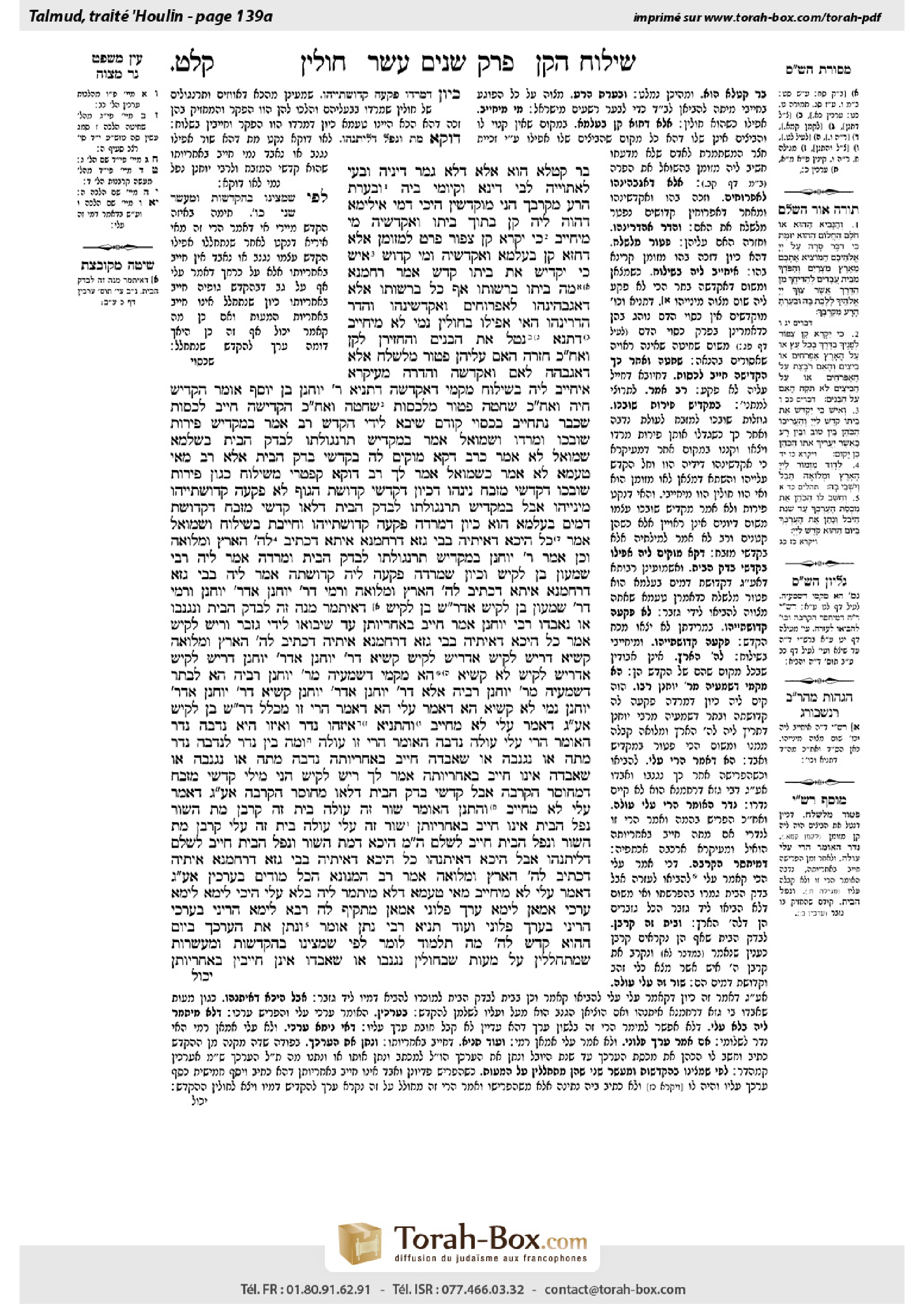
Chullin 139a: Talmud study for Daf Yomi
Study the Talmud for Daf Yomi with scanned pages, Hebrew text, English translations from Sefaria and AI-generated French translations.
Passage selection and English or AI-generated French translation are available where the scan has annotations. Daf Study is independent of Torah-Box and Sefaria.
Browse Chullin · חולין · All tractatesChullin 139a text and translations
This page of Chullin includes the Aramaic text, an English translation and an AI-generated French translation, alongside the scan above.
חולין קל״ט א · Aramaic and Hebrew text
בַּר קְטָלָא הוּא, אֶלָּא דְּלָא גְּמַר דִּינֵיהּ, וּבָעֵי לְאֵתוֹיֵיהּ לְבֵי דִינָא וְקַיּוֹמֵי בֵּיהּ ״וּבִעַרְתָּ הָרַע מִקִּרְבֶּךָ״.
הָנֵי מוּקְדָּשִׁין הֵיכִי דָמֵי? אִילֵּימָא דַּהֲוָה לֵיהּ קֵן בְּתוֹךְ בֵּיתוֹ וְאַקְדְּשֵׁיהּ – מִי מִיחַיַּיב? ״כִּי יִקָּרֵא קַן צִפּוֹר״ – פְּרָט לִמְזוּמָּן.
אֶלָּא דַּחֲזָא קֵן בְּעָלְמָא וְאַקְדְּשֵׁיהּ, וּמִי קָדוֹשׁ? ״אִישׁ כִּי יַקְדִּשׁ אֶת בֵּיתוֹ קֹדֶשׁ״ אָמַר רַחֲמָנָא, מָה בֵּיתוֹ בִּרְשׁוּתוֹ, אַף כֹּל בִּרְשׁוּתוֹ.
אֶלָּא דְּאַגְבְּהִינְהוּ לְאֶפְרוֹחִים, וְאַקְדְּשִׁינְהוּ, וַהֲדַר אַהְדְּרִינְהוּ – הַאי אֲפִילּוּ בְּחוּלִּין נָמֵי לָא מִיחַיַּיב, דִּתְנָא: נָטַל אֶת הַבָּנִים וְהֶחְזִירָן לַקֵּן, וְאַחַר כָּךְ חָזְרָה הָאֵם עֲלֵיהֶן – פָּטוּר מִלְּשַׁלֵּחַ.
אֶלָּא, דְּאַגְבְּהַהּ לְאֵם, וְאַקְדְּשַׁהּ, וַהֲדַרָה. מֵעִיקָּרָא אִיחַיַּיב לֵיהּ בְּשִׁילּוּחַ מִקַּמֵּי דְּאַקְדְּשַׁהּ, דְּתַנְיָא: רַבִּי יוֹחָנָן בֶּן יוֹסֵף אוֹמֵר: הִקְדִּישׁ חַיָּה וְאַחַר כָּךְ שְׁחָטָהּ – פָּטוּר מִלְּכַסּוֹת, שְׁחָטָהּ וְאַחַר כָּךְ הִקְדִּישָׁהּ – חַיָּיב לְכַסּוֹת, שֶׁכְּבָר נִתְחַיֵּיב בְּכִסּוּי קוֹדֶם שֶׁיָּבֹא לִידֵי הֶקְדֵּשׁ.
רַב אָמַר: בְּמַקְדִּישׁ פֵּירוֹת שׁוֹבָכוֹ וּמָרְדוּ, וּשְׁמוּאֵל אָמַר: בְּמַקְדִּישׁ תַּרְנְגוֹלְתּוֹ לְבֶדֶק הַבַּיִת.
בִּשְׁלָמָא שְׁמוּאֵל לֹא אָמַר כְּרַב, דְּקָא מוֹקֵים לַהּ בְּקׇדְשֵׁי בֶּדֶק הַבַּיִת, אֶלָּא רַב מַאי טַעְמָא לָא אָמַר כִּשְׁמוּאֵל?
אָמַר לְךָ רַב: דַּוְקָא קָפָטְרִי מִשִּׁילּוּחַ, כְּגוֹן פֵּירוֹת שׁוֹבָכוֹ דְּקׇדְשֵׁי מִזְבֵּחַ נִינְהוּ, דְּכֵיוָן דְּקָדְשִׁי קְדוּשַּׁת הַגּוּף – לָא פָּקְעָה קְדוּשְׁתַּיְיהוּ מִינַּיְיהוּ, אֲבָל בְּמַקְדִּישׁ תַּרְנְגוֹלְתּוֹ לְבֶדֶק הַבַּיִת, דְּלָאו קׇדְשֵׁי מִזְבֵּחַ, דִּקְדוּשַּׁת דָּמִים בְּעָלְמָא הוּא – כֵּיוָן דִּמְרַדָה פְּקַעָה קְדוּשְׁתַּיְיהוּ, וְחַיֶּיבֶת בְּשִׁילּוּחַ.
וּשְׁמוּאֵל אָמַר: כֹּל הֵיכָא דְּאִיתֵיהּ – בְּבֵי גַזָּא דְּרַחֲמָנָא אִיתֵיהּ, דִּכְתִיב: ״לַה׳ הָאָרֶץ וּמְלוֹאָהּ״. וְכֵן אָמַר רַבִּי יוֹחָנָן בְּמַקְדִּישׁ תַּרְנְגוֹלְתּוֹ לְבֶדֶק הַבַּיִת וּמָרְדָה. אֲמַר לֵיהּ רַבִּי שִׁמְעוֹן בֶּן לָקִישׁ: וְכֵיוָן שֶׁמָּרְדָה פְּקַעָה לַיהּ קְדוּשְׁתַּהּ! אֲמַר לֵיהּ: בְּבֵי גַזָּא דְּרַחֲמָנָא אִיתַאּ, דִּכְתִיב: ״לַה׳ הָאָרֶץ וּמְלוֹאָהּ״.
וּרְמִי דְּרַבִּי יוֹחָנָן אַדְּרַבִּי יוֹחָנָן, וּרְמִי דְּרַבִּי שִׁמְעוֹן בֶּן לָקִישׁ אַדְּרַבִּי שִׁמְעוֹן בֶּן לָקִישׁ.
דְּאִיתְּמַר: מָנֶה זֶה לְבֶדֶק הַבַּיִת, וְנִגְנְבוּ אוֹ נֶאֶבְדוּ – רַבִּי יוֹחָנָן אָמַר: חַיָּיב בְּאַחְרָיוּתָן עַד שֶׁיָּבוֹאוּ לִידֵי גִזְבָּר, וְרֵישׁ לָקִישׁ אָמַר: כֹּל הֵיכָא דְּאִיתֵיהּ בְּבֵי גַזָּא דְּרַחֲמָנָא אִיתֵיהּ, דִּכְתִיב: ״לַה׳ הָאָרֶץ וּמְלוֹאָהּ״. קַשְׁיָא דְּרֵישׁ לָקִישׁ אַדְּרֵישׁ לָקִישׁ, קַשְׁיָא דְּרַבִּי יוֹחָנָן אַדְּרַבִּי יוֹחָנָן.
דְּרֵישׁ לָקִישׁ אַדְּרֵישׁ לָקִישׁ לָא קַשְׁיָא, הָא מִקַּמֵּי דְּשַׁמְעֵיהּ מֵרַבִּי יוֹחָנָן רַבֵּיהּ, הָא לְבָתַר דְּשַׁמְעֵיהּ מֵרַבִּי יוֹחָנָן רַבֵּיהּ.
אֶלָּא דְּרַבִּי יוֹחָנָן אַדְּרַבִּי יוֹחָנָן קַשְׁיָא! דְּרַבִּי יוֹחָנָן אַדְּרַבִּי יוֹחָנָן נָמֵי לָא קַשְׁיָא, הָא דְּאָמַר ״עָלַי״, הָא דְּאָמַר ״הֲרֵי זוֹ״.
מִכְּלָל דְּרַבִּי שִׁמְעוֹן בֶּן לָקִישׁ, אַף עַל גַּב דְּאָמַר ״עָלַי״, לָא מְחַיֵּיב?
וְהָתַנְיָא: אֵיזֶהוּ נֶדֶר וְאֵיזוֹ הִיא נְדָבָה? נֶדֶר – הָאוֹמֵר ״הֲרֵי עָלַי עוֹלָה״, נְדָבָה – הָאוֹמֵר ״הֲרֵי זוֹ עוֹלָה״. וּמָה בֵּין נֶדֶר לִנְדָבָה? נֶדֶר – מֵתָה אוֹ נִגְנְבָה אוֹ שֶׁאָבְדָה, חַיָּיב בְּאַחְרָיוּתָהּ; נְדָבָה – מֵתָה אוֹ נִגְנְבָה אוֹ שֶׁאָבְדָה, אֵינוֹ חַיָּיב בְּאַחְרָיוּתָהּ.
אָמַר לָךְ רֵישׁ לָקִישׁ: הָנֵי מִילֵּי קׇדְשֵׁי מִזְבֵּחַ, דִּמְחוּסַּר הַקְרָבָה, אֲבָל קׇדְשֵׁי בֶּדֶק הַבַּיִת, דְּלָאו מְחוּסַּר הַקְרָבָה – אַף עַל גַּב דְּאָמַר ״עָלַי״ – לָא מְחַיֵּיב.
וְהָתְנַן: הָאוֹמֵר ״שׁוֹר זֶה עוֹלָה״, ״בַּיִת זֶה קׇרְבָּן״ – מֵת הַשּׁוֹר, נָפַל הַבַּיִת – אֵינוֹ חַיָּיב בְּאַחְרָיוּתָן; ״שׁוֹר זֶה עָלַי עוֹלָה״, ״בַּיִת זֶה עָלַי קׇרְבָּן״ – מֵת הַשּׁוֹר וְנָפַל הַבַּיִת – חַיָּיב לְשַׁלֵּם.
הָנֵי מִילֵּי הֵיכָא דְּמֵת הַשּׁוֹר וְנָפַל הַבַּיִת, חַיָּיב לְשַׁלֵּם, דְּלֵיתַנְהוּ, אֲבָל הֵיכָא דְּאִיתַנְהוּ, כֹּל הֵיכָא דְּאִיתֵיהּ בְּבֵי גַזָּא דְּרַחֲמָנָא אִיתֵיהּ, דִּכְתִיב ״לַה׳ הָאָרֶץ וּמְלוֹאָהּ״.
אָמַר רַב הַמְנוּנָא: הַכֹּל מוֹדִים בַּעֲרָכִין, אַף עַל גַּב דְּאָמַר ״עָלַי״ – לָא מִיחַיַּיב. מַאי טַעְמָא? דְּלָא מִיתְּמַר לֵיהּ בְּלָא ״עָלַי״.
הֵיכִי לֵימָא? לֵימָא ״עֶרְכִּי״ – אַמַּאן? לֵימָא ״עֵרֶךְ פְּלוֹנִי״ – אַמַּאן?
מַתְקֵיף לַהּ רָבָא: לֵימָא ״הֲרֵינִי בְּעֶרְכִּי״, ״הֲרֵינִי בְּעֵרֶךְ פְּלוֹנִי״! וְעוֹד, תַּנְיָא רַבִּי נָתָן אוֹמֵר: ״וְנָתַן אֶת הָעֶרְכְּךָ בַּיּוֹם הַהוּא קֹדֶשׁ לַה׳״ – מָה תַּלְמוּד לוֹמַר? לְפִי שֶׁמָּצִינוּ בְּהֶקְדֵּשׁוֹת וּמַעַשְׂרוֹת שֶׁמִּתְחַלְּלִין עַל מָעוֹת שֶׁבַּחוּלִּין, נִגְנְבוּ אוֹ שֶׁאָבְדוּ – אֵינָן חַיָּיבִין בְּאַחְרָיוּתָן,
Chullin 139a · English translation
how could it be free to rest on its eggs? It is subject to being killed and should have been executed. Rather, it must be a case where its verdict was not yet issued, and one is required to bring it to the court to fulfill through it the verse: “And you shall eradicate the evil from your midst” (Deuteronomy 13:6).
§ With regard to the statement of the mishna that sacrificial birds are not included in the mitzva of sending away the mother bird from the nest, the Gemara asks: What are the circumstances of these sacrificial birds discussed in the mishna? If we say that the mishna is referring to a case where one had a nest in his house and consecrated it, is one obligated to send away even a non-sacred bird in such a case? The verse states: “If a bird’s nest happens before you on the way” (Deuteronomy 22:6), which excludes a nest readily available in one’s home.
Rather, perhaps the mishna is referring to a case where one merely saw a nest that did not belong to him, and he consecrated it. But this, too, is problematic: Is the nest consecrated in such a case? But the Merciful One states: “When a man shall sanctify his house to be holy” (Leviticus 27:14), indicating that just as his house is in his possession when he consecrates it, so too, any item that one wishes to consecrate must be in his possession when consecrating it. If so, one cannot consecrate a nest that does not belong to him.
Rather, say that the mishna is referring to a case where one lifted the chicks, taking possession of them, and then consecrated them, and then returned them to the nest. But this too cannot be, as even with regard to non-sacred birds one is not obligated to send the mother away in such a case, as is taught in a mishna (141a): If one sent the mother away and took the offspring and then returned them to the nest, and thereafter, the mother returned and rested upon them, one is exempt from sending the mother bird away, because he has acquired the offspring and they are now considered readily available.
The Gemara suggests: Rather, say that the mishna is referring to a case where one lifted the mother, taking possession of her, and then consecrated her, and thereafter returned her to the nest. The Gemara responds that this too cannot be, because he was initially obligated in the sending away of the mother bird before he consecrated her. Consequently, the consecration of the bird afterward cannot abrogate the requirement to send it away, as it is taught in a baraita: Rabbi Yoḥanan ben Yosef says: If one consecrated an undomesticated animal and then slaughtered it, he is exempt from covering its blood, because a consecrated animal is not subject to the obligation of covering the blood. But if he slaughtered it and then consecrated it, he is obligated to cover its blood, as he was already obligated in the mitzva of covering of the blood before it came into the possession of the Temple treasury.
Rather, Rav says: The mishna is referring to a case of one who consecrates the fruit, i.e., the chicks, of his dovecote for sacrifice on the altar, and they later rebelled and fled from the dovecote and nested elsewhere. The mishna teaches that although such birds are not considered readily available, one is exempt from sending away the mother because they are sacrificial birds. If they were non-sacred, one who finds them would be obligated to do so. And Shmuel says: The mishna is referring to a case of one who consecrates his chicken for Temple maintenance, and the chicken later rebelled and fled its owner’s home and established a nest elsewhere.
The Gemara objects: Granted, Shmuel did not state his explanation of the mishna in accordance with that of Rav, since he interprets it as referring even to birds consecrated for Temple maintenance, which do not have inherent sanctity. Accordingly, the mishna teaches that all consecrated birds are not included in the mitzva of sending away the mother bird. But what is the reason that Rav did not state his explanation in accordance with that of Shmuel?
The Gemara responds: Rav could have said to you: I specifically exempted one from sending the mother bird away in a case where the birds are the fruit of his dovecote, as they are consecrated for the altar. Since they are consecrated with inherent sanctity, their sanctity is not abrogated from them even when they flee from the dovecote. But in a case where one consecrates his chicken for Temple maintenance, where the chicken is not consecrated for the altar but merely has sanctity that inheres in its value, once it rebels its sanctity is abrogated, and it is obligated in, i.e., subject to, the mitzva of sending away the mother bird.
And Shmuel could have said: Though it has rebelled, the chicken retains its sanctity, since wherever it is, it is in the treasury [bei gazza] of the Merciful One, as it is written: “The earth is the Lord’s, and its fullness thereof” (Psalms 24:1). And so Rabbi Yoḥanan says that the mishna is referring to a case where one consecrated his chicken for Temple maintenance, and the chicken then rebelled. Rabbi Shimon ben Lakish said to him: But once it rebels, its sanctity is abrogated. Rabbi Yoḥanan said to him: Wherever it is, it is in the treasury of the Merciful One, as it is written: “The earth is the Lord’s, and its fullness thereof.”
And the Gemara raises a contradiction between the statement of Rabbi Yoḥanan here and that of Rabbi Yoḥanan elsewhere, and the Gemara raises a contradiction between the statement of Rabbi Shimon ben Lakish here and that of Rabbi Shimon ben Lakish elsewhere.
As it was stated: If one declares that these one hundred dinars are consecrated for Temple maintenance, and they were stolen or lost, Rabbi Yoḥanan says: He bears responsibility for them until they come into the physical possession of the Temple treasurer [gizbar]. Consequently, he must pay one hundred dinars to the treasury. And Reish Lakish says: One is not required to replace the lost money, since wherever it is, it is in the treasury of the Merciful One, as it is written: “The earth is the Lord’s, and its fullness.” Accordingly, the money is considered to have entered the possession of the treasury. If so, this statement of Reish Lakish poses a difficulty for the other statement of Reish Lakish, and this statement of Rabbi Yoḥanan poses a difficulty for the other statement of Rabbi Yoḥanan.
The Gemara responds: The apparent contradiction between this statement of Reish Lakish and that statement of Reish Lakish is not difficult. This statement, that the sanctity of a consecrated chicken that rebelled is abrogated, was made before he heard the statement from Rabbi Yoḥanan, his teacher, that wherever it is, it is in God’s treasury. That statement, that one is not liable to replace the missing consecrated funds, was made after he heard that statement from Rabbi Yoḥanan his teacher.
The Gemara objects: But still, this statement of Rabbi Yoḥanan poses a difficulty for that statement of Rabbi Yoḥanan. The Gemara responds: The apparent contradiction between this statement of Rabbi Yoḥanan and that statement of Rabbi Yoḥanan is also not difficult. This statement, that one bears responsibility for the missing consecrated funds, is referring to a case where the consecrator said: It is incumbent upon me to bring one hundred dinars to the Temple treasury. In such a case, one bears responsibility for the money until it reaches the Temple treasurer. That statement, that a consecrated chicken that rebelled remains consecrated, is referring to a case where the consecrator said: This chicken is consecrated for Temple maintenance. In such a case, the sanctity is not abrogated even after the chicken flees, because wherever it is, it is in God’s treasury.
The Gemara objects: If it is so that when Rabbi Yoḥanan says that one bears financial responsibility for the missing consecrated funds, he is referring to a case where one said: It is incumbent upon me, by inference one may conclude that according to Rabbi Shimon ben Lakish, who says that one does not bear responsibility for the money, one does not bear financial responsibility even though one said: It is incumbent upon me.
But isn’t it taught in a mishna (Kinnim 1:1): Which is the case of a vow offering, and which is the case of a gift offering? A vow offering is where one says: It is incumbent upon me to bring a burnt offering. A gift offering is where one says: This animal is a burnt offering. And what is the difference between a vow offering and a gift offering? With regard to a vow offering, if it died or was stolen or lost, one bears financial responsibility for it. With regard to a gift offering, if it died or was stolen or lost, one does not bear financial responsibility for it.
The Gemara responds that Reish Lakish could have said to you: This statement, that one who says: It is incumbent upon me, bears financial responsibility, applies only to an item consecrated for the altar, since one vowed to sacrifice it as an offering and it has not yet been sacrificed. But with regard to an item consecrated for Temple maintenance, which is not lacking sacrifice on the altar, even though one said: It is incumbent upon me, one does not bear financial responsibility for it.
The Gemara objects: But didn’t we learn in a mishna (Arakhin 20b) that in the case of one who says: This bull is consecrated as a burnt offering, or: This house is consecrated as an offering, and the bull died or the house collapsed, he does not bear financial responsibility for them; but in the case of one who says: It is incumbent upon me to give this bull as a burnt offering, or: It is incumbent upon me to give this house as an offering, if the bull died or the house collapsed, he is obligated to pay its value? Evidently, even with regard to items consecrated for Temple maintenance, if one says: It is incumbent upon me, one bears financial responsibility for them.
The Gemara responds: With regard to this statement, that if one says: It is incumbent upon me to give an item for Temple maintenance, he bears financial responsibility, that applies only where the bull died or the house collapsed. In such a case he is obligated to pay, since they no longer exist. But where they still exist, e.g., in the case of an item or sum of money that was lost or stolen, one applies the principle: Wherever it is, it is in the treasury of the Merciful One, as it is written: “The earth is the Lord’s, and its fullness thereof.”
§ The Gemara above cited a dispute between Rabbi Yoḥanan and Reish Lakish as to the halakha about one who says: It is incumbent upon me to bring an item for Temple maintenance. With regard to this dispute, Rav Hamnuna says: Everyone concedes with regard to valuations that even if one said: It is incumbent upon me to donate my own valuation, and one set aside money that was then lost or stolen, one does not bear financial responsibility for it. What is the reason for this? It is because it cannot be stated by him without stating: Upon me. In other words, one cannot say: This is my valuation, since he has yet to accept upon himself any such obligation.
Therefore, although one says: It is incumbent upon me to donate my valuation, this is not considered an acceptance of financial responsibility. After all, how shall he say it without stating: It is incumbent upon me? Shall he say only: My own valuation, without: Is incumbent upon me? If so, upon whom is the obligation placed to pay the money? Or shall he say only: The valuation of so-and-so? Still, upon whom is the obligation placed to pay the money?
Rava objects to this: Let him say: I am encumbered with my own valuation, or: I am encumbered with the valuation of so-and-so. One need not say: Is incumbent upon me. Additionally, it is taught in a baraita with regard to the redemption of a purchased field that was consecrated that Rabbi Natan says about the verse: “Then the priest shall reckon for him the worth of your valuation until the Jubilee Year, and he shall give your valuation on that day, as a consecrated thing to the Lord” (Leviticus 27:23): Why must the verse state: “And he shall give your valuation”? It could have stated simply: And he shall give it. It is necessary because we have found with regard to consecrated property and tithes that they can be desacralized by transferring their sanctity onto non-sacred money, and that if that money was stolen or lost, the owners do not bear financial responsibility for it.
Chullin 139a · Traduction française (IA)
Comment pourrait-il être libre de reposer sur ses œufs ? Il est soumis à être tué et aurait dû être exécuté. Plutôt, il doit s'agir d'un cas où son verdict n'a pas encore été rendu, et l'on est tenu de le présenter devant le tribunal afin de remplir la parole : « Et vous éradiquerez le mal de votre milieu » (Deutéronome 13 : 6).
§ En ce qui concerne l'affirmation de la Michna que les oiseaux sacrés ne sont pas inclus dans la mitsva d'expulser la mère de son nid, la Guemara pose la question : Quelles sont les circonstances de ces oiseaux sacrés évoqués dans la Michna ? Si l'on dit que la Michna fait référence à un cas où l'on avait un nid dans sa maison et qu'il l'a consacré, est-on tenu d'expulser même un oiseau non sacré dans ce cas ? La parole dit : « Si un nid d'oiseau se trouve devant toi sur le chemin » (Deutéronome 22 : 6), ce qui exclut un nid facilement accessible dans sa maison.
Plutôt, peut-être la Michna fait référence à un cas où l'on a simplement vu un nid qui ne lui appartenait pas, et l'a consacré. Mais cela aussi est problématique : Le nid est-il consacré dans ce cas ? Mais le Très Miséricordieux dit : « Quand un homme sanctifiera sa maison pour être saint » (Lévitique 27 : 14), indiquant que tout comme sa maison est en son possession lorsqu'il la consacre, de même tout objet que l'on souhaite consacrer doit être en son possession lors de la consécration. Si c'est ainsi, on ne peut pas consacrer un nid qui ne lui appartient pas.
Plutôt, disons que la mitsna fait référence à un cas où l'on a soulevé les poussins, en les prenant en possession, et puis les a consacrés, et ensuite les a remis dans le nid. Mais cela non plus ne peut pas être, car même concernant les oiseaux non sacrés, on n'est pas tenu d'expulser la mère dans ce cas, comme il est enseigné dans une mitsna (141a) : Si l'on a expulsé la mère, pris les petits et puis les a remis dans le nid, et ensuite la mère est revenue et s'est reposée sur eux, on est exempt d'expulser la mère, car l'on a acquis les petits et ils sont désormais considérés comme facilement accessibles.
La Guemara suggère : Plutôt, disons que la mitsna fait référence à un cas où l'on a soulevé la mère, en la prenant en possession, et puis l'a consacrée, et ensuite l'a remise dans le nid. La Guemara répond que cela non plus ne peut pas être, car l'on était initialement tenu d'expulser la mère avant de la consacrer. Par conséquent, la consécration de l'oiseau après cela ne peut pas annuler l'obligation d'expulser, comme il est enseigné dans une baraïta : Rabbi Yoḥanan ben Yosef dit : Si l'on a consacré un animal non domestique et puis l'a tué, il est exempt de recouvrir son sang, car un animal consacré n'est pas soumis à l'obligation de recouvrir le sang. Mais si l'on a tué l'animal et puis l'a consacré, il est tenu de recouvrir son sang, car l'on était déjà tenu de la mitsva de recouvrir le sang avant qu'il ne soit entré dans la propriété du trésor du Temple.
Plutôt, Rav dit : La mitsva fait référence à un cas où l'on consacre les poussins, c'est-à-dire les petits, de son colombier pour sacrifice sur l'autel, et ils ont ensuite rebelle et fui du colombier et ont fait leur nid ailleurs. La mitsva enseigne que bien que ces oiseaux ne soient pas considérés comme facilement accessibles, l'on est exempt d'expulser la mère car ils sont des oiseaux sacrés. Si ce n'étaient pas des oiseaux sacrés, celui qui les trouve serait tenu de le faire. Et Shmuel dit : La mitsva fait référence à un cas où l'on consacre son poulet pour l'entretien du Temple, et le poulet a ensuite rebelle et fui de la maison de son propriétaire et a établi un nid ailleurs.
La Guemara s'oppose : Cela est admis, Shmuel n'a pas formulé son explication de la mitsva conformément à celle de Rav, puisqu'il l'interprète comme faisant référence même aux oiseaux consacrés pour l'entretien du Temple, qui n'ont pas de sanctité intrinsèque. Ainsi, la mitsva enseigne que tous les oiseaux consacrés ne sont pas inclus dans la mitsva d'expulser la mère. Mais quelle est la raison pour laquelle Rav n'a pas formulé son explication conformément à celle de Shmuel ?
La Guemara répond : Rav aurait pu dire à toi : Je me suis spécifiquement exempté de l'obligation d'expulser la mère dans le cas où les oiseaux sont les fruits de son colombier, car ils sont consacrés pour l'autel. Puisque leur sanctité est intrinsèque, leur sanctité n'est pas annulée même s'ils fuient du colombier. Mais dans le cas où l'on consacre son poulet pour l'entretien du Temple, où le poulet n'est pas consacré pour l'autel mais possède une sanctité qui réside dans sa valeur, une fois qu'il révolte, sa sanctité est annulée, et il est tenu, c'est-à-dire soumis, à la mitsva d'expulser la mère.
Et Shmuel aurait pu dire : Bien qu'il ait rebelle, le poulet conserve sa sanctité, puisque partout où il est, il est dans le trésor du Très Miséricordieux, comme il est écrit : « La terre est du Seigneur, et toute sa plénitude » (Psaumes 24 : 1). Et ainsi Rabbi Yoḥanan dit que la mitsva fait référence à un cas où l'on a consacré son poulet pour l'entretien du Temple, et le poulet a ensuite rebelle. Rabbi Shimon ben Lakish lui a dit : Mais une fois qu'il rebelle, sa sanctité est annulée. Rabbi Yoḥanan lui a répondu : Partout où il est, il est dans le trésor du Très Miséricordieux, comme il est écrit : « La terre est du Seigneur, et toute sa plénitude. »
Et la Guemara soulève une contradiction entre l'affirmation de Rabbi Yoḥanan ici et celle de Rabbi Yoḥanan ailleurs, et la Guemara soulève une contradiction entre l'affirmation de Rabbi Shimon ben Lakish ici et celle de Rabbi Shimon ben Lakish ailleurs.
Comme il a été dit : Si l'on déclare que ces cent dinars sont consacrés à l'entretien du Temple, et qu'ils ont été volés ou perdus, Rabbi Yoḥanan dit : Il est responsable d'eux jusqu'à ce qu'ils soient en possession physique du trésorier du Temple [gizbar]. Ainsi, il doit payer cent dinars au trésor. Et Reish Lakish dit : On n'est pas tenu de remplacer l'argent perdu, car où qu'il soit, il est dans le trésor du Tout-Puissant, comme il est écrit : « La terre est du Seigneur, et toute sa plénitude. » Ainsi, l'argent est considéré comme entré en possession du trésor. Si c'est ainsi, cette déclaration de Reish Lakish pose un problème pour l'autre déclaration de Reish Lakish, et cette déclaration de Rabbi Yoḥanan pose un problème pour l'autre déclaration de Rabbi Yoḥanan.
Le Guemara répond : Le paradoxe apparent entre cette déclaration de Reish Lakish et celle-ci n'est pas difficile. Cette déclaration, que la sanctité d'un poulet consacré qui s'est enfui est abolie, a été faite avant qu'il n'entende la déclaration de Rabbi Yoḥanan, son maître, que là où il est, il est dans le trésor du Tout-Puissant. Cette déclaration, que l'on n'est pas tenu de remplacer les fonds consacrés manquants, a été faite après avoir entendu cette déclaration de Rabbi Yoḥanan, son maître.
Le Guemara s'oppose : Mais tout de même, cette déclaration de Rabbi Yoḥanan pose un problème pour cette déclaration de Rabbi Yoḥanan. Le Guemara répond : Le paradoxe apparent entre cette déclaration de Rabbi Yoḥanan et celle-ci n'est pas difficile. Cette déclaration, que l'on est responsable des fonds consacrés manquants, fait référence à un cas où le consacrant a dit : Il m'est impératif de donner cent dinars au trésor du Temple. Dans ce cas, l'on est responsable de l'argent jusqu'à ce qu'il arrive au trésorier du Temple. Cette déclaration, que le poulet consacré qui s'est enfui reste consacré, fait référence à un cas où le consacrant a dit : Ce poulet est consacré à l'entretien du Temple. Dans ce cas, la sanctité n'est pas abolie même après que le poulet ait fui, car là où il est, il est dans le trésor du Tout-Puissant.
Le Guemara s'oppose : Si c'est ainsi que Rabbi Yoḥanan dit que l'on est responsable financièrement des fonds consacrés manquants, il fait référence à un cas où l'on a dit : Il m'est impératif, et l'on peut en déduire que selon Rabbi Shimon ben Lakish, qui dit que l'on n'est pas responsable de l'argent, l'on n'est pas responsable financièrement même si l'on a dit : Il m'est impératif.
Mais n'est-ce pas enseigné dans une mitsva (Kinnim 1:1) : Quel est le cas d'une offrande de vœu et quel est le cas d'une offrande de don ? Une offrande de vœu est celle où l'on dit : Il m'est impératif de présenter un holocauste. Une offrande de don est celle où l'on dit : Cet animal est un holocauste. Et quelle est la différence entre une offrande de vœu et une offrande de don ? Concernant une offrande de vœu, si elle est morte, volée ou perdue, l'on est responsable financièrement d'elle. Concernant une offrande de don, si elle est morte, volée ou perdue, l'on n'est pas responsable financièrement d'elle.
Le Guemara répond que Reish Lakish aurait pu dire à vous : Cette déclaration, que celui qui dit : Il m'est impératif est responsable, s'applique uniquement à un objet consacré pour l'autel, car l'on a prêté serment de le sacrifier comme une offrande et il n'a pas encore été sacrifié. Concernant un objet consacré pour l'entretien du Temple, qui n'a pas besoin d'être sacrifié sur l'autel, même si l'on a dit : Il m'est impératif, l'on n'est pas responsable financièrement d'eux.
Le Guemara s'oppose : Mais n'avons-nous pas appris dans une mitsna (Arakhin 20b) que dans le cas où l'on dit : Ce taureau est consacré comme un holocauste, ou : Cette maison est consacrée comme une offrande, et que le taureau est mort ou que la maison s'est effondrée, il n'est pas responsable financièrement d'eux ; mais dans le cas où l'on dit : Il m'est impératif de donner ce taureau comme un holocauste, ou : Il m'est impératif de donner cette maison comme une offrande, si le taureau est mort ou que la maison s'est effondrée, il est tenu de payer sa valeur ? Évidemment, même concernant les objets consacrés pour l'entretien du Temple, si l'on dit : Il m'est impératif, l'on est responsable financièrement d'eux.
Le Guemara répond : Concernant cette déclaration, que si l'on dit : Il m'est impératif de donner un objet pour l'entretien du Temple, l'on est responsable financièrement, cela s'applique uniquement dans le cas où le taureau est mort ou que la maison s'est effondrée. Dans ce cas-là, il est tenu de payer, car ils n'existent plus. Mais dans le cas où ils existent encore, par exemple dans le cas d'un objet ou d'une somme d'argent perdu ou volé, l'on applique le principe : Lorsque l'argent est là, il est dans le trésor du Tout-Puissant, comme il est écrit : « La terre est du Seigneur, et toute sa plénitude. »
§ Le Guemara mentionné ci-dessus cite un désaccord entre Rabbi Yoḥanan et Reish Lakish concernant la halakha concernant celui qui dit : Il m'est impératif de présenter un objet pour l'entretien du Temple. Concernant ce désaccord, Rav Hamnuna dit : Tout le monde reconnaît que concernant les évaluations, même si l'on dit : Il m'est impératif de donner mon évaluation, et qu'on a mis de côté de l'argent qui a ensuite été perdu ou volé, l'on n'est pas responsable financièrement d'eux. Quelle est la raison de cela ? C'est parce qu'on ne peut pas dire cela sans dire : Il m'est impératif. En d'autres termes, on ne peut pas dire : C'est mon évaluation, car il n'a pas encore accepté une telle obligation.
Par conséquent, bien que l'on dise : Il m'est impératif de donner mon évaluation, cela n'est pas considéré comme une acceptation d'une responsabilité financière. En effet, comment pourrait-il le dire sans dire : Il m'est impératif ? Devrait-il dire seulement : Mon évaluation, sans : Il m'est impératif ? Si c'est ainsi, à qui incombe l'obligation de payer l'argent ? Ou devrait-il dire seulement : L'évaluation de tel ou tel ? Et pourtant, à qui incombe l'obligation de payer l'argent ?
Rava s'oppose à cela : qu'il dise : Je suis chargé de ma propre estimation, ou : Je suis chargé de l'estimation de tel ou tel. Il n'est pas nécessaire de dire : C'est une obligation pour moi. De plus, il est enseigné dans une baraïta concernant la rachat d'un champ acheté qui a été consacré, que Rabbi Natan dit sur la parole : « Puis le prêtre calculera pour lui la valeur de votre estimation jusqu'à l'année du Jubilé, et il donnera votre estimation ce jour-là, comme chose consacrée au Seigneur » (Lévitique 27:23) : Pourquoi la parole dit-elle : « Et il donnera votre estimation » ? Elle aurait pu dire simplement : « Et il le donnera ». Il est nécessaire car nous avons trouvé concernant les biens consacrés et les dîmes que ceux-ci peuvent être désacralisés en transférant leur sainteté sur de l'argent non sacré, et que si cet argent a été volé ou perdu, les propriétaires ne portent pas la responsabilité financière.
Traduction française générée par IA à partir de l’édition anglaise de Sefaria. Vérifie toujours un passage avec le texte source.
Text from Sefaria: William Davidson Edition - Vocalized Aramaic (unknown); William Davidson Edition - English (CC BY NC).