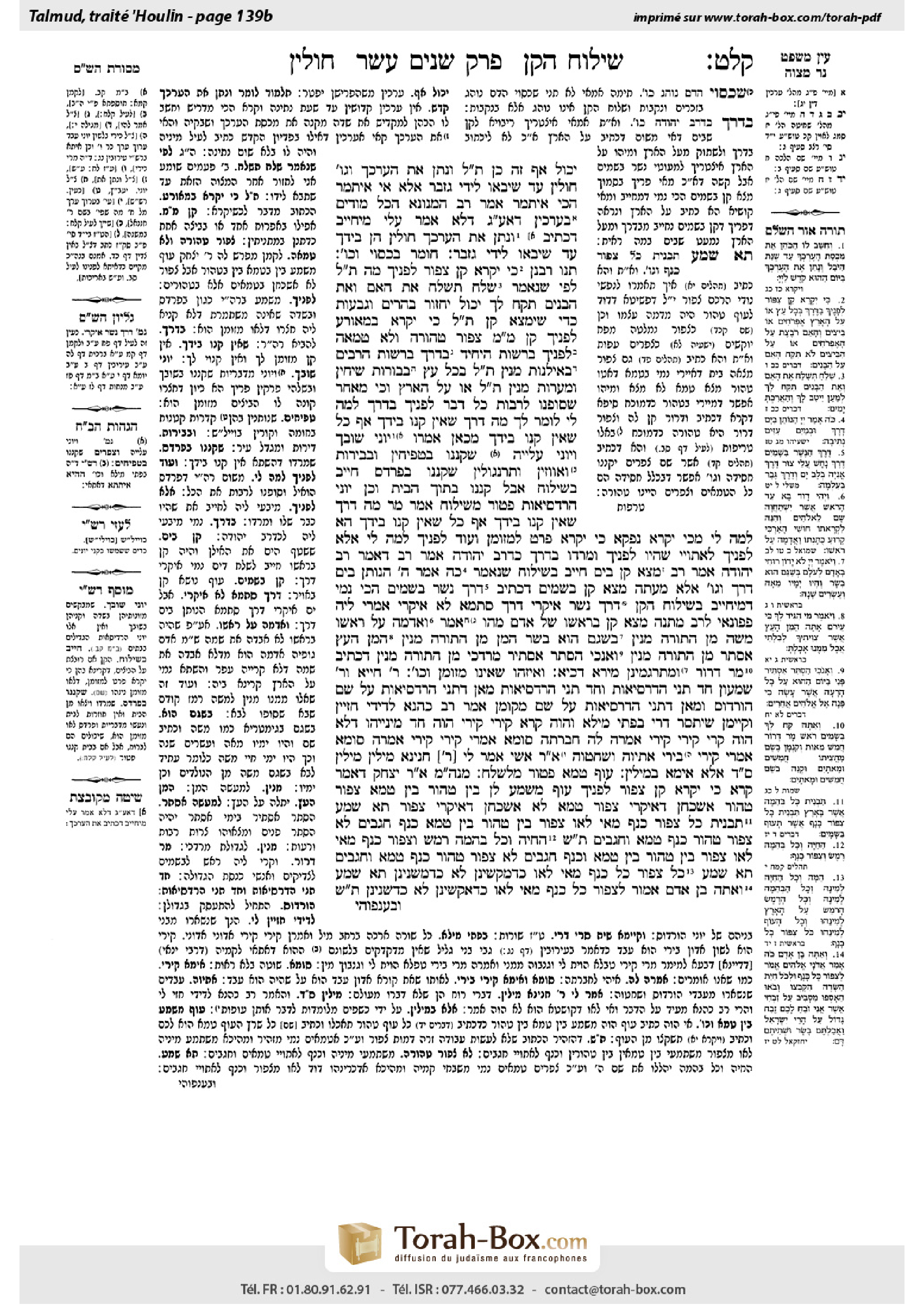
Chullin 139b: Talmud study for Daf Yomi
Study the Talmud for Daf Yomi with scanned pages, Hebrew text, English translations from Sefaria and AI-generated French translations.
Passage selection and English or AI-generated French translation are available where the scan has annotations. Daf Study is independent of Torah-Box and Sefaria.
Browse Chullin · חולין · All tractatesChullin 139b text and translations
This page of Chullin includes the Aramaic text, an English translation and an AI-generated French translation, alongside the scan above.
חולין קל״ט ב · Aramaic and Hebrew text
יָכוֹל אַף זֶה כֵּן? תַּלְמוּד לוֹמַר: ״וְנָתַן אֶת הָעֶרְכְּךָ וְגוֹ׳״ – חוּלִּין עַד שֶׁיָּבֹאוּ לִידֵי גִזְבָּר.
אֶלָּא, אִי אִיתְּמַר, הָכִי אִיתְּמַר: אָמַר רַב הַמְנוּנָא: הַכֹּל מוֹדִים בַּעֲרָכִין, דְּאַף עַל גַּב דְּלָא אָמַר ״עָלַי״ – מִיחַיַּיב, דִּכְתִיב ״וְנָתַן אֶת הָעֶרְכְּךָ״, חוּלִּין הֵן בְּיָדְךָ עַד שֶׁיָּבֹאוּ לִידֵי גִזְבָּר.
חוֹמֶר בְּכִסּוּי וְכוּ׳. תָּנוּ רַבָּנַן, ״כִּי יִקָּרֵא קַן צִפּוֹר לְפָנֶיךָ״ – מָה תַּלְמוּד לוֹמַר?
לְפִי שֶׁנֶּאֱמַר ״שַׁלֵּחַ תְּשַׁלַּח אֶת הָאֵם וְאֶת הַבָּנִים תִּקַּח לָךְ״, יָכוֹל יַחְזוֹר בְּהָרִים וּגְבָעוֹת כְּדֵי שֶׁיִּמְצָא קֵן? תַּלְמוּד לוֹמַר ״כִּי יִקָּרֵא״ – בִּמְאוֹרָע לְפָנֶיךָ.
״קַן״ – [קֵן] מִכׇּל מָקוֹם, ״צִפּוֹר״ – טְהוֹרָה וְלֹא טְמֵאָה, ״לְפָנֶיךָ״ – בִּרְשׁוּת הַיָּחִיד, ״בַּדֶּרֶךְ״ – בִּרְשׁוּת הָרַבִּים, בָּאִילָנוֹת מִנַּיִן? תַּלְמוּד לוֹמַר ״בְּכׇל עֵץ״, בְּבוֹרוֹת שִׁיחִין וּמְעָרוֹת מִנַּיִן? תַּלְמוּד לוֹמַר ״אוֹ עַל הָאָרֶץ״.
וְכִי מֵאַחַר שֶׁסּוֹפֵנוּ לְרַבּוֹת כׇּל דָּבָר, ״לְפָנֶיךָ בַּדֶּרֶךְ״ לְמָה לִי? לוֹמַר לָךְ: מָה דֶּרֶךְ שֶׁאֵין קִנּוֹ בְּיָדֶךָ, אַף כֹּל שֶׁאֵין קִנּוֹ בְּיָדֶךָ. מִכָּאן אָמְרוּ: יוֹנֵי שׁוֹבָךְ וְיוֹנֵי עֲלִיָּיה שֶׁקִּנְּנוּ בִּטְפִיחִין וּבְבִירוֹת, וַאֲוָוזִין וְתַרְנְגוֹלִין שֶׁקִּנְּנוּ בַּפַּרְדֵּס – חַיָּיב בְּשִׁילּוּחַ, אֲבָל קִנְּנוּ בְּתוֹךְ הַבַּיִת, וְכֵן יוֹנֵי הַרְדָּסִיָּאוֹת – פָּטוּר מִשִּׁילּוּחַ.
אָמַר מָר: מָה ״דֶּרֶךְ״ – שֶׁאֵין קִנּוֹ בְּיָדְךָ, אַף כֹּל שֶׁאֵין קִנּוֹ בְּיָדְךָ. הָא לְמָה לִי? מִ״כִּי יִקָּרֵא״ נָפְקָא, ״כִּי יִקָּרֵא״ פְּרָט לִמְזוּמָּן. וְעוֹד, ״לְפָנֶיךָ״ לְמָה לִּי?
אֶלָּא ״לְפָנֶיךָ״, לְאֵתוֹיֵי שֶׁהָיוּ לְפָנֶיךָ וּמָרְדוּ, ״בַּדֶּרֶךְ״ – כִּדְרַב יְהוּדָה אָמַר רַב, דְּאָמַר רַב יְהוּדָה אָמַר רַב: מָצָא קֵן בַּיָּם חַיָּיב בְּשִׁילּוּחַ, שֶׁנֶּאֱמַר ״כֹּה אָמַר ה׳ הַנּוֹתֵן בַּיָּם דָּרֶךְ וְגוֹ׳״.
אֶלָּא מֵעַתָּה, מָצָא קֵן בַּשָּׁמַיִם, דִּכְתִיב ״דֶּרֶךְ נֶשֶׁר בַּשָּׁמַיִם״, הָכִי נָמֵי דְּמִיחַיַּיב בְּשִׁילּוּחַ הַקֵּן? ״דֶּרֶךְ נֶשֶׁר״ אִיקְּרִי, ״דֶּרֶךְ״ סְתָמָא לָא אִיקְּרִי.
אָמְרִי לֵיהּ פַּפּוּנָאֵי לְרַב מַתְנָה: מָצָא קֵן בְּרֹאשׁוֹ שֶׁל אָדָם מַהוּ? אֲמַר [לְהוּ]: ״וַאֲדָמָה עַל רֹאשׁוֹ״. מֹשֶׁה מִן הַתּוֹרָה מִנַּיִן? ״בְּשַׁגַּם הוּא בָּשָׂר״.
הָמָן מִן הַתּוֹרָה מִנַּיִן? ״הֲמִן הָעֵץ״.
אֶסְתֵּר מִן הַתּוֹרָה מִנַּיִן? ״וְאָנֹכִי הַסְתֵּר אַסְתִּיר״. מׇרְדֳּכַי מִן הַתּוֹרָה מִנַּיִן? דִּכְתִיב: ״מׇר דְּרוֹר״, וּמְתַרְגְּמִינַן: ״מֵירָא דַּכְיָא״.
וְאֵיזֶהוּ שֶׁאֵינוֹ מְזוּמָּן וְכוּ׳. רַבִּי חִיָּיא וְרַבִּי שִׁמְעוֹן – חַד תָּנֵי ״הַדְּרָסִיָּאוֹת״, וְחַד תָּנֵי ״הַרְדָּסִיָּאוֹת״. מַאן דְּתָנֵי ״הַרְדָּסִיָּאוֹת״ – עַל שֵׁם הוֹרְדוֹס, וּמַאן דְּתָנֵי ״הַדְּרָסִיָּאוֹת״ – עַל שֵׁם מְקוֹמָן.
אָמַר רַב כָּהֲנָא: לְדִידִי חַזְיָין [לִי], וְקָיְימָן שִׁיתְּסַר דָּרֵי בִּפְתֵי מִילָא, (וַהֲוָה קָרָא) [וְאָמְרָן] ״קִירִי, קִירִי״, (הֲוָה חַד מִינַּיְיהוּ דְּלָא הֲוָה קָרֵי קִירִי קִירִי) [הֲוָות חֲדָא דְּלָא הֲוָות יָדְעָה לְמֵימַר], אֲמַרָה לַהּ חֲבֶרְתַּהּ: סוֹמָא, אֱמַרִי ״קִירִי, קִירִי״, אֲמַרָה: סוֹמָא, אֱמַרִי ״קִירִי כִּירִי״, אַתְיוּהָ וְשַׁחְטוּהָ.
אָמַר רַב אָשֵׁי: אֲמַר לִי [רַבִּי] חֲנִינָא: מִילִּין. מִילִּין סָלְקָא דַּעְתָּךְ? אֶלָּא אֵימָא: בְּמִילִּין.
עוֹף טָמֵא פָּטוּר מִלְּשַׁלֵּחַ. מְנָהָנֵי מִילֵּי? אָמַר רַבִּי יִצְחָק: דְּאָמַר קְרָא ״כִּי יִקָּרֵא קֵן צִפּוֹר לְפָנֶיךָ״, עוֹף מַשְׁמַע לַן בֵּין טָהוֹר בֵּין טָמֵא. ״צִפּוֹר״ – טָהוֹר אַשְׁכְּחַן דְּאִיקְּרִי ״צִפּוֹר״, טָמֵא לָא אַשְׁכְּחַן דְּאִיקְּרִי ״צִפּוֹר״.
תָּא שְׁמַע: ״תַּבְנִית כׇּל צִפּוֹר כָּנָף״, מַאי לָאו ״צִפּוֹר״ – בֵּין טָהוֹר בֵּין טָמֵא, ״כָּנָף״ – חֲגָבִים? לָא, ״צִפּוֹר״ – טָהוֹר, ״כָּנָף״ – טָמֵא וַחֲגָבִים.
תָּא שְׁמַע: ״הַחַיָּה וְכׇל בְּהֵמָה רֶמֶשׂ וְצִפּוֹר כָּנָף״, מַאי לָאו ״צִפּוֹר״ – בֵּין טָהוֹר בֵּין טָמֵא, וְ״כָנָף״ – חֲגָבִים? לָא, ״צִפּוֹר״ – טָהוֹר, ״כָּנָף״ – טָמֵא וַחֲגָבִים.
תָּא שְׁמַע: ״כׇּל צִפּוֹר כׇּל כָּנָף״, מַאי לָאו כִּדְמַקְשִׁינַן? לָא, כְּדִמְשַׁנֵּינַן.
תָּא שְׁמַע: ״וְאַתָּה בֶן אָדָם אֱמֹר לְצִפּוֹר כׇּל כָּנָף״, מַאי לָאו כִּדְאַקְשִׁינַן? לָא, כִּדְשַׁנֵּינַן.
תָּא שְׁמַע:
Chullin 139b · English translation
One might have thought that with regard to this valuation too, the halakha should be so, i.e., if money from a valuation is stolen or lost, the owner does not bear financial responsibility for it. Therefore, the verse states: “And he shall give your valuation on that day,” indicating that the valuation money is non-sacred until it enters the possession of the Temple treasurer, and that the owner bears responsibility for it until that time. Evidently, even with regard to valuations, the consecrator bears financial responsibility, in contradiction to the statement of Rav Hamnuna.
Rather, if a statement was stated, this is what was stated: Rav Hamnuna says that everyone concedes with regard to valuations that even if one did not say: It is incumbent upon me, one bears financial responsibility for it, as it is written: “And he shall give your valuation,” indicating that the valuation money is non-sacred until it enters the possession of the Temple treasurer.
§ The mishna states: There are more stringent elements in the covering of the blood than in the sending away of the mother from the nest, as the covering of the blood applies to undomesticated animals and birds, to animals and birds that are readily available in one’s home, and to animals and birds that are not readily available; and the sending of the mother from the nest applies only to birds that are not readily available. With regard to the mitzva of sending away the mother, the Sages taught in a baraita: The verse states: “If a bird’s nest happens before you on the way, in any tree or on the ground, with fledglings or eggs, and the mother is resting upon the fledglings, or upon the eggs, you shall not take the mother with the young; you shall send the mother, but the young you may take for yourself” (Deuteronomy 22:6–7). What is the meaning when the verse states all the various details contained in it?
Since it is stated: “You shall send [shalle’aḥ teshallaḥ] the mother, but the young you may take for yourself,” one might have thought that the doubled verb “shalle’aḥ teshallaḥ” indicates that one must search even in the mountains and hills in order to find a nest with which to perform this mitzva. Therefore, the verse states: “If a bird’s nest happens,” indicating that one is obligated to send away the mother only when it confronts you; one is not required to seek out a nest.
The baraita continues: The word “nest” indicates that this mitzva applies in any case, even to a nest with only a single chick or egg. The word “bird’s” indicates that the mitzva applies only to kosher birds, and not to non-kosher birds. The term “before you” indicates that the mitzva applies to a nest that is on private property, e.g., an unguarded orchard or field, such that the owner’s property does not acquire the nest for him. The term “on the way” indicates that the mitzva also applies to a nest found in a public thoroughfare. From where is it derived that the mitzva also applies to nests found in trees? The verse states: “In any tree.” And with regard to nests found in pits, ditches, and caves, from where is it derived that the mitzva also applies to them? The verse states: “Or on the ground,” indicating that the mitzva applies to a nest on any type of ground.
The baraita continues: And since, in the end, we will include everything, i.e., every location of the nest, from the verse: “In any tree or on the ground,” why do I need the earlier statement: “Before you on the way”? It is to say to you: Just as a nest on the way is a case in which the bird’s nest is not in your possession and is not readily available for you, so too, with regard to all other cases, one is obligated only when its nest is not in your possession. From here the Sages stated: With regard to pigeons of a dovecote or pigeons of an attic that nested in small wall niches or in buildings, and geese or chickens that nested in an orchard, one is obligated in the mitzva of sending the mother bird away, because such birds are not in one’s possession. But with regard to birds that nested inside the house, and likewise with regard to domesticated pigeons, one is exempt from the mitzva of sending the mother bird away.
§ The Gemara analyzes the above baraita: The Master said: Just as a nest on the way is a case in which the bird’s nest is not in your possession, so too, with regard to all other cases, one is obligated only when its nest is not in your possession. The Gemara asks: Why do I need this derivation? It may be derived from: “If a bird’s nest happens,” as it is taught: “If a bird’s nest happens” excludes a nest that is readily available. And furthermore, why do I need the term “before you” to include even a nest found on private property? It is already derived from the verse: “In any tree or on the ground.”
Rather, the term “before you” is necessary to include a case where the birds were before you, i.e., they had an owner and were readily available to him, and they then rebelled and fled and nested elsewhere. “On the way” is necessary for that which Rav Yehuda said that Rav said, as Rav Yehuda said that Rav said: If one found a nest in the sea, e.g., in a case where a tree was washed out to sea with a nest in its branches, one is obligated in the mitzva of sending the mother bird away, as it is stated: “So said the Lord, who makes a way in the sea, and a path in the mighty waters” (Isaiah 43:16). The term “way” applies even to the sea.
The Gemara challenges: If that is so, then if one found a nest in the sky, e.g., in a case where a bird carries the nest as it flies, about which it is written: “The way of an eagle in the sky” (Proverbs 30:19), one should also be obligated in the mitzva of sending away the mother bird from the nest. The Gemara responds: The sky is called “the way of an eagle,” but it is not called: A way, in an unspecified manner. The sea, by contrast, is referred to simply as: A way.
§ The residents of Pappunya said to Rav Mattana: If one found a nest on the head of a person, what is the halakha with regard to the mitzva of sending away the mother? Is the nest considered to be on the ground, such that one is obligated in the mitzva? Rav Mattana said to them that one is obligated in the mitzva in such a case because the verse states: “And earth upon his head” (II Samuel 15:32), rather than: Dirt upon his head, indicating that one’s head is considered like the ground. They also asked Rav Mattana: From where in the Torah is the existence of Moses [Moshe] alluded to before his birth? He replied that the verse states: “For that he also [beshaggam] is flesh; therefore shall his days be one hundred and twenty years” (Genesis 6:3). The numerical value of beshaggam is the same as that of the Hebrew name Moshe, and it is known that Moses lived a total of 120 years (see Deuteronomy 34:7).
They also asked Rav Mattana: From where in the Torah can one find an allusion to the hanging of Haman? He replied: The verse states after Adam ate from the tree of knowledge: “Have you eaten of [hamin] the tree, about which I commanded you that you should not eat?” (Genesis 3:11). Hamin is spelled in the same manner as Haman: Heh, mem, nun.
They also asked Rav Mattana: From where in the Torah can one find an allusion to the events involving Esther? He replied to them that the verse states: “Then My anger shall be kindled against them on that day, and I will forsake them, and I will hide My face from them, and they shall be devoured, and many evils and troubles shall come upon them; so that they will say in that day: Have not these evils come upon us because our God is not among us? And I will hide [haster astir] My face on that day for all the evil which they shall have wrought, in that they are turned to other gods” (Deuteronomy 31:17–18). They also asked him: From where in the Torah can one find an allusion to the greatness bestowed upon Mordecai? He replied: As it is written with regard to the anointing oil in the Tabernacle: “And you shall also take the chief spices, of flowing myrrh [mor deror]” (Exodus 30:23); and we translate mor deror into Aramaic as: Mira dakhya, which resembles the name Mordecai.
§ The mishna states: And which are considered birds that are not readily available? They are any birds such as geese or chickens that nested in the orchard. But if the geese or chickens nested in the house, one is exempt from sending them away, and likewise with regard to domesticated pigeons. The Gemara relates: With regard to the correct name of the domesticated pigeons referred to in the mishna, Rabbi Ḥiyya and Rabbi Shimon disagree. One teaches that the correct name is yonei hadrisei’ot, and the other one teaches that the correct name is yonei hardisei’ot. According to the one who teaches that the correct name is yonei hardisei’ot, they are called so on account of King Herod, who was involved in breeding these pigeons; and according to the one who teaches that the correct name is yonei hadrisei’ot, they are called so on account of their location.
Rav Kahana said: I myself saw these pigeons, and they were standing in sixteen rows, each a mil wide, and they were calling out: My master, my master. There was one of them who was not calling out: My master, my master. Another one said to it: Blind one, i.e., fool, say: My master, my master, so that you will not be punished for refusing to acknowledge the authority of the king. The pigeon said in response: Blind one, you should say: My master, my slave, as Herod is not a king but a slave. They brought that pigeon to a slaughterhouse and slaughtered it for speaking against the king.
Rav Ashi said: Rabbi Ḥanina said to me: This story is no more than mere words, as no such incident took place. The Gemara asks: Can it enter your mind that Rabbi Ḥanina dismisses as mere words an incident reported by Rav Kahana? Rather, say that Rabbi Ḥanina said that those pigeons acted as described above through words of witchcraft.
§ The mishna states: If one encounters a nest of a non-kosher bird, one is exempt from sending away the mother bird. The Gemara asks: From where is this matter derived? Rabbi Yitzḥak said: As the verse states: “If a bird’s [tzippor] nest happens before you” (Deuteronomy 22:6), and not: If a bird’s [of ] nest happens before you. The word of indicates to us that all birds are included, whether kosher or non-kosher. But with regard to the word tzippor, we have found that a kosher bird is called a tzippor, but we have not found that a non-kosher bird is called a tzippor.
The Gemara attempts to reject the above assertion: Come and hear that which is stated in the verse with regard to the prohibition against fashioning idols: “The likeness of any winged bird [tzippor]” (Deuteronomy 4:17). What, is it not that the word “tzippor” is referring to any bird, whether kosher or non-kosher, and the word “winged” adds the likeness of grasshoppers to the prohibition? If so, we have found that a non-kosher bird is called a tzippor. The Gemara rejects this: No, the word “tzippor” means a kosher bird, while the word “winged” is referring to non-kosher birds and to grasshoppers.
The Gemara suggests: Come and hear that which is stated in the passage describing how all of creation praises God: “The undomesticated animal and all domesticated animals, creeping things and winged birds [tzippor]” (Psalms 148:10). What, is it not that the word “tzippor” is referring to all birds, whether kosher or non-kosher, and the word “winged” is referring to grasshoppers? The Gemara rejects this: No, the word “tzippor” means a kosher bird, while the word “winged” is referring to non-kosher birds and to grasshoppers.
The Gemara suggests: Come and hear that which is stated in the verse about the animals that entered Noah’s ark: “Every bird [tzippor] of every type of wing” (Genesis 7:14). What, is it not the same difficulty that we posed previously, that the word “tzippor” is referring to all birds, kosher and non-kosher, and the word “wing” is referring to grasshoppers? The Gemara rejects this as well: No, it is actually as we resolved it, that the word “tzippor” is referring only to kosher birds, and the word “wing” is referring to non-kosher birds and to grasshoppers.
The Gemara suggests: Come and hear that which is stated in the passage describing the war of Gog and Magog: “And you, son of man, so said the Lord God: Speak to the birds [tzippor] of every type of wing, and to every animal of the field: Assemble yourselves, and come” (Ezekiel 39:17). What, is it not the same difficulty that we posed previously? The Gemara responds: No, it is actually as we resolved it.
The Gemara suggests: Come and hear that which is
Chullin 139b · Traduction française (IA)
On aurait pu penser que, concernant cette évaluation également, la halakha devrait être ainsi, c'est-à-dire que si de l'argent provenant d'une évaluation est volé ou perdu, le propriétaire ne porte pas la responsabilité financière. Ainsi, la Sainte Écriture dit : « Et il donnera ta valeur ce jour-là », indiquant que l'argent d'évaluation n'est pas sacré jusqu'à ce qu'il entre en possession du trésorier du Temple, et que le propriétaire porte la responsabilité jusqu'à ce moment. Évidemment, même concernant les évaluations, le consacrator porte la responsabilité financière, en contradiction avec l'affirmation de Rav Hamnuna.
Au contraire, si une déclaration a été faite, c'est ce qui a été dit : Rav Hamnuna dit que tout le monde reconnaît concernant les évaluations que même si l'on n'a pas dit : « C'est à moi », l'on porte la responsabilité financière, car il est écrit : « Et il donnera ta valeur », indiquant que l'argent d'évaluation n'est pas sacré jusqu'à ce qu'il entre en possession du trésorier du Temple.
§ La mitsva de couvrir le sang est plus exigeante que celle d'expulser la mère du nid, car la couverture du sang s'applique aux animaux non domestiques et aux oiseaux, aux animaux et oiseaux disponibles à la maison, ainsi qu'à ceux non disponibles, tandis que l'expulsion de la mère du nid s'applique uniquement aux oiseaux non disponibles. Concernant la mitsva d'expulser la mère, les Sages ont enseigné dans une baraïta : La Sainte Écriture dit : « Si un nid d'oiseau se trouve devant toi sur le chemin, dans un arbre ou sur la terre, avec des petits ou des œufs, et la mère est reposant sur les petits ou sur les œufs, tu ne prendras pas la mère avec les petits ; tu expulseras la mère, mais les petits tu les prendras pour toi-même » (Deutéronome 22:6-7). Quelle est la signification lorsque la Sainte Écriture mentionne tous ces détails ?
Puisque cela est dit : « Tu expulseras [shalle’aḥ teshallaḥ] la mère, mais les petits tu les prendras pour toi-même », on aurait pu penser que le verbe double « shalle’aḥ teshallaḥ » indique qu'il faut chercher même dans les montagnes et les collines afin de trouver un nid pour accomplir cette mitsva. Ainsi, la Sainte Écriture dit : « Si un nid d'oiseau se trouve », indiquant qu'on est tenu de faire cette mitsva uniquement lorsque le nid se présente devant soi ; on n'est pas tenu de chercher un nid.
La baraïta continue : Le mot « nid » indique que cette mitsva s'applique à tout cas, même à un nid avec un seul petit ou œuf. Le mot « oiseau » indique que la mitsva s'applique uniquement aux oiseaux kasher, et non aux oiseaux non kasher. Le terme « devant toi » indique que la mitsva s'applique à un nid sur une propriété privée, par exemple un verger ou un champ non gardé, de sorte que la propriété de l'homme ne s'acquiert pas le nid pour lui. Le terme « sur le chemin » indique que la mitsva s'applique également à un nid trouvé dans une voie publique. D'où est tiré le fait que la mitsva s'applique également aux nids trouvés dans les arbres ? La Sainte Écriture dit : « Dans tout arbre ». Et concernant les nids trouvés dans des fossés, des ravins et des grottes, d'où est tiré le fait que la mitsva s'applique également à eux ? La Sainte Écriture dit : « Ou sur la terre », indiquant que la mitsva s'applique à un nid sur tout type de sol.
La baraïta continue : Et puisque, à la fin, nous inclurons tout, c'est-à-dire toute localisation du nid, à partir de la Sainte Écriture : « Dans tout arbre ou sur la terre », pourquoi ai-je besoin de l'expression précédente : « Devant toi sur le chemin » ? C'est pour dire : Tout comme un nid sur le chemin est un cas où le nid d'oiseau n'est pas en votre possession et n'est pas facilement disponible pour vous, de même, concernant tous les autres cas, on est tenu uniquement lorsque le nid n'est pas en votre possession. D'où les Sages ont dit : Concernant les pigeons d'un colombier ou des pigeons d'un grenier qui ont niché dans des niches de murs ou dans les bâtiments, et les canards ou les poulets qui ont niché dans un verger, on est tenu de la mitsva d'expulser la mère oiseau, car ces oiseaux ne sont pas en votre possession. Concernant les oiseaux qui ont niché à l'intérieur de la maison, et de même concernant les pigeons domestiques, on est exempt de la mitsva d'expulser la mère oiseau.
§ L'analyse de la baraïta par le Guemara : Le Maître dit : Tout comme un nid sur le chemin est un cas où le nid d'oiseau n'est pas en votre possession, de même, concernant tous les autres cas, on est tenu uniquement lorsque le nid n'est pas en votre possession. Le Guemara pose la question : Pourquoi ai-je besoin de cette dérivation ? Il pourrait être dérivé de : « Si un nid d'oiseau se trouve », comme il est enseigné : « Si un nid d'oiseau se trouve » exclut un nid facilement disponible. Et de plus, pourquoi ai-je besoin du terme « devant toi » pour inclure même un nid trouvé sur une propriété privée ? Il est déjà dérivé de la Sainte Écriture : « Dans tout arbre ou sur la terre ».
Au contraire, le terme « devant toi » est nécessaire pour inclure un cas où les oiseaux étaient devant toi, c'est-à-dire qu'ils avaient un propriétaire et étaient facilement disponibles pour lui, et ils ont ensuite rebeldé et s'éloigné pour se nicher ailleurs. « Sur le chemin » est nécessaire pour ce que Rav Yehuda a dit que Rav a dit, comme Rav Yehuda a dit que Rav a dit : Si l'on a trouvé un nid dans la mer, par exemple dans un cas où un arbre a été emporté à la mer avec un nid dans ses branches, l'on est tenu de la mitsva d'expulser la mère oiseau, car il est dit : « Ainsi parla l'Éternel, qui fait un chemin dans la mer, et un chemin dans les eaux tumultueuses » (Isaïe 43:16). Le terme « chemin » s'applique même à la mer.
Le Guemara conteste : Si c'est ainsi, alors si l'on a trouvé un nid dans le ciel, par exemple dans un cas où un oiseau transporte le nid alors qu'il vole, concernant lequel il est écrit : « Le chemin de l'aigle dans le ciel » (Proverbes 30:19), l'on devrait être tenu de la mitsva d'expulser la mère oiseau du nid. Le Guemara répond : Le ciel est appelé « le chemin de l'aigle », mais il n'est pas appelé : Un chemin, de manière indéterminée. La mer, en revanche, est désignée simplement comme : Un chemin.
§ Les habitants de Pappunya dirent à R. Mattana : Si l'on trouvait un nid sur la tête d'une personne, quelle est la halakha concernant la mitsva d'expulser la mère ? Le nid est-il considéré comme étant sur le sol, de sorte que l'on est tenu de remplir la mitsva ? R. Mattana répondit qu'on est tenu de remplir la mitsva dans ce cas-là, car la Parashah dit : « Et la terre sur sa tête » (II Samuel 15:32), plutôt que : « La boue sur sa tête », indiquant que la tête d'une personne est considérée comme le sol. Ils lui demandèrent également : D'où dans la Torah peut-on trouver une allusion à l'existence de Moïse [Moshe] avant sa naissance ? Il répondit que la Parashah dit : « Car il est de chair ; donc ses jours seront cent vingt ans » (Genèse 6:3). La valeur numérique de « beshaggam » est la même que celle du nom hébreu « Moshe », et on sait que Moïse a vécu exactement cent vingt ans (cf. Deutéronome 34:7).
Ils lui demandèrent également : D'où dans la Torah peut-on trouver une allusion à l'attache de Haman ? Il répondit : La Parashah dit après que Adam a mangé de l'arbre de la connaissance : « As-tu mangé de [hamin] l'arbre, dont je t'ai commandé de ne pas manger ? » (Genèse 3:11). « Hamin » est orthographié de la même manière que Haman : Heh, Mem, Nun.
Ils lui demandèrent également : D'où dans la Torah peut-on trouver une allusion aux événements concernant Esther ? Il répondit qu'il est écrit : « Alors ma colère s'embrasera contre eux ce jour-là, et je les abandonnerai, et je cacherais mon visage devant eux, et ils seront dévorés, et beaucoup de maux et de tribulations viendront sur eux ; de sorte qu'ils diront ce jour-là : N'est-ce pas ces maux qui sont tombés sur nous parce que notre Dieu n'est pas parmi nous ? Et je cacherai [haster astir] mon visage ce jour-là pour tous les maux qu'ils auront commis, en ce qu'ils se sont tournés vers d'autres dieux » (Deutéronome 31:17–18). Ils lui demandèrent également : D'où dans la Torah peut-on trouver une allusion à la grandeur accordée à Mordecai ? Il répondit : Comme il est écrit concernant l'huile d'immersion dans le Tabernacle : « Et tu prendras les épices principales, de myrrhe [mor deror] » (Exode 30:23) ; et nous traduisons « mor deror » en araméen comme : Mira dakhya, ce qui ressemble au nom Mordecai.
§ La Michna dit : Quels oiseaux sont considérés comme ne se trouvant pas facilement à la disposition de l'homme ? Ce sont tous les oiseaux tels que les canards ou les poulets qui ont fait leur nid dans le verger. Mais si les canards ou les poulets ont fait leur nid dans la maison, on est exempt de les expulser, et de même pour les pigeons domestiques. La Guemara rapporte : En ce qui concerne le nom correct des pigeons domestiques mentionnés dans la Michna, Rabbi Ḥiyya et Rabbi Shimon sont en désaccord. L'un enseigne que le nom correct est yonei hardisei’ot, et l'autre enseigne que le nom correct est yonei hadrisei’ot. Selon celui qui enseigne que le nom correct est yonei hardisei’ot, ils sont ainsi appelés en raison du roi Hérode, qui s'était impliqué dans la domestication de ces pigeons ; et selon celui qui enseigne que le nom correct est yonei hadrisei’ot, ils sont ainsi appelés en raison de leur localisation.
Rav Kahana dit : Je l'ai moi-même vu, et ils étaient debout en seize rangs, chacun d'un mil de large, et ils criaient : Mon maître, mon maître. Il y avait l'un d'entre eux qui ne criait pas : Mon maître, mon maître. Un autre lui dit : Aveugle, c'est-à-dire un imbécile, dis : Mon maître, mon maître, afin que tu ne sois pas puni pour avoir refusé d'admettre l'autorité du roi. Le pigeon répondit en réponse : Aveugle, tu devrais dire : Mon maître, mon esclave, car Hérode n'est pas un roi mais un esclave. Ils amenèrent ce pigeon à un abattoir et le tuèrent pour avoir parlé contre le roi.
Rav Ashi dit : Rabbi Ḥanina me dit : Cette histoire n'est que des mots, car aucun tel événement n'a eu lieu. La Guemara demande : Est-ce que cela entre dans ton esprit que Rabbi Ḥanina rejette comme des mots une histoire rapportée par Rav Kahana ? Plutôt, disons que Rabbi Ḥanina dit que ces pigeons ont agi comme décrit ci-dessus par la parole de sorcellerie.
§ La Michna dit : Si l'on rencontre un nid d'un oiseau non-kosher, on est exempt de l'envoyer loin de la mère. La Guemara demande : D'où cette matière est-elle dérivée ? Rabbi Yitzḥak dit : Comme la Parashah dit : « Si un nid d'oiseau [tzippor] se trouve devant toi » (Deutéronome 22:6), et non : « Si un nid d'un oiseau [de] se trouve devant toi ». Le mot tzippor nous indique que tous les oiseaux sont inclus, qu'ils soient kasher ou non-kasher. Mais concernant le mot tzippor, nous avons trouvé que l'oiseau kasher est appelé tzippor, mais nous n'avons pas trouvé que l'oiseau non-kasher soit appelé tzippor.
La Guemara tente de rejeter l'affirmation ci-dessus : Viens écouter ce qui est dit dans la Parashah concernant l'interdiction de fabriquer des idoles : « La ressemblance de tout oiseau volant [tzippor] » (Deutéronome 4:17). Qu'est-ce que cela signifie, que le mot « tzippor » ne désigne pas tout oiseau, qu'il soit kasher ou non-kasher, et que le mot « volant » ajoute la ressemblance des sauterelles à l'interdiction ? Si c'est ainsi, nous avons trouvé que l'oiseau non-kasher est appelé « tzippor ». La Guemara rejette cela : Non, le mot « tzippor » signifie un oiseau kasher, tandis que le mot « volant » désigne les oiseaux non-kashers et les sauterelles.
La Guemara suggère : Viens écouter ce qui est dit dans la Parashah décrivant comment toute la création loue Dieu : « Les bêtes sauvages et toutes les bêtes domestiques, les reptiles et les oiseaux volants [tzippor] » (Psaumes 148:10). Qu'est-ce que cela signifie, que le mot « tzippor » ne désigne pas tout oiseau, qu'il soit kasher ou non-kasher, et que le mot « volant » désigne les sauterelles ? La Guemara rejette cela : Non, le mot « tzippor » signifie un oiseau kasher, tandis que le mot « volant » désigne les oiseaux non-kashers et les sauterelles.
La Guemara suggère : Viens écouter ce qui est dit dans la parole concernant les animaux qui entrèrent dans l'arche de Noé : « Tous les oiseaux [tzippor] de toute espèce d'ailes » (Genèse 7:14). Qu'est-ce que cela n'est pas la même difficulté que nous avions posée précédemment, que le mot « tzippor » désigne tous les oiseaux, les animaux kasher et non kasher, et que le mot « ailes » désigne les sauterelles ? La Guemara rejette cela également : Non, c'est en réalité comme nous l'avons résolu, que le mot « tzippor » désigne uniquement les oiseaux kasher, et que le mot « ailes » désigne les oiseaux non kasher et les sauterelles.
La Guemara suggère : Viens écouter ce qui est dit dans le passage décrivant la guerre de Gog et de Magog : « Et toi, fils de l'homme, dit l'Éternel, parle aux oiseaux [tzippor] de toute espèce d'ailes, et à tout animal du champ : Rassemblez-vous, et venez » (Ezéchiel 39:17). Qu'est-ce que cela n'est pas la même difficulté que nous avions posée précédemment ? La Guemara répond : Non, c'est en réalité comme nous l'avons résolu.
La Guemara suggère : Viens écouter ce qui est dit dans le passage décrivant
Traduction française générée par IA à partir de l’édition anglaise de Sefaria. Vérifie toujours un passage avec le texte source.
Text from Sefaria: William Davidson Edition - Vocalized Aramaic (unknown); William Davidson Edition - English (CC BY NC).