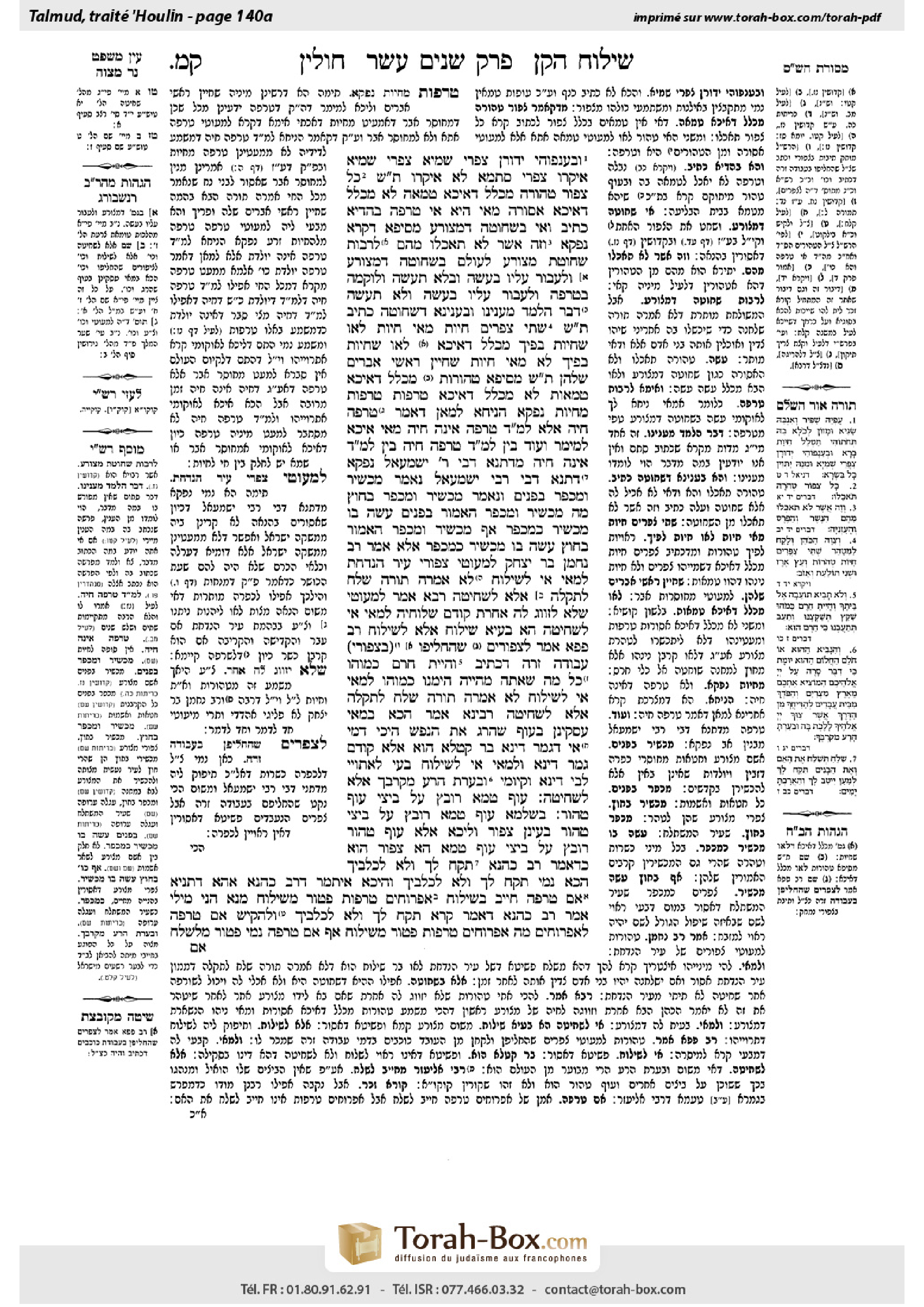
Chullin 140a: Talmud study for Daf Yomi
Study the Talmud for Daf Yomi with scanned pages, Hebrew text, English translations from Sefaria and AI-generated French translations.
Passage selection and English or AI-generated French translation are available where the scan has annotations. Daf Study is independent of Torah-Box and Sefaria.
Browse Chullin · חולין · All tractatesChullin 140a text and translations
This page of Chullin includes the Aramaic text, an English translation and an AI-generated French translation, alongside the scan above.
חולין ק״מ א · Aramaic and Hebrew text
״וּבְעַנְפוֹהִי יְדוּרָן צִפְּרֵי שְׁמַיָּא״ – ״צִפְּרֵי שְׁמַיָּא״ אִיקְּרוֹ, ״צִפְּרֵי״ סְתָמָא לָא אִיקְּרוֹ.
תָּא שְׁמַע: ״כׇּל צִפּוֹר טְהוֹרָה״, מִכְּלָל דְּאִיכָּא טְמֵאָה? לָא, מִכְּלָל דְּאִיכָּא אֲסוּרָה.
מַאי הִיא? אִי טְרֵפָה – בְּהֶדְיָא כְּתִיב! וְאִי בִּשְׁחוּטָה דִּמְצוֹרָע – מִסֵּיפָא דִּקְרָא נָפְקָא, ״וְזֶה אֲשֶׁר לֹא תֹאכְלוּ מֵהֶם״ – לְרַבּוֹת שְׁחוּטַת מְצוֹרָע.
לְעוֹלָם בִּשְׁחוּטָה דִּמְצוֹרָע, וְלַעֲבוֹר עָלָיו בַּעֲשֵׂה וּבְלֹא תַעֲשֶׂה. וְלוֹקְמַהּ בִּטְרֵפָה, וְלַעֲבוֹר עָלָיו בַּעֲשֵׂה וְלֹא תַעֲשֶׂה? דָּבָר הַלָּמֵד מֵעִנְיָנוֹ, וּבְעִנְיָנָא דִּשְׁחוּטָה כְּתִיב.
תָּא שְׁמַע: ״שְׁתֵּי צִפֳּרִים חַיּוֹת״, מַאי ״חַיּוֹת״? לָאו שֶׁחַיּוֹת בְּפִיךְ? מִכְּלָל דְּאִיכָּא לָאו שֶׁחַיּוֹת בְּפִיךְ! לָא, מַאי ״חַיּוֹת״? שֶׁחַיִּין רָאשֵׁי אֵבָרִים שֶׁלָּהֶן.
תָּא שְׁמַע מִסֵּיפָא: ״טְהוֹרוֹת״, מִכְּלָל דְּאִיכָּא טְמֵאוֹת? לָא, מִכְּלָל דְּאִיכָּא טְרֵפוֹת.
טְרֵפוֹת מֵ״חַיּוֹת״ נָפְקָא. הָנִיחָא לְמַאן דְּאָמַר טְרֵפָה חַיָּה, אֶלָּא לְמַאן דְּאָמַר טְרֵפָה אֵינָהּ חַיָּה, מַאי אִיכָּא לְמֵימַר? וְעוֹד, בֵּין לְמַאן דְּאָמַר טְרֵפָה חַיָּה, בֵּין לְמַאן דְּאָמַר אֵינָהּ חַיָּה, מִדְּתָנָא דְּבֵי רַבִּי יִשְׁמָעֵאל נָפְקָא.
דְּתָנָא דְּבֵי רַבִּי יִשְׁמָעֵאל: נֶאֱמַר מַכְשִׁיר וּמְכַפֵּר בִּפְנִים, וְנֶאֱמַר מַכְשִׁיר וּמְכַפֵּר בַּחוּץ.
מָה מַכְשִׁיר וּמְכַפֵּר הָאָמוּר בִּפְנִים – עָשָׂה בּוֹ מַכְשִׁיר כִּמְכַפֵּר, אַף מַכְשִׁיר וּמְכַפֵּר הָאָמוּר בַּחוּץ – עָשָׂה בּוֹ מַכְשִׁיר כִּמְכַפֵּר.
אֶלָּא אָמַר רַב נַחְמָן בַּר יִצְחָק: לְמַעוֹטֵי צִפּוֹרֵי עִיר הַנִּדַּחַת. לְמַאי? אִי לְשִׁילּוּחַ – לֹא אָמְרָה תּוֹרָה שַׁלַּח לְתַקָּלָה, אֶלָּא לִשְׁחִיטָה.
רָבָא אָמַר: לְמַעוֹטֵי שֶׁלֹּא לְזַוֵּוג לָהּ אַחֶרֶת קוֹדֶם שִׁלּוּחֶיהָ. לְמַאי? אִי לִשְׁחִיטָה – הָא בָּעֲיָא שִׁילּוּחַ! אֶלָּא לְשִׁילּוּחַ.
רַב פָּפָּא אָמַר: לְצִפֳּרִים (שֶׁהֶחְלִיפוּ) [שֶׁהֶחְלִיפָן] בְּצִפֳּרֵי עֲבוֹדָה זָרָה, דִּכְתִיב: ״וְהָיִיתָ חֵרֶם כָּמֹהוּ״, כׇּל מַה שֶּׁאַתָּה מְהַיֶּיה הֵימֶנּוּ כָּמוֹהוּ. לְמַאי? אִי לְשִׁילּוּחַ – לֹא אָמְרָה תּוֹרָה שַׁלַּח לְתַקָּלָה, אֶלָּא לִשְׁחִיטָה.
רָבִינָא אָמַר: הָכָא בְּמַאי עָסְקִינַן? בְּעוֹף שֶׁהָרַג אֶת הַנֶּפֶשׁ. הֵיכִי דָמֵי? אִי דִּגְמַר דִּינֵהּ – בַּר קְטָלָא הוּא! אֶלָּא קוֹדֶם גְּמַר דִּינֵאּ, וּלְמַאי? אִי לְשִׁילּוּחַ – בָּעֵי לְאֵתוֹיֵי לְבֵי דִינָא וְקַיּוֹמֵי ״וּבִעַרְתָּ הָרַע מִקִּרְבֶּךָ״! אֶלָּא לִשְׁחִיטָה.
עוֹף טָמֵא רוֹבֵץ עַל בֵּיצֵי עוֹף טָהוֹר. בִּשְׁלָמָא עוֹף טָמֵא רוֹבֵץ עַל בֵּיצֵי טָהוֹר – בָּעֵינַן ״צִפּוֹר״ וְלֵיכָּא, אֶלָּא עוֹף טָהוֹר רוֹבֵץ עַל בֵּיצֵי עוֹף טָמֵא – הָא ״צִפּוֹר״ הוּא!
כִּדְאָמַר רַב כָּהֲנָא: ״תִּקַּח לָךְ״ – וְלֹא לִכְלָבֶיךָ, הָכָא נָמֵי: ״תִּקַּח לָךְ״ – וְלֹא לִכְלָבֶיךָ.
וְהֵיכָא אִיתְּמַר דְּרַב כָּהֲנָא? אַהָא דְּתַנְיָא: אִם טְרֵפָה – חַיָּיב בְּשִׁילּוּחַ, אֶפְרוֹחִים טְרֵפוֹת – פָּטוּר מִשִּׁילּוּחַ. מְנָא הָנֵי מִילֵּי? אָמַר רַב כָּהֲנָא: דְּאָמַר קְרָא ״תִּקַּח לָךְ״ – וְלֹא לִכְלָבֶיךָ.
וּלְהַקִּישׁ אֵם טְרֵפָה לְאֶפְרוֹחִים, מָה אֶפְרוֹחִים טְרֵפוֹת – פָּטוּר מִשִּׁילּוּחַ, אַף אֵם טְרֵפָה נָמֵי – פָּטוּר מִלְּשַׁלֵּחַ.
Chullin 140a · English translation
stated in the verse describing a tree: “And in its branches will dwell the birds [tzipparei] of the heaven” (Daniel 4:9). The verse states only: “The birds [tzipparei],” and not: The birds of any type of wing. Accordingly, the term “the birds [tzipparei]” must be referring to all birds, whether kosher or non-kosher, since all birds dwell in tree branches. The Gemara rejects this: Non-kosher birds are called: Birds [tzipparei] of the heaven, but they are not called: Tzipparei, in an unspecified manner.
The Gemara suggests: Come and hear that which is stated in the passage discussing kosher and non-kosher animals: “Every kosher bird [tzippor] you may eat” (Deuteronomy 14:11). Since it was necessary for the verse to specify that it is referring to a kosher bird [tzippor], by inference, one may conclude that there is a non-kosher bird [tzippor], in contradiction to the statement of Rabbi Yitzḥak. The Gemara rejects this: No, this is not the correct inference. Rather, by inference one may conclude that there is a tzippor that is prohibited for consumption, despite its being a kosher bird.
The Gemara asks: What is this kosher bird whose prohibition must be derived from this verse? If it is a bird with a wound that will cause it to die within twelve months [tereifa], that would be superfluous, as that is written explicitly in the verse: “An unslaughtered animal carcass, or a tereifa, he shall not eat” (Leviticus 22:8). And if it is referring to the slaughtered bird from the purification ritual of a leper, which is prohibited for consumption despite being kosher, that would also be superfluous, since it is derived from the latter clause of the verse in Deuteronomy, as the verse states: “But these are they of which you shall not eat” (Deuteronomy 14:12), which serves to include the slaughtered bird of the leper.
The Gemara responds: Actually, the verse: “Every kosher bird you may eat,” is referring to the slaughtered bird of a leper, and the verse indicates that one transgresses the positive mitzva of: “You may eat,” in addition to the prohibition of: “But these are they of which you shall not eat,” on account of it. The Gemara objects: But why not interpret the verse as referring to a tereifa, and explain that the verse teaches that one transgresses a positive mitzva and a prohibition on account of it? The Gemara responds: The verse should be interpreted as referring to the slaughtered bird of a leper, since it is a matter derived from its context, as that verse is written in the context of a slaughtered bird. By contrast, a tereifa is not properly slaughtered, and interpreting the verse in that manner does not fit the context.
The Gemara suggests: Come and hear that which is stated in the passage discussing the purification ritual of a leper: “Then shall the priest command to take for him that is to be cleansed two living birds [tzipporim] that are kosher” (Leviticus 14:4). Since the birds are obviously alive before the purification ritual begins, what is the meaning of the word “living”? Is it not that they are living in your mouth, i.e., permitted for consumption? If so, by inference, one may conclude that there are birds [tzipporim] that are not living in your mouth, i.e., that are not kosher. The Gemara rejects this: No, that is not its meaning. Rather, what is the meaning of the word “living”? It means that their extremities are living, i.e., attached to their bodies. The verse indicates that the kosher birds must have all their limbs attached to their bodies in order to be used in the purification ritual.
The Gemara suggests: Come and hear a proof from the latter clause of that verse: “Two living birds [tzipporim] that are kosher.” Since it was necessary for the verse to specify that it is referring to kosher birds, by inference one may conclude that there are non-kosher birds, in contradiction to the statement of Rabbi Yitzḥak. The Gemara rejects this: No, that is not the correct inference. Rather, by inference one may conclude that there are other birds of kosher species that may not be used for this ritual, i.e., tereifot.
The Gemara objects: But the disqualification of tereifot is already derived from the word “living” in that verse. The Gemara elaborates: Granted, this works out well according to the one who says that a tereifa can live (see 42a); it is therefore necessary for the verse to state “kosher” to exclude tereifot, because one could not have derived it from the word “living.” But according to the one who says that a tereifa animal cannot live, what is there to say? Let it be derived from the word “living.” And furthermore, whether according to the one who says that a tereifa can live or according to the one who says that a tereifa cannot live, it is not necessary to derive the exclusion of tereifot from the word “kosher,” since it is derived from that which the school of Rabbi Yishmael taught.
As the school of Rabbi Yishmael taught: It is stated in the Torah that there are offerings that enable one to partake of sacrificial foods, e.g., the sin offering of a woman who has given birth or the guilt offering of a leper, and there are offerings that atone, e.g., a sin offering or guilt offering, all of which are brought inside the Temple. And it is also stated in the Torah that there are offerings that enable one to partake of sacrificial foods, e.g., the birds of a leper’s purification ritual, and offerings that atone, e.g., the scapegoat of the Yom Kippur service, that are brought outside the Temple.
The baraita continues: Therefore, the offerings brought outside the Temple are compared to those offered inside: Just as with regard to the offerings that enable or atone stated in the Torah that are offered inside the Temple, the Torah made the offering that enables like the offering that atones, as even the former has portions of it that are burned on the altar, so too, with regard to offerings that enable or atone stated in the Torah that are offered outside the Temple, the Torah made the offering that enables like the offering that atones. Accordingly, just as the scapegoat must not be a tereifa, so too, the birds of a leper’s purification ritual must not be tereifot. If so, there is no need to derive the exclusion of tereifa birds from the word “kosher.”
Rather, Rav Naḥman bar Yitzḥak said: The word “kosher” serves to exclude birds from an idolatrous city. Such a city must be burned to the ground, and it is prohibited for one to derive benefit from any of its contents. The verse indicates that such a bird is unfit for use in the leper’s purification ritual. The Gemara asks: For what function are such birds rendered unfit by the word “kosher”? If the verse means to render them unfit for sending away as part of the ritual, this is unnecessary, since the Torah did not say to send a bird only to create a stumbling block. It is obvious that any bird prohibited for consumption is unfit for sending, since the Torah would not allow for the possibility that the bird sent away will be trapped and consumed by unwitting individuals. Rather, the verse means to render them unfit for use as the bird intended for slaughter.
Rava said: The word “kosher” serves to exclude the repeated use of a bird, i.e., a leper may not pair a bird with another bird from a previous leper, before its being sent away. The Gemara asks: For what function does the word “kosher” indicate that a bird may not be reused? If it means to indicate that the bird intended for being sent away by the first leper may not be used for slaughter by the second leper, the verse is unnecessary, as this bird requires being sent away as part of the first leper’s purification ritual. Rather, the verse means to indicate that the bird intended for being sent away by the first leper may not be used for sending simultaneously by the second leper.
Rav Pappa said: The word “kosher” serves to exclude the use of birds that were exchanged for birds of idol worship, i.e., a gentile paid a Jew for his idol by giving the Jew birds. Such birds are prohibited from use in the leper’s ritual, as it is written about objects of idol worship: “And you shall not bring an abomination into your house, and become [vahayita] accursed like it” (Deuteronomy 7:26), indicating that anything that you generate [mehayye] from it, e.g., through exchange, is prohibited like it. The Gemara asks: For what function does the word “kosher” indicate that such birds are prohibited? If it serves to exclude such birds from being sent away, this is unnecessary, because the Torah did not say: Send it away, if doing so could lead to a mishap. If the bird were prohibited, the Torah would not have commanded one to send it away, as others might eat it unwittingly. Rather, the word “kosher” serves to disqualify such birds for slaughter.
Ravina said: Here we are dealing with a bird that killed a person and is therefore subject to being killed. The verse indicates that such a bird is unfit for use in the leper’s ritual. The Gemara asks: What are the circumstances of this case? If this is a case where its verdict of execution was issued, then it is subject to being killed, and there is no need for the verse to teach that it cannot be used in the ritual. Rather, it must be referring to a bird before its verdict of execution was issued. And for what function does the verse exclude such a bird? If it serves to exclude the bird from sending away, this is unnecessary, since one is required to bring it to the court to fulfill the verse: “And you shall eradicate the evil from your midst” (Deuteronomy 13:6). Obviously, one may not send it away. Rather, the verse serves to disqualify such a bird for slaughter.
§ The mishna states: If a non-kosher bird is resting upon the eggs of a kosher bird, or a kosher bird is resting upon the eggs of a non-kosher bird, one is exempt from sending away the bird. The Gemara objects: Granted, it is understandable that one is exempt in a case where a non-kosher bird is resting upon the eggs of a kosher bird, since we require a kosher bird, as the verse uses the word “tzippor” (Deuteronomy 22:6) in this context, which the Gemara earlier (139b) interpreted as a reference to a kosher bird, and this bird is not kosher. But in a case where a kosher bird is resting upon the eggs of a non-kosher bird, it is a tzippor, a kosher bird, and one should be required to send it away.
The Gemara responds that this is in accordance with that which Rav Kahana said in a different context: The verse states: “But the young you may take for yourself” (Deuteronomy 22:7), indicating that one is required to send away the mother only if the eggs are fit for consumption, but not if they are fit only for your dog. Here too, with regard to non-kosher eggs, the mitzva applies only if you may take for yourself, but not if they are fit only for your dog because they are not kosher.
The Gemara asks: And where was this statement of Rav Kahana stated? The Gemara answers that it was stated with regard to that which is taught in a baraita: Even if the mother bird is a tereifa, one is obligated to send away the mother from the nest. But if the fledglings are tereifot, one is exempt from sending away the mother. From where is this matter derived? Rav Kahana said: As the verse states: “You may take for yourself,” indicating that you are required to send away the mother only if the fledglings are fit for consumption, but not if they are fit only for your dog because they are tereifot.
The Gemara objects: But why not compare a tereifa mother bird to tereifa fledglings and say: Just as with regard to tereifa fledglings one is exempt from sending away the mother, so too, with regard to a tereifa mother one should also be exempt from sending her away.
Chullin 140a · Traduction française (IA)
Il est dit dans la versette décrivant un arbre : « Et dans ses branches habitent les oiseaux [tzipparei] du ciel » (Daniel 4:9). La versette indique simplement : « Les oiseaux [tzipparei] », et non : « Les oiseaux de tout genre d'ailes ». Ainsi, le terme « les oiseaux [tzipparei] » doit nécessairement désigner tous les oiseaux, qu'ils soient kasher ou non-kasher, puisque tous les oiseaux habitent dans les branches d'arbres. La Guemara rejette cette interprétation : les oiseaux non-kasher sont appelés : « oiseaux [tzipparei] du ciel », mais ils ne sont pas appelés : « tzipparei » de manière indéterminée.
La Guemara suggère : Viens écouter ce qui est dit dans le passage concernant les animaux kasher et non-kasher : « Tout oiseau [tzippor] kasher que tu pourras manger » (Deutéronome 14:11). Puisque la versette avait besoin de préciser qu'il s'agissait d'un oiseau kasher, on peut en déduire qu'il existe un oiseau non-kasher, ce qui contredit la déclaration du Rabbi Yitzḥak. La Guemara rejette cela : Non, cette déduction n'est pas correcte. Plutôt, on peut en déduire qu'il existe un tzippor interdit à la consommation, même s'il est kasher.
La Guemara pose la question : Quel est cet oiseau kasher dont la prohibition doit être déduite de cette versette ? Si c'est un oiseau blessé qui mourra dans les douze mois [tereifa], cela serait superflu, car cela est explicitement mentionné dans la versette : « Il ne doit pas manger un cadavre non sacrifié, ou un tereifa » (Lévitique 22:8). Et si c'est l'oiseau sacrifié dans la purification du lépreux, qui est interdit à la consommation malgré son statut de kasher, cela serait également superflu, car cela est déduit de la clause ultérieure de la versette dans Deutéronome, comme la versette dit : « Mais ces sont ceux que tu ne dois pas manger » (Deutéronome 14:12), ce qui inclut l'oiseau sacrifié du lépreux.
La Guemara répond : En réalité, la versette : « Tout oiseau kasher que tu pourras manger », fait référence à l'oiseau sacrifié du lépreux, et la versette indique qu'on transgresse la mitsva positive : « Tu pourras manger », en plus de la prohibition : « Mais ces sont ceux que tu ne dois pas manger », à cause de cela. La Guemara s'oppose à cela : Mais pourquoi ne pas interpréter la versette comme faisant référence à un tereifa, et expliquer que la versette enseigne qu'on transgresse une mitsva positive et une prohibition à cause de cela ? La Guemara répond : La versette doit être interprétée comme faisant référence à l'oiseau sacrifié du lépreux, car cela est déduit de son contexte, comme cette versette est écrite dans le contexte d'un oiseau sacrifié. À l'inverse, un tereifa n'est pas correctement sacrifié, et interpréter la versette ainsi ne s'aligne pas avec le contexte.
La Guemara suggère : Viens écouter ce qui est dit dans le passage concernant la purification du lépreux : « Alors le prêtre ordonnera de prendre pour lui qui est à purifier deux oiseaux [tzipporim] vivants qui sont kasher » (Lévitique 14:4). Puisque les oiseaux sont évidemment vivants avant le début de la purification, quelle est la signification du mot « vivants » ? N'est-ce pas que ce sont des oiseaux permis à la consommation ? Si c'est le cas, on peut en déduire qu'il existe des oiseaux [tzipporim] qui ne sont pas vivants dans votre bouche, c'est-à-dire qui ne sont pas kasher. La Guemara rejette cela : Non, cela n'est pas sa signification. Plutôt, quelle est la signification du mot « vivants » ? Cela signifie que leurs extrémités sont vivantes, c'est-à-dire attachées à leur corps. La versette indique que les oiseaux kasher doivent avoir tous leurs membres attachés à leur corps pour être utilisés dans la purification.
La Guemara suggère : Viens écouter une preuve à partir de la clause ultérieure de cette versette : « Deux oiseaux [tzipporim] vivants qui sont kasher ». Puisque la versette avait besoin de préciser qu'il s'agissait d'oiseaux kasher, on peut en déduire qu'il existe des oiseaux non-kasher, ce qui contredit la déclaration du Rabbi Yitzḥak. La Guemara rejette cela : Non, cette déduction n'est pas correcte. Plutôt, on peut en déduire qu'il existe d'autres oiseaux de espèces kasher qui ne peuvent pas être utilisés pour ce rituel, c'est-à-dire les tereifot.
La Guemara s'oppose : Mais la déqualification des tereifot est déjà déduite du mot « vivants » dans cette versette. La Guemara développe : Cela fonctionne bien selon celui qui dit qu'un tereifa peut vivre (voir 42a) ; il est donc nécessaire que la versette mentionne « kasher » pour exclure les tereifot, car on ne pouvait pas en déduire cela du mot « vivants ». Mais selon celui qui dit qu'un tereifa ne peut pas vivre, que dire alors ? Laissons-le déduire du mot « vivants ». Et de plus, qu'importe selon celui qui dit qu'un tereifa peut vivre ou selon celui qui dit qu'un tereifa ne peut pas vivre, il n'est pas nécessaire de déduire l'exclusion des tereifot du mot « kasher », car cela est déduit de ce que l'école de Rabbi Yishmael a enseigné.
Comme l'école de Rabbi Yishmael a enseigné : Il est dit dans la Torah qu'il existe des offrandes qui permettent de consommer les aliments sacrés, par exemple l'offrande expiatoire d'une femme qui a donné naissance ou l'offrande de culpabilité du lépreux, et des offrandes qui expient, par exemple l'offrande expiatoire ou l'offrande de culpabilité, toutes offertes à l'intérieur du Temple. Et il est également dit dans la Torah qu'il existe des offrandes qui permettent de consommer les aliments sacrés, par exemple les oiseaux de la purification du lépreux, et des offrandes qui expient, par exemple le bouc expiatoire du service du Yom Kippur, offerts à l'extérieur du Temple.
La baraïta continue : Ainsi, les offrandes offertes à l'extérieur du Temple sont comparées à celles offertes à l'intérieur : Comme il est dit dans la Torah concernant les offrandes qui permettent ou expient et qui sont offertes à l'intérieur du Temple, la Torah a fait l'offrande qui permet comme l'offrande qui expie, car même la première a des parties brûlées sur l'autel, de même, concernant les offrandes qui permettent ou expient et qui sont offertes à l'extérieur du Temple, la Torah a fait l'offrande qui permet comme l'offrande qui expie. Ainsi, comme le bouc expiatoire ne doit pas être un tereifa, de même, les oiseaux utilisés dans la purification du lépreux doivent être des oiseaux qui ne sont pas tereifot. Si c'est le cas, il n'est pas nécessaire de déduire l'exclusion des oiseaux tereifa du mot « kasher ».
Plutôt, Rav Naḥman bar Yitzḥak a dit : Le mot « kosher » sert à exclure les oiseaux d'une ville idolâtre. Une telle ville doit être brûlée au sol, et il est interdit de tirer profit de ses contenus. La versette indique que cet oiseau n'est pas propre à l'usage dans le rituel de purification du lépreux. La Guemara demande : Pour quelle fonction le mot « kosher » rend-il cet oiseau inutilisable ? Si la versette vise à rendre ces oiseaux inutilisables pour l'envoi comme partie du rituel, cela est inutile, car la Torah n'a pas dit d'envoyer un oiseau uniquement pour créer un obstacle. Il est évident que tout oiseau interdit à la consommation est inutilisable pour l'envoi, car la Torah ne permettrait pas que l'oiseau envoyé soit capturé et consommé par des personnes non conscientes. Plutôt, la versette vise à rendre ces oiseaux inutilisables pour l'usage comme l'oiseau destiné à être sacrifié.
Rava a dit : Le mot « kosher » sert à exclure l'usage répétitif d'un oiseau, c'est-à-dire qu'un lépreux ne peut pas associer un oiseau à un autre oiseau d'un autre lépreux avant que celui-ci ne soit envoyé. La Guemara demande : Pour quelle fonction le mot « kosher » indique-t-il qu'un oiseau ne peut pas être réutilisé ? Si cela signifie que l'oiseau destiné à être envoyé par le premier lépreux ne peut pas être utilisé pour la sacrifice par le second lépreux, la versette est inutile, car cet oiseau nécessite d'être envoyé comme partie du rituel de purification du premier lépreux. Plutôt, la versette vise à indiquer que l'oiseau destiné à être envoyé par le premier lépreux ne peut pas être utilisé pour l'envoi simultanément par le second lépreux.
Rav Pappa a dit : Le mot « kosher » sert à exclure l'usage d'oiseaux échangés contre des oiseaux d'idolâtrie, c'est-à-dire qu'un gentil a payé un Juif pour son idole en donnant des oiseaux au Juif. Ces oiseaux sont interdits à l'usage dans le rituel du lépreux, car il est écrit à propos des objets d'idolâtrie : « Et tu ne porteras pas l'abomination dans ta maison, et tu seras [vahayita] maudit comme elle » (Deutéronome 7:26), indiquant que tout ce que tu génères [mehayye] à partir d'elle, par exemple par échange, est interdit comme elle. La Guemara demande : Pour quelle fonction le mot « kosher » indique-t-il que ces oiseaux sont interdits ? Si cela sert à exclure ces oiseaux de l'envoi, cela est inutile, car la Torah n'a pas dit : Envoie-le, si cela pourrait entraîner un problème. Si l'oiseau était interdit, la Torah ne commanderait pas d'envoyer cet oiseau, car d'autres pourraient le manger sans le savoir. Plutôt, le mot « kosher » sert à disqualifier ces oiseaux pour la bataille.
Ravina a dit : Ici nous traitons d'un oiseau qui a tué une personne et est donc sujet à être tué. La versette indique que cet oiseau n'est pas propre à l'usage dans le rituel du lépreux. La Guemara demande : Quelles sont les circonstances de ce cas ? Si c'est un cas où l'arrêt de condamnation a été rendu, alors il est sujet à être tué, et il n'y a pas besoin de la versette pour enseigner qu'il ne peut pas être utilisé dans le rituel. Plutôt, il doit s'agir d'un oiseau avant que l'arrêt de condamnation n'ait été rendu. Et pour quelle fonction la versette exclut-elle cet oiseau ? Si elle sert à exclure l'oiseau de l'envoi, cela est inutile, car l'on est tenu de le présenter devant le tribunal pour accomplir la versette : « Et tu éradiqueras le mal de ton milieu » (Deutéronome 13:6). Il est évident qu'on ne peut pas l'envoyer. Plutôt, la versette sert à disqualifier cet oiseau pour la bataille.
§ La Michna stipule : Si un oiseau non-kosher est reposant sur les œufs d'un oiseau kosher, ou un oiseau kosher est reposant sur les œufs d'un oiseau non-kosher, on est exempt d'envoyer l'oiseau. La Guemara s'oppose à cela : C'est compréhensible que l'on soit exempt dans le cas où un oiseau non-kosher est reposant sur les œufs d'un oiseau kosher, car nous exigeons un oiseau kosher, comme la versette utilise le mot « tzippor » (Deutéronome 22:6) dans ce contexte, que la Guemara a interprété précédemment (139b) comme faisant référence à un oiseau kosher, et cet oiseau n'est pas kosher. Mais dans le cas où un oiseau kosher est reposant sur les œufs d'un oiseau non-kosher, il s'agit d'un tzippor, un oiseau kosher, et l'on devrait être tenu d'envoyer celui-ci.
La Guemara répond que cela correspond à ce que Rav Kahana a dit dans un contexte différent : La versette stipule : « Mais le jeune vous appartient » (Deutéronome 22:7), indiquant que l'on est tenu d'envoyer la mère uniquement si les œufs sont propres à la consommation, mais pas si ils sont propres uniquement à votre chien. Ici aussi, concernant les œufs non-kosher, la mitsva s'applique uniquement si vous pouvez prendre pour vous, mais pas si ils sont propres uniquement à votre chien car ils ne sont pas kosher.
La Guemara demande : Et où a-t-on dit cette déclaration de Rav Kahana ? La Guemara répond que cela a été dit concernant ce qui est enseigné dans une baraïta : Même si la mère est une tereifa, l'on est tenu d'envoyer la mère du nid. Mais si les petits sont tereifot, l'on est exempt d'envoyer la mère. D'où cela est-il tiré ? Rav Kahana a dit : Comme la versette stipule : « Vous pouvez prendre pour vous », indiquant que l'on est tenu d'envoyer la mère uniquement si les petits sont propres à la consommation, mais pas si ils sont propres uniquement à votre chien car ils sont tereifot.
La Guemara s'oppose : Mais pourquoi ne pas comparer une mère tereifa aux petits tereifos et dire : Tout comme, concernant les petits tereifos, on est exempt d'envoyer la mère, ainsi, concernant une mère tereifa, on devrait aussi être exempt d'envoyer celle-ci.
Traduction française générée par IA à partir de l’édition anglaise de Sefaria. Vérifie toujours un passage avec le texte source.
Text from Sefaria: William Davidson Edition - Vocalized Aramaic (unknown); William Davidson Edition - English (CC BY NC).