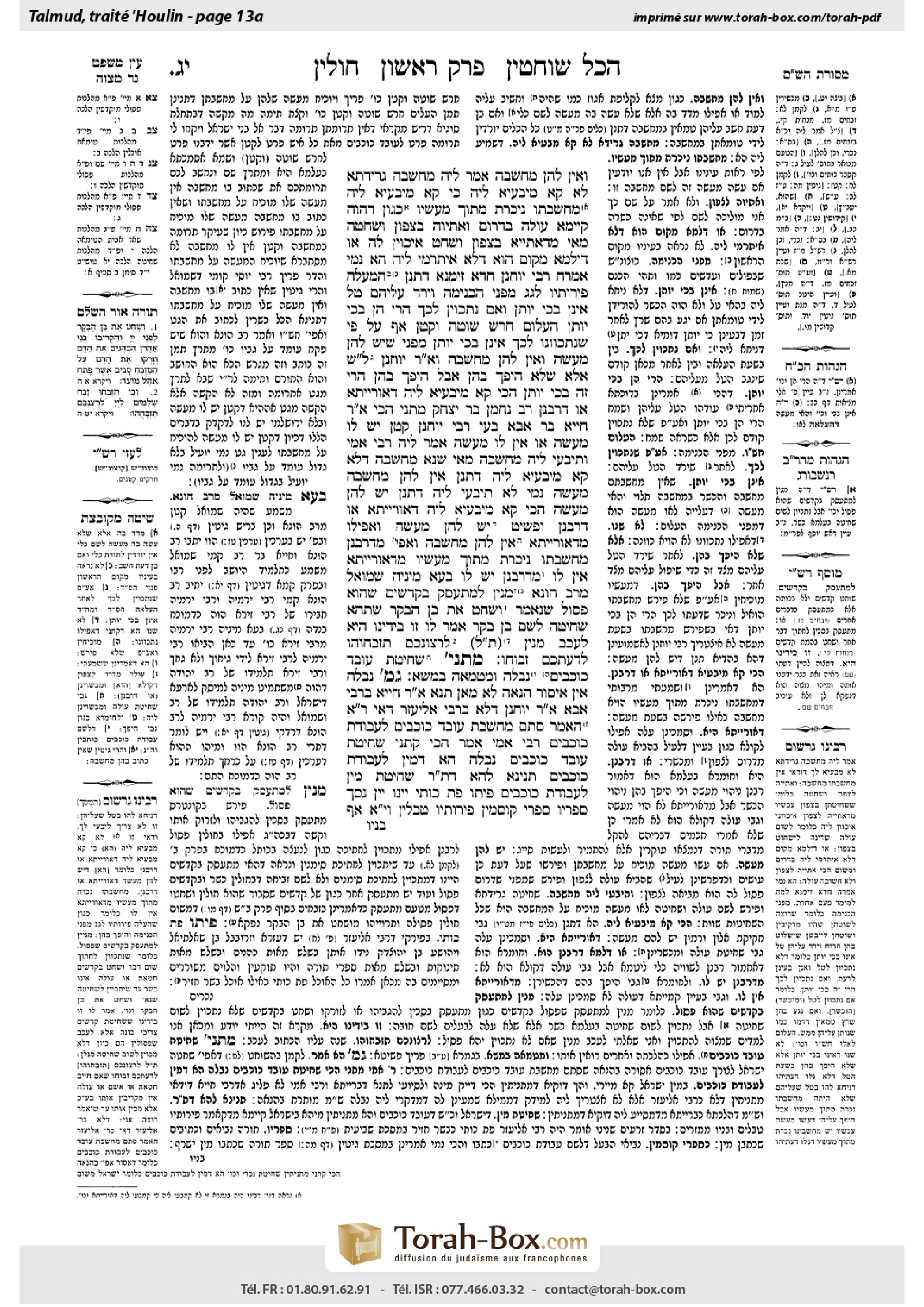
Chullin 13a: Talmud study for Daf Yomi
Study the Talmud for Daf Yomi with scanned pages, Hebrew text, English translations from Sefaria and AI-generated French translations.
Passage selection and English or AI-generated French translation are available where the scan has annotations. Daf Study is independent of Torah-Box and Sefaria.
Browse Chullin · חולין · All tractatesChullin 13a text and translations
This page of Chullin includes the Aramaic text, an English translation and an AI-generated French translation, alongside the scan above.
חולין י״ג א · Aramaic and Hebrew text
וְאֵין לָהֶן מַחְשָׁבָה.
אֲמַר לֵיהּ: מַחְשָׁבָה גְּרֵידְתָּא לָא קָא מִיבַּעְיָא לֵיהּ, כִּי קָא מִיבַּעְיָא לֵיהּ – מַחְשַׁבְתּוֹ נִיכֶּרֶת מִתּוֹךְ מַעֲשָׂיו.
כְּגוֹן דַּהֲוָה קָיְימָא עוֹלָה בַּדָּרוֹם, וְאַתְיַיהּ בַּצָּפוֹן וְשַׁחְטַהּ, מַאי? מִדְּאַתְיַיהּ בַּצָּפוֹן וְשַׁחְטַהּ אִיכַּוֵּין לַהּ, אוֹ דִילְמָא מָקוֹם הוּא דְּלָא אִיתְרְמִי לֵיהּ?
הָא נָמֵי אַמְרַהּ רַבִּי יוֹחָנָן חֲדָא זִימְנָא, דִּתְנַן: הַמַּעֲלֶה פֵּירוֹתָיו לַגַּג מִפְּנֵי הַכְּנִימָה, וְיָרַד עֲלֵיהֶם טַל – אֵינָן בְּ״כִי יוּתַּן״, וְאִם נִתְכַּוֵּין לְכָךְ – הֲרֵי הֵן בְּ״כִי יוּתַּן״.
הֶעֱלוּם חֵרֵשׁ שׁוֹטֶה וְקָטָן, אַף עַל פִּי שֶׁנִּתְכַּוְּונוּ לְכָךְ, אֵינָן בְּ״כִי יוּתַּן״, מִפְּנֵי שֶׁיֵּשׁ לָהֶן מַעֲשֶׂה וְאֵין לָהֶן מַחְשָׁבָה.
וְאָמַר רַבִּי יוֹחָנָן: לֹא שָׁנוּ אֶלָּא שֶׁלֹּא הִיפֵּךְ בָּהֶן, אֲבָל הִיפֵּךְ בָּהֶן – הֲרֵי זֶה בְּ״כִי יוּתַּן״.
הָכִי קָא מִיבַּעְיָא לֵיהּ: דְּאוֹרָיְיתָא אוֹ דְּרַבָּנַן?
רַב נַחְמָן בַּר יִצְחָק מַתְנֵי הָכִי: אָמַר רַבִּי חִיָּיא בַּר אַבָּא, בָּעֵי רַבִּי יוֹחָנָן: קָטָן יֵשׁ לוֹ מַעֲשֶׂה אוֹ אֵין לוֹ מַעֲשֶׂה?
אֲמַר לֵיהּ רַבִּי אַמֵּי: וְתִיבְּעֵי לֵיהּ מַחְשָׁבָה! מַאי שְׁנָא מַחְשָׁבָה דְּלָא קָא מִיבַּעְיָא לֵיהּ? דִּתְנַן: אֵין לָהֶן מַחְשָׁבָה. מַעֲשֶׂה נָמֵי לָא תִּיבְּעֵי לֵיהּ, דִּתְנַן: יֵשׁ לָהֶן מַעֲשֶׂה.
הָכִי קָא מִיבַּעְיָא לֵיהּ: דְּאוֹרָיְיתָא אוֹ דְּרַבָּנַן? וּפָשֵׁיט: יֵשׁ לָהֶן מַעֲשֶׂה, וַאֲפִילּוּ מִדְּאוֹרָיְיתָא, אֵין לָהֶן מַחְשָׁבָה, וַאֲפִילּוּ מִדְּרַבָּנַן. מַחְשַׁבְתּוֹ נִיכֶּרֶת מִתּוֹךְ מַעֲשָׂיו – מִדְּאוֹרָיְיתָא אֵין לוֹ, מִדְּרַבָּנַן יֵשׁ לוֹ.
בְּעָא מִינֵּיהּ שְׁמוּאֵל מֵרַב הוּנָא: מִנַּיִן לַמִּתְעַסֵּק בְּקָדָשִׁים שֶׁהוּא פָּסוּל? שֶׁנֶּאֱמַר: ״וְשָׁחַט אֶת בֶּן הַבָּקָר״, שֶׁתְּהֵא שְׁחִיטָה לְשֵׁם בֶּן בָּקָר. אָמַר לוֹ: זוֹ בְּיָדֵינוּ הִיא, לְעַכֵּב מִנַּיִן? תַּלְמוּד לוֹמַר: ״לִרְצוֹנְכֶם תִּזְבָּחֻהוּ״, לְדַעְתְּכֶם זְבוּחוּ.
מַתְנִי׳ שְׁחִיטַת נׇכְרִי נְבֵלָה, וּמְטַמְּאָה בְּמַשָּׂא.
גְּמָ׳ נְבֵלָה – אִין, אִיסּוּר הֲנָאָה – לָא. מַאן תַּנָּא? אָמַר רַבִּי חִיָּיא בְּרַבִּי אַבָּא אָמַר רַבִּי יוֹחָנָן: דְּלָא כְּרַבִּי אֱלִיעֶזֶר, דְּאִי רַבִּי אֱלִיעֶזֶר – הָאָמַר: סְתָם מַחְשֶׁבֶת נׇכְרִי לַעֲבוֹדָה זָרָה.
רַבִּי אַמֵּי אָמַר: הָכִי קָתָנֵי, שְׁחִיטַת נׇכְרִי – נְבֵלָה, הָא דְּמִין – לַעֲבוֹדָה זָרָה. תְּנֵינָא לְהָא דְּתָנוּ רַבָּנַן: שְׁחִיטַת מִין לַעֲבוֹדָה זָרָה, פִּיתּוֹ – פַּת כּוּתִי, יֵינוֹ – יֵין נֶסֶךְ, סְפָרָיו – סִפְרֵי קוֹסְמִין, פֵּירוֹתָיו – טְבָלִין, וְיֵשׁ אוֹמְרִים: אַף
Chullin 13a · English translation
but they do not have the capacity to effect a halakhic status by means of thought.
Rabbi Ḥiyya bar Abba said to Rabbi Ami: With regard to a case of effecting a halakhic status by means of thought alone, Rabbi Yoḥanan does not raise a dilemma. When he raises a dilemma, it is with regard to a case where his thought is discernible from his actions.
For example, in a case where an animal that is brought as a burnt offering was standing in the south of the Temple courtyard and a minor took it to the north of the courtyard, the designated place for its slaughter, and slaughtered it there, what is the halakha? Can one conclude from the fact that he took it to the north and slaughtered it there that he had the intent to slaughter the animal for the sake of a burnt offering; or perhaps he moved the animal to the north because a place did not happen to be available for him in the south?
Rabbi Ami asked: But with regard to this matter, too, Rabbi Yoḥanan already said a conclusive resolution one time, as we learned in a mishna (Makhshirin 6:1): In the case of one who takes his produce up to the roof to protect it from insects, and dew fell upon it, the produce is not in the category of the verse: “But when water is placed upon the seed” (Leviticus 11:38), from which it is derived that produce becomes susceptible to ritual impurity only if it is dampened by one of seven liquids and its owner was agreeable to its dampening. And if after taking the produce up to the roof he intended that the produce would be dampened by dew, the produce is in the category of the verse “But when water is placed upon the seed.”
That mishna continues: In a case where a deaf-mute, an imbecile, or a minor took the produce up to the roof, even if they intended that the produce would be dampened by dew, the produce is not in the category of the verse “But when water is placed upon the seed” due to the fact that they have the capacity to perform an action but they do not have the capacity for halakhically effective thought.
And Rabbi Yoḥanan says: The tanna taught this halakha only in a case where the minor did not turn them over. But if he turned them over, indicating that he wants them to be dampened by the dew, the produce is in the category of the verse “But when water is placed upon the seed.” Evidently, Rabbi Yoḥanan rules that when the intention of a minor is apparent from his actions, it is halakhically effective.
Rabbi Ḥiyya bar Abba said to Rabbi Ami that this is the dilemma that Rabbi Yoḥanan raises: In a case where the intent of a minor is clear from his actions, is the fact that his thought is effective by Torah law or by rabbinic law? That is one version of the exchange between Rabbi Ḥiyya bar Abba and Rabbi Ami.
Rav Naḥman bar Yitzḥak teaches their exchange in this manner. Rabbi Ḥiyya bar Abba says that Rabbi Yoḥanan raises a dilemma: With regard to a minor, does he have the capacity to perform an action that is halakhically effective or does he not have the capacity to perform such an action?
Rabbi Ami said to Rabbi Ḥiyya bar Abba: And let Rabbi Yoḥanan raise this dilemma with regard to the thought of a minor. What is different about the thought of a minor that Rabbi Yoḥanan does not raise a dilemma? Is it due to the fact that we learned in a mishna (Kelim 17:15): A deaf-mute, an imbecile, and a minor do not have the capacity for effective thought? With regard to action as well let him not raise this dilemma, as we learned in the same mishna: They have the capacity to perform an action.
Rabbi Ḥiyya bar Abba said to Rabbi Ami that this is the dilemma that Rabbi Yoḥanan raises: Is the fact that their actions are effective and their thought is ineffective by Torah law, and a minor’s action would consequently be effective even with regard to the sacrifice of a burnt offering, or is this fact by rabbinic law and it is merely a stringency? And Rabbi Yoḥanan resolves the dilemma: They have the capacity to perform an action and it is effective, even by Torah law. But they do not have the capacity for effective thought, even by rabbinic law. Nevertheless, in a case where his thought is apparent from his actions, by Torah law he does not have effective thought, and by rabbinic law he has effective thought.
§ Shmuel asked Rav Huna: From where is it derived with regard to one who acts unawares in the slaughter of sacrificial animals, i.e., he slaughtered without intending to perform the act of slaughter at all, that the offering is disqualified? Rav Huna said to him that it is derived from a verse, as it is stated: “And he shall slaughter the young bull” (Leviticus 1:5), indicating that the slaughter must be for the sake of a young bull, i.e., knowing that he is performing an act of slaughter. Shmuel said to him: we received this as an established halakha already that one must have intent to slaughter the animal ab initio. But from where is it derived that intent to slaughter is indispensable even after the fact? It is derived from a verse, as the verse states: “You shall slaughter it to your will” (Leviticus 19:5), indicating: Slaughter the animal with your intent, i.e., in the form of a purposeful action.
MISHNA: Slaughter performed by a gentile renders the animal an unslaughtered carcass, and the carcass imparts ritual impurity through carrying.
GEMARA: The slaughter renders the animal an unslaughtered carcass, yes; an item from which deriving benefit is prohibited, no. Who is the tanna who taught the mishna? Rabbi Ḥiyya, son of Rabbi Abba, said that Rabbi Yoḥanan said: It is not in accordance with the opinion of Rabbi Eliezer, as, if it were in accordance with the opinion of Rabbi Eliezer, doesn’t he say: The unspecified thought of a gentile is for idol worship.
Rabbi Ami said that this is what the mishna is teaching: Slaughter performed by a gentile renders the animal an unslaughtered carcass, but slaughter performed by a heretic is for the sake of idol worship. The Gemara notes: We learn from an inference in the mishna that which the Sages taught explictly in a baraita: Slaughter performed by a heretic is for the sake of idol worship and deriving benefit from it is prohibited, the halakhic status of his bread is that of the bread of a Samaritan, the status of his wine is that of wine used for a libation in idol worship, his sacred scrolls that he writes are the scrolls of sorcerers and it is a mitzva to burn them, his produce is untithed produce even if he separated teruma and tithes, and some say: Even
Chullin 13a · Traduction française (IA)
mais ils n'ont pas la capacité de créer un statut halakhique par la pensée seule.
Rabbi Ḥiyya bar Abba dit à Rabbi Ami : En ce qui concerne un cas où un statut halakhique est créé par la pensée seule, Rabbi Yoḥanan ne soulève pas de difficulté. Lorsqu'il soulève une difficulté, c'est en ce qui concerne un cas où sa pensée est discernable de ses actions.
Par exemple, dans un cas où un animal amené en holocauste était debout au sud du cour de l'Autel et un mineur l'apporta au nord du cour, la place désignée pour son immolation, et l'immola là, quelle est la halakha ? Peut-on conclure du fait qu'il l'a apporté au nord et l'a immolé là qu'il avait l'intention d'immoler l'animal en holocauste ; ou peut-être l'a-t-il transporté au nord parce qu'il n'y avait pas de place disponible au sud ?
Rabbi Ami demande : Mais concernant cette affaire également, Rabbi Yoḥanan a déjà donné une résolution concluante une fois, comme nous l'avons appris dans une mitsva (Makhshirin 6:1) : Dans le cas d'une personne qui amène ses produits sur le toit pour les protéger des insectes, et que la rosée s'est abattue sur eux, les produits ne sont pas dans la catégorie de la verset : « Mais quand de l'eau est versée sur la semence » (Lévitique 11:38), d'où il est déduit que les produits deviennent sujets à la souillure rituelle uniquement si ils sont mouillés par l'une des sept liqueurs et que leur propriétaire était d'accord qu'ils soient mouillés. Et si après avoir amène les produits sur le toit il avait l'intention que les produits soient mouillés par la rosée, les produits sont dans la catégorie de la verset « Mais quand de l'eau est versée sur la semence ».
Cette mitsva continue : Dans le cas d'un sourd-muet, d'un imbécile ou d'un mineur qui amène les produits sur le toit, même s'ils avaient l'intention que les produits soient mouillés par la rosée, les produits ne sont pas dans la catégorie de la verset « Mais quand de l'eau est versée sur la semence » en raison du fait qu'ils ont la capacité d'agir mais pas la capacité de pensée halakhiquement efficace.
Et Rabbi Yoḥanan dit : Le tanna a enseigné cette halakha uniquement dans un cas où le mineur n'avait pas transféré les produits. Mais s'il les avait transférés, indiquant qu'il voulait qu'ils soient mouillés par la rosée, les produits sont dans la catégorie de la verset « Mais quand de l'eau est versée sur la semence ». Évidemment, Rabbi Yoḥanan considère que lorsqu'intention d'un mineur est apparente de ses actions, elle est halakhiquement efficace.
Rabbi Ḥiyya bar Abba dit à Rabbi Ami que c'est la difficulté que Rabbi Yoḥanan soulève : Dans un cas où l'intention d'un mineur est claire à partir de ses actions, est-ce que la pensée est efficace par la loi de la Torah ou par la loi rabbinique ? C'est une version de l'échange entre Rabbi Ḥiyya bar Abba et Rabbi Ami.
Rav Naḥman bar Yitzḥak enseigne leur échange ainsi. Rabbi Ḥiyya bar Abba dit que Rabbi Yoḥanan soulève une difficulté : Concernant un mineur, a-t-il la capacité d'agir de manière halakhiquement efficace ou n'a-t-il pas cette capacité ?
Rabbi Ami dit à Rabbi Ḥiyya bar Abba : Et laisse Rabbi Yoḥanan soulever cette difficulté concernant la pensée d'un mineur. Qu'est-ce qui diffère dans la pensée d'un mineur qui fait que Rabbi Yoḥanan ne soulève pas de difficulté ? Est-ce en raison de ce que nous avons appris dans une mitsva (Kelim 17:15) : Les sourds-muets, les imbéciles et les mineurs n'ont pas la capacité de pensée efficace ? Concernant l'action également, laisse-le ne pas soulever cette difficulté, comme nous l'avons appris dans la même mitsva : Ils ont la capacité d'agir.
Rabbi Ḥiyya bar Abba dit à Rabbi Ami que c'est la difficulté que Rabbi Yoḥanan soulève : Est-ce que le fait que leurs actions sont efficaces et leur pensée inefficace est par la loi de la Torah, et qu'une action d'un mineur serait donc efficace même concernant l'immolation d'un holocauste, ou est-ce par la loi rabbinique et c'est simplement une stricteur ? Et Rabbi Yoḥanan résout la difficulté : Ils ont la capacité d'agir et cela est efficace, même par la loi de la Torah. Mais ils n'ont pas la capacité de pensée efficace, même par la loi rabbinique. Cependant, dans un cas où sa pensée est apparente de ses actions, par la loi de la Torah il n'a pas de pensée efficace, et par la loi rabbinique il a une pensée efficace.
§ Shmuel demande à Rav Huna : D'où est-t-il déduit concernant celui qui agit sans s'en rendre compte dans l'immolation des animaux sacrés, c'est-à-dire qu'il a immolé sans avoir l'intention d'accomplir l'acte d'immolation, que l'offrande est disqualifiée ? Rav Huna dit à lui que c'est déduit d'un verset, comme il est dit : « Et il immolera le veau jeune » (Lévitique 1:5), indiquant que l'immolation doit être pour le compte du veau jeune, c'est-à-dire sachant qu'il accomplit un acte d'immolation. Shmuel dit à lui : nous avons reçu cela comme une halakha établie déjà que l'on doit avoir l'intention d'immoler l'animal dès le début. Mais d'où est-t-il déduit que l'intention d'immolation est indispensable même après l'acte ? C'est déduit d'un verset, comme le verset dit : « Tu immoleras cela selon ton désir » (Lévitique 19:5), indiquant : Immole l'animal avec ton intention, c'est-à-dire dans la forme d'une action délibérée.
MICHNA : L'immolation effectuée par un non-Juif rend l'animal un cadavre non immolé, et le cadavre transmet la souillure rituelle par le transport.
GUEMARA : L'immolation rend l'animal un cadavre non immolé, oui ; un objet dont l'usage est interdit, non. Qui est le tanna qui a enseigné la mitsna ? Rabbi Ḥiyya, fils de Rabbi Abba, dit que Rabbi Yoḥanan a dit : Cela n'est pas selon l'opinion de Rabbi Eliezer, car, si c'était selon l'opinion de Rabbi Eliezer, ne dit-il pas : La pensée indéterminée d'un non-Juif est pour l'idolâtrie.
Rabbi Ami a dit que c'est ce que la Michna enseigne : l'abattage réalisé par un non-Juif rend l'animal un cadavre non abattu, mais l'abattage réalisé par un apostat est fait à l'intention du culte idolâtre. La Guemara note : nous apprenons par une déduction contenue dans la Michna ce que les Sages ont explicitement enseigné dans une baraïta : l'abattage réalisé par un apostat est fait à l'intention du culte idolâtre et il est interdit d'en tirer un bénéfice, le statut halakhique de son pain est celui du pain des Samaritains, le statut de son vin est celui du vin utilisé pour une libation idolâtre, ses écritures sacrées qu'il écrit sont les écritures des sorciers et il est un mitsva de les brûler, ses produits agricoles sont des produits non titrés même s'il a séparé la terouma et les dîmes, et certains disent même :
Traduction française générée par IA à partir de l’édition anglaise de Sefaria. Vérifie toujours un passage avec le texte source.
Text from Sefaria: William Davidson Edition - Vocalized Aramaic (unknown); William Davidson Edition - English (CC BY NC).