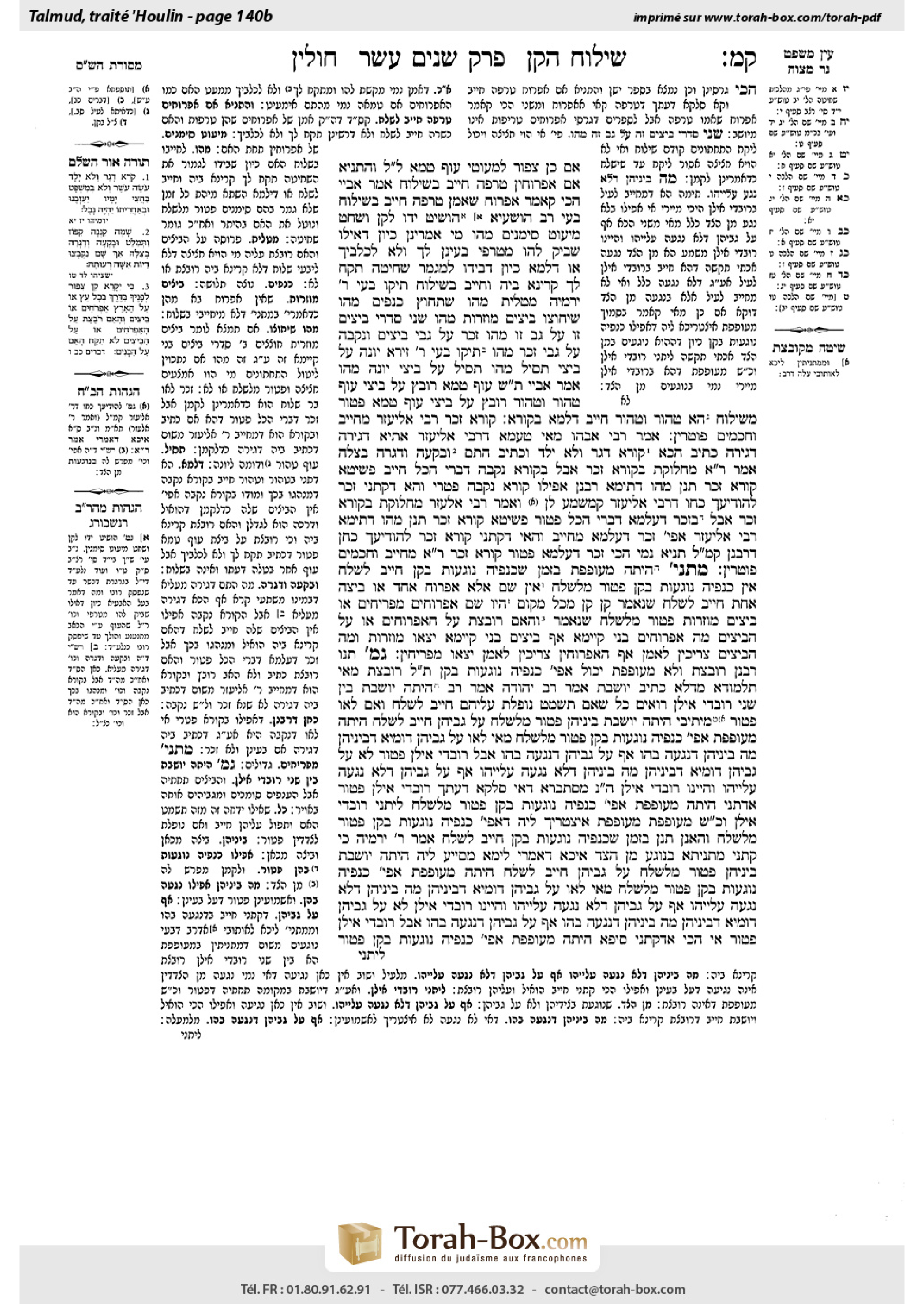
Chullin 140b: Talmud study for Daf Yomi
Study the Talmud for Daf Yomi with scanned pages, Hebrew text, English translations from Sefaria and AI-generated French translations.
Passage selection and English or AI-generated French translation are available where the scan has annotations. Daf Study is independent of Torah-Box and Sefaria.
Browse Chullin · חולין · All tractatesChullin 140b text and translations
This page of Chullin includes the Aramaic text, an English translation and an AI-generated French translation, alongside the scan above.
חולין ק״מ ב · Aramaic and Hebrew text
אִם כֵּן, ״צִפּוֹר״ לְמַעוֹטֵי עוֹף טָמֵא לְמָה לִי?
וְהָתַנְיָא: אֵם אֶפְרוֹחִין טְרֵפָה – חַיָּיב בְּשִׁילּוּחַ! אָמַר אַבָּיֵי: הָכִי קָאָמַר – אֶפְרוֹחַ שֶׁאִמָּן טְרֵפָה חַיָּיב בְּשִׁילּוּחַ.
בָּעֵי רַב הוֹשַׁעְיָא: הוֹשִׁיט יָדוֹ לַקֵּן, וְשָׁחַט מִיעוּט סִימָנִים, מַהוּ?
מִי אָמְרִינַן: כֵּיוָן דְּאִילּוּ שָׁבֵיק לְהוּ מִטַּרְפִי, בָּעֵינַן ״לָךְ וְלֹא לִכְלָבֶיךָ״, אוֹ דִלְמָא, כֵּיוָן דִּבְיָדוֹ לְמִגְמַר שְׁחִיטָה, ״תִּקַּח לָךְ״ קָרֵינָא בֵּיהּ, וְחַיָּיב בְּשִׁילּוּחַ? תֵּיקוּ.
בָּעֵי רַבִּי יִרְמְיָה: מַטְלֵית מַהוּ שֶׁתָּחוֹץ? כְּנָפַיִם מַהוּ שֶׁיָּחוֹצּוּ?
בֵּיצִים מוּזָרוֹת, מַהוּ? שְׁנֵי סִדְרֵי בֵיצִים זוֹ עַל גַּב זוֹ, מַהוּ? זָכָר עַל גַּבֵּי בֵיצִים וּנְקֵבָה עַל גַּבֵּי זָכָר, מַהוּ? תֵּיקוּ.
בָּעֵי רַבִּי זֵירָא: יוֹנָה עַל בֵּיצֵי תָסִיל, מַהוּ? תָּסִיל עַל בֵּיצֵי יוֹנָה, מַהוּ?
אָמַר אַבָּיֵי: תָּא שְׁמַע, עוֹף טָמֵא רוֹבֵץ עַל בֵּיצֵי עוֹף טָהוֹר, וְטָהוֹר רוֹבֵץ עַל בֵּיצֵי עוֹף טָמֵא – פָּטוּר מִשִּׁילּוּחַ. הָא טָהוֹר וְטָהוֹר – חַיָּיב! דִּלְמָא בְּקוֹרֵא.
קוֹרֵא זָכָר, רַבִּי אֱלִיעֶזֶר מְחַיֵּיב וַחֲכָמִים פּוֹטְרִין. אָמַר רַבִּי אֲבָהוּ: מַאי טַעְמָא דְּרַבִּי אֱלִיעֶזֶר? אָתְיָא ״דְּגִירָה״ ״דְּגִירָה״, כְּתִיב הָכָא ״קוֹרֵא דָגַר וְלֹא יָלָד״, וּכְתִיב הָתָם ״וּבָקְעָה וְדָגְרָה בְצִלָּהּ״.
אָמַר רַבִּי אֶלְעָזָר: מַחְלוֹקֶת בְּקוֹרֵא זָכָר, אֲבָל בְּקוֹרֵא נְקֵבָה – דִּבְרֵי הַכֹּל חַיָּיב. פְּשִׁיטָא, ״קוֹרֵא זָכָר״ תְּנַן! מַהוּ דְּתֵימָא רַבָּנַן אֲפִילּוּ קוֹרֵא נְקֵבָה פָּטְרִי, וְהָא דְּקָתָנֵי ״זָכָר״ – לְהוֹדִיעֲךָ כֹּחוֹ דְּרַבִּי אֱלִיעֶזֶר, קָמַשְׁמַע לַן.
וְאָמַר רַבִּי אֶלְעָזָר: מַחְלוֹקֶת בְּקוֹרֵא זָכָר, אֲבָל בְּזָכָר דְּעָלְמָא – דִּבְרֵי הַכֹּל פָּטוּר. פְּשִׁיטָא, ״קוֹרֵא זָכָר״ תְּנַן! מַהוּ דְּתֵימָא רַבִּי אֱלִיעֶזֶר אֲפִילּוּ זָכָר דְּעָלְמָא מְחַיֵּיב, וְהַאי דְּקָתָנֵי ״קוֹרֵא זָכָר״ – לְהוֹדִיעֲךָ כֹּחָן דְּרַבָּנַן, קָא מַשְׁמַע לַן.
תַּנְיָא נָמֵי הָכִי: זָכָר דְּעָלְמָא – פָּטוּר, קוֹרֵא זָכָר – רַבִּי אֱלִיעֶזֶר מְחַיֵּיב, וַחֲכָמִים פּוֹטְרִין.
מַתְנִי׳ הָיְתָה מְעוֹפֶפֶת, בִּזְמַן שֶׁכְּנָפֶיהָ נוֹגְעוֹת בַּקֵּן – חַיָּיב לְשַׁלֵּחַ, אֵין כְּנָפֶיהָ נוֹגְעוֹת בַּקֵּן – פָּטוּר מִלְּשַׁלֵּחַ. אֵין שָׁם אֶלָּא אֶפְרוֹחַ אֶחָד אוֹ בֵּיצָה אַחַת – חַיָּיב לְשַׁלֵּחַ, שֶׁנֶּאֱמַר ״קַן״, קֵן מִכׇּל מָקוֹם.
הָיוּ שָׁם אֶפְרוֹחִים מַפְרִיחִים, אוֹ בֵּיצִים מוּזָרוֹת – פָּטוּר מִלְּשַׁלֵּחַ, שֶׁנֶּאֱמַר ״וְהָאֵם רֹבֶצֶת עַל הָאֶפְרֹחִים אוֹ עַל הַבֵּיצִים״, מָה אֶפְרוֹחִים בְּנֵי קַיָּימָא, אַף בֵּיצִים בְּנֵי קַיָּימָא, יָצְאוּ מוּזָרוֹת. וּמָה הַבֵּיצִים צְרִיכִין לְאִמָּן, אַף הָאֶפְרוֹחִין צְרִיכִין לְאִמָּן, יָצְאוּ מַפְרִיחִין.
גְּמָ׳ תָּנוּ רַבָּנַן: ״רוֹבֶצֶת״ – וְלֹא מְעוֹפֶפֶת. יָכוֹל אֲפִילּוּ כְּנָפֶיהָ נוֹגְעוֹת בַּקֵּן? תַּלְמוּד לוֹמַר ״רוֹבֶצֶת״. מַאי תַּלְמוּדָא? מִדְּלָא כְּתִיב ״יוֹשֶׁבֶת״.
אָמַר רַב יְהוּדָה אָמַר רַב: הָיְתָה יוֹשֶׁבֶת בֵּין שְׁנֵי רוֹבְדֵי אִילָן – רוֹאִים, כֹּל שֶׁאִם תִּשָּׁמֵט נוֹפֶלֶת עֲלֵיהֶם – חַיָּיב לְשַׁלֵּחַ, וְאִם לָאו – פָּטוּר.
מֵיתִיבִי: הָיְתָה יוֹשֶׁבֶת בֵּינֵיהֶן – פָּטוּר מִלְּשַׁלֵּחַ, עַל גַּבֵּיהֶן – חַיָּיב לְשַׁלֵּחַ, הָיְתָה מְעוֹפֶפֶת, אֲפִילּוּ כְּנָפֶיהָ נוֹגְעוֹת בַּקֵּן – פָּטוּר מִלְּשַׁלֵּחַ.
מַאי לָאו עַל גַּבֵּיהֶן, דּוּמְיָא דְּבֵינֵיהֶן: מָה בֵּינֵיהֶן – דְּנָגְעָה בְּהוּ, אַף עַל גַּבֵּיהֶן – דְּנָגְעָה בְּהוּ, אֲבָל רוֹבְדֵי אִילָן – פָּטוּר?
לֹא, עַל גַּבֵּיהֶן דּוּמְיָא דְּבֵינֵיהֶן: מָה בֵּינֵיהֶן – דְּלֹא נָגְעָה עֲלַיְיהוּ, אַף עַל גַּבֵּיהֶן – דְּלֹא נָגְעָה עֲלַיְיהוּ, וְהַיְינוּ רוֹבְדֵי אִילָן.
הָכִי נָמֵי מִסְתַּבְּרָא, דְּאִי סָלְקָא דַעְתָּךְ רוֹבְדֵי אִילָן פָּטוּר – אַדְּתָנֵי: הָיְתָה מְעוֹפֶפֶת, אֲפִילּוּ כְּנָפֶיהָ נוֹגְעוֹת בַּקֵּן פָּטוּר מִלְּשַׁלֵּחַ, לִיתְנֵי רוֹבְדֵי אִילָן, וְכׇל שֶׁכֵּן מְעוֹפֶפֶת!
מְעוֹפֶפֶת אִיצְטְרִיךְ לֵיהּ, דַּאֲפִילּוּ כְּנָפֶיהָ נוֹגְעוֹת בַּקֵּן – פָּטוּר מִלְּשַׁלֵּחַ.
וְהָאֲנַן תְּנַן: בִּזְמַן שֶׁכְּנָפֶיהָ נוֹגְעוֹת בַּקֵּן חַיָּיב לְשַׁלֵּחַ! אָמַר רַבִּי יִרְמְיָה: כִּי קָתָנֵי מַתְנִיתָא בְּנוֹגֵעַ מִן הַצַּד.
אִיכָּא דְאָמְרִי, לֵימָא מְסַיַּיע לֵיהּ: הָיְתָה יוֹשֶׁבֶת בֵּינֵיהֶן – פָּטוּר מִלְּשַׁלֵּחַ, עַל גַּבֵּיהֶן – חַיָּיב לְשַׁלֵּחַ, הָיְתָה מְעוֹפֶפֶת, אֲפִילּוּ כְּנָפֶיהָ נוֹגְעוֹת בַּקֵּן – פָּטוּר מִלְּשַׁלֵּחַ.
מַאי לָאו עַל גַּבֵּיהֶן, דּוּמְיָא דְּבֵינֵיהֶן: מָה בֵּינֵיהֶן – דְּלָא נָגְעָה עֲלַיְיהוּ, אַף עַל גַּבֵּיהֶן – דְּלָא נָגְעָה עֲלַיְיהוּ, וְהַיְינוּ רוֹבְדֵי אִילָן?
לָא, עַל גַּבֵּיהֶן דּוּמְיָא דְּבֵינֵיהֶן: מָה בֵּינֵיהֶן – דְּנָגְעָה בְּהוּ, אַף עַל גַּבֵּיהֶן – דְּנָגְעָה בְּהוּ. אֲבָל רוֹבְדֵי אִילָן – פָּטוּר. אִי הָכִי, אַדְּקָתָנֵי סֵיפָא: הָיְתָה מְעוֹפֶפֶת, אֲפִילּוּ כְּנָפֶיהָ נוֹגְעוֹת בַּקֵּן – פָּטוּר,
Chullin 140b · English translation
The Gemara responds: If so, that the mother should be compared to the fledglings, then why do I need the word “tzippor” to exclude a non-kosher bird? One could simply derive it from the fact that one is exempt from the mitzva in the case of non-kosher fledglings, since they are not fit for consumption. Rather, since it was necessary for the verse to teach that non-kosher birds are not included in the mitzva of sending away the mother, it must be that no such comparison is to be drawn.
The Gemara questions the statement of Rav Kahana that the mitzva of sending away the mother bird from the nest does not apply in the case of fledglings unfit for consumption: But isn’t it taught in a baraita: With regard to a mother of fledglings, in the case of a tereifa, one is obligated to send away the mother bird from the nest? The baraita appears to teach that even if the fledglings themselves are tereifot, one is obligated in the mitzva. Abaye said in response: The word tereifa is not referring to the fledglings. Rather, this is what the baraita is saying: In the case of a fledgling whose mother is a tereifa, one is obligated to send away the mother bird. This baraita, then, is in accordance with the statement of Rav Kahana.
§ With regard to the statement of Rav Kahana above, Rav Hoshaya raises a dilemma: If one stretched his hand into a nest containing a mother bird and its fledglings and slaughtered, i.e., severed, a minority of the two organs that must be severed in ritual slaughter [simanim], i.e., the windpipe and the gullet, of the fledglings,what is the halakha with regard to sending away the mother bird?
The two sides of the dilemma are explained: Do we say: Since if those fledglings are left as they are, with only partially severed simanim, they will eventually be rendered tereifot, one is therefore exempt from sending away the mother because we require that the fledglings be taken “for yourself,” and not for your dog? Or perhaps, since it is in his power to complete the act of slaughter, thereby permitting the fledglings for consumption, we may call this case: “Take for yourself,” and one is obligated to send away the mother bird. Since no answer is given, the Gemara concludes: The dilemma shall stand unresolved.
§ Rabbi Yirmeya raises a dilemma: In a case where a rag is lying in the nest between the mother bird and the eggs, what is the halakha? Does it interposebetween them,such that the mother is not considered to be resting upon the eggs? If so, one would be exempt from sending away the mother. Similarly, if feathers are detached from a bird’s wings and are lying between the mother bird and the eggs, what is the halakha? Do they interpose between the eggs and the mother?
Rabbi Yirmeya continues: If unfertilized [muzarot] eggs separate between the mother bird and fertilized eggs, what is the halakha? Additionally, in a case where two sets of fertilized eggs are lying one on top of the other, what is the halakha? Does the upper set of eggs interpose between the mother and the lower set? Furthermore, what is the halakha in a case where a male bird is resting on top of the eggs and a female bird is resting on top of the male? Does the male bird interpose between the female and the eggs? No answers are given, so the Gemara concludes: The dilemma shall stand unresolved in all of these cases.
§ Rabbi Zeira raises a dilemma: If a pigeon is resting upon the eggs of a tasil, a kosher bird resembling a pigeon, what is the halakha with regard to sending away the mother bird from the nest? Likewise, if a tasil is resting upon the eggs of a pigeon, what is the halakha?
Abaye said: Come and hear that which is taught in the mishna: In a case where a non-kosher bird is resting upon the eggs of a kosher bird, or a kosher bird is resting upon the eggs of a non-kosher bird, one is exempt from sending away the bird. One may infer from the mishna that in a case involving a kosher bird and kosher eggs, e.g., a tasil resting on the eggs of a pigeon, one is obligated to send away the mother bird. The Gemara rejects this: Perhaps this inference applies only to the case of a female pheasant, which normally rests upon the eggs of other birds. Since this is its normal behavior, one is obligated to send it away even if it rests upon the eggs of another kosher bird. This may not be the case with regard to a tasil or pigeon.
§ The mishna teaches: With regard to the case of a male pheasant that rests upon the eggs of its species, Rabbi Eliezer deems one obligated to send away the pheasant, and the Rabbis deem one exempt from sending it away. With regard to this dispute, Rabbi Abbahu said: What is the reasoning of Rabbi Eliezer? According to Rabbi Eliezer, a verbal analogy between brooding stated with regard to a male pheasant and brooding with regard to a female bird comes to indicate that the resting of a male pheasant upon its eggs is considered an effective resting. It is written here: “As the pheasant that broods over young that he has not brought forth” (Jeremiah 17:11), and it is written elsewhere about a female bird: “There shall the great owl make her nest, and lay, and hatch, and brood under her shadow” (Isaiah 34:15). Just as a female bird broods over its nest, so too, a male pheasant broods over a nest. Therefore, one is required to send away the male bird from the nest as well.
With regard to this dispute between Rabbi Eliezer and the Rabbis, Rabbi Elazar says: Their dispute is only with regard to a male pheasant, but with regard to a female pheasant all agree that one is obligated to send away the bird. The Gemara asks: Isn’t that obvious, given that we learned in the mishna: A male pheasant? The Gemara responds: Lest you say that the Rabbis deem one exempt from the mitzva of sending away the mother bird even in the case of a female pheasant, and as for that which the mishna teaches the dispute in the case of a male pheasant, the reason is to convey to you the far-reaching nature of the opinion of Rabbi Eliezer, in that he requires one to send away even a male pheasant, therefore, Rabbi Elazar teaches us that the Rabbis agree that one must send away a female pheasant.
And Rabbi Elazar also says: The dispute between Rabbi Eliezer and the Rabbis is only with regard to a male pheasant, but with regard to male birds in general, all agree that one is exempt from the mitzva of sending away the bird from the nest. The Gemara asks: Isn’t that obvious, given that we learned in the mishna: A male pheasant? The Gemara responds: Lest you say that Rabbi Eliezer deems one obligated to send away even male birds in general, and that which the mishna teaches: A male pheasant, is to convey to you the far-reaching nature of the opinion of the Rabbis, in that they also deem one exempt from sending a male pheasant, therefore, Rabbi Elazar teaches us that even according to Rabbi Eliezer, one is exempt from sending away male birds in general.
The Gemara notes: This explanation of Rabbi Elazar is also taught in a baraita: With regard to a male bird in general, one is exempt from the mitzva of sending it away, but with regard to a male pheasant, Rabbi Eliezer deems one obligated to send it away from the nest, and the Rabbis deem one exempt from sending it away.
MISHNA: If the mother bird was hovering over the eggs or fledglings in the nest, when its wings are touching the eggs or fledglings in the nest, one is obligated to send away the mother. When its wings are not touching the eggs or fledglings in the nest, one is exempt from sending away the mother. Even if there is only one fledgling or one egg, one is obligated to send away the mother, as it is stated: “If a bird’s nest happens before you” (Deuteronomy 22:6), indicating that one is obligated to send away the mother bird from the nest in any case.
If there were fledglings capable of flying, or unfertilized eggs from which a fledgling will not hatch, one is exempt from sending away the mother bird from the nest, as it is stated in the same verse: “And the mother is resting upon the fledglings or upon the eggs.” From the juxtaposition of the fledglings and the eggs one derives: Just as the fledglings are living, so too, the eggs must be capable of producing living fledglings. This excludes unfertilized eggs, which cannot produce a living fledgling. And furthermore, just as the eggs need their mothers to hatch them, so too, the fledglings must be those that need their mothers. This excludes fledglings that are capable of flying.
GEMARA: The mishna discusses the case of a mother bird that hovers over the nest. With regard to this, the Sages taught in a baraita: The verse teaches that one is obligated to send away the mother bird only when it is at rest, as it states: “And the mother is resting upon the fledglings” (Deuteronomy 22:6), and not when it is hovering. One might have thought that one is exempt even if the mother is hovering and its wings are touching the nest. Therefore, the verse states: “Resting,” indicating that in fact one is obligated in the mitzva in such a case. The Gemara asks: What is the biblical derivation, i.e., how is this derived from the word “resting”? The Gemara responds: It is derived from the fact that the word sitting is not written in the verse. Although a bird whose wings are touching the nest is not sitting upon it, such a bird is considered to be resting upon it.
§ Rav Yehuda says that Rav says: If the mother bird was sitting above the eggs or fledglings between two tree branches, one looks at the following factor in order to determine whether the obligation to send away the mother applies: In any case where if the branches were to separate, the bird would slip between them and fall upon the eggs or fledglings, one is obligated to send away the mother bird. And if the bird would not fall upon them, but to the sides, one is exempt from the mitzva of sending away the mother bird.
The Gemara raises an objection to the statement of Rav from that which was taught in a baraita: If the mother bird was sitting among the eggs or the fledglings, one is exempt from sending it away, as the verse states: “And the mother is resting upon the fledglings, or upon the eggs” (Deuteronomy 22:6), i.e., upon and not among. If it was sitting above them, one is obligated to send it away. If it was hovering, even if its wings are touching the nest, one is exempt from sending it away.
What, is it not that the case of sitting above them is similar to the case of sitting between them? The Gemara elaborates: Just as in the case of sitting between them one is exempt where she is touching them, so too, in the case of sitting above them one is obligated where she is touching them. If so, conclude from this baraita that one is obligated only if the bird is touching the fledglings or eggs, but if it is sitting between two tree branches above the eggs or fledglings without touching them, one is exempt from sending her away.
The Gemara rejects this: No; actually, the case of sitting above them is similar to that of sitting between them in the following manner: Just as the case of sitting between them is one where she is not touching them from above, but from the side, so too, the case of sitting above them is one where she is not touching them from above. Accordingly, the baraita teaches that one is obligated to send away the bird if it is resting on branches above the nest, even though it is not touching the eggs or fledglings. And that is the case where the mother is sitting between two tree branches.
The Gemara notes: This, too, stands to reason, that one is obligated to send away a mother bird that is sitting between two tree branches above the nest. As, if it should enter your mind that one is exempt when the mother bird is sitting between two tree branches, then one may ask: Rather than teaching that if it was hovering, even if its wings are touching the nest, one is exempt from sending it away, let the baraita teach that one is exempt in the case of a mother bird that is sitting between two tree branches, and all the more so if the mother is hovering.
The Gemara rejects this: Perhaps one is exempt from sending the mother bird if it is resting between two tree branches. Nevertheless, it was necessary for the tanna to teach the case of a hovering bird, in order to teach that even if its wings are touching the nest, one is exempt from sending away the mother bird. Had the tanna taught the exemption in a case of a bird resting between two tree branches, one might have thought that this is because the bird’s wings are not touching the nest.
The Gemara now questions the baraita itself: How can the baraita state that even if the hovering bird’s wings are touching the nest, one is exempt from sending the bird away? But didn’t we learn in the mishna: When its wings are touching the nest, one is obligated to send away the mother? Rabbi Yirmeya said: When the case of the hovering mother bird is taught in the baraita, it is referring to a bird touching the nest from the side. In such a case, one is exempt because its wings are not touching the nest from above. By contrast, the mishna is referring to a case where the bird is hovering directly above the nest and touching the nest with its wings from above.
There are those who say that the discussion proceeded as follows: Let us say that the following baraita supports the opinion of Rav: If the mother bird was sitting among the eggs or the fledglings, one is exempt from sending it away. If it was sitting above them, one is obligated to send it away. If it was hovering, even if its wings are touching the nest, one is exempt from sending it away.
What, is it not that the case of sitting above them is similar to that of sitting between them in the following manner: Just as the case of sitting between them is one where she is not touching them from above but from the side, so too, the case of sitting above them is one where she is not touching them from above? If so, the baraita teaches that if the bird rests on branches over the eggs or fledglings without touching them, one is obligated in the mitzva. And that is the case where the mother is sitting between two tree branches.
The Gemara rejects this: No, the case of sitting above them is similar to that of sitting between them in the following manner: Just as the case of sitting between them is one where she is touching them, so too, the case of sitting above them is one where she is touching them. Accordingly, one is obligated only if the bird is touching the nest from above; but if it is sitting between two tree branches without touching the eggs or the fledglings, one is exempt from sending it away. The Gemara objects: If that is so, rather than teaching in the last clause: If it was hovering, even if its wings are touching the nest, one is exempt from sending it away,
Chullin 140b · Traduction française (IA)
La Guemara répond : Si c'est ainsi, que la mère doit être comparée aux petits, pourquoi ai-je besoin du mot « tzippor » pour exclure un oiseau non-kosher ? On pourrait simplement en déduire que l'on est exempt de la mitsva dans le cas des petits non-kosher, puisqu'ils ne sont pas comestibles. Cependant, puisque la parole devait enseigner que les oiseaux non-kosher ne sont pas inclus dans la mitsva d'expulser la mère, il faut admettre qu'aucune telle comparaison ne doit être faite.
La Guemara questionne la déclaration de Rav Kahana selon laquelle la mitsva d'expulser la mère oiseau du nid ne s'applique pas dans le cas des petits non comestibles : Mais n'est-il pas enseigné dans une baraïta : Concernant la mère d'un petit, dans le cas d'un tereifa, est-on tenu d'expulser la mère oiseau du nid ? La baraïta semble enseigner que même si les petits eux-mêmes sont tereifot, l'on est tenu de la mitsva. Abaye répondit en ce sens : Le mot « tereifa » ne se réfère pas aux petits. En réalité, la baraïta dit ceci : Dans le cas d'un petit dont la mère est tereifa, l'on est tenu d'expulser la mère oiseau. Cette baraïta est donc en accord avec la déclaration de Rav Kahana.
§ Concernant la déclaration de Rav Kahana ci-dessus, Rav Hoshaya soulève un dilemme : Si l'on tendait la main dans un nid contenant une mère oiseau et ses petits et que l'on tranchait, c'est-à-dire que l'on séparait, une minorité des deux organes qui doivent être tranchés dans la cérémonie de sacrifice [simanim], c'est-à-dire la trachée et le gosier, des petits, quelle est la halakha concernant l'expulsion de la mère oiseau ?
Les deux côtés du dilemme sont expliqués : Disons-nous : Puisque si ces petits restent tels qu'ils sont, avec seulement les simanim partiellement tranchés, ils deviendront finalement tereifot, l'on est donc exempt d'expulser la mère, car l'on exige que les petits soient pris « pour soi-même », et non pour son chien ? Ou bien, puisque c'est en son pouvoir de terminer l'acte de sacrifice, permettant ainsi aux petits d'être comestibles, pouvons-nous considérer ce cas comme « prendre pour soi-même », et l'on est tenu d'expulser la mère oiseau ? Puisque aucune réponse n'est donnée, la Guemara conclut : Ce dilemme restera sans réponse.
§ Rabbi Yirmeya soulève un dilemme : Dans le cas où un tissu est posé dans le nid entre la mère oiseau et les œufs, quelle est la halakha ? Ce tissu interpose-t-il entre eux, de sorte que la mère n'est pas considérée comme reposant sur les œufs ? Si c'est le cas, l'on serait exempt d'expulser la mère. De même, si des plumes sont détachées des ailes d'un oiseau et sont posées entre la mère oiseau et les œufs, quelle est la halakha ? Ces plumes interposent-elles entre les œufs et la mère ?
Rabbi Yirmeya continue : Si des œufs non fécondés [muzarot] séparent entre la mère oiseau et les œufs fécondés, quelle est la halakha ? De plus, dans le cas où deux ensembles d'œufs fécondés sont posés l'un sur l'autre, quelle est la halakha ? L'ensemble supérieur d'œufs interpose-t-il entre la mère et l'ensemble inférieur ? De plus, quelle est la halakha dans le cas où un oiseau mâle est posé sur les œufs et un oiseau femelle est posé sur le mâle ? Le mâle interpose-t-il entre la femelle et les œufs ? Aucune réponse n'est donnée, donc la Guemara conclut : Ce dilemme restera sans réponse dans tous ces cas.
§ Rabbi Zeira soulève un dilemme : Si un pigeon est posé sur les œufs d'un tasil, un oiseau kosher ressemblant au pigeon, quelle est la halakha concernant l'expulsion de la mère oiseau du nid ? De même, si un tasil est posé sur les œufs d'un pigeon, quelle est la halakha ?
Abaye dit : Viens écouter ce qui est enseigné dans la mishna : Dans le cas où un oiseau non-kosher est posé sur les œufs d'un oiseau kosher, ou un oiseau kosher est posé sur les œufs d'un oiseau non-kosher, l'on est exempt d'expulser l'oiseau. On peut en déduire de la mishna que dans le cas d'un oiseau kosher et d'œufs kosher, par exemple un tasil posé sur les œufs d'un pigeon, l'on est tenu d'expulser la mère oiseau. La Guemara rejette cette déduction : Peut-être que cette déduction s'applique uniquement au cas d'un puceron mâle, qui se pose normalement sur les œufs d'autres oiseaux. Puisque c'est son comportement normal, l'on est tenu d'expulser même s'il se pose sur les œufs d'un autre oiseau kosher. Cela ne s'appliquerait pas nécessairement au cas d'un tasil ou d'un pigeon.
§ La Michna enseigne : Concernant le cas d'un puceron mâle qui se pose sur les œufs de sa propre espèce, Rabbi Eliezer considère qu'il est tenu d'expulser le puceron, et les Rabbins considèrent qu'il est exempt d'expulser l'oiseau. Concernant ce débat, Rabbi Abbahu dit : Quel est le raisonnement de Rabbi Eliezer ? Selon Rabbi Eliezer, une analogie verbale entre le couvage mentionné concernant un puceron mâle et le couvage mentionné concernant une femelle oiseau indique que le repos d'un puceron mâle sur ses œufs est considéré comme un couvage efficace. Il est écrit ici : « Comme le puceron qui couve sur des petits qu'il n'a pas mis au monde » (Jérémie 17:11), et il est écrit ailleurs concernant une femelle oiseau : « Là où l'oiseau grand sera, elle fera son nid, et pondra, et couvera, et se couvera sous son ombre » (Yachout 34:15). Tout comme une femelle oiseau couve sur son nid, ainsi un puceron mâle couve sur un nid. Par conséquent, l'on est tenu d'expulser le mâle oiseau du nid également.
Concernant ce débat entre Rabbi Eliezer et les Rabbins, Rabbi Elazar dit : Leur débat est uniquement concernant un puceron mâle, mais concernant un puceron femelle, tous s'accordent à dire qu'il est tenu d'expulser l'oiseau. La Guemara demande : N'est-ce pas évident, vu que nous avons appris dans la Michna : un puceron mâle ? La Guemara répond : Pour éviter que vous ne disiez que les Rabbins considèrent qu'on est exempt de la Mitsva d'expulser la mère oiseau même dans le cas d'un puceron femelle, et concernant ce que la Michna enseigne comme débat dans le cas d'un puceron mâle, la raison est de vous faire comprendre la portée de l'opinion de Rabbi Eliezer, en ce qu'il exige d'expulser même un puceron mâle, donc Rabbi Elazar nous enseigne que les Rabbins s'accordent à dire qu'il faut expulser un puceron femelle.
Et le Rabbi Elazar dit aussi : La dispute entre le Rabbi Eliezer et les Rabbins est uniquement concernant un puceron mâle, mais concernant les oiseaux mâles en général, tous s'accordent sur le fait qu'on est exempt de la Mitsva de faire partir l'oiseau du nid. La Guemara demande : N'est-ce pas évident, vu que nous avons appris dans la Michna : Un puceron mâle ? La Guemara répond : Afin de ne pas dire que le Rabbi Eliezer considère qu'on est tenu de faire partir même les oiseaux mâles en général, et que ce que la Michna enseigne : Un puceron mâle, est pour vous faire comprendre la portée de l'opinion des Rabbins, à savoir qu'ils aussi considèrent qu'on est exempt de faire partir un puceron mâle, donc le Rabbi Elazar nous apprend que même selon le Rabbi Eliezer, on est exempt de faire partir les oiseaux mâles en général.
La Guemara note : Cette explication du Rabbi Elazar est aussi enseignée dans une baraïta : Concernant un oiseau mâle en général, on est exempt de la Mitsva de le faire partir, mais concernant un puceron mâle, le Rabbi Eliezer considère qu'on est tenu de le faire partir du nid, et les Rabbins considèrent qu'on est exempt de le faire partir.
MICHNA : Si la mère était en vol sur les œufs ou les petits dans le nid, lorsque ses ailes touchent les œufs ou les petits dans le nid, on est tenu de faire partir la mère. Lorsque ses ailes ne touchent pas les œufs ou les petits dans le nid, on est exempt de la Mitsva de faire partir la mère. Même s'il y a un seul petit ou un seul œuf, on est tenu de faire partir la mère, car il est dit : « Si un nid d'oiseau se trouve devant toi » (Lévitique 22:6), indiquant que l'on est tenu de faire partir la mère oiseau du nid dans tous les cas.
Si des petits pouvaient voler, ou des œufs non fécondés qui ne donneraient pas naissance à des petits, on est exempt de la Mitsva de faire partir la mère oiseau du nid, car il est dit dans le même verset : « Et la mère est reposant sur les petits ou sur les œufs. » De la juxtaposition des petits et des œufs, on déduit : Comme les petits sont vivants, ainsi les œufs doivent être capables de produire des petits vivants. Cela exclut les œufs non fécondés, qui ne peuvent pas produire un petit vivant. De plus, comme les œufs ont besoin de leur mère pour éclore, ainsi les petits doivent être ceux qui ont besoin de leur mère. Cela exclut les petits capables de voler.
GUEMARA : La Michna discute du cas d'une mère oiseau qui est au-dessus du nid. À ce sujet, les Sages ont enseigné dans une baraïta : Le verset enseigne qu'on est tenu de faire partir la mère oiseau uniquement lorsqu'elle est au repos, comme il est dit : « Et la mère est reposant sur les petits » (Deutéronome 22:6), et non lorsqu'elle est au-dessus. On pourrait penser qu'on est exempt même si la mère est au-dessus et que ses ailes touchent le nid. Par conséquent, le verset dit : « Reposant », indiquant que l'on est tenu de la Mitsva dans ce cas. La Guemara demande : Quelle est la dérivation biblique, c'est-à-dire comment est-ce déduit du mot « reposant » ? La Guemara répond : C'est déduit du fait que le mot « assis » n'est pas écrit dans le verset. Bien qu'une oie dont les ailes touchent le nid ne soit pas assise dessus, un tel oiseau est considéré comme reposant dessus.
§ Rav Yehuda dit que Rav dit : Si la mère oiseau était assise au-dessus des œufs ou des petits entre deux branches d'arbre, on examine le facteur suivant afin de déterminer si la Mitsva de faire partir la mère s'applique : Dans tout cas où, si les branches s'écartaient, l'oiseau tomberait entre elles et toucherait les œufs ou les petits, on est tenu de faire partir la mère oiseau. Et si l'oiseau ne tomberait pas sur eux, mais sur les côtés, on est exempt de la Mitsva de faire partir la mère oiseau.
La Guemara soulève une objection contre l'affirmation de Rav à partir de ce qui a été enseigné dans une baraïta : Si la mère oiseau était assise parmi les œufs ou les petits, on est exempt de la Mitsva de la faire partir, car le verset dit : « Et la mère est reposant sur les petits, ou sur les œufs » (Deutéronome 22:6), c'est-à-dire sur et non parmi. Si elle était assise au-dessus d'eux, on est tenu de la faire partir. Si elle volait, même si ses ailes touchaient le nid, on est exempt de la Mitsva de la faire partir.
Qu'est-ce que cela signifie, que ce cas d'assise au-dessus d'eux est similaire à celui d'assise entre eux ? La Guemara explique : Comme dans le cas d'assise entre eux, on est exempt lorsque elle touche, ainsi dans le cas d'assise au-dessus d'eux, on est tenu lorsque elle touche. Si c'est ainsi, concluez de cette baraïta que l'on est tenu uniquement si l'oiseau touche les petits ou les œufs, mais si l'oiseau est assis entre deux branches d'arbre au-dessus des œufs ou des petits sans les toucher, on est exempt de la Mitsva de la faire partir.
La Guemara rejette cela : Non ; en réalité, le cas d'une personne assise au-dessus d'eux est similaire à celui d'une personne assise entre eux de la manière suivante : Comme le cas d'une personne assise entre eux est celui où elle ne touche pas d'en haut, mais du côté, ainsi le cas d'une personne assise au-dessus d'eux est celui où elle ne touche pas d'en haut. Par conséquent, la baraïta enseigne que l'on est tenu de faire partir l'oiseau si elle est reposant sur des branches au-dessus du nid, même s'il ne touche pas les œufs ou les petits. Et c'est le cas où la mère est assise entre deux branches d'arbre.
La Guemara note : Cela aussi est logique, que l'on soit tenu de faire partir une mère oiseau assise entre deux branches d'arbre au-dessus du nid. Car, si cela entre dans votre esprit que l'on est exempt lorsque la mère oiseau est assise entre deux branches d'arbre, alors on peut demander : Plutôt que d'enseigner que si elle vole, même si ses ailes touchaient le nid, on est exempt de la mitsva de la faire partir, faites enseigner que l'on est exempt dans le cas d'une mère oiseau assise entre deux branches d'arbre, et encore plus si la mère oiseau vole.
La Guemara rejette cette interprétation : Peut-être est-on exempt de renvoyer la mère si elle est perchée entre deux branches d'arbre. Cependant, il était nécessaire que le tanna enseigne le cas d'un oiseau planant, afin d'enseigner que même si ses ailes touchent le nid, on est exempt de renvoyer la mère. Si le tanna avait enseigné l'exemption dans le cas d'un oiseau reposant entre deux branches d'arbre, on aurait pu penser que c'est parce que les ailes de l'oiseau ne touchent pas le nid.
La Guemara pose alors une question sur la baraïta elle-même : Comment la baraïta peut-elle affirmer que même si les ailes de l'oiseau planant touchent le nid, on est exempt de renvoyer l'oiseau ? Mais n'avons-nous pas appris dans la mitsva que lorsque ses ailes touchent le nid, on est tenu de renvoyer la mère ? Rabbi Yirmeya dit : Lorsque le cas de l'oiseau planant est enseigné dans la baraïta, il s'agit d'un oiseau qui touche le nid du côté. Dans ce cas, on est exempt car ses ailes ne touchent pas le nid du haut. À l'inverse, la mitsva s'applique à un cas où l'oiseau est directement au-dessus du nid et touche le nid avec ses ailes du haut.
Certains disent que la discussion s'est déroulée ainsi : Disons que la baraïta suivante soutient l'opinion de Rav : Si la mère était assise parmi les œufs ou les petits, on est exempt de la renvoyer. Si elle était assise au-dessus d'eux, on est tenu de la renvoyer. Si elle planait, même si ses ailes touchaient le nid, on est exempt de la renvoyer.
Qu'est-ce que cela signifie, ne serait-ce pas que le cas d'une oie assise au-dessus est similaire à celui d'une oie assise entre elles de la manière suivante : Tout comme le cas d'une oie assise entre elles est un cas où elle ne touche pas d'en haut mais du côté, de même, le cas d'une oie assise au-dessus est un cas où elle ne touche pas d'en haut ? Si c'est ainsi, la baraïta enseigne que si l'oiseau repose sur des branches au-dessus des œufs ou des petits sans les toucher, on est tenu de la renvoyer. Et c'est le cas où la mère est assise entre deux branches d'arbre.
La Guemara rejette cela : Non, le cas d'une oie assise au-dessus est similaire à celui d'une oie assise entre elles de la manière suivante : Tout comme le cas d'une oie assise entre elles est un cas où elle touche, de même, le cas d'une oie assise au-dessus est un cas où elle touche. Ainsi, on est tenu uniquement si l'oiseau touche le nid d'en haut ; mais si elle est assise entre deux branches d'arbre sans toucher les œufs ou les petits, on est exempt de la renvoyer. La Guemara s'oppose à cela : Si c'est ainsi, plutôt que d'enseigner dans la dernière clause : Si elle planait, même si ses ailes touchent le nid, on est exempt de la renvoyer,
Traduction française générée par IA à partir de l’édition anglaise de Sefaria. Vérifie toujours un passage avec le texte source.
Text from Sefaria: William Davidson Edition - Vocalized Aramaic (unknown); William Davidson Edition - English (CC BY NC).