Chullin 141a: Talmud study for Daf Yomi
Study the Talmud for Daf Yomi with scanned pages, Hebrew text, English translations from Sefaria and AI-generated French translations.
Passage selection and English or AI-generated French translation are available where the scan has annotations. Daf Study is independent of Torah-Box and Sefaria.
Browse Chullin · חולין · All tractatesChullin 141a text and translations
This page of Chullin includes the Aramaic text, an English translation and an AI-generated French translation, alongside the scan above.
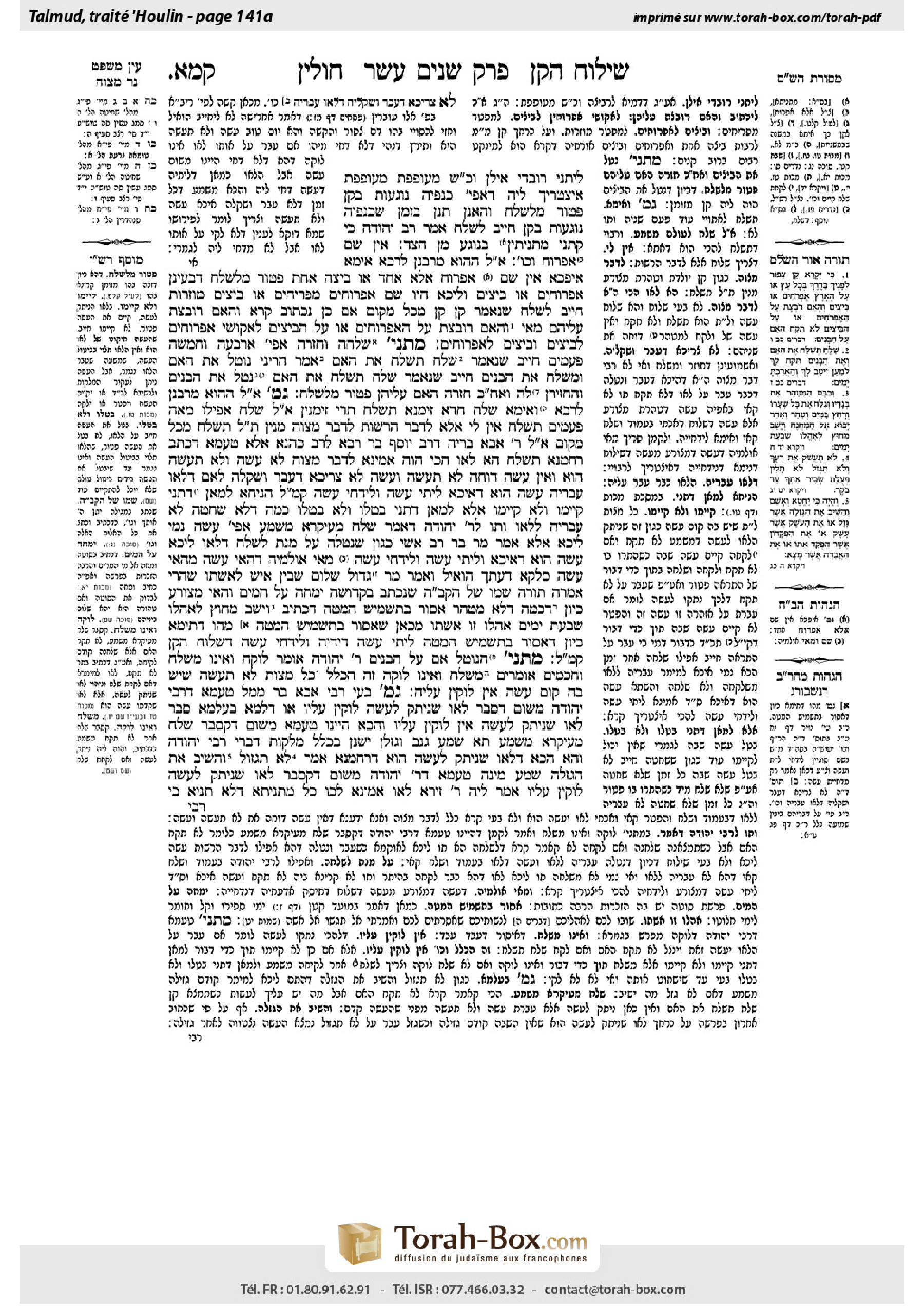
חולין קמ״א א · Aramaic and Hebrew text
לִיתְנֵי רוֹבְדֵי אִילָן, וְכׇל שֶׁכֵּן מְעוֹפֶפֶת? מְעוֹפֶפֶת אִיצְטְרִיךְ לֵיהּ, דַּאֲפִילּוּ כְּנָפֶיהָ נוֹגְעוֹת בַּקֵּן – פָּטוּר מִלְּשַׁלֵּחַ.
וְהָאֲנַן תְּנַן: בִּזְמַן שֶׁכְּנָפֶיהָ נוֹגְעוֹת בַּקֵּן – חַיָּיב לְשַׁלֵּחַ! אָמַר רַב יְהוּדָה: כִּי קָתָנֵי מַתְנִיתִין – בְּנוֹגֵעַ מִן הַצַּד.
אֵין שָׁם אֶפְרוֹחַ וְכוּ׳. אֲמַר לֵיהּ הָהוּא מֵרַבָּנַן לְרָבָא: אֵימָא אִיפְּכָא, אֵין שָׁם אֶפְרוֹחַ אֶלָּא אֶחָד אוֹ בֵּיצָה אַחַת – פָּטוּר מִלְּשַׁלֵּחַ, דְּבָעֵינַן ״אֶפְרוֹחִים אוֹ בֵיצִים״ וְלֵיכָּא.
הָיוּ שָׁם אֶפְרוֹחִים מַפְרִיחִים אוֹ בֵּיצִים מוּזָרוֹת, חַיָּיב לְשַׁלֵּחַ, שֶׁנֶּאֱמַר ״קַן״ – קֵן מִכׇּל מָקוֹם. אִם כֵּן, נִכְתּוֹב קְרָא ״וְהָאֵם רוֹבֶצֶת עֲלֵיהֶם״, מַאי ״וְהָאֵם רֹבֶצֶת עַל הָאֶפְרֹחִים אוֹ עַל הַבֵּיצִים״? לְאַקּוֹשֵׁי אֶפְרוֹחִים לְבֵיצִים וּבֵיצִים לְאֶפְרוֹחִים.
מַתְנִי׳ שִׁלְּחָהּ וְחָזְרָה, אֲפִילּוּ אַרְבָּעָה וַחֲמִשָּׁה פְּעָמִים – חַיָּיב, שֶׁנֶּאֱמַר: ״שַׁלֵּחַ תְּשַׁלַּח אֶת הָאֵם״. אָמַר: הֲרֵינִי נוֹטֵל אֶת הָאֵם וּמְשַׁלֵּחַ אֶת הַבָּנִים – חַיָּיב, שֶׁנֶּאֱמַר: ״שַׁלֵּחַ תְּשַׁלַּח אֶת הָאֵם״. נָטַל אֶת הַבָּנִים וְהֶחְזִירָן לָהּ, וְאַחַר כָּךְ חָזְרָה הָאֵם עֲלֵיהֶן – פָּטוּר מִלְּשַׁלֵּחַ.
גְּמָ׳ אֲמַר לֵיהּ הָהוּא מֵרַבָּנַן לְרָבָא, וְאֵימָא: ״שַׁלֵּחַ״ – חֲדָא זִימְנָא, ״תְּשַׁלַּח״ – תְּרֵי זִימְנִין.
אֲמַר לֵיהּ: ״שַׁלֵּחַ״ – אֲפִילּוּ מֵאָה פְּעָמִים, ״תְּשַׁלַּח״ – אֵין לִי אֶלָּא לִדְבַר הָרְשׁוּת, לִדְבַר מִצְוָה מִנַּיִן? תַּלְמוּד לוֹמַר ״תְּשַׁלַּח״ – מִכׇּל מָקוֹם.
אֲמַר לֵיהּ רַבִּי אַבָּא בְּרֵיהּ דְּרַב יוֹסֵף בַּר רָבָא לְרַב כָּהֲנָא: אֶלָּא טַעְמָא דִּכְתַב רַחֲמָנָא ״תְּשַׁלַּח״, הָא לָאו הָכִי, הָוֵה אָמֵינָא: לִדְבַר מִצְוָה לָא? עֲשֵׂה וְלֹא תַעֲשֶׂה הוּא, וְאֵין עֲשֵׂה דּוֹחֶה לֹא תַעֲשֶׂה וַעֲשֵׂה!
לָא צְרִיכָא, דַּעֲבַר וְשַׁקְלַהּ לְאֵם, דְּלָאו עַבְרֵיהּ, עֲשֵׂה הוּא דְּאִיכָּא, לֵיתֵי עֲשֵׂה וְלִידְחֵי עֲשֵׂה, קָא מַשְׁמַע לַן.
הָנִיחָא לְמַאן דְּתָנֵי קִיְּימוֹ וְלֹא קִיְּימוֹ.
אֶלָּא לְמַאן דְּתָנֵי בִּטְּלוֹ וְלֹא בִּטְּלוֹ, כַּמָּה דְּלָא שַׁחְטַהּ – לָא עַבְרֵיהּ לְלָאו.
וְתוּ, לְרַבִּי יְהוּדָה דְּאָמַר ״שַׁלֵּחַ״ מֵעִיקָּרָא מַשְׁמַע, אֲפִילּוּ עֲשֵׂה נָמֵי לֵיכָּא!
אֶלָּא אָמַר מָר בַּר רַב אָשֵׁי: כְּגוֹן שֶׁנְּטָלָהּ עַל מְנָת לְשַׁלֵּחַ, דְּלָאו לֵיכָּא, עֲשֵׂה הוּא דְּאִיכָּא, וְלֵיתֵי עֲשֵׂה וְלִידְחֵי עֲשֵׂה.
מַאי אוּלְמֵיהּ דְּהַאי עֲשֵׂה מֵהַאי עֲשֵׂה? סָלְקָא דַּעְתָּךְ, הוֹאִיל וְאָמַר מָר: גָּדוֹל שָׁלוֹם שֶׁבֵּין אִישׁ לְאִשְׁתּוֹ, שֶׁהֲרֵי אָמְרָה תּוֹרָה: שְׁמוֹ שֶׁל הַקָּדוֹשׁ בָּרוּךְ הוּא שֶׁנִּכְתַּב בִּקְדוּשָּׁה יִמָּחֶה עַל הַמַּיִם.
וְהַאי מְצוֹרָע, כֵּיוָן דְּכַמָּה דְּלָא מִטַּהַר, אָסוּר בְּתַשְׁמִישׁ הַמִּטָּה, דִּכְתִיב: ״וְיָשַׁב מִחוּץ לְאׇהֳלוֹ שִׁבְעַת יָמִים״, ״אׇהֳלוֹ״ – זוֹ אִשְׁתּוֹ, מִכָּאן שֶׁאָסוּר בְּתַשְׁמִישׁ הַמִּטָּה. מַהוּ דְּתֵימָא: כֵּיוָן דְּאָסוּר בְּתַשְׁמִישׁ הַמִּטָּה, לֵיתֵי עֲשֵׂה דִּידֵיהּ וְלִידְחֵי עֲשֵׂה דְּשִׁלּוּחַ הַקֵּן, קָא מַשְׁמַע לַן.
מַתְנִי׳ הַנּוֹטֵל אֵם עַל הַבָּנִים – רַבִּי יְהוּדָה אוֹמֵר: לוֹקֶה וְאֵינוֹ מְשַׁלֵּחַ, וַחֲכָמִים אוֹמְרִים: מְשַׁלֵּחַ וְאֵינוֹ לוֹקֶה. זֶה הַכְּלָל: כׇּל מִצְוַת לֹא תַעֲשֶׂה שֶׁיֵּשׁ בָּהּ קוּם עֲשֵׂה – אֵין לוֹקִין עָלֶיהָ.
גְּמָ׳ בָּעֵי רַבִּי אַבָּא בַּר מֶמֶל: טַעְמָא דְּרַבִּי יְהוּדָה מִשּׁוּם דְּסָבַר לָאו שֶׁנִּיתָּק לַעֲשֵׂה לוֹקִין עָלָיו.
אוֹ דִלְמָא בְּעָלְמָא סָבַר, לָאו שֶׁנִּיתָּק לַעֲשֵׂה אֵין לוֹקִין עָלָיו, וְהָכָא הַיְינוּ טַעְמָא, מִשּׁוּם דְּקָסָבַר ״שַׁלֵּחַ״ מֵעִיקָּרָא מַשְׁמַע.
תָּא שְׁמַע: גַּנָּב וְגַזְלָן יֶשְׁנָן בִּכְלַל מַלְקוֹת, דִּבְרֵי רַבִּי יְהוּדָה. וְהָא הָכָא, דְּלָאו שֶׁנִּיתָּק לַעֲשֵׂה הוּא, דְּרַחֲמָנָא אָמַר ״לֹא תִגְזוֹל״ ״וְהֵשִׁיב אֶת הַגְּזֵלָה״. שְׁמַע מִינַּהּ טַעְמָא דְּרַבִּי יְהוּדָה מִשּׁוּם דְּקָסָבַר לָאו שֶׁנִּיתָּק לַעֲשֵׂה לוֹקִין עָלָיו.
אֲמַר לֵיהּ רַבִּי זֵירָא: לָאו אָמֵינָא לְכוּ, כֹּל מַתְנִיתָא דְּלָא תַּנְיָא בֵּי
Chullin 141a · English translation
let the baraita teach that one is exempt in a case where the bird is sitting between two tree branches, which resembles a case where the bird is resting upon the nest itself in that the bird is sitting in both cases, and it would be clear all the more so that one is exempt if the mother is hovering. The Gemara responds: It was necessary for the baraita to teach the case of a hovering bird in order to teach that even if its wings are touching the nest, one is exempt from sending away the mother bird. Had the baraita taught the exemption in a case of a bird resting between two tree branches, one might have thought that this is because the bird’s wings are not touching the nest.
The Gemara now questions the baraita itself: How can the baraita state that even if the hovering bird’s wings are touching the nest, one is exempt from sending the bird? But didn’t we learn in the mishna: When its wings are touching the nest, one is obligated to send away the mother? Rav Yehuda said: When the case of the hovering mother bird is taught in the baraita, it is referring to a bird touching the nest from the side. In such a case, one is exempt because its wings are not touching the nest from above. By contrast, the mishna is referring to a case where the bird is hovering directly above the nest and touching the nest with its wings from above.
§ The mishna teaches: Even if there is only one fledgling or one egg, one is obligated to send away the mother, as it is stated: “If a bird’s nest happens before you” (Deuteronomy 22:6), indicating that one is obligated to send the mother bird away from the nest in any case. Additionally, if there were fledglings capable of flying or unfertilized eggs, one is exempt from sending away the mother bird, as it is stated in the same verse: “And the mother is resting upon the fledglings or upon the eggs.” From the juxtaposition of the fledglings and the eggs, one derives that the eggs or fledglings must be capable of living and they must require their mothers. With regard to this, one of the Sages said to Rava: Say the opposite, that if there is only one fledgling or one egg, one is exempt from sending away the mother, since we require that the mother be “resting upon the fledglings or upon the eggs,” and this condition is not fulfilled with fewer than two.
Additionally, if there were fledglings capable of flying or unfertilized eggs in the nest, say that one is obligated to send the mother bird away, as it is stated in that verse: “Nest,” indicating that one is obligated to send the mother bird away from the nest in any case. Rava responds: If so, let the verse write: And the mother is resting upon them. For what reason does the verse state: “And the mother is resting upon the fledglings or upon the eggs”? It is to compare the fledglings to the eggs and the eggs to the fledglings, i.e., to indicate that the eggs or fledglings must be capable of living and must require their mothers. Fledglings that can fly and unfertilized eggs are therefore not included in the mitzva. Consequently, the word “nest” serves to indicate that one is obligated to send away the mother bird even if there is only one egg or fledgling in the nest.
MISHNA: If one sent away the mother bird and it returned to rest on the eggs, even if it returned four or five times, one is obligated to send it away again, as it is stated: “You shall send [shalle’aḥ teshallaḥ] the mother” (Deuteronomy 22:7). The doubled verb indicates that one must send away the mother bird multiple times if needed. If one said: I am hereby taking the mother and sending away the offspring, he is still obligated to send away the mother even if he sent away the offspring, as it is stated: “You shall send the mother.” If one sent away the mother and took the offspring and then returned them to the mother’s nest, and thereafter the mother returned and rested upon them, one is exempt from sending away the mother bird.
GEMARA: The mishna teaches that if the mother bird returned to rest on the eggs, even if it returned four or five times, one is obligated to send it away again, as it is stated: “You shall send [shalle’aḥ teshallaḥ].” With regard to this, one of the Sages said to Rava: But say instead that the word “shalle’aḥ” indicates that one must send away the mother once, and the word “teshallaḥ” indicates that one must do so twice, and beyond that there is no obligation.
Rava said to him: Actually, the halakha that one must send away the mother multiple times is not derived from the phrase “shalle’aḥ teshallaḥ.” Rather, the word “shalle’aḥ” indicates that one must send away the mother bird even one hundred times, and the word “teshallaḥ” teaches another matter: I have derived only the obligation to send away the mother bird in a case where one takes the eggs or the fledglings and wants to take the mother bird for a discretionary purpose, e.g., to eat it. In a case where one takes the eggs or the fledglings and needs the mother bird for a matter involving a mitzva, e.g., the purification of a leper, from where is the halakha that he must send away the mother derived? The verse states: “Teshallaḥ,” to teach that in any case one must send away the mother bird.
Rabbi Abba, son of Rav Yosef bar Rava, said to Rav Kahana: But according to this explanation, the only reason that one must send away the mother bird even when needed for a matter involving a mitzva is that the Merciful One wrote: “Teshallaḥ”; but if not for this, I would say that when the mother is needed for a matter involving a mitzva, one is not obligated to send her away. But this is difficult, as the sending of the mother bird is both a positive mitzva and a prohibition, as the verse states: “You shall not take the mother with the young; you shall send the mother” (Deuteronomy 22:6–7), and there is a principle that a positive mitzva cannot override both a prohibition and a positive mitzva.
Rav Kahana replied: No, the word “teshallaḥ” is necessary for a case where one transgressed and took the mother with the fledglings. In such a case, he has already transgressed the prohibition, and there is now only a positive mitzva to send away the mother. Perhaps one might say: Let the positive mitzva performed with the mother, e.g., the purification of the leper, come and override the positive mitzva of sending away the mother. Therefore, the word “teshallaḥ” teaches us that this is not so, and one is obligated to send away the mother.
The Gemara notes: This works out well according to the one who teaches that the criterion for determining whether one is flogged for violating a prohibition that entails fulfillment of a positive mitzva is whether he fulfilled the mitzva immediately afterward or did not fulfill it. If he does not fulfill the mitzva immediately, he is flogged when he fails to do so. Consequently, if one does not send away the mother bird immediately after taking her with the fledglings, he has immediately violated the prohibition, and only the requirement to fulfill the positive mitzva remains.
The Gemara continues: But according to the one who teaches that the criterion for determining whether one is flogged in that case is whether he negated the possibility of fulfilling the positive mitzva or did not negate it, and one is flogged only if he performed an action that renders it impossible to fulfill the mitzva, this explanation does not work out well. After all, as long as one has not slaughtered the mother bird, he has not transgressed the prohibition, since he may still send her away. Consequently, even if one takes the mother, as long as he has not slaughtered her, the prohibition remains in addition to the positive mitzva. If so, there is no need for the Torah to teach that the obligation to send away the mother bird applies in the case of a mitzva.
And furthermore, one may ask: According to the opinion of Rabbi Yehuda, who said that the word “shalle’aḥ” indicates that the mitzva to send away the mother bird applies only at the outset, i.e., before taking the fledglings, one who takes the mother together with the fledglings violates both the prohibition and the positive mitzva associated with it, such that even a positive mitzva does not remain.
Rather, Mar bar Rav Ashi said: The word “teshallaḥ” is necessary to indicate that the mitzva to send away the mother bird applies in a case where one took her in order to send her away immediately. In such a case, there is no prohibition, as one intends to send her away, but there is still a positive mitzva to send her away. And therefore, one might have said: Let another positive mitzva, e.g., taking the mother for the purification of a leper, come and override the positive mitzva of sending the mother. Therefore, the word “teshallaḥ” indicates that the mitzva of sending the mother bird applies even in such a case.
The Gemara asks: What is the strength of that other positive mitzva over this positive mitzva of sending away the mother bird? Why might the former override the latter? The Gemara responds: It might enter your mind to say that since the Master said: Great is peace between a man and his wife, as the Torah said that the name of the Holy One, Blessed be He, which is written in sanctity, shall be erased on the waters as part of the ritual of a woman suspected by her husband of adultery (see Numbers 5:23) in order to clear her from suspicion and restore peace between her and her husband, therefore, perhaps the halakha should be more lenient with regard to the leper.
The Gemara explains: And with regard to this leper, since as long as he is not purified he is prohibited from engaging in marital relations, as it is written: “But he shall dwell outside his tent seven days” (Leviticus 14:8), and when the verse states: “His tent,” this is referring to his wife, such that one may derive from here that a leper is prohibited from engaging in marital relations, perhaps his purification ceremony should take precedence. This is because perhaps you will say: Since he is prohibited from engaging in marital relations, let his positive mitzva of purification come and override the positive mitzva of the sending away of the mother bird from the nest. Therefore, the word “teshallaḥ” teaches us that even so, one may not take the mother bird.
MISHNA: With regard to one who takes the mother bird with its fledglings, Rabbi Yehuda says: He is flogged for taking the mother bird, and he does not send away the mother. And the Rabbis say: He sends away the mother and is not flogged, as this is the principle: With regard to any prohibition that entails a command to arise and perform a mitzva, one is not flogged for its violation.
GEMARA: The mishna teaches that according to Rabbi Yehuda, one who takes the mother with the offspring is flogged. With regard to this, Rabbi Abba bar Memel raises a dilemma: Is the reasoning for the ruling of Rabbi Yehuda that he holds that one is flogged for violation of a prohibition that entails fulfillment of a positive mitzva? Accordingly, one is flogged for transgressing the prohibition: “You shall not take the mother with the young,” which entails the fulfillment of: “You shall send the mother.”
The second possibility is now presented: Or perhaps in general Rabbi Yehuda holds that one is not flogged for violation of a prohibition that entails fulfillment of a positive mitzva; and here, this is the reason one is flogged for taking the mother: It is because he holds that when the verse states: “You shall send the mother [shalle’aḥ teshallaḥ]” (Deuteronomy 22:7), the word “shalle’aḥ” indicates that the mitzva to sending the mother bird applies only at the outset, i.e., when encountering the nest. Accordingly, this is not a case of a prohibition that entails the performance of a positive mitzva, but an independent prohibition, for which one is liable to receive lashes.
The Gemara suggests: Come and hear a resolution to the dilemma from that which is taught: A thief and a robber are included among those who are liable to receive lashes by Torah law. A thief violates the prohibition of: “You shall not steal” (Leviticus 19:11), and a robber violates the prohibition of: “You shall not rob” (Leviticus 19:13); this is the statement of Rabbi Yehuda. The Gemara continues: But here, the prohibition against robbing is a prohibition that entails fulfillment of a positive mitzva, as the Merciful One states: “You shall not rob” (Leviticus 19:13), and: “And he shall restore the robbed item” (Leviticus 5:23). And nevertheless, Rabbi Yehuda deems one liable to receive lashes for transgressing the prohibition against robbing. Therefore, conclude from it that the reasoning of the ruling of Rabbi Yehuda in the mishna is that he holds that one is flogged for violation of a prohibition that entails fulfillment of a positive mitzva.
Rabbi Zeira said to him: Didn’t I already tell you that any baraita that is not taught in the study hall
Chullin 141a · Traduction française (IA)
que la baraïta enseigne que l'on est dispensé dans le cas où l'oiseau est assis entre deux branches d'arbre, ce qui ressemble au cas où l'oiseau repose sur son nid, puisque l'oiseau est assis dans les deux cas, et il serait encore plus clair que l'on est dispensé si la mère plane. La Guemara répond : il était nécessaire que la baraïta enseigne le cas de l'oiseau planant afin d'enseigner que même si ses ailes touchent le nid, l'on est dispensé de renvoyer la mère. Si la baraïta avait enseigné la dispense dans le cas d'un oiseau reposant entre deux branches d'arbre, on aurait pu penser que c'est parce que les ailes de l'oiseau ne touchent pas le nid.
La Guemara questionne alors la baraïta elle-même : comment peut-elle affirmer que l'on est dispensé même si les ailes de l'oiseau planant touchent le nid ? Mais n'avons-nous pas appris dans la Michna : lorsque ses ailes touchent le nid, l'on est tenu de renvoyer la mère ? Rav Yehuda dit : lorsque le cas de l'oiseau planant est enseigné dans la baraïta, il s'agit d'un oiseau touchant le nid du côté. Dans ce cas, l'on est dispensé car ses ailes ne touchent pas le nid du haut. À l'inverse, la Michna s'applique à un cas où l'oiseau est directement au-dessus du nid et touche le nid avec ses ailes du haut.
§ La Michna enseigne : même s'il y a seulement un petit oiseau ou un œuf, l'on est tenu de renvoyer la mère, comme il est dit : « Si un nid d'oiseau se trouve devant toi » (Deutéronome 22:6), indiquant que l'on est tenu de renvoyer la mère du nid dans tous les cas. De plus, si les petits oiseaux sont capables de voler ou les œufs sont non fécondés, l'on est dispensé de renvoyer la mère, comme il est dit dans le même verset : « et la mère repose sur les petits ou sur les œufs ». À partir de la juxtaposition des petits oiseaux et des œufs, on déduit que les œufs ou les petits oiseaux doivent être capables de vivre et avoir besoin de leur mère. À ce sujet, l'un des Sages a dit à Rava : dis le contraire, c'est-à-dire que si l'on a seulement un petit oiseau ou un œuf, l'on est dispensé de renvoyer la mère, car nous exigeons que la mère « repose sur les petits ou sur les œufs », et cette condition n'est pas remplie avec moins de deux.
De plus, si les petits oiseaux sont capables de voler ou s'il y a des œufs non fécondés dans le nid, dis que l'on est tenu de renvoyer la mère, comme il est dit dans ce verset : « Nid », indiquant que l'on est tenu de renvoyer la mère du nid dans tous les cas. Rava répond : si c'est ainsi, pourquoi le verset ne dit-il pas : « et la mère repose sur eux » ? Pourquoi le verset dit-il : « et la mère repose sur les petits ou sur les œufs » ? C'est pour comparer les petits oiseaux aux œufs et les œufs aux petits oiseaux, c'est-à-dire pour indiquer que les œufs ou les petits oiseaux doivent être capables de vivre et avoir besoin de leur mère. Les petits oiseaux capables de voler et les œufs non fécondés ne sont donc pas inclus dans la mitsva. Ainsi, le mot « nid » sert à indiquer que l'on est tenu de renvoyer la mère même s'il y a seulement un œuf ou un petit oiseau dans le nid.
MICHNA : Si l'on a renvoyé la mère et qu'elle est revenue se reposer sur les œufs, même si elle est revenue quatre ou cinq fois, l'on est tenu de la renvoyer à nouveau, comme il est dit : « Tu dois renvoyer [shalle’aḥ teshallaḥ] la mère » (Deutéronome 22:7). Le verbe doublé indique que l'on doit renvoyer la mère plusieurs fois si nécessaire. Si l'on dit : « Je prends la mère et je renvoie les petits », l'on est toujours tenu de renvoyer la mère même si l'on a renvoyé les petits, comme il est dit : « Tu dois renvoyer la mère ». Si l'on a renvoyé la mère, a pris les petits et les a rendus à leur nid, et ensuite la mère est revenue et s'est reposée sur eux, l'on est dispensé de renvoyer la mère.
GUEMARA : La Michna enseigne que si la mère est revenue se reposer sur les œufs, même si elle est revenue quatre ou cinq fois, l'on est tenu de la renvoyer à nouveau, comme il est dit : « Tu dois renvoyer [shalle’aḥ teshallaḥ] la mère ». À ce sujet, l'un des Sages a dit à Rava : mais dis plutôt que le mot « shalle’aḥ » indique que l'on doit renvoyer la mère une fois, et le mot « teshallaḥ » indique que l'on doit le faire deux fois, et au-delà il n'y a pas d'obligation.
Rava dit à lui : en réalité, la halakha selon laquelle l'on doit renvoyer la mère plusieurs fois n'est pas dérivée du phrasé « shalle’aḥ teshallaḥ ». Plutôt, le mot « shalle’aḥ » indique que l'on doit renvoyer la mère cent fois, et le mot « teshallaḥ » enseigne une autre chose : j'ai dérivé l'obligation de renvoyer la mère dans le cas où l'on prend les œufs ou les petits et veut prendre la mère pour une raison discrétionnaire, par exemple pour la manger. Dans le cas où l'on prend les œufs ou les petits et a besoin de la mère pour une affaire liée à une mitsva, par exemple la purification d'un lépreux, d'où est dérivée la halakha selon laquelle l'on doit renvoyer la mère ? Le verset dit : « teshallaḥ », pour enseigner que dans tous les cas l'on doit renvoyer la mère.
Rabbi Abba, fils de Rav Yosef bar Rava, dit à Rav Kahana : mais selon cette explication, la seule raison pour laquelle l'on doit renvoyer la mère même lorsqu'elle est nécessaire pour une affaire liée à une mitsva est que l'Éternel a écrit : « teshallaḥ » ; mais si ce n'était pas pour cela, je dirais que lorsqu'on a besoin de la mère pour une affaire liée à une mitsva, l'on n'est pas tenu de la renvoyer. Mais cela est difficile, car le renvoi de la mère est à la fois une mitsva positive et une interdiction, comme le verset dit : « Tu ne prendras pas la mère avec les petits ; tu renverras la mère » (Lévitique 22:6–7), et il y a un principe selon lequel une mitsva positive ne peut pas annuler à la fois une interdiction et une mitsva positive.
Rav Kahana répondit : Non, le mot « teshallaḥ » est nécessaire dans le cas où l'on a transgressé et pris la mère avec les petits. Dans ce cas, il a déjà transgressé la prohibition, et il ne reste plus qu'une mitsva positive à envoyer la mère loin. Peut-être pourrait-on dire : Que la mitsva positive accomplie avec la mère, par exemple la purification du lépreux, vienne annuler la mitsva positive d'envoyer la mère loin. Ainsi, le mot « teshallaḥ » nous apprend que cela n'est pas le cas, et qu'on est tenu de faire partir la mère.
La Guemara note : Cela s'explique bien selon celui qui affirme que le critère pour déterminer si l'on est fouetté pour avoir violé une prohibition qui implique l'accomplissement d'une mitsva positive est de savoir si l'on a accompli la mitsva immédiatement après ou non. Si l'on n'a pas accompli la mitsva immédiatement, on est fouetté lorsqu'on ne l'a pas accomplie. Ainsi, si l'on ne fait pas partir la mère immédiatement après avoir pris celle-ci avec les petits, on a immédiatement violé la prohibition, et il ne reste plus qu'une obligation d'accomplir la mitsva positive.
La Guemara continue : Mais selon celui qui affirme que le critère pour déterminer si l'on est fouetté dans ce cas est de savoir si l'on a rendu impossible l'accomplissement de la mitsva positive ou non, et qu'on est fouetté uniquement si l'on a accompli une action qui rend impossible l'accomplissement de la mitsva, cette explication ne s'explique pas bien. En effet, tant que l'on n'a pas sacrifié la mère, on n'a pas transgressé la prohibition, car l'on peut encore la faire partir. Ainsi, même si l'on prend la mère, tant qu'on n'a pas sacrifié celle-ci, la prohibition reste en plus de la mitsva positive. Si c'est ainsi, il n'y a pas besoin que la Torah enseigne que l'obligation de faire partir la mère s'applique dans le cas d'une mitsva.
Et de plus, on peut demander : Selon l'opinion de Rabbi Yehuda, qui affirmait que le mot « shalléaḥ » indique que la mitsva de faire partir la mère s'applique uniquement au début, c'est-à-dire avant de prendre les petits, celui qui prend la mère avec les petits transgresse à la fois la prohibition et la mitsva positive associée, de sorte qu'aucune mitsva positive ne reste.
Plutôt, Mar bar Rav Ashi dit : Le mot « teshallaḥ » est nécessaire pour indiquer que la mitsva de faire partir la mère s'applique dans le cas où l'on a pris celle-ci afin de la faire partir immédiatement. Dans ce cas, il n'y a pas de prohibition, car l'intention est de la faire partir, mais il reste une mitsva positive à la faire partir. Ainsi, on pourrait dire : Que la mitsva positive, par exemple, de prendre la mère pour la purification du lépreux, vienne annuler la mitsva positive de faire partir la mère. Ainsi, le mot « teshallaḥ » indique que la mitsva de faire partir la mère s'applique même dans ce cas.
La Guemara pose la question : Quelle est la force de cette autre mitsva positive sur cette mitsva positive de faire partir la mère ? Pourquoi la première pourrait-elle annuler la seconde ? La Guemara répond : Il pourrait entrer en votre esprit de dire que puisque le Maître a dit : « La paix entre un homme et sa femme est grande », comme la Torah a dit que le nom du Saint, le Très Haut, qui est écrit dans la sanctité, sera effacé sur les eaux comme partie de la cérémonie d'une femme soupçonnée d'adultère (voir Nombres 5:23) afin de la débarrasser de son soupçon et de restaurer la paix entre elle et son mari, peut-être la halakha devrait être plus clémente concernant le lépreux.
La Guemara explique : Et concernant ce lépreux, puisque tant qu'il n'est pas purifié, il est interdit d'engager des relations conjugales, comme il est écrit : « Il habitera en dehors de sa tente sept jours » (Lévitique 14:8), et lorsque le verset dit : « Sa tente », cela fait référence à sa femme, de sorte qu'on peut en déduire ici que le lépreux est interdit d'engager des relations conjugales, peut-être sa cérémonie de purification devrait avoir la priorité. Cela est parce que peut-être vous direz : Puisque il est interdit d'engager des relations conjugales, la mitsva positive de sa purification devrait annuler la mitsva positive de faire partir la mère de la nasse. Ainsi, le mot « teshallaḥ » nous apprend que même ainsi, on ne peut pas prendre la mère.
MICHNA : Concernant celui qui prend la mère avec ses petits, Rabbi Yehuda dit : Il est fouetté pour avoir pris la mère, et il ne fait pas partir la mère. Et les Rabbins disent : Il fait partir la mère et n'est pas fouetté, car c'est le principe : Concernant toute prohibition qui implique l'accomplissement d'une mitsva positive, on n'est pas fouetté pour sa violation.
GUEMARA : La mishna enseigne que selon Rabbi Yehuda, celui qui prend la mère avec les petits est fouetté. Concernant cela, Rabbi Abba bar Memel soulève un dilemme : Est-ce que la raison du jugement de Rabbi Yehuda est qu'il considère que l'on est fouetté pour la violation d'une prohibition qui implique l'accomplissement d'une mitsva positive ? Ainsi, on est fouetté pour avoir transgressé la prohibition : « Tu ne prendras pas la mère avec les petits », qui implique l'accomplissement de : « Tu enverras la mère ».
La seconde possibilité est maintenant présentée : Ou peut-être, en général, Rabbi Yehuda considère que l'on n'est pas fouetté pour la violation d'une prohibition qui implique l'accomplissement d'une mitsva positive ; et ici, c'est la raison pour laquelle on est fouetté pour avoir pris la mère : C'est parce qu'il considère que lorsque le verset dit : « Tu enverras la mère [shalle’aḥ teshallaḥ] » (Deutéronome 22:7), le mot « shalléaḥ » indique que la mitsva de faire partir la mère s'applique uniquement au début, c'est-à-dire lorsqu'on rencontre le nid. Ainsi, ce n'est pas un cas de prohibition qui implique l'accomplissement d'une mitsva positive, mais une prohibition indépendante, pour laquelle l'on est puni par des coups de fouet.
La Guemara suggère : Viens entendre une résolution de ce dilemme à partir de ce qui est enseigné : le voleur et le voleur sont inclus parmi ceux qui sont tenus de recevoir des fessées selon la loi divine. Le voleur viole l'interdiction de : « Tu ne voleras point » (Lévitique 19,11), et le voleur viole l'interdiction de : « Tu ne voleras point » (Lévitique 19,13) ; c'est la déclaration du Rabbi Yéhuda. La Guemara continue : Mais ici, l'interdiction de voler est une interdiction qui implique la réalisation d'une positive mitsva, car l'Éternel dit : « Tu ne voleras point » (Lévitique 19,13), et : « Et il restituera l'objet volé » (Lévitique 5,23). Et pourtant, le Rabbi Yéhuda considère que l'on est tenu de recevoir des fessées pour avoir transgressé l'interdiction de voler. Par conséquent, conclure de cela que la raison du jugement du Rabbi Yéhuda dans la mitsva est qu'il considère que l'on est fouetté pour la violation d'une interdiction qui implique la réalisation d'une positive mitsva.
Le Rabbi Zéira dit à lui : N'ai-je pas déjà dit que tout baraïta non enseigné dans la salle de study est considéré comme non authentique ?
Traduction française générée par IA à partir de l’édition anglaise de Sefaria. Vérifie toujours un passage avec le texte source.
Text from Sefaria: William Davidson Edition - Vocalized Aramaic (unknown); William Davidson Edition - English (CC BY NC).