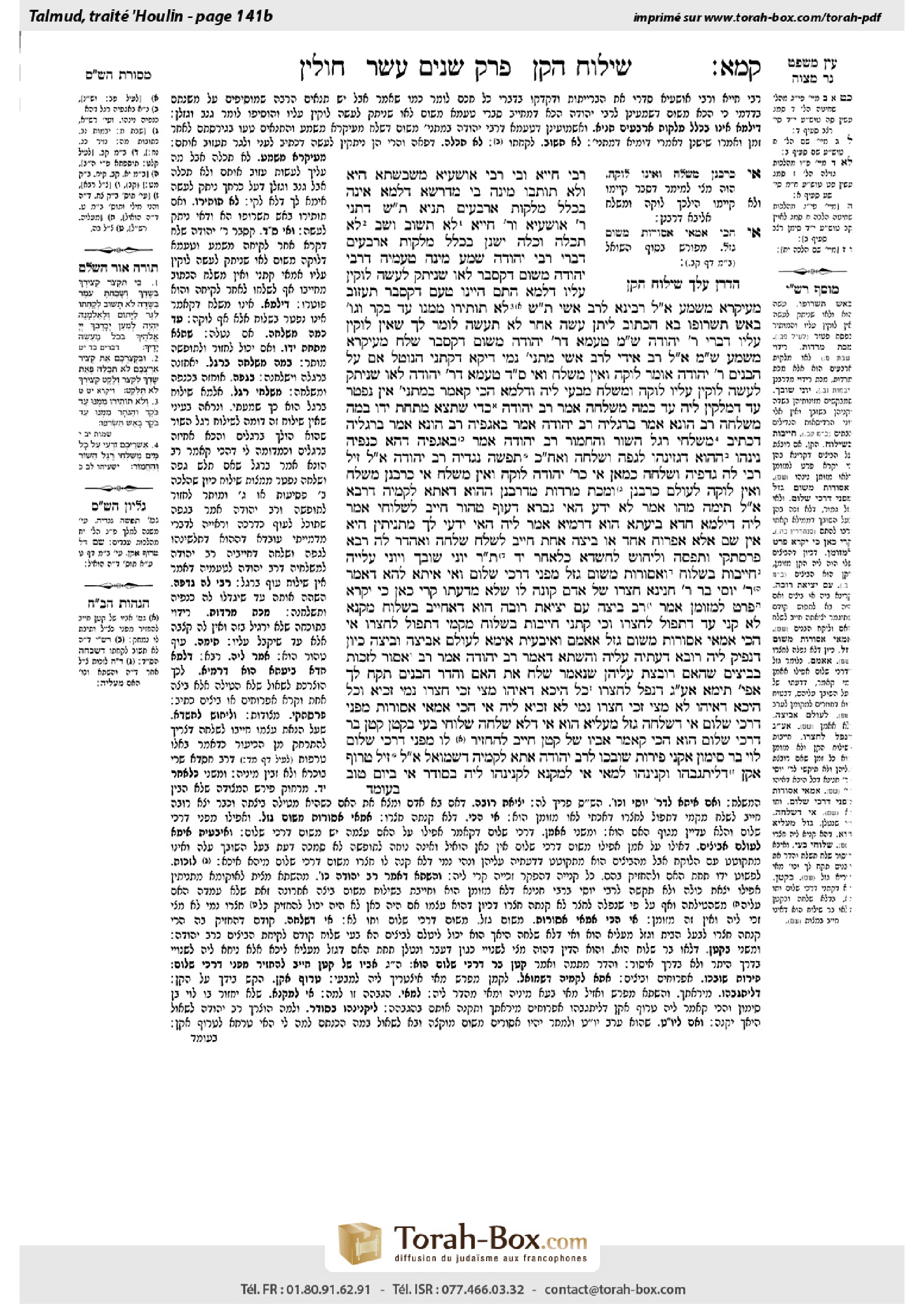
Chullin 141b: Talmud study for Daf Yomi
Study the Talmud for Daf Yomi with scanned pages, Hebrew text, English translations from Sefaria and AI-generated French translations.
Passage selection and English or AI-generated French translation are available where the scan has annotations. Daf Study is independent of Torah-Box and Sefaria.
Browse Chullin · חולין · All tractatesChullin 141b text and translations
This page of Chullin includes the Aramaic text, an English translation and an AI-generated French translation, alongside the scan above.
חולין קמ״א ב · Aramaic and Hebrew text
רַבִּי חִיָּיא וּבֵי רַבִּי אוֹשַׁעְיָא מְשַׁבַּשְׁתָּא הִיא, וְלָא תּוֹתְבוּ מִינַּהּ בֵּי מִדְרְשָׁא, דִּלְמָא אֵינָהּ בִּכְלַל מַלְקוֹת אַרְבָּעִים תַּנְיָא.
תָּא שְׁמַע, דְּתָנֵי רַבִּי אוֹשַׁעְיָא וְרַבִּי חִיָּיא: ״לֹא תָשׁוּב״ וְשָׁב, ״לֹא תְכַלֶּה״ וְכִלָּה – יֶשְׁנָן בִּכְלַל מַלְקוֹת אַרְבָּעִים, דִּבְרֵי רַבִּי יְהוּדָה.
שְׁמַע מִינַּהּ טַעְמֵיהּ דְּרַבִּי יְהוּדָה, מִשּׁוּם דְּקָסָבַר לָאו שֶׁנִּיתָּק לַעֲשֵׂה – לוֹקִין עָלָיו.
דִּלְמָא הָתָם הַיְינוּ טַעַם, דְּקָסָבַר ״תַּעֲזוֹב״ מֵעִיקָּרָא מַשְׁמַע.
אֲמַר לֵיהּ רָבִינָא לְרַב אָשֵׁי: תָּא שְׁמַע, ״לֹא תוֹתִירוּ מִמֶּנּוּ עַד בֹּקֶר וְגוֹ׳ בָּאֵשׁ תִּשְׂרֹפוּ״ – בָּא הַכָּתוּב לִיתֵּן עֲשֵׂה אַחַר לֹא תַעֲשֶׂה, לוֹמַר לָךְ שֶׁאֵין לוֹקִין עָלָיו, דִּבְרֵי רַבִּי יְהוּדָה.
שְׁמַע מִינַּהּ: טַעְמָא דְּרַבִּי יְהוּדָה מִשּׁוּם דְּקָסָבַר ״שַׁלֵּחַ״ מֵעִיקָּרָא מַשְׁמַע, שְׁמַע מִינַּהּ.
אֲמַר לֵיהּ רַב אִידִי לְרַב אָשֵׁי: מַתְנִיתִין נָמֵי דַּיְקָא, דְּקָתָנֵי: הַנּוֹטֵל אֵם עַל הַבָּנִים – רַבִּי יְהוּדָה אוֹמֵר: לוֹקֶה וְאֵין מְשַׁלֵּחַ, וְאִי סָלְקָא דַעְתָּךְ טַעְמָא דְּרַבִּי יְהוּדָה לָאו שֶׁנִּיתָּק לַעֲשֵׂה לוֹקִין עָלָיו, ״לוֹקֶה וּמְשַׁלֵּחַ״ מִבְּעֵי לֵיהּ!
וְדִלְמָא הָכִי קָאָמַר בְּמַתְנִיתִין: אֵין נִפְטָר עַד דְּמַלְקִין לֵיהּ.
עַד כַּמָּה מְשַׁלְּחָהּ? אָמַר רַב יְהוּדָה: כְּדֵי שֶׁתֵּצֵא מִתַּחַת יָדוֹ. בַּמֶּה מְשַׁלְּחָהּ? רַב הוּנָא אָמַר: בְּרַגְלֶיהָ, רַב יְהוּדָה אָמַר: בַּאֲגַפֶּיהָ. רַב הוּנָא אָמַר בְּרַגְלֶיהָ, דִּכְתִיב: ״מְשַׁלְּחֵי רֶגֶל הַשּׁוֹר וְהַחֲמוֹר״. רַב יְהוּדָה אָמַר בַּאֲגַפֶּיהָ, דְּהָא כְּנָפֶיהָ נִינְהוּ.
הַהוּא דְּגַזִּינְהוּ לְגַפַּהּ, וְשַׁלְּחַהּ, וְאַחַר כָּךְ תַּפְשַׂהּ. נַגְּדֵיהּ רַב יְהוּדָה. אֲמַר לֵיהּ: זִיל רַבִּי לַהּ גַּדְפַיהּ, וְשַׁלְּחַהּ!
כְּמַאן? אִי כְּרַבִּי יְהוּדָה – לוֹקֶה וְאֵין מְשַׁלֵּחַ, אִי כְּרַבָּנַן – מְשַׁלֵּחַ וְאֵין לוֹקֶה! לְעוֹלָם כְּרַבָּנַן, וּמַכַּת מַרְדּוּת מִדְּרַבָּנַן.
הָהוּא דַּאֲתָא לְקַמֵּיהּ דְּרָבָא, אֲמַר לֵיהּ: תֵּימָה מַהוּ? אָמַר: לָא יָדַע הַאי גַּבְרָא דְּעוֹף טָהוֹר חַיָּיב לְשַׁלּוֹחֵי? אֲמַר לֵיהּ: דִּילְמָא חֲדָא בֵּיעֲתָא הוּא דְּרַמְיָא? אֲמַר לֵיהּ: (הַאי יָדְעִי) [אִין. אֲמַר לֵיהּ: מַאי תִּיבְּעֵי] לָךְ? מַתְנִיתִין הִיא: אֵין שָׁם אֶלָּא אֶפְרוֹחַ אֶחָד אוֹ בֵיצָה אַחַת – חַיָּיב לְשַׁלֵּחַ.
שַׁלְחַהּ, וְאַהְדַּר לַהּ רָבָא פְּרִסְתָּקֵי וְתַפְסַהּ. וְלֵיחוּשׁ לַחֲשָׁדָא? כִּלְאַחַר יָד.
תָּנוּ רַבָּנַן: יוֹנֵי שׁוֹבָךְ וְיוֹנֵי עֲלִיָּיה – חַיָּיבוֹת בְּשִׁלּוּחַ, וַאֲסוּרוֹת מִשּׁוּם גָּזֵל מִפְּנֵי דַּרְכֵי שָׁלוֹם.
וְאִי אִיתָא לְהָא דְּאָמַר רַבִּי יוֹסֵי בַּר רַבִּי חֲנִינָא, חֲצֵרוֹ שֶׁל אָדָם קוֹנָה לוֹ שֶׁלֹּא מִדַּעְתּוֹ, קְרִי כָּאן ״כִּי יִקָּרֵא״ – פְּרָט לִמְזוּמָּן!
אָמַר (רב) [רַבָּה]: בֵּיצָה – עִם יְצִיאַת רוּבָּהּ הוּא דְּאִחַיַּיב בְּשִׁלּוּחַ, מִקְנָא לָא קָנֵי עַד דְּתִפּוֹל לַחֲצֵרוֹ, וְכִי קָתָנֵי חַיָּיבוֹת בְּשִׁלּוּחַ – מִקַּמֵּי דְּתִפּוֹל לַחֲצֵרוֹ.
אִי הָכִי, אַמַּאי אֲסוּרוֹת מִשּׁוּם גָּזֵל? אַאִמָּם. וְאִיבָּעֵית אֵימָא: לְעוֹלָם אַבֵּיצָה, וּבֵיצָה כֵּיוָן דִּנְפַק לֵיהּ רוּבָּא – דַּעְתֵּיהּ עֲלֵיהּ.
וְהַשְׁתָּא דְּאָמַר רַב יְהוּדָה אָמַר רַב: אָסוּר לִזְכּוֹת בְּבֵיצִים שֶׁהָאֵם רוֹבֶצֶת עֲלֵיהֶן, שֶׁנֶּאֱמַר: ״שַׁלֵּחַ אֶת הָאֵם״ וַהֲדַר ״הַבָּנִים תִּקַּח לָךְ״. אֲפִילּוּ תֵּימָא אַף עַל גַּב דִּנְפַל לַחֲצֵרוֹ, כֹּל הֵיכָא דְּאִיהוּ מָצֵי זָכֵי – חֲצֵרוֹ נָמֵי זָכְיָא, וְכֹל הֵיכָא דְּאִיהוּ לָא מָצֵי זָכֵי – חֲצֵרוֹ נָמֵי לָא זָכְיָא לֵיהּ.
אִי הָכִי, אַמַּאי אֲסוּרוֹת מִפְּנֵי דַּרְכֵי שָׁלוֹם? אִי דְּשַׁלְּחַהּ – גָּזֵל מְעַלְּיָא הוּא, אִי דְּלָא שַׁלְּחַהּ – שַׁלּוֹחֵי בָּעֵי!
בְּקָטָן. קָטָן בַּר דַּרְכֵי שָׁלוֹם הוּא? הָכִי קָאָמַר: אָבִיו שֶׁל קָטָן חַיָּיב לְהַחְזִיר לוֹ, מִפְּנֵי דַּרְכֵי שָׁלוֹם.
לֵוִי בַּר סִימוֹן אַקְנִי פֵּירוֹת שׁוֹבָכוֹ לְרַב יְהוּדָה. אֲתָא לְקַמֵּיהּ דִּשְׁמוּאֵל, אֲמַר לֵיהּ: זִיל טְרוֹף אַקַּן, דְּלִיתְגַּבְהוּ וּקְנִינְהוּ.
לְמַאי? אִי לְמִקְנֵא – לַקְנִינְהוּ לֵיהּ בְּסוּדָר! אִי בְּיוֹם טוֹב –
Chullin 141b · English translation
of Rabbi Ḥiyya or the study hall of Rabbi Oshaya, who were precise in the formulation of their baraitot, is corrupted, and you may not raise objections based upon it in the study hall? Since this baraita was not taught in either of the aforementioned study halls, you may not cite it as proof. After all, perhaps the phrase: Are not included among those who are liable to receive forty lashes by Torah law, was taught by Rabbi Yehuda in the baraita, but the text was corrupted. It is therefore possible that according to Rabbi Yehuda, one is not flogged for violation of a prohibition that entails fulfillment of a positive mitzva, and his reasoning of his ruling in the mishna is that the word “shalle’aḥ” indicates that the mitzva to send away the mother bird applies only at the outset.
The Gemara suggests: Come and hear a resolution from that which is taught in a baraita by Rabbi Oshaya and Rabbi Ḥiyya: It is written with regard to forgotten sheaves left for the poor: “When you reap your harvest in your field and forget a sheaf in the field, you shall not return to fetch it” (Deuteronomy 24:19). If one transgressed this prohibition and one returned to fetch it, he is liable to receive lashes. Likewise, it is written with regard to produce in the corner of the field [pe’a], which is given to the poor: “And when you reap the harvest of your land, you shall not wholly reap the corner of your field” (Leviticus 19:9). If one transgressed this prohibition and reaped the corner of his field, such individuals are included among those who are liable to receive lashes by Torah law. This is the statement of Rabbi Yehuda.
The Gemara concludes the resolution: Since the mitzvot of leaving pe’a and forgotten sheaves are prohibitions that entail fulfillment of a positive mitzva, as the verse states with regard to both of them: “For the poor and for the stranger you shall leave them” (Leviticus 19:10), conclude from the baraita that the reasoning of the ruling of Rabbi Yehuda in the mishna is that he holds that one is flogged for violation of a prohibition that entails fulfillment of a positive mitzva.
The Gemara rejects this: Perhaps there, with regard to pe’a and forgotten sheaves, this is the reason that Rabbi Yehuda deems one liable to receive lashes: Because he holds that the positive mitzva: “For the poor and for the stranger you shall leave them,” indicates that these mitzvot apply only at the outset. Accordingly, these are not cases of prohibitions that entail fulfillment of a positive mitzva, but of independent prohibitions. Similarly, it is possible that the reasoning of the ruling of Rabbi Yehuda in the mishna is that the mitzva of the sending away of the mother bird applies only at the outset.
Ravina said to Rav Ashi: Come and hear a resolution from that which is taught in a baraita: The verse states with regard to the Paschal offering: “You shall let nothing of it remain until the morning; but that which remains of it until the morning you shall burn in fire” (Exodus 12:10). The verse comes to position the positive mitzva of burning the leftover meat after the prohibition against leaving over the meat, in order to say that one is not flogged for its violation; this is the statement of Rabbi Yehuda.
Ravina continued: Conclude from the baraita that according to Rabbi Yehuda, one is not flogged for violation of a prohibition that entails fulfillment of a positive mitzva, and that the reasoning of the ruling of Rabbi Yehuda in the mishna is that he holds that the word “shalle’aḥ” indicates that the mitzva to send away the mother applies only at the outset. Consequently, the prohibition against taking the mother with the offspring is not one that entails fulfillment of a positive mitzva, but an independent prohibition that is punishable by lashes. The Gemara concedes: Conclude from it that this is the reasoning of Rabbi Yehuda.
Rav Idi said to Rav Ashi: The language of the mishna is also precise, as it teaches: With regard to one who takes the mother with the offspring, Rabbi Yehuda says: He is flogged and there is no longer a mitzva to send away the mother. But if it enters your mind to say that the reasoning of the ruling of Rabbi Yehuda in the mishna is that one is flogged for violation of a prohibition that entails fulfillment of a positive mitzva, then Rabbi Yehuda should have said: He is flogged and sends away the mother. Rather, conclude that according to Rabbi Yehuda, this is not a prohibition that entails fulfillment of a positive mitzva.
The Gemara rejects this: One cannot infer anything from the language of the mishna, since perhaps this is what Rabbi Yehuda is saying in the mishna: There is still a mitzva to send away the mother, but one is not absolved of guilt for transgressing the prohibition against taking the mother until the court flogs him.
§ The mishna teaches that according to the Rabbis, if one transgressed the mitzva and took the mother bird with the young, one must send away the mother. The Gemara asks: How far from the nest must he send her? Rav Yehuda says: Far enough that she leaves his grasp and can no longer be caught immediately. The Gemara asks: In what manner does he send her away?Rav Huna says: He holds the mother by her feet and sends her away. Rav Yehuda says: He holds her by her wings [baagappeha] and sends her away. The Gemara elaborates: Rav Huna says that one holds the mother by her feet, as it is written: “That send forth freely the feet of the ox and the donkey” (Isaiah 32:20), indicating that the sending of an animal is associated with its feet. Rav Yehuda says that one holds her by her wings, because the feet of the mother bird are her wings, as it is by means of her wings that she moves about.
§ The Gemara relates: A certain person clipped a mother bird’s wing and sent it away and thereafter caught it. Rav Yehuda flogged him for transgressing the prohibition: “You shall not take the mother with the young” (Deuteronomy 22:6). Rav Yehuda also said to him: Go and let its wings grow back and then send it away.
The Gemara asks: In accordance with whose opinion did Rav Yehuda act in this case? If he acted in accordance with the opinion of Rabbi Yehuda, then there was no need to send away the mother, because according to Rabbi Yehuda, he is flogged for taking the mother bird, and he does not send away the mother. If he acted in accordance with the opinion of the Rabbis, then he should not have flogged this individual, since according to the Rabbis, he sends away the mother and is not flogged. The Gemara responds: Actually, he acted in accordance with the opinion of the Rabbis, and the lashes administered by Rav Yehuda were not for transgressing a Torah prohibition; rather, they were rabbinic lashes for rebelliousness [makkat mardut], as this individual acted inappropriately.
The Gemara relates that a certain man came before Rava and said to him: What is the halakha with regard to a certain kosher bird known as the teima? Is it included in the mitzva of sending away the mother bird from the nest? Rava said: Doesn’t this man know that with regard to any kosher bird one is obligated to send away the mother? The man responded: Nevertheless, I am uncertain with regard to the halakha. Rava said to him: Perhaps you are uncertain about a case where a single egg is placed in the nest, since the Torah states: “Upon the fledglings or upon the eggs” (Deuteronomy 22:6). The man replied in the affirmative. Rava said to him: That too should be known to you, as it is stated in the mishna (140b): Even if there is only one fledgling or one egg, one is obligated to send away the mother.
The man sent away the bird, and Rava then surrounded her with nets [perastekei] and caught her. The Gemara asks: But shouldn’t Rava be concerned about arousing suspicion that he required the sending away of the bird only so that he might catch it for himself? The Gemara responds: The nets were positioned far from the nest in an unusual manner that did not arouse suspicion.
§ The Sages taught in a baraita: Pigeons of a dovecote and pigeons of an attic are subject to the obligation of sending away the motherbird,because they are ownerless and therefore not considered readily available. But nevertheless, they are subject to the prohibition of robbery due to a rabbinic ordinance to maintain the ways of peace.
The Gemara objects: But if it is so that this ruling is correct that Rabbi Yosei, son of Rabbi Ḥanina, says, i.e., that a person’s courtyard effects acquisition for him of an item placed in it even without his knowledge, then a dovecote or attic will effect acquisition for its owner of any eggs inside them. Accordingly, one should apply here the principle that the mitzva to send away the mother bird from the nest applies only in the case described in the verse: “If a bird’s nest happens before you” (Deuteronomy 22:6), which excludes from the mitzva a bird or egg readily available in one’s home. Yet the baraita rules that the mitzva does apply in this case.
Rav says: It is from the time of the emergence of the majority of an egg from a mother bird’s body that one becomes obligated to send away the mother from the nest. On the other hand, the owner of a courtyard does not acquire the egg until it fully emerges and falls into his courtyard. And therefore, when the baraita teaches that in the case of the pigeons in a dovecote or an attic, they are subject to the obligation of sending away the mother bird, it is referring to a time before the egg falls into his courtyard.
The Gemara asks: If that is so, that the baraita is referring to a case where the egg has not fully emerged, why does the baraita rule that the eggs are forbidden by rabbinic law for others to take due to the prohibition of robbery? The eggs have not yet been acquired by the owner of the courtyard. The Gemara answers: That ruling of the baraita is referring to their mother, i.e., the mother bird. Or, if you wish, say instead: Actually, that ruling is referring to the egg. And the reason the Sages rendered it prohibited to take the eggs due to the prohibition of robbery is that once the majority of an egg emerges from the body of the mother bird, the owner’s mind is upon the eggs to acquire them, although technically he will not acquire them until they fully emerge.
The Gemara adds: And now that Rav Yehuda said that Rav said: It is prohibited to acquire eggs whose mother is resting upon them, as it is stated: “You shall send the mother,” and only then: “The young you may take for yourself” (Deuteronomy 22:7), you may even say: Even though the eggs fully emerged and fell into his courtyard, he must still send away the mother bird. This is because in any case in which a courtyard owner is capable of acquiring an item by himself, his courtyard can also effect acquisition of it for him. But in any case in which he is incapable of acquiring an item by himself, his courtyard cannot effect acquisition of it for him either. Since one is incapable of acquiring the eggs so long as the mother bird is resting upon them, one’s property does not acquire the eggs for him even if they have already fallen into it.
The Gemara asks: If that is so, that the baraita is referring to a case where the courtyard cannot effect acquisition of the eggs for him, why does the baraita rule: They are subject to the prohibition only due to the rabbinic ordinance to maintain the ways of peace? If one sent away the mother bird before taking the eggs, then it is full-fledged robbery by Torah law, since the courtyard has effected acquisition of the eggs on behalf of its owner, and if one did not send away the mother bird, he needs to send her away before it is permitted to take the eggs. Either way, one will have transgressed Torah law and not a rabbinic prohibition.
The Gemara answers: The baraita is referring to a case where a minor took the eggs without sending away the mother. A minor is not obligated in the mitzva of sending away the mother bird. The Gemara asks: Is a minor subject to a rabbinic ordinance concerning robbery enacted to maintain the ways of peace? The Gemara responds: This is what the latter clause of the baraita is saying: The father of a minor who took such eggs is obligated to return them to the owner of the dovecote or attic, due to the rabbinic prohibition concerning robbery instituted to maintain the ways of peace.
§ The Gemara relates an additional incident with regard to pigeons of a dovecote that were discussed above: Levi bar Simon transferred ownership of the produce of his dovecote, i.e., the fledglings and the eggs contained in it, to Rav Yehuda. Rav Yehuda came before Shmuel and told him of his acquisition. Shmuel said to him: Go, bang on the nest, i.e., the dovecote, so that the fledglings will rise up and you will acquire them.
The Gemara asks: For what purpose did Shmuel tell Rav Yehuda to do this? If he meant for Rav Yehuda to finalize the acquisition so that Levi bar Simon could not retract, let him do so through acquisition by means of a cloth. There is no need for him to bang on the dovecote. If this incident occurred on the eve of a Festival, and Rav Yehuda came to ask what action to take in order to render the birds permitted for slaughter on the Festival, then banging on the dovecote should not be necessary,
Chullin 141b · Traduction française (IA)
de Rabbi Ḥiyya ou de la salle de study de Rabbi Oshaya, qui étaient précis dans la formulation de leurs baraitot, est corrompu, et vous ne pouvez pas élever d'objections basées sur cela dans la salle de study ? Puisque cette baraïta n'a pas été enseignée dans l'une ou l'autre de ces salles de study mentionnées, vous ne pouvez pas la citer comme preuve. En effet, peut-être que la phrase : Ceux qui ne sont pas inclus parmi ceux qui sont punis de quarante coups de fouet selon la loi divine, a été enseignée par Rabbi Yehuda dans la baraïta, mais le texte a été corrompu. Il est donc possible que selon Rabbi Yehuda, on ne soit pas fouetté pour la violation d'un interdit qui implique l'accomplissement d'une positive mitsva, et sa raison de son jugement dans la mishna est que le mot « shalle’aḥ » indique que la mitsva de faire partir la mère est applicable uniquement au début.
Le Guemara suggère : Venez écouter une résolution à partir de ce qui est enseigné dans une baraïta par Rabbi Oshaya et Rabbi Ḥiyya : Il est écrit concernant les épis oubliés laissés aux pauvres : « Quand vous moissonnez votre récolte dans votre champ et que vous oubliez un épis dans le champ, vous ne reviendrez pas le chercher » (Deutéronome 24:19). Si l'on a transgressé cet interdit et qu'on est revenu le chercher, l'on est puni de coups de fouet. De même, il est écrit concernant les produits dans la partie du champ [pe’a], qui sont donnés aux pauvres : « Et quand vous moissonnez la récolte de votre terre, vous ne moissonnerez pas entièrement la partie du champ » (Lévitique 19:9). Si l'on a transgressé cet interdit et qu'on a moissonné la partie du champ, ces personnes sont incluses parmi ceux qui sont punis de coups de fouet selon la loi divine. C'est l'opinion de Rabbi Yehuda.
Le Guemara conclut la résolution : Puisque les mitsvot de laisser le pe’a et les épis oubliés sont des interdits qui impliquent l'accomplissement d'une mitsva positive, comme le dit le verset concernant les deux d'entre eux : « Pour le pauvre et pour l'étranger, vous les laisserez » (Lévitique 19:10), concluez de la baraïta que la raison du jugement de Rabbi Yehuda dans la mishna est qu'il considère que l'on est fouetté pour la violation d'un interdit qui implique l'accomplissement d'une mitsva positive.
Le Guemara rejette cela : Peut-être là, concernant le pe’a et les épis oubliés, c'est la raison pour laquelle Rabbi Yehuda considère que l'on est puni de coups de fouet : parce qu'il considère que la mitsva positive : « Pour le pauvre et pour l'étranger, vous les laisserez », indique que ces mitsvot s'appliquent uniquement au début. Ainsi, ces cas ne sont pas des interdits qui impliquent l'accomplissement d'une mitsva positive, mais des interdits indépendants. De même, il est possible que la raison du jugement de Rabbi Yehuda dans la mishna soit que la mitsva de l'envoi de la mère est applicable uniquement au début.
Ravina dit à Rav Ashi : Venez écouter une résolution à partir de ce qui est enseigné dans une baraïta : Le verset dit concernant l'offrande pascal : « Vous laisserez rien de cela jusqu'au matin ; mais ce qui reste de cela jusqu'au matin, vous le brûlerez dans le feu » (Exode 12:10). Le verset vise à placer la mitsva positive de brûler la viande restante après l'interdit de laisser rester la viande, afin de dire qu'on n'est pas fouetté pour sa violation ; c'est l'opinion de Rabbi Yehuda.
Ravina continua : Concluez de la baraïta que selon Rabbi Yehuda, on n'est pas fouetté pour la violation d'un interdit qui implique l'accomplissement d'une positive mitsva, et que la raison du jugement de Rabbi Yehuda dans la mishna est qu'il considère que le mot « shalle’aḥ » indique que la mitsva d'envoyer la mère s'applique uniquement au début. Ainsi, l'interdit de prendre la mère avec les petits n'est pas un interdit qui implique l'accomplissement d'une positive mitsva, mais un interdit indépendant punissable de coups de fouet. Le Guemara admet : Concluez-en qu'il s'agit de la raison de Rabbi Yehuda.
Rav Idi dit à Rav Ashi : La langue de la mishna est aussi précise, car elle enseigne : Concernant celui qui prend la mère avec les petits, Rabbi Yehuda dit : Il est fouetté et il n'y a plus de mitsva d'envoyer la mère. Mais si vous avez l'idée de dire que la raison du jugement de Rabbi Yehuda dans la mishna est qu'on est fouetté pour la violation d'un interdit qui implique l'accomplissement d'une positive mitsva, alors Rabbi Yehuda aurait dû dire : Il est fouetté et il envoie la mère. Plutôt, concluez que selon Rabbi Yehuda, cela n'est pas un interdit qui implique l'accomplissement d'une positive mitsva.
Le Guemara rejette cela : On ne peut en déduire rien à partir de la langue de la mishna, car peut-être c'est ce que Rabbi Yehuda dit dans la mishna : Il y a encore une mitsva d'envoyer la mère, mais on n'est pas exempté de la culpabilité pour avoir transgressé l'interdit de prendre la mère jusqu'à ce que le tribunal fasse fouetter l'individu.
§ La mishna enseigne que selon les Rabbins, si l'on a transgressé la mitsva et qu'on a pris la mère avec les petits, l'on doit envoyer la mère. Le Guemara demande : À quelle distance du nid doit-il l'envoyer ? Rav Yehuda dit : Suffisamment loin qu'elle sorte de son emprise et qu'elle ne puisse plus être immédiatement rattrapée. Le Guemara demande : De quelle manière doit-il l'envoyer ? Rav Huna dit : Il tient la mère par les pieds et l'envoie. Rav Yehuda dit : Il tient sa mère par ses ailes [baagappeha] et l'envoie. Le Guemara développe : Rav Huna dit qu'on tient la mère par les pieds, car il est écrit : « Que les pieds de l'âne et de l'âne bâté s'éloignent librement » (Isaïe 32:20), indiquant que l'envoi d'un animal est associé à ses pieds. Rav Yehuda dit qu'on tient sa mère par ses ailes, car les pieds de la mère sont ses ailes, comme il est par ses ailes qu'elle se déplace.
§ Le Guemara rapporte : Un certain homme a taillé les ailes de la mère et l'a envoyée, puis l'a rattrapée. Rav Yehuda a fouetté l'individu pour avoir transgressé l'interdit : « Vous ne prendrez pas la mère avec les petits » (Deutéronome 22:6). Rav Yehuda a aussi dit à lui : Allez et faites repousser ses ailes, puis envoyez-la.
La Guemara pose la question : Selon l'opinion de qui a agi Rav Yéhuda dans ce cas ? Si c'est selon l'opinion de Rabbi Yéhuda, alors il n'était pas nécessaire d'expulser la mère, car selon Rabbi Yéhuda, il est battu pour avoir pris la mère, et il ne l'expulse pas. Si c'est selon l'opinion des Sages, alors il ne devrait pas avoir battu cette personne, car selon les Sages, il expulse la mère et n'est pas battu. La Guemara répond : En réalité, il a agi selon l'opinion des Sages, et les coups de fouet administrés par Rav Yéhuda n'étaient pas pour transgresser une interdiction divine ; ils étaient des coups rabbiniques pour la rébellion [makkat mardut], car cette personne agissait de manière inappropriée.
La Guemara rapporte qu'un certain homme est venu devant Rava et lui a dit : Quel est le halakha concernant un certain oiseau kasher appelé le teima ? Est-il inclus dans la mitsva d'expulser la mère de la niche ? Rava a dit : N'est-ce pas que cet homme sait que concernant tout oiseau kasher, on est tenu d'expulser la mère ? L'homme a répondu : Cependant, je suis incertain concernant le halakha. Rava a dit à lui : Peut-être que vous êtes incertain dans un cas où un seul œuf est placé dans la niche, car la Torah dit : « Sur les petits ou sur les œufs » (Deutéronome 22:6). L'homme a répondu affirmativement. Rava a dit à lui : Cela aussi devrait vous être connu, car il est dit dans la mitsna (140b) : Même s'il n'y a qu'un seul petit ou un seul œuf, on est tenu d'expulser la mère.
L'homme expulsa l'oiseau, et Rava l'entoura ensuite de filets [perastekei] et le captura. La Guemara pose la question : Mais ne devrait-on pas craindre que Rava ne suscite pas de soupçons qu'il exigeait l'expulsion de l'oiseau uniquement pour le capturer lui-même ? La Guemara répond : Les filets étaient placés loin de la niche, de manière inhabituelle, ce qui ne suscitait pas de soupçons.
§ Les Sages enseignèrent dans une baraïta : Les pigeons d'un poulailler et les pigeons d'un grenier sont soumis à l'obligation d'expulser la mère, car ils sont sans propriétaire et donc ne sont pas considérés comme facilement accessibles. Cependant, malgré cela, ils sont soumis à l'interdiction de vol, en vertu d'un ordonnance rabbinique pour maintenir les voies de la paix.
La Guemara s'oppose : Mais si c'est ainsi que cette décision est correcte, que Rabbi Yosei, fils de Rabbi Ḥanina, dit, c'est-à-dire que le jardin d'une personne acquiert pour lui un objet placé dedans même sans son savoir, alors un poulailler ou un grenier acquiert pour son propriétaire tout œuf à l'intérieur. Ainsi, on devrait appliquer ici le principe que la mitsva d'expulser la mère de la niche s'applique uniquement dans le cas décrit dans la Torah écrite : « Si un nid d'oiseau se trouve devant toi » (Deutéronome 22:6), ce qui exclut de la mitsva un oiseau ou un œuf facilement disponible dans sa maison. Cependant, la baraïta déclare que la mitsva s'applique dans ce cas.
Rav dit : C'est à partir du moment où la majorité d'un œuf sort du corps de la mère que l'on devient tenu d'expulser la mère de la niche. D'un autre côté, le propriétaire d'un jardin ne peut acquérir l'œuf qu'une fois qu'il est entièrement sorti et tombe dans son jardin. Ainsi, lorsque la baraïta enseigne que dans le cas des pigeons d'un poulailler ou d'un grenier, ils sont soumis à l'obligation d'expulser la mère, elle fait référence à un moment avant que l'œuf ne tombe dans son jardin.
La Guemara pose la question : Si c'est ainsi, que la baraïta fait référence à un cas où l'œuf n'a pas entièrement sorti, pourquoi la baraïta déclare-t-elle que les œufs sont interdits par la loi rabbinique pour qu'une autre personne les prenne en raison de l'interdiction de vol ? Les œufs n'ont pas encore été acquis par le propriétaire du jardin. La Guemara répond : Cette décision de la baraïta fait référence à leur mère, c'est-à-dire à l'oiseau mère. Ou, si vous préférez, dites plutôt : En réalité, cette décision fait référence à l'œuf. Et la raison pour laquelle les Sages ont rendu interdit de prendre les œufs en raison de l'interdiction de vol est que dès que la majorité d'un œuf sort du corps de la mère, l'esprit du propriétaire est sur les œufs pour les acquérir, bien que techniquement il ne les acquière pas jusqu'à ce qu'ils soient entièrement sortis.
La Guemara ajoute : Et maintenant que Rav Yéhuda a dit que Rav dit : Il est interdit d'acquérir des œufs dont la mère est sur eux, car il est dit : « Tu dois expulser la mère », et seulement alors : « Tu peux prendre les petits pour toi-même » (Deutéronome 22:7), vous pouvez même dire : Même si les œufs sont entièrement sortis et tombés dans son jardin, il doit encore expulser la mère. Cela est dû au fait que dans tout cas où un propriétaire de jardin est capable d'acquérir un objet par lui-même, son jardin peut aussi effectuer l'acquisition de cet objet pour lui. Mais dans tout cas où il n'est pas capable d'acquérir un objet par lui-même, son jardin ne peut pas non plus effectuer l'acquisition de cet objet pour lui. Puisque l'on n'est pas capable d'acquérir les œufs tant que la mère est sur eux, la propriété de l'homme ne peut pas acquérir les œufs pour lui même si ils sont déjà tombés dans son jardin.
La Guemara pose la question : Si c'est ainsi, que la baraïta fait référence à un cas où le jardin ne peut pas effectuer l'acquisition des œufs à son intention, pourquoi la baraïta déclare-t-elle : Ils sont soumis à l'interdiction uniquement en vertu de l'ordonnance rabbinique pour maintenir les voies de la paix ? Si l'on a expulsé la mère avant de prendre les œufs, alors c'est un vol complet selon la loi divine, car le jardin a effectué l'acquisition des œufs à l'intention de son propriétaire, et si l'on n'a pas expulsé la mère, il faut l'expulser avant qu'il ne soit permis de prendre les œufs. Quel que soit le cas, on a transgressé la loi divine et non une interdiction rabbinique.
La Guemara répond : La baraïta fait référence à un cas où un mineur a pris les œufs sans expédier la mère. Un mineur n'est pas tenu de la mitsva d'expédier la mère. La Guemara demande : Un mineur est-il soumis à une ordonnance rabbinique concernant le vol instituée pour préserver les voies de la paix ? La Guemara répond : C'est ce que dit la seconde partie de la baraïta : Le père d'un mineur qui a pris de tels œufs est tenu de les rendre à l'propriétaire du colombier ou de l'attique, en raison de l'interdiction rabbinique concernant le vol instituée pour préserver les voies de la paix.
§ La Guemara rapporte un autre incident concernant les pigeons d'un colombier évoqués ci-dessus : Levi bar Simon a transféré la propriété des produits de son colombier, c'est-à-dire les petits et les œufs qu'il contenait, à Rav Yehuda. Rav Yehuda est venu devant Shmuel et lui a raconté son acquisition. Shmuel lui a dit : Va, frappe le nid, c'est-à-dire le colombier, afin que les petits montent et tu les acquires.
La Guemara demande : À quel but a-t-il dit à Rav Yehuda de faire cela ? Si c'était pour que Rav Yehuda finalise l'acquisition afin que Levi bar Simon ne puisse pas revenir sur sa décision, qu'il le fasse par acquisition avec un tissu. Il n'y a pas besoin de frapper le colombier. Si cet incident s'est produit la veille de la fête, et que Rav Yehuda est venu demander quelle action entreprendre afin que les oiseaux soient permis à la boucherie pendant la fête, il ne devrait pas être nécessaire de frapper le colombier,
Traduction française générée par IA à partir de l’édition anglaise de Sefaria. Vérifie toujours un passage avec le texte source.
Text from Sefaria: William Davidson Edition - Vocalized Aramaic (unknown); William Davidson Edition - English (CC BY NC).