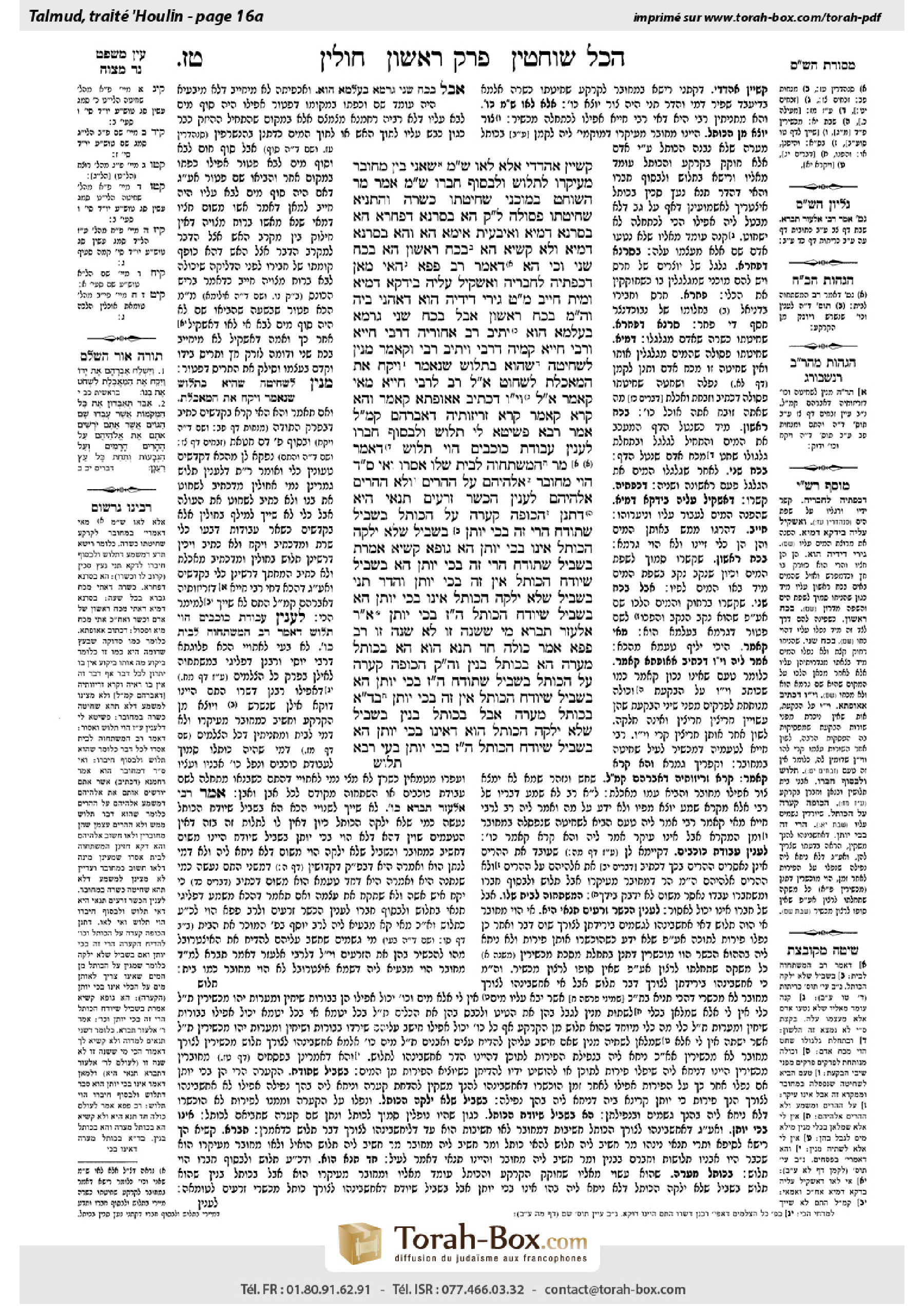
Chullin 16a: Talmud study for Daf Yomi
Study the Talmud for Daf Yomi with scanned pages, Hebrew text, English translations from Sefaria and AI-generated French translations.
Passage selection and English or AI-generated French translation are available where the scan has annotations. Daf Study is independent of Torah-Box and Sefaria.
Browse Chullin · חולין · All tractatesChullin 16a text and translations
This page of Chullin includes the Aramaic text, an English translation and an AI-generated French translation, alongside the scan above.
חולין י״ו א · Aramaic and Hebrew text
קַשְׁיָין אַהֲדָדֵי! אֶלָּא לָאו שְׁמַע מִינַּהּ שָׁאנֵי בֵּין מְחוּבָּר מֵעִיקָּרוֹ לְתָלוּשׁ וּלְבַסּוֹף חִבְּרוֹ, שְׁמַע מִינַּהּ.
אָמַר מָר: הַשּׁוֹחֵט בְּמוּכְנִי שְׁחִיטָתוֹ כְּשֵׁרָה, וְהָתַנְיָא: שְׁחִיטָתוֹ פְּסוּלָה! לָא קַשְׁיָא: הָא בְּסַרְנָא דְּפַחְרָא, הָא בְּסַרְנָא דְּמַיָּא.
וְאִיבָּעֵית אֵימָא: הָא וְהָא בְּסַרְנָא דְּמַיָּא, וְלָא קַשְׁיָא: הָא בְּכֹחַ רִאשׁוֹן, הָא בְּכֹחַ שֵׁנִי.
וְכִי הָא דְּאָמַר רַב פָּפָּא: הַאי מַאן דְּכַפְתֵיהּ לְחַבְרֵיהּ וְאַשְׁקֵיל עֲלֵיהּ בִּידְקָא דְּמַיָּא וּמִית – חַיָּיב. מַאי טַעְמָא? גִּירֵי דִּידֵיהּ הוּא דְּאַהֲנִי בֵּיהּ. וְהָנֵי מִילֵּי – בְּכֹחַ רִאשׁוֹן, אֲבָל בְּכֹחַ שֵׁנִי – גְּרָמָא בְּעָלְמָא הוּא.
יָתֵיב רַב אֲחוֹרֵיהּ דְּרַבִּי חִיָּיא, וְרַבִּי חִיָּיא קַמֵּיהּ דְּרַבִּי, וְיָתֵיב רַבִּי וְקָאָמַר: מִנַּיִן לִשְׁחִיטָה שֶׁהִיא בְּתָלוּשׁ? שֶׁנֶּאֱמַר: ״וַיִּקַּח אֶת הַמַּאֲכֶלֶת לִשְׁחֹט״. אֲמַר לֵיהּ רַב לְרַבִּי חִיָּיא: מַאי קָאָמַר? אֲמַר לֵיהּ: וָי״ו דִּכְתִיב אַאוּפְתָּא קָאָמַר. וְהָא קְרָא קָאָמַר! קְרָא זְרִיזוּתֵיהּ דְּאַבְרָהָם קָא מַשְׁמַע לַן.
אָמַר רָבָא: פְּשִׁיטָא לִי, תָּלוּשׁ וּלְבַסּוֹף חִבְּרוֹ לְעִנְיַן עֲבוֹדָה זָרָה הָוֵי תָּלוּשׁ, דְּאָמַר מָר: הַמִּשְׁתַּחֲוֶה לְבַיִת שֶׁלּוֹ אֲסָרוֹ, וְאִי סָלְקָא דַעְתָּךְ הָוֵי מְחוּבָּר – ״אֱלֹהֵיהֶם עַל הֶהָרִים״ וְלֹא הֶהָרִים אֱלֹהֵיהֶם.
לְעִנְיַן הֶכְשֵׁר זְרָעִים תַּנָּאֵי הִיא, דִּתְנַן: הַכּוֹפֶה קְעָרָה עַל הַכּוֹתֶל בִּשְׁבִיל שֶׁתּוּדַח – הֲרֵי זֶה בְּ״כִי יוּתַּן״, בִּשְׁבִיל שֶׁלֹּא יִלְקֶה הַכּוֹתֶל – אֵינוֹ בְּ״כִי יוּתַּן״.
הָא גּוּפַהּ קַשְׁיָא: אָמְרַתְּ, בִּשְׁבִיל שֶׁתּוּדַח – הֲרֵי זֶה בְּ״כִי יוּתַּן״, הָא בִּשְׁבִיל שֶׁיּוּדַח הַכּוֹתֶל – אֵין זֶה בְּ״כִי יוּתַּן״.
וַהֲדַר תָּנֵי: בִּשְׁבִיל שֶׁלֹּא יִלְקֶה הַכּוֹתֶל – אֵינוֹ בְּ״כִי יוּתַּן״, הָא בִּשְׁבִיל שֶׁיּוּדַח הַכּוֹתֶל – הֲרֵי זֶה בְּ״כִי יוּתַּן״.
אָמַר רַבִּי אֶלְעָזָר: תִּבְרַאּ, מִי שֶׁשָּׁנָה זוֹ לֹא שָׁנָה זוֹ. רַב פָּפָּא אָמַר: כּוּלָּהּ חַד תַּנָּא הוּא, הָא בַּכּוֹתֶל מְעָרָה, הָא בְּכוֹתֶל בִּנְיָן.
וְהָכִי קָאָמַר: הַכּוֹפֶה קְעָרָה עַל הַכּוֹתֶל בִּשְׁבִיל שֶׁתּוּדַח – הֲרֵי זֶה בְּ״כִי יוּתַּן״, הָא בִּשְׁבִיל שֶׁיּוּדַח הַכּוֹתֶל – אֵין זֶה בְּ״כִי יוּתַּן״.
בַּמֶּה דְּבָרִים אֲמוּרִים? בְּכוֹתֶל מְעָרָה, אֲבָל בְּכוֹתֶל בִּנְיָן – בִּשְׁבִיל שֶׁלֹּא יִלְקֶה הַכּוֹתֶל הוּא דְּאֵינוֹ בְּ״כִי יוּתַּן״, הָא בִּשְׁבִיל שֶׁיּוּדַח הַכּוֹתֶל – הֲרֵי זֶה בְּ״כִי יוּתַּן״.
בָּעֵי רָבָא:
Chullin 16a · English translation
Ostensibly, the two clauses of the baraita are difficult, as they contradict each other, since the first clause states that slaughter with a blade that is attached is valid and the latter clause states that slaughter is not valid. Rather, must one not conclude from it that there is a difference between a case where the blade was attached from the outset and a case where the blade was detached and ultimately he reattached it? The Gemara affirms: Indeed, learn from it.
§ The Master said: In the case of one who slaughters with a mechanism of a wheel with a knife attached to it, his slaughter is valid. The Gemara asks: But isn’t it taught in a baraita that his slaughter is not valid? The Gemara answers: This contradiction is not difficult. This baraita, which rules that the slaughter is valid, is in a case where the knife was attached to a potter’s wheel, whose movement is generated by the potter pressing on a pedal. Since the slaughter was performed by the force of the person’s actions, the slaughter is valid. That baraita, which rules that the slaughter is not valid, is in a case where the knife was attached to a waterwheel. Since the slaughter was not performed by the force of the person’s actions, the slaughter is not valid.
And if you wish, say instead: The rulings of both this baraita and that baraita are in a case where the knife was attached to a waterwheel, and the contradiction is not difficult. This baraita, which rules that the slaughter is valid, is in a case where the movement of the slaughter was generated by primary force, as the person releases the water that turns the wheel, and on that initial turn of the wheel the knife slaughters the animal. That baraita, which rules that the slaughter is not valid, is in a case where the slaughter was generated by secondary force, as the knife slaughters the animal on the second turn of the wheel.
And this is like that which Rav Pappa says: In the case of a certain person who bound another and diverted a flow [bidka] of water upon him and he died, the one who diverted the water is liable for his murder. What is the reason? It is because those were his arrows that were effective in his murder. And this matter applies in a case where he killed the other person by primary force, as the person was proximate to him and was directly drowned by the water. But if the person was further away and was killed by secondary force after the water flowed on its own, it is not by his direct action; rather, it is merely an indirect action, and he is exempt.
§ Rav sat behind Rabbi Ḥiyya, and Rabbi Ḥiyya sat before Rabbi Yehuda HaNasi, and Rabbi Yehuda HaNasi sat and said: From where is it derived that slaughter is performed specifically with a blade that is detached? It is derived from a verse, as it is stated: “And Abraham stretched forth his hand and took the knife to slaughter his son” (Genesis 22:10). Rav said to Rabbi Ḥiyya: What is he saying? Rabbi Ḥiyya said to Rav: He is saying an incorrect reason, comparable to the letter vav that is written on the rough surface of a tree trunk [a’ufta]. The Gemara asks: But didn’t Rabbi Yehuda HaNasi say a verse as proof for his statement? The Gemara answers: The verse teaches us the diligence of Abraham, who had a knife prepared to slaughter Isaac. It does not teach any halakha concerning ritual slaughter.
§ Apropos the issue of slaughter with a detached blade, Rava said: It is obvious to me that concerning an item that was detached and ultimately one attached it, with regard to the matter of idol worship its halakhic status is that of a detached item, as the Master says: One who bows to his house has rendered it forbidden as an object of idol worship. And if it enters your mind to say that its halakhic status is that of an attached item, it is written with regard to idolatry: “Their gods, upon the high mountains” (Deuteronomy 12:2), from which it is derived: But the mountains are not their gods, as items attached to the ground are never rendered forbidden as objects of idol worship. The halakhic status of a house built from stones that were detached is that of a detached item.
With regard to the matter of rendering seeds susceptible to ritual impurity, there is a dispute between tanna’im, as we learned in a mishna (Makhshirin 4:3): In the case of one who places a bowl on the wall while it is raining so that the bowl will be rinsed with the rainwater, if the water from the bowl then falls onto produce, that is under the rubric of the verse: “But when water is placed upon the seed” (Leviticus 11:38). The water has the halakhic status of a liquid that he poured of his own volition on fruit and seeds. Consequently, it renders them susceptible to ritual impurity. But if he placed the bowl there so that the wall will not be damaged, it is not under the rubric of the verse “but when water is placed upon the seed.” Since he had no intent to use the water, it is not considered to have entered the bowl of his own volition, and it does not render produce susceptible to impurity.
This mishna itself is difficult, as the inferences from the first clause and the latter clause are contradictory. In the first clause you said: In the case of one who places a bowl on the wall so that the bowl will be rinsed with the rainwater, that is under the rubric of the verse “but when water is placed upon the seed,” and the water renders produce susceptible to impurity. By inference, if he placed the bowl so that the wall will be rinsed by means of the bowl, that is not under the rubric of the verse “but when water is placed upon the seed.” That water would not render produce susceptible to impurity, because the intent was for the water to rinse the wall, which is an item attached to the ground.
And then the mishna teaches in the latter clause: If he placed the bowl so that the wall will not be damaged, it is not under the rubric of the verse: “But when water is placed upon the seed.” By inference, if he placed the bowl so that the wall will be rinsed, that is under the rubric of the verse: “But when water is placed upon the seed,” as a wall has the status of a detached item, since it was built from stones that were detached.
Rabbi Elazar said: This mishna is disjointed; the tanna who taught this first clause did not teach that second clause. There is a tannaitic dispute whether the status of a wall that is built from detached stones is that of an attached item or a detached item. Rav Pappa said: The entire mishna is the opinion of one tanna: This first clause is in the case of the wall of a cave, which is attached from the outset; that latter clause is in the case of the wall of a building, which is built from stones that were detached from the ground.
And this is what the mishna is saying: In the case of one who places a bowl on the wall so that the bowl will be rinsed with the rainwater, that is under the rubric of the verse “but when water is placed upon the seed,” and the water renders produce susceptible to impurity. By inference, if he placed the bowl so that the wall will be rinsed by means of the bowl, that is not under the rubric of the verse “but when water is placed upon the seed.”
In what case is this statement said? It is said in the case of the wall of a cave, which was always attached to the ground. But in the case of the wall of a building, whose stones were detached and subsequently reattached, if he places the bowl so that the wall will not be damaged, that is when it is not under the rubric of the verse “but when water is placed upon the seed.” But if he places the bowl so that the wall will be rinsed, that is under the rubric of the verse “but when water is placed upon the seed.”
Rava raises a dilemma:
Chullin 16a · Traduction française (IA)
Apparemment, les deux clauses de la baraïta sont difficiles, car elles s'opposent l'une à l'autre, puisque la première clause affirme que l'immolation avec un couteau fixé est valide, tandis que la seconde clause affirme que l'immolation n'est pas valide. Cependant, ne devons-nous pas conclure de cela que la différence réside entre un cas où le couteau était fixé dès le départ et un cas où le couteau était détaché et finalement réattache ? La Guemara affirme : En effet, apprenez-en.
§ Le Maître dit : Dans le cas d'une personne qui immole avec un mécanisme de roue sur lequel un couteau est fixé, son immolation est valide. La Guemara pose la question : Mais n'est-il pas enseigné dans une baraïta que son immolation n'est pas valide ? La Guemara répond : Cette contradiction n'est pas difficile. Cette baraïta, qui établit que l'immolation est valide, est dans un cas où le couteau était fixé à une roue de potier, dont le mouvement est généré par la pression du potier sur une pédale. Puisque l'immolation a été effectuée par la force des actions de la personne, l'immolation est valide. Cette baraïta, qui établit que l'immolation n'est pas valide, est dans un cas où le couteau était fixé à une roue d'eau. Puisque l'immolation n'a pas été effectuée par la force des actions de la personne, l'immolation n'est pas valide.
Et si vous le souhaitez, dites plutôt : Les décisions de ces deux baraitas sont dans un cas où le couteau était fixé à une roue d'eau, et la contradiction n'est pas difficile. Cette baraïta, qui établit que l'immolation est valide, est dans un cas où le mouvement de l'immolation a été généré par une force primaire, car la personne libère l'eau qui fait tourner la roue, et sur cette première rotation de la roue, le couteau immole l'animal. Cette baraïta, qui établit que l'immolation n'est pas valide, est dans un cas où l'immolation a été générée par une force secondaire, car le couteau immole l'animal sur la deuxième rotation de la roue.
Et cela ressemble à ce que Rav Pappa dit : Dans le cas d'une personne qui a ligoté une autre personne et a dévié un courant d'eau sur elle, et elle est morte, celui qui a dévié l'eau est responsable de son meurtre. Quelle est la raison ? C'est parce que ces étaient ses flèches qui ont été efficaces dans son meurtre. Et cette affaire s'applique dans un cas où il a tué l'autre personne par une force primaire, car la personne était proche de lui et a été directement noyée par l'eau. Mais si la personne était plus loin et a été tuée par une force secondaire après que l'eau ait coulé d'elle-même, ce n'est pas par son action directe ; plutôt, c'est une action indirecte, et il est exempt.
§ Rav était assis derrière Rabbi Ḥiyya, et Rabbi Ḥiyya était assis devant Rabbi Yehuda HaNasi, et Rabbi Yehuda HaNasi était assis et a dit : D'où est tiré le fait que l'immolation est effectuée spécifiquement avec un couteau détaché ? C'est tiré d'un verset, car il est dit : « Et Abraham tendit sa main et prit le couteau pour immoler son fils » (Genèse 22:10). Rav a dit à Rabbi Ḥiyya : Qu'est-ce qu'il dit ? Rabbi Ḥiyya a dit à Rav : Il dit une raison incorrecte, comparable à la lettre vav écrite sur la surface rugueuse d'un tronc d'arbre [a’ufta]. La Guemara pose la question : Mais n'a-t-il pas dit Rabbi Yehuda HaNasi un verset comme preuve pour son affirmation ? La Guemara répond : Le verset nous apprend la diligence d'Abraham, qui avait un couteau préparé pour immoler Isaac. Il ne nous apprend aucune halakha concernant l'immolation rituelle.
§ A propos de l'immolation avec un couteau détaché, Rava a dit : Cela me semble évident concernant un objet détaché et finalement attaché, en ce qui concerne la question de l'idolâtrie, son statut halakhique est celui d'un objet détaché, car le Maître dit : Celui qui s'incline devant sa maison l'a rendu interdit comme objet d'idolâtrie. Et si vous avez l'idée de dire que son statut halakhique est celui d'un objet attaché, il est écrit concernant l'idolâtrie : « Leurs dieux, sur les montagnes élevées » (Deutéronome 12:2), d'où on déduit : Mais les montagnes ne sont pas leurs dieux, car les objets attachés au sol ne sont jamais rendus interdits comme objets d'idolâtrie. Le statut halakhique d'une maison construite à partir de pierres détachées est celui d'un objet détaché.
Concernant la question de la rendre susceptible de souillure rituelle, il y a un débat entre les tannaïm, comme nous l'avons appris dans une mishna (Makhshirin 4:3) : Dans le cas d'une personne qui place un bol sur le mur pendant qu'il pleut afin que le bol soit rincé par l'eau de pluie, si l'eau du bol tombe ensuite sur les produits, cela relève du verset : « Mais quand de l'eau est versée sur la semence » (Lévitique 11:38). L'eau a le statut halakhique d'un liquide que l'on a versé volontairement sur les fruits et les semences. Par conséquent, elle les rend susceptibles de souillure rituelle. Mais si la personne a placé le bol là afin que le mur ne soit pas endommagé, cela ne relève pas du verset « mais quand de l'eau est versée sur la semence ». Puisque l'intention n'était pas d'utiliser l'eau, cela n'est pas considéré comme un versement volontaire, et cela ne rend pas les produits susceptibles de souillure.
Cette mishna elle-même est difficile, car les déductions des deux clauses sont contradictoires. Dans la première clause, vous dites : Dans le cas d'une personne qui place un bol sur le mur afin que le mur soit rincé par l'eau de pluie, cela relève du verset « mais quand de l'eau est versée sur la semence », et l'eau rend les produits susceptibles de souillure. Par déduction, si la personne a placé le bol afin que l'eau rince le mur, cela ne relève pas du verset « mais quand de l'eau est versée sur la semence ». Cette eau ne rendrait pas les produits susceptibles de souillure, car l'intention était de rincer le mur, qui est un objet attaché au sol.
Et ensuite, la mishna enseigne dans la seconde clause : Si la personne a placé le bol afin que le mur ne soit pas endommagé, cela ne relève pas du verset : « Mais quand de l'eau est versée sur la semence ». Par déduction, si la personne a placé le bol afin que le mur soit rincé, cela relève du verset : « Mais quand de l'eau est versée sur la semence », car un mur a le statut d'un objet détaché, car il a été construit à partir de pierres détachées.
Le Rabbi Eléazar a dit : Cette mitsna est disjointe ; le tanna qui a enseigné cette première clause n'a pas enseigné cette deuxième clause. Il y a un débat tannaitique sur le statut d'une muraille construite à partir de pierres détachées : est-ce celui d'un objet attaché ou d'un objet détaché. Rav Pappa a dit : toute cette mitsna est l'opinion d'un seul tanna : cette première clause est dans le cas d'une muraille de caverne, qui est attachée dès le départ ; cette dernière clause est dans le cas d'une muraille d'un bâtiment, construite à partir de pierres détachées du sol.
Et c'est ce que la mitsna dit : dans le cas d'une personne qui place un bol contre un mur de sorte que le bol soit rincé par l'eau de pluie, cela relève du verset « mais quand on verse de l'eau sur la semence », et l'eau rend les produits sujets à la souillure. Par déduction, si l'on place le bol de sorte que le mur soit rincé par le bol, cela ne relève pas du verset « mais quand on verse de l'eau sur la semence ».
Dans quel cas cette déclaration est-elle dite ? Elle est dite dans le cas d'une muraille de caverne, qui était toujours attachée au sol. Mais dans le cas d'une muraille d'un bâtiment, dont les pierres étaient détachées et ensuite reattachées, si l'on place le bol de sorte que la muraille ne soit pas endommagée, c'est alors qu'il ne relève pas du verset « mais quand on verse de l'eau sur la semence ». Mais si l'on place le bol de sorte que la muraille soit rincée, cela relève du verset « mais quand on verse de l'eau sur la semence ».
Rava pose un dilemme :
Traduction française générée par IA à partir de l’édition anglaise de Sefaria. Vérifie toujours un passage avec le texte source.
Text from Sefaria: William Davidson Edition - Vocalized Aramaic (unknown); William Davidson Edition - English (CC BY NC).