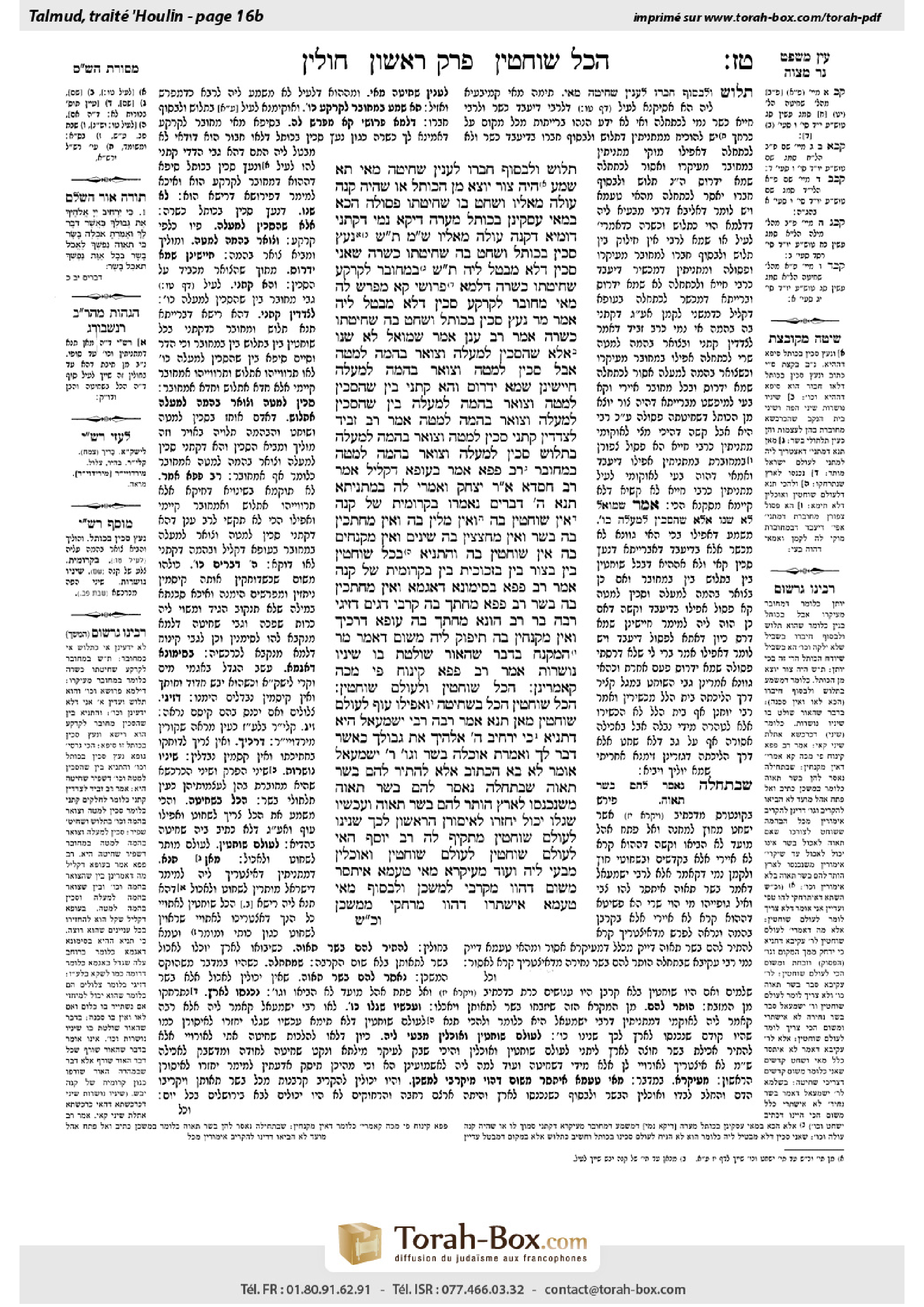
Chullin 16b: Talmud study for Daf Yomi
Study the Talmud for Daf Yomi with scanned pages, Hebrew text, English translations from Sefaria and AI-generated French translations.
Passage selection and English or AI-generated French translation are available where the scan has annotations. Daf Study is independent of Torah-Box and Sefaria.
Browse Chullin · חולין · All tractatesChullin 16b text and translations
This page of Chullin includes the Aramaic text, an English translation and an AI-generated French translation, alongside the scan above.
חולין י״ו ב · Aramaic and Hebrew text
תָּלוּשׁ וּלְבַסּוֹף חִבְּרוֹ לְעִנְיַן שְׁחִיטָה מַאי?
תָּא שְׁמַע: הָיָה צוֹר יוֹצֵא מִן הַכּוֹתֶל, אוֹ שֶׁהָיָה קָנֶה עוֹלֶה מֵאֵלָיו וְשָׁחַט בּוֹ – שְׁחִיטָתוֹ פְּסוּלָה.
הָכָא בְּמַאי עָסְקִינַן? בְּכוֹתֶל מְעָרָה. דַּיְקָא נָמֵי, דְּקָתָנֵי דּוּמְיָא דְּ״קָנֶה עוֹלֶה מֵאֵלָיו״, שְׁמַע מִינַּהּ.
תָּא שְׁמַע: נָעַץ סַכִּין בַּכּוֹתֶל וְשָׁחַט בָּהּ – שְׁחִיטָתוֹ כְּשֵׁרָה. שָׁאנֵי סַכִּין, דְּלָא מְבַטֵּל לֵיהּ.
תָּא שְׁמַע: בִּמְחוּבָּר לַקַּרְקַע שְׁחִיטָתוֹ כְּשֵׁרָה. דִּלְמָא פָּרוֹשֵׁי קָא מְפָרֵשׁ לַהּ – מַאי ״מְחוּבָּר לַקַּרְקַע״? סַכִּין, דְּלָא מְבַטֵּל לֵיהּ.
אָמַר מָר: נָעַץ סַכִּין בַּכּוֹתֶל וְשָׁחַט בָּהּ, שְׁחִיטָתוֹ כְּשֵׁרָה. אָמַר רַב עָנָן אָמַר שְׁמוּאֵל: לֹא שָׁנוּ אֶלָּא שֶׁהַסַּכִּין לְמַעְלָה וְצַוַּאר בְּהֵמָה לְמַטָּה, אֲבָל סַכִּין לְמַטָּה וְצַוַּאר בְּהֵמָה לְמַעְלָה – חָיְישִׁינַן שֶׁמָּא יִדְרוֹס.
וְהָא קָתָנֵי: בֵּין שֶׁהַסַּכִּין לְמַטָּה וְצַוַּאר בְּהֵמָה לְמַעְלָה, בֵּין שֶׁהַסַּכִּין לְמַעְלָה וְצַוַּאר בְּהֵמָה לְמַטָּה!
אָמַר רַב זְבִיד: לִצְדָדִין קָתָנֵי, סַכִּין לְמַטָּה וְצַוַּאר בְּהֵמָה לְמַעְלָה – בְּתָלוּשׁ, סַכִּין לְמַעְלָה וְצַוַּאר בְּהֵמָה לְמַטָּה – בִּמְחוּבָּר. רַב פָּפָּא אָמַר: בְּעוֹפָא דְּקַלִּיל.
אָמַר רַב חִסְדָּא אָמַר רַבִּי יִצְחָק, וְאָמְרִי לַהּ בְּמַתְנִיתָא תָּנָא: חֲמִשָּׁה דְּבָרִים נֶאֶמְרוּ בִּקְרוּמִית שֶׁל קָנֶה: אֵין שׁוֹחֲטִין בָּהּ, וְאֵין מָלִין בָּהּ, וְאֵין מְחַתְּכִין בָּהּ בָּשָׂר, וְאֵין מְחַצְּצִין בָּהּ שִׁינַּיִם, וְאֵין מְקַנְּחִים בָּהּ.
אֵין שׁוֹחֲטִין בָּהּ, וְהָתַנְיָא: בַּכֹּל שׁוֹחֲטִין, בֵּין בְּצוֹר, בֵּין בִּזְכוּכִית, בֵּין בִּקְרוּמִית שֶׁל קָנֶה! אָמַר רַב פָּפָּא: בְּסִימוֹנָא דְּאַגְמָא.
וְאֵין מְחַתְּכִין בָּהּ בָּשָׂר. רַב פָּפָּא מְחַתֵּךְ בַּהּ קִרְבֵי דָגִים, דְּזִיגִי. רַבָּה בַּר רַב הוּנָא מְחַתֵּךְ בַּהּ עוֹפָא דְּרַכִּיךְ.
וְאֵין מְקַנְּחִין בַּהּ, תִּיפּוֹק לֵיהּ מִשּׁוּם דְּאָמַר מָר: הַמְקַנֵּחַ בְּדָבָר שֶׁהָאוּר שׁוֹלֶטֶת בּוֹ שִׁינָּיו נוֹשְׁרוֹת. אָמַר רַב פָּפָּא: קִינּוּחַ פִּי מַכָּה קָאָמְרִינַן.
הַכֹּל שׁוֹחֲטִין, וּלְעוֹלָם שׁוֹחֲטִין. הַכֹּל שׁוֹחֲטִין – הַכֹּל בִּשְׁחִיטָה, וַאֲפִילּוּ עוֹף.
לְעוֹלָם שׁוֹחֲטִין, מַאן תַּנָּא? אָמַר רַבָּה: רַבִּי יִשְׁמָעֵאל הִיא, דְּתַנְיָא: ״כִּי יַרְחִיב ה׳ אֱלֹהֶיךָ אֶת גְּבוּלְךָ כַּאֲשֶׁר דִּבֶּר לָךְ וְאָמַרְתָּ אֹכְלָה בָשָׂר וְגוֹ׳״, רַבִּי יִשְׁמָעֵאל אוֹמֵר: לֹא בָּא הַכָּתוּב אֶלָּא לְהַתִּיר לָהֶם בְּשַׂר תַּאֲוָה.
שֶׁבַּתְּחִלָּה, נֶאֱסַר לָהֶם בְּשַׂר תַּאֲוָה, מִשֶּׁנִּכְנְסוּ לָאָרֶץ הוּתַּר לָהֶם בְּשַׂר תַּאֲוָה.
וְעַכְשָׁיו שֶׁגָּלוּ, יָכוֹל יַחְזְרוּ לְאִיסּוּרָן הָרִאשׁוֹן? לְכָךְ שָׁנִינוּ: לְעוֹלָם שׁוֹחֲטִין.
מַתְקֵיף לַהּ רַב יוֹסֵף: הַאי ״לְעוֹלָם שׁוֹחֲטִין״, ״לְעוֹלָם שׁוֹחֲטִין וְאוֹכְלִין״ מִבְּעֵי לֵיהּ! וְעוֹד, מֵעִיקָּרָא מַאי טַעְמָא אִיתְּסַר – מִשּׁוּם דְּהָווּ מְקָרְבִי לְמִשְׁכָּן, וּלְבַסּוֹף מַאי טַעְמָא אִישְׁתְּרוֹ – דַּהֲווֹ מְרַחֲקִי מִמִּשְׁכָּן,
Chullin 16b · English translation
In the case of a blade that was detached and ultimately one attached it, with regard to slaughter, what is the halakha?
The Gemara suggests: Come and hear proof from a baraita: If there was a flint emerging from a wall or a reed arising from the ground on its own and he slaughtered with it, his slaughter is not valid. Since the wall itself was made from stones that were detached and subsequently reattached, the slaughter is not valid.
The Gemara rejects that proof: What are we dealing with here? We are dealing with the case of the wall of a cave that was always attached. The language of the baraita is also precise in support of that explanation, as the tanna teaches the case of the flint emerging from a wall juxtaposed to, and therefore similar to, the case of a reed arising from the ground on its own, which was also always attached. The Gemara affirms: Indeed, learn from it that this is the case.
The Gemara suggests: Come and hear proof from a baraita: If one embedded a knife in a wall and slaughtered with it, his slaughter is valid. The knife was detached and then reattached, and the slaughter is valid. The Gemara rejects the proof: The reason that the slaughter is valid is that a knife is different, as he does not subsume it to the wall.
The Gemara suggests: Come and hear proof from an earlier point in that baraita: If one slaughtered with an item that is attached to the ground, his slaughter is valid. This is a case where it was detached and then attached, as later in the baraita a case is cited when the blade was always attached and the slaughter is not valid. The Gemara rejects the proof: Perhaps the phrase that follows in the baraita: If one embedded a knife in a wall, is explaining the previous case. And accordingly, what is the meaning of attached to the ground? It is in the case of a knife, as he does not subsume it to the wall. But if he embedded a flint in a wall and slaughtered with it, his slaughter would be valid. Therefore, there is no proof from this baraita.
§ The Master said in the baraita: If one embedded a knife in a wall and slaughtered with it, his slaughter is valid. Rav Anan says that Shmuel says: The tanna taught this halakha only in a case where the knife is above and the animal’s neck is below, and he raises the animal’s head and draws it back and forth on the blade. But in a case where the knife is below and the animal’s neck is above, the slaughter is not valid because we are concerned lest he press the knife, due to the weight of the animal, thereby cutting the simanim without drawing the knife back and forth, which invalidates the slaughter.
The Gemara asks: But isn’t it taught explicitly in the baraita: With any item that cuts, one may slaughter, whether with a blade that is attached to the ground or with a blade that is detached from the ground; whether the knife is below and the neck of the animal is above or the knife is above and the neck of the animal is below?
Rav Zevid said: The baraita is taught disjunctively: In the case where the knife is below and the neck of the animal is above, the slaughter is valid when the blade is detached. In the case where the knife is above and the neck of the animal is below, the slaughter is valid even when the blade is attached. Rav Pappa said: The baraita that teaches that one may slaughter even when the attached knife is below is referring to slaughter of a bird, which is light, and there is no concern that the weight of the bird will cause the slaughterer to press the bird’s neck onto the knife.
§ Rav Ḥisda says that Rabbi Yitzḥak says, and some say it was taught in a baraita: Five matters were said with regard to the stalk of a reed, which is used for cutting due to its sharpness. One may neither slaughter with it, due to the concern that splinters will be separated and become embedded in the simanim, invalidating the slaughter; nor circumcise with it for the same reason, due to the potential danger; nor cut meat with it, lest splinters become embedded in the meat and endanger one who eats it; nor pick one’s teeth with it, lest he wound himself; nor wipe with it after relieving oneself.
The baraita teaches: One may neither slaughter with it. The Gemara asks: But isn’t it taught in another baraita: With any sharp object one may slaughter an animal, whether with a flint, or with glass shards, or with the stalk of a reed? Rav Pappa said: There, the reference is to a specific type of reed that grows in a marsh, which becomes a smooth, hard surface when it dries.
The baraita teaches: Nor cut meat with it. Rav Pappa cuts with the stalk of a reed the innards of fish, which are transparent, such that any splinters would be obvious. Rabba bar Rav Huna cuts with it the meat of a bird, which is soft and will not cause the stalk of the reed to splinter.
The baraita teaches: Nor wipe with it after relieving oneself. The Gemara objects: Derive that one may not wipe with it because the Master said: One who wipes with an object that is flammable, his lower teeth, i.e., the rectum that holds the intestines in place, fall out. Rav Pappa said in explanation: The reference in the baraita is not to wiping after relieving oneself. Rather, we are speaking with regard to wiping the blood or dirt from the opening of a wound.
§ The mishna teaches: All slaughter [hakkol shoḥatin] and one may always slaughter. The Gemara interprets the phrase: All slaughter [hakkol shoḥatin], to mean all animals are included in the mitzva of slaughter, and even a bird.
With regard to the statement: One may always slaughter, who is the tanna who taught this halakha? Rabba said: It is Rabbi Yishmael, as it is taught in a baraita with regard to the verse: “When the Lord your God shall expand your border, as He has promised you, and you shall say: I will eat flesh…you may eat flesh with all the desire of your soul” (Deuteronomy 12:20), Rabbi Yishmael says: The verse comes only to permit consumption of the non-sacrificial meat of desire to the Jewish people.
As, at the outset, the meat of desire was forbidden to them, and anyone who wanted to eat meat would sacrifice the animal as an offering. After the priest sprinkled the blood, it was permitted for one to eat the meat. When they entered into Eretz Yisrael, the meat of desire was permitted for them, and they could slaughter and eat meat wherever they chose.
Rabba added: And now that the Jewish people were exiled, might one have thought that they return to their initial prohibition? Therefore, we learned in the mishna: One may always slaughter non-sacrificial meat.
Rav Yosef objects to this. If so, this phrase: One may always slaughter, is inappropriate; the tanna should have taught: One may always slaughter and eat, as the matter of permission primarily relates to eating the meat, not to slaughtering the animal. And furthermore, initially, what is the reason that the meat of desire was forbidden? It was because in the wilderness, they were proximate to the Tabernacle and could partake of sacrificial meat from the table of God. And ultimately, what is the reason that the meat of desire was permitted? The reason was that in Eretz Yisrael they were distant from the Tabernacle.
Chullin 16b · Traduction française (IA)
Dans le cas d’un couteau détaché qui a finalement été réattache, concernant la boucherie, quelle est la halakha ?
La Guemara suggère : Viens écouter une preuve tirée d’une baraïta : Si un flint sortait d’un mur ou un roseau sortait du sol de lui-même et qu’on sacrifiait avec, son sacrifice n’est pas valide. Puisque le mur lui-même était fait de pierres détachées et ensuite réattachées, le sacrifice n’est pas valide.
La Guemara rejette cette preuve : De quoi sommes-nous en train de parler ? Nous parlons du mur d’une grotte toujours attaché. La formulation de la baraïta est aussi précise pour soutenir cette explication, car le tanna enseigne le cas du flint sortant d’un mur, juxtaposé à, et donc similaire au cas du roseau sortant du sol de lui-même, qui était aussi toujours attaché. La Guemara affirme : En effet, apprends-en que c’est le cas.
La Guemara suggère : Viens écouter une preuve tirée d’une baraïta : Si l’on a enfoncé un couteau dans un mur et qu’on sacrifie avec, son sacrifice est valide. Le couteau était détaché puis réattaché, et le sacrifice est valide. La Guemara rejette cette preuve : La raison pour laquelle le sacrifice est valide est que le couteau est différent, car on ne le considère pas comme faisant partie du mur.
La Guemara suggère : Viens écouter une preuve tirée d’un point antérieur dans cette même baraïta : Si l’on sacrifie avec un objet attaché au sol, son sacrifice est valide. C’est le cas où il était détaché puis réattaché, comme plus tard dans la baraïta un cas est cité où le couteau était toujours attaché et le sacrifice n’était pas valide. La Guemara rejette cette preuve : Peut-être que la phrase suivante dans la baraïta : Si l’on a enfoncé un couteau dans un mur, explique le cas précédent. Et ainsi, quelle est la signification d’attaché au sol ? C’est dans le cas du couteau, car on ne le considère pas comme faisant partie du mur. Mais si l’on a enfoncé un flint dans un mur et qu’on sacrifiait avec, son sacrifice serait valide. Ainsi, il n’y a pas de preuve à tirer de cette baraïta.
§ Le Maître a dit dans la baraïta : Si l’on a enfoncé un couteau dans un mur et qu’on sacrifiait avec, son sacrifice est valide. Rav Anan dit que Shmuel dit : Le tanna a enseigné cette halakha uniquement dans le cas où le couteau est au-dessus et la gorge de l’animal est en dessous, et qu’on soulève la tête de l’animal et qu’on la fait glisser sur le couteau. Mais dans le cas où le couteau est en dessous et la gorge de l’animal est en haut, le sacrifice n’est pas valide, car on craint que l’animal pèse sur le couteau et qu’on coupe les simanim sans faire glisser le couteau, ce qui invalide le sacrifice.
La Guemara demande : Mais n’est-ce pas explicitement enseigné dans la baraïta : Avec n’importe quel objet qui coupe, on peut sacrifier, qu’il s’agisse d’un couteau attaché au sol ou d’un couteau détaché du sol ; qu’il s’agisse du couteau en bas et de la gorge de l’animal en haut ou du couteau en haut et de la gorge de l’animal en bas ?
Rav Zevid a dit : La baraïta est enseignée de manière disjunctive : Dans le cas où le couteau est en bas et la gorge de l’animal est en haut, le sacrifice est valide lorsque le couteau est détaché. Dans le cas où le couteau est en haut et la gorge de l’animal est en bas, le sacrifice est valide même lorsque le couteau est attaché. Rav Pappa a dit : La baraïta qui enseigne que l’on peut sacrifier même lorsque le couteau attaché est en bas fait référence à la boucherie d’un oiseau, qui est léger, et il n’y a pas de crainte que le poids de l’oiseau cause à l’homme de presser la gorge de l’oiseau contre le couteau.
§ Rav Ḥisda a dit que Rabbi Yitzḥak a dit, et certains disent qu’il a été enseigné dans une baraïta : Cinq choses ont été dites concernant le roseau, utilisé pour couper en raison de sa pointe. On ne peut pas sacrifier avec lui, en raison de la crainte que des éclats s’éloignent et s’incrustent dans les simanim, invalidant le sacrifice ; ni faire la circoncision avec lui pour la même raison, en raison du danger potentiel ; ni couper la viande avec lui, de peur que des éclats s’incrustent dans la viande et mettent en danger celui qui la mange ; ni se nettoyer les dents avec lui, de peur qu’il se blesse ; ni frotter avec lui après s’être soulagé.
La baraïta enseigne : On ne peut pas sacrifier avec lui. La Guemara demande : Mais n’est-ce pas enseigné dans une autre baraïta : Avec n’importe quel objet tranchant, on peut sacrifier un animal, qu’il s’agisse d’un flint, ou de fragments de verre, ou du roseau ? Rav Pappa a dit : Là, la référence est à un type spécifique de roseau qui pousse dans un marais, qui devient une surface lisse et dure lorsqu’il sèche.
La baraïta enseigne : Ni couper la viande avec lui. Rav Pappa coupe avec le roseau les entrailles des poissons, qui sont transparentes, de sorte que tout éclat serait évident. Rabba bar Rav Huna coupe avec lui la viande d’un oiseau, qui est douce et ne provoquera pas l’éclatement du roseau.
La baraïta enseigne : Ni frotter avec lui après s’être soulagé. La Guemara s’oppose à cela : Déduis que l’on ne peut pas frotter avec lui parce que le Maître a dit : Celui qui frotte avec un objet inflammable, ses dents inférieures, c’est-à-dire le rectum qui tient les intestines en place, tombent. Rav Pappa a expliqué : La référence dans la baraïta n’est pas à frotter après s’être soulagé. Plutôt, nous parlons de frotter le sang ou la saleté de l’ouverture d’une plaie.
§ La Michna enseigne : Tous les sacrifices [hakkol shoḥatin] et l’on peut toujours sacrifier. La Guemara interprète la phrase : Tous les sacrifices [hakkol shoḥatin], pour signifier que tous les animaux sont inclus dans la mitsva du sacrifice, et même un oiseau.
Concerning the statement: One may always slaughter, which tanna taught this halakha? Rabba said: It is Rabbi Yishmael, as it is taught in a baraïta with regard to the verse: 'When the Lord your God shall expand your border, as He has promised you, and you shall say: I will eat flesh... you may eat flesh with all the desire of your soul' (Deuteronomy 12:20), Rabbi Yishmael says: The verse comes only to permit the consumption of the non-sacrificial meat of desire to the Jewish people.
At the outset, the meat of desire was forbidden to them, and anyone who wanted to eat meat would sacrifice the animal as an offering. After the priest sprinkled the blood, it was permitted for one to eat the meat. When they entered into Eretz Yisrael, the meat of desire was permitted for them, and they could slaughter and eat meat wherever they chose.
Rabba added: And now that the Jewish people were exiled, might one have thought that they return to their initial prohibition? Therefore, we learned in the mishna: One may always slaughter non-sacrificial meat.
Rav Yosef s'oppose à cela. Si c'est ainsi, cette phrase : On peut toujours sacrifier, est inadaptée ; le tanna aurait dû enseigner : On peut toujours sacrifier et manger, car la question de la permission concerne principalement la consommation de la viande, pas le sacrifice de l'animal. Et de plus, initialement, quelle est la raison pour laquelle la viande de désir était interdite ? C'était parce qu'en désert, ils étaient proches du Tabernacle et pouvaient manger de la viande sacrée sur la table du Seigneur. Et finalement, quelle est la raison pour laquelle la viande de désir était permise ? La raison était qu'en Terre d'Israël, ils étaient éloignés du Tabernacle.
Traduction française générée par IA à partir de l’édition anglaise de Sefaria. Vérifie toujours un passage avec le texte source.
Text from Sefaria: William Davidson Edition - Vocalized Aramaic (unknown); William Davidson Edition - English (CC BY NC).