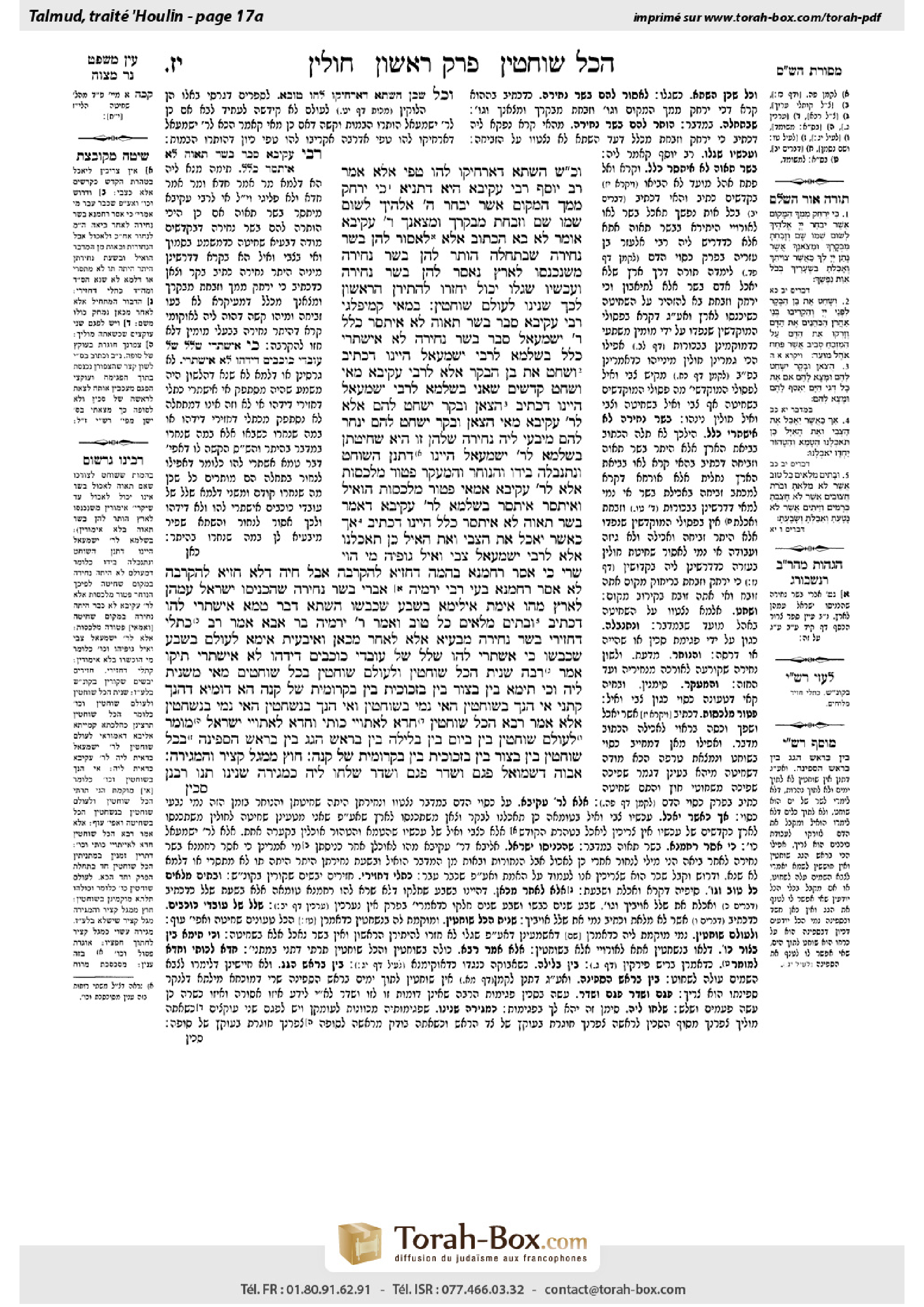
Chullin 17a: Talmud study for Daf Yomi
Study the Talmud for Daf Yomi with scanned pages, Hebrew text, English translations from Sefaria and AI-generated French translations.
Passage selection and English or AI-generated French translation are available where the scan has annotations. Daf Study is independent of Torah-Box and Sefaria.
Browse Chullin · חולין · All tractatesChullin 17a text and translations
This page of Chullin includes the Aramaic text, an English translation and an AI-generated French translation, alongside the scan above.
חולין י״ז א · Aramaic and Hebrew text
וְכׇל שֶׁכֵּן הַשְׁתָּא דְּאַרְחִיקוּ לְהוּ טְפֵי.
אֶלָּא אָמַר רַב יוֹסֵף: רַבִּי עֲקִיבָא הִיא, דְּתַנְיָא: ״כִּי יִרְחַק מִמְּךָ הַמָּקוֹם אֲשֶׁר יִבְחַר ה׳ אֱלֹהֶיךָ לָשׂוּם שְׁמוֹ שָׁם וְזָבַחְתָּ מִבְּקָרְךָ וּמִצֹּאנְךָ״, רַבִּי עֲקִיבָא אוֹמֵר: לֹא בָּא הַכָּתוּב אֶלָּא לֶאֱסוֹר לָהֶן בְּשַׂר נְחִירָה, שֶׁבַּתְּחִלָּה הוּתַּר לָהֶן בְּשַׂר נְחִירָה, מִשֶּׁנִּכְנְסוּ לָאָרֶץ נֶאֱסַר לָהֶן בְּשַׂר נְחִירָה.
וְעַכְשָׁיו שֶׁגָּלוּ, יָכוֹל יַחְזְרוּ לְהֶתֵּירָן הָרִאשׁוֹן? לְכָךְ שָׁנִינוּ: לְעוֹלָם שׁוֹחֲטִין.
בְּמַאי קָמִיפַּלְגִי? רַבִּי עֲקִיבָא סָבַר: בְּשַׂר תַּאֲוָה לָא אִיתְּסַר כְּלָל, רַבִּי יִשְׁמָעֵאל סָבַר: בְּשַׂר נְחִירָה לָא אִישְׁתְּרִי כְּלָל.
בִּשְׁלָמָא לְרַבִּי יִשְׁמָעֵאל, הַיְינוּ דִּכְתִיב ״וְשָׁחַט אֶת בֶּן הַבָּקָר״, אֶלָּא לְרַבִּי עֲקִיבָא מַאי ״וְשָׁחַט״? קָדָשִׁים שָׁאנֵי.
בִּשְׁלָמָא לְרַבִּי יִשְׁמָעֵאל, הַיְינוּ דִּכְתִיב ״הֲצֹאן וּבָקָר יִשָּׁחֵט לָהֶם״, אֶלָּא לְרַבִּי עֲקִיבָא מַאי ״הֲצֹאן וּבָקָר יִשָּׁחֵט לָהֶם״? ״יִנָּחֵר לָהֶם״ מִיבְּעֵי לֵיהּ! נְחִירָה שֶׁלָּהֶן זוֹ הִיא שְׁחִיטָתָן.
בִּשְׁלָמָא לְרַבִּי יִשְׁמָעֵאל – הַיְינוּ דִּתְנַן: הַשּׁוֹחֵט וְנִתְנַבְּלָה בְּיָדוֹ, וְהַנּוֹחֵר וְהַמְעַקֵּר – פָּטוּר מִלְּכַסּוֹת, אֶלָּא לְרַבִּי עֲקִיבָא אַמַּאי פָּטוּר מִלְּכַסּוֹת?
הוֹאִיל וְאִיתְּסַר, אִיתְּסַר.
בִּשְׁלָמָא לְרַבִּי עֲקִיבָא, דְּאָמַר בְּשַׂר תַּאֲוָה לָא אִיתְּסַר כְּלָל – הַיְינוּ דִּכְתִיב: ״אַךְ כַּאֲשֶׁר יֵאָכֵל אֶת הַצְּבִי וְאֶת הָאַיָּל כֵּן תֹּאכְלֶנּוּ״, אֶלָּא לְרַבִּי יִשְׁמָעֵאל, צְבִי וְאַיָּל גּוּפֵיהּ מִי הֲוֵי שְׁרֵי?
כִּי אֲסַר רַחֲמָנָא – בְּהֵמָה דְּחַזְיָא לְהַקְרָבָה, אֲבָל חַיָּה דְּלָא חַזְיָא לְהַקְרָבָה – לָא אֲסַר רַחֲמָנָא.
בָּעֵי רַבִּי יִרְמְיָה: אֵבְרֵי בְּשַׂר נְחִירָה שֶׁהִכְנִיסוּ יִשְׂרָאֵל עִמָּהֶן לָאָרֶץ, מַהוּ?
אֵימַת? אִילֵּימָא בְּשֶׁבַע שֶׁכִּבְּשׁוּ – הַשְׁתָּא דָּבָר טָמֵא אִישְׁתְּרִי לְהוּ, דִּכְתִיב: ״וּבָתִּים מְלֵאִים כׇּל טוּב״, וְאָמַר רַבִּי יִרְמְיָה בַּר אַבָּא אָמַר רַב: כֻּתְלֵי דַּחֲזִירֵי – בְּשַׂר נְחִירָה מִבַּעְיָא?
אֶלָּא, לְאַחַר מִכָּאן. וְאִיבָּעֵית אֵימָא: לְעוֹלָם בְּשֶׁבַע שֶׁכִּבְּשׁוּ, כִּי אִשְׁתְּרִי לְהוּ שָׁלָל שֶׁל גּוֹיִם – דִּידְהוּ לָא אִישְׁתְּרִי. תֵּיקוּ.
אָמַר רַבָּה: שַׁנֵּית ״הַכֹּל שׁוֹחֲטִין״ וּ״לְעוֹלָם שׁוֹחֲטִין״, ״בַּכֹּל שׁוֹחֲטִים״ – מַאי מְשַׁנֵּית לֵיהּ?
וְכִי תֵּימָא, בֵּין בְּצוֹר בֵּין בִּזְכוּכִית בֵּין בִּקְרוּמִית שֶׁל קָנֶה, הָא דּוּמְיָא דְּהָנָךְ קָתָנֵי; אִי הָנָךְ בְּשׁוֹחֲטִין – הַאי נָמֵי בְּשׁוֹחֲטִין, וְאִי הָנָךְ בְּנִשְׁחָטִין – הַאי נָמֵי בְּנִשְׁחָטִין.
אֶלָּא אָמַר רָבָא: ״הַכֹּל שׁוֹחֲטִין״, חֲדָא לְאֵתוֹיֵי כּוּתִי, וַחֲדָא לְאֵתוֹיֵי יִשְׂרָאֵל מְשׁוּמָּד. ״לְעוֹלָם שׁוֹחֲטִין״ – בֵּין בַּיּוֹם בֵּין בַּלַּיְלָה, בֵּין בְּרֹאשׁ הַגָּג בֵּין בְּרֹאשׁ הַסְּפִינָה. ״בַּכֹּל שׁוֹחֲטִין״ – בֵּין בְּצוֹר, בֵּין בִּזְכוּכִית, בֵּין בִּקְרוּמִית שֶׁל קָנֶה.
חוּץ מִמַּגַּל קָצִיר וְהַמְּגֵירָה. אֲבוּהּ דִּשְׁמוּאֵל פְּגַם וְשַׁדַּר, פְּגַם וְשַׁדַּר. שְׁלַחוּ לֵיהּ: כִּמְגֵירָה שָׁנִינוּ.
תָּנוּ רַבָּנַן:
Chullin 17a · English translation
And, if so, all the more so now, in exile, when they are even more distant from the Temple, the meat of desire should be permitted. Consequently, it is unnecessary for the mishna to teach this halakha.
Rather, Rav Yosef said: The tanna who teaches this halakha is Rabbi Akiva, as it is taught in a baraita with regard to the verse: “If the place that the Lord your God shall choose to put His name there be too far from you, then you shall slaughter of your herd and of your flock” (Deuteronomy 12:21), Rabbi Akiva says: The verse comes only to prohibit for them consumption of meat of an animal killed by means of stabbing rather than valid slaughter, as, initially, the meat of stabbing was permitted for them. When they entered into Eretz Yisrael, the meat of stabbing was forbidden to them, and it was permitted to eat the meat of an animal only after valid slaughter.
Rav Yosef added: And now that the Jewish people were exiled, might one have thought that stabbed animals are restored to their initial permitted state? Therefore, we learned in the mishna: One must always slaughter the animal to eat its meat.
The Gemara asks: With regard to what principle do they disagree? The Gemara answers that Rabbi Akiva holds: The meat of desire was not forbidden at all, and Rabbi Yishmael holds: The meat of stabbing was not permitted at all.
The Gemara asks a series of questions: Granted, according to Rabbi Yishmael, who holds that the meat of stabbing was forbidden in the wilderness, that is the meaning of that which is written with regard to the burnt offerings sacrificed in the Tabernacle: “And he shall slaughter the young bull” (Leviticus 1:5). But according to Rabbi Akiva, what is the meaning of: “And he shall slaughter”? Why would he slaughter it if stabbing is permitted? The Gemara answers: Sacrificial animals are different, as slaughter is required in that case. By contrast, there was no obligation to slaughter non-sacrificial animals to eat their meat.
Granted, according to Rabbi Yishmael, who holds that the meat of stabbing was forbidden in the wilderness, that is the meaning of that which is written: “Will flocks and herds be slaughtered for them” (Numbers 11:22), indicating that they slaughtered the animals in the wilderness. But according to Rabbi Akiva, what is the meaning of: “Will flocks and herds be slaughtered for them”? Ostensibly, the words: Be stabbed for them, should have been written. The Gemara answers: In the wilderness, their stabbing is their slaughter.
Granted, according to Rabbi Yishmael, that is the meaning of that which we learned in a mishna (85a) with regard to the mitzva of covering the blood of an undomesticated animal or a bird: One who slaughters an undomesticated animal and the slaughter is not valid and it became an unslaughtered carcass by his hand, and one who stabs an animal, and one who rips the simanim from their place before cutting them, invalidating the slaughter, is exempt from covering the blood. One must cover the blood of only an animal whose slaughter was valid. But according to Rabbi Akiva, why is one exempt from covering the blood of an animal that was stabbed, since in his opinion when they were commanded to cover blood, animals that were stabbed were permitted?
The Gemara answers: Since the meat of stabbing was forbidden, it was forbidden, and the halakhic status of stabbing is no longer that of slaughtering.
Granted, according to Rabbi Akiva, who says that the meat of desire was not forbidden at all, that is the meaning of that which is written before they entered Eretz Yisrael: “However, as the gazelle and as the deer is eaten, so shall you eat of it, the pure and the impure may eat of it alike” (Deuteronomy 12:22). This means that just as it is permitted to eat the meat of a gazelle and a deer in the wilderness in a state of ritual impurity, so may you eat them when you enter Eretz Yisrael, although at that point it will be prohibited to stab them and eat their meat, as their meat will be permitted only through slaughter. But according to Rabbi Yishmael, who holds that the meat of desire was forbidden in the wilderness, were the gazelle and the deer themselves permitted in the wilderness? They are not brought as offerings.
The Gemara answers: When the Merciful One rendered the meat of desire forbidden, that was specifically the meat of a domesticated animal that is fit for sacrifice. But the Merciful One did not render forbidden undomesticated animals that are not fit for sacrifice.
§ Rabbi Yirmeya raises a dilemma according to the opinion of Rabbi Akiva, who says that the meat of stabbing was permitted in the wilderness: With regard to the limbs of the meat of stabbing that the Jewish people took with them into Eretz Yisrael, what is their halakhic status?
The Gemara asks: When? With regard to what period does Rabbi Yirmeya raise his dilemma? If we say that the dilemma is with regard to the seven years during which they conquered the land, now, non-kosher items were permitted for them during that period, as it is written: “And it shall be, when the Lord your God shall bring you into the land that He swore to your fathers, and houses full of all good things…and you shall eat and be satisfied” (Deuteronomy 6:10–11), and Rabbi Yirmeya bar Abba says that Rav says: Cuts of pig meat [kotlei daḥazirei] that they found in the houses were permitted for them; is it necessary to say that the meat from the stabbing of a kosher animal was permitted?
Rather, Rabbi Yirmeya’s dilemma is with regard to the period thereafter. And if you wish, say instead: Actually, his dilemma is with regard to the seven years during which they conquered the land, as perhaps when the forbidden food was permitted for them, it was specifically food from the spoils of gentiles, but their own forbidden food was not permitted. The Gemara concludes: The dilemma shall stand unresolved.
§ Rabba says: You explained the phrases in the mishna: All slaughter, and: One may always slaughter. In what way do you explain the phrase: One may slaughter with any item that cuts?
And if you would say that it means: Whether with a flint, or with glass shards, or with the stalk of a reed, but isn’t this phrase taught in a manner similar to those other phrases in the mishna? If these phrases: All slaughter, and: One may always slaughter, are referring to those that slaughter, this phrase too is referring to those that slaughter; and if those phrases are referring to those that are slaughtered, this phrase too is referring to those that are slaughtered. The first two phrases in the mishna were explained as referring to the animals that are slaughtered. The first phrase was interpreted to include birds, and the second phrase was interpreted as referring to the halakha that meat may be eaten only through slaughter of the animal.
Rather, Rava said that the entire mishna is referring to those that slaughter. The initial phrase means everyone [hakkol] slaughters. Although an identical phrase was used in the first mishna (2a), both are necessary: One is to include a Samaritan and one is to include a Jewish transgressor. The second phrase: One may always slaughter, means both during the day and at night, both on a rooftop and atop a ship, and there is no concern that it will appear that he is slaughtering in an idolatrous manner to the hosts of heaven or to the god of the sea. The phrase: One may slaughter with any item that cuts, means: Whether with a flint, or with glass shards, or with the stalk of a reed.
The mishna states: Except for the serrated side of the harvest sickle, and the saw. Shmuel’s father would notch a knife and send it to Eretz Yisrael to ask if it is fit for slaughter, and would notch a knife in a different manner and send it to Eretz Yisrael in order to determine the type of notch that invalidates slaughter. They sent to him from Eretz Yisrael that the principle is: We learned that the notch that invalidates slaughter is like a saw, whose teeth point upward, as it rips the simanim with every draw of the knife back and forth.
The Sages taught in a baraita:
Chullin 17a · Traduction française (IA)
Et si c'est ainsi, encore davantage maintenant, en exil, lorsqu'ils sont encore plus éloignés du Temple, la viande de désir devrait être permise. Ainsi, il n'était pas nécessaire que la mitsva enseigne cette halakha.
Au contraire, Rav Yosef dit : Le tanna qui enseigne cette halakha est Rabbi Akiva, comme il est enseigné dans une baraïta concernant la parole : « Si la place que le Seigneur votre Dieu choisira pour y placer Son nom est trop éloignée de vous, alors vous tuerez de votre troupeau et de votre bétail » (Deutéronome 12:21), Rabbi Akiva dit : Cette parole vise uniquement à interdire leur consommation de viande d'animaux tués par élanement plutôt que par un sacrifice valide, car, initialement, la viande d'élanement était permise pour eux. Lorsqu'ils sont entrés en Terre d'Israël, la viande d'élanement leur fut interdite, et il leur fut permis de manger la viande d'animaux uniquement après un sacrifice valide.
Rav Yosef ajoute : Et maintenant que le peuple juif est en exil, pourrait-on penser que les animaux élanés retrouvent leur état initial permis ? Ainsi, nous avons appris dans la mitsva : On doit toujours sacrifier l'animal pour manger sa viande.
La Guemara pose la question : Sur quel principe ces deux opinions s'opposent-elles ? La Guemara répond que Rabbi Akiva considère que la viande de désir n'était pas interdite du tout, et Rabbi Yishmael considère que la viande d'élanement n'était pas permise du tout.
La Guemara pose une série de questions : Admettons que selon Rabbi Yishmael, qui considère que la viande d'élanement était interdite dans le désert, c'est la signification de ce qui est écrit concernant les offrandes brûlées sacrifiées dans le Tabernacle : « Et il tuera le jeune taureau » (Lévitique 1:5). Mais selon Rabbi Akiva, quelle est la signification de : « Et il tuera » ? Pourquoi l'aurait-il tué s'il était permis d'élaner ? La Guemara répond : Les animaux sacrés sont différents, car un sacrifice est requis dans ce cas. En revanche, il n'y avait pas d'obligation de sacrifier des animaux non sacrés pour manger leur viande.
Admettons que selon Rabbi Yishmael, qui considère que la viande d'élanement était interdite dans le désert, c'est la signification de ce qui est écrit : « Seront-ils sacrifiés pour eux les troupeaux et les bêtes » (Nombres 11:22), indiquant qu'ils sacrifiaient les animaux dans le désert. Mais selon Rabbi Akiva, quelle est la signification de : « Seront-ils sacrifiés pour eux » ? Apparemment, les mots : « Élanés pour eux » auraient dû être écrits. La Guemara répond : Dans le désert, leur élanement était leur sacrifice.
Admettons que selon Rabbi Yishmael, c'est la signification de ce qui est appris dans une mitsna (85a) concernant la mitsva de recouvrir le sang d'un animal sauvage ou d'un oiseau : Celui qui sacrifie un animal sauvage et le sacrifice n'est pas valide et il est devenu un cadavre non sacrifié par sa main, et celui qui élançait un animal, et celui qui arrache les simanim de leur place avant de les couper, invalidant le sacrifice, est exempt de recouvrir le sang. On doit recouvrir le sang uniquement d'un animal dont le sacrifice était valide. Mais selon Rabbi Akiva, pourquoi est-on exempt de recouvrir le sang d'un animal élançé, puisque selon lui, lorsqu'ils furent commandés à recouvrir le sang, les animaux élançés étaient permis ?
La Guemara répond : Puisque la viande d'élançage était interdite, elle l'était, et le statut halakhique de l'élançage n'est plus celui de sacrifier.
Admettons que selon Rabbi Akiva, qui dit que la viande de désir n'était pas interdite du tout, c'est la signification de ce qui est écrit avant qu'ils n'entrent en Terre d'Israël : « Cependant, comme le gazelle et le chevreau est mangé, ainsi devra-t-on manger de lui, le pur et l'impur peuvent manger de lui de même » (Deutéronome 12:22). Cela signifie que tout comme il est permis de manger la viande d'un gazelle et d'un chevreau dans le désert dans un état d'impureté rituelle, ainsi peut-on les manger lorsqu'on entre en Terre d'Israël, bien que, à ce moment-là, il soit interdit de les élançer et de manger leur viande, car leur viande sera permise uniquement par le sacrifice. Mais selon Rabbi Yishmael, qui considère que la viande de désir était interdite dans le désert, les gazelles et les chevreaux eux-mêmes étaient-ils permis dans le désert ? Ils ne sont pas apportés comme offrandes.
La Guemara répond : Lorsque le Mercieux a rendu la viande de désir interdite, cela concernait spécifiquement la viande d'un animal domestique adapté à l'offrande sacrificielle. Le Mercieux n'a pas rendu interdite la viande d'animaux sauvages non adaptés à l'offrande sacrificielle.
§ Rabbi Yirmeya soulève un dilemme selon l'opinion de Rabbi Akiva, qui dit que la viande d'élanement était permise dans le désert : Concernant les membres de la viande d'élanement que le peuple juif emporta avec lui en Terre d'Israël, quel est leur statut halakhique ?
La Guemara pose la question : Quand ? Concernant quelle période Rabbi Yirmeya soulève-t-il son dilemme ? Si nous disons que le dilemme concerne les sept ans durant lesquels ils conquérrent la terre, maintenant, les aliments non-kosher étaient permis pour eux durant cette période, car il est écrit : « Et il sera, quand le Seigneur votre Dieu vous conduira dans la terre qu'Il a juré à vos pères, et des maisons remplies de toutes choses bonnes… et vous mangerez et vous serez rassasiés » (Deutéronome 6:10–11), et Rabbi Yirmeya bar Abba dit que Rav dit : Les morceaux de viande de porc [kotlei daḥazirei] qu'ils trouvèrent dans les maisons étaient permis pour eux ; est-il nécessaire de dire que la viande d'élanement d'un animal kasher était permise ?
Au contraire, le dilemme de Rabbi Yirmeya concerne la période suivante. Et si vous le souhaitez, dites plutôt : En réalité, son dilemme concerne les sept ans durant lesquels ils ont conquis la terre, car peut-être que lorsque les aliments interdits étaient permis pour eux, c'était spécifiquement les aliments des butins des gentils, mais leurs propres aliments interdits n'étaient pas permis. La Guemara conclut : Le dilemme restera sans solution.
§ Rabba dit : Vous avez expliqué les phrases de la michna : Toute immolation, et : On peut toujours immoler. De quelle manière expliquez-vous la phrase : On peut immoler avec tout objet qui coupe ?
Et si vous disiez que cela signifie : Qu'importe qu'on utilise un caillou, ou des éclats de verre, ou le tige d'un roseau, n'est-ce pas que cette phrase est enseignée de manière similaire aux autres phrases de la michna ? Si ces phrases : Toute immolation, et : On peut toujours immoler, se réfèrent à ceux qui immolent, cette phrase aussi se réfère à ceux qui immolent ; et si ces phrases se réfèrent à ceux qui sont immolés, cette phrase aussi se réfère à ceux qui sont immolés. Les deux premières phrases de la michna ont été interprétées comme se référant aux animaux qui sont immolés. La première phrase a été interprétée pour inclure les oiseaux, et la seconde phrase a été interprétée comme se référant à la halakha selon laquelle la viande peut être mangée uniquement par l'immolation de l'animal.
Plutôt, Rava dit que toute la michna se réfère à ceux qui immolent. La première phrase signifie que tout le monde [hakkol] immole. Bien qu'une phrase identique ait été utilisée dans la première michna (2a), les deux sont nécessaires : l'une inclut un Samaritain et l'autre inclut un Juif transgressant. La seconde phrase : On peut toujours immoler, signifie à la fois pendant la journée et la nuit, à la fois sur un toit et sur un bateau, et il n'y a pas de crainte qu'il puisse apparaître qu'il immole de manière idolâtre aux hôtes du ciel ou au dieu de la mer. La phrase : On peut immoler avec tout objet qui coupe, signifie : Qu'importe qu'on utilise un caillou, ou des éclats de verre, ou le tige d'un roseau.
La michna stipule : À l'exception du côté denté de la faucille de récolte et de la scie. Le père de Shmuel faisait un entaille dans un couteau et l'envoyait en Eretz Yisrael pour demander s'il est propre à l'immolation, et faisait un entaille dans un couteau de manière différente et l'envoyait en Eretz Yisrael afin de déterminer le type d'entaille qui rend l'immolation invalide. Ils envoyèrent à lui d'Eretz Yisrael que le principe est : Nous avons appris que l'entaille qui rend l'immolation invalide est comme une scie, dont les dents pointent vers le haut, car elle arrache les simanim avec chaque mouvement du couteau vers l'avant et vers l'arrière.
Les Sages enseignèrent dans une baraïta :
Traduction française générée par IA à partir de l’édition anglaise de Sefaria. Vérifie toujours un passage avec le texte source.
Text from Sefaria: William Davidson Edition - Vocalized Aramaic (unknown); William Davidson Edition - English (CC BY NC).