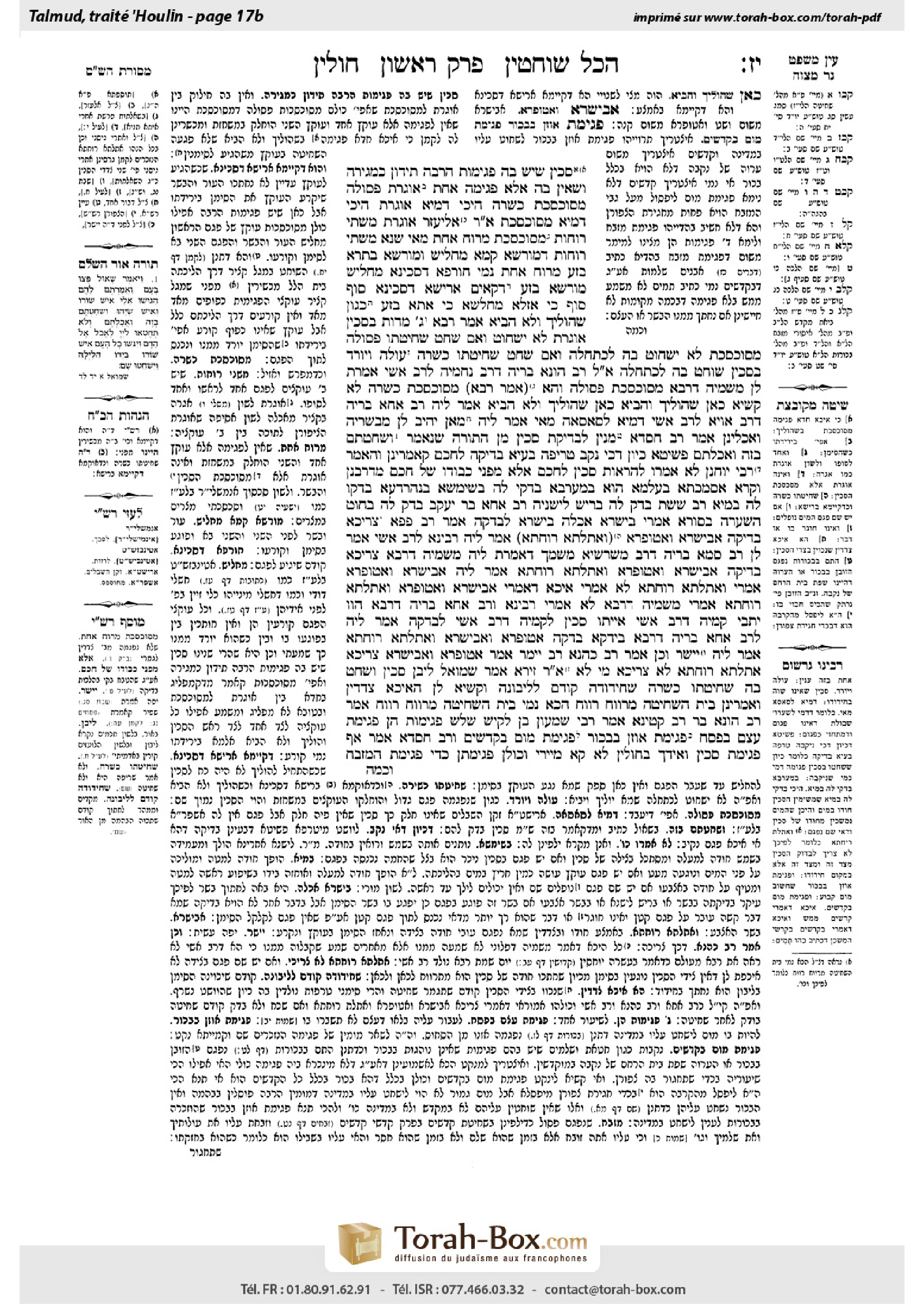
Chullin 17b: Talmud study for Daf Yomi
Study the Talmud for Daf Yomi with scanned pages, Hebrew text, English translations from Sefaria and AI-generated French translations.
Passage selection and English or AI-generated French translation are available where the scan has annotations. Daf Study is independent of Torah-Box and Sefaria.
Browse Chullin · חולין · All tractatesChullin 17b text and translations
This page of Chullin includes the Aramaic text, an English translation and an AI-generated French translation, alongside the scan above.
חולין י״ז ב · Aramaic and Hebrew text
סַכִּין שֶׁיֵּשׁ בָּהּ פְּגִימוֹת הַרְבֵּה – תִּידּוֹן כִּמְגֵירָה, וְשֶׁאֵין בָּהּ אֶלָּא פְּגִימָה אַחַת: אוֹגֶרֶת – פְּסוּלָה, מְסוּכְסֶכֶת – כְּשֵׁרָה. הֵיכִי דָּמְיָא אוֹגֶרֶת? הֵיכִי דָּמְיָא מְסוּכְסֶכֶת? אָמַר רַבִּי אֱלִיעֶזֶר: אוֹגֶרֶת – מִשְׁתֵּי רוּחוֹת, מְסוּכְסֶכֶת – מֵרוּחַ אַחַת.
מַאי שְׁנָא מִשְׁתֵּי רוּחוֹת, דְּמוּרְשָׁא קַמָּא מַחְלֵישׁ וּמוּרְשָׁא בָּתְרָא בָּזַע? מֵרוּחַ אַחַת נָמֵי, חוּרְפָּא דְּסַכִּינָא מַחְלֵישׁ, מוּרְשָׁא בָּזַע! דְּקָאֵים אַרֵישָׁא דְּסַכִּינָא. סוֹף סוֹף, כִּי אָזְלָא מַחְלְשָׁא, כִּי (אתא בזע) [אָתְיָא בָּזְעָה]! כְּגוֹן שֶׁהוֹלִיךְ וְלֹא הֵבִיא.
אָמַר רָבָא: שָׁלֹשׁ מִדּוֹת בְּסַכִּין – אוֹגֶרֶת – לֹא יִשְׁחוֹט, וְאִם שָׁחַט – שְׁחִיטָתוֹ פְּסוּלָה. מְסוּכְסֶכֶת – לֹא יִשְׁחוֹט בָּהּ לְכִתְחִלָּה, וְאִם שָׁחַט – שְׁחִיטָתוֹ כְּשֵׁרָה. עוֹלֶה וְיוֹרֵד בְּסַכִּין – שׁוֹחֵט בָּהּ לְכַתְּחִלָּה.
אֲמַר לֵיהּ רַב הוּנָא בְּרֵיהּ דְּרַב נְחֶמְיָה לְרַב אָשֵׁי: אֲמַרְתְּ לַן מִשְּׁמֵיהּ דְּרָבָא: מְסוּכְסֶכֶת פְּסוּלָה, וְהָא אָמַר רָבָא: מְסוּכְסֶכֶת כְּשֵׁרָה! לָא קַשְׁיָא: כָּאן שֶׁהוֹלִיךְ וְהֵבִיא, כָּאן שֶׁהוֹלִיךְ וְלֹא הֵבִיא.
אֲמַר לֵיהּ רַב אַחָא בְּרֵיהּ דְּרַב אַוְיָא לְרַב אָשֵׁי: דָּמְיָא לְסָאסָא, מַאי? אֲמַר לֵיהּ: מַאן יָהֵיב לַן מִבִּשְׂרֵיהּ וְאָכְלִינַן.
אָמַר רַב חִסְדָּא: מִנַּיִן לִבְדִיקַת סַכִּין מִן הַתּוֹרָה? שֶׁנֶּאֱמַר: ״וּשְׁחַטְתֶּם בָּזֶה וַאֲכַלְתֶּם״.
פְּשִׁיטָא, כֵּיוָן דְּכִי נְקַב טְרֵיפָה, בָּעֲיָא בְּדִיקָה לְחָכָם קָאָמְרִינַן! וְהָאָמַר רַבִּי יוֹחָנָן: לֹא אָמְרוּ לְהַרְאוֹת סַכִּין לְחָכָם אֶלָּא מִפְּנֵי כְּבוֹדוֹ שֶׁל חָכָם! מִדְּרַבָּנַן, וּקְרָא אַסְמַכְתָּא בְּעָלְמָא הוּא.
בְּמַעְרְבָא בָּדְקִי לַהּ בְּשִׁימְשָׁא, בִּנְהַרְדְּעָא בָּדְקוּ לַהּ בְּמַיָּא, רַב שֵׁשֶׁת בָּדֵק לַהּ בְּרֵישׁ לִישָּׁנֵיהּ, רַב אַחָא בַּר יַעֲקֹב בָּדֵק לַהּ בְּחוּט הַשַּׂעֲרָה.
בְּסוּרָא אָמְרִי: בִּישְׂרָא אָכְלָה, בִּישְׂרָא לִבְדְּקַהּ. אָמַר רַב פָּפָּא: צְרִיכָא בְּדִיקָה אַבִּישְׂרָא, וְאַטּוּפְרָא, וְאַתְּלָתָא רוּחָתָא.
אֲמַר לֵיהּ רָבִינָא לְרַב אָשֵׁי: אָמַר לַן רַב סַמָּא בְּרֵיהּ דְּרַב מְשַׁרְשְׁיָא מִשְּׁמָךְ, דַּאֲמַרְתְּ לֵיהּ מִשְּׁמֵיהּ דְּרָבָא: צְרִיכָא בְּדִיקָה אַבִּישְׂרָא וְאַטּוּפְרָא וְאַתְּלָתָא רוּחָתָא. אֲמַר לֵיהּ: אַבִּישְׂרָא וְאַטּוּפְרָא אֲמַרִי, וְאַתְּלָתָא רוּחָתָא לָא אֲמַרִי. אִיכָּא דְּאָמְרִי: אַבִּישְׂרָא וְאַטּוּפְרָא וְאַתְּלָתָא רוּחָתָא אֲמַרִי, מִשְּׁמֵיהּ דְּרָבָא לָא אֲמַרִי.
רָבִינָא וְרַב אַחָא בְּרֵיהּ דְּרָבָא הֲווֹ יָתְבִי קַמֵּיהּ דְּרַב אָשֵׁי, אַיְיתוֹ סַכִּין לְקַמֵּיהּ דְּרַב אָשֵׁי לִבְדְּקַהּ. אֲמַר לֵיהּ לְרַב אַחָא בְּרֵיהּ דְּרָבָא: בִּידְקַהּ. בַּדְקַהּ אַטּוּפְרָא וְאַבִּישְׂרָא וְאַתְּלָתָא רוּחָתָא. אֲמַר לֵיהּ: יִישַׁר, וְכֵן אָמַר רַב כָּהֲנָא.
רַב יֵימַר אֲמַר: אַטֻּופְרָא וְאַבִּישְׂרָא צְרִיכָא, אַתְּלָתָא רוּחָתָא לָא צְרִיכָא. מִי לָא אָמַר רַבִּי זֵירָא אָמַר שְׁמוּאֵל: לִיבֵּן סַכִּין וְשָׁחַט בָּהּ – שְׁחִיטָתוֹ כְּשֵׁרָה, שֶׁחִידּוּדָהּ קוֹדֶם לְלִיבּוּנָהּ; וְקַשְׁיָא לַן: הָאִיכָּא צְדָדִין! וְאָמְרִינַן: בֵּית הַשְּׁחִיטָה מִרְוָוח רָוַוח. הָכָא נָמֵי, בֵּית הַשְּׁחִיטָה מִרְוָוח רָוַוח.
אָמַר רַב הוּנָא בַּר רַב קַטִּינָא אָמַר רַבִּי שִׁמְעוֹן בֶּן לָקִישׁ, שָׁלֹשׁ פְּגִימוֹת הֵן: פְּגִימַת עֶצֶם בַּפֶּסַח, פְּגִימַת אוֹזֶן בִּבְכוֹר, פְּגִימַת מוּם בְּקָדָשִׁים.
וְרַב חִסְדָּא אָמַר: אַף פְּגִימַת סַכִּין. וְאִידַּךְ בְּחוּלִּין לָא קָא מַיְירֵי.
וְכוּלָּן, פְּגִימָתָן כְּדֵי פְּגִימַת הַמִּזְבֵּחַ.
Chullin 17b · English translation
The status of a knife in which there are several notches is considered like that of a saw; and with regard to a knife in which there is only one notch, if it catches, the slaughter is unfit, but if it entangles [mesukhsekhet], the slaughter is fit. What are the circumstances of a notch that catches, and what are the circumstances of a notch that entangles? Rabbi Eliezer said: A notch that catches is one that has a sharp edge on two sides, while a notch that entangles is one that has a sharp edge on one side.
The Gemara challenges this explanation: What is different about a notch with a sharp edge on two sides, where the first edge [moresha] compromises the neck by removing the hide and the flesh, and the latter edge rips the simanim; in the case of a notch with a sharp edge on one side too, the sharp tip of the knife compromises the neck and the edge of the notch rips the simanim. The Gemara explains: The reference is to a notch that stands at the top of the knife, which begins the slaughter. The Gemara objects: Ultimately, when the knife goes in one direction it compromises the neck and when it comes back in the other direction it rips the simanim. The Gemara explains: The reference is to a case where he drew the knife backward and did not draw it forward.
Rava says: There are three types of notches in a knife. If the notch catches, one may not slaughter with it, and if he slaughtered, his slaughter is not valid. If the notch entangles, one may not slaughter with it ab initio; and if he slaughtered with it, his slaughter is valid after the fact. If the notch rises and falls in the knife and has no sharp edges, one may slaughter with it ab initio.
Rav Huna, son of Rav Neḥemya, said to Rav Ashi: You said to us in the name of Rava that if the notch entangles, the slaughter is not valid. But doesn’t Rava say: If the notch entangles, the slaughter is valid? Rav Ashi answers: This is not difficult. Here, where Rava says that the slaughter is not valid, is in a case where he drew the knife back and forth. There, where Rava says that the slaughter is valid, is in a case where he drew the knife backward and did not draw it forward.
Rav Aḥa, son of Rav Avya, said to Rav Ashi: If the knife was similar to an awn of grain [sasa], which is not perfectly smooth but does not have actual notches, what is the halakha? Rav Ashi said to him: Who will give us from the meat of an animal slaughtered with that knife, and we will eat it.
§ Rav Ḥisda says: From where is it derived that examination of a knife is an obligation by Torah law? It is derived from a verse, as it is stated with regard to Saul’s instructions to the people: “And slaughter with this and eat” (I Samuel 14:34), indicating that Saul gave them the knife only after ensuring that it was fit to slaughter their animals.
The Gemara asks: Isn’t it obvious that a knife must be examined before slaughter? Since were one to create a perforation in the gullet, the animal would be a tereifa, therefore the knife requires examination to prevent that situation. The Gemara answers: We are saying that a source for the halakha that one must show the knife to a Torah scholar for examination is needed. The Gemara asks: Is that an obligation by Torah law? But doesn’t Rabbi Yoḥanan say that the Sages said to show the knife to a Torah scholar only due to the requirement to show deference to the Torah scholar? The Gemara answers: Indeed, it is a requirement by rabbinic law, and the verse is cited as a mere support for that practice, not as a source.
The Gemara notes: In the West, Eretz Yisrael, they examine the knife in the sun to determine whether there is a notch. In Neharde’a they examine the knife with water. They would place the blade on the surface of the water, and if there was a notch, it would noticeably alter the surface of the water. Rav Sheshet would examine it with the tip of his tongue. Rav Aḥa bar Ya’akov would examine it with a strand of hair. He would pass the strand over the blade of the knife and if there was a notch, it would be caught in that notch.
In Sura they say: The knife consumes the flesh; let the flesh examine the knife. Since the concern is that the knife will rip the flesh during the slaughter, it should be examined by passing it on the tongue or the fingertip. Rav Pappa said: The knife requires examination on the flesh, and on the fingernail, and on the three sides of the knife, i.e., the blade and the two sides of the knife.
Ravina said to Rav Ashi: Rav Sama, son of Rav Mesharshiyya, said to us in your name that which you said to him in the name of Rava: The knife requires examination on the flesh, and on the fingernail, and on the three sides. Rav Ashi said to Ravina: On the flesh and on the fingernail I said, and on the three sides I did not say. There are those who say that Rav Ashi said to him: On the flesh and on the fingernail and on the three sides I said, and in the name of Rava I did not say.
Ravina and Rav Aḥa, son of Rava, were sitting before Rav Ashi. People brought a knife before Rav Ashi to examine it. Rav Ashi said to Rav Aḥa, son of Rava: Examine it. He examined it on the fingernail, and on the flesh, and on the three sides. Rav Ashi said to him: Well done, and Rav Kahana likewise said that this is the way to examine a knife.
Rav Yeimar said: Examination on the fingernail and on the flesh is necessary, and examination on the three sides is not necessary. Doesn’t Rabbi Zeira say that Shmuel says: If one heated a knife until it became white hot and slaughtered an animal with it, his slaughter is valid, as its sharp blade preceded the effect of its white heat; and it is difficult for us: But aren’t there the sides of the knife, which burn the throat and render the animal a tereifa? And we say: The area of the slaughter in the throat separates quickly after the incision, and the tissue on either side of the incision is not seared by the white hot blade. Here too, the area of slaughter separates quickly, and notches on the side of the knife do not come in contact with the simanim.
§ Rav Huna bar Rav Ketina says that Rabbi Shimon ben Lakish says that there are three deficiencies with the same measure, as follows: The deficiency of a bone in the Paschal offering, with regard to which it is written: “Neither shall you break a bone therein” (Exodus 12:46); the deficiency of an ear in a firstborn animal that renders it blemished and unfit for sacrifice, in which case a priest may slaughter it anywhere and eat it; and the deficiency that constitutes a blemish in other forms of sacrificial animals.
And Rav Ḥisda says: There is the deficiency of a knife as well. The Gemara asks: And the other amora, Rabbi Shimon ben Lakish, why does he not include the knife? The Gemara answers: He does not include it because he is not speaking with regard to non-sacred animals.
Rav Ḥisda continues: And with regard to all of these deficiencies, the measure of their deficiency is equivalent to the measure of deficiency that renders the altar unfit.
Chullin 17b · Traduction française (IA)
Le statut d'un couteau qui présente plusieurs entailles est considéré comme celui d'une scie ; quant à un couteau qui présente une seule entaille, si elle se cogne, la bête est impieuse, mais si elle s'entrelace, la bête est propre. Quelles sont les circonstances d'une entaille qui se cogne, et quels sont ceux d'une entaille qui s'entrelace ? Rabbi Eliezer dit : Une entaille qui se cogne est celle qui a un bord aigu sur les deux côtés, tandis qu'une entaille qui s'entrelace est celle qui a un bord aigu sur un seul côté.
La Guemara conteste cette explication : Qu'est-ce qui diffère dans une entaille qui a un bord aigu sur les deux côtés, où le premier bord [moresha] compromet le cou en enlevant la peau et la chair, et le second bord déchire les simanim ; dans le cas d'une entaille qui a un bord aigu sur un seul côté, le point aigu du couteau compromet le cou et le bord de l'entaille déchire les simanim. La Guemara explique : Il s'agit d'une entaille qui se trouve en haut du couteau, qui commence la boucherie. La Guemara s'oppose : Finalement, lorsque le couteau entre dans une direction, il compromet le cou, et lorsqu'il revient dans l'autre direction, il déchire les simanim. La Guemara explique : Il s'agit d'un cas où l'on a tiré le couteau en arrière sans le tirer en avant.
Rava dit : Il existe trois types d'entailles dans un couteau. Si l'entaille se cogne, on ne peut pas boucher avec ce couteau, et si l'on a bouché avec, la boucherie n'est pas valide. Si l'entaille s'entrelace, on ne peut pas boucher avec ce couteau dès le début ; et si l'on a bouché avec, la boucherie est valide après coup. Si l'entaille monte et descend dans le couteau et n'a pas de bords aigus, on peut boucher avec ce couteau dès le début.
Rav Huna, fils de Rav Néchemyah, dit à Rav Ashi : Vous avez dit en notre nom à Rava que si l'entaille s'entrelace, la boucherie n'est pas valide. Mais ne dit-on pas que Rava dit : Si l'entaille s'entrelace, la boucherie est valide ? Rav Ashi répond : Ce n'est pas difficile. Ici, où Rava dit que la boucherie n'est pas valide, c'est dans le cas où l'on a tiré le couteau en arrière et en avant. Là, où Rava dit que la boucherie est valide, c'est dans le cas où l'on a tiré le couteau en arrière sans le tirer en avant.
Rav Acha, fils de Rav Avya, dit à Rav Ashi : Si le couteau était semblable à un épis de blé [sasa], qui n'est pas parfaitement lisse mais n'a pas d'entailles réelles, quelle est la halakha ? Rav Ashi dit à lui : Qui nous donnera de la viande d'un animal bouché avec ce couteau, et nous mangerons.
§ Rav Hisda dit : D'où est tiré l'obligation de vérifier un couteau selon la Torah ? Il est tiré d'une versette, comme il est dit concernant les instructions de Saül aux gens : « Et bouscoute avec cela et mangez » (I Samuel 14:34), indiquant que Saül leur a donné le couteau seulement après avoir veillé à ce qu'il soit propre à boucher leurs bêtes.
La Guemara demande : N'est-ce pas évident que le couteau doit être examiné avant la boucherie ? Car si l'on créait une perforation dans le cou, l'animal serait téréif, donc le couteau nécessite une vérification pour éviter cette situation. La Guemara répond : Nous disons qu'il existe une source pour la halakha selon laquelle l'on doit montrer le couteau à un savant de la Torah afin qu'il l'examine. La Guemara demande : Est-ce une obligation selon la Torah ? Mais ne dit-on pas que Rabbi Yochanan a affirmé que les Sages ont ordonné de montrer le couteau à un savant de la Torah uniquement en raison de la nécessité de montrer le respect à la Torah ? La Guemara répond : En effet, c'est une obligation selon la loi rabbinique, et la versette est citée comme simple support de cette pratique, et non comme source.
La Guemara note : Dans l'Ouest, en Eretz Yisrael, on examine le couteau en plein soleil afin de déterminer s'il y a une entaille. À Neharde’a, on examine le couteau avec de l'eau. On posait la lame sur la surface de l'eau, et si une entaille existait, elle altérait notablement la surface de l'eau. Rav Sheshet examinait le couteau avec la pointe de sa langue. Rav Acha bar Ya'akov examinait le couteau avec un fil de laine. Il passait le fil sur la lame du couteau, et si une entaille existait, elle était capturée dans cette entaille.
À Sura, ils disent : Le couteau consomme la chair ; faites examiner le couteau par la chair. Puisque la préoccupation est que le couteau déchire la chair lors de la boucherie, il doit être examiné en passant sur la langue ou le doigt. Rav Pappa dit : Le couteau nécessite une vérification sur la chair, sur l'ongle et sur les trois côtés du couteau, c'est-à-dire la lame et les deux côtés du couteau.
Ravina dit à Rav Ashi : Rav Sama, fils de Rav Mesharshiyya, a dit à nous en votre nom ce que vous avez dit à lui en nom de Rava : Le couteau nécessite une vérification sur la chair, sur l'ongle et sur les trois côtés. Rav Ashi dit à Ravina : Sur la chair et sur l'ongle j'ai dit, et sur les trois côtés je n'ai pas dit. Certains disent que Rav Ashi a dit à lui : Sur la chair et sur l'ongle et sur les trois côtés j'ai dit, et en nom de Rava je n'ai pas dit.
Ravina et Rav Acha, fils de Rav Rava, étaient assis devant Rav Ashi. Des gens apportèrent un couteau devant Rav Ashi pour l'examiner. Rav Ashi dit à Rav Acha, fils de Rava : Examine-le. Il l'a examiné sur l'ongle, sur la chair et sur les trois côtés. Rav Ashi dit à lui : Bien fait, et Rav Kahana a dit également que c'est ainsi qu'on examine un couteau.
Rav Yeimar dit : L'examen sur l'ongle et sur la chair est nécessaire, et l'examen sur les trois côtés n'est pas nécessaire. Ne dit-on pas que Rabbi Zeira dit que Shmuel dit : Si l'on a chauffé un couteau jusqu'à ce qu'il devienne blanc et a bouché un animal avec, sa boucherie est valide, car sa lame aiguë a précédé l'effet de sa chaleur blanche ; et c'est difficile pour nous : Mais ne sont-ce pas les côtés du couteau, qui brûlent le cou et rendent l'animal téréif ? Et nous disons : La zone de boucherie dans le cou s'éloigne rapidement après l'incision, et les tissus des deux côtés de l'incision ne sont pas brûlés par la lame blanche. Ici aussi, la zone de boucherie s'éloigne rapidement, et les entailles sur les côtés du couteau ne viennent pas en contact avec les simanim.
§ Rav Huna bar Rav Ketina dit que Rabbi Shimon ben Lakish dit que trois défauts sont considérés comme ayant la même mesure, à savoir : le défaut d'un os dans l'offrande pascal, concernant lequel il est écrit : « Vous ne briserez point les os dedans » (Exode 12:46) ; le défaut d'une oreille dans un animal prématuré qui le rend inadapté à l'offrande, dans le cas où un prêtre peut le sacrifier n'importe où et le manger ; et le défaut qui constitue une blemish dans d'autres formes d'animaux sacrés.
Et Rav Ḥisda dit : Il y a aussi le défaut d'un couteau. La Guemara demande : Et l'autre amora, Rabbi Shimon ben Lakish, pourquoi ne mentionne-t-il pas le couteau ? La Guemara répond : Il ne le mentionne pas car il ne parle pas en ce qui concerne les animaux non sacrés.
Rav Ḥisda continue : Et concernant tous ces défauts, la mesure de leur défaut est équivalente à la mesure de défaut qui rend l'autel inadapté.
Traduction française générée par IA à partir de l’édition anglaise de Sefaria. Vérifie toujours un passage avec le texte source.
Text from Sefaria: William Davidson Edition - Vocalized Aramaic (unknown); William Davidson Edition - English (CC BY NC).