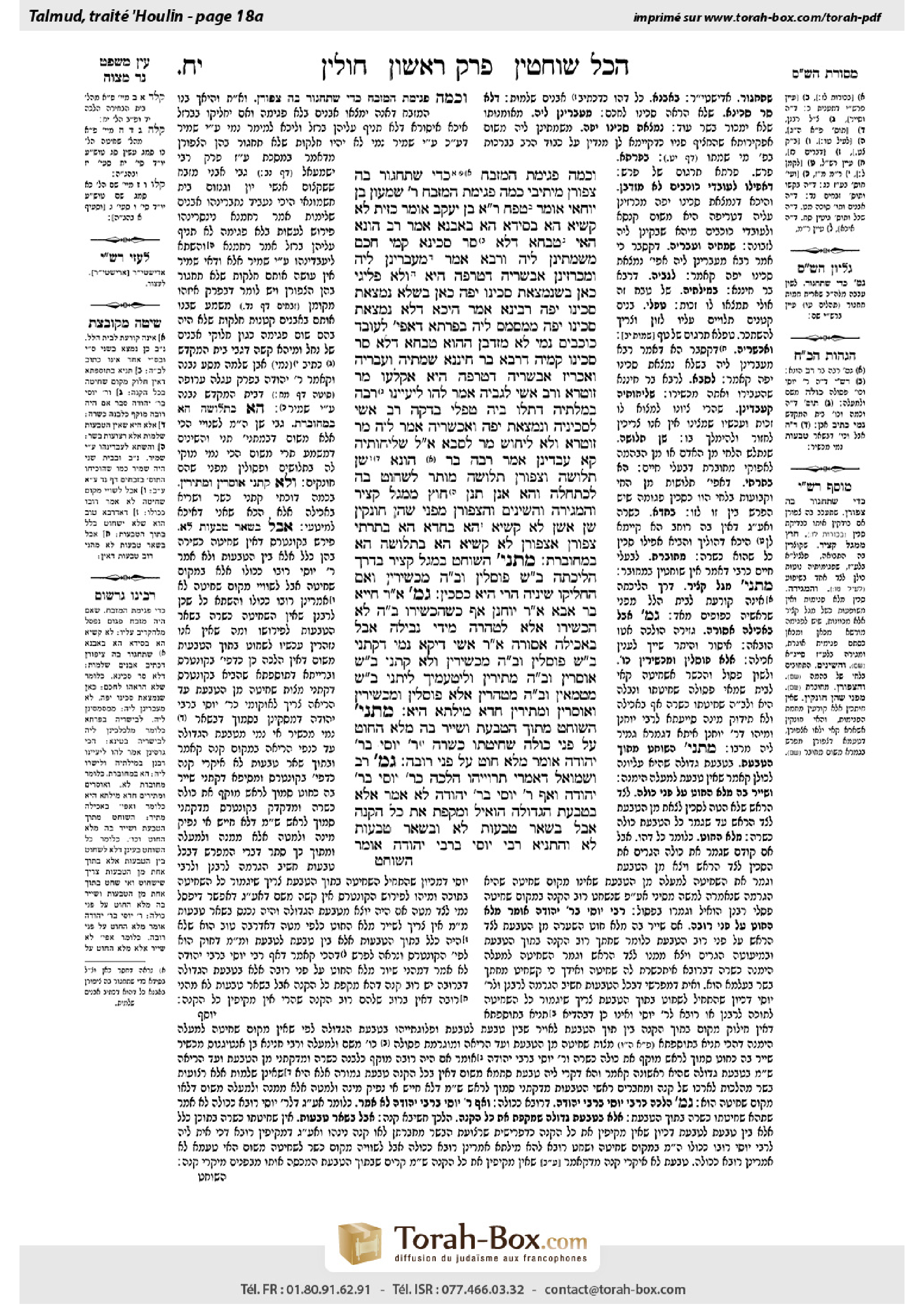
Chullin 18a: Talmud study for Daf Yomi
Study the Talmud for Daf Yomi with scanned pages, Hebrew text, English translations from Sefaria and AI-generated French translations.
Passage selection and English or AI-generated French translation are available where the scan has annotations. Daf Study is independent of Torah-Box and Sefaria.
Browse Chullin · חולין · All tractatesChullin 18a text and translations
This page of Chullin includes the Aramaic text, an English translation and an AI-generated French translation, alongside the scan above.
חולין י״ח א · Aramaic and Hebrew text
וְכַמָּה פְּגִימַת הַמִּזְבֵּחַ? כְּדֵי שֶׁתַּחְגּוֹר בָּהּ צִפּוֹרֶן.
מֵיתִיבִי: כַּמָּה פְּגִימַת הַמִּזְבֵּחַ? רַבִּי שִׁמְעוֹן בֶּן יוֹחַאי אוֹמֵר: טֶפַח, רַבִּי אֱלִיעֶזֶר בֶּן יַעֲקֹב אוֹמֵר: כְּזַיִת. לָא קַשְׁיָא: הָא בְּסִידָא, הָא בְּאַבְנָא.
אָמַר רַב הוּנָא: הַאי טַבָּחָא דְּלָא סָר סַכִּינָא קַמֵּי חָכָם – מְשַׁמְּתִינַן לֵיהּ, וְרָבָא אֲמַר: מְעַבְּרִינַן לֵיהּ, וּמַכְרְזִינַן אַבִּשְׂרֵיהּ דִּטְרֵפָה הִיא.
וְלָא פְּלִיגִי, כָּאן – בְּשֶׁנִּמְצֵאת סַכִּינוֹ יָפָה, כָּאן – בְּשֶׁלֹּא נִמְצֵאת סַכִּינוֹ יָפָה. רָבִינָא אָמַר: הֵיכָא דְּלֹא נִמְצֵאת סַכִּינוֹ יָפָה – מְמַסְמֵס לֵיהּ בְּפַרְתָּא, דַּאֲפִילּוּ לְגוֹיִם נָמֵי לָא מִזְדַּבַּן.
הָהוּא טַבָּחָא דְּלָא סָר סַכִּינָא קַמֵּיהּ דְּרָבָא בַּר חִינָּנָא, שַׁמְּתֵיהּ וְעַבְּרֵיהּ, וְאַכְרֵיז אַבִּשְׂרֵיהּ דִּטְרֵפָה הִיא. אִקְּלַעוּ מָר זוּטְרָא וְרַב אָשֵׁי לְגַבֵּיהּ, אֲמַר לְהוּ: לִיעַיְּינוּ רַבָּנַן בְּמִלְּתֵיהּ, דִּתְלוּ בֵּיהּ טַפְלֵי.
בַּדְקֵהּ רַב אָשֵׁי לְסַכִּינֵיהּ, וְנִמְצֵאת יָפָה, וְאַכְשְׁרֵיהּ. אֲמַר לֵיהּ מָר זוּטְרָא: וְלָא לֵיחוּשׁ מָר לְסָבָא? אֲמַר לֵיהּ: שְׁלִיחוּתֵיהּ קָא עָבְדִינַן.
אָמַר רַבָּה בַּר הוּנָא: שֵׁן תְּלוּשָׁה וְצִפּוֹרֶן תְּלוּשָׁה מוּתָּר לִשְׁחוֹט בָּהּ לְכַתְּחִלָּה. וְהָא אֲנַן תְּנַן: חוּץ מִמַּגַּל קָצִיר וְהַמְּגֵירָה וְהַשִּׁינַּיִם וְהַצִּפּוֹרֶן, מִפְּנֵי שֶׁהֵן חוֹנְקִין.
שֵׁן אַשֵּׁן – לָא קַשְׁיָא: הָא בַּחֲדָא, הָא בְּתַרְתֵּי. צִפּוֹרֶן אַצִּפּוֹרֶן – לָא קַשְׁיָא: הָא בִּתְלוּשָׁה, הָא בִּמְחוּבֶּרֶת.
מַתְנִי׳ הַשּׁוֹחֵט בְּמַגַּל קָצִיר, בַּדֶּרֶךְ הֲלִיכָתָהּ – בֵּית שַׁמַּאי פּוֹסְלִין, וּבֵית הִלֵּל מַכְשִׁירִין. וְאִם הֶחְלִיקוּ שִׁינֶּיהָ – הֲרֵי הִיא כְּסַכִּין.
גְּמָ׳ אָמַר רַבִּי חִיָּיא בַּר אַבָּא אָמַר רַבִּי יוֹחָנָן: אַף כְּשֶׁהִכְשִׁירוּ בֵּית הִלֵּל, לֹא הִכְשִׁירוּ אֶלָּא לְטַהֲרָהּ מִידֵי נְבֵילָה, אֲבָל בַּאֲכִילָה אֲסוּרָה. אָמַר רַב אָשֵׁי: דַּיְקָא נָמֵי, דְּקָתָנֵי ״בֵּית שַׁמַּאי פּוֹסְלִין וּבֵית הִלֵּל מַכְשִׁירִין״, וְלָא קָתָנֵי ״בֵּית שַׁמַּאי אוֹסְרִין וּבֵית הִלֵּל מַתִּירִין״. וְלִיטַעְמָיךְ, לִיתְנֵי ״בֵּית שַׁמַּאי מְטַמְּאִין וּבֵית הִלֵּל מְטַהֲרִין״! אֶלָּא, פּוֹסְלִין וּמַכְשִׁירִין וְאוֹסְרִין וּמַתִּירִין – חֲדָא מִילְּתָא הִיא.
מַתְנִי׳ הַשּׁוֹחֵט מִתּוֹךְ הַטַּבַּעַת, וְשִׁיֵּיר בָּהּ מְלֹא הַחוּט עַל פְּנֵי כּוּלָּהּ – שְׁחִיטָתוֹ כְּשֵׁרָה. רַבִּי יוֹסֵי בְּרַבִּי יְהוּדָה אוֹמֵר: מְלֹא חוּט עַל פְּנֵי רוּבָּהּ.
גְּמָ׳ רַב וּשְׁמוּאֵל דְּאָמְרִי תַּרְוַיְיהוּ: הֲלָכָה כְּרַבִּי יוֹסֵי בְּרַבִּי יְהוּדָה, וְאַף רַבִּי יוֹסֵי בְּרַבִּי יְהוּדָה לֹא אָמַר אֶלָּא בְּטַבַּעַת הַגְּדוֹלָה, הוֹאִיל וּמַקֶּפֶת אֶת כׇּל הַקָּנֶה, אֲבָל בִּשְׁאָר טַבָּעוֹת – לֹא.
וּבִשְׁאָר טַבָּעוֹת לֹא? וְהָתַנְיָא: רַבִּי יוֹסֵי בְּרַבִּי יְהוּדָה אוֹמֵר:
Chullin 18a · English translation
And how much is the deficiency that renders the altar unfit? It is a deficiency that is sufficient for a fingernail to be impeded on it.
The Gemara raises an objection from a baraita: How much is the deficiency that renders the altar unfit? Rabbi Shimon ben Yoḥai says: One handbreadth. Rabbi Eliezer ben Ya’akov says: One olive-bulk. The Gemara answers: This apparent contradiction is not difficult. This measure of one handbreadth or one olive-bulk is referring to a deficiency in the limestone coating of the altar; that smaller measure of a fingernail being caught is referring to a deficiency in the stone of the altar.
§ Apropos the obligation to show the knife to a Torah scholar, Rav Huna says: This slaughterer who did not present [sar] the knife before a Torah scholar, we ostracize him. And Rava says: We remove him from his position and we proclaim about meat from an animal that he slaughtered that it is tereifa.
The Gemara notes: And they do not disagree. Here, where Rav Huna says that he is ostracized, it is in a case where his knife was discovered intact, and he is ostracized for treating the scholar with contempt. There, where Rava says that his slaughter is proclaimed tereifa, it is in a case where his knife was discovered not intact, as in that case the meat from all animals that he slaughtered is suspect. Ravina said: In a case where his knife was discovered not to be intact, one spreads excrement on the flesh so that even to a gentile it will not be sold.
There was a certain slaughterer who did not present his knife before Rava bar Ḥinnana. Rava bar Ḥinnana ostracized him, and removed him from his position, and proclaimed about meat from an animal that he slaughtered that it is tereifa. Mar Zutra and Rav Ashi happened before Rava bar Ḥinnana in his place of residence. Rava bar Ḥinnana said to them: Let the Sages examine the matter of the slaughterer, as small children are dependent upon him.
Rav Ashi examined his knife and it was discovered intact, and he deemed his meat fit for consumption. Mar Zutra said to Rav Ashi: And shouldn’t the Master be concerned for the honor of the elder, Rava bar Ḥinnana, who removed him from his position and you restored him? Rav Ashi said to Mar Zutra: We are carrying out his agency, as he requested that we examine the matter of the slaughterer.
§ Rabba bar Huna says: With a detached tooth and a detached fingernail, it is permitted to slaughter ab initio. The Gemara asks: But didn’t we learn in the mishna (15b): Except for the harvest sickle, and the saw, and the teeth, and the fingernail, because they strangle?
The Gemara answers that the contradiction between this statement with regard to a tooth and that statement with regard to a tooth is not difficult: This statement of Rava bar Huna that one may slaughter with a tooth is referring to slaughter with one tooth. That mishna that prohibits slaughter with teeth is referring to slaughter with two teeth, as due to the gap between them they rip the simanim. The contradiction between the statement with regard to a fingernail and the statement with regard to a fingernail is not difficult: This statement of Rava bar Huna that one may slaughter with a fingernail is referring to slaughter with a detached fingernail. That mishna that prohibits slaughter with a fingernail is referring to slaughter with an attached fingernail, in accordance with the opinion of Rabbi Yehuda HaNasi (15b), who invalidates slaughter performed with an item attached to the ground or a living animal.
MISHNA: In the case of one who slaughters an animal with a harvest sickle, which is serrated with its teeth inclined considerably in one direction, in a forward direction, where the serrations do not tear the flesh, Beit Shammai deem the slaughter not valid and Beit Hillel deem it valid. And they both agree that if they smoothed its serrations so that they do not tear the flesh, its halakhic status is like that of a knife and one may slaughter with it.
GEMARA: Rabbi Ḥiyya bar Abba says that Rabbi Yoḥanan says: Even when Beit Hillel deemed the slaughter valid, they deemed it valid only to purify it from the ritual impurity of an unslaughtered carcass; but its consumption is prohibited. Rav Ashi said: The language of the mishna is also precise, as the tanna teaches: Beit Shammai deem the slaughter not valid and Beit Hillel deem it valid, and he does not teach: Beit Shammai prohibit and Beit Hillel permit its consumption. The Gemara objects: But according to your reasoning, let the tanna teach: Beit Shammai deem the carcass ritually impure and Beit Hillel deem it ritually pure. Rather, the terms deem it not valid and deem it valid and the terms prohibit and permit are all one matter, and no inferences may be drawn from that phrasing.
MISHNA: With regard to one who slaughters an animal from within the cricoid cartilage that forms a complete ring at the top of the windpipe and left a thread breadth over the surface of the ring in its entirety intact, as the knife did not go beyond the ring toward the head of the animal, his slaughter is valid. Rabbi Yosei, son of Rabbi Yehuda, says: It is valid even if he left a thread breadth over the majority of the surface of the ring.
GEMARA: It is Rav and Shmuel who both say: The halakha is in accordance with the opinion of Rabbi Yosei, son of Rabbi Yehuda. And even Rabbi Yosei, son of Rabbi Yehuda, says his statement only with regard to the large upper ring, since it encircles the entire windpipe, but with regard to the rest of the rings, which are incomplete and where a strip of flesh connects their edges, he did not state his halakha. Therefore, his slaughter is not valid, as he is required to slaughter in the space between those rings and not in the rings themselves.
The Gemara objects: And with regard to the rest of the rings, Rabbi Yosei, son of Rabbi Yehuda, did not state his halakha; but isn’t it taught in a baraita that Rabbi Yosei, son of Rabbi Yehuda, says:
Chullin 18a · Traduction française (IA)
Et combien est la déficience qui rend l'autel inutilisable ? C'est une déficience suffisante pour que l'on ne puisse pas glisser un ongle sur lui.
La Guemara soulève un objet tiré d'une baraïta : Combien est la déficience qui rend l'autel inutilisable ? Rabbi Shimon ben Yoḥai dit : Un tefach. Rabbi Eliezer ben Ya’akov dit : Une quantité d'olive. La Guemara répond : Ce paradoxe apparent n'est pas difficile. Cette mesure d'un tefach ou d'une quantité d'olive fait référence à une déficience dans la couche de pierre calcaire de l'autel ; cette mesure plus petite d'un ongle coincé fait référence à une déficience dans la pierre de l'autel.
§ A propos de l'obligation de montrer le couteau à un savant, Rav Huna dit : Ce boucher qui n'a pas présenté le couteau devant un savant, nous le mettons à l'isolement. Et Rava dit : Nous le retirons de son poste et nous déclarons que la viande provenant d'un animal qu'il a sacrifié est tereifa.
La Guemara observe : Et ils ne s'opposent pas. Ici, où Rav Huna dit qu'il est mis à l'isolement, c'est dans le cas où son couteau a été découvert intact, et il est mis à l'isolement pour avoir méprisé le savant. Là, où Rava dit que son sacrifice est déclaré tereifa, c'est dans le cas où son couteau a été découvert non intact, car dans ce cas, la viande de tous les animaux qu'il a sacrifiés est suspecte. Ravina dit : Dans le cas où son couteau a été découvert non intact, on répand des déjections sur la viande afin qu'elle ne soit même pas vendue à un non-Juif.
Il y avait un boucher qui n'avait pas présenté son couteau devant Rava bar Ḥinnana. Rava bar Ḥinnana l'a mis à l'isolement, l'a retiré de son poste et a déclaré que la viande provenant d'un animal qu'il avait sacrifié était tereifa. Mar Zutra et Rav Ashi se sont présentés devant Rava bar Ḥinnana dans son lieu de résidence. Rava bar Ḥinnana a dit à eux : Faisons examiner la question du boucher par les Sages, car les petits enfants en dépendent.
Rav Ashi a examiné son couteau et il a été découvert intact, et il a jugé sa viande propre à la consommation. Mar Zutra a dit à Rav Ashi : Et ne devrait pas le Maître s'inquiéter de l'honneur de l'ancien, Rava bar Ḥinnana, qui l'a mis à l'isolement et toi tu l'as restauré ? Rav Ashi a dit à Mar Zutra : Nous appliquons son mandat, car il a demandé que nous examinions la question du boucher.
§ Rabba bar Huna dit : Avec un dent perdue et un ongle détaché, il est permis de sacrifier dès le début. La Guemara demande : Mais n'avons-nous pas appris dans la mitsva (15b) : À l'exception du faux couteau, du ciseau, des dents et des ongles, car ils étranglent ?
La Guemara répond que le paradoxe entre cette déclaration concernant un dent et celle concernant un dent n'est pas difficile : Cette déclaration de Rabba bar Huna qui permet de sacrifier avec un dent fait référence à un sacrifier avec une seule dent. Cette mitsva qui interdit le sacrifier avec des dents fait référence à un sacrifier avec deux dents, car à cause de l'espace entre elles, elles déchirent les simanim. Le paradoxe entre la déclaration concernant un ongle et celle concernant un ongle n'est pas difficile : Cette déclaration de Rabba bar Huna qui permet de sacrifier avec un ongle fait référence à un sacrifier avec un ongle détaché. Cette mitsva qui interdit le sacrifier avec un ongle fait référence à un sacrifier avec un ongle attaché, conformément à l'opinion de Rabbi Yehuda HaNasi (15b), qui invalidate le sacrifier effectué avec un objet attaché au sol ou à un animal vivant.
MITSVA : Dans le cas d'une personne qui sacrifie un animal avec un faux couteau, qui est dentelé avec ses dents inclinées considérablement dans une direction, en avant, où les dents ne déchirent pas la chair, Beit Shammai considèrent le sacrifier non valide et Beit Hillel considèrent qu'il est valide. Et ils s'accordent sur le fait que si on lisse ses dents afin qu'elles ne déchirent pas la chair, son statut halakhique est comme celui d'un couteau et on peut sacrifier avec lui.
GUEMARA : Rabbi Ḥiyya bar Abba dit que Rabbi Yoḥanan dit : Même lorsque Beit Hillel considéraient le sacrifice valide, ils le considéraient valide uniquement pour purifier de la souillure rituelle d'un cadavre non sacrifié ; mais sa consommation est interdite. Rav Ashi dit : La langue de la mitsva est aussi précise, car le tanna enseigne : Beit Shammai considèrent le sacrifice non valide et Beit Hillel considèrent qu'il est valide, et il ne dit pas : Beit Shammai interdisent et Beit Hillel permettent sa consommation. La Guemara s'oppose : Mais selon votre raisonnement, la mitsva devrait enseigner : Beit Shammai considèrent le cadavre souillé rituellement et Beit Hillel considèrent qu'il est propre rituellement. Plutôt, les termes considèrent qu'il n'est pas valide et considèrent qu'il est valide et les termes interdire et permettre sont tous une même chose, et aucune déduction ne peut être tirée de cette formulation.
MITSVA : Concernant une personne qui sacrifie un animal à l'intérieur de la cartilagine cricoïde qui forme un anneau complet au sommet de la trachée et a laissé une largeur d'un fil intacte sur toute la surface de l'anneau, comme le couteau n'est pas allé au-delà de l'anneau vers la tête de l'animal, son sacrifice est valide. Rabbi Yosei, fils de Rabbi Yehuda, dit : Il est valide même s'il a laissé une largeur d'un fil sur la majorité de la surface de l'anneau.
GUEMARA : C'est Rav et Shmuel qui disent tous les deux : La halakha suit l'opinion de Rabbi Yosei, fils de Rabbi Yehuda. Et même Rabbi Yosei, fils de Rabbi Yehuda, dit que son déclaration ne concerne que l'anneau supérieur grand, puisque celui-ci entoure toute la trachée, mais concernant les autres anneaux, qui sont incomplets et où un morceau de chair relie leurs bords, il n'a pas déclaré sa halakha. Par conséquent, son sacrifice n'est pas valide, car il est tenu de sacrifier dans l'espace entre ces anneaux et non dans les anneaux eux-mêmes.
La Guemara s'oppose : Et concernant les autres anneaux, Rabbi Yosei, fils de Rabbi Yehuda, n'a pas formulé sa halakha ; mais n'est-il pas enseigné dans une baraïta que Rabbi Yosei, fils de Rabbi Yehuda, dit :
Traduction française générée par IA à partir de l’édition anglaise de Sefaria. Vérifie toujours un passage avec le texte source.
Text from Sefaria: William Davidson Edition - Vocalized Aramaic (unknown); William Davidson Edition - English (CC BY NC).