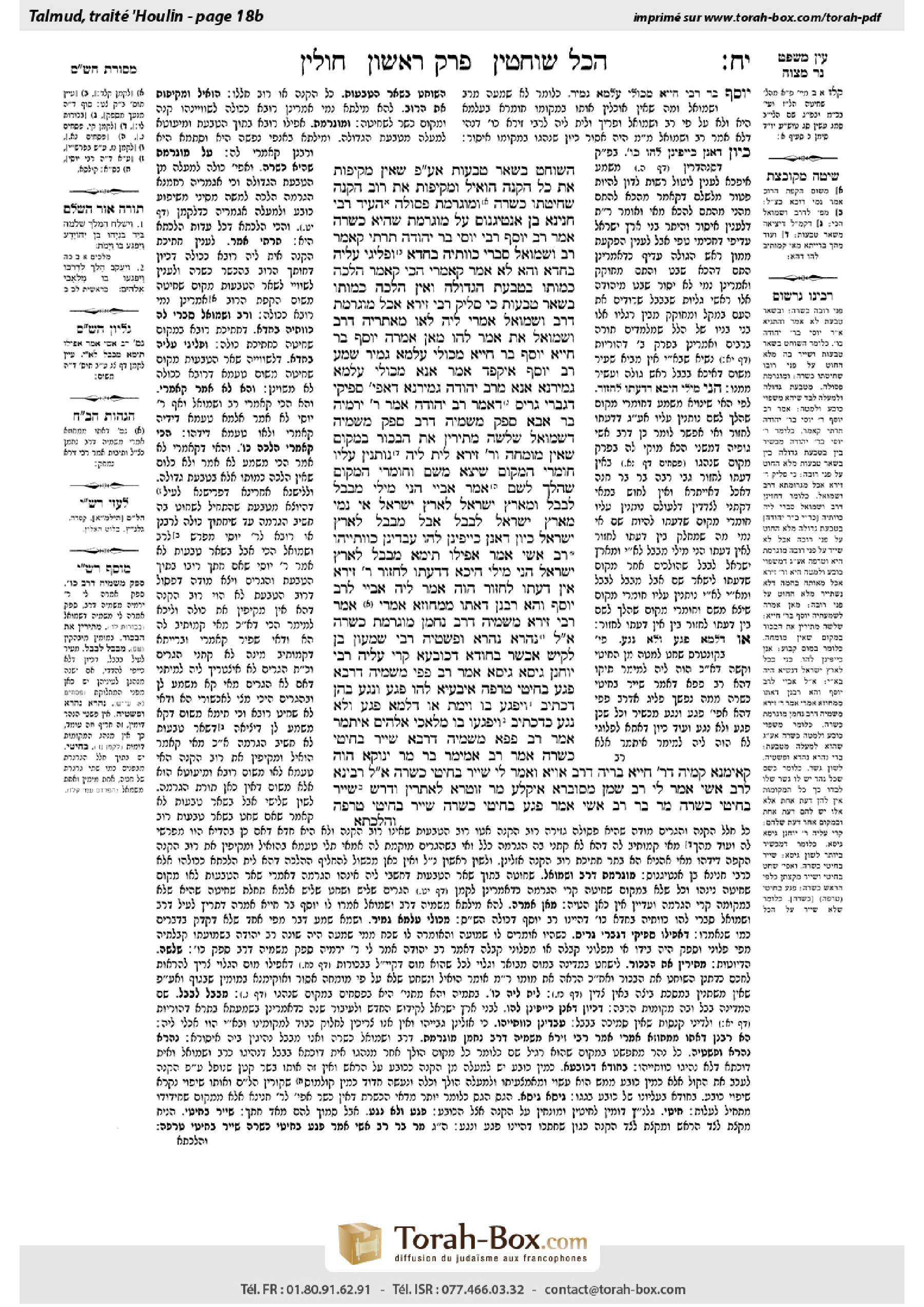
Chullin 18b: Talmud study for Daf Yomi
Study the Talmud for Daf Yomi with scanned pages, Hebrew text, English translations from Sefaria and AI-generated French translations.
Passage selection and English or AI-generated French translation are available where the scan has annotations. Daf Study is independent of Torah-Box and Sefaria.
Browse Chullin · חולין · All tractatesChullin 18b text and translations
This page of Chullin includes the Aramaic text, an English translation and an AI-generated French translation, alongside the scan above.
חולין י״ח ב · Aramaic and Hebrew text
הַשּׁוֹחֵט בִּשְׁאָר טַבָּעוֹת, אַף עַל פִּי שֶׁאֵין מַקִּיפוֹת אֶת כׇּל הַקָּנֶה, הוֹאִיל וּמַקִּיפוֹת אֶת רוֹב הַקָּנֶה – שְׁחִיטָתוֹ כְּשֵׁרָה, וּמוּגְרֶמֶת פְּסוּלָה. הֵעִיד רַבִּי חֲנִינָא בֶּן אַנְטִיגְנוֹס עַל מוּגְרֶמֶת שֶׁהִיא כְּשֵׁרָה.
אָמַר רַב יוֹסֵף: רַבִּי יוֹסֵי בַּר יְהוּדָה תַּרְתֵּי קָאָמַר. רַב וּשְׁמוּאֵל סָבְרִי כְּוָותֵיהּ בַּחֲדָא, וּפְלִיגִי עֲלֵיהּ בַּחֲדָא.
וְהָא ״לֹא אָמַר״ קָאָמְרִי? הָכִי קָאָמַר: הֲלָכָה כְּמוֹתוֹ בְּטַבַּעַת הַגְּדוֹלָה, וְאֵין הֲלָכָה כְּמוֹתוֹ בִּשְׁאָר טַבָּעוֹת.
כִּי סְלֵיק רַבִּי זֵירָא, אֲכַל מוּגְרֶמֶת דְּרַב וּשְׁמוּאֵל. אָמְרִי לֵיהּ: לָאו מֵאַתְרֵיהּ דְּרַב וּשְׁמוּאֵל אַתְּ? אֲמַר לְהוּ: מַאן אַמְרַהּ? יוֹסֵף בַּר חִיָּיא! יוֹסֵף בַּר חִיָּיא מִכּוּלֵּי עָלְמָא גְּמִיר.
שְׁמַע רַב יוֹסֵף, אִיקְּפַד, אֲמַר: אֲנָא מִכּוּלֵּי עָלְמָא גְּמִירְנָא? אֲנָא מֵרַב יְהוּדָה גְּמִירְנָא, דַּאֲפִילּוּ סְפֵיקֵי דְּגַבְרֵי גָּרֵיס. דְּאָמַר רַב יְהוּדָה: אָמַר רַבִּי יִרְמְיָה בַּר אַבָּא, סָפֵק מִשְּׁמֵיהּ דְּרַב, סָפֵק מִשְּׁמֵיהּ דִּשְׁמוּאֵל: שְׁלֹשָׁה מַתִּירִין אֶת הַבְּכוֹר בִּמְקוֹם שֶׁאֵין מוּמְחֶה.
וְרַבִּי זֵירָא, לֵית לֵיהּ נוֹתְנִין עָלָיו חוּמְרֵי הַמָּקוֹם שֶׁיָּצָא מִשָּׁם וְחוּמְרֵי הַמָּקוֹם שֶׁהָלַךְ לְשָׁם?
אָמַר אַבָּיֵי: הָנֵי מִילֵּי מִבָּבֶל לְבָבֶל, וּמֵאֶרֶץ יִשְׂרָאֵל לְאֶרֶץ יִשְׂרָאֵל, אִי נָמֵי מֵאֶרֶץ יִשְׂרָאֵל לְבָבֶל, אֲבָל מִבָּבֶל לְאֶרֶץ יִשְׂרָאֵל, כֵּיוָן דַּאֲנַן כַּיְיפִינַן לְהוּ – עָבְדִינַן כְּוָותַיְיהוּ.
רַב אָשֵׁי אָמַר: אֲפִילּוּ תֵּימָא מִבָּבֶל לְאֶרֶץ יִשְׂרָאֵל, הָנֵי מִילֵּי הֵיכָא דְּדַעְתּוֹ לַחֲזוֹר, רַבִּי זֵירָא אֵין דַּעְתּוֹ לַחֲזוֹר הֲוָה.
אֲמַר לֵיהּ אַבָּיֵי לְרַב יוֹסֵף: וְהָא רַבָּנַן דַּאֲתוֹ מִמָּחוֹזָא אָמְרִי, אָמַר רַבִּי זֵירָא מִשְּׁמֵיהּ דְּרַב נַחְמָן: מוּגְרֶמֶת כְּשֵׁרָה! אֲמַר לֵיהּ: נַהֲרָא נַהֲרָא וּפְשָׁטֵיהּ.
רַבִּי שִׁמְעוֹן בֶּן לָקִישׁ אַכְשַׁר בְּחוּדָּא דְּכוֹבָעָא, קָרֵי עֲלֵיהּ רַבִּי יוֹחָנָן: גִּיסָא גִּיסָא, אָמַר רַב פַּפִּי מִשְּׁמֵיהּ דְּרָבָא: פְּגַע בְּחִיטֵּי – טְרֵפָה.
אִיבַּעְיָא לְהוּ: פָּגַע וְנָגַע בָּהֶן, דִּכְתִיב ״וַיִּפְגַּע בּוֹ וַיָּמֹת״, אוֹ דִלְמָא פָּגַע וְלֹא נָגַע, כְּדִכְתִיב ״וַיִּפְגְּעוּ בוֹ מַלְאֲכֵי אֱלֹהִים״?
אִיתְּמַר, אָמַר רַב פָּפָּא מִשְּׁמֵיהּ דְּרָבָא: שַׁיַּיר בְּחִיטֵּי – כְּשֵׁרָה. אָמַר רַב אַמֵּימָר בַּר מָר יָנוֹקָא: הֲוָה קָאֵימְנָא קַמֵּיהּ דְּרַבִּי חִיָּיא בְּרֵיהּ דְּרַב אַוְיָא, וְאָמַר לִי: שַׁיַּיר בְּחִיטֵּי – כְּשֵׁרָה. אֲמַר לֵיהּ רָבִינָא לְרַב אָשֵׁי: אֲמַר לִי רַב שֶׁמֶן מִסּוּבְרָא, אִיקְּלַע מָר זוּטְרָא לְאַתְרִין וּדְרַשׁ: שַׁיַּיר בְּחִיטֵּי – כְּשֵׁרָה. מָר בַּר רַב אָשֵׁי אָמַר: פְּגַע בְּחִיטֵּי – כְּשֵׁרָה, שַׁיַּיר בְּחִיטֵּי – טְרֵפָה.
Chullin 18b · English translation
With regard to one who slaughters from within the rest of the rings, even though they do not encircle the entire windpipe, since they encircle the majority of the windpipe his slaughter is valid. The baraita adds: And in a case where the knife is diverted from the place of slaughter above the ring, the slaughter is not valid. Rabbi Ḥanina ben Antigonus testified about a case where the knife is diverted from the area of slaughter above the ring that in such a case the slaughter is valid. Contrary to that which Rav and Shmuel said with regard to the opinion of Rabbi Yosei, son of Rabbi Yehuda, he holds that slaughter from within the other rings is valid.
Rav Yosef said: Rabbi Yosei bar Yehuda is saying two statements; Rav and Shmuel hold in accordance with his opinion with regard to one matter, that if one cuts a majority of the windpipe within the large ring the slaughter is valid, and disagree with him with regard to one matter, as in their opinion if one cuts the windpipe within the other rings, the slaughter is not valid.
The Gemara objects: But didn’t Rav and Shmuel say: And even Rabbi Yosei, son of Rabbi Yehuda, said his statement only with regard to the large upper ring and not with regard to the other rings, indicating that in their opinion, this is the opinion of Rabbi Yosei, son of Rabbi Yehuda? The Gemara explains that this is what Rav and Shmuel are saying: The halakha is in accordance with the opinion of Rabbi Yosei, son of Rabbi Yehuda, with regard to cutting the majority of the windpipe within the large ring, and the halakha is not in accordance with his opinion with regard to the other rings that since they encircle a majority of the windpipe, one may slaughter within them as well.
When Rabbi Zeira ascended from Babylonia to Eretz Yisrael, he ate meat from an animal during whose slaughter the knife was diverted from the place of slaughter, with regard to which Rav and Shmuel ruled that the slaughter is not valid, and in Eretz Yisrael the ruling was that the slaughter is valid. The Torah scholars in Eretz Yisrael said to Rabbi Zeira: Aren’t you from Babylonia, the place where Rav and Shmuel are the halakhic authorities? You should follow their ruling. Rabbi Zeira said to them: Who said this halakha citing Rav and Shmuel? It was Yosef bar Ḥiyya, referring to Rav Yosef. Yosef bar Ḥiyya learns from everyone, even from students of Rav and Shmuel who misquote their statements.
Rav Yosef heard the comment of Rabbi Zeira and was angry. He said: Do I learn from everyone? I learn from Rav Yehuda, who is so meticulous in citing the statements of Rav and Shmuel that he cites even uncertainties with regard to attribution of statements to the men who said them. As Rav Yehuda says that Rabbi Yirmeya bar Abba says, and it is uncertain whether it is in the name of Rav and uncertain whether it is in the name of Shmuel: A tribunal of three permits slaughter of a blemished firstborn animal outside of the Temple in a place where there is no expert Sage to consult.
The Gemara asks: And does Rabbi Zeira not accept the principle that when a person travels from place to place, the Sages impose upon him the stringencies of the place from which he emerged and the stringencies of the place to which he went?
Abaye said: That statement applies when one travels from one place in Babylonia to another place in Babylonia, or from one place in Eretz Yisrael to another place in Eretz Yisrael, or alternatively, when one descends from Eretz Yisrael to Babylonia. But when one ascends from Babylonia to Eretz Yisrael, this principle does not apply. Since we, the residents of Babylonia, are subordinate to them in terms of halakha, we act in accordance with their custom.
Rav Ashi said: Even if you say that when one travels from Babylonia to Eretz Yisrael, he is required to act stringently in accordance with the custom of the place from which he emerged, that statement applies only in a case where his intent is to return. Rabbi Zeira was not one whose intent was to return. Therefore, he was not obligated to observe the Babylonian stringencies.
Abaye said to Rav Yosef: But didn’t the Sages who came from Meḥoza say that Rabbi Zeira says in the name of Rav Naḥman: In a case where the knife is diverted from the place of slaughter above the ring, the slaughter is valid? Rav Yosef said to him: Each river and its unique course, i.e., each place follows its custom, and in Meḥoza the custom was not in accordance with the opinion of Rav and Shmuel.
The Gemara relates that Rabbi Shimon ben Lakish deemed the slaughter valid in a case where one cut the windpipe at the tip of the thyroid cartilage that is above the large ring. Rabbi Yoḥanan proclaimed about Rabbi Shimon ben Lakish: He greatly exaggerated the limits of valid slaughter. Rav Pappi said in the name of Rava: If one cut the windpipe and encountered the arytenoid cartilage that is adjacent to the upper ring in the direction of the jaw and covered by the tip of the thyroid cartilage, the animal is a tereifa, i.e., forbidden. Since the arytenoid cartilage is outside the area of slaughter, the slaughter is invalid.
A dilemma was raised before the Sages: Does encountered mean encountered and touched it, as it is written: “And he encountered him and he died” (I Kings 2:25); or perhaps it means encountered but did not touch, like that which is written: “And the angels of God encountered him” (Genesis 32:2)?
It was stated that Rav Pappa said in the name of Rava: If one left part of the arytenoid cartilage, i.e., if he cut it in the middle, the slaughter is valid. Rav Ameimar bar Mar Yenuka said: I was standing before Rabbi Ḥiyya, son of Rav Avya, and he said to me: If one left part of the arytenoid cartilage, the slaughter is valid. Ravina said to Rav Ashi: Rav Shemen of Suvara said to me that Mar Zutra happened to come to our place and taught: If one left part of the arytenoid cartilage, the slaughter is valid. Mar bar Rav Ashi said: If one encountered the arytenoid cartilage, the slaughter is valid. If one left part of the arytenoid cartilage, the animal is a tereifa.
Chullin 18b · Traduction française (IA)
Concernant celui qui sacrifie à l'intérieur des autres anneaux, même s'ils ne circonscrivent pas l'ensemble du trachée, puisqu'ils circonscrivent la majorité du trachée, son sacrifice est valide. La baraïta ajoute : Et dans le cas où le couteau est détourné du lieu du sacrifice au-dessus de l'anneau, le sacrifice n'est pas valide. Rabbi Ḥanina ben Antigonus témoigna d'un cas où le couteau est détourné de la zone du sacrifice au-dessus de l'anneau, et il affirma que dans ce cas, le sacrifice est valide. Contre ce que Rav et Shmuel dirent concernant l'opinion de Rabbi Yosei, fils de Rabbi Yehuda, il maintient que le sacrifice à l'intérieur des autres anneaux est valide.
Rav Yosef dit : Rabbi Yosei bar Yehuda énonce deux opinions ; Rav et Shmuel adoptent son opinion concernant une question, à savoir que si l'on coupe la majorité du trachée à l'intérieur de l'anneau supérieur, le sacrifice est valide, et ils s'opposent à son opinion concernant une autre question, à savoir que selon leur avis, si l'on coupe le trachée à l'intérieur des autres anneaux, le sacrifice n'est pas valide.
La Guemara s'oppose : Mais n'ont pas dit Rav et Shmuel : Et même Rabbi Yosei, fils de Rabbi Yehuda, a formulé son opinion uniquement concernant l'anneau supérieur et non concernant les autres anneaux, ce qui indique que selon leur avis, c'est l'opinion de Rabbi Yosei, fils de Rabbi Yehuda ? La Guemara explique que c'est ce que Rav et Shmuel affirment : la halakha suit l'opinion de Rabbi Yosei, fils de Rabbi Yehuda, concernant le fait de couper la majorité du trachée à l'intérieur de l'anneau supérieur, et la halakha ne suit pas son opinion concernant les autres anneaux, à savoir que puisqu'ils circonscrivent la majorité du trachée, on peut sacrifier à l'intérieur d'eux également.
Quand le Rabbi Zéira est monté de Babylone en Eretz Yisrael, il a mangé de la viande d'un animal dont le couteau avait été détourné du lieu de sacrifice, concernant lequel Rav et Shmuel avaient déclaré que le sacrifice n'était pas valide, et en Eretz Yisrael la décision était que le sacrifice était valide. Les sages d'Eretz Yisrael dirent à Rabbi Zéira : N'es-tu pas de Babylone, la terre où Rav et Shmuel sont les autorités halakhiques ? Tu dois suivre leur décision. Rabbi Zéira répondit à ceux-ci : Qui a dit cette halakha en citant Rav et Shmuel ? C'était Yosef bar Ḥiyya, faisant référence à Rav Yosef. Yosef bar Ḥiyya apprend de tout le monde, même des élèves de Rav et Shmuel qui déforment leurs propos.
Rav Yosef entendit le commentaire de Rabbi Zéira et s'indigna. Il dit : Apprends-je donc de tout le monde ? Je apprends de Rav Yehuda, qui est si minutieux dans la citation des propos de Rav et Shmuel qu'il cite même les incertitudes concernant l'attribution des propos aux hommes qui les ont dits. Comme Rav Yehuda dit que Rabbi Yirmeya bar Abba dit, et il est incertain si c'est en nom de Rav ou s'il est en nom de Shmuel : Un tribunal de trois permet le sacrifice d'un animal premier blemi en dehors du Temple dans un lieu où il n'y a pas de sage expert à consulter.
La Guemara demande : Et Rabbi Zéira ne reconnaît-il pas le principe selon lequel quand une personne voyage d'un lieu à un autre, les Sages imposent à cette personne les stricteurs du lieu d'où elle vient et ceux du lieu où elle va ?
Abaye dit : Cette déclaration s'applique lorsqu'une personne voyage d'un lieu en Babylonie à un autre lieu en Babylonie, ou d'un lieu en Terre d'Israël à un autre lieu en Terre d'Israël, ou bien lorsqu'une personne descend de la Terre d'Israël vers Babylonie. Mais lorsqu'une personne monte de Babylonie vers la Terre d'Israël, ce principe ne s'applique pas. Puisque nous, les habitants de Babylonie, sommes subordonnés à eux en matière de halakha, nous suivons leur coutume.
Rav Ashi dit : Même si vous dites que lorsqu'une personne voyage de Babylonie vers la Terre d'Israël, elle doit agir avec stricte rigueur en suivant la coutume du lieu d'où elle vient, cette déclaration s'applique uniquement dans le cas où son intention est de revenir. Rabbi Zeira n'était pas une personne dont l'intention était de revenir. Par conséquent, il n'était pas tenu de respecter les stricteurs de Babylonie.
Abaye dit à Rav Yosef : Mais n'ont pas dit les Sages qui venaient de Meḥoza que Rabbi Zeira cite en nom de Rav Naḥman : Dans le cas où le couteau est détourné du lieu de sacrifice au-dessus de l'anneau, le sacrifice est valide ? Rav Yosef répondit à lui : Chaque fleuve et son cours particulier, c'est-à-dire que chaque lieu suit sa propre coutume, et à Meḥoza la coutume n'était pas conforme à l'opinion de Rav et de Shmuel.
La Guemara rapporte que le Rabbi Simon ben Lakish considérait la boucherie valide dans le cas où l'on coupait la trachée au sommet de la cartilagine thyroïdienne qui est au-dessus du grand anneau. Le Rabbi Yoḥanan déclara à propos du Rabbi Simon ben Lakish : Il a beaucoup exagéré les limites de la boucherie valide. Rav Pappi dit en nom de Rava : Si l'on coupait la trachée et qu'on rencontrait la cartilagine arythénoidienne qui est adjacente au grand anneau dans la direction de la mâchoire et recouverte par le sommet de la cartilagine thyroïdienne, l'animal est un tereifa, c'est-à-dire interdit. Puisque la cartilagine arythénoidienne est en dehors de la zone de boucherie, la boucherie est invalide.
Un dilemme a été soulevé devant les Sages : Le terme « rencontré » signifie-t-il avoir rencontré et touché, comme il est écrit : « Et il rencontra lui et il mourut » (I Rois 2:25) ; ou bien signifie-t-il avoir rencontré sans avoir touché, comme dans ce qui est écrit : « Et les anges du Seigneur rencontrèrent lui » (Genèse 32:2) ?
On a dit que Rav Pappa a dit au nom de Rava : Si l'on laissait une partie de la cartilagine de l'arytenoid, c'est-à-dire si l'on coupait celle-ci au milieu, la bête est valide. Rav Ameimar bar Mar Yenuka a dit : J'étais devant Rabbi Ḥiyya, fils de Rav Avya, et il m'a dit : Si l'on laissait une partie de la cartilagine de l'arytenoid, la bête est valide. Ravina a dit à Rav Ashi : Rav Shemen de Suvara m'a dit qu'arriva Mar Zutra à notre lieu et enseigna : Si l'on laissait une partie de la cartilagine de l'arytenoid, la bête est valide. Mar bar Rav Ashi a dit : Si l'on rencontrait la cartilagine de l'arytenoid, la bête est valide. Si l'on laissait une partie de la cartilagine de l'arytenoid, l'animal est un tereifa.
Traduction française générée par IA à partir de l’édition anglaise de Sefaria. Vérifie toujours un passage avec le texte source.
Text from Sefaria: William Davidson Edition - Vocalized Aramaic (unknown); William Davidson Edition - English (CC BY NC).