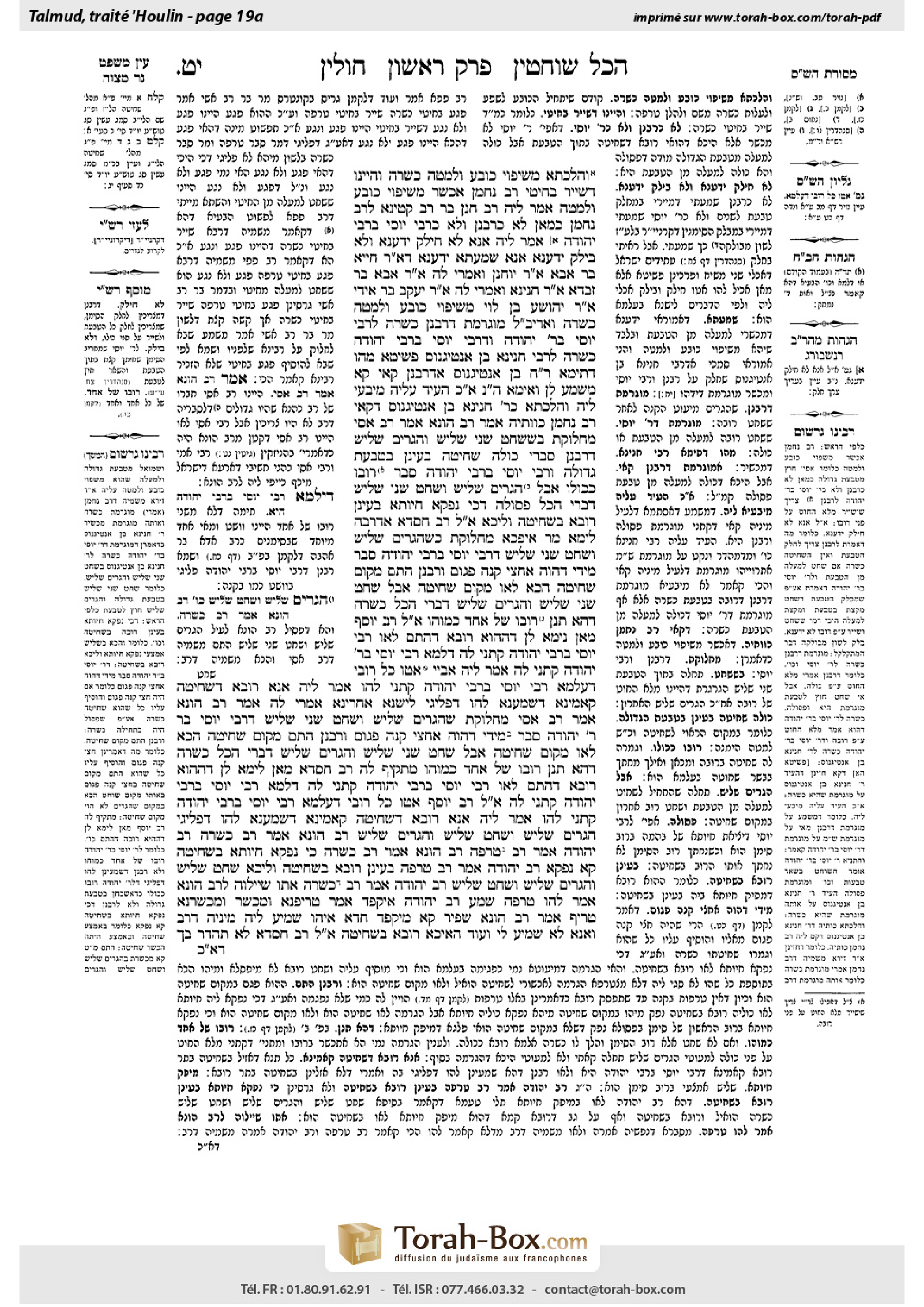
Chullin 19a: Talmud study for Daf Yomi
Study the Talmud for Daf Yomi with scanned pages, Hebrew text, English translations from Sefaria and AI-generated French translations.
Passage selection and English or AI-generated French translation are available where the scan has annotations. Daf Study is independent of Torah-Box and Sefaria.
Browse Chullin · חולין · All tractatesChullin 19a text and translations
This page of Chullin includes the Aramaic text, an English translation and an AI-generated French translation, alongside the scan above.
חולין י״ט א · Aramaic and Hebrew text
וְהִלְכְתָא מִשִּׁיפּוּי כּוֹבַע וּלְמַטָּה – כְּשֵׁרָה, וְהַיְינוּ דְּשַׁיַּיר בְּחִיטֵּי.
רַב נַחְמָן אַכְשַׁר מִשִּׁיפּוּי כּוֹבַע וּלְמַטָּה, אֲמַר לֵיהּ רַב חָנָן בַּר רַב קַטִּינָא לְרַב נַחְמָן: כְּמַאן? לָא כְּרַבָּנַן וְלָא כְּרַבִּי יוֹסֵי בְּרַבִּי יְהוּדָה.
אֲמַר לֵיהּ: אֲנָא לָא חִילָק יָדַעְנָא וְלָא בִּילָק יָדַעְנָא, אֲנָא שְׁמַעְתָּא יָדַעְנָא, דְּאָמַר רַבִּי חִיָּיא בַּר אַבָּא אָמַר רַבִּי יוֹחָנָן, וְאָמְרִי לַהּ אָמַר רַבִּי אַבָּא בַּר זַבְדָּא אָמַר רַבִּי חֲנִינָא, וְאָמְרִי לָהּ אָמַר רַבִּי יַעֲקֹב בַּר אִידִי אָמַר רַבִּי יְהוֹשֻׁעַ בֶּן לֵוִי: מִשִּׁיפּוּי כּוֹבַע וּלְמַטָּה כְּשֵׁרָה.
וְאָמַר רַבִּי יְהוֹשֻׁעַ בֶּן לֵוִי: מוּגְרֶמֶת דְּרַבָּנַן כְּשֵׁרָה לְרַבִּי יוֹסֵי בְּרַבִּי יְהוּדָה.
וּדְרַבִּי יוֹסֵי בְּרַבִּי יְהוּדָה, כְּשֵׁרָה לְרַבִּי חֲנִינָא בֶּן אַנְטִיגְנוֹס.
פְּשִׁיטָא! מַהוּ דְּתֵימָא: רַבִּי חֲנִינָא בֶּן אַנְטִיגְנוֹס אַדְּרַבָּנַן קָאֵי, קָא מַשְׁמַע לַן.
וְאֵימָא הָכִי נָמֵי? אִם כֵּן, ״הֵעִיד עָלֶיהָ״ מִיבְּעֵי לֵיהּ. וְהִלְכְתָא כְּרַבִּי חֲנִינָא בֶּן אַנְטִיגְנוֹס, דְּקָאֵי רַב נַחְמָן כְּוָותֵיהּ.
אָמַר רַב הוּנָא אָמַר רַב אַסִּי: מַחְלוֹקֶת בְּשֶׁשָּׁחַט שְׁנֵי שְׁלִישׁ וְהִגְרִים שְׁלִישׁ, דְּרַבָּנַן סָבְרִי: כּוּלַּהּ שְׁחִיטָה בָּעֵינַן בְּטַבַּעַת גְּדוֹלָה, וְרַבִּי יוֹסֵי בְּרַבִּי יְהוּדָה סָבַר: רוּבּוֹ כְּכוּלּוֹ.
אֲבָל הִגְרִים שְׁלִישׁ, וְשָׁחַט שְׁנֵי שְׁלִישׁ – דִּבְרֵי הַכֹּל פְּסוּלָה, דְּכִי נָפְקָא חִיּוּתָא בָּעֵינַן רוּבָּא בִּשְׁחִיטָה, וְלֵיכָּא.
אֲמַר לֵיהּ רַב חִסְדָּא: אַדְּרַבָּה, לֵימָא מָר אִיפְּכָא: מַחְלוֹקֶת כְּשֶׁהִגְרִים שְׁלִישׁ, וְשָׁחַט שְׁנֵי שְׁלִישׁ, דְּרַבִּי יוֹסֵי בְּרַבִּי יְהוּדָה סָבַר מִידֵּי דְּהָוֵה אַחֲצִי קָנֶה פָּגוּם.
וְרַבָּנַן, הָתָם מָקוֹם שְׁחִיטָה, הָכָא לָאו מְקוֹם שְׁחִיטָה.
אֲבָל שָׁחַט שְׁנֵי שְׁלִישׁ, וְהִגְרִים שְׁלִישׁ – דִּבְרֵי הַכֹּל כְּשֵׁרָה, דְּהָא תְּנַן: רוּבּוֹ שֶׁל אֶחָד כָּמוֹהוּ.
אֲמַר לֵיהּ רַב יוֹסֵף: מַאן נֵימָא לַן דְּהָהוּא רוּבָּא דְּהָתָם לָאו רַבִּי יוֹסֵי בְּרַבִּי יְהוּדָה קָתָנֵי לַהּ? דִּלְמָא רַבִּי יוֹסֵי בְּרַבִּי יְהוּדָה קָתָנֵי לַהּ!
אֲמַר לֵיהּ אַבָּיֵי: אַטּוּ כֹּל רוּבֵּי דְּעָלְמָא רַבִּי יוֹסֵי בְּרַבִּי יְהוּדָה קָתָנֵי לְהוּ? אֲמַר לֵיהּ: אֲנָא רוּבָּא דִּשְׁחִיטָה קָאָמֵינָא, דִּשְׁמַעְנָא לְהוּ דִּפְלִיגִי.
לִישָּׁנָא אַחֲרִינָא אָמְרִי לַהּ, אָמַר רַב הוּנָא אָמַר רַב אַסִּי: מַחְלוֹקֶת שֶׁהִגְרִים שְׁלִישׁ וְשָׁחַט שְׁנֵי שְׁלִישׁ, דְּרַבִּי יוֹסֵי בַּר רַבִּי יְהוּדָה סָבַר: מִידֵּי דְּהָוֵה אַחֲצִי קָנֶה פָּגוּם, וְרַבָּנַן – הָתָם מְקוֹם שְׁחִיטָה, הָכָא לָאו מְקוֹם שְׁחִיטָה.
אֲבָל שָׁחַט שְׁנֵי שְׁלִישׁ, וְהִגְרִים שְׁלִישׁ – דִּבְרֵי הַכֹּל כְּשֵׁרָה, דְּהָא תְּנַן: רוּבּוֹ שֶׁל אֶחָד כָּמוֹהוּ.
מַתְקֵיף לַהּ רַב חִסְדָּא: מַאן לֵימָא לַן דְּהָהוּא רוּבָּא דְּהָתָם לָאו רַבִּי יוֹסֵי בְּרַבִּי יְהוּדָה קָתָנֵי לַהּ? דִּלְמָא רַבִּי יוֹסֵי בְּרַבִּי יְהוּדָה קָתָנֵי לַהּ! אֲמַר לֵיהּ רַב יוֹסֵף: אַטּוּ כֹּל רוּבֵּי דְּעָלְמָא רַבִּי יוֹסֵי בְּרַבִּי יְהוּדָה קָתָנֵי לְהוּ? אֲמַר לֵיהּ: אֲנָא רוּבָּא דִּשְׁחִיטָה קָאָמֵינָא, דִּשְׁמַעְנָא לְהוּ דִּפְלִיגִי.
הִגְרִים שְׁלִישׁ, וְשָׁחַט שְׁלִישׁ, וְהִגְרִים שְׁלִישׁ – רַב הוּנָא אָמַר רַב: כְּשֵׁרָה, רַב יְהוּדָה אָמַר רַב: טְרֵפָה. רַב הוּנָא אָמַר רַב: כְּשֵׁרָה – כִּי נָפְקָא חִיּוּתָא בִּשְׁחִיטָה קָא נָפְקָא. רַב יְהוּדָה אָמַר רַב: טְרֵפָה – בָּעֵינַן רוּבָּא בִּשְׁחִיטָה וְלֵיכָּא.
שָׁחַט שְׁלִישׁ, וְהִגְרִים שְׁלִישׁ, וְשָׁחַט שְׁלִישׁ – רַב יְהוּדָה אָמַר רַב: כְּשֵׁרָה. אֲתוֹ שַׁיְילוּהּ לְרַב הוּנָא, אֲמַר לְהוּ: טְרֵפָה. שְׁמַע רַב יְהוּדָה אִיקְּפַד, אֲמַר: טָרֵיפְנָא (ומכשר) [מַכְשַׁר], (ומכשרנא) [מַכְשַׁרְנָא] טָרֵיף! אָמַר רַב הוּנָא: שַׁפִּיר קָא מִיקְּפַד, חֲדָא – אִיהוּ שְׁמִיעַ לֵיהּ מִינֵּיהּ דְּרַב, וַאֲנָא לָא שְׁמִיעַ לִי, וְעוֹד – הָאִיכָּא רוּבָּא בִּשְׁחִיטָה.
אֲמַר לֵיהּ רַב חִסְדָּא: לָא תֶּהְדַּר בָּךְ,
Chullin 19a · English translation
The Gemara concludes: And the halakha is: If one slaughters from the incline of the thyroid cartilage and below in the direction of the windpipe, the slaughter is valid, and that is in accordance with the opinion that one who left part of the arytenoid cartilage has still performed a valid slaughter, as the arytenoid cartilage extends beyond this point.
The Gemara relates that Rav Naḥman deemed the slaughter valid in a case where one slaughtered from the incline of the thyroid cartilage and below. Rav Ḥanan bar Rav Ketina said to Rav Naḥman: In accordance with whose opinion is that ruling? It is neither in accordance with the opinion of the Rabbis nor in accordance with the opinion of Rabbi Yosei, son of Rabbi Yehuda, who both hold that if one cuts the windpipe above the large upper ring, the cricoid cartilage, the slaughter is not valid.
Rav Naḥman said to him: Neither do I know Ḥillek nor do I know Billek, i.e., I know the reason neither for this one’s opinion nor for that one’s opinion. I know the halakha, as Rabbi Ḥiyya bar Abba says that Rabbi Yoḥanan says, and some say that Rabbi Abba bar Zavda says that Rabbi Ḥanina says, and some say that Rabbi Ya’akov bar Idi says that Rabbi Yehoshua ben Levi says: From the incline of the thyroid cartilage and below, the slaughter is valid.
§ The Gemara returns to analyzing the baraita (18b): In a case where the knife is diverted from the place of slaughter above the ring, the slaughter is not valid. Rabbi Ḥanina ben Antigonus testified about a case where the knife is diverted from the place of slaughter above the ring that the slaughter is valid. And Rabbi Yehoshua ben Levi says: With regard to a case where the knife was diverted according to the opinion of the Rabbis cited in the mishna, the slaughter is valid according to the opinion of Rabbi Yosei, son of Rabbi Yehuda, who ruled that the slaughter is valid when the majority of the windpipe was cut within the large, upper ring.
And with regard to a case where the knife was diverted according to the opinion of Rabbi Yosei, son of Rabbi Yehuda, it is valid according to the opinion of Rabbi Ḥanina ben Antigonus, who ruled that even if a majority of the windpipe was cut outside the large upper ring, the slaughter is valid.
The Gemara objects: That is obvious. The Gemara explains: Lest you say that the statement of Rabbi Ḥanina ben Antigonus, who ruled that in a case where the knife is diverted from the place of slaughter above the ring it is valid, addresses the statement of the Rabbis and he agrees with the opinion of Rabbi Yosei, son of Rabbi Yehuda, that the slaughter is not valid when the majority of the windpipe was cut above the large upper ring, therefore, Rabbi Yehoshua ben Levi teaches us that this is not the case.
The Gemara objects: And say it is indeed so that Rabbi Ḥanina ben Antigonus agrees with Rabbi Yosei, son of Rabbi Yehuda. The Gemara responds: If so, the formulation of the baraita should have been: Rabbi Ḥanina ben Antigonus testified about it. Since the opinion of Rabbi Ḥanina ben Antigonus was introduced merely with the term: Testified, apparently he disagrees with all of the other opinions. The Gemara concludes: And the halakha is in accordance with the opinion of Rabbi Ḥanina ben Antigonus, as Rav Naḥman holds in accordance with his opinion.
§ The mishna cited a dispute between the Rabbis, who hold that in a case where one slaughtered within the large upper ring and did not leave a thread breadth over the entire surface of the ring, the slaughter is not valid, and Rabbi Yosei, son of Rabbi Yehuda, who holds that even if one left a thread breadth over a majority of the surface of the ring, the slaughter is valid. Apropos to that, Rav Huna said that Rav Asi says: The dispute is only in a case where one cut two-thirds of the windpipe within the ring and then diverted the knife upward toward the head of the animal and cut the remaining one-third, as the Rabbis hold that we require the entire slaughter to be performed within the large ring, and Rabbi Yosei, son of Rabbi Yehuda, holds: The halakhic status of its majority is like that of its entirety.
But if one diverted the knife upward toward the head of the animal, cut one-third of the windpipe, and then cut two-thirds within the ring, everyone agrees that the slaughter is not valid, as when the life left the animal, i.e., when the majority of the windpipe was cut, we require that the entire majority be cut by means of slaughter, and that is not so in this case.
Rav Ḥisda said to Rav Huna: On the contrary, let the Master say the opposite. The dispute is only in a case when one diverted the knife upward toward the head of the animal, cut one-third of the windpipe, and then cut two-thirds within the ring, as Rabbi Yosei, son of Rabbi Yehuda, holds that the slaughter is valid just as it is in the case where half the windpipe is deficient. In that case, once the slaughterer cuts any additional part of the windpipe, the slaughter is valid because the cut that rendered a majority of the windpipe slaughtered was performed properly. So too in this case, since the cut of the second third was performed properly, the slaughter is valid.
And the Rabbis hold that there, in the case of the deficient windpipe, the deficiency was in the place of proper slaughter, and therefore most of the life of the animal left in the proper place. Here, the first third was cut while the knife was diverted, and therefore most of the life of the animal did not leave in the place of proper slaughter.
But in a case where one cut two-thirds of the windpipe within the ring and then diverted the knife and cut the remaining one-third, everyone agrees that the slaughter is valid, as didn’t we learn in a mishna (27a): The halakhic status of the slaughter of the majority of one siman, the windpipe or the gullet, is like that of the slaughter of the entire siman itself?
Rav Yosef said to Rav Ḥisda: Who will say to us that with regard to the mishna there concerning the majority of one siman, Rabbi Yosei, son of Rabbi Yehuda, did not teach it? Perhaps Rabbi Yosei, son of Rabbi Yehuda, taught it, and the Rabbis disagree.
Abaye said to Rav Yosef: Is that to say that with regard to all principles that address majorities in general, Rabbi Yosei, son of Rabbi Yehuda, taught them? Rav Yosef said to him: I am speaking of the principle of majority with regard to slaughter, as we heard that the Rabbis disagree with him.
Some say that there is an alternative version of this discussion: Rav Huna said that Rav Asi says: The dispute is only in a case where one diverted the knife upward toward the head of the animal, cut one-third of the windpipe, and then cut two-thirds within the ring, as Rabbi Yosei, son of Rabbi Yehuda, holds that the slaughter is valid just as it is in the case where half the windpipe is deficient, and the Rabbis hold that there, in the case of the deficient windpipe, the deficiency was in the place of proper slaughter, but here, most of the life of the animal did not leave in the place of proper slaughter.
But in a case where one cut two-thirds of the windpipe within the ring and then diverted the knife and cut the remaining one-third, everyone agrees that the slaughter is valid, as didn’t we learn in a mishna (27a): The halakhic status of the slaughter of the majority of one siman, the windpipe or the gullet, is like that of the slaughter of the entire siman itself?
Rav Ḥisda objects to this: Who will say to us that with regard to the mishna there concerning the majority of one siman, Rabbi Yosei, son of Rabbi Yehuda, did not teach it? Perhaps Rabbi Yosei, son of Rabbi Yehuda, taught it, and the Rabbis disagree. Rav Yosef said to Rav Ḥisda: Is that to say that with regard to all principles that address majorities in general, Rabbi Yosei, son of Rabbi Yehuda, taught them? Rav Ḥisda said to him: I am speaking of the principle of majority with regard to slaughter, as we heard that the Rabbis disagree with him.
§ If one diverted the knife and cut one-third of the windpipe, and then cut one-third properly, and then diverted and cut the final one-third, Rav Huna says that Rav says: The slaughter is valid. Rav Yehuda says that Rav says: The animal is a tereifa, i.e., forbidden. Rav Huna says that Rav says: The slaughter is valid, as when the life left the animal, it was in the course of a valid slaughter that it left. Rav Yehuda says that Rav says: The animal is a tereifa, as we require a majority of the windpipe to be cut with valid slaughter, and that is not the case.
If one cut one-third of the windpipe properly, and then diverted the knife and cut one-third, and then cut the final one-third of the windpipe properly, Rav Yehuda says that Rav said: The slaughter is valid. When the Sages came and asked Rav Huna, he said to them: It is a tereifa. Rav Yehuda heard the ruling of Rav Huna, and he was angry. He said: I deem it a tereifa and he deems the slaughter valid, and I deem the slaughter valid and he deems it a tereifa. Rav Huna said: It is proper that he was angry. One reason is that he heard it from Rav and I did not hear it from Rav; and furthermore, isn’t there the majority of the siman that was cut with valid slaughter?
Rav Ḥisda said to Rav Huna: Do not retract your statement,
Chullin 19a · Traduction française (IA)
La Guemara conclut : Et la halakha est : Si l'on sacrifie depuis la pente de la cartilagine thyroïdienne et en dessous dans la direction de la trachée, le sacrifice est valide, et cela correspond à l'opinion selon laquelle celui qui a laissé une partie de la cartilagine aryténoïde a tout de même accompli un sacrifice valide, car la cartilagine aryténoïde s'étend au-delà de ce point.
La Guemara rapporte que Rav Naḥman considérait le sacrifice valide dans le cas où l'on sacrifie depuis la pente de la cartilagine thyroïdienne et en dessous. Rav Ḥanan bar Rav Ketina dit à Rav Naḥman : Selon quel opinion est-ce que cette décision est prise ? Ce n'est ni selon l'opinion des Rabbins ni selon l'opinion de Rabbi Yosei, fils de Rabbi Yehuda, qui tous deux considèrent que si l'on coupe la trachée au-dessus de l'anneau supérieur grand, la cartilagine cricoïde, le sacrifice n'est pas valide.
Rav Naḥman dit à lui : Je ne connais ni Ḥillek ni Billek, c'est-à-dire je ne connais la raison ni pour cette opinion ni pour celle-ci. Je connais la halakha, car Rabbi Ḥiyya bar Abba dit que Rabbi Yoḥanan dit, et certains disent que Rabbi Abba bar Zavda dit que Rabbi Ḥanina dit, et certains disent que Rabbi Ya’akov bar Idi dit que Rabbi Yehoshua ben Levi dit : Depuis la pente de la cartilagine thyroïdienne et en dessous, le sacrifice est valide.
§ La Guemara reprend l'analyse de la baraïta (18b) : Dans le cas où le couteau est détourné du lieu de la boucherie au-dessus de l'anneau, la boucherie n'est pas valide. Rabbi Ḥanina ben Antigonus témoigna d'un cas où le couteau est détourné du lieu de la boucherie au-dessus de l'anneau et la boucherie est valide. Et Rabbi Yehoshua ben Levi dit : En ce qui concerne un cas où le couteau a été détourné selon l'opinion des Rabbins cités dans la mitsva, la boucherie est valide selon l'opinion de Rabbi Yosei, fils de Rabbi Yehuda, qui décida que la boucherie est valide lorsque la majorité de la trachée a été coupée à l'intérieur de l'anneau supérieur grand.
Et en ce qui concerne un cas où le couteau a été détourné selon l'opinion de Rabbi Yosei, fils de Rabbi Yehuda, il est valide selon l'opinion de Rabbi Ḥanina ben Antigonus, qui décida que même si la majorité de la trachée a été coupée en dehors de l'anneau supérieur grand, la boucherie est valide.
La Guemara s'oppose : Cela est évident. La Guemara explique : De peur que vous disiez que la déclaration de Rabbi Ḥanina ben Antigonus, qui décida que dans le cas où le couteau est détourné du lieu de la boucherie au-dessus de l'anneau, il est valide, concerne la déclaration des Rabbins et qu'il est d'accord avec l'opinion de Rabbi Yosei, fils de Rabbi Yehuda, qui décida que la boucherie n'est pas valide lorsque la majorité de la trachée a été coupée au-dessus de l'anneau supérieur grand, donc Rabbi Yehoshua ben Levi nous enseigne que cela n'est pas le cas.
La Guemara s'oppose : Et dites-le comme c'est vrai que Rabbi Ḥanina ben Antigonus est d'accord avec Rabbi Yosei, fils de Rabbi Yehuda. La Guemara répond : Si c'est ainsi, la formulation de la baraïta aurait dû être : Rabbi Ḥanina ben Antigonus a témoigné à ce sujet. Puisque l'opinion de Rabbi Ḥanina ben Antigonus a été introduite uniquement avec le terme : A témoigné, apparemment il est d'accord avec toutes les autres opinions. La Guemara conclut : Et la halakha est selon l'opinion de Rabbi Ḥanina ben Antigonus, car Rav Naḥman tient à son opinion.
§ La mitsva citée a évoqué un débat entre les Rabbins, qui considèrent que dans le cas où l'on sacrifie à l'intérieur de l'anneau supérieur grand et qu'on n'a pas laissé une largeur d'un fil sur toute la surface de l'anneau, le sacrifice n'est pas valide, et Rabbi Yosei, fils de Rabbi Yehuda, qui considère que même si l'on a laissé une largeur d'un fil sur la majorité de la surface de l'anneau, le sacrifice est valide. A propos de cela, Rav Huna dit que Rav Asi dit : Le débat est seulement dans le cas où l'on a coupé deux tiers de la trachée à l'intérieur de l'anneau et puis a détourné le couteau vers la tête de l'animal et a coupé le reste, un tiers, car les Rabbins considèrent que nous exigeons que l'ensemble du sacrifice soit effectué à l'intérieur de l'anneau grand, et Rabbi Yosei, fils de Rabbi Yehuda, considère : Le statut halakhique de la majorité est comme celui de l'ensemble.
Mais si l'on a détourné le couteau vers la tête de l'animal, a coupé un tiers de la trachée, et puis a coupé deux tiers à l'intérieur de l'anneau, tout le monde est d'accord pour dire que le sacrifice n'est pas valide, car lorsque la vie est sortie de l'animal, c'est-à-dire lorsque la majorité de la trachée a été coupée, nous exigeons que l'ensemble de la majorité soit coupé par le sacrifice, et cela n'est pas le cas dans ce cas-ci.
Rav Ḥisda dit à Rav Huna : Au contraire, faites-nous dire l'opposé. Le débat est seulement dans le cas où l'on a détourné le couteau vers la tête de l'animal, a coupé un tiers de la trachée, et puis a coupé deux tiers à l'intérieur de l'anneau, car Rabbi Yosei, fils de Rabbi Yehuda, considère que le sacrifice est valide tout comme dans le cas où la moitié de la trachée est déficiente. Dans ce cas, une fois que le sacrificateur coupe une autre partie de la trachée, le sacrifice est valide car la coupure qui a rendu la majorité de la trachée sacrifiée a été effectuée correctement. De même, dans ce cas-ci, puisque la coupure du tiers suivant a été effectuée correctement, le sacrifice est valide.
Et les Rabbins considèrent que là, dans le cas de la trachée déficiente, la déficience était à l'endroit du sacrifice correct, et donc la majorité de la vie de l'animal est sortie à l'endroit correct. Ici, le premier tiers a été coupé alors que le couteau était détourné, et donc la majorité de la vie de l'animal n'a pas quitté à l'endroit du sacrifice correct.
Mais dans le cas où l'on a coupé deux tiers de la trachée à l'intérieur de l'anneau et puis a détourné le couteau et a coupé le reste, tout le monde est d'accord pour dire que le sacrifice est valide, car n'avons-nous pas appris dans une mitsva (27a) : Le statut halakhique du sacrifice de la majorité d'un siman, la trachée ou le gosier, est comme celui du sacrifice de l'ensemble du siman lui-même ?
Rav Yosef dit à Rav Ḥisda : Qui nous dira que, concernant la michna mentionnée là, la majorité d'un siman, Rabbi Yosei, fils de Rabbi Yehuda, n'a pas enseigné cela ? Peut-être que Rabbi Yosei, fils de Rabbi Yehuda, l'a enseigné, et les Rabbins sont en désaccord.
Abaye dit à Rav Yosef : Est-ce que cela signifie que, concernant tous les principes relatifs aux majorités en général, Rabbi Yosei, fils de Rabbi Yehuda, les a enseignés ? Rav Yosef dit à lui : Je parle du principe de la majorité concernant la boucherie, comme nous avons entendu que les Rabbins sont en désaccord avec lui.
Certains disent qu'il existe une version alternative de cette discussion : Rav Huna dit que Rav Asi dit : Le désaccord est seulement dans le cas où l'on a détourné le couteau vers la tête de l'animal, coupé un tiers du trachée, puis coupé deux tiers à l'intérieur de l'anneau, comme Rabbi Yosei, fils de Rabbi Yehuda, considère que la boucherie est valide telle quelle dans le cas où la moitié du trachée est déficiente, et les Rabbins pensent que, dans ce cas de trachée déficiente, la déficience était dans la place de la boucherie correcte, mais ici, la majorité de la vie de l'animal n'a pas quitté dans la place de la boucherie correcte.
Mais dans le cas où l'on a coupé deux tiers du trachée à l'intérieur de l'anneau, puis détourné le couteau et coupé le reste, tout le monde convient que la boucherie est valide, comme n'avons-nous pas appris dans une michna (27a) : Le statut halakhique de la boucherie de la majorité d'un siman, le trachée ou le gosèl, est comme celui de la boucherie de l'ensemble du siman lui-même ?
Rav Ḥisda s'oppose à cela : Qui nous dira que, concernant la michna mentionnée là, la majorité d'un siman, Rabbi Yosei, fils de Rabbi Yehuda, n'a pas enseigné cela ? Peut-être que Rabbi Yosei, fils de Rabbi Yehuda, l'a enseigné, et les Rabbins sont en désaccord. Rav Yosef dit à Rav Ḥisda : Est-ce que cela signifie que, concernant tous les principes relatifs aux majorités en général, Rabbi Yosei, fils de Rabbi Yehuda, les a enseignés ? Rav Ḥisda dit à lui : Je parle du principe de la majorité concernant la boucherie, comme nous avons entendu que les Rabbins sont en désaccord avec lui.
§ Si l'on a détourné le couteau et coupé un tiers du trachée, puis coupé un tiers correctement, puis détourné et coupé le dernier tiers, Rav Huna dit que Rav dit : La boucherie est valide. Rav Yehuda dit que Rav dit : L'animal est tereifa, c'est-à-dire interdit. Rav Huna dit que Rav dit : La boucherie est valide, comme lorsque la vie est sortie de l'animal, elle l'a fait dans le cours d'une boucherie valide. Rav Yehuda dit que Rav dit : L'animal est tereifa, comme nous exigeons que la majorité du trachée soit coupée avec une boucherie valide, et cela n'est pas le cas.
Si l'on coupe un tiers du trachée correctement, puis on détoure le couteau et on coupe un tiers, puis on coupe le dernier tiers du trachée correctement, Rav Yehuda dit que Rav a dit : La boucherie est valide. Lorsque les Sages sont venus demander à Rav Huna, il a dit à eux : C'est un tereifa. Rav Yehuda a entendu le jugement de Rav Huna, et il s'est fâché. Il a dit : Je considère qu'il s'agit d'un tereifa et lui considère la boucherie valide, et je considère la boucherie valide et lui considère qu'il s'agit d'un tereifa. Rav Huna a dit : Il est juste qu'il ait été fâché. Une raison est qu'il l'a entendu de Rav et je ne l'ai pas entendu de Rav ; et de plus, n'y a-t-il pas la majorité du siman qui a été coupée avec une boucherie valide ?
Rav Ḥisda dit à Rav Huna : Ne retirez pas votre déclaration,
Traduction française générée par IA à partir de l’édition anglaise de Sefaria. Vérifie toujours un passage avec le texte source.
Text from Sefaria: William Davidson Edition - Vocalized Aramaic (unknown); William Davidson Edition - English (CC BY NC).