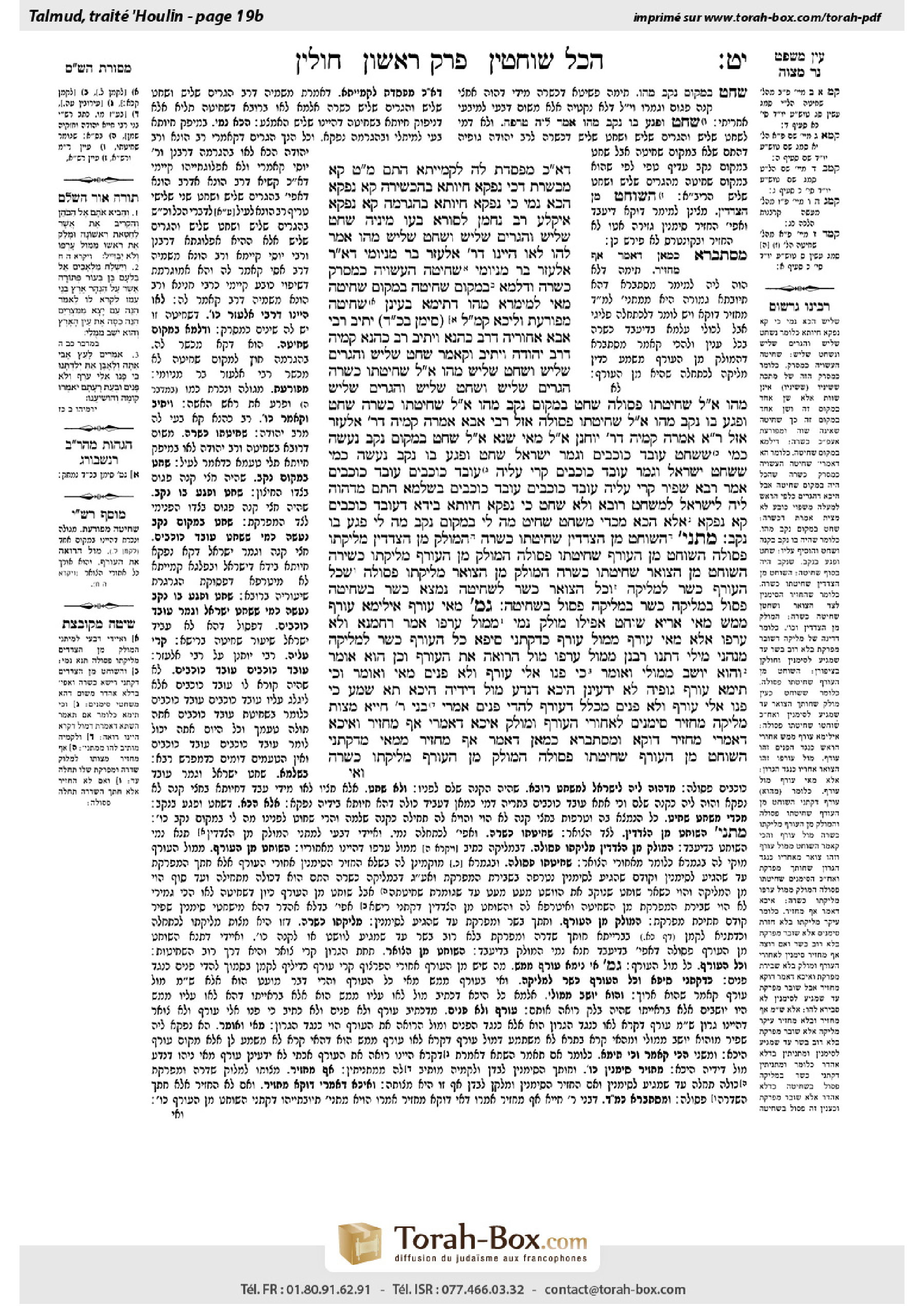
Chullin 19b: Talmud study for Daf Yomi
Study the Talmud for Daf Yomi with scanned pages, Hebrew text, English translations from Sefaria and AI-generated French translations.
Passage selection and English or AI-generated French translation are available where the scan has annotations. Daf Study is independent of Torah-Box and Sefaria.
Browse Chullin · חולין · All tractatesChullin 19b text and translations
This page of Chullin includes the Aramaic text, an English translation and an AI-generated French translation, alongside the scan above.
חולין י״ט ב · Aramaic and Hebrew text
דְּאִם כֵּן, מַפְסְדַתְּ לַהּ לְקַמַּיְיתָא. הָתָם מַאי טַעְמָא קָא מַכְשְׁרַתְּ? דְּכִי נָפְקָא חִיּוּתָא – בְּהֶכְשֵׁירַהּ קָא נָפְקָא. הָכָא נָמֵי, כִּי נָפְקָא חִיּוּתָא – בְּהַגְרָמָה קָא נָפְקָא.
אִיקְּלַע רַב נַחְמָן לְסוּרָא, בְּעוֹ מִינֵּיהּ: שָׁחַט שְׁלִישׁ וְהִגְרִים שְׁלִישׁ וְשָׁחַט שְׁלִישׁ, מַהוּ? אֲמַר לְהוּ: לָאו הַיְינוּ דְּרַבִּי אֶלְעָזָר בַּר מִנְיוֹמֵי, דְּאָמַר רַבִּי אֶלְעָזָר בַּר מִנְיוֹמֵי: שְׁחִיטָה הָעֲשׂוּיָה כְּמַסְרֵק כְּשֵׁרָה.
וְדִלְמָא בִּמְקוֹם שְׁחִיטָה! בִּמְקוֹם שְׁחִיטָה מַאי לְמֵימְרָא? מַהוּ דְּתֵימָא: בָּעֵינַן שְׁחִיטָה מְפוֹרַעַת וְלֵיכָּא, קָא מַשְׁמַע לַן.
(סִימָן: בַּכַּ״ד).
יְתֵיב רַבִּי אַבָּא אֲחוֹרֵיהּ דְּרַב כָּהֲנָא, וְיָתֵיב רַב כָּהֲנָא קַמֵּיהּ דְּרַב יְהוּדָה, וְיָתֵיב וְקָאָמַר: שָׁחַט שְׁלִישׁ וְהִגְרִים שְׁלִישׁ וְשָׁחַט שְׁלִישׁ, מַהוּ? אֲמַר לֵיהּ: שְׁחִיטָתוֹ כְּשֵׁרָה.
הִגְרִים שְׁלִישׁ וְשָׁחַט שְׁלִישׁ וְהִגְרִים שְׁלִישׁ, מַהוּ? אֲמַר לֵיהּ: שְׁחִיטָתוֹ פְּסוּלָה.
שָׁחַט בִּמְקוֹם נֶקֶב, מַהוּ? אֲמַר לֵיהּ: שְׁחִיטָתוֹ כְּשֵׁרָה.
שָׁחַט וּפָגַע בּוֹ נֶקֶב, מַהוּ? אֲמַר לֵיהּ: שְׁחִיטָתוֹ פְּסוּלָה.
אֲזַל רַבִּי אַבָּא, אַמְרַהּ קַמֵּיהּ דְּרַבִּי אֶלְעָזָר, אֲזַל רַבִּי אֶלְעָזָר, אַמְרַהּ קַמֵּיהּ דְּרַבִּי יוֹחָנָן, אֲמַר לֵיהּ: מַאי שְׁנָא?
אֲמַר לֵיהּ: שָׁחַט בִּמְקוֹם נֶקֶב, נַעֲשָׂה כְּמִי שֶׁשָּׁחַט גּוֹי וְגָמַר יִשְׂרָאֵל. שָׁחַט וּפָגַע בּוֹ נֶקֶב, נַעֲשָׂה כְּמִי שֶׁשָּׁחַט יִשְׂרָאֵל וְגָמַר גּוֹי. קָרֵי עֲלֵיהּ: ״גּוֹי גּוֹי״.
אָמַר רָבָא: שַׁפִּיר קָרֵי עֲלֵיהּ ״גּוֹי גּוֹי״, בִּשְׁלָמָא הָתָם מִדַּהֲוָה לֵיהּ לְיִשְׂרָאֵל לְמִשְׁחַט רוּבָּא וְלָא שְׁחַט, כִּי נָפְקָא חִיּוּתָא – בִּידָא דְּגוֹי קָא נָפְקָא, אֶלָּא הָכָא מִכְּדֵי מִשְׁחָט שָׁחֵיט, מָה לִי בִּמְקוֹם נֶקֶב, מָה לִי פָּגַע בּוֹ נֶקֶב?
מַתְנִי׳ הַשּׁוֹחֵט מִן הַצְּדָדִין – שְׁחִיטָתוֹ כְּשֵׁרָה, הַמּוֹלֵק מִן הַצְּדָדִין – מְלִיקָתוֹ פְּסוּלָה. הַשּׁוֹחֵט מִן הָעוֹרֶף – שְׁחִיטָתוֹ פְּסוּלָה, הַמּוֹלֵק מִן הָעוֹרֶף – מְלִיקָתוֹ כְּשֵׁירָה. הַשּׁוֹחֵט מִן הַצַּוָּאר – שְׁחִיטָתוֹ כְּשֵׁרָה, הַמּוֹלֵק מִן הַצַּוָּאר – מְלִיקָתוֹ פְּסוּלָה, שֶׁכׇּל הָעוֹרֶף כָּשֵׁר לִמְלִיקָה, וְכׇל הַצַּוָּאר כָּשֵׁר לִשְׁחִיטָה. נִמְצָא, כָּשֵׁר בִּשְׁחִיטָה – פָּסוּל בִּמְלִיקָה, כָּשֵׁר בִּמְלִיקָה – פָּסוּל בִּשְׁחִיטָה.
גְּמָ׳ מַאי עוֹרֶף? אִילֵימָא עוֹרֶף מַמָּשׁ, מַאי אִרְיָא שׁוֹחֵט? אֲפִילּוּ מוֹלֵק נָמֵי! ״מִמּוּל עׇרְפּוֹ״ אָמַר רַחֲמָנָא, וְלֹא עׇרְפּוֹ. אֶלָּא מַאי עוֹרֶף? מִמּוּל עוֹרֶף, כִּדְקָתָנֵי סֵיפָא: כׇּל הָעוֹרֶף כָּשֵׁר לִמְלִיקָה.
מְנָהָנֵי מִילֵּי, דְּתָנוּ רַבָּנַן: ״מִמּוּל עׇרְפּוֹ״ – מוּל הָרוֹאֶה אֶת הָעוֹרֶף, וְכֵן הוּא אוֹמֵר: ״וְהוּא יֹשֵׁב מִמֻּלִי״, וְאוֹמֵר: ״כִּי פָנוּ אֵלַי עֹרֶף וְלֹא פָנִים״. מַאי וְאוֹמֵר? וְכִי תֵּימָא: עוֹרֶף גּוּפֵיהּ לָא יָדְעִינַן הֵיכָא, דְּנִדַּע מוּל דִּידֵיהּ הֵיכָא – תָּא שְׁמַע: ״כִּי פָנוּ אֵלַי עֹרֶף וְלֹא פָנִים״, מִכְּלָל דְּעוֹרֶף לַהֲדֵי פָּנִים.
אָמְרִי בְּנֵי רַבִּי חִיָּיא: מִצְוַת מְלִיקָה מַחֲזִיר סִימָנִים לַאֲחוֹרֵי הָעוֹרֶף וּמוֹלֵק. אִיכָּא דְּאָמְרִי: אַף מַחְזִיר, וְאִיכָּא דְּאָמְרִי: מַחְזִיר דַּוְקָא.
וּמִסְתַּבְּרָא כְּמַאן דְּאָמַר אַף מַחְזִיר, מִמַּאי? מִדְּקָתָנֵי: הַשּׁוֹחֵט מִן הָעוֹרֶף – שְׁחִיטָתוֹ פְּסוּלָה, הַמּוֹלֵק מִן הָעוֹרֶף – מְלִיקָתוֹ כְּשֵׁרָה,
Chullin 19b · English translation
as, if you retract your statement, you repudiate the first ruling that you stated with regard to a case where one diverted the knife and cut one-third of the windpipe, and then cut one-third properly, and then diverted and cut the final one-third. There, what is the reason that you deemed the slaughter valid? The reason is that when life left the animal with the cutting of the second third of the windpipe, it left the animal in the course of valid slaughter. Based on that reasoning, here too, when life left the animal with the cutting of the second third of the windpipe, it left the animal in the course of diverting the knife, and the slaughter is invalid.
Rav Naḥman happened to come to Sura, where they asked him: If one cut one-third of the windpipe properly, and then diverted the knife and cut one-third, and then cut the final one-third of the windpipe properly, what is the halakha? He said to them: Isn’t that the halakha stated by Rabbi Elazar bar Minyumi, as Rabbi Elazar bar Minyumi says: Slaughter that is performed like the teeth of a comb, which are jagged, is valid.
The Gemara objects: And perhaps Rabbi Elazar bar Minyumi stated his halakha only when the slaughter goes up and down within the proper place of slaughter. The Gemara asks in response: Within the proper place of slaughter, what is the purpose of stating it? Clearly the slaughter is valid in that case. The Gemara explains: Lest you say that we require slaughter that is clear and straight, and slaughter that is jagged is not straight, therefore, Rabbi Elazar bar Minyumi teaches us that nevertheless, the slaughter is valid.
The Gemara cites a mnemonic for the order of the Sages in the following discussion: Beit for Rabbi Abba; kaf for Rav Kahana; dalet for Rav Yehuda.
Rabbi Abba sat behind Rav Kahana and Rav Kahana sat before Rav Yehuda, and he sat and said to Rav Yehuda: If one cut one-third of the windpipe properly, and then diverted the knife and cut one-third, and then cut the final one-third of the windpipe properly, what is the halakha? Rav Yehuda said to Rav Kahana: His slaughter is valid.
Rav Kahana then asked: If one diverted the knife and cut one-third of the windpipe, and then cut one-third properly, and then diverted and cut the final one-third, what is the halakha? Rav Yehuda said to him: His slaughter is not valid.
Rav Kahana then asked: If one cut in a place where there was a perforation in the front of the windpipe and continued cutting, what is the halakha? Rav Yehuda said to him: His slaughter is valid.
Rav Kahana further asked: If one cut the windpipe and after cutting half the windpipe encountered a perforation, after which point a majority of the windpipe had been cut, what is the halakha? Rav Yehuda said to him: His slaughter is not valid.
Rabbi Abba went to Eretz Yisrael and stated these halakhot in the presence of Rabbi Elazar, and Rabbi Elazar went and stated these halakhot in the presence of Rabbi Yoḥanan. Rabbi Yoḥanan said to him: What is different about a case where one cut in a place where there was a perforation relative to a case where he encountered a perforation in the middle of the slaughter?
Rabbi Elazar said to him: In a case where one cut in a place where there was a perforation, it becomes like an animal that a gentile began to slaughter and a Jew completed its slaughter, in which case the slaughter is valid. In a case where one cut the windpipe and encountered a perforation, it becomes like an animal that a Jew began to slaughter and a gentile completed its slaughter, in which case the slaughter is not valid. Rabbi Yoḥanan mockingly proclaimed about him: Gentile, gentile, i.e., you merely repeat something about gentiles. Rabbi Yoḥanan did not accept the distinction.
Rava said: Rabbi Yoḥanan did well when he proclaimed about him: Gentile, gentile. Granted, there, in the case where the gentile completed the slaughter, since a Jew was supposed to cut a majority of the windpipe and he did not cut it, when life left the animal it left by the hand of a gentile. But here, after all, he was the one who slaughtered the entire animal, and the animal was not a tereifa until this point, and so what difference is there to me if one began to cut in a place where there was a perforation and what difference is there to me if he encountered a perforation?
MISHNA: One who slaughters from the sides of the throat, his slaughter is valid. One who pinches the neck of a bird offering from the sides, his pinching is not valid. One who slaughters from the nape [oref] of the neck, his slaughter is not valid. One who pinches a bird offering from the nape of the neck, his pinching is valid. One who slaughters from the throat, his slaughter is valid. One who pinches a bird offering from the throat, his pinching is not valid, as the entire nape is valid for pinching and the entire throat is valid for slaughter. It is found that that which is valid for slaughter is not valid for pinching and that which is valid for pinching is not valid for slaughter.
GEMARA: With regard to the statement in the mishna: One who slaughters an animal from the oref, its slaughter is not valid, the Gemara asks: What is the meaning of oref? If we say that the reference is to the actual occipital bone at the rear of the skull, why does this halakha apply specifically to one who slaughters from the oref? Even if one pinches a bird offering from the oref it would also not be valid, as the Merciful One states: “Pinch off its head adjacent to its oref” (Leviticus 5:8), at the nape beneath the occipital bone, and not its oref. Rather, what is the oref mentioned in the mishna? It is adjacent to the oref, the back of the neck below the occipital bone, as it is taught in the latter clause of the mishna: The entire nape is valid for pinching.
The Gemara asks: From where are these matters derived? They are derived as the Sages taught in a baraita: In the phrase “adjacent to [mimmul] its oref,” adjacent means a place that sees the oref and not the oref itself. And likewise, the verse states: “And they reside adjacent to me [mimmuli]” (Numbers 22:5); and the verse states: “For they have turned their oref unto Me, and not their face” (Jeremiah 2:27). The Gemara asks: What is added by the latter proof, introduced with the term: And the verse states? The Gemara answers: And if you would say, we do not know where the oref itself is, so that we will know where adjacent to it is, come and hear: “For they have turned their oref unto Me, and not their face,” from which it may be ascertained by inference that the oref is opposite the face, at the rear of the head.
§ The sons of Rabbi Ḥiyya say: How is the mitzva of pinching of a bird offering performed? One moves the two simanim that must be severed in ritual slaughter, i.e., the windpipe and the gullet, behind the nape and pinches. There is a dispute among the Sages with regard to the meaning of the statement. There are those who say: The mitzva ab initio is to pinch through the spinal column first and then pinch the windpipe and the gullet, and one may even move the simanim to behind the nape and pinch. And there are those who say: The mitzva is specifically to move the simanim behind the nape and pinch.
The Gemara notes: And it is reasonable according to the one who says: One may even move the simanim behind the nape. From where does one draw that conclusion? It is from the fact that the mishna teaches: One who slaughters from the nape of the neck, his slaughter is not valid. One who pinches from the nape of the neck, his pinching is valid.
Chullin 19b · Traduction française (IA)
car, si vous rétractez votre déclaration, vous répudiez la première décision que vous avez émise concernant un cas où l'on a détourné le couteau et tranché un tiers du larynx, puis tranché un tiers correctement, puis détourné et tranché le dernier tiers. Là, pourquoi avez-vous considéré la bête comme sacrifiée ? La raison est que lorsque la vie est sortie de l'animal avec la tranchée du deuxième tiers du larynx, elle est sortie de l'animal dans le cours d'un sacrifice valide. Sur cette base, ici aussi, lorsque la vie est sortie de l'animal avec la tranchée du deuxième tiers du larynx, elle est sortie de l'animal dans le cours de détournement du couteau, et le sacrifice est invalide.
Rav Naḥman est venu à Sura, où on lui a demandé : Si l'on trancha un tiers du larynx correctement, puis détourna le couteau et trancha un tiers, puis trancha correctement le dernier tiers du larynx, quelle est la halakha ? Il a dit à ceux-ci : N'est-ce pas la halakha énoncée par Rabbi Elazar bar Minyumi, car Rabbi Elazar bar Minyumi dit : Le sacrifice effectué comme les dents d'une pince, qui sont irrégulières, est valide.
La Guemara s'oppose : Et peut-être que Rabbi Elazar bar Minyumi a énoncé sa halakha uniquement lorsqu'on trancha en montant et en descendant dans la bonne place du sacrifice. La Guemara demande en réponse : Dans la bonne place du sacrifice, à quoi sert d'insister sur cela ? Évidemment, le sacrifice est valide dans ce cas. La Guemara explique : Pour éviter que l'on dise que nous exigeons un sacrifice clair et droit, et que le sacrifice irrégulier n'est pas droit, donc Rabbi Elazar bar Minyumi nous enseigne que néanmoins, le sacrifice est valide.
La Guemara cite un acrostère pour l'ordre des Sages dans la discussion suivante : Beit pour Rabbi Abba ; kaf pour Rav Kahana ; dalet pour Rav Yehuda.
Rabbi Abba s'est assis derrière Rav Kahana et Rav Kahana s'est assis devant Rav Yehuda, et il a dit à Rav Yehuda : Si l'on trancha un tiers du larynx correctement, puis détourna le couteau et trancha un tiers, puis trancha correctement le dernier tiers du larynx, quelle est la halakha ? Rav Yehuda a dit à Rav Kahana : Son sacrifice est valide.
Rav Kahana a ensuite demandé : Si l'on détourna le couteau et trancha un tiers du larynx, puis trancha correctement un tiers, puis détourna et trancha le dernier tiers, quelle est la halakha ? Rav Yehuda a dit à lui : Son sacrifice n'est pas valide.
Rav Kahana demanda alors : Si l'on tranchait dans un endroit où il y avait une perforation dans le larynx et continuait à trancher, quelle est la halakha ? Rav Yehuda répondit à lui : Son sacrifice est valide.
Rav Kahana demanda encore : Si l'on tranchait le larynx et, après avoir tranché la moitié du larynx, rencontrait une perforation, après quoi la majorité du larynx avait été tranchée, quelle est la halakha ? Rav Yehuda répondit à lui : Son sacrifice n'est pas valide.
Rabbi Abba est allé en Terre d'Israël et a énoncé ces halakhot en présence de Rabbi Elazar, et Rabbi Elazar est allé énoncer ces halakhot en présence de Rabbi Yoḥanan. Rabbi Yoḥanan demanda à lui : Quelle est la différence entre un cas où l'on tranchait dans un endroit où il y avait une perforation et un cas où l'on rencontrait une perforation au milieu du sacrifice ?
Rabbi Elazar a dit à lui : Dans un cas où l'on trancha dans un endroit où il y avait une perforation, cela devient comme un animal que le gentil commença à sacrifier et que le juif termina son sacrifice, dans lequel cas le sacrifice est valide. Dans un cas où l'on trancha le larynx et rencontra une perforation, cela devient comme un animal que le juif commença à sacrifier et que le gentil termina son sacrifice, dans lequel cas le sacrifice n'est pas valide. Rabbi Yoḥanan a déclamé ironiquement à son sujet : Gentil, gentil, c'est-à-dire que vous répétez simplement quelque chose à propos des gentils. Rabbi Yoḥanan n'a pas accepté cette distinction.
Rava a dit : Rabbi Yoḥanan a bien fait lorsqu'il déclama à son sujet : Gentil, gentil. En effet, là, dans le cas où le gentil termina le sacrifice, puisque le juif devait trancher la majorité du larynx et ne l'a pas tranché, lorsque la vie est sortie de l'animal, elle est sortie par la main d'un gentil. Mais ici, après tout, c'est lui qui sacrifia l'animal entier, et l'animal n'était pas tereifa jusqu'à ce point, et donc quelle différence y a-t-il pour moi si l'on commença à trancher dans un endroit où il y avait une perforation et quelle différence y a-t-il pour moi si l'on rencontra une perforation ?
MICHNA : Celui qui sacrifie du côté du larynx, son sacrifice est valide. Celui qui écrase le cou d'une offrande de poule du côté, son écrasement n'est pas valide. Celui qui sacrifie du côté du cou [oref], son sacrifice n'est pas valide. Celui qui écrase une offrande de poule du côté du cou, son écrasement est valide. Celui qui sacrifie du larynx, son sacrifice est valide. Celui qui écrase une offrande de poule du larynx, son écrasement n'est pas valide, car l'ensemble du cou est valide pour l'écrasement et l'ensemble du larynx est valide pour le sacrifice. On trouve que ce qui est valide pour le sacrifice n'est pas valide pour l'écrasement et ce qui est valide pour l'écrasement n'est pas valide pour le sacrifice.
GUEMARA : Concernant l'énoncé de la Michna : Celui qui sacrifie un animal du oref, son sacrifice n'est pas valide, la Guemara demande : Quelle est la signification du oref ? Si nous disons que la référence est à l'os occipital à l'arrière de la tête, pourquoi cette halakha s'applique-t-elle spécifiquement à celui qui sacrifie du oref ? Même si l'on écrase une offrande de poule du oref, cela ne serait pas valide non plus, car l'Éternel dit : « Écrase sa tête à côté de son oref » (Lévitique 5:8), à la base du cou sous l'os occipital, et non à son oref. Plutôt, quel oref est mentionné dans la Michna ? C'est à côté du oref, l'arrière du cou en dessous de l'os occipital, comme il est enseigné dans la seconde partie de la Michna : L'ensemble du cou est valide pour l'écrasement.
La Guemara pose la question : D'où sont tirés ces enseignements ? Ils sont tirés comme les Sages l'ont enseigné dans une baraïta : dans la phrase « adjacent à [mimmul] son oref », adjacent signifie un lieu qui voit l'oref et non l'oref lui-même. De même, la Parashah dit : « Et ils habitent adjacent à moi [mimmuli] » (Nombres 22:5) ; et la Parashah dit : « Car ils ont tourné leur oref vers Moi, et non leur visage » (Jérémie 2:27). La Guemara pose la question : Quel est l'apport de cette preuve ultérieure, introduite par le terme « et la Parashah dit » ? La Guemara répond : Et si l'on disait, nous ne savons pas où est l'oref lui-même, de sorte que nous ne savons pas où est l'adjacent à lui, viens écouter : « Car ils ont tourné leur oref vers Moi, et non leur visage », d'où l'on peut déduire par l'inférence que l'oref est opposé au visage, à l'arrière de la tête.
§ Les fils de Rabbi Ḥiyya disent : Comment est accomplie la mitsva de la pincée du sacrifice de volaille ? On déplace les deux simanim qui doivent être sectionnés lors de la bain-ma'ïm, c'est-à-dire la trachée et le gosier, derrière la nuque et on les pince. Il y a un désaccord parmi les Sages quant à la signification de cette déclaration. Certains disent : La mitsva ab initio est de pincer par le long de la colonne vertébrale d'abord, puis de pincer la trachée et le gosier, et on peut même déplacer les simanim derrière la nuque et les pincer. D'autres disent : La mitsva est spécifiquement de déplacer les simanim derrière la nuque et de les pincer.
La Guemara note : Et cela est raisonnable selon celui qui dit : On peut même déplacer les simanim derrière la nuque. D'où tire-t-on cette conclusion ? C'est à partir du fait que la mitsna enseigne : Celui qui sacrifie du côté de la nuque, son sacrifice n'est pas valide. Celui qui pince du côté de la nuque, sa pincée est valide.
Traduction française générée par IA à partir de l’édition anglaise de Sefaria. Vérifie toujours un passage avec le texte source.
Text from Sefaria: William Davidson Edition - Vocalized Aramaic (unknown); William Davidson Edition - English (CC BY NC).