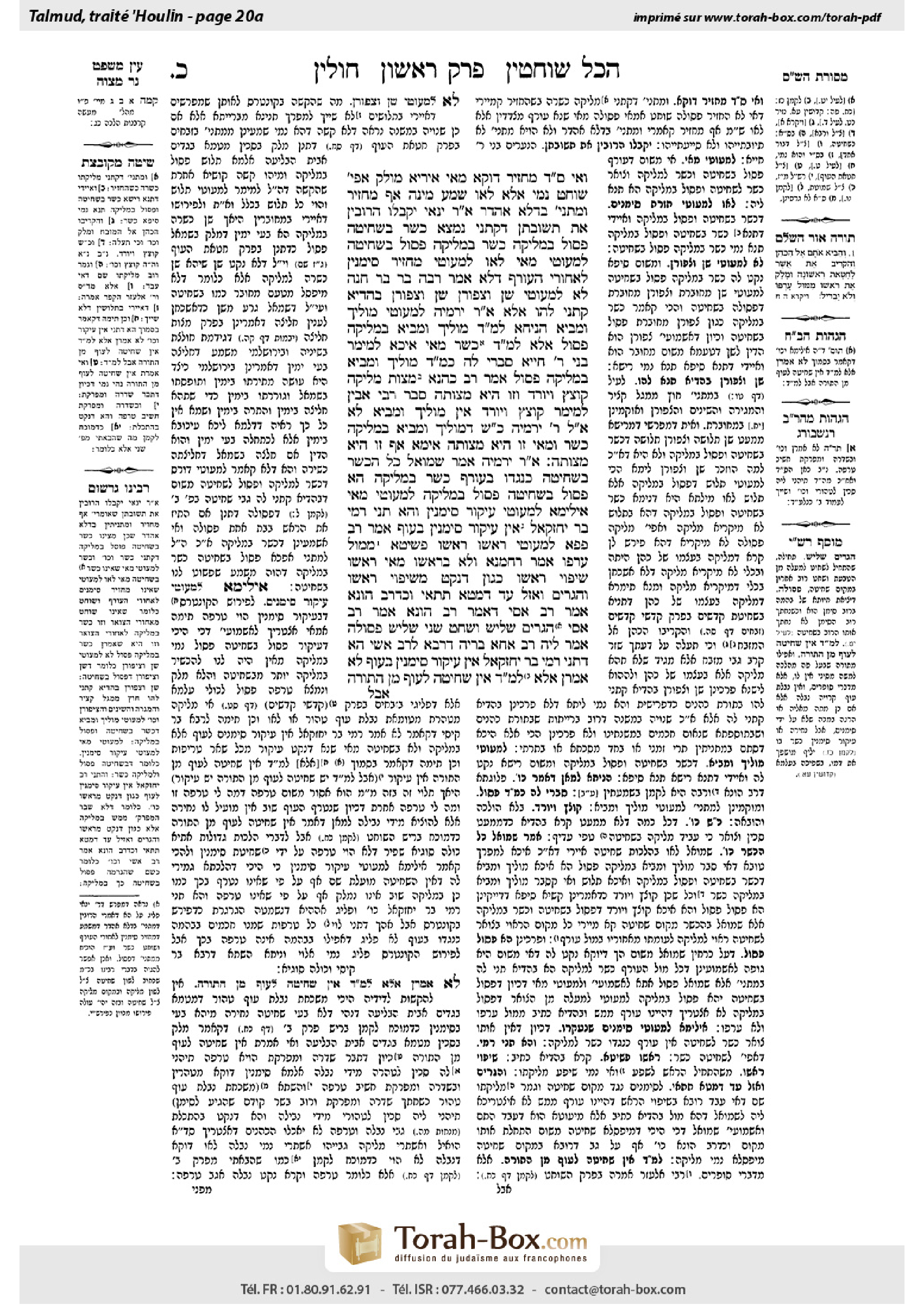
Chullin 20a: Talmud study for Daf Yomi
Study the Talmud for Daf Yomi with scanned pages, Hebrew text, English translations from Sefaria and AI-generated French translations.
Passage selection and English or AI-generated French translation are available where the scan has annotations. Daf Study is independent of Torah-Box and Sefaria.
Browse Chullin · חולין · All tractatesChullin 20a text and translations
This page of Chullin includes the Aramaic text, an English translation and an AI-generated French translation, alongside the scan above.
חולין כ׳ א · Aramaic and Hebrew text
וְאִי סָלְקָא דַעְתָּךְ מַחְזִיר דַּוְקָא, מַאי אִירְיָא מוֹלֵק? אֲפִילּוּ שׁוֹחֵט נָמֵי! אֶלָּא לָאו שְׁמַע מִינַּהּ אַף מַחְזִיר, וּמַתְנִיתִין בִּדְלָא אַהְדַּר.
אָמַר רַבִּי יַנַּאי: יְקַבְּלוּ הָרוֹבִין אֶת תְּשׁוּבָתָן, דְּקָתָנֵי: נִמְצָא כָּשֵׁר בִּשְׁחִיטָה – פָּסוּל בִּמְלִיקָה, כָּשֵׁר בִּמְלִיקָה – פָּסוּל בִּשְׁחִיטָה. לְמַעוֹטֵי מַאי? לָאו לְמַעוֹטֵי מַחֲזִיר סִימָנִין לַאֲחוֹרֵי הָעוֹרֶף, דְּלָא?
אָמַר רַבָּה בַּר בַּר חָנָה: לָא, לְמַעוֹטֵי שֵׁן וְצִפּוֹרֶן. שֵׁן וְצִפּוֹרֶן בְּהֶדְיָא קָתָנֵי לְהוּ.
אֶלָּא אָמַר רַבִּי יִרְמְיָה: לְמַעוֹטֵי מוֹלִיךְ וּמֵבִיא. הָנִיחָא לְמַאן דְּאָמַר מוֹלִיךְ וּמֵבִיא בִּמְלִיקָה – פָּסוּל, אֶלָּא לְמַאן דְּאָמַר כָּשֵׁר, מַאי אִיכָּא לְמֵימַר? בְּנֵי רַבִּי חִיָּיא סָבְרִי לַהּ כְּמַאן דְּאָמַר מוֹלִיךְ וּמֵבִיא בִּמְלִיקָה – פָּסוּל.
אָמַר רַב כָּהֲנָא: מִצְוַת מְלִיקָה קוֹצֵץ וְיוֹרֵד, וְזוֹ הִיא מִצְוָתָהּ. סָבַר רַבִּי אָבִין לְמֵימַר: קוֹצֵץ וְיוֹרֵד – אִין, מוֹלִיךְ וּמֵבִיא – לָא. אֲמַר לֵיהּ רַבִּי יִרְמְיָה: כׇּל שֶׁכֵּן דְּמוֹלִיךְ וּמֵבִיא בִּמְלִיקָה כָּשֵׁר, וּמַאי זוֹ הִיא מִצְוָתָהּ? אֵימָא: אַף זוֹ הִיא מִצְוָתָהּ.
אָמַר רַבִּי יִרְמְיָה אָמַר שְׁמוּאֵל: כׇּל הַכָּשֵׁר בִּשְׁחִיטָה – כְּנֶגְדּוֹ בָּעוֹרֶף כָּשֵׁר בִּמְלִיקָה, הָא פָּסוּל בִּשְׁחִיטָה – פָּסוּל בִּמְלִיקָה. לְמַעוֹטֵי מַאי? אִילֵּימָא לְמַעוֹטֵי עִיקּוּר סִימָנִין, וְהָא תָּנֵי רָמֵי בַּר יְחֶזְקֵאל: אֵין עִיקּוּר סִימָנִין בָּעוֹף!
אָמַר רַב פָּפָּא: לְמַעוֹטֵי רֹאשׁוֹ. רֹאשׁוֹ פְּשִׁיטָא? ״מִמּוּל עׇרְפּוֹ״ אָמַר רַחֲמָנָא, וְלֹא בְּרֹאשׁוֹ!
מַאי ״רֹאשׁוֹ״? שִׁיפּוּי רֹאשׁוֹ, כְּגוֹן דְּנָקֵט מִשִּׁיפּוּי רֹאשׁוֹ וְהִגְרִים וַאֲזַל עַד דִּמְטָא תַּתַּאי, וְכִדְרַב הוּנָא אָמַר רַב אַסִּי, דְּאָמַר רַב הוּנָא אָמַר רַב אַסִּי: הִגְרִים שְׁלִישׁ וְשָׁחַט שְׁנֵי שְׁלִישׁ – פְּסוּלָה.
אֲמַר לֵיהּ רַב אַחָא בְּרֵיהּ דְּרָבָא לְרַב אָשֵׁי: הָא דְּתָנֵי רָמֵי בַּר יְחֶזְקֵאל אֵין עִיקּוּר סִימָנִין בָּעוֹף, לָא אֲמַרַן אֶלָּא לְמַאן דְּאָמַר אֵין שְׁחִיטָה לָעוֹף מִן הַתּוֹרָה,
Chullin 20a · English translation
And if it enters your mind that the mitzva is specifically to move the simanim behind the nape and pinch them, why did the tanna say specifically that if one pinches in this manner it is valid? Even if one slaughters from the nape in this manner the slaughter would be valid. Rather, must one not conclude from it that the proper understanding is: One may even move the simanim behind the nape and pinch, and the mishna is referring to a case where one did not move the simanim behind the nape.
Rabbi Yannai says: The young ones [rovin], the sons of Rabbi Ḥiyya, shall receive their response that rejects their statement from that which is taught in the mishna: It is found that that which is valid for slaughter is not valid for pinching and that which is valid for pinching is not valid for slaughter. What does this statement serve to exclude? Does it not serve to exclude the case where one moves the simanim behind the nape, teaching that it is valid only for slaughter and not for pinching?
Rabba bar bar Ḥana said: No, perhaps it serves to exclude one who uses a tooth or a fingernail that is not detached, which are valid for pinching and not valid for slaughter. The Gemara objects: That could not be, as the tanna teaches explicitly the case of a tooth and a fingernail in a mishna (15b), and there was no need to repeat it.
Rather, Rabbi Yirmeya said: The statement of the mishna: That which is valid for slaughter is not valid for pinching, serves to exclude drawing back and forth. One who pinches may not cut the simanim by drawing his fingernail back and forth. Rather, he must press and cut them in one motion. The Gemara asks: This works out well according to the one who says: Drawing back and forth for pinching is not valid, but according to the one who says: It is valid, what is there to say? The Gemara answers: The sons of Rabbi Ḥiyya hold in accordance with the one who says: Drawing back and forth for pinching is not valid.
Rav Kahana says: The mitzva of pinching is that one cuts with his fingernail from the nape and continues downward, and that is its mitzva. Rabbi Avin thought to say: Cuts and continues downward, yes; draws back and forth, no. Rabbi Yirmeya said to him: All the more so that drawing back and forth for pinching is valid. The Gemara asks: And what is the meaning of the phrase: That is its mitzva, which indicates that it is specifically in that manner? The Gemara answers: Say that it means: That too is its mitzva.
§ Rabbi Yirmeya says that Shmuel says: Any place that is valid for slaughter on the throat is correspondingly valid for pinching on the nape. By inference, any place on the throat that is not valid for slaughter is not valid for pinching. The Gemara asks: What does this statement serve to exclude? If we say that it serves to exclude ripping the simanim from their place before cutting them, which is invalid with regard to pinching just as with regard to slaughter, but didn’t Rami bar Yeḥezkel teach: There is no disqualification of ripping the simanim in the case of a bird?
Rav Pappa said: It serves to exclude pinching the occipital bone at the back of its head; just as it is not the place of slaughter, it is not the place of pinching. The Gemara asks: Isn’t it obvious that pinching at the back of its head is not valid? The Merciful One states: “Adjacent to its nape,” and not at its head.
The Gemara answers: What is its head that is not the place for pinching? It is the incline of its head, e.g., in a case where one began at the incline of its head and diverted and continued until he reached below to the place of the simanim, where he completed the pinching. Since he began the process in the incorrect location, it is invalid, similar to slaughter. And this is in accordance with the opinion that Rav Huna says that Rav Asi says, as Rav Huna says that Rav Asi says: If one diverted the knife upward and cut one-third of the windpipe and then cut two-thirds within the ring, the slaughter is not valid.
Rav Aḥa, son of Rava, said to Rav Ashi: With regard to that which Rami bar Yeḥezkel teaches: There is no disqualification for ripping simanim in a bird, we say it only according to the one who says: There is no source for the slaughter of a bird in the Torah.
Chullin 20a · Traduction française (IA)
Et si cela entre dans votre pensée que la mitsva est spécifiquement de déplacer les simanim derrière la nuque et de les écraser, pourquoi le tanna a-t-il dit spécifiquement que si l'on écrase ainsi, cela est valide ? Même si l'on sacrifie de la nuque de cette manière, la sacrifice serait valide. Plutôt, ne devons-nous pas conclure de cela que la compréhension correcte est : On peut même déplacer les simanim derrière la nuque et les écraser, et la mitsna fait référence à un cas où l'on n'a pas déplacé les simanim derrière la nuque.
Rabbi Yannai dit : Les jeunes [rovin], les fils de Rabbi Ḥiyya, recevront leur réponse qui rejette leur déclaration à partir de ce qui est enseigné dans la mitsna : On trouve que ce qui est valide pour la sacrifice n'est pas valide pour l'écrasement et ce qui est valide pour l'écrasement n'est pas valide pour la sacrifice. À quoi cette déclaration sert-elle à exclure ? N'est-ce pas pour exclure le cas où l'on déplace les simanim derrière la nuque, enseignant qu'il est valide uniquement pour la sacrifice et non pour l'écrasement ?
Rabba bar bar Ḥana dit : Non, peut-être sert-elle à exclure celui qui utilise un dent ou un ongle non détaché, qui sont valides pour l'écrasement et non pour la sacrifice. La Guemara s'oppose : Cela ne peut pas être, car le tanna enseigne explicitement le cas d'un dent et d'un ongle dans une mitsna (15b), et il n'y avait pas besoin de le répéter.
Plutôt, Rabbi Yirmeya dit : La déclaration de la mitsna : Ce qui est valide pour la sacrifice n'est pas valide pour l'écrasement, sert à exclure le déplacement en arrière et en avant. Celui qui écrase ne doit pas couper les simanim en déplaçant son ongle en arrière et en avant. Plutôt, il doit les couper en un seul mouvement. La Guemara demande : Cela s'aligne bien avec celui qui dit que le déplacement en arrière et en avant pour l'écrasement n'est pas valide, mais selon celui qui dit qu'il est valide, que dire ? La Guemara répond : Les fils de Rabbi Ḥiyya suivent celui qui dit que le déplacement en arrière et en avant pour l'écrasement n'est pas valide.
Rav Kahana dit : La mitsva de l'écrasement est que l'on coupe avec son ongle de la nuque et qu'on continue vers le bas, et c'est ainsi que la mitsva est accomplie. Rabbi Avin pensait à dire : Couper et continuer vers le bas, oui ; déplacer en arrière et en avant, non. Rabbi Yirmeya dit à lui : Tout autant que le déplacement en arrière et en avant pour l'écrasement est valide. La Guemara demande : Et quelle est la signification de la phrase : C'est ainsi que la mitsva est accomplie, qui indique qu'il est spécifiquement ainsi ? La Guemara répond : Dites que cela signifie : Cela aussi est la mitsva.
§ Rabbi Yirmeya dit que Shmuel dit : Tout lieu valide pour la sacrifice sur la gorge est correspondamment valide pour l'écrasement sur la nuque. Par conséquent, tout lieu sur la gorge qui n'est pas valide pour la sacrifice n'est pas valide pour l'écrasement. La Guemara demande : À quoi cette déclaration sert-elle à exclure ? Si nous disons qu'elle sert à exclure l'arrachage des simanim de leur place avant de les couper, ce qui est invalide concernant l'écrasement tout comme concernant la sacrifice, mais n'a-t-il pas dit Rami bar Yeḥezkel : Il n'y a pas de disqualification pour l'arrachage des simanim dans le cas d'un oiseau ?
Rav Pappa dit : Elle sert à exclure l'écrasement de l'os occipital à l'arrière de sa tête ; tout comme ce n'est pas le lieu de la bataille, ce n'est pas le lieu de l'écrasement. La Guemara demande : N'est-ce pas évident que l'écrasement à l'arrière de sa tête n'est pas valide ? L'Éternel dit : "Proche de sa nuque", et non à sa tête.
La Guemara répond : Quel est ce que l'on appelle la tête qui n'est pas le lieu pour l'écrasement ? C'est l'inclinaison de sa tête, c'est-à-dire dans un cas où l'on commence à l'inclinaison de sa tête et s'écarte pour continuer jusqu'à ce qu'on atteigne en dessous le lieu des simanim, où l'on termine l'écrasement. Puisque l'on a commencé le processus au lieu incorrect, cela est invalide, semblable à la bataille. Et cela correspond à l'opinion que Rav Huna dit que Rav Asi dit, comme Rav Huna dit que Rav Asi dit : Si l'on a dévié le couteau vers le haut et a coupé un tiers du trachée puis deux tiers à l'intérieur de l'anneau, la bataille n'est pas valide.
Rav Aḥa, fils de Rava, dit à Rav Ashi : Concernant ce que Rami bar Yeḥezkel enseigne : Il n'y a pas de disqualification pour l'arrachage des simanim dans un oiseau, nous disons cela uniquement selon celui qui dit : Il n'y a pas de source pour la bataille d'un oiseau dans la Torah.
Traduction française générée par IA à partir de l’édition anglaise de Sefaria. Vérifie toujours un passage avec le texte source.
Text from Sefaria: William Davidson Edition - Vocalized Aramaic (unknown); William Davidson Edition - English (CC BY NC).