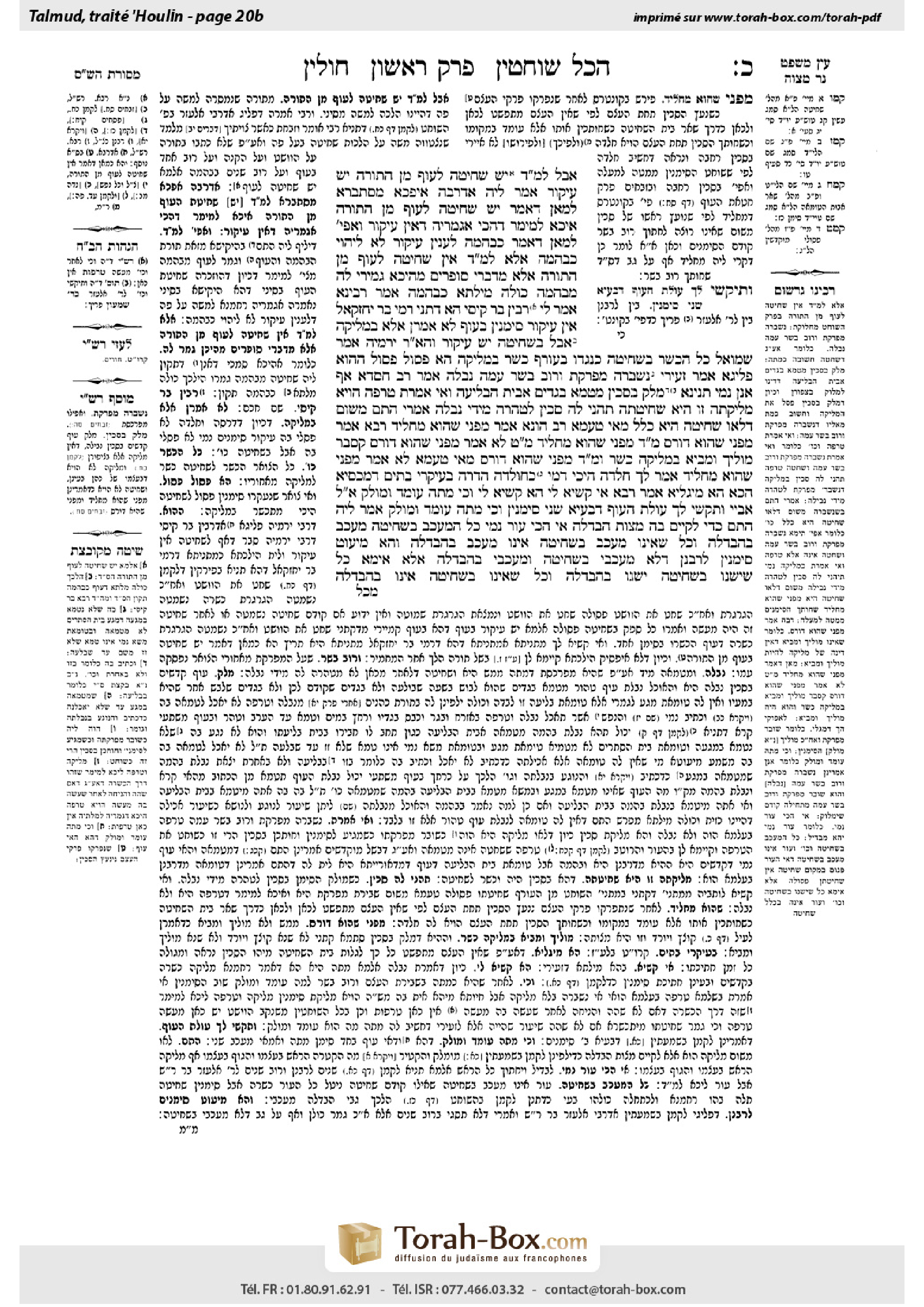
Chullin 20b: Talmud study for Daf Yomi
Study the Talmud for Daf Yomi with scanned pages, Hebrew text, English translations from Sefaria and AI-generated French translations.
Passage selection and English or AI-generated French translation are available where the scan has annotations. Daf Study is independent of Torah-Box and Sefaria.
Browse Chullin · חולין · All tractatesChullin 20b text and translations
This page of Chullin includes the Aramaic text, an English translation and an AI-generated French translation, alongside the scan above.
חולין כ׳ ב · Aramaic and Hebrew text
אֲבָל לְמַאן דְּאָמַר יֵשׁ שְׁחִיטָה לָעוֹף מִן הַתּוֹרָה, יֵשׁ עִיקּוּר.
אֲמַר לֵיהּ: אַדְּרַבָּה, אִיפְּכָא מִסְתַּבְּרָא! לְמַאן דְּאָמַר יֵשׁ שְׁחִיטָה לָעוֹף מִן הַתּוֹרָה, אִיכָּא לְמֵימַר דְּהָכִי אַגְמְרֵיהּ דְּאֵין עִיקּוּר, וַאֲפִילּוּ לְמַאן דְּאָמַר כִּבְהֵמָה, לְעִנְיַן עִיקּוּר לָא לֶיהֱוֵי כִּבְהֵמָה.
אֶלָּא לְמַאן דְּאָמַר: אֵין שְׁחִיטָה לָעוֹף מִן הַתּוֹרָה אֶלָּא מִדִּבְרֵי סוֹפְרִים, מֵהֵיכָא גְּמִירִי לַהּ? מִבְּהֵמָה, כּוּלַּהּ מִילְּתָא כִּבְהֵמָה!
אָמַר רָבִינָא, אָמַר לִי רָבִין בַּר קִיסִי: הָא דְּתָנֵי רָמֵי בַּר יְחֶזְקֵאל, אֵין עִיקּוּר סִימָנִין בָּעוֹף – לָא אֲמַרַן אֶלָּא בִּמְלִיקָה, אֲבָל בִּשְׁחִיטָה יֵשׁ עִיקּוּר. וְהָאָמַר רַבִּי יִרְמְיָה אָמַר שְׁמוּאֵל: כׇּל הַכָּשֵׁר בִּשְׁחִיטָה כְּנֶגְדּוֹ בָּעוֹרֶף כָּשֵׁר בִּמְלִיקָה, הָא פָּסוּל – פָּסוּל! הָהִיא פְּלִיגָא.
אָמַר זְעֵירִי: נִשְׁבְּרָה מַפְרֶקֶת וְרוֹב בָּשָׂר עִמָּהּ – נְבֵלָה.
אָמַר רַב חִסְדָּא: אַף אֲנַן נָמֵי תְּנֵינָא, מָלַק בְּסַכִּין – מְטַמֵּא בְּגָדִים אַבֵּית הַבְּלִיעָה, וְאִי אָמְרַתְּ טְרֵפָה הָוְיָא, מְלִיקָתָהּ זוֹ הִיא שְׁחִיטָתָהּ – תַּהֲנֵי לַהּ סַכִּין לְטַהֲרָהּ מִידֵי נְבֵלָה.
אָמְרִי: הָתָם מִשּׁוּם דְּלָאו שְׁחִיטָה הִיא כְּלָל. מַאי טַעְמָא? רַב הוּנָא אָמַר: מִפְּנֵי שֶׁהוּא מַחְלִיד, רָבָא אָמַר: מִפְּנֵי שֶׁהוּא דּוֹרֵס.
מַאן דְּאָמַר מִפְּנֵי שֶׁהוּא מַחְלִיד, מַאי טַעְמָא לָא אָמַר מִפְּנֵי שֶׁהוּא דּוֹרֵס? קָסָבַר: מוֹלִיךְ וּמֵבִיא בִּמְלִיקָה כָּשֵׁר. וּמַאן דְּאָמַר מִפְּנֵי שֶׁהוּא דּוֹרֵס, מַאי טַעְמָא לָא אָמַר מִפְּנֵי שֶׁהוּא מַחְלִיד? אָמַר לָךְ: חֲלָדָה הֵיכִי דָּמֵי? כְּחוּלְדָּה הַדָּרָה בְּעִיקְּרֵי בָתִּים דְּמִכַּסְּיָא, הָכָא הָא מִיגַּלְּיָא.
אָמַר רָבָא: אִי קַשְׁיָא לִי הָא קַשְׁיָא לִי, וְכִי מֵתָה עוֹמֵד וּמוֹלֵק?
אֲמַר לֵיהּ אַבָּיֵי: וְתִקְשֵׁי לָךְ עוֹלַת הָעוֹף, דְּבָעֲיָא שְׁנֵי סִימָנִין, וְכִי מֵתָה עוֹמֵד וּמוֹלֵק? אֲמַר לֵיהּ: הָתָם כְּדֵי לְקַיֵּים בָּהּ מִצְוַת הַבְדָּלָה.
אִי הָכִי, עוֹר נָמֵי! כׇּל הַמְעַכֵּב בִּשְׁחִיטָה מְעַכֵּב בְּהַבְדָּלָה, וְכֹל שֶׁאֵינוֹ מְעַכֵּב בִּשְׁחִיטָה אֵינוֹ מְעַכֵּב בְּהַבְדָּלָה.
וְהָא מִיעוּט סִימָנִין לְרַבָּנַן, דְּלָא מִעַכְּבִי בִּשְׁחִיטָה, וּמְעַכְּבִי בְּהַבְדָּלָה! אֶלָּא אֵימָא: כֹּל שֶׁיֶּשְׁנוֹ בִּשְׁחִיטָה יֶשְׁנוֹ בְּהַבְדָּלָה, וְכֹל שֶׁאֵינוֹ בִּשְׁחִיטָה אֵינוֹ בְּהַבְדָּלָה.
Chullin 20b · English translation
But according to the one who says: There is a source for the slaughter of a bird in the Torah, there is disqualification for ripping simanim in a bird as well.
Rav Ashi said to him: On the contrary, the opposite is reasonable. According to the one who says: There is a source for the slaughter of a bird in the Torah, the halakhot of slaughter are not explicit and were transmitted to Moses orally, and it can be said that this is what God taught him, that there is no disqualification for ripping simanim. And even according to the one who says that the halakhic status of a bird is like that of an animal, as the halakhot of the slaughter of a bird are derived from the halakhot of the slaughter of an animal, perhaps God taught Moses that with regard to the matter of ripping simanim it will not be like an animal.
But according to the one who says: There is no source for the slaughter of a bird in the Torah, but rather it is by rabbinic law, from where are the halakhot of the slaughter of a bird learned? They are learned from the halakhot of the slaughter of an animal; consequently, the entire matter of the slaughter of a bird is like that of an animal.
Ravina said: Ravin bar Kisi said to me: With regard to that which Rami bar Yeḥezkel teaches, i.e., that there is no disqualification for ripping simanim in a bird, we say it only with regard to pinching, but with regard to slaughter, there is disqualification for ripping simanim. The Gemara objects: But doesn’t Rabbi Yirmeya say that Shmuel says: Any place that is valid for slaughter on the throat is correspondingly valid for pinching on the nape, but that which is not valid for slaughter is not valid for pinching. The Gemara explains: That halakha disagrees with this statement of Shmuel.
§ Ze’eiri says: If the neck bone of an animal or a bird was broken and most of the surrounding flesh was cut with it, the status of the animal or the bird is that of an unslaughtered carcass. It is dead and can no longer be rendered fit by slaughter.
Rav Ḥisda said that we learn this in a mishna (Zevaḥim 68a) as well: If one pinched a bird offering with a knife and not with his thumbnail, the bird renders the garments of one who swallows it impure when it is in the throat, which is the halakha in the case of an unslaughtered carcass of a kosher bird. And if you would say that if the neck bone of an animal or a bird was broken and most of the surrounding flesh was cut with it, the bird is not an unslaughtered carcass but it is a tereifa, then since with regard to a bird offering its pinching is its slaughter, let pinching with a knife be effective to purify the bird from the impurity of an unslaughtered carcass, as a tereifa does not transmit impurity when slaughtered properly. From the halakha that pinching with a knife does not render the bird pure it is evident that when its neck bone is broken the bird is rendered an unslaughtered carcass.
The Sages say in response: There, pinching with a knife is ineffective in rendering it pure not because the breaking of the neck bone renders the bird an unslaughtered carcass. Rather, it is because it is not slaughter at all. The Gemara asks: What is the reason? Rav Huna says: It is because he conceals the knife and performs an inverted slaughter, which invalidates the slaughter. Rava says: It is because he presses the knife.
The Gemara asks: With regard to the one who says: Because he conceals the knife and performs an inverted slaughter, what is the reason that he does not say: Because he presses the knife? The Gemara answers: It is because he holds that drawing back and forth in pinching is valid. The Gemara asks: And the one who says: Because he presses the knife, what is the reason that he does not say: Because he conceals [maḥlid] the knife? The Gemara answers that he could have said to you: What are the circumstances of concealing the knife? It is like a rat [ḥulda] that resides in the foundations of houses that are concealed. Here, when he begins cutting from the nape of the neck, that knife is exposed.
Rava said: If that which Ze’eiri said: If the neck bone of an animal or a bird was broken and most of the surrounding flesh was cut with it, the status of the animal or the bird is that of an unslaughtered carcass, is difficult for me, this is difficult for me: How does pinching a bird offering prepare it for sacrifice? Since pinching involves breaking the neck bone and cutting most of the surrounding flesh with it before cutting the simanim, what significance is there to pinching the simanim? And does he stand and pinch a dead bird? If it is dead, of what use is the pinching?
Abaye said to him: And even without the statement of Ze’eiri, let the case of a bird burnt offering be difficult for you, as it requires cutting of two simanim. Since slaughter of a non-sacred bird requires cutting of one siman, once one siman is cut the bird is considered dead for all intents and purposes, and does he stand and pinch a dead bird? Rava said to him: There, he continues pinching in order to fulfill through it the mitzva of separation between the head and the body in the bird burnt offering.
The Gemara asks: If so, there should be an obligation to cut the skin of the bird as well in order to fulfill the mitzva of separation. Abaye answers: Any element that invalidates slaughter invalidates separation, and any element that does not invalidate slaughter does not invalidate separation. Failure to cut the skin does not invalidate slaughter.
The Gemara objects: But isn’t there the minority of the simanim according to the Rabbis, which do not invalidate slaughter, as, if one slaughtered a majority of the simanim and a minority remained uncut, the slaughter is valid, and they hold that they invalidate separation? The Gemara clarifies: Rather, say: Any element that is in effect with regard to slaughter is in effect with regard to separation, and any element that is not in effect with regard to slaughter is not in effect with regard to separation. The two simanim, although they do not invalidate slaughter, are part of the mitzva of slaughter, while the skin is not part of the mitzva of slaughter.
Chullin 20b · Traduction française (IA)
Mais selon celui qui dit : Il y a une source pour la mise à mort d'un oiseau dans la Torah, il y a aussi une invalidation pour l'arrachage des simanim dans un oiseau.
Rav Ashi dit à lui : Au contraire, l'inverse est raisonnable. Selon celui qui dit : Il y a une source pour la mise à mort d'un oiseau dans la Torah, les halakhot de la mise à mort ne sont pas explicites et ont été transmises à Moïse oralement, et on peut dire que c'est ce que Dieu lui a enseigné, à savoir qu'il n'y a pas d'invalidation pour l'arrachage des simanim. Et même selon celui qui dit que le statut halakhique d'un oiseau est comme celui d'un animal, puisque les halakhot de la mise à mort d'un oiseau sont dérivées des halakhot de la mise à mort d'un animal, peut-être Dieu a-t-il enseigné à Moïse que concernant la question de l'arrachage des simanim, cela ne sera pas comme pour un animal.
Mais selon celui qui dit : Il n'y a pas de source pour la mise à mort d'un oiseau dans la Torah, mais plutôt par la loi rabbinique, d'où les halakhot de la mise à mort d'un oiseau sont-elles apprises ? Elles sont apprises à partir des halakhot de la mise à mort d'un animal ; par conséquent, toute la question de la mise à mort d'un oiseau est comme celle d'un animal.
Ravina dit : Rabin bar Kisi me l'a dit : Concernant ce que Rami bar Yéhézqel enseigne, c'est-à-dire que l'arrachage des simanim dans un oiseau n'est pas invalidant, on dit cela uniquement concernant l'écrasement, mais concernant la mise à mort, l'arrachage des simanim est invalidant. La Guemara s'oppose à cela en disant : Mais ne dit pas Rabbi Yirmeya que Shmuel dit : Tout lieu valide pour la mise à mort à la gorge est correspondamment valide pour l'écrasement à la nuque, mais ce qui n'est pas valide pour la mise à mort n'est pas valide pour l'écrasement. La Guemara explique : Cette halakha est en désaccord avec cette déclaration de Shmuel.
Ze’eiri dit : Si l'os de la gorge d'un animal ou d'un oiseau a été brisé et que la plupart de la chair environnante a été coupée avec lui, le statut de l'animal ou de l'oiseau est celui d'un cadavre non sacrifié. Il est mort et ne peut plus être rendu propre par la mise à mort.
Rav Ḥisda dit que nous apprenons cela également dans une mitsva (Zevaḥim 68a) : Si l'on écrase un oiseau sacré avec un couteau et non avec son ongle, l'oiseau rend impur les vêtements de celui qui le déglutit lorsqu'il est dans la gorge, ce qui est la halakha dans le cas d'un cadavre non sacrifié d'un oiseau kasher. Et si l'on dit que si l'os de la gorge d'un animal ou d'un oiseau a été brisé et que la plupart de la chair environnante a été coupée avec lui, l'oiseau n'est pas un cadavre non sacrifié mais un tereifa, alors puisque concernant l'offrande d'oiseau l'écrasement est sa mise à mort, l'écrasement avec un couteau purifierait l'oiseau de l'impureté du cadavre non sacrifié, car un tereifa ne transmet pas l'impureté lorsqu'il est correctement sacrifié. À partir de la halakha que l'écrasement avec un couteau ne rend pas l'oiseau propre, il est évident que lorsque son os de la gorge est brisé, l'oiseau devient un cadavre non sacrifié.
Les Sages répondent : Là, l'écrasement avec un couteau n'est pas efficace pour le rendre propre non pas parce que le bris de l'os de la gorge rend l'oiseau un cadavre non sacrifié. Mais plutôt, c'est parce que ce n'est pas une mise à mort du tout. La Guemara demande : Quelle est la raison ? Rav Huna dit : C'est parce qu'il cache le couteau et effectue une mise à mort inversée, ce qui annule la mise à mort. Rava dit : C'est parce qu'il presse le couteau.
La Guemara demande : Concernant celui qui dit : Parce qu'il cache le couteau et effectue une mise à mort inversée, quelle est la raison qu'il ne dit pas : Parce qu'il presse le couteau ? La Guemara répond : C'est parce qu'il considère que le glissement dans l'écrasement est valide. La Guemara demande : Et celui qui dit : Parce qu'il presse le couteau, quelle est la raison qu'il ne dit pas : Parce qu'il cache [maḥlid] le couteau ? La Guemara répond qu'il pourrait vous dire : Quelles sont les circonstances du cache couteau ? C'est comme un rat [ḥulda] qui habite dans les fondations des maisons cachées. Ici, lorsqu'il commence à couper à la nuque, ce couteau est exposé.
Rava dit : Si ce que Ze’eiri a dit : Si l'os de la gorge d'un animal ou d'un oiseau a été brisé et que la plupart de la chair environnante a été coupée avec lui, le statut de l'animal ou de l'oiseau est celui d'un cadavre non sacrifié, me pose difficulté, cela me pose difficulté : Comment l'écrasement d'une offrande d'oiseau prépare-t-il à la sacrifice ? Puisque l'écrasement implique de briser l'os de la gorge et de couper la plupart de la chair environnante avant de couper les simanim, quelle est l'importance de l'écrasement des simanim ? Et est-ce qu'il se tient et écrase un oiseau mort ? Si c'est mort, à quoi sert l'écrasement ?
Abaye dit à lui : Et même sans la déclaration de Ze’eiri, faites que le cas d’une offrande d’oiseau brûlé soit difficile pour vous, car il exige la coupe de deux simanim. Puisque la mise à mort d’un oiseau non sacré exige la coupe d’un seul siman, une fois que ce siman est coupé, l’oiseau est considéré comme mort pour tous les effets, et est-ce qu’il se tient et écrase un oiseau mort ? Rava dit à lui : Là, il continue l’écrasement afin de remplir par là la mitsva de séparation entre la tête et le corps dans l’offrande d’oiseau brûlé.
La Guemara demande : Si c’est ainsi, il devrait y avoir une obligation de couper la peau de l’oiseau également afin de remplir la mitsva de séparation. Abaye répond : Tout élément qui invalide la mise à mort invalide la séparation, et tout élément qui ne invalide pas la mise à mort ne invalide pas la séparation. L’échec à couper la peau ne invalide pas la mise à mort.
La Guemara rétorque : Mais n’y a-t-il pas la minorité des simanim selon les Rabbins, qui ne rendent pas nulle la bataille, comme, si l’on a sacrifié la majorité des simanim et que la minorité reste non tranchée, la bataille est valide, et ils considèrent qu’ils rendent nulle la séparation ? La Guemara clarifie : Plutôt, disons : Tout élément qui est en jeu concernant la bataille est en jeu concernant la séparation, et tout élément qui n’est pas en jeu concernant la bataille n’est pas en jeu concernant la séparation. Les deux simanim, bien qu’ils ne rendent pas nulle la bataille, font partie de la Mitsva de la bataille, tandis que la peau n’en fait pas partie.
Traduction française générée par IA à partir de l’édition anglaise de Sefaria. Vérifie toujours un passage avec le texte source.
Text from Sefaria: William Davidson Edition - Vocalized Aramaic (unknown); William Davidson Edition - English (CC BY NC).