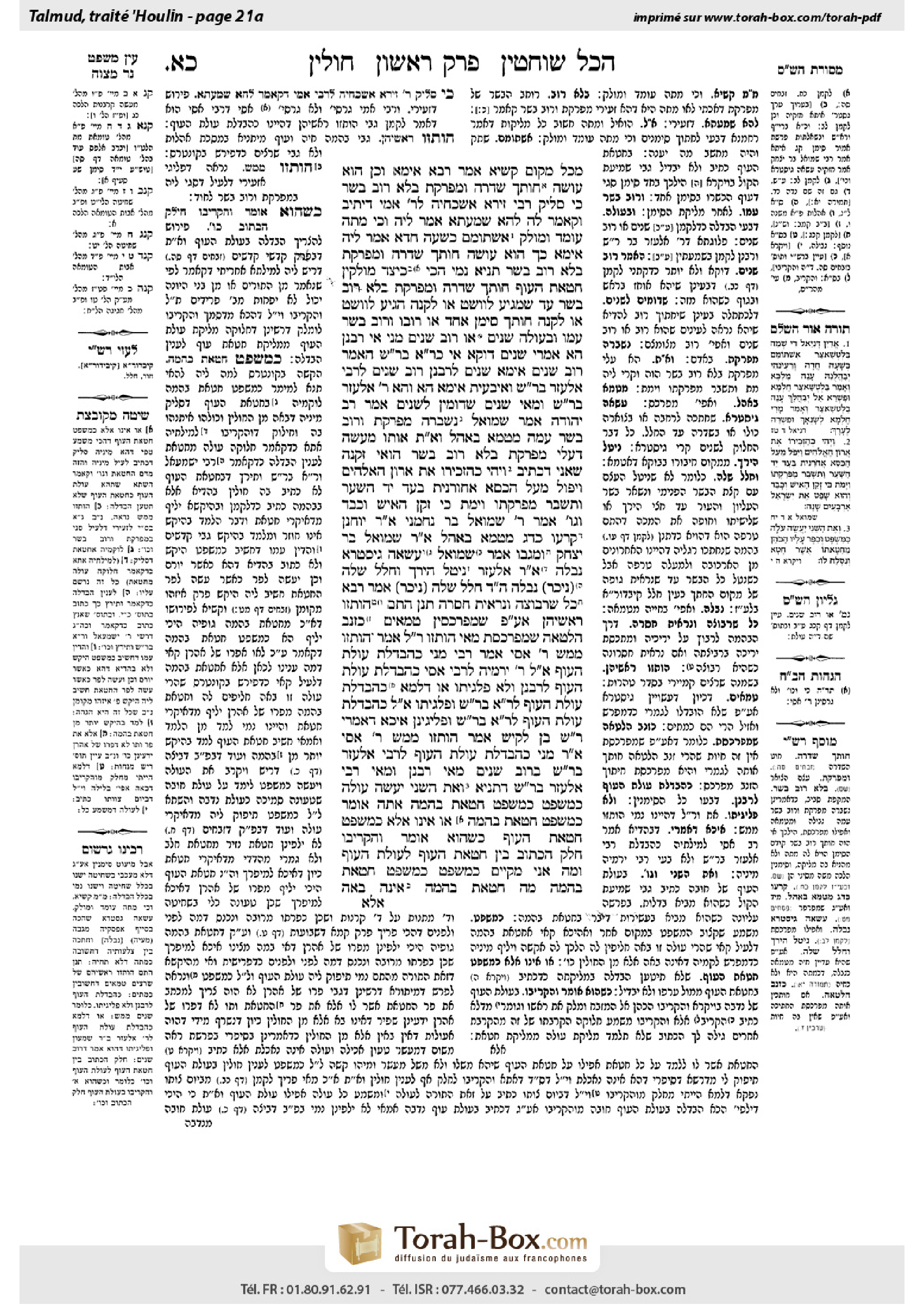
Chullin 21a: Talmud study for Daf Yomi
Study the Talmud for Daf Yomi with scanned pages, Hebrew text, English translations from Sefaria and AI-generated French translations.
Passage selection and English or AI-generated French translation are available where the scan has annotations. Daf Study is independent of Torah-Box and Sefaria.
Browse Chullin · חולין · All tractatesChullin 21a text and translations
This page of Chullin includes the Aramaic text, an English translation and an AI-generated French translation, alongside the scan above.
חולין כ״א א · Aramaic and Hebrew text
מִכׇּל מָקוֹם קַשְׁיָא! אָמַר רָבָא, אֵימָא: וְכֵן הוּא עוֹשֶׂה – חוֹתֵךְ שִׁדְרָה וּמַפְרֶקֶת בְּלֹא רוֹב בָּשָׂר.
כִּי סָלֵיק רַבִּי זֵירָא, אַשְׁכְּחֵיהּ לְרַבִּי אַמֵּי דְּיָתֵיב וְקָאָמַר לַהּ לְהָא שְׁמַעְתָּא. אֲמַר לֵיהּ: וְכִי מֵתָה עוֹמֵד וּמוֹלֵק? אֶשְׁתּוֹמַם כְּשָׁעָה חֲדָא, אֲמַר לֵיהּ: אֵימָא, כָּךְ הוּא עוֹשֶׂה: חוֹתֵךְ שִׁדְרָה וּמַפְרֶקֶת בְּלֹא רוֹב בָּשָׂר.
תַּנְיָא נָמֵי הָכִי: כֵּיצַד מוֹלְקִין חַטַּאת הָעוֹף? חוֹתֵךְ שִׁדְרָה וּמַפְרֶקֶת בְּלֹא רוֹב בָּשָׂר עַד שֶׁמַּגִּיעַ לַוֶּושֶׁט אוֹ לַקָּנֶה; הִגִּיעַ לַוֶּושֶׁט אוֹ לַקָּנֶה, חוֹתֵךְ סִימָן אֶחָד אוֹ רוּבּוֹ וְרוֹב בָּשָׂר עִמּוֹ, וּבְעוֹלָה שְׁנַיִם אוֹ רוֹב שְׁנַיִם.
מַנִּי? אִי רַבָּנַן – הָא אָמְרִי: שְׁנַיִם דַּוְקָא! אִי כְּרַבִּי אֶלְעָזָר בְּרַבִּי שִׁמְעוֹן – הָאָמַר: רוֹב שְׁנַיִם!
אֵימָא: שְׁנַיִם – לְרַבָּנַן, רוֹב שְׁנַיִם – לְרַבִּי אֶלְעָזָר בְּרַבִּי שִׁמְעוֹן, וְאִיבָּעֵית אֵימָא: הָא וְהָא רַבִּי אֶלְעָזָר בְּרַבִּי שִׁמְעוֹן, וּמַאי שְׁנַיִם – שֶׁדּוֹמִין לִשְׁנַיִם.
אָמַר רַב יְהוּדָה אָמַר שְׁמוּאֵל: נִשְׁבְּרָה מַפְרֶקֶת וְרוֹב בָּשָׂר עִמָּהּ – מְטַמֵּא בְּאֹהֶל.
וְאִם תֹּאמַר: אוֹתוֹ מַעֲשֶׂה דְּעֵלִי, מַפְרֶקֶת בְּלֹא רוֹב בָּשָׂר הֲוַאי! זִקְנָה שָׁאנֵי, דִּכְתִיב: ״וַיְהִי כְּהַזְכִּירוֹ אֶת אֲרוֹן הָאֱלֹהִים וַיִּפֹּל מֵעַל הַכִּסֵּא אֲחֹרַנִּית בְּעַד יַד הַשַּׁעַר וַתִּשָּׁבֵר מַפְרַקְתּוֹ וַיָּמֹת כִּי זָקֵן הָאִישׁ וְכָבֵד וְגוֹ׳״.
אָמַר רַבִּי שְׁמוּאֵל בַּר נַחְמָנִי אָמַר רַבִּי יוֹחָנָן: קְרָעוֹ כַּדָּג – מְטַמֵּא בְּאֹהֶל. אָמַר רַבִּי שְׁמוּאֵל בַּר יִצְחָק: וּמִגַּבּוֹ.
אָמַר שְׁמוּאֵל: עֲשָׂאָהּ גִּיסְטְרָא – נְבֵלָה. אָמַר רַבִּי אֶלְעָזָר: נִיטַּל הַיָּרֵךְ וְחָלָל שֶׁלָּהּ (נִיכָּר) – נְבֵלָה. הֵיכִי דָּמֵי חָלָל שֶׁלָּהּ (נִיכָּר)? אָמַר רָבָא: כֹּל שֶׁרְבוּצָה וְנִרְאֵית חֲסֵרָה.
תְּנַן הָתָם: הוּתְּזוּ רָאשֵׁיהֶן, אַף עַל פִּי שֶׁמְּפַרְכְּסִין – טְמֵאִים, כִּזְנַב הַלְּטָאָה שֶׁמְּפַרְכֶּסֶת.
מַאי הוּתְּזוּ? רֵישׁ לָקִישׁ אָמַר: הוּתְּזוּ מַמָּשׁ, רַבִּי אַסִּי אָמַר רַבִּי מָנִי: כְּהַבְדָּלַת עוֹלַת הָעוֹף.
אֲמַר לֵיהּ רַבִּי יִרְמְיָה לְרַבִּי אַסִּי: כְּהַבְדָּלַת עוֹלַת הָעוֹף לְרַבָּנַן, וְלָא פְּלִיגִיתוּ, אוֹ דִלְמָא כְּהַבְדָּלַת עוֹלַת הָעוֹף לְרַבִּי אֶלְעָזָר בְּרַבִּי שִׁמְעוֹן, וּפְלִגִיתוּ?
אֲמַר לֵיהּ: כְּהַבְדָּלַת עוֹלַת הָעוֹף לְרַבִּי אֶלְעָזָר בְּרַבִּי שִׁמְעוֹן, וּפְלִיגִינַן.
אִיכָּא דְּאָמְרִי: רַבִּי שִׁמְעוֹן בֶּן לָקִישׁ אָמַר: הוּתְּזוּ מַמָּשׁ, רַבִּי אַסִּי אָמַר רַבִּי מָנִי: כְּהַבְדָּלַת עוֹלַת הָעוֹף לְרַבִּי אֶלְעָזָר בְּרַבִּי שִׁמְעוֹן בְּרוֹב שְׁנַיִם.
מַאי רַבָּנַן וּמַאי רַבִּי אֶלְעָזָר בְּרַבִּי שִׁמְעוֹן? דְּתַנְיָא: ״וְאֶת הַשֵּׁנִי יַעֲשֶׂה עֹלָה כַּמִּשְׁפָּט״ – כְּמִשְׁפַּט חַטַּאת בְּהֵמָה.
אַתָּה אוֹמֵר כְּמִשְׁפַּט חַטַּאת בְּהֵמָה, אוֹ אֵינוֹ אֶלָּא כְּמִשְׁפַּט חַטַּאת הָעוֹף? כְּשֶׁהוּא אוֹמֵר ״וְהִקְרִיבוֹ״, חִלֵּק הַכָּתוּב בֵּין חַטַּאת הָעוֹף לְעוֹלַת הָעוֹף, וּמָה אֲנִי מְקַיֵּים ״כַּמִּשְׁפָּט״ – כְּמִשְׁפַּט חַטַּאת בְּהֵמָה. מָה חַטַּאת בְּהֵמָה אֵינָהּ בָּאָה
Chullin 21a · English translation
In any case, the statement of Ze’eiri remains difficult. What is the significance of pinching a dead bird? Rava said: Say in explanation: And likewise he does when he pinches, he cuts the spinal column and the neck bone without a majority of the surrounding flesh and then he pinches the simanim.
The Gemara relates: When Rabbi Zeira ascended from Babylonia to Eretz Yisrael, he found Rabbi Ami sitting and saying this halakha that Ze’eiri said, and Rabbi Zeira said to him: And does one stand and pinch a dead bird? Rabbi Ami was astonished [eshtomam] for a moment (see Daniel 4:16), and thought about it and said to Rabbi Ami: Say that this is what he does: He cuts the spinal column and the neck bone without a majority of the surrounding flesh.
That is also taught in a baraita: How does one pinch the nape of a bird sin offering? He cuts the spinal column and the neck bone without a majority of the surrounding flesh until he reaches the gullet or the windpipe. Once he has reached the gullet or the windpipe, he cuts one siman or its majority and a majority of the surrounding flesh with it; and in a burnt offering he cuts two simanim or the majority of two simanim.
The Gemara asks: Who is the tanna whose opinion is cited in the baraita? If you say it is the Rabbis, don’t they say that one must cut specifically two simanim and not their majority? If it is in accordance with the opinion of Rabbi Elazar, son of Rabbi Shimon, doesn’t he say that one must cut only a majority of the two simanim and no more, in which case why does the baraita specify two simanim or the majority of two simanim?
The Gemara answers: Say that when the baraita says two, it is according to the Rabbis; when it says a majority of two, it is according to Rabbi Elazar, son of Rabbi Shimon. And if you wish, say instead: Both this, two, and that, a majority of two, are in accordance with the opinion of Rabbi Elazar, son of Rabbi Shimon, and what is the meaning of two? It does not mean two simanim in their entirety; rather, it means that one must cut a significant majority of the simanim that is similar to two entire simanim.
§ Rav Yehuda says that Shmuel says: If the neck bone of a person was broken and a majority of the surrounding flesh with it was cut, that person imparts impurity in a tent, i.e., if one is beneath the same roof with him he becomes impure, as his halakhic status is that of a corpse even though he is still twitching.
And if you say that the incident of the death of Eli, the High Priest, whose death is described: “And his neck bone broke, and he died” (I Samuel 4:18), was one where the neck bone broke without the majority of the surrounding flesh being cut, and nevertheless he died immediately, the Gemara responds: Old age is different, as it is written: “And it came to pass, when he made mention of the Ark of God, that he fell from off his seat backward by the side of the gate, and his neck broke, and he died; for he was an old man, and heavy; and he had judged Israel forty years” (I Samuel 4:18).
Rabbi Shmuel bar Naḥmani says that Rabbi Yoḥanan says: If one ripped a person like one cuts a fish, lengthwise, the halakhic status of the ripped person is that of a corpse even though he is still convulsing, and he imparts impurity in a tent. Rabbi Shmuel bar Yitzḥak says: And that is specifically if he was ripped from his back.
§ The Gemara resumes discussions of the halakhot of an animal. Shmuel says: If one rendered the animal like a shard [gistera] by cutting it in two widthwise, its halakhic status is that of an unslaughtered carcass even though it is still convulsing. Rabbi Elazar says: If the thigh, the hind leg of the animal, was removed and its recess is obvious, it is an unslaughtered carcass and it imparts impurity even if it remains alive. The Gemara asks: What are the circumstances of its recess being obvious? Rava said: It is any situation where the animal is collapsed and even so its hind leg is visibly lacking.
We learned in a mishna there (Oholot 1:6) with regard to creeping animals whose carcasses are ritually impure: If their heads were removed, even if they are convulsing, they are impure like the tail of a lizard that was severed that convulses even though it is not alive.
The Gemara asks: What is the meaning of the term: Were removed? Reish Lakish said: They were actually removed. Rabbi Asi said that Rabbi Mani said: It is like the separation of the head of the bird burnt offering.
Rabbi Yirmeya said to Rabbi Asi: Do you mean like the separation of the head of the bird burnt offering according to the Rabbis, who hold that in addition to the neck bone and the surrounding flesh, one also completely severs the simanim, and then you and Reish Lakish do not disagree, as it is just like breaking the neck of the animal, since nothing remains other than the skin? Or perhaps you mean like the separation of the head of the bird burnt offering according to Rabbi Elazar, son of Rabbi Shimon, who says that one cuts the majority of two simanim, and you and Reish Lakish disagree, as Reish Lakish holds that the animal imparts impurity only when it is completely beheaded.
Rabbi Asi said to Rabbi Yirmeya: I mean like the separation of the head of the bird burnt offering according to Rabbi Elazar, son of Rabbi Shimon, who says that one cuts the majority of two simanim, and we disagree.
There are those who say that Rabbi Shimon ben Lakish said: They were actually removed. Rabbi Asi said that Rabbi Mani said: It is like the separation of the head of the bird burnt offering according to Rabbi Elazar, son of Rabbi Shimon, who holds that one suffices with cutting a majority of two simanim.
§ The Gemara asks: What is the opinion of the Rabbis, and what is the opinion of Rabbi Elazar, son of Rabbi Shimon? The dispute is as it is taught in a baraita: With regard to a sliding-scale offering, in which a poor person who cannot afford an animal sin offering brings two doves or two pigeons, one as a sin offering and one as a burnt offering, it is written: “And he shall prepare the second as a burnt offering, according to the ordinance” (Leviticus 5:10), which means according to the ordinance of an animal sin offering in whose stead the offering was brought.
Do you say that it is according to the ordinance of an animal sin offering, or perhaps it is only according to the ordinance of a bird sin offering? The Gemara answers: When it says with regard to the bird burnt offering brought as a gift offering: “And the priest shall bring it to the altar” (Leviticus 1:15), meaning that it shall be sacrificed in a unique manner, the verse distinguished between a bird sin offering and a bird burnt offering. And if so, how do I realize the meaning of the term “according to the ordinance”? It means according to the ordinance of an animal sin offering; just as an animal sin offering comes only
Chullin 21a · Traduction française (IA)
En tout cas, la déclaration de Zé’iri reste difficile. Quel est le sens de pincer un oiseau mort ? Rava dit : Explique ainsi : Et de même il fait lorsqu’il pince, il coupe la colonne vertébrale et l’os du cou sans une majorité de la chair environnante, puis il pince les simanim.
La Guemara rapporte : Lorsque Rabbi Zéira est monté de Babylone en Terre d’Israël, il a trouvé Rabbi Ami assis et disant cette halakha que Zé’iri avait dite, et Rabbi Zéira a dit à lui : Et l’on se lève pour pincer un oiseau mort ? Rabbi Ami a été stupéfait [eshtomam] un moment (voir Daniel 4:16), et a réfléchi et a dit à Rabbi Zéira : Dis que c’est ainsi qu’il fait : Il coupe la colonne vertébrale et l’os du cou sans une majorité de la chair environnante.
C’est également enseigné dans une baraïta : Comment pince-t-on le cou d’un oiseau sacrifice expiatoire ? Il coupe la colonne vertébrale et l’os du cou sans une majorité de la chair environnante jusqu’à ce qu’il atteigne le gosier ou la trachée. Une fois qu’il a atteint le gosier ou la trachée, il coupe un siman ou sa majorité et une majorité de la chair environnante avec lui ; et dans un holocauste, il coupe deux simanim ou la majorité de deux simanim.
La Guemara pose la question : Qui est le tanna dont l’opinion est citée dans la baraïta ? Si l’on dit qu’il s’agit des Rabbins, n’ont-ils pas dit qu’il faut couper spécifiquement deux simanim et non leur majorité ? Si c’est selon l’opinion de Rabbi Elazar, fils de Rabbi Shimon, n’a-t-il pas dit qu’il faut couper seulement la majorité des deux simanim et pas plus, dans ce cas pourquoi la baraïta précise-t-elle deux simanim ou la majorité de deux simanim ?
La Guemara répond : Dis que lorsque la baraïta dit deux, c’est selon les Rabbins ; lorsque elle dit une majorité de deux, c’est selon l’opinion de Rabbi Elazar, fils de Rabbi Shimon. Et si l’on veut, dis plutôt : À la fois ce deux et cette majorité de deux sont selon l’opinion de Rabbi Elazar, fils de Rabbi Shimon, et que signifie deux ? Il ne signifie pas deux simanim en entier ; plutôt, il signifie qu’il faut couper une majorité significative des simanim qui est semblable à deux simanim entiers.
§ Rav Yéhuda dit que Shmuel dit : Si l’os du cou d’une personne a été brisé et que la majorité de la chair environnante avec lui a été coupée, cette personne transmet l’impureté dans une tente, c’est-à-dire, si l’on est sous le même toit avec lui, on devient impur, car son statut halakhique est celui d’un cadavre même s’il continue de convulser.
Et si l’on dit que l’incident de la mort d’Elie, le grand prêtre, dont la mort est décrite : « Et son os du cou brisa, et il mourut » (I Samuel 4:18), était un cas où l’os du cou brisa sans que la majorité de la chair environnante ne soit coupée, et pourtant il mourut immédiatement, la Guemara répond : La vieillesse est différente, car il est écrit : « Et il arriva, lorsqu’il fit mention de l’Arca de Dieu, qu’il tomba de son siège en arrière à côté de la porte, et son os du cou brisa, et il mourut ; car il était un vieillard, et lourd ; et il avait jugé Israël quarante ans » (I Samuel 4:18).
Rabbi Shmuel bar Naḥmani dit que Rabbi Yoḥanan dit : Si l’on déchire une personne comme l’on coupe un poisson, longitudinalement, le statut halakhique de la personne déchirée est celui d’un cadavre même s’il continue de convulser, et il transmet l’impureté dans une tente. Rabbi Shmuel bar Yitzḥak dit : Et c’est spécifiquement si l’on l’a déchiré du dos.
§ La Guemara reprend les discussions sur les halakhot d’un animal. Shmuel dit : Si l’on rend l’animal comme un fragment [gistera] en le coupant en deux transversalement, son statut halakhique est celui d’un cadavre non sacrifié même s’il continue de convulser. Rabbi Elazar dit : Si la cuisse, la patte arrière de l’animal, a été retirée et son retrait est évident, c’est un cadavre non sacrifié et il transmet l’impureté même s’il reste vivant. La Guemara pose la question : Quelles sont les circonstances de son retrait étant évident ? Rava dit : C’est toute situation où l’animal est tombé et même ainsi sa patte arrière est visiblement absente.
Nous avons appris dans une mishna là (Oholot 1:6) concernant les animaux rampants dont les cadavres sont impurs : Si leurs têtes ont été retirées, même s’ils convulsent, ils sont impurs comme la queue d’un lézard qui a été coupée et convulse même s’il n’est pas vivant.
La Guemara pose la question : Quel est le sens du terme : Ont été retirées ? Reish Lakish dit : Elles ont été effectivement retirées. Rabbi Asi dit que Rabbi Mani dit : C’est comme la séparation de la tête d’un oiseau holocauste.
Rabbi Yirmeya dit à Rabbi Asi : Veux-tu dire comme la séparation de la tête d’un oiseau holocauste selon les Rabbins, qui pensent que, en plus de l’os du cou et de la chair environnante, l’on doit aussi complètement séparer les simanim, et alors tu et Reish Lakish ne diffères pas, car c’est comme briser le cou de l’animal, car il ne reste plus que la peau ? Ou peut-être veux-tu dire comme la séparation de la tête d’un oiseau holocauste selon Rabbi Elazar, fils de Rabbi Shimon, qui dit qu’il suffit de couper la majorité de deux simanim, et tu et Reish Lakish diffères, car Reish Lakish pense que l’animal transmet l’impureté seulement lorsqu’il est entièrement décapité.
Rabbi Asi dit à Rabbi Yirmeya : Je veux dire comme la séparation de la tête d’un oiseau holocauste selon Rabbi Elazar, fils de Rabbi Shimon, qui dit qu’il suffit de couper la majorité de deux simanim, et nous sommes en désaccord.
Il y a ceux qui disent que Rabbi Shimon ben Lakish dit : Elles ont été effectivement retirées. Rabbi Asi dit que Rabbi Mani dit : C’est comme la séparation de la tête d’un oiseau holocauste selon Rabbi Elazar, fils de Rabbi Shimon, qui considère que suffit de couper la majorité de deux simanim.
§ La Guemara pose la question : Quelle est l'opinion des Rabbins et quelle est l'opinion de Rabbi Eléazar, fils de Rabbi Shim'on ? La dispute est telle que l'on l'enseigne dans une baraïta : En ce qui concerne une offrande à échelle variable, dans laquelle une personne pauvre qui ne peut pas se permettre un sacrifice expiatoire animal apporte deux poulets ou deux pigeons, l'un comme sacrifice expiatoire et l'autre comme holocauste, il est écrit : « Et il préparera le second comme holocauste, selon l'ordonnance » (Lévitique 5:10), ce qui signifie selon l'ordonnance d'un sacrifice expiatoire animal, dont l'offrande a été apportée à la place.
Vous dites que c'est selon l'ordonnance d'un sacrifice expiatoire animal, ou peut-être seulement selon l'ordonnance d'un sacrifice expiatoire oiseau ? La Guemara répond : Lorsqu'il dit, en ce qui concerne l'holocauste d'oiseau apporté comme offrande de bienfaisance : « Et le prêtre le portera sur l'autel » (Lévitique 1:15), ce qui signifie qu'il sera sacrifié d'une manière unique, la parole distingue entre un sacrifice expiatoire oiseau et un holocauste oiseau. Et si c'est ainsi, comment puis-je comprendre le sens du terme « selon l'ordonnance » ? Cela signifie selon l'ordonnance d'un sacrifice expiatoire animal ; tout comme un sacrifice expiatoire animal n'est offert que
Traduction française générée par IA à partir de l’édition anglaise de Sefaria. Vérifie toujours un passage avec le texte source.
Text from Sefaria: William Davidson Edition - Vocalized Aramaic (unknown); William Davidson Edition - English (CC BY NC).