Chullin 22a: Talmud study for Daf Yomi
Study the Talmud for Daf Yomi with scanned pages, Hebrew text, English translations from Sefaria and AI-generated French translations.
Passage selection and English or AI-generated French translation are available where the scan has annotations. Daf Study is independent of Torah-Box and Sefaria.
Browse Chullin · חולין · All tractatesChullin 22a text and translations
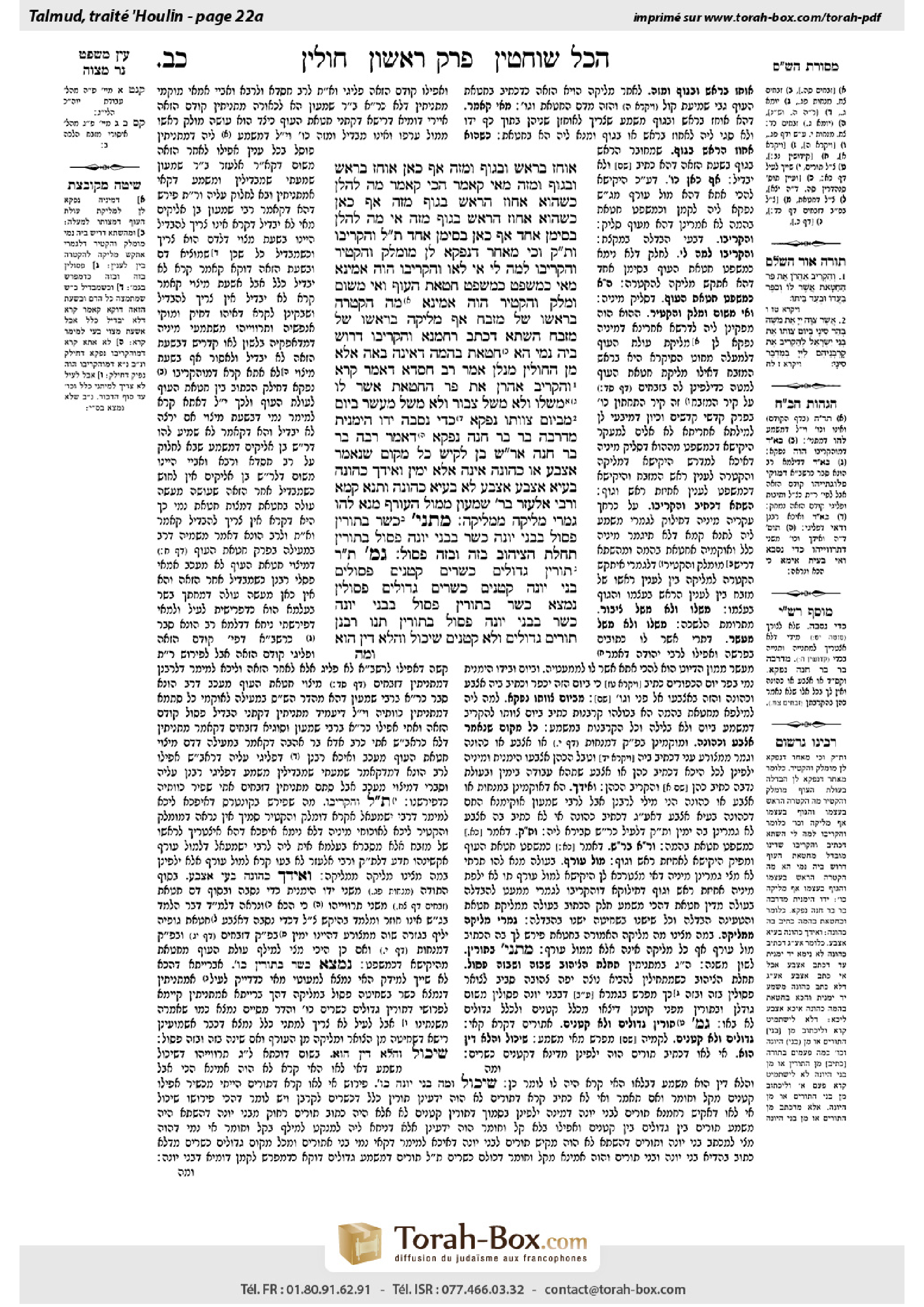
This page of Chullin includes the Aramaic text, an English translation and an AI-generated French translation, alongside the scan above.
חולין כ״ב א · Aramaic and Hebrew text
אוֹחֵז בָּרֹאשׁ וּבַגּוּף וּמַזֶּה, אַף כָּאן אוֹחֵז בְּרֹאשׁ וּבַגּוּף וּמַזֶּה.
מַאי קָאָמַר? הָכִי קָאָמַר: מָה לְהַלָּן, כְּשֶׁהוּא אָחוּז הָרֹאשׁ בַּגּוּף מַזֶּה, אַף כָּאן, כְּשֶׁהוּא אָחוּז הָרֹאשׁ בַּגּוּף מַזֶּה.
אִי מָה לְהַלָּן בְּסִימָן אֶחָד, אַף כָּאן בְּסִימָן אֶחָד? תַּלְמוּד לוֹמַר ״וְהִקְרִיבוֹ״.
וְתַנָּא קַמָּא, וְכִי מֵאַחַר דְּנָפְקָא לַן מִ״וּמָלַק … וְהִקְטִיר״, ״וְהִקְרִיבוֹ״ לְמָה לִי?
אִי לָאו ״וְהִקְרִיבוֹ״, הֲוָה אָמֵינָא: מַאי ״כַּמִּשְׁפָּט״ – כְּמִשְׁפַּט חַטַּאת הָעוֹף.
וְאִי מִשּׁוּם ״וּמָלַק וְהִקְטִיר״ – הֲוָה אָמֵינָא: מָה הַקְטָרָה בְּרֹאשׁוֹ שֶׁל מִזְבֵּחַ – אַף מְלִיקָה בְּרֹאשׁוֹ שֶׁל מִזְבֵּחַ.
הַשְׁתָּא דִּכְתַב רַחֲמָנָא ״וְהִקְרִיבוֹ״, דְּרוֹשׁ בֵּיהּ נָמֵי הָא.
חַטַּאת בְּהֵמָה, דְּאֵינָהּ בָּאָה אֶלָּא מִן הַחוּלִּין, מְנָלַן? אָמַר רַב חִסְדָּא, דְּאָמַר קְרָא: ״וְהִקְרִיב אַהֲרֹן אֶת פַּר הַחַטָּאת אֲשֶׁר לוֹ״ – מִשֶּׁלּוֹ, וְלֹא מִשֶּׁל צִבּוּר, וְלֹא מִשֶּׁל מַעֲשֵׂר.
בַּיּוֹם – מִ״בְּיוֹם צַוֹּתוֹ״ נָפְקָא! כְּדִי נַסְבַהּ.
יָדוֹ הַיְמָנִית – מִדְּרַבָּה בַּר בַּר חָנָה נָפְקָא, דְּאָמַר רַבָּה בַּר בַּר חָנָה אָמַר רַבִּי שִׁמְעוֹן בֶּן לָקִישׁ: כׇּל מָקוֹם שֶׁנֶּאֱמַר אֶצְבַּע אוֹ כְהוּנָּה אֵינָהּ אֶלָּא יָמִין.
וְאִידַּךְ, כְּהוּנָּה בָּעֲיָא אֶצְבַּע, אֶצְבַּע לָא בָּעֲיָא כְּהוּנָּה.
וְתַנָּא קַמָּא וְרַבִּי אֶלְעָזָר בְּרַבִּי שִׁמְעוֹן, מִמּוּל הָעוֹרֶף מְנָא לְהוּ? גָּמְרִי מְלִיקָה מִמְּלִיקָה.
מַתְנִי׳ כָּשֵׁר בְּתוֹרִין – פָּסוּל בִּבְנֵי יוֹנָה, כָּשֵׁר בִּבְנֵי יוֹנָה – פָּסוּל בְּתוֹרִין, תְּחִלַּת הַצִּיהוּב בָּזֶה וּבָזֶה – פָּסוּל.
גְּמָ׳ תָּנוּ רַבָּנַן: תּוֹרִין גְּדוֹלִים – כְּשֵׁרִים, קְטַנִּים – פְּסוּלִים; בְּנֵי יוֹנָה קְטַנִּים – כְּשֵׁרִים, גְּדוֹלִים – פְּסוּלִין. נִמְצָא כָּשֵׁר בְּתוֹרִין – פָּסוּל בִּבְנֵי יוֹנָה, כָּשֵׁר בִּבְנֵי יוֹנָה – פָּסוּל בְּתוֹרִין.
תָּנוּ רַבָּנַן: ״תּוֹרִים״ – גְּדוֹלִים וְלֹא קְטַנִּים, שֶׁיָּכוֹל וַהֲלֹא דִּין הוּא:
Chullin 22a · English translation
after the pinching, the priest holds [oḥez] the head and the body of the bird and sprinkles the blood on the altar, so too here, with regard to the bird burnt offering, he holds the head and the body and sprinkles the blood on the altar.
The Gemara asks: What is he saying? There is no requirement with regard to a bird sin offering that the priest hold both the head and the body while sprinkling the blood. The Gemara answers that this is what he is saying: Just as there, with regard to the bird sin offering, when the head is attached [aḥuz] to the body, the priest sprinkles the blood on the altar, so too here, with regard to the bird burnt offering, when the head is attached to the body, the priest sprinkles the blood on the altar. This is what was cited above in the name of Rabbi Elazar, son of Rabbi Shimon, that one cuts a majority of two simanim in a burnt offering and not the two simanim in their entirety.
The baraita continues: If so, perhaps just as there, in the sin offering, the pinching is performed with the cutting of one siman, so too here, in the burnt offering, the pinching is performed with the cutting of one siman. To counter this, the verse states: “And the priest shall bring it,” meaning that the burnt offering is sacrificed in a manner different from that of the sin offering, by cutting two simanim.
The Gemara asks: And according to the first tanna, once we derive that both simanim of a bird burnt offering must be cut in their entirety from the verse: “And pinch off its head…and burn it on the altar,” why do I need the phrase: “And the priest shall bring it?”
The Gemara answers: If not for the verse that states: “And the priest shall bring it,” I would say: What is the meaning of “according to the ordinance” that is stated with regard to the bird burnt offering? It means according to the ordinance of the bird sin offering mentioned in that same passage, in the sense that even in the burnt offering, the priest cuts only one siman.
And if you would say that one cannot suggest this interpretation due to the verse: “And pinch off its head…and burn it on the altar,” I would say that perhaps another halakha would be derived from that verse: Just as burning the offering is atop the altar, so too pinching is performed atop the altar.
Now that the Merciful One writes: “And the priest shall bring it,” indicating the distinction between the pinching of a bird burnt offering and the pinching of a bird sin offering, derive this also from the verse: “And pinch off its head…and burn it on the altar,” i.e., that the body and the head of a bird burnt offering must be completely separated.
§ The first tanna of the baraita derives from the analogy between the bird burnt offering and the animal sin offering that a bird burnt offering is brought only from non-sacred animals and not from an animal purchased with second-tithe money, that it is sacrificed only during the day, and that the priest sacrificing it must do so with his right hand. The Gemara asks: From where do we derive the halakha that an animal sin offering comes only from non-sacred animals? Rav Ḥisda said that the verse states: “And Aaron shall sacrifice the bull of the sin offering that is his” (Leviticus 16:6, 11), from which it is derived: The animal must come from his cattle, but not from communal property, from his cattle, but not from second-tithe property.
The Gemara objects: The halakha that the bird burnt offering is sacrificed only during the day is derived from the verse: “In the day that he commanded the children of Israel to present their offerings” (Leviticus 7:38), not from the halakha of the animal sin offering. The Gemara explains: The requirement of sacrificing the bird burnt offering during the day is not derived from the halakha of the animal sin offering, and it was cited in that list incidentally, for no reason [kedi].
The Gemara objects: The halakha that the priest performs the service with his right hand is derived from the statement of Rabba bar bar Ḥana, as Rabba bar bar Ḥana says that Rabbi Shimon ben Lakish says: Any place where the terms finger or priesthood are stated with regard to offerings, the sacrificial rites of that offering are performed only with the right hand, and in the context of the bird burnt offering the term “priest” is employed. It is therefore unnecessary to derive this halakha from the analogy to the animal sin offering.
The Gemara responds: And the other tanna, the first tanna of the baraita, who derived that the right hand is used from the analogy to the animal sin offering based on the term “according to the ordinance,” did not derive it from the statement of Rabba bar bar Ḥana because in his opinion, in order to derive that the right hand must be used, if the verse mentions only the priesthood, it requires mention of finger for the limitation to apply. If the verse mentions only the term finger, then it does not require a mention of the priesthood as well. With regard to the bird burnt offering, the priesthood is mentioned, but the word finger is not. Therefore, the halakha must be derived from the animal sin offering.
It is taught in the baraita that Rabbi Yishmael derived from the term “according to the ordinance” that is written with regard to the bird burnt offering that the pinching of the bird burnt offering is performed at the nape of the neck, as it is in a bird sin offering. The Gemara asks: And as for the first tanna and Rabbi Elazar, son of Rabbi Shimon, who derive other matters from that term, from where do they derive that pinching of the bird burnt offering is performed at the nape of the neck? The Gemara answers: They derive pinching that is written with regard to the burnt offering: “And pinch off its head” (Leviticus 1:15), from pinching that is written with regard to the sin offering: “And pinch off its head adjacent to its neck” (Leviticus 5:8).
MISHNA: It is written with regard to bird offerings: “He shall bring his offering of doves, or of young pigeons” (Leviticus 1:14). The age that is fit for sacrifice in doves, mature birds, is unfit for sacrifice in pigeons, immature birds;the age that is fit for sacrifice in pigeons is unfit for sacrifice in doves. At the intermediate stage of the beginning of the yellowing of its plumage (see 22b), a bird is unfit both as this, a pigeon, and as that, a dove, since it is no longer a fledgling but is not yet a mature bird.
GEMARA: The Sages taught a baraita in explaining the mishna: Doves, when they are older, are fit for sacrifice; when they are younger, they are unfit. Pigeons, when they are younger, are fit for sacrifice; when they are older, they are unfit. It is found that that which is fit for sacrifice in doves is unfit for sacrifice in pigeons; that which is fit for sacrifice in pigeons is unfit for sacrifice in doves.
The Sages taught in a baraita with regard to the verse: “And he shall bring his offering of doves, or of young pigeons” (Leviticus 1:14), that doves are older and not younger. As one might have thought: And couldn’t this be derived through an a fortiori inference:
Chullin 22a · Traduction française (IA)
après avoir écrasé la tête, le prêtre tient [oḥez] la tête et le corps de l'oiseau et verse le sang sur l'autel, de même ici, concernant l'holocauste d'oiseau, il tient la tête et le corps et verse le sang sur l'autel.
La Guemara demande : De quoi parle-t-il ? Il n'y a pas de nécessité concernant l'offrande expiatoire d'oiseau que le prêtre tienne à la fois la tête et le corps lors du versement du sang. La Guemara répond que c'est ce qu'il dit : Tout comme là, concernant l'offrande expiatoire d'oiseau, lorsque la tête est attachée [aḥuz] au corps, le prêtre verse le sang sur l'autel, de même ici, concernant l'holocauste d'oiseau, lorsque la tête est attachée au corps, le prêtre verse le sang sur l'autel. C'est ce qui a été cité ci-dessus au nom de Rabbi Elazar, fils de Rabbi Shimon, que l'on coupe une majorité de deux simanim dans une offrande brûlée et non les deux simanim en entier.
La baraïta continue : Si tel est le cas, peut-être tout comme là, dans l'offrande expiatoire, l'écrasement est effectué avec la coupe d'un siman, de même ici, dans l'holocauste, l'écrasement est effectué avec la coupe d'un siman. Pour contrecarrer cela, la Parashah stipule : « Et le prêtre le présentera », ce qui signifie que l'holocauste est sacrifiée d'une manière différente de celle de l'offrande expiatoire, en coupant deux simanim.
La Guemara demande : Et selon le premier tanna, une fois que nous dérivons que les deux simanim d'une offrande brûlée d'oiseau doivent être coupés en entier à partir de la Parashah : « Et écrase sa tête… et brûle-le sur l'autel », pourquoi a-t-on besoin de la phrase : « Et le prêtre le présentera » ?
La Guemara répond : Si ce n'était pas pour la Parashah qui stipule : « Et le prêtre le présentera », je dirais : De quoi signifie « selon l'ordre » qui est mentionné concernant l'holocauste d'oiseau ? Cela signifie selon l'ordre de l'offrande expiatoire d'oiseau mentionné dans ce même passage, dans le sens que même dans l'holocauste, le prêtre coupe seulement un siman.
Et si vous dites que l'on ne peut pas interpréter ainsi en raison de la Parashah : « Et écrase sa tête… et brûle-le sur l'autel », je dirais que peut-être une autre halakha pourrait être dérivée de cette Parashah : Tout comme la brûlation de l'offrande est sur l'autel, de même l'écrasement est effectué sur l'autel.
Maintenant que l'Éternel écrit : « Et le prêtre le présentera », indiquant la distinction entre l'écrasement de l'holocauste d'oiseau et l'écrasement de l'offrande expiatoire d'oiseau, tirez-en aussi la déduction de la Parashah : « Et écrase sa tête… et brûle-le sur l'autel », c'est-à-dire que la tête et le corps d'une offrande brûlée d'oiseau doivent être entièrement séparés.
§ Le premier tanna de la baraïta tire son origine de l'analogie entre l'holocauste d'oiseau et l'offrande expiatoire d'animal, selon laquelle l'holocauste d'oiseau est offerte uniquement d'animaux non sacrés et non d'un animal acheté avec les dîmes secondaires, qu'elle est sacrifiée uniquement pendant la journée, et que le prêtre sacrifiant doit le faire avec sa main droite. La Guemara demande : D'où dérivons-nous la halakha selon laquelle l'offrande expiatoire d'animal vient uniquement d'animaux non sacrés ? Rav Ḥisda dit que la Parashah stipule : « Et Aaron sacrifiera le taureau de l'offrande expiatoire qui est le sien » (Lévitique 16:6, 11), d'où on dérive : L'animal doit venir de ses bêtes, mais pas de la propriété commune, de ses bêtes, mais pas des dîmes secondaires.
La Guemara s'oppose : La halakha selon laquelle l'holocauste d'oiseau est sacrifiée uniquement pendant la journée est tirée de la Parashah : « En le jour où il commanda aux enfants d'Israël de présenter leurs offrandes » (Lévitique 7:38), et non de la halakha de l'offrande expiatoire d'animal. La Guemara explique : La nécessité de sacrifier l'holocauste d'oiseau pendant la journée ne provient pas de la halakha de l'offrande expiatoire d'animal, et elle a été citée dans cette liste par hasard, sans raison [kedi].
La Guemara s'oppose : La halakha que le prêtre effectue le service avec sa main droite est dérivée de la déclaration de Rabba bar bar Ḥana, car Rabba bar bar Ḥana dit que Rabbi Shimon ben Lakish dit : Tout lieu où les termes doigt ou sacerdoce sont mentionnés concernant les offrandes, les rites sacrificiels de cette offrande sont effectués uniquement avec la main droite, et dans le contexte de l'holocauste d'oiseau, le terme « prêtre » est employé. Il n'est donc pas nécessaire de dériver cette halakha de l'analogie avec l'offrande expiatoire d'animal.
La Guemara répond : Et l'autre tanna, le premier tanna de la baraïta, qui dérivait que la main droite est utilisée à partir de l'analogie avec l'offrande expiatoire d'animal basé sur le terme « selon l'ordre », n'a pas dérivé cela à partir de la déclaration de Rabba bar bar Ḥana car, selon son avis, afin de dériver que la main droite doit être utilisée, si la Parashah mentionne seulement le sacerdoce, il faut mentionner le doigt pour que la limitation s'applique. Si la Parashah mentionne seulement le terme doigt, alors il ne faut pas mentionner le sacerdoce non plus. Concernant l'holocauste d'oiseau, le sacerdoce est mentionné, mais le terme doigt n'est pas. Il faut donc dériver cette halakha à partir de l'offrande expiatoire d'animal.
Il est enseigné dans la baraïta que Rabbi Yishmael dérive du terme « selon l'ordre » qui est écrit concernant l'holocauste d'oiseau que l'écrasement de l'holocauste d'oiseau est effectué au niveau du cou, comme dans l'offrande expiatoire d'oiseau. La Guemara demande : Et concernant le premier tanna et Rabbi Elazar, fils de Rabbi Shimon, qui dérivent d'autres choses à partir de ce terme, d'où dérivent-ils que l'écrasement de l'holocauste d'oiseau est effectué au niveau du cou ? La Guemara répond : Ils dérivent l'écrasement qui est écrit concernant l'holocauste : « Et écrase sa tête » (Lévitique 1:15), à partir de l'écrasement qui est écrit concernant l'offrande expiatoire : « Et écrase sa tête adjacent à son cou » (Lévitique 5:8).
MICHNA : Il est écrit concernant les offrandes d'oiseaux : « Il apportera son offrande de moineaux ou de jeunes pigeons » (Lvq 1:14). L'âge adapté à l'offrande des moineaux, les oiseaux mûrs, est inadapté à l'offrande des pigeons, les oiseaux jeunes ; l'âge adapté à l'offrande des pigeons est inadapté à l'offrande des moineaux. À l'étape intermédiaire du début de la coloration jaune de leur plumage (voir 22b), un oiseau est inadapté à la fois comme pigeon et comme moineau, car il n'est plus un petit oiseau mais n'est pas encore un oiseau mûr.
GUEMARA : Les Sages enseignèrent une baraïta pour expliquer la mishna : Les moineaux, lorsqu'ils sont plus âgés, sont adaptés à l'offrande ; lorsqu'ils sont plus jeunes, ils ne le sont pas. Les pigeons, lorsqu'ils sont plus jeunes, sont adaptés à l'offrande ; lorsqu'ils sont plus âgés, ils ne le sont pas. On trouve que ce qui est adapté à l'offrande des moineaux n'est pas adapté à l'offrande des pigeons ; ce qui est adapté à l'offrande des pigeons n'est pas adapté à l'offrande des moineaux.
Les Sages enseignèrent dans une baraïta concernant la parole : « Et il apportera son offrande de moineaux ou de jeunes pigeons » (Lvq 1:14), que les moineaux sont plus âgés et non plus jeunes. Comme on pourrait penser : Et ne pourrait-on pas déduire cela par une inférence a fortiori :
Traduction française générée par IA à partir de l’édition anglaise de Sefaria. Vérifie toujours un passage avec le texte source.
Text from Sefaria: William Davidson Edition - Vocalized Aramaic (unknown); William Davidson Edition - English (CC BY NC).