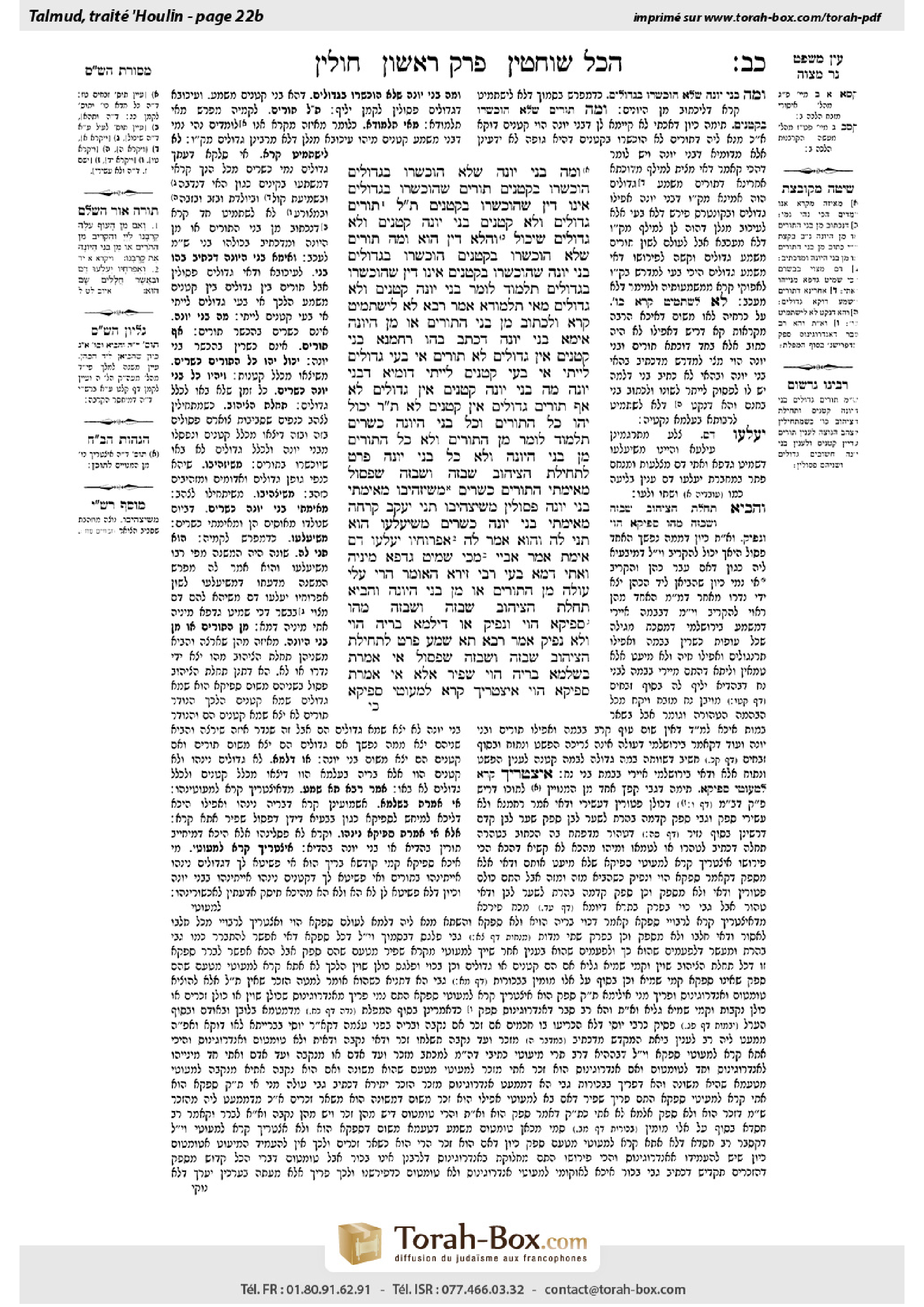
Chullin 22b: Talmud study for Daf Yomi
Study the Talmud for Daf Yomi with scanned pages, Hebrew text, English translations from Sefaria and AI-generated French translations.
Passage selection and English or AI-generated French translation are available where the scan has annotations. Daf Study is independent of Torah-Box and Sefaria.
Browse Chullin · חולין · All tractatesChullin 22b text and translations
This page of Chullin includes the Aramaic text, an English translation and an AI-generated French translation, alongside the scan above.
חולין כ״ב ב · Aramaic and Hebrew text
וּמָה בְּנֵי יוֹנָה שֶׁלֹּא הוּכְשְׁרוּ בִּגְדוֹלִים הוּכְשְׁרוּ בִּקְטַנִּים, תּוֹרִים שֶׁהוּכְשְׁרוּ בִּגְדוֹלִים אֵינוֹ דִּין שֶׁהוּכְשְׁרוּ בִּקְטַנִּים? תַּלְמוּד לוֹמַר: ״תּוֹרִים״ – גְּדוֹלִים וְלֹא קְטַנִּים.
״בְּנֵי יוֹנָה״ – קְטַנִּים וְלֹא גְּדוֹלִים, שֶׁיָּכוֹל וַהֲלֹא דִּין הוּא: וּמָה תּוֹרִים שֶׁלֹּא הוּכְשְׁרוּ בִּקְטַנִּים – הוּכְשְׁרוּ בִּגְדוֹלִים, בְּנֵי יוֹנָה שֶׁהוּכְשְׁרוּ בִּקְטַנִּים – אֵינוֹ דִּין שֶׁהוּכְשְׁרוּ בִּגְדוֹלִים? תַּלְמוּד לוֹמַר ״בְּנֵי יוֹנָה״ – קְטַנִּים וְלֹא גְּדוֹלִים.
מַאי תַּלְמוּדָא? אָמַר רָבָא: לָא לִישְׁתְּמִיט קְרָא וְלִכְתּוֹב ״מִן בְּנֵי הַתּוֹרִים אוֹ מִן הַיּוֹנָה״.
אֵימָא: בְּנֵי יוֹנָה דִּכְתַב בְּהוּ רַחֲמָנָא ״בְּנֵי״ – קְטַנִּים אִין, גְּדוֹלִים לָא, תּוֹרִים – אִי בָּעֵי גְּדוֹלִים לַיְיתֵי, אִי בָּעֵי קְטַנִּים לַיְיתֵי! דֻּמְיָא דִּבְנֵי יוֹנָה: מָה בְּנֵי יוֹנָה – קְטַנִּים אִין, גְּדוֹלִים לָא, אַף תּוֹרִים – גְּדוֹלִים אִין, קְטַנִּים לָא.
תָּנוּ רַבָּנַן: יָכוֹל יְהוּ כׇּל הַתּוֹרִים וְכׇל בְּנֵי הַיּוֹנָה כְּשֵׁרִים? תַּלְמוּד לוֹמַר: ״מִן הַתּוֹרִים״ – וְלֹא כׇּל הַתּוֹרִים, ״מִן בְּנֵי הַיּוֹנָה״ – וְלֹא כׇּל בְּנֵי יוֹנָה, פְּרָט לִתְחִילַּת הַצִּיהוּב שֶׁבָּזֶה וְשֶׁבָּזֶה שֶׁפָּסוּל. מֵאֵימָתַי הַתּוֹרִים כְּשֵׁרִים – מִשֶּׁיַּזְהִיבוּ, מֵאֵימָתַי בְּנֵי יוֹנָה פְּסוּלִין – מִשֶּׁיַּצְהִיבוּ.
תָּנֵי יַעֲקֹב קָרְחָה: מֵאֵימָתַי בְּנֵי יוֹנָה כְּשֵׁרִים? מִשֶּׁיְּעַלְעוּ. הוּא תָנֵי לַהּ וְהוּא אָמַר לַהּ, ״אֶפְרוֹחָיו יְעַלְעוּ דָם״. אֵימַת? אָמַר אַבָּיֵי: מִכִּי שָׁמֵיט גַּדְפָּא מִינֵיהּ וְאָתֵי דְּמָא.
בָּעֵי רַבִּי זֵירָא: הָאוֹמֵר ״הֲרֵי עָלַי עוֹלָה מִן הַתּוֹרִים אוֹ מִן בְּנֵי הַיּוֹנָה״, וְהֵבִיא תְּחִלַּת הַצִּיהוּב שֶׁבָּזֶה וְשֶׁבָּזֶה, מַהוּ? סְפֵיקָא הָוֵי וְנָפֵיק, אוֹ דִילְמָא בְּרִיָּה הָוֵי וְלָא נָפֵיק?
אָמַר רָבָא, תָּא שְׁמַע: פְּרָט לִתְחִילַּת הַצִּיהוּב שֶׁבָּזֶה וְשֶׁבָּזֶה, שֶׁפָּסוּל. אִי אָמְרַתְּ בִּשְׁלָמָא בְּרִיָּה הָוֵי – שַׁפִּיר, אֶלָּא אִי אָמְרַתְּ סְפֵיקָא הָוֵי, אִיצְטְרִיךְ קְרָא לְמַעוֹטֵי סְפֵיקָא?
Chullin 22b · English translation
If pigeons, which were not deemed fit when older, were deemed fit when younger, as the term “young pigeons” indicates that they are young, then with regard to doves, which were deemed fit when older, isn’t it logical that they were deemed fit when younger? Therefore, the verse states: “Doves,” meaning older and not younger.
The baraita continues: Young pigeons must be younger and not older, as one might have thought: And couldn’t this be derived through an a fortiori inference: If doves, which were not deemed fit when younger, were deemed fit when older, then with regard to pigeons, which were deemed fit when younger, isn’t it logical that they were deemed fit when older? Therefore, the verse states: “Young pigeons,” meaning younger and not older.
The Gemara asks: What is the biblical derivation of these matters? Rava said: It is derived from the fact that it is not found that the verse would deviate from the norm and write: Of young doves, or of pigeons; rather, the wording in the Torah is always “of doves” or “of young pigeons.” Evidently, doves must be older and pigeons must be younger.
The Gemara objects: Say instead that with regard to pigeons, since the Merciful One writes: “Young,” this means younger birds, yes, older birds, no; but with regard to doves, if one wishes, let him bring older birds, and if he wishes, let him bring younger birds. The Gemara responds: Since doves and pigeons are always juxtaposed to one another in the Torah, it is derived that the halakha of doves is similar to the halakha of pigeons: Just as with regard to pigeons the halakha is younger birds, yes, older birds, no, so too with regard to doves, the halakha is older birds, yes, younger birds, no.
The Sages taught in a baraita: One might have thought that all the older doves or all the younger pigeons would be fit for sacrifice; therefore, the verse states: “Of doves,” and not all doves; “of young pigeons,” and not all young pigeons. This serves to exclude birds at the beginning of the yellowing of their neck plumage, which are unfit as this, doves, and as that, pigeons. They are unfit as doves because they are not sufficiently old and as pigeons because they are no longer young. The tanna elaborates: From when are the doves fit? It is from when the color of their feathers turns a glistening gold. From when are the pigeons unfit? It is from when their feathers turn yellow.
Ya’akov Korḥa taught a baraita: From when are pigeons fit? It is from when ye’alu. He teaches the baraita and he states its explanation: The reference is to that which is stated: “Its fledglings will suck up [ye’alu] blood” (Job 39:30). When is that? Abaye said: It is from the stage when one plucks a feather from it and blood emerges.
§ Rabbi Zeira raises a dilemma: With regard to one who says: It is incumbent upon me to bring a burnt offering of doves or of pigeons, and he brought birds at the beginning of the yellowing of their neck plumage of this, doves, and of that, pigeons, what is the halakha? Is it a case of uncertainty whether it is considered older or younger, and therefore when he brings both he fulfills his obligation, as one of the birds was fit for sacrifice; or perhaps a bird at the beginning of the yellowing is an entity in and of itself and is neither older nor younger, and he does not fulfill his obligation?
Rava said: Come and hear proof from the baraita where it is taught that the verse: “Of doves or of young pigeons,” serves to exclude birds at the beginning of the yellowing of their neck plumage that are unfit as this, doves, and as that, pigeons. Granted, if you say that a bird at that stage is an entity in and of itself, that works out well, as the verse serves to ensure that a bird at that stage of development will never be sacrificed. But if you say that it is a case of uncertainty, was it necessary for the verse to exclude a case of uncertainty?
Chullin 22b · Traduction française (IA)
Si les moineaux, qui n'étaient pas considérés comme propres lorsqu'ils étaient âgés, sont considérés comme propres lorsqu'ils sont jeunes, comme le terme « moineaux jeunes » indique qu'ils sont jeunes, alors concernant les colombes, qui étaient considérés comme propres lorsqu'ils étaient âgés, n'est-il pas logique qu'ils soient considérés comme propres lorsqu'ils sont jeunes ? Ainsi, la Sainte Écriture dit : « Colombe », ce qui signifie âgée et non jeune.
La baraïta continue : Les moineaux jeunes doivent être jeunes et non âgés, car on pourrait penser : Et ne pourrait-on pas déduire cela par une inférence a fortiori : Si les colombes, qui n'étaient pas considérés comme propres lorsqu'ils étaient jeunes, sont considérés comme propres lorsqu'ils sont âgés, alors concernant les moineaux, qui sont considérés comme propres lorsqu'ils sont jeunes, n'est-il pas logique qu'ils soient considérés comme propres lorsqu'ils sont âgés ? Ainsi, la Sainte Écriture dit : « Moineaux jeunes », ce qui signifie jeunes et non âgés.
La Guemara pose la question : Quelle est la dérivation biblique de ces questions ? Rava dit : Cela est dérivé du fait que la Sainte Écriture ne mentionne pas que le texte s'écarte de la norme en disant : « De jeunes colombes », ou « de moineaux », mais plutôt, le texte de la Torah est toujours « de colombe » ou « de jeunes moineaux ». Évidemment, les colombes doivent être âgées et les moineaux jeunes.
La Guemara s'oppose : Dites plutôt que concernant les moineaux, puisque le Très Miséricordieux écrit : « Jeunes », cela signifie des oiseaux jeunes, oui, des oiseaux âgés, non ; mais concernant les colombe, si l'on veut, on peut apporter des oiseaux âgés, et si l'on veut, des oiseaux jeunes. La Guemara répond : Puisque les colombe et les moineaux sont toujours juxtaposés l'un à l'autre dans la Torah, il est dérivé que la halakha des colombe est semblable à celle des moineaux : Tout comme concernant les moineaux la halakha est que les oiseaux jeunes sont acceptés, les oiseaux âgés non, ainsi aussi concernant les colombe, la halakha est que les oiseaux âgés sont acceptés, les oiseaux jeunes non.
Les Sages enseignent dans une baraïta : On pourrait penser que tous les colombe âgés ou tous les moineaux jeunes sont propres à l'offrande ; donc la Sainte Écriture dit : « De colombe », et non tous les colombe ; « de jeunes moineaux », et non tous les jeunes moineaux. Cela sert à exclure les oiseaux au début de la coloration jaune de leur plumage du cou, qui sont inpropres, car en tant que colombe ils ne sont pas suffisamment âgés et en tant que moineaux ils ne sont plus jeunes. Le tanna développe : À partir de quand les colombe sont-ils propres ? C'est à partir du moment où la couleur de leurs plumes devient dorée. À partir de quand les moineaux sont-ils inpropres ? C'est à partir du moment où leurs plumes deviennent jaunes.
Ya’akov Korḥa enseigna une baraïta : À partir de quand les moineaux sont-ils propres ? C'est à partir du moment où ils « ye’alu ». Il enseigna la baraïta et il expliqua : La référence est à ce qui est dit : « Leur petit se nourrira du sang [ye’alu] » (Job 39:30). À quel moment ? Abaye dit : C'est à la phase où l'on arrache une plume et du sang en sort.
§ Rabbi Zeira soulève un dilemme : Concernant celui qui dit : Il m'est commandé d'apporter une offrande brûlée de colombe ou de moineaux, et il apporta des oiseaux au début de la coloration jaune de leur plumage du cou, de ce côté des colombes et de ce côté des moineaux, quelle est la halakha ? Est-ce un cas d'incertitude quant à ce qu'il est considéré comme âgé ou jeune, et donc, lorsqu'il apporte les deux, il accompli son obligation, comme l'un des oiseaux était propre à l'offrande ; ou peut-être un oiseau au début de la coloration jaune est une entité à part et n'est ni âgé ni jeune, et il ne rempli pas son obligation ?
Rava dit : Venez et entendez la preuve dans la baraïta où il est enseigné que la Sainte Écriture : « De colombe ou de jeunes moineaux », sert à exclure les oiseaux au début de la coloration jaune de leur plumage du cou qui sont inpropres, en tant que colombe et en tant que moineaux. Admettons, si vous dites que cet oiseau à cette étape est une entité à part, cela s'explique bien, car la Sainte Écriture sert à garantir que cet oiseau à cette étape de développement ne sera jamais sacrifié. Mais si vous dites qu'il s'agit d'une incertitude, aurait-il été nécessaire pour la Sainte Écriture d'exclure un cas d'incertitude ?
Traduction française générée par IA à partir de l’édition anglaise de Sefaria. Vérifie toujours un passage avec le texte source.
Text from Sefaria: William Davidson Edition - Vocalized Aramaic (unknown); William Davidson Edition - English (CC BY NC).