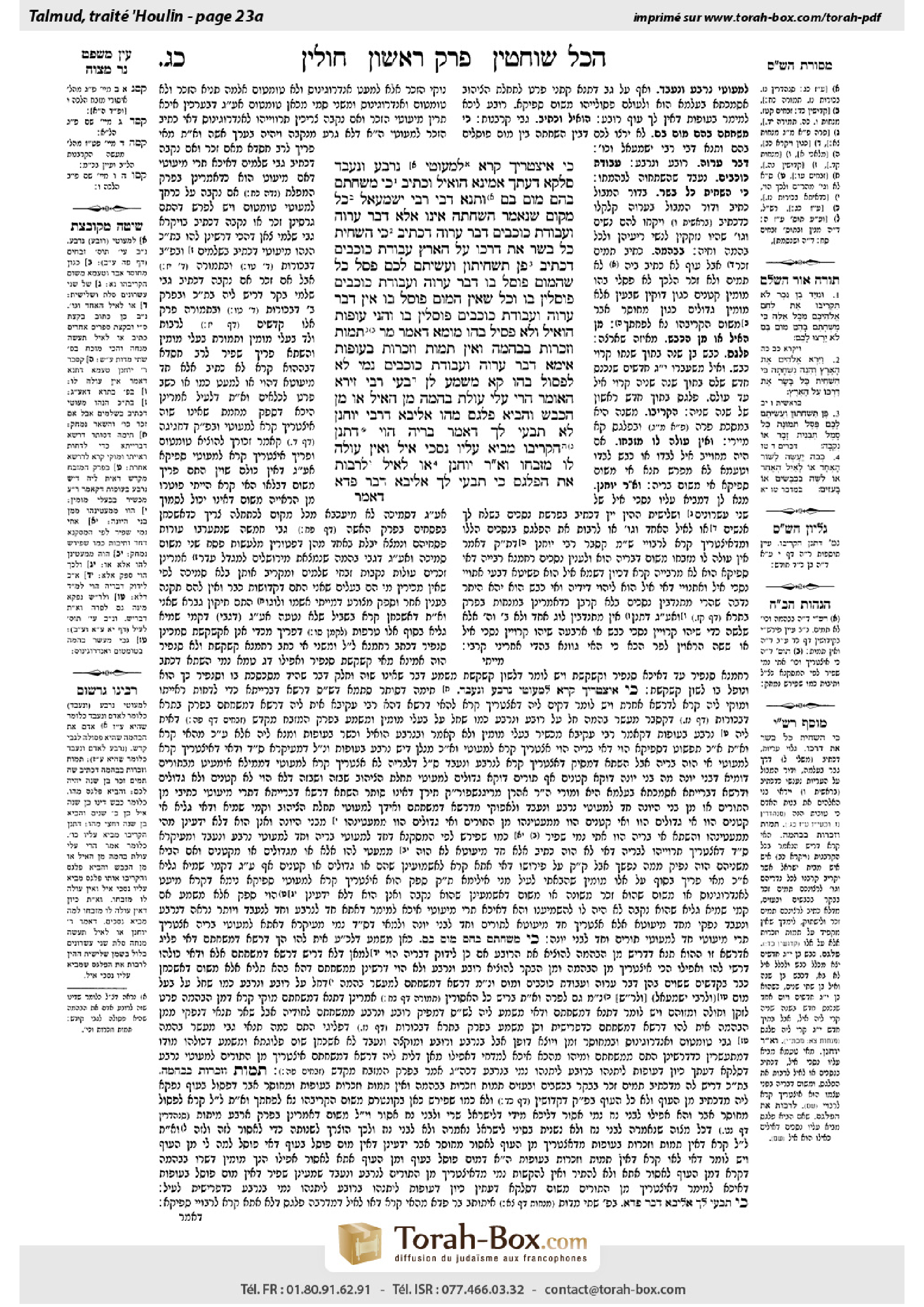
Chullin 23a: Talmud study for Daf Yomi
Study the Talmud for Daf Yomi with scanned pages, Hebrew text, English translations from Sefaria and AI-generated French translations.
Passage selection and English or AI-generated French translation are available where the scan has annotations. Daf Study is independent of Torah-Box and Sefaria.
Browse Chullin · חולין · All tractatesChullin 23a text and translations
This page of Chullin includes the Aramaic text, an English translation and an AI-generated French translation, alongside the scan above.
חולין כ״ג א · Aramaic and Hebrew text
כִּי אִיצְטְרִיךְ קְרָא לְמַעוֹטֵי נִרְבָּע וְנֶעֱבָד.
סָלְקָא דַּעְתָּךְ אָמֵינָא: הוֹאִיל וּכְתִיב ״כִּי מׇשְׁחָתָם בָּהֶם מוּם בָּם״, וְתָנָא דְּבֵי רַבִּי יִשְׁמָעֵאל: כָּל מָקוֹם שֶׁנֶּאֱמַר הַשְׁחָתָה, אֵינוֹ אֶלָּא דְּבַר עֶרְוָה וַעֲבוֹדָה זָרָה; דְּבַר עֶרְוָה, דִּכְתִיב: ״כִּי הִשְׁחִית כׇּל בָּשָׂר אֶת דַּרְכּוֹ עַל הָאָרֶץ״;
עֲבוֹדָה זָרָה, דִּכְתִיב: ״פֶּן תַּשְׁחִתוּן וַעֲשִׂיתֶם לָכֶם פֶּסֶל״, כֹּל שֶׁהַמּוּם פּוֹסֵל בּוֹ – דְּבַר עֶרְוָה וַעֲבוֹדָה זָרָה פּוֹסְלִין בּוֹ, וְכֹל שֶׁאֵין הַמּוּם פּוֹסֵל בּוֹ – אֵין דְּבַר עֶרְוָה וַעֲבוֹדָה זָרָה פּוֹסְלִין בּוֹ. וְהָנֵי עוֹפוֹת, הוֹאִיל וְלָא פָּסֵיל בְּהוּ מוּמָא, דְּאָמַר מָר: תַּמּוּת וְזַכְרוּת בִּבְהֵמָה וְאֵין תַּמּוּת וְזַכְרוּת בְּעוֹפוֹת, אֵימָא דְּבַר עֶרְוָה וַעֲבוֹדָה זָרָה נָמֵי לָא לִפְסוֹל בְּהוּ – קָא מַשְׁמַע לַן.
בָּעֵי רַבִּי זֵירָא: הָאוֹמֵר ״הֲרֵי עָלַי עוֹלַת בְּהֵמָה מִן הָאַיִל אוֹ מִן הַכֶּבֶשׂ״, וְהֵבִיא פַּלְגָּס, מַהוּ?
אַלִּיבָּא דְּרַבִּי יוֹחָנָן לָא תִּבְּעֵי לָךְ, דְּאָמַר בְּרִיָּה הָוֵי, דִּתְנַן: הִקְרִיבוֹ – מֵבִיא עָלָיו נִסְכֵּי אַיִל, וְאֵין עוֹלֶה לוֹ מִזִּבְחוֹ.
וְאָמַר רַבִּי יוֹחָנָן: ״אוֹ לָאַיִל״, לְרַבּוֹת אֶת הַפַּלְגָּס.
כִּי תִּבְּעֵי לָךְ אַלִּיבָּא דְּבַר פְּדָא,
Chullin 23a · English translation
The Gemara rejects that proof: When the phrase in the verse “of doves or of young pigeons” was necessary, it was to exclude a bird that was the object of bestiality or a bird that was worshipped as a deity.
As it could enter your mind to say: Since it is written with regard to the halakhot of disqualified offerings: “Because their corruption [moshḥatam] is in them, there is a blemish in them” (Leviticus 22:25), referring to two types of disqualifications: Corruption and blemish, and the school of Rabbi Yishmael taught: Anywhere that the term corruption [hashḥata] is stated, it is referring to nothing other than a matter of licentiousness and idol worship. The Gemara cites proofs for this claim: Corruption is referring to matters of licentiousness, as it is written: “For all flesh had corrupted [hishḥit] their way upon the earth” (Genesis 6:12); the word “way” alludes to sexual intercourse.
Corruption is also referring to idol worship, as it is written: “Lest you deal corruptly [tashḥitun], and make you a graven image” (Deuteronomy 4:16); one might have thought: Any type of offering that a blemish disqualifies, matters of licentiousness and idol worship disqualify it, and any type of offering that a blemish does not disqualify, matters of licentiousness and idol worship do not disqualify it. And with regard to these birds, since blemishes do not disqualify them, as the Master says: There is a requirement of an unblemished state and male gender in a sacrificial animal and there is no requirement of an unblemished state and male gender in sacrificial birds, say that matters of licentiousness and idol worship should also not disqualify the birds. Therefore, the tanna teaches us from the phrase in the verse “of doves or of young pigeons” that a bird that was the object of bestiality and a bird that was worshipped as a deity are disqualified.
§ Apropos the discussion of the beginning of the yellowing of the neck plumage, the Gemara cites another matter where there is uncertainty as to whether an animal of a particular age is of uncertain status or an entity in and of itself. Rabbi Zeira raises a dilemma: With regard to one who says: It is incumbent upon me to bring an animal burnt offering of a ram, which is a sheep that is at least thirteen months old, or of a lamb, which is up to one year old, and he brought a palges, which is between one year and thirteen months old, what is the halakha?
The Gemara elaborates: According to the opinion of Rabbi Yoḥanan, do not raise a dilemma, as he says that a palges is an entity in and of itself, as we learned in a mishna (Para 1:3): If one was obligated to bring a ram or lamb as an offering, and he sacrificed a palges, he brings with it the meal offering and the libations of a ram offering, namely, a meal offering of two-tenths of an ephah of fine flour mingled with four log of oil, and a libation of four log of wine, but it does not fulfill his obligation to bring his offering.
And Rabbi Yoḥanan says that the requirement to bring the meal offering and libations of a ram offering is derived from the verse in the portion of the libations: “Or for a ram, you shall prepare for a meal offering two-tenths of an ephah of fine flour mixed with one-third of a hin of oil” (Numbers 15:6); that serves to include the palges, whose meal offering and libations are like that of a ram. Based on that derivation, there is no uncertainty with regard to the status of the palges.
When you raise a dilemma, it is according to the opinion of bar Padda, who holds that it is a case of uncertainty,
Chullin 23a · Traduction française (IA)
La Guemara rejette cette preuve : Lorsque la formule du verset « de moineaux ou de jeunes pigeons » était nécessaire, c'était pour exclure un oiseau qui était l'objet de bestialité ou un oiseau qui était vénéré comme un dieu.
Car on pourrait penser que, puisque cela est écrit concernant les halakhot des offrandes incompatibles : « Car leur corruption [moshḥatam] est en eux, il y a une tache en eux » (Lévitique 22:25), cela fait référence à deux types d'incompatibilités : la corruption et la tache, et la maison de Rabbi Yishmael enseignait : partout que le terme « corruption » [hashḥata] est utilisé, cela fait référence à rien d'autre qu'une question de luxure et de culte idolâtre. La Guemara cite des preuves pour cette affirmation : la corruption fait référence à des questions de luxure, comme il est écrit : « Car toute la chair avait corrompu [hishḥit] leur voie sur la terre » (Gn 6:12) ; le mot « voie » fait allusion à l'acte sexuel.
La corruption fait également référence au culte idolâtre, comme il est écrit : « De peur que vous ne vous corrompiez [tashḥitun], et que vous fassiez un image gravée » (Dt 4:16) ; on pourrait penser que toute sorte d'offrande que la tache incompétente, les questions de luxure et de culte idolâtre incompétent, et toute sorte d'offrande que la tache ne rend pas incompétente, les questions de luxure et de culte idolâtre ne rendent pas incompétente. Et concernant ces oiseaux, puisque les taches ne les rendent pas incompétents, comme le Maître dit : il y a une exigence d'état sans tache et de sexe masculin dans un animal sacré et il n'y a pas d'exigence d'état sans tache et de sexe masculin dans les oiseaux sacrés, disons que les questions de luxure et de culte idolâtre ne devraient pas non plus les rendre incompétents. Par conséquent, le tanna nous apprend à travers la formule du verset « de moineaux ou de jeunes pigeons » que l'oiseau qui était l'objet de bestialité et l'oiseau qui était vénéré comme un dieu sont incompatibles.
§ En ce qui concerne la discussion sur le début de la jaunisse des plumes du cou, la Guemara cite une autre question où il y a de l'incertitude quant à l'âge d'un animal, celui-ci étant soit d'un statut incertain ou une entité en soi. Rabbi Zéira soulève un dilemme : concernant celui qui dit : il est tenu de présenter un animal holocauste de mouton, qui est un agneau d'au moins treize mois, ou d'agneau, qui est jusqu'à un an, et il a présenter un palges, qui est entre un an et treize mois, quelle est la halakha ?
La Guemara développe : selon l'opinion de Rabbi Yoḥanan, ne soulève pas de dilemme, car il dit que le palges est une entité en soi, comme nous avons appris dans une mitsva (Para 1:3) : Si l'on était tenu de présenter un mouton ou un agneau comme offrande, et qu'il a sacrifié un palges, il présente avec cela l'offrande de pain et les libations d'une offrande de mouton, à savoir une offrande de pain de deux dixièmes d'ephah de farine fine mélangée avec quatre log d'huile, et une libation de quatre log de vin, mais cela ne remplit pas son obligation de présenter son offrande.
Et Rabbi Yoḥanan dit que la nécessité de présenter l'offrande de pain et les libations d'une offrande de mouton est tirée du verset dans la portion des libations : « Ou pour un mouton, tu prépareras pour une offrande de pain deux dixièmes d'ephah de farine fine mélangée avec un tiers d'un hin d'huile » (Nm 15:6) ; cela sert à inclure le palges, dont l'offrande de pain et les libations sont comme ceux d'un mouton. Sur la base de cette dérivation, il n'y a pas d'incertitude concernant le statut du palges.
Lorsque vous soulevez un dilemme, c'est selon l'opinion de bar Padda, qui considère que c'est un cas d'incertitude,
Traduction française générée par IA à partir de l’édition anglaise de Sefaria. Vérifie toujours un passage avec le texte source.
Text from Sefaria: William Davidson Edition - Vocalized Aramaic (unknown); William Davidson Edition - English (CC BY NC).