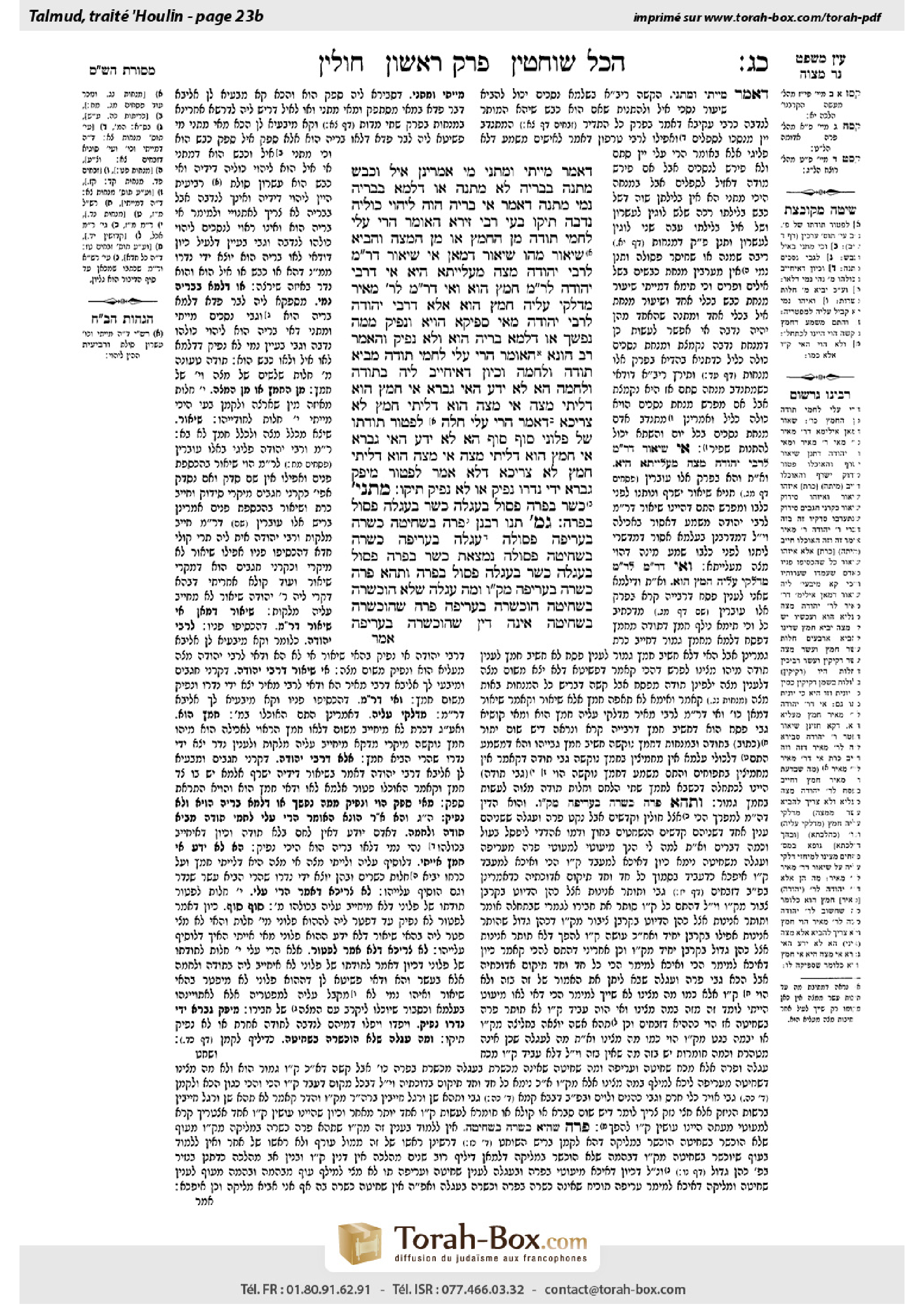
Chullin 23b: Talmud study for Daf Yomi
Study the Talmud for Daf Yomi with scanned pages, Hebrew text, English translations from Sefaria and AI-generated French translations.
Passage selection and English or AI-generated French translation are available where the scan has annotations. Daf Study is independent of Torah-Box and Sefaria.
Browse Chullin · חולין · All tractatesChullin 23b text and translations
This page of Chullin includes the Aramaic text, an English translation and an AI-generated French translation, alongside the scan above.
חולין כ״ג ב · Aramaic and Hebrew text
דְּאָמַר מַיְיתֵי וּמַתְנֵי.
מִי אָמְרִינַן: אַיִל וָכֶבֶשׂ מַתְנֵה, בִּבְרִיָּה לָא מַתְנֵה, אוֹ דִלְמָא בִּבְרִיָּה נָמֵי מַתְנֵה, דְּאָמַר: אִי בְּרִיָּה הָוֵה – לֶיהֱוֵי כּוּלֵּיהּ נְדָבָה? תֵּיקוּ.
בָּעֵי רַבִּי זֵירָא: הָאוֹמֵר ״הֲרֵי עָלַי לַחְמֵי תוֹדָה מִן הֶחָמֵץ אוֹ מִן הַמַּצָּה״, וְהֵבִיא שִׂיאוּר, מַהוּ?
שִׂיאוּר דְּמַאן? אִי שִׂיאוּר דְּרַבִּי מֵאִיר – לְרַבִּי יְהוּדָה מַצָּה מְעַלַּיְיתָא הִיא.
אִי דְּרַבִּי יְהוּדָה, לְרַבִּי מֵאִיר – חָמֵץ הוּא.
וְאִי דְּרַבִּי מֵאִיר, לְרַבִּי מֵאִיר, מִדְּלָקֵי עֲלֵיהּ – חָמֵץ הוּא.
אֶלָּא דְּרַבִּי יְהוּדָה לְרַבִּי יְהוּדָה, מַאי? סְפֵיקָא הָוֵי, וְנָפֵיק מִמָּה נַפְשָׁךְ, אוֹ דִלְמָא בְּרִיָּה הוּא, וְלָא נָפֵיק?
וְהָאָמַר רַב הוּנָא: הָאוֹמֵר ״הֲרֵי עָלַי לַחְמֵי תוֹדָה״ – מֵבִיא תּוֹדָה וְלַחְמָהּ, וְכֵיוָן דְּאִיחַיַּיב לֵיהּ בְּתוֹדָה וְלַחְמָהּ, הָא לָא יָדַע הַאי גַּבְרָא אִי חָמֵץ הוּא דְּלַיְתֵי מַצָּה, אִי מַצָּה הוּא דְּלַיְתֵי חָמֵץ!
לָא צְרִיכָא, דְּאָמַר ״הֲרֵי עָלַי חַלָּה לִפְטוֹר תּוֹדָתוֹ שֶׁל פְּלוֹנִי״.
סוֹף סוֹף הָא לָא יָדַע הַאי גַּבְרָא, אִי חָמֵץ הוּא דְּלַיְתֵי מַצָּה, אִי מַצָּה הוּא דְּלַיְתֵי חָמֵץ! לָא צְרִיכָא, דְּלָא אָמַר ״לִפְטוֹר״, מִיפָּק גַּבְרָא יְדֵי נִדְרוֹ נָפֵיק אוֹ לָא נָפֵיק? תֵּיקוּ.
מַתְנִי׳ כָּשֵׁר בַּפָּרָה – פָּסוּל בָּעֶגְלָה, כָּשֵׁר בָּעֶגְלָה – פָּסוּל בַּפָּרָה.
גְּמָ׳ תָּנוּ רַבָּנַן: פָּרָה בִּשְׁחִיטָה כְּשֵׁרָה, בַּעֲרִיפָה פְּסוּלָה; עֶגְלָה בַּעֲרִיפָה כְּשֵׁרָה, בִּשְׁחִיטָה פְּסוּלָה; (נמצאת) [נִמְצָא] כָּשֵׁר בַּפָּרָה – פָּסוּל בָּעֶגְלָה, כָּשֵׁר בָּעֶגְלָה – פָּסוּל בַּפָּרָה.
וּתְהֵא פָּרָה כְּשֵׁרָה בַּעֲרִיפָה מִקַּל וְחוֹמֶר: וּמָה עֶגְלָה שֶׁלֹּא הוּכְשְׁרָה בִּשְׁחִיטָה – הוּכְשְׁרָה בַּעֲרִיפָה, פָּרָה שֶׁהוּכְשְׁרָה בִּשְׁחִיטָה – אֵינָהּ דִּין שֶׁהוּכְשְׁרָה בַּעֲרִיפָה?
Chullin 23b · English translation
as he says that one who sacrifices a palges brings the meal offering and the libation of a ram and stipulates: If it is a ram, this is its meal offering and libation, and if it is a lamb, whose meal offering and libation are less than that of the ram, then the remainder will be a gift offering.
The dilemma is: Do we say that he stipulates only if it is a ram or if it is a lamb, but he does not stipulate the possibility that it is an entity in and of itself, as bar Padda does not accept such a possibility? If so, bar Padda holds that one who vowed to bring a ram or a lamb can fulfill his obligation by bringing a palges and stipulating accordingly. Or perhaps bar Padda holds that he also stipulates the possibility that it is an entity in and of itself, and in that case he says: If it is an entity, let the entire libation be a gift offering. According to that possibility, even according to bar Padda, if one vowed to bring a ram or a lamb and brought a palges, due to the uncertainty he does not fulfill his obligation. The Gemara concludes: The dilemma shall stand unresolved.
§ The concept of an entity in and of itself is mentioned with regard to a thanks offering, with which one must bring twenty tenths of an ephah for the accompanying loaves: Ten tenths of an ephah for matza and ten for leavened bread. Rabbi Zeira raises a dilemma: With regard to one who says: It is incumbent upon me to bring loaves of a thanks offering of leavened bread or of matza, and he brought leavening dough [siur], what is the halakha?
The Gemara asks: Siur according to whose opinion? If the reference is to the siur of Rabbi Meir, who says that it is dough at the stage when its surface pales, according to Rabbi Yehuda it is not leavened bread at all; it is full-fledged matza and one fulfills his vow to bring matza.
If the reference is to the siur of Rabbi Yehuda, who says that it is dough at the stage when it has cracks that look like the antennae of locusts and is in accordance with the opinion of Rabbi Meir, Rabbi Meir holds that it is full-fledged leavened bread, and one fulfills his vow to bring leavened bread.
And if the reference is to the siur of Rabbi Meir and is in accordance with the opinion of Rabbi Meir, although one is not liable to receive karet for eating it on Passover, from the halakha that one is flogged for eating it on Passover it is clearly leavened bread, with which one fulfills his vow to bring leavened bread.
Rather, the dilemma is with regard to the siur of Rabbi Yehuda and is in accordance with the opinion of Rabbi Yehuda, who holds that although one is obligated to destroy it before Passover, one is not liable to receive lashes for eating it on Passover. It is unclear whether this is due to uncertainty or due to siur having a unique status. Therefore, Rabbi Zeira raises the dilemma: What is its status? Is it a case of uncertainty, and consequently one who vowed to bring loaves of matza or leavened bread and brings siur fulfills his obligation whichever way you look at it, because if it is matza, he fulfills his vow to bring matza, and if it is leavened bread, he fulfills his vow to bring leavened bread? Or perhaps siur is an entity in and of itself, neither matza nor leavened bread, and he does not fulfill his obligation at all.
The Gemara asks: Even if it is a case of uncertainty, how can a person fulfill his vow with that siur? But doesn’t Rav Huna say that one who says: It is incumbent upon me to bring loaves of a thanks offering, is obligated to bring a thanks offering and all its loaves, twenty tenths of an ephah, ten for matza and ten for leavened bread? And since he is obligated to bring a thanks offering and all its loaves, but this man does not know whether the siur that he brought is leavened bread so that he will bring matza, or whether the siur that he brought is matza so that he will bring leavened bread, so how can he fulfill his vow? In any case, the only way that he could fulfill his vow would be to bring an additional twenty tenths of an ephah.
The Gemara answers: No, the dilemma of Rabbi Zeira is necessary only in a case where one said: It is incumbent upon me to bring the loaf element of the thanks offering to exempt the thanks offering of so-and-so from the obligation to bring loaves, as in that case he can fulfill his vow because he did not obligate himself to bring a thanks offering.
The Gemara objects: Ultimately, this man who brings the thanks offering does not know whether the siur that the other contributed is leavened bread so that he will bring matza, or whether the siur that the other contributed is matza so that he will bring leavened bread. Therefore, the man bringing the thanks offering must bring both matza and unleavened bread in addition to the siur, and the one who vowed has then not exempted him from any obligation by contributing the siur. The Gemara responds: No, the dilemma of Rabbi Zeira is necessary only in a case where he said: It is incumbent upon me to bring loaves of leavened bread or matza for the thanks offering of so-and-so, but did not say: To exempt his thanks offering. In that case, he is not obligated to fulfill the other’s obligation, and the dilemma is: Does the man fulfill his vow by bringing the loaves of siur or does he not fulfill his vow? The Gemara concludes: The dilemma shall stand unresolved.
MISHNA: That which is fit in a red heifer is unfit in a heifer whose neck is broken; that which is fit in a heifer whose neck is broken is unfit in a red heifer.
GEMARA: The Sages taught in a baraita in explanation of the mishna: With regard to the red heifer, with slaughter it is fit; with breaking the neck it is unfit. With regard to the heifer whose neck is broken, with breaking the neck it is fit; with slaughter it is unfit. Consequently, that which is fit in a red heifer is unfit in a heifer whose neck is broken; that which is fit in a heifer whose neck is broken is unfit in a red heifer.
The Gemara asks: And let it be derived that the red heifer is fit with breaking the neck by means of an a fortiori inference: If a heifer whose neck is broken, which is not rendered fit with slaughter, is rendered fit with breaking the neck, then with regard to a red heifer, which is rendered fit with slaughter, isn’t it logical that it is rendered fit with breaking the neck?
Chullin 23b · Traduction française (IA)
car il dit qu'qui sacrifie un palges apporte l'offrande de table et le vin de libation d'un bouc et stipule : Si c'est un bouc, c'est son offrande de table et son vin de libation, et si c'est un agneau, dont l'offrande de table et le vin de libation sont moindres que ceux du bouc, alors le reste sera une offrande de don.
Le dilemme est : Disons-nous qu'il stipule seulement si c'est un bouc ou si c'est un agneau, mais il ne stipule pas la possibilité qu'il s'agisse d'une entité en soi, comme bar Padda ne reconnaît pas cette possibilité ? Si c'est le cas, bar Padda considère que celui qui a juré d'apporter un bouc ou un agneau peut remplir son obligation en apportant un palges et en stipulant ainsi. Ou peut-être bar Padda considère qu'il stipule aussi la possibilité qu'il s'agisse d'une entité en soi, et dans ce cas il dit : Si c'est une entité, que l'ensemble du vin de libation soit une offrande de don. Selon cette possibilité, même selon bar Padda, si l'on a juré d'apporter un bouc ou un agneau et qu'on apporte un palges, en raison de l'incertitude, on ne rempli pas son obligation. La Guemara conclut : Ce dilemme restera sans solution.
§ Le concept d'une entité en soi est mentionné en ce qui concerne une offrande de remerciement, avec laquelle on doit apporter vingt dixièmes d'ephah pour les pains accompagnants : dix dixièmes d'ephah pour la matza et dix pour le pain levé. Rabbi Zeira soulève un dilemme : En ce qui concerne celui qui dit : Il m'est imposé d'apporter des pains d'une offrande de remerciement de pain levé ou de matza, et il apporte de la pâte [siur], quelle est la halakha ?
La Guemara demande : Siur selon l'opinion de qui ? Si la référence est à la siur de Rabbi Meir, qui dit que c'est de la pâte à l'étape où sa surface pâlit, selon Rabbi Yehuda, ce n'est pas du pain levé du tout ; c'est de la matza complète et on rempli son serment d'apporter de la matza.
Si la référence est à la siur de Rabbi Yehuda, qui dit que c'est de la pâte à l'étape où elle a des fissures qui ressemblent aux antennes des sauterelles et qui est selon l'opinion de Rabbi Meir, Rabbi Meir considère qu'il s'agit de pain levé complet, et on rempli son serment d'apporter du pain levé.
Et si la référence est à la siur de Rabbi Meir et est selon l'opinion de Rabbi Meir, bien qu'on ne soit pas puni de karet pour en manger pendant la Pâque, à partir de la halakha qu'on est fouetté pour en manger pendant la Pâque, il est clair qu'il s'agit de pain levé, avec lequel on rempli son serment d'apporter du pain levé.
Plutôt, le dilemme est en ce qui concerne la siur de Rabbi Yehuda et est selon l'opinion de Rabbi Yehuda, qui considère que bien qu'on soit tenu de le détruire avant la Pâque, on n'est pas puni de coups de fouet pour en manger pendant la Pâque. Il est unclear si cela est dû à l'incertitude ou à un statut unique de la siur. Ainsi, Rabbi Zeira soulève le dilemme : Quel est son statut ? Est-ce un cas d'incertitude, et par conséquent celui qui a juré d'apporter des pains de matza ou de pain levé et apporte de la siur rempli son obligation indépendamment de la manière de le regarder, car si c'est de la matza, il rempli son serment d'apporter de la matza, et si c'est du pain levé, il rempli son serment d'apporter du pain levé ? Ou peut-être la siur est une entité en soi, ni matza ni pain levé, et il ne rempli pas son obligation du tout.
La Guemara demande : Même si c'est un cas d'incertitude, comment un homme peut-il remplir son serment avec cette siur ? Mais ne dit pas Rav Huna que celui qui dit : Il m'est imposé d'apporter des pains d'une offrande de remerciement, est tenu d'apporter une offrande de remerciement et tous ses pains, vingt dixièmes d'ephah, dix pour la matza et dix pour le pain levé ? Et puisque il est tenu d'apporter une offrande de remerciement et tous ses pains, mais cet homme ne sait pas si la siur qu'il a apporté est du pain levé afin qu'il apporte de la matza, ou si la siur qu'il a apporté est de la matza afin qu'il apporte du pain levé, comment peut-il remplir son serment ? En tout cas, la seule façon dont il pourrait remplir son serment serait d'apporter une autre vingt dixièmes d'ephah.
La Guemara répond : Non, le dilemme de Rabbi Zeira est nécessaire uniquement dans un cas où l'on a dit : Il m'est imposé d'apporter l'élément des pains de l'offrande de remerciement pour exempter l'offrande de remerciement de tel et tel de l'obligation d'apporter des pains, comme dans ce cas il peut remplir son serment car il n'a pas imposé à lui-même d'apporter une offrande de remerciement.
La Guemara s'oppose : Finalement, cet homme qui apporte l'offrande de remerciement ne sait pas si la siur que l'autre a contribué est du pain levé afin qu'il apporte de la matza, ou si la siur que l'autre a contribué est de la matza afin qu'il apporte du pain levé. Par conséquent, l'homme apportant l'offrande de remerciement doit apporter à la fois de la matza et du pain levé en plus de la siur, et celui qui a juré n'a pas exempté de toute obligation en contribuant la siur. La Guemara répond : Non, le dilemme de Rabbi Zeira est nécessaire uniquement dans un cas où il a dit : Il m'est imposé d'apporter des pains de pain levé ou de matza pour l'offrande de remerciement de tel et tel, mais n'a pas dit : Pour exempter son offrande de remerciement. Dans ce cas, il n'est pas tenu de remplir l'obligation de l'autre, et le dilemme est : L'homme rempli-t-il son serment en apportant les pains de siur ou ne rempli-t-il pas son serment ? La Guemara conclut : Ce dilemme restera sans solution.
MICHNA : Ce qui est adapté à une vache rouge est inadapté à une vache dont le cou est brisé ; ce qui est adapté à une vache dont le cou est brisé est inadapté à une vache rouge.
GUEMARA : Les Sages ont enseigné dans une baraïta en explication de la mishna : En ce qui concerne la vache rouge, avec la mise à mort elle est adaptée ; avec la brisade du cou elle est inadaptée. En ce qui concerne la vache dont le cou est brisé, avec la brisade du cou elle est adaptée ; avec la mise à mort elle est inadaptée. Par conséquent, ce qui est adapté à une vache rouge est inadapté à une vache dont le cou est brisé ; ce qui est adapté à une vache dont le cou est brisé est inadapté à une vache rouge.
La Guemara pose la question : Et on peut déduire que la vache rouge est propre à l'immersion par une inférence a fortiori : Si une vache dont le cou est brisé, qui n'est pas rendue propre par la mise à mort, est rendue propre par la brisure du cou, alors, concernant la vache rouge, qui est rendue propre par la mise à mort, n'est-il pas logique qu'elle soit rendue propre par la brisure du cou ?
Traduction française générée par IA à partir de l’édition anglaise de Sefaria. Vérifie toujours un passage avec le texte source.
Text from Sefaria: William Davidson Edition - Vocalized Aramaic (unknown); William Davidson Edition - English (CC BY NC).