Chullin 26b: Talmud study for Daf Yomi
Study the Talmud for Daf Yomi with scanned pages, Hebrew text, English translations from Sefaria and AI-generated French translations.
Passage selection and English or AI-generated French translation are available where the scan has annotations. Daf Study is independent of Torah-Box and Sefaria.
Browse Chullin · חולין · All tractatesChullin 26b text and translations
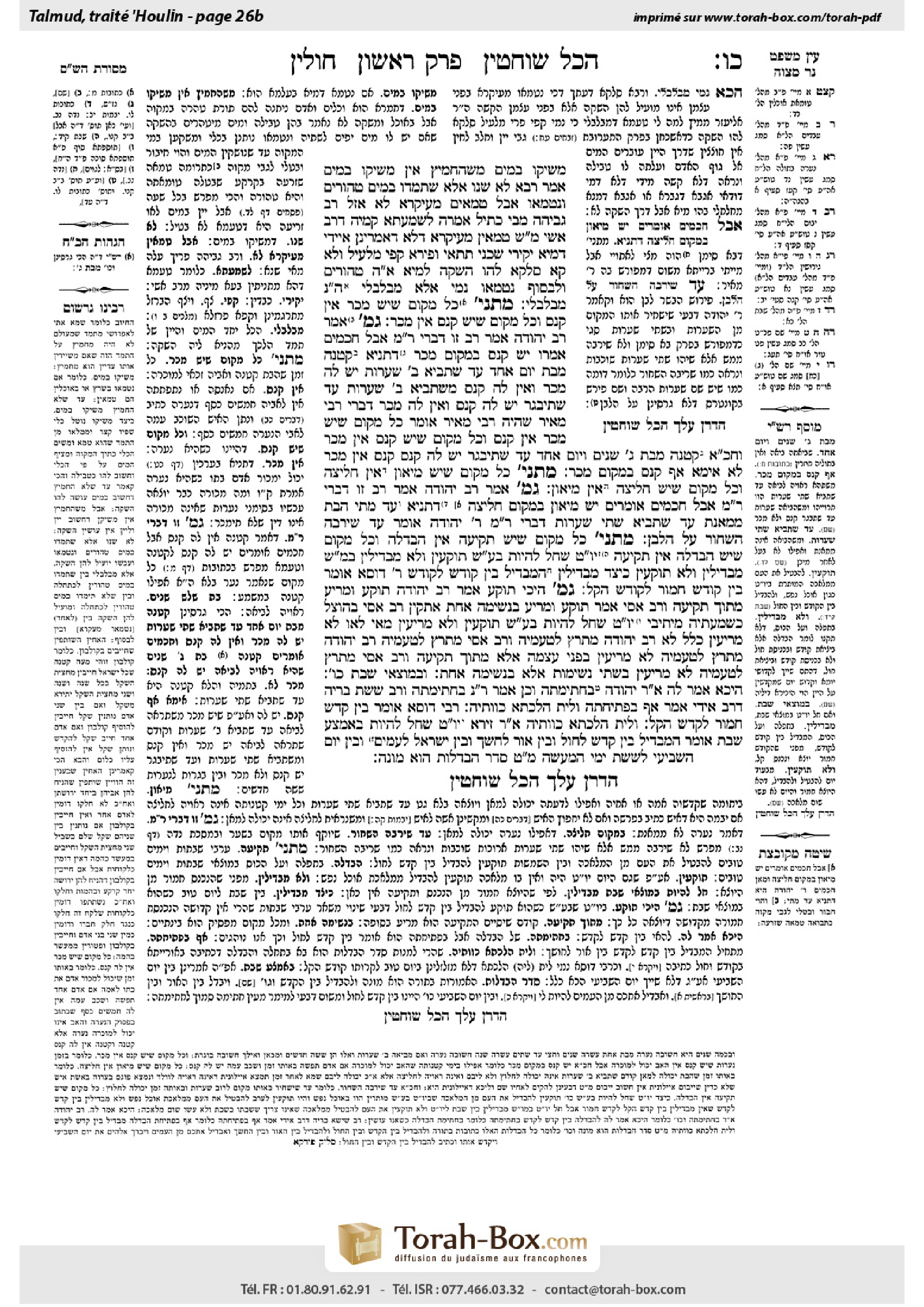
This page of Chullin includes the Aramaic text, an English translation and an AI-generated French translation, alongside the scan above.
חולין כ״ו ב · Aramaic and Hebrew text
מַשִּׁיקוֹ בַּמַּיִם, מִשֶּׁהֶחְמִיץ – אֵין מַשִּׁיקוֹ בְּמַיִם. אָמַר רָבָא: לֹא שָׁנוּ אֶלָּא שֶׁתִּמְּדוֹ בְּמַיִם טְהוֹרִים וְנִטְמְאוּ, אֲבָל טְמֵאִים מֵעִיקָּרָא – לָא.
אֲזַל רַב גְּבִיהָה מִבֵּי כְתִיל, אַמְרַהּ לִשְׁמַעְתָּא קַמֵּיהּ דְּרַב אָשֵׁי, מַאי שְׁנָא טְמֵאִין מֵעִיקָּרָא דְּלָא, דְּאָמְרִינַן: אַיְּידֵי דְּמַיָּא יַקִּירִי שׇׁכְנִי תַּתַּאי, וּפֵירָא קָפֵי מִלְּעֵיל, וְלָא קָא סָלְקָא לְהוּ הַשָּׁקָה לְמַיָּא. אִי הָכִי, טְהוֹרִים וּלְבַסּוֹף נִטְמְאוּ נָמֵי.
אֶלָּא, מְבַלְבְּלִי; הָכָא נָמֵי – מְבַלְבְּלִי.
מַתְנִי׳ כׇּל מָקוֹם שֶׁיֵּשׁ מֶכֶר, אֵין קְנָס, וְכׇל מָקוֹם שֶׁיֵּשׁ קְנָס, אֵין מֶכֶר.
גְּמָ׳ אָמַר רַב יְהוּדָה אָמַר רַב: זוֹ דִּבְרֵי רַבִּי מֵאִיר, אֲבָל חֲכָמִים אָמְרוּ: יֵשׁ קְנָס בִּמְקוֹם מֶכֶר, דְּתַנְיָא: קְטַנָּה מִבַּת יוֹם אֶחָד עַד שֶׁתָּבִיא שְׁתֵּי שְׂעָרוֹת – יֵשׁ לָהּ מֶכֶר וְאֵין לָהּ קְנָס, מִשֶּׁתָּבִיא שְׁתֵּי שְׂעָרוֹת עַד שֶׁתִּיבְגַּר – יֵשׁ לָהּ קְנָס וְאֵין לָהּ מֶכֶר, דִּבְרֵי רַבִּי מֵאִיר, שֶׁהָיָה רַבִּי מֵאִיר אוֹמֵר: כׇּל מָקוֹם שֶׁיֵּשׁ מֶכֶר – אֵין קְנָס, וְכׇל מָקוֹם שֶׁיֵּשׁ קְנָס – אֵין מֶכֶר.
וַחֲכָמִים אוֹמְרִים: קְטַנָּה מִבַּת שָׁלֹשׁ שָׁנִים וְיוֹם אֶחָד עַד שֶׁתִּיבְגַּר – יֵשׁ לָהּ קְנָס.
קְנָס – אִין, מֶכֶר – לָא? אֵימָא: אַף קְנָס בִּמְקוֹם מֶכֶר.
מַתְנִי׳ כׇּל מָקוֹם שֶׁיֵּשׁ מֵיאוּן – אֵין חֲלִיצָה, וְכׇל מָקוֹם שֶׁיֵּשׁ חֲלִיצָה – אֵין מֵיאוּן.
גְּמָ׳ אָמַר רַב יְהוּדָה, אָמַר רַב: זוֹ דִּבְרֵי רַבִּי מֵאִיר, אֲבָל חֲכָמִים אוֹמְרִים: יֵשׁ מֵיאוּן בִּמְקוֹם חֲלִיצָה, דְּתַנְיָא: עַד מָתַי הַבַּת מְמָאֶנֶת? עַד שֶׁתָּבִיא שְׁתֵּי שְׂעָרוֹת, דִּבְרֵי רַבִּי מֵאִיר. רַבִּי יְהוּדָה אוֹמֵר: עַד שֶׁיִּרְבֶּה הַשָּׁחוֹר עַל הַלָּבָן.
מַתְנִי׳ כׇּל מָקוֹם שֶׁיֵּשׁ תְּקִיעָה – אֵין הַבְדָּלָה, וְכׇל מָקוֹם שֶׁיֵּשׁ הַבְדָּלָה – אֵין תְּקִיעָה.
יוֹם טוֹב שֶׁחָל לִהְיוֹת בְּעֶרֶב שַׁבָּת – תּוֹקְעִין, וְלֹא מַבְדִּילִין; בְּמוֹצָאֵי שַׁבָּת – מַבְדִּילִין, וְלֹא תּוֹקְעִין.
כֵּיצַד מַבְדִּילִין? ״הַמַּבְדִּיל בֵּין קוֹדֶשׁ לְקוֹדֶשׁ״. רַבִּי דּוֹסָא אוֹמֵר: ״בֵּין קוֹדֶשׁ חָמוּר לְקוֹדֶשׁ הַקַּל״.
גְּמָ׳ הֵיכִי תּוֹקֵעַ? אָמַר רַב יְהוּדָה: תּוֹקֵעַ וּמֵרִיעַ מִתּוֹךְ תְּקִיעָה, וְרַב אַסִּי אָמַר: תּוֹקֵעַ וּמֵרִיעַ בִּנְשִׁימָה אַחַת. אַתְקֵין רַב אַסִּי בְּהוּצָל כִּשְׁמַעְתֵּיהּ.
מֵיתִיבִי: יוֹם טוֹב שֶׁחָל לִהְיוֹת בְּעֶרֶב שַׁבָּת, תּוֹקְעִין וְלֹא מְרִיעִין. מַאי לָאו לֹא מְרִיעִין כְּלָל? לָא, רַב יְהוּדָה מְתָרֵץ לְטַעְמֵיהּ וְרַב אַסִּי מְתָרֵץ לְטַעְמֵיהּ. רַב יְהוּדָה מְתָרֵץ לְטַעְמֵיהּ: לָא מְרִיעִין בִּפְנֵי עַצְמָהּ, אֶלָּא מִתּוֹךְ תְּקִיעָה. וְרַב אַסִּי מְתָרֵץ לְטַעְמֵיהּ: לָא מְרִיעִין בִּשְׁתֵּי נְשִׁימוֹת, אֶלָּא בִּנְשִׁימָה אַחַת.
וּבְמוֹצָאֵי שַׁבָּת כּוּ׳. הֵיכָא אָמַר לַהּ? אָמַר רַב יְהוּדָה: בַּחֲתִימָתָהּ, וְכֵן אָמַר רַב נַחְמָן: בַּחֲתִימָתָהּ.
וְרַב שֵׁשֶׁת בְּרֵיהּ דְּרַב אִידִי אָמַר: אַף בִּפְתִיחָתָהּ, וְלֵית הִלְכְתָא כְּוָותֵיהּ.
רַבִּי דּוֹסָא אוֹמֵר: ״בֵּין קֹדֶשׁ חָמוּר לְקֹדֶשׁ הַקַּל״, וְלֵית הִלְכְתָא כְּוָותֵיהּ.
אָמַר רַבִּי זֵירָא: יוֹם טוֹב שֶׁחָל לִהְיוֹת בְּאֶמְצַע שַׁבָּת, אוֹמֵר ״הַמַּבְדִּיל בֵּין קֹדֶשׁ לְחוֹל וּבֵין אוֹר לְחֹשֶׁךְ וּבֵין יִשְׂרָאֵל לַגּוֹיִם וּבֵין יוֹם הַשְּׁבִיעִי לְשֵׁשֶׁת יְמֵי הַמַּעֲשֶׂה״, מַאי טַעְמָא? סֵדֶר הַבְדָּלוֹת הוּא מוֹנֶה.
הֲדַרַן עֲלָךְ הַכֹּל שׁוֹחֲטִין.
Chullin 26b · English translation
one brings the temed into contact with water of a ritual bath by immersing the vessel holding the temed in a ritual bath, thereby purifying the temed. Once it ferments, he does not bring it into contact with water, as that is effective only in purifying water and not in purifying other liquids. Rava said: The Sages taught this only with regard to a case where one prepared temed with ritually pure water and it later became impure, but if the water was impure from the outset, the contact with the ritual bath would not purify it.
Rav Geviha from Bei Katil went and stated this halakha before Rav Ashi and asked: What is different in the case of water that is impure from the outset such that bringing the temed into contact with the ritual bath would not purify it, as we say: Since the water is heavy it settles at the bottom of the vessel, and the fruit, the grape residue, floats above, and therefore, contact with the water of the ritual bath would not be effective for the water of the temed? If so, the same would apply in the case of water that was ritually pure and ultimately became impure as temed also.
Rather, the reason contact is effective in the case of ritually pure water that later became impure as temed is that the water and the residue are intermingled. Here too, in the case of water that was impure from the outset, the water and the residue are intermingled, and contact with the water of a ritual bath would be effective.
MISHNA: Any situation where there is sale of one’s daughter as a Hebrew maidservant, i.e., when she is a minor, there is no fine of fifty sela paid to her father if she is raped or seduced, as that fine is paid to her father only when she is a young woman. And any situation where there is a fine paid to the father there is no sale.
GEMARA: Rav Yehuda says that Rav says: This is the statement of Rabbi Meir, but the Rabbis said: There is the possibility of payment of a fine in a situation where there is sale, as it is taught in a baraita: A minor girl from the age of one day old until she reaches puberty and grows two pubic hairs is subject to sale, but is not entitled to receive payment of a fine. Once she reaches puberty and grows two pubic hairs, from that point until she matures into a grown woman she is entitled to receive payment of a fine, but is not subject to sale. This is the statement of Rabbi Meir, as Rabbi Meir would state a principle: Any situation where there is a sale, there is no fine; and any situation where there is a fine, there is no sale.
And the Rabbis say: A minor girl from the age of three years and one day until she matures into a grown woman is entitled to receive payment of a fine.
The Gemara asks: Is that to say that yes, she is entitled to payment of a fine, but she is not subject to sale? Isn’t her father permitted to sell her during most of that period? The Gemara answers: Say that the Rabbis said: She is also entitled to receive payment of a fine during that period in a situation where she is subject to sale.
MISHNA: Any situation where there is the right of refusal for a minor girl married by her mother or brothers, enabling her to opt out of the marriage, there is no ḥalitza, as a minor girl whose husband died without children cannot perform ḥalitza. And any situation where there is ḥalitza, once she has reached majority, there is no right of refusal.
GEMARA: Rav Yehuda says that Rav says: This is the statement of Rabbi Meir, but the Rabbis say: There is the right of refusal in a situation where there is ḥalitza, as it is taught in a baraita: Until when may a girl refuse? She may do so as long as she is a minor, until she grows two pubic hairs, which are signs of puberty rendering her a young woman; this is the statement of Rabbi Meir. Rabbi Yehuda says: She may refuse until the black hairs in the pubic area appear to cover an area greater than the white skin of the area uncovered by hair. At that stage, she is already eligible to perform the rite of ḥalitza. That is the opinion of the Rabbis.
MISHNA: Any situation where there is a shofar blast sounded on the eve of Shabbat or a Festival to stop the people from performing labor and to demarcate between the sacred and the profane, there is no havdala recited at the conclusion of the Shabbat or Festival in prayer and over a cup of wine. And any situation where there is havdala recited, there is no shofar blast sounded.
How so? On a Festival that occurs on Shabbat eve, one sounds the shofar to stop the people from performing labor that is permitted on the Festival and prohibited on Shabbat and to demarcate between one sacred day and another; and one does not recite havdala, as that is recited only when the transition is from a sacred day to a profane day or from a day of greater sanctity to a day of lesser sanctity. The sanctity of Shabbat is greater than the sanctity of the Festival, and therefore havdala is not recited in this case. On a Festival that occurs at the conclusion of Shabbat, one recites havdala, but one does not sound the shofar.
How does one recite havdala in that case; i.e., what is the formula of the blessing? It concludes: Who distinguishes between sacred and sacred, as opposed to the standard blessing at the conclusion of Shabbat: Who distinguishes between sacred and profane. Rabbi Dosa says that the formula is: Who distinguishes between greater sanctity and lesser sanctity.
GEMARA: The Gemara asks: How does one sound a tekia on a Festival that occurs on Shabbat eve, when the difference between the sanctity of the preceding day and the sanctity of the coming day is not as pronounced as it is on a standard Shabbat eve? Rav Yehuda said: One sounds a tekia, i.e., a long continuous shofar blast, and sounds a terua, i.e., a staccato series of shofar blasts, from the midst of the tekia. And Rav Asi said: One does not sound a continuous blast; rather, he sounds a tekia and then sounds a terua in one breath. Rav Asi instituted the practice in the city of Huzal in accordance with his halakha.
The Gemara raises an objection to the statements of Rav Yehuda and Rav Asi from a baraita: On a Festival that occurs on Shabbat eve, one sounds a tekia but does not sound a terua. What, is it not that one does not sound a terua at all? The Gemara answers: No, rather, Rav Yehuda explains the baraita according to his line of reasoning and Rav Asi explains the baraita according to his line of reasoning. Rav Yehuda explains the baraita according to his line of reasoning: One does not sound a distinct terua; rather, he sounds the terua that emerges from the midst of the tekia. And Rav Asi explains the baraita according to his line of reasoning: One does not sound the tekia and the terua in two breaths; rather, he sounds them in one breath.
§ The mishna states that on a Festival that occurs at the conclusion of Shabbat one recites havdala, and that the Sages disagreed as to the formula of that blessing. The Gemara asks: Where does one recite the formula in question? Rav Yehuda said: He recites the formula at the conclusion of the blessing. But in the body of the blessing one recites the same formula as in every conclusion of Shabbat: Who distinguishes between sacred and profane, between light and darkness, etc. And likewise, Rav Naḥman said: He recites the formula at the conclusion of the blessing.
And Rav Sheshet, son of Rav Idi, said: One recites that formula even at the beginning, in the body of the blessing, instead of the formula: Who distinguishes between sacred and profane. The Gemara comments: And the halakha is not in accordance with his opinion.
The mishna teaches: Rabbi Dosa says that the formula is: Who distinguishes between greater sanctity and lesser sanctity. The Gemara comments: And the halakha is not in accordance with his opinion.
Rabbi Zeira said: At the conclusion of a Festival that occurs in the middle of the week, one recites: Who distinguishes between sacred and profane, and between light and darkness, and between Israel and the nations, and between the seventh day and the six days of labor, even though it is not Shabbat. What is the reason for that practice? He is enumerating the series of distinctions that the Sages instituted and not specifically the distinction unique to that particular day.
Chullin 26b · Traduction française (IA)
On apporte le temed en contact avec l'eau du bain rituel en plongeant le récipient contenant le temed dans un bain rituel, ce qui purifie ainsi le temed. Une fois qu'il fermentise, il ne l'apporte plus en contact avec l'eau, car cela est efficace uniquement pour purifier l'eau et non pour purifier d'autres liquides. Rava a dit : Les Sages ont enseigné cela uniquement dans le cas où l'on préparait le temed avec de l'eau rituellement pure et qu'il devint ensuite impur, mais si l'eau était impure dès le départ, le contact avec le bain rituel ne le purifierait pas.
Rav Geviha de Bei Katil est allé affirmer cette halakha devant Rav Ashi et a demandé : Qu'est-ce qui diffère dans le cas d'eau impure dès le départ tel que le contact avec le bain rituel ne purifie pas l'eau, comme nous disons : Puisque l'eau est lourde, elle s'accumule au fond du récipient, et le résidu de raisin flotte au-dessus, et donc, le contact avec l'eau du bain rituel ne serait pas efficace pour l'eau du temed ? Si c'est ainsi, cela s'appliquerait également dans le cas d'eau qui était rituellement pure et qui devint finalement impure comme temed.
En réalité, la raison pour laquelle le contact est efficace dans le cas d'eau rituellement pure qui devint impure comme temed est que l'eau et le résidu sont mélangés. Ici aussi, dans le cas d'eau impure dès le départ, l'eau et le résidu sont mélangés, et le contact avec l'eau du bain rituel serait efficace.
MICHNA : Tout cas où il y a la vente d'une fille comme servante juive, c'est-à-dire quand elle est mineure, il n'y a pas de dommages de cinquante sela versés à son père si elle est violée ou séduite, car ce dommage est versé à son père uniquement quand elle est jeune femme. Et tout cas où il y a un dommage versé au père, il n'y a pas de vente.
GUEMARA : Rav Yehuda dit que Rav dit : C'est l'opinion de Rabbi Meir, mais les Rabbins disent : Il y a la possibilité de verser un dommage dans un cas où il y a une vente, comme il est enseigné dans une baraïta : Une jeune fille, depuis l'âge d'un jour jusqu'à l'âge de la puberté et qu'elle ait deux poils pubiens, est soumise à la vente, mais n'a pas le droit de recevoir un dommage. Une fois qu'elle atteint la puberté et qu'elle a deux poils pubiens, à partir de ce moment jusqu'à ce qu'elle devienne une femme adulte, elle a le droit de recevoir un dommage, mais elle n'est pas soumise à la vente. C'est l'opinion de Rabbi Meir, car Rabbi Meir énonce un principe : Tout cas où il y a une vente, il n'y a pas de dommage ; et tout cas où il y a un dommage, il n'y a pas de vente.
Et les Rabbins disent : Une jeune fille, depuis l'âge de trois ans et un jour jusqu'à ce qu'elle devienne une femme adulte, a le droit de recevoir un dommage.
La Guemara demande : Est-ce que cela signifie que oui, elle a le droit de recevoir une amende, mais elle n'est pas soumise à la vente ? N'est-ce pas que son père est autorisé à la vendre pendant la majeure partie de cette période ? La Guemara répond : Dites que les Rabbins disent : Elle a aussi le droit de recevoir une amende pendant cette période dans un cas où elle est soumise à la vente.
MICHNA : Tout cas où il y a le droit de refus pour une jeune fille mariée par sa mère ou ses frères, lui permettant de refuser le mariage, il n'y a pas de ḥalitza, car une jeune fille dont le mari est mort sans enfants ne peut pas effectuer ḥalitza. Et tout cas où il y a ḥalitza, une fois qu'elle a atteint la majorité, il n'y a pas de droit de refus.
GUEMARA : Rav Yehuda dit que Rav dit : C'est l'opinion de Rabbi Meir, mais les Rabbins disent : Il y a le droit de refus dans un cas où il y a ḥalitza, comme il est enseigné dans une baraïta : Jusqu'à quel âge une fille peut-elle refuser ? Elle peut le faire tant qu'elle est mineure, jusqu'à ce qu'elle ait deux poils pubiens, qui sont des signes de la puberté la rendant une jeune femme ; c'est l'opinion de Rabbi Meir. Rabbi Yehuda dit : Elle peut refuser jusqu'au moment où les poils noirs dans la région pubienne couvrent une surface supérieure à la peau blanche non couverte par les poils. À ce stade, elle est déjà éligible à effectuer la cérémonie de ḥalitza. C'est l'opinion des Rabbins.
MICHNA : Tout cas où il y a un coup de corne sonné la veille du Shabbat ou d'un Festival pour empêcher les gens de travailler et pour distinguer le sacré du profane, il n'y a pas de havdala prononcé à la fin du Shabbat ou du Festival en prière et sur un verre de vin. Et tout cas où il y a une havdala prononcée, il n'y a pas de coup de corne sonné.
Comment cela se passe-t-il ? Sur un Festival qui a lieu la veille du Shabbat, on sonne le corne pour empêcher les gens de travailler ce qui est permis sur le Festival mais interdit sur le Shabbat, et pour distinguer un jour sacré d'un autre ; et on ne prononce pas de havdala, car cela est prononcé uniquement lors du passage d'un jour sacré à un jour profane ou d'un jour de plus grande sainteté à un jour de moindre sainteté. La sainteté du Shabbat est supérieure à celle du Festival, et donc la havdala n'est pas prononcée dans ce cas. Sur un Festival qui a lieu à la fin du Shabbat, on prononce la havdala, mais on ne sonne pas le corne.
Comment prononce-t-on la havdala dans ce cas ; c'est-à-dire, quelle est la formule de la bénédiction ? Elle conclut : Qui distingue entre sacré et sacré, contrairement à la bénédiction habituelle à la fin du Shabbat : Qui distingue entre sacré et profane. Rabbi Dosa dit que la formule est : Qui distingue entre une sainteté supérieure et une sainteté inférieure.
GUEMARA : La Guemara pose la question : Comment sonne-t-on un tekia lors d’un festival qui a lieu le soir du Shabbat, lorsque la différence entre la sainteté du jour précédent et celle du jour suivant n’est pas aussi marquée que lors d’un soir de Shabbat normal ? Rav Yehuda dit : On sonne un tekia, c’est-à-dire un long souffle continu du cor, et on sonne une terua, c’est-à-dire une série de sons rapprochés du cor, au milieu du tekia. Et Rav Asi dit : On ne sonne pas un souffle continu ; plutôt, on sonne un tekia puis une terua en un seul souffle. Rav Asi a institué cette pratique dans la ville de Huzal conformément à sa halakha.
La Guemara soulève une objection contre les propos de Rav Yehuda et de Rav Asi, tirée d’une baraïta : Lors d’un festival qui a lieu le soir du Shabbat, on sonne un tekia mais on ne sonne pas une terua. Qu’est-ce que cela signifie, ne sonne-t-on pas du tout une terua ? La Guemara répond : Non, plutôt, Rav Yehuda explique la baraïta selon sa ligne de raisonnement et Rav Asi explique la baraïta selon sa ligne de raisonnement. Rav Yehuda explique la baraïta selon sa ligne de raisonnement : On ne sonne pas une terua distincte ; plutôt, on sonne la terua qui émerge au milieu du tekia. Et Rav Asi explique la baraïta selon sa ligne de raisonnement : On ne sonne pas le tekia et la terua en deux souffles ; plutôt, on les sonne en un seul souffle.
§ La mitsva stipule que lors d’un festival qui a lieu à la fin du Shabbat, on récite le havdala, et que les Sages s’entendaient sur la formule de cette bénédiction. La Guemara pose la question : Où récite-t-on la formule en question ? Rav Yehuda dit : On récite la formule à la fin de la bénédiction. Mais dans le corps de la bénédiction, on récite la même formule que lors de toute autre fin de Shabbat : Qui distingue entre le sacré et le profane, entre la lumière et les ténèbres, etc. Et de même, Rav Naḥman dit : On récite la formule à la fin de la bénédiction.
Et Rav Sheshet, fils de Rav Idi, dit : On récite cette formule même au début, dans le corps de la bénédiction, à la place de la formule : Qui distingue entre le sacré et le profane. La Guemara commente : Et la halakha ne suit pas son avis.
La mitsva enseigne : Rabbi Dosa dit que la formule est : Qui distingue entre une sainteté supérieure et une sainteté inférieure. La Guemara commente : Et la halakha ne suit pas son avis.
Rabbi Zeira dit : À la fin d’un festival qui a lieu au milieu de la semaine, on récite : Qui distingue entre le sacré et le profane, entre la lumière et les ténèbres, entre Israël et les nations, entre le septième jour et les six jours de travail, même si ce n’est pas le Shabbat. Quelle est la raison de cette pratique ? Il énumère la série de distinctions que les Sages ont instituées, et non spécifiquement la distinction unique à ce jour-là.
Traduction française générée par IA à partir de l’édition anglaise de Sefaria. Vérifie toujours un passage avec le texte source.
Text from Sefaria: William Davidson Edition - Vocalized Aramaic (unknown); William Davidson Edition - English (CC BY NC).