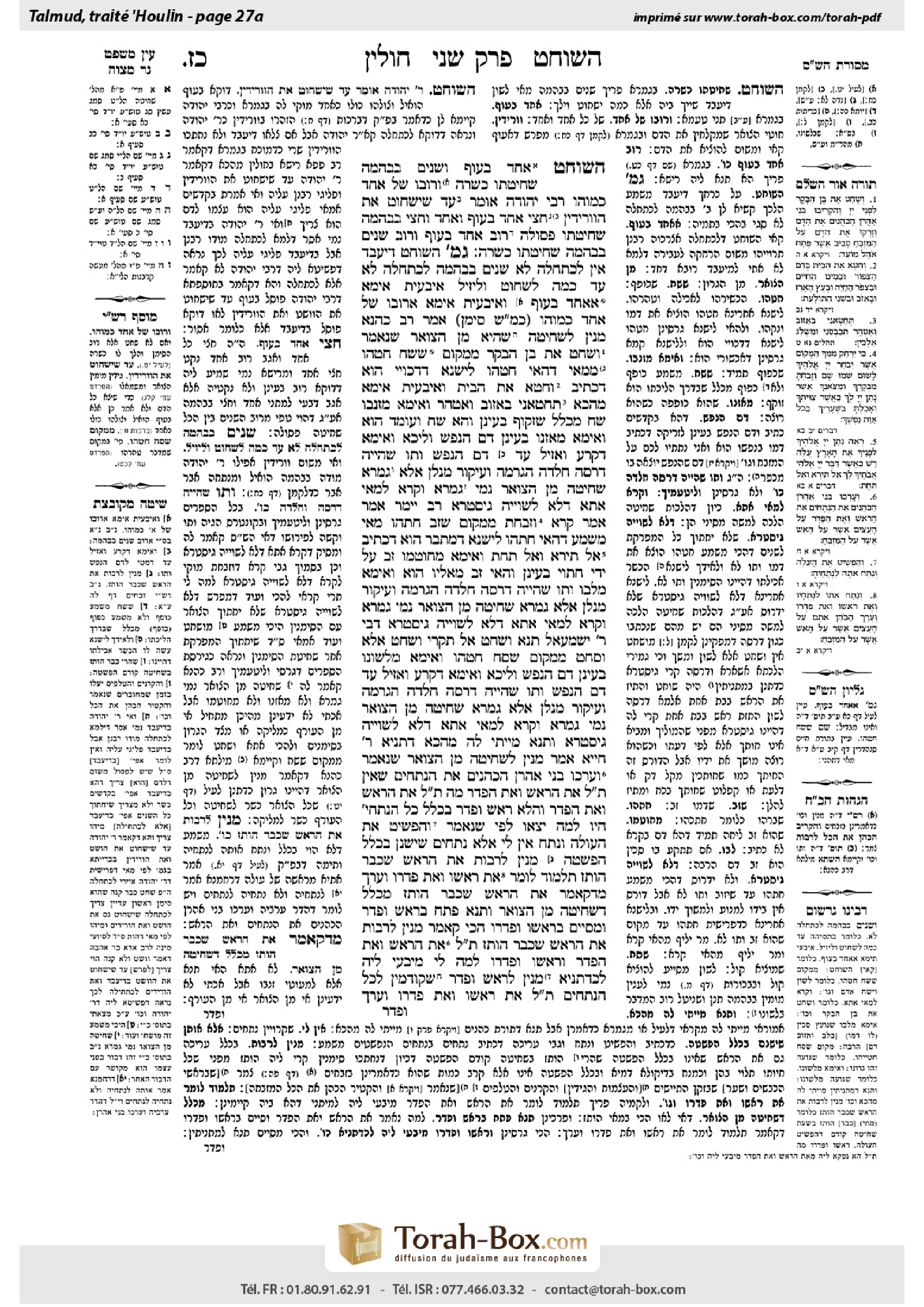
Chullin 27a: Talmud study for Daf Yomi
Study the Talmud for Daf Yomi with scanned pages, Hebrew text, English translations from Sefaria and AI-generated French translations.
Passage selection and English or AI-generated French translation are available where the scan has annotations. Daf Study is independent of Torah-Box and Sefaria.
Browse Chullin · חולין · All tractatesChullin 27a text and translations
This page of Chullin includes the Aramaic text, an English translation and an AI-generated French translation, alongside the scan above.
חולין כ״ז א · Aramaic and Hebrew text
מַתְנִי׳ הַשּׁוֹחֵט אֶחָד בָּעוֹף וּשְׁנַיִם בַּבְּהֵמָה – שְׁחִיטָתוֹ כְּשֵׁרָה, וְרוּבּוֹ שֶׁל אֶחָד כָּמוֹהוּ. רַבִּי יְהוּדָה אוֹמֵר: עַד שֶׁיִּשְׁחוֹט אֶת הַוְּורִידִין. חֲצִי אֶחָד בְּעוֹף וְאֶחָד וָחֵצִי בִּבְהֵמָה – שְׁחִיטָתוֹ פְּסוּלָה. רוֹב אֶחָד בָּעוֹף וְרוֹב שְׁנַיִם בַּבְּהֵמָה – שְׁחִיטָתוֹ כְּשֵׁרָה.
גְּמָ׳ ״הַשּׁוֹחֵט״ – דִּיעֲבַד אִין, לְכַתְּחִלָּה לָא. שְׁנַיִם בַּבְּהֵמָה לְכִתְחִלָּה לָא? עַד כַּמָּה לִשְׁחוֹט וְלֵיזִיל? אִיבָּעֵית אֵימָא: אַאֶחָד בָּעוֹף, וְאִיבָּעֵית אֵימָא: אַרוּבּוֹ שֶׁל אֶחָד כָּמוֹהוּ.
(כמ״ש סִימָן).
אָמַר רַב כָּהֲנָא: מִנַּיִן לִשְׁחִיטָה שֶׁהִיא מִן הַצַּוָּאר? שֶׁנֶּאֱמַר: ״וְשָׁחַט אֶת בֶּן הַבָּקָר״, מִמָּקוֹם שֶׁשָּׁח חַטֵּהוּ. מִמַּאי דְּהַאי חַטֵּהוּ לִישָּׁנָא דְּדַכּוֹיֵי הוּא? דִּכְתִיב: ״וְחִטֵּא אֶת הַבַּיִת״, וְאִיבָּעֵית אֵימָא מֵהָכָא: ״תְּחַטְּאֵנִי בְאֵזוֹב וְאֶטְהָר״.
וְאֵימָא מִזְּנָבוֹ? שָׁח – מִכְּלָל שֶׁזָּקוּף בָּעֵינַן, וְהָא שָׁח וְעוֹמֵד הוּא. וְאֵימָא מֵאׇזְנוֹ? בָּעֵינַן דַּם הַנֶּפֶשׁ, וְלֵיכָּא.
וְאֵימָא: דְּקָרַע וְאָזֵיל עַד דַּם הַנֶּפֶשׁ! וְתוּ, שְׁהִיָּיה, דְּרָסָה, חֲלָדָה, הַגְרָמָה, וְעִיקּוּר – מְנָלַן? אֶלָּא גְּמָרָא. שְׁחִיטָה מִן הַצַּוָּאר נָמֵי גְּמָרָא.
וּקְרָא לְמַאי אֲתָא? דְּלָא לְשַׁוְּיַיהּ גִּיסְטְרָא.
רַב יֵימַר אָמַר: אָמַר קְרָא ״וְזָבַחְתָּ״, מִמָּקוֹם שֶׁזָּב חַתֵּהוּ. מַאי מַשְׁמַע דְּהַאי חַתֵּהוּ לִישָּׁנָא דְּמִתְבַּר הוּא? דִּכְתִיב: ״אַל תִּירָא וְאַל תֵּחָת״.
וְאֵימָא מֵחוֹטְמוֹ, זָב עַל יְדֵי חִתּוּי בָּעֵינַן, וְהַאי זָב מֵאֵלָיו הוּא. וְאֵימָא מִלִּבּוֹ, וְתוּ: שְׁהִיָּיה, דְּרָסָה, חֲלָדָה, הַגְרָמָה, וְעִיקּוּר – מְנָלַן? אֶלָּא גְּמָרָא. שְׁחִיטָה מִן הַצַּוָּאר נָמֵי גְּמָרָא.
וּקְרָא לְמַאי אֲתָא? דְּלָא לְשַׁוְּיֵיהּ גִּיסְטְרָא.
דְּבֵי רַבִּי יִשְׁמָעֵאל תָּנָא: ״וְשָׁחַט״ – אַל תִּקְרֵי ״וְשָׁחַט״ אֶלָּא ״וְסָחַט״, מִמָּקוֹם שֶׁסָּח חַטֵּהוּ.
וְאֵימָא מִלְּשׁוֹנוֹ! בָּעֵינַן דַּם הַנֶּפֶשׁ וְלֵיכָּא, וְאֵימָא דְּקָרַע וְאָזֵיל עַד דַּם הַנֶּפֶשׁ! וְתוּ, שְׁהִיָּיה דְּרָסָה חֲלָדָה הַגְרָמָה וְעִיקּוּר מְנָלַן? אֶלָּא גְּמָרָא, שְׁחִיטָה מִן הַצַּוָּאר נָמֵי גְּמָרָא.
וּקְרָא לְמַאי אֲתָא? דְּלָא לְשַׁוְּיֵיהּ גִּיסְטְרָא.
וְתַנָּא מַיְיתֵי לַהּ מֵהָכָא, דְּתַנְיָא: רַבִּי חִיָּיא אָמַר: מִנַּיִן לִשְׁחִיטָה מִן הַצַּוָּאר? שֶׁנֶּאֱמַר: ״וְעָרְכוּ בְּנֵי אַהֲרֹן הַכֹּהֲנִים אֵת הַנְּתָחִים״.
שֶׁאֵין תַּלְמוּד לוֹמַר ״אֶת הָרֹאשׁ וְאֶת הַפָּדֶר״, מָה תַּלְמוּד לוֹמַר ״אֶת הָרֹאשׁ וְאֶת הַפָּדֶר״? וַהֲלֹא רֹאשׁ וּפֶדֶר בִּכְלַל כׇּל הַנְּתָחִים הָיוּ, לָמָּה יָצְאוּ? לְפִי שֶׁנֶּאֱמַר ״וְהִפְשִׁיט אֶת הָעֹלָה וְנִתַּח״, אֵין לִי אֶלָּא נְתָחִים שֶׁיֶּשְׁנָן בִּכְלַל הַפְשָׁטָה, מִנַּיִן לְרַבּוֹת אֶת הָרֹאשׁ שֶׁכְּבָר הוּתַּז? תַּלְמוּד לוֹמַר ״אֶת רֹאשׁוֹ וְאֶת פִּדְרוֹ וְעָרַךְ״.
מִדְּקָאָמַר ״אֶת הָרֹאשׁ שֶׁכְּבָר הוּתַּז״, מִכְּלָל דִּשְׁחִיטָה מִן הַצַּוָּאר.
וְתַנָּא פָּתַח בְּ״רֹאשׁ וּפֶדֶר״, וּמְסַיֵּים בְּ״רֹאשׁוֹ וּפִדְרוֹ״? הָכִי קָאָמַר: מִנַּיִן לְרַבּוֹת אֶת הָרֹאשׁ שֶׁכְּבָר הוּתַּז? תַּלְמוּד לוֹמַר: ״אֶת הָרֹאשׁ וְאֶת הַפָּדֶר״.
וְ״רֹאשׁוֹ וּפִדְרוֹ״ לְמָה לִי? מִיבְּעֵי לֵיהּ לְכִדְתַנְיָא: מִנַּיִן לְרֹאשׁ וּפֶדֶר שֶׁקּוֹדְמִין לְכׇל הַנְּתָחִים? תַּלְמוּד לוֹמַר: ״אֶת רֹאשׁוֹ וְאֶת פִּדְרוֹ וְעָרַךְ״.
Chullin 27a · English translation
MISHNA: In the case of one who slaughters by cutting one siman, i.e., the windpipe or the gullet, in a bird, and two simanim in an animal, his slaughter is valid, and the halakhic status of the majority of one siman is like that of the entire siman. Rabbi Yehuda says: The slaughter is not valid until he cuts the veins [haveridin], i.e., the major blood vessels in the neck. If one cut half of one siman in a bird or one and a half simanim in an animal, his slaughter is not valid. If one cut the majority of one siman in a bird or the majority of two simanim in an animal, his slaughter is valid.
GEMARA: The Gemara infers from the term: One who slaughters, that if one slaughtered, then after the fact, yes, the slaughter is valid; but ab initio, no, it is prohibited. The Gemara asks: Is the ruling with regard to the cutting of two simanim in an animal that ab initio, no, it is prohibited? If so, how much is one expected to continue and cut the simanim, ab initio? There are only two relevant simanim to be cut. The Gemara answers: If you wish, say that the reference is to the cutting of one siman in a bird, as one is required to cut both simanim in a bird ab initio. And if you wish, say instead that the reference is to the passage in the mishna that states that the halakhic status of the majority of one siman is like that of the entire siman, as one is required to cut the entire siman ab initio.
§ Kaf, mem, shin is a mnemonic for the sources of the statements cited in the discussion that follows: Rav Kahana, Rav Yeimar, and the school of Rabbi Yishmael.
Rav Kahana says: From where is it derived with regard to slaughter that it is performed from the neck? It is derived from a verse, as it is stated: “And he shall slaughter [veshaḥat] the young bull before the Lord” (Leviticus 1:5), which is interpreted homiletically: From the place where the animal bends [shaḥ], purify it [ḥattehu] through slaughter. The Gemara asks: From where does one ascertain that this term, ḥattehu, is an expression of purification? The Gemara answers: It is ascertained from a verse, as it is written: “And he shall purify [veḥitte] the house” (Leviticus 14:52). And if you wish, say instead that it is ascertained from here: “Purge me [teḥatte’eni] with hyssop and I will be pure” (Psalms 51:9).
The Gemara challenges: And say that slaughter is from its tail, which is also a place in the animal’s body that is bent. The Gemara responds: From the term: Bends [shaḥ], one can conclude by inference that we require a part of the animal’s body that can stand erect and that bends; and this, the tail, is bent perpetually and is never erect. The Gemara challenges: And say that slaughter is from its ear, which is erect and bends. The Gemara explains: We require that slaughter be performed on a part of the animal’s body from which blood of the soul is spilled, and when one cuts the ear there is no blood of the soul spilled.
The Gemara asks: And say that one rends the animal starting from the ear and continues until the blood of the soul is spilled. And furthermore, with regard to those actions that invalidate slaughter, i.e., interrupting the slaughter, pressing the knife, concealing the knife in the course of an inverted slaughter, diverting the knife from the place of slaughter, and ripping the simanim from their place before cutting them, from where do we derive them? Rather, these disqualifications are learned through tradition, i.e., a halakha transmitted to Moses from Sinai. The requirement of slaughter from the neck is also learned through tradition, and has no biblical source.
The Gemara asks: And if the halakha is derived through tradition, what halakha does the verse: “And you shall slaughter,” come to teach? The Gemara answers: The verse serves to teach that one should not sever the head completely from the animal’s body and render it a broken animal. He cuts only the windpipe and the gullet, which are adjacent to the major blood vessels.
Rav Yeimar says: From where is it derived that slaughter is performed from the neck? It is derived from a verse, as the verse states: “And you shall slaughter [vezavaḥta] of your herd and of your flock” (Deuteronomy 12:21), which is interpreted homiletically: From the place where the blood flows [shezav], break it [ḥattehu], i.e., cut it. The Gemara asks: From where may it be inferred that this term, ḥattehu, is an expression of breaking? The Gemara answers: It is inferred from a verse, as it is written: “Neither fear nor be dismayed [teḥat]” (Deuteronomy 1:21); ensure that your spirit will not be broken.
The Gemara challenges: And say that an animal is slaughtered from its nose, from which mucus flows, as the verse did not mention blood. The Gemara responds: We require a fluid that flows by means of breaking, and this mucus flows on its own. The Gemara challenges: And say that an animal is slaughtered from its heart by means of stabbing. And furthermore, with regard to those actions that invalidate slaughter, i.e., interrupting, pressing the knife during slaughter, concealing the knife in the course of an inverted slaughter, diverting the knife from the place of slaughter, and ripping, from where do we derive them? Rather, these disqualifications are learned through tradition. The requirement of slaughter from the neck is also learned through tradition.
The Gemara asks: And if the halakha is derived through tradition, what halakha does the phrase in the verse: “And you shall slaughter” come to teach? The Gemara answers: The phrase serves to teach that one should not sever the head completely from the animal’s body and render it a broken animal. He cuts only the windpipe and the gullet.
The school of Rabbi Yishmael taught: From where is it derived that slaughter is performed from the neck? It is derived from a verse, as it is stated: “And he shall slaughter [veshaḥat]” (Leviticus 1:5). Do not read it as: Veshaḥat; rather, read it as: Vesaḥat, which literally means: And he shall squeeze, which is interpreted homiletically: From the place where the animal speaks [saḥ], purify it [ḥattehu]. The animal’s voice emanates from its throat; therefore, it is slaughtered from the neck.
The Gemara objects: And say that slaughter is from its tongue. The Gemara explains: We require that slaughter be performed on a part of the animal’s body from which blood of the soul is spilled, and when one cuts the tongue there is no blood of the soul spilled. The Gemara objects: And say that one rends the animal starting from the tongue and continues until the blood of the soul is spilled. And furthermore, with regard to those actions that invalidate slaughter, i.e., interrupting, pressing the knife, concealing the knife, diverting the knife, and ripping, from where do we derive them? Rather, these disqualifications are learned through tradition. The requirement of slaughter from the neck is also learned through tradition.
The Gemara asks: And if the halakha is derived through tradition, what halakha does the phrase in the verse: “And you shall slaughter,” come to teach? The Gemara answers: The phrase serves to teach that one should not sever the head completely from the animal’s body and render it a broken animal. He cuts only the windpipe and the gullet.
And a tanna who recited mishnayot and baraitot in the study hall cites the source for the halakha that slaughter is performed from the neck from here: As it is taught in a baraita that Rabbi Ḥiyya says: From where is it derived with regard to slaughter that it is performed from the neck? It is derived from a verse, as it is stated: “And Aaron’s sons, the priests, shall arrange the pieces, the head, and the fat…upon the altar” (Leviticus 1:8).
Rabbi Ḥiyya explains: As there is no need for the verse to state: “The head, and the fat.” What is the meaning when the verse states: “The head, and the fat”? Weren’t the head and the fat included in the category of all the pieces, mentioned earlier in the verse? For what purpose did they emerge from the category and warrant individual mention? This is due to the fact that it is stated: “And he shall flay the burnt offering, and cut it into its pieces” (Leviticus 1:6). One might have thought that I have derived that only the pieces that are included in the category of flaying must be arranged on the altar. From where is it derived to include the head, which was already partially severed when the animal was slaughtered, and is not flayed? It is derived from a verse, as the verse states: “With its head and its fat, and the priest shall arrange them” (Leviticus 1:12).
The tanna concludes: From the fact that Rabbi Ḥiyya says: The head, which was already partially severed, one learns by inference that slaughter is from the neck, as the neck connects the head to the body.
The Gemara questions the formulation of the baraita. And the tanna of the baraita opened with a question about the extraneous phrase written with regard to a bull burnt offering: “The head, and the fat” (Leviticus 1:8), and concludes with an explanation of the phrase written with regard to a sheep burnt offering: “Its head and its fat” (Leviticus 1:12). The Gemara answers that this is what the tanna is saying: From where is it derived to include the head, which was already partially severed? It is derived from a verse, as the verse states: “The head, and the fat” (Leviticus 1:8).
The Gemara asks: And if so, why do I need the verse cited at the end of the baraita: “Its head and its fat”? The Gemara answers: The verse is necessary for that which is taught in a baraita: From where is it derived that the head and the fat precede all the other pieces when the sacrificial portions are sacrificed on the altar? The verse states: “With its head and its fat, and the priest shall arrange them” (Leviticus 1:12).
Chullin 27a · Traduction française (IA)
MICHNA: Dans le cas d'une personne qui sacrifie en coupant un siman, c'est-à-dire la trachée ou l'œsophage, dans un oiseau, et deux simans dans un animal, son sacrifice est valide, et le statut halakhique de la majorité d'un seul siman est comme celui de l'ensemble du siman. Rabbi Yéhuda dit : Le sacrifice n'est pas valide jusqu'à ce qu'il coupe les veines [haveridin], c'est-à-dire les grands vaisseaux sanguins du cou. Si l'on coupe la moitié d'un seul siman dans un oiseau ou un et demi simans dans un animal, son sacrifice n'est pas valide. Si l'on coupe la majorité d'un seul siman dans un oiseau ou la majorité de deux simans dans un animal, son sacrifice est valide.
GUEMARA : La Guemara déduit du terme : Celui qui sacrifie, que si l'on sacrifie, alors après coup, oui, le sacrifice est valide ; mais ab initio, non, il est interdit. La Guemara pose la question : Le règlement concernant le coup de deux simans dans un animal est-il tel que ab initio, non, il est interdit ? Si c'est le cas, jusqu'à quel point est-on censé continuer et couper les simans ab initio ? Il n'y a que deux simans pertinents à couper. La Guemara répond : Si vous le souhaitez, dites que la référence est au coup d'un seul siman dans un oiseau, car l'on est tenu de couper les deux simans dans un oiseau ab initio. Et si vous le souhaitez, dites plutôt que la référence est à la partie de la Michna qui stipule que le statut halakhique de la majorité d'un seul siman est comme celui de l'ensemble du siman, car l'on est tenu de couper l'ensemble du siman ab initio.
§ Kaf, mem, shin est un mnémonique pour les sources des déclarations citées dans la discussion qui suit : Rav Kahana, Rav Yeimar et la scolie de Rabbi Yishmael.
Rav Kahana dit : D'où est tiré le fait que le sacrifice est effectué du cou ? Il est tiré d'une versette, car il est dit : « Et il sacrifiera [veshaḥat] le veau jeune devant l'Éternel » (Lévitique 1:5), qui est interprété homélatiquement : De la place où l'animal se courbe [shaḥ], purifie-le [ḥattehu] par le sacrifice. La Guemara pose la question : D'où peut-on conclure que ce terme, ḥattehu, exprime la purification ? La Guemara répond : Il est établi à partir d'une versette, car il est écrit : « Et il purifiera [veḥitte] la maison » (Lévitique 14:52). Et si vous le souhaitez, dites plutôt qu'il est établi d'ici : « Purifie-moi [teḥatte’eni] avec l'hysope et je serai pur » (Psa 51:9).
La Guemara conteste : Et dites que le sacrifice est effectué de la queue, qui est aussi une partie du corps de l'animal qui se courbe. La Guemara répond : À partir du terme : Se courbe [shaḥ], on peut conclure par déduction que nous exigeons une partie du corps de l'animal qui peut se dresser et se courber ; et cela, la queue, se courbe constamment et n'est jamais dressée. La Guemara conteste : Et dites que le sacrifice est effectué de l'oreille, qui est dressée et se courbe. La Guemara explique : Nous exigeons que le sacrifice soit effectué sur une partie du corps de l'animal d'où le sang de l'âme est versé, et lorsqu'on coupe l'oreille, aucun sang de l'âme n'est versé.
La Guemara pose la question : Et dites que l'on déchire l'animal à partir de l'oreille et continue jusqu'à ce que le sang de l'âme soit versé. Et de plus, concernant ces actions qui invalident la boucherie, c'est-à-dire interrompre la boucherie, appuyer le couteau, cacher le couteau lors d'une boucherie inversée, dévier le couteau du lieu de la boucherie, et arracher les simanim de leur place avant de les couper, d'où les tire-t-on ? Plutôt, ces invalidations sont apprises par tradition, c'est-à-dire une halakha transmise à Moïse depuis Sinaï. La nécessité de boucherie du cou est également apprise par tradition, et n'a pas de source biblique.
La Guemara pose la question : Et si la halakha est tirée par tradition, quelle halakha la verset : « Et vous sacrifierez », vient-il enseigner ? La Guemara répond : La verset sert à enseigner qu'on ne doit pas séparer la tête entièrement du corps de l'animal et le rendre un animal brisé. Il coupe seulement la trachée et l'œsophage, qui sont adjacents aux grands vaisseaux sanguins.
Rav Yeimar dit : D'où est tiré le fait que la boucherie est effectuée du cou ? Il est tiré d'une verset, car la verset dit : « Et vous sacrifierez [vezavaḥta] de votre troupeau et de votre bétail » (Dt 12:21), qui est interprété homélatiquement : De la place où le sang coule [shezav], brise-le [ḥattehu], c'est-à-dire coupe-le. La Guemara pose la question : D'où peut-on déduire que ce terme, ḥattehu, exprime le bris ? La Guemara répond : Il est déduit d'une verset, car il est écrit : « Ni craignez ni soyez découragé [teḥat] » (Dt 1:21) ; assurez-vous que votre esprit ne soit pas brisé.
La Guemara conteste : Et dites que l'animal est sacrifié de son nez, d'où le mucus coule, car la verset n'a pas mentionné le sang. La Guemara répond : Nous exigeons un fluide qui coule par le bris, et ce mucus coule tout seul. La Guemara conteste : Et dites que l'animal est sacrifié de son cœur par le pointage. Et de plus, concernant ces actions qui invalident le sacrifice, c'est-à-dire interrompre, appuyer le couteau pendant le sacrifice, cacher le couteau lors d'un sacrifice inversé, dévier le couteau du lieu du sacrifice, et arracher, d'où les tire-t-on ? Plutôt, ces invalidations sont apprises par tradition. La nécessité de sacrifier du cou est également apprise par tradition.
La Guemara pose la question : Et si la halakha est tirée par tradition, quelle halakha la phrase dans la verset : « Et vous sacrifierez » vient-elle enseigner ? La Guemara répond : La phrase sert à enseigner qu'on ne doit pas séparer la tête entièrement du corps de l'animal et le rendre un animal brisé. Il coupe seulement la trachée et l'œsophage.
L'école de Rabbi Yishmael enseignait : D'où est tiré que la bête est sacrifiée à partir du cou ? C'est tiré d'un verset, comme il est dit : « Et il sacrifiera [veshaḥat] » (Lévitique 1:5). Ne le lis pas comme : Veshaḥat ; plutôt, le lis comme : Vesaḥat, qui littéralement signifie : Et il écrasera, ce qui est interprété par allégorie : De la place où l'animal parle [saḥ], purifie-le [ḥattehu]. La voix de l'animal sort du cou ; donc, il est sacrifié à partir du cou.
La Guemara s'oppose : Et disons que le sacrifice est effectué à partir de sa langue. La Guemara explique : Nous exigeons que le sacrifice soit effectué sur une partie du corps de l'animal d'où le sang de l'âme est versé, et quand on coupe la langue, il n'y a pas de sang de l'âme versé. La Guemara s'oppose : Et disons que l'on déchire l'animal à partir de la langue et continue jusqu'à ce que le sang de l'âme soit versé. Et de plus, concernant ces actions qui invalident le sacrifice, c'est-à-dire interrompre, appuyer le couteau, cacher le couteau, détourner le couteau et déchirer, d'où les tire-t-on ? Plutôt, ces invalidations sont apprises par tradition. La nécessité de sacrifier à partir du cou est également apprise par tradition.
La Guemara pose la question : Et si la halakha est tirée par tradition, quelle halakha la phrase du verset : « Et tu sacrifieras », vient-elle enseigner ? La Guemara répond : Cette phrase sert à enseigner que l'on ne doit pas séparer entièrement la tête du corps de l'animal et le rendre un animal brisé. Il coupe seulement la trachée et le gosier.
Et un tanna qui a récité des mishnayot et des baraitot dans la salle de study cite la source de la halakha que le sacrifice est effectué à partir du cou d'ici : Comme il est enseigné dans une baraïta que Rabbi Ḥiyya dit : D'où est tiré concernant le sacrifice que celui-ci est effectué à partir du cou ? C'est tiré d'un verset, comme il est dit : « Et les fils d'Aaron, les prêtres, disposeront les morceaux, la tête et la graisse… sur l'autel » (Lévitique 1:8).
Rabbi Ḥiyya explique : Comme il n'y a pas besoin que le verset dise : « La tête et la graisse », quelle est la signification lorsque le verset dit : « La tête et la graisse » ? Ne sont-ce pas la tête et la graisse incluses dans la catégorie de tous les morceaux, mentionnés plus tôt dans le verset ? Pour quelle raison sont-ils sortis de cette catégorie et méritent-ils une mention particulière ? C'est à cause de ce qui est dit : « Et il dépecera l'holocauste, et le coupera en ses morceaux » (Lévitique 1:6). On pourrait penser que j'ai tiré que seulement les morceaux inclus dans la catégorie du dépecage doivent être disposés sur l'autel. D'où est tiré inclure la tête, qui était déjà partiellement séparée lors du sacrifice et n'est pas dépecée ? C'est tiré d'un verset, comme le verset dit : « Avec sa tête et sa graisse, et le prêtre disposera ces choses » (Lévitique 1:12).
Le tanna conclut : D'après le fait que Rabbi Ḥiyya dit : La tête, qui était déjà partiellement séparée, on apprend par déduction que le sacrifice est fait à partir du cou, car le cou relie la tête au corps.
La Guemara questionne la formulation de la baraïta. Et le tanna de la baraïta a commencé par une question concernant la phrase étrangère écrite concernant un holocauste de bœuf : « La tête et la graisse » (Lévitique 1:8), et a conclu par une explication de la phrase écrite concernant un holocauste de mouton : « Sa tête et sa graisse » (Lévitique 1:12). La Guemara répond que c'est ce que le tanna dit : D'où est tiré l'inclusion de la tête, qui était déjà partiellement séparée ? C'est tiré d'un verset, comme le verset dit : « La tête et la graisse » (Lévitique 1:8).
La Guemara pose la question : Et si c'est ainsi, pourquoi ai-je besoin du verset cité à la fin de la baraïta : « Sa tête et sa graisse » ? La Guemara répond : Ce verset est nécessaire pour ce qui est enseigné dans une baraïta : D'où est tiré que la tête et la graisse précèdent tous les autres morceaux lorsqu'on sacrifie les parties du sacrifice sur l'autel ? Le verset dit : « Avec sa tête et sa graisse, et le prêtre disposera ces choses » (Lévitique 1:12).
Traduction française générée par IA à partir de l’édition anglaise de Sefaria. Vérifie toujours un passage avec le texte source.
Text from Sefaria: William Davidson Edition - Vocalized Aramaic (unknown); William Davidson Edition - English (CC BY NC).