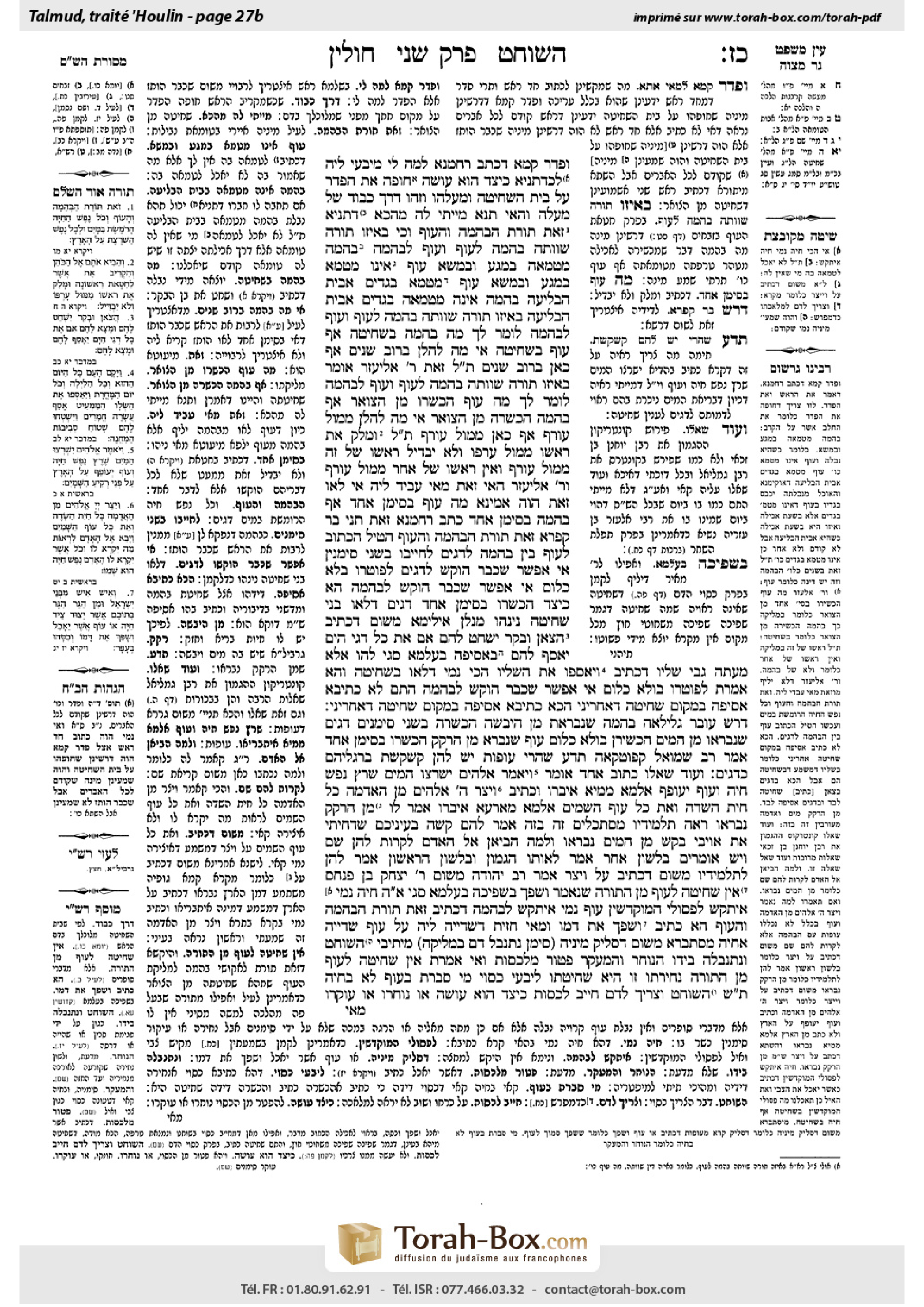
Chullin 27b: Talmud study for Daf Yomi
Study the Talmud for Daf Yomi with scanned pages, Hebrew text, English translations from Sefaria and AI-generated French translations.
Passage selection and English or AI-generated French translation are available where the scan has annotations. Daf Study is independent of Torah-Box and Sefaria.
Browse Chullin · חולין · All tractatesChullin 27b text and translations
This page of Chullin includes the Aramaic text, an English translation and an AI-generated French translation, alongside the scan above.
חולין כ״ז ב · Aramaic and Hebrew text
וּפֶדֶר קַמָּא דִּכְתַב רַחֲמָנָא לְמָה לִי? מִיבְּעֵי לֵיהּ לְכִדְתַנְיָא: כֵּיצַד הוּא עוֹשֶׂה? חוֹפֶה אֶת הַפֶּדֶר עַל בֵּית הַשְּׁחִיטָה וּמַעֲלֵהוּ, וְזֶהוּ דֶּרֶךְ כָּבוֹד שֶׁל מַעְלָה.
וְהַאי תַּנָּא מַיְיתֵי לַהּ מֵהָכָא, דְּתַנְיָא: ״זֹאת תּוֹרַת הַבְּהֵמָה וְהָעוֹף״, וְכִי בְּאֵיזוֹ תּוֹרָה שָׁוְותָה בְּהֵמָה לָעוֹף וְעוֹף לִבְהֵמָה? בְּהֵמָה מְטַמְּאָה בְּמַגָּע וּבְמַשָּׂא, עוֹף אֵינוֹ מְטַמֵּא בְּמַגָּע וּבְמַשָּׂא! עוֹף מְטַמֵּא בְּגָדִים אַבֵּית הַבְּלִיעָה, בְּהֵמָה אֵינָהּ מְטַמְּאָה בְּגָדִים אַבֵּית הַבְּלִיעָה!
בְּאֵיזוֹ תּוֹרָה שָׁוְותָה בְּהֵמָה לְעוֹף וְעוֹף לִבְהֵמָה? לוֹמַר לָךְ: מָה בְּהֵמָה בִּשְׁחִיטָה – אַף עוֹף בִּשְׁחִיטָה. אִי מָה לְהַלָּן בְּרוֹב שְׁנַיִם – אַף כָּאן בְּרוֹב שְׁנַיִם? תַּלְמוּד לוֹמַר: ״זֹאת״.
רַבִּי אֱלִיעֶזֶר אוֹמֵר: בְּאֵיזוֹ תּוֹרָה שָׁוְותָה בְּהֵמָה לְעוֹף וְעוֹף לִבְהֵמָה? לוֹמַר לָךְ: מָה עוֹף הֶכְשֵׁרוֹ מִן הַצַּוָּאר, אַף בְּהֵמָה הֶכְשֵׁרָהּ מִן הַצַּוָּאר.
אִי מָה לְהַלָּן ״מִמּוּל עוֹרֶף״, אַף כָּאן ״מִמּוּל עוֹרֶף״? תַּלְמוּד לוֹמַר: ״וּמָלַק אֶת רֹאשׁוֹ מִמּוּל עׇרְפּוֹ וְלֹא יַבְדִּיל״ – רֹאשׁוֹ שֶׁל זֶה מִמּוּל עוֹרֶף, וְאֵין רֹאשׁוֹ שֶׁל אַחַר מִמּוּל עוֹרֶף.
וְרַבִּי אֱלִיעֶזֶר, הַאי ״זֹאת״ מַאי עָבֵיד לֵיהּ? אִי לָאו ״זֹאת״ הֲוָה אָמֵינָא: מָה עוֹף בְּסִימָן אֶחָד, אַף בְּהֵמָה בְּסִימָן אֶחָד, כְּתַב רַחֲמָנָא ״זֹאת״.
תָּנֵי בַּר קַפָּרָא: ״זֹאת תּוֹרַת הַבְּהֵמָה וְהָעוֹף״ – הֵטִיל הַכָּתוּב לְעוֹף בֵּין בְּהֵמָה לְדָגִים, לְחַיְּיבוֹ בִּשְׁנֵי סִימָנִין אִי אֶפְשָׁר – שֶׁכְּבָר הוּקַּשׁ לְדָגִים, לְפוֹטְרוֹ בְּלֹא כְּלוּם אִי אֶפְשָׁר – שֶׁכְּבָר הוּקַּשׁ לִבְהֵמָה. הָא כֵּיצַד הֶכְשֵׁרוֹ? בְּסִימָן אֶחָד.
דָּגִים דְּלָאו בְּנֵי שְׁחִיטָה נִינְהוּ, מְנָלַן? אִילֵּימָא מִשּׁוּם דִּכְתִיב: ״הֲצֹאן וּבָקָר יִשָּׁחֵט לָהֶם אִם אֶת כׇּל דְּגֵי הַיָּם יֵאָסֵף לָהֶם״, בַּאֲסִיפָה בְּעָלְמָא סַגִּי לְהוּ.
אֶלָּא מֵעַתָּה, גַּבֵּי שְׂלָיו דִּכְתִיב: ״וַיַּאַסְפוּ אֶת הַשְּׂלָיו״, הָכִי נָמֵי דְּלָאו בִּשְׁחִיטָה? וְהָא אָמְרַתְּ: לְפוֹטְרוֹ בִּוְלֹא כְּלוּם אִי אֶפְשָׁר, שֶׁכְּבָר הוּקַּשׁ לִבְהֵמָה! הָתָם לָא כְּתִיבָא אֲסִיפָה בִּמְקוֹם שְׁחִיטָה דְּאַחֲרִינֵי, הָכָא כְּתִיבָא אֲסִיפָה בִּמְקוֹם שְׁחִיטָה דְּאַחֲרִינֵי.
דָּרַשׁ עוֹבֵר גָּלִילָאָה: בְּהֵמָה שֶׁנִּבְרֵאת מִן הַיַּבָּשָׁה – הֶכְשֵׁרָהּ בִּשְׁנֵי סִימָנִים, דָּגִים שֶׁנִּבְרְאוּ מִן הַמַּיִם – הֶכְשֵׁירָן בִּוְלֹא כְּלוּם, עוֹף שֶׁנִּבְרָא מִן הָרְקָק – הֶכְשֵׁרוֹ בְּסִימָן אֶחָד. אָמַר רַב שְׁמוּאֵל קַפּוֹטְקָאָה: תֵּדַע, שֶׁהֲרֵי עוֹפוֹת יֵשׁ לָהֶן קַשְׂקֶשֶׂת בְּרַגְלֵיהֶם כַּדָּגִים.
וְעוֹד שְׁאֵלוֹ, כָּתוּב אֶחָד אוֹמֵר: ״וַיֹּאמֶר אֱלֹהִים יִשְׁרְצוּ הַמַּיִם שֶׁרֶץ נֶפֶשׁ חַיָּה וְעוֹף יְעוֹפֵף״, אַלְמָא מִמַּיָּא אִיבְּרוֹ, וּכְתִיב: ״וַיִּצֶר ה׳ אֱלֹהִים מִן הָאֲדָמָה כׇּל חַיַּת הַשָּׂדֶה וְאֵת כׇּל עוֹף הַשָּׁמַיִם״, אַלְמָא מֵאַרְעָא אִיבְּרוֹ!
אָמַר לוֹ: מִן הָרְקָק נִבְרְאוּ. רָאָה תַּלְמִידָיו מִסְתַּכְּלִים זֶה בָּזֶה, אָמַר לָהֶם: קָשֶׁה בְּעֵינֵיכֶם שֶׁדָּחִיתִי אֶת אוֹיְבִי בְּקַשׁ? מִן הַמַּיִם נִבְרְאוּ, וְלָמָּה הֱבִיאָן אֶל הָאָדָם? לִקְרוֹת לָהֶן שֵׁם.
וְיֵשׁ אוֹמְרִים: בְּלָשׁוֹן אַחֵר אָמַר לְאוֹתוֹ הֶגְמוֹן, וּבַלָּשׁוֹן הָרִאשׁוֹן אָמַר לָהֶן לְתַלְמִידָיו, מִשּׁוּם דִּכְתִיב עַל ״וַיִּצֶר״.
אָמַר רַב יְהוּדָה מִשּׁוּם רַבִּי יִצְחָק בֶּן פִּנְחָס: אֵין שְׁחִיטָה לָעוֹף מִן הַתּוֹרָה, שֶׁנֶּאֱמַר: ״וְשָׁפַךְ״ – בִּשְׁפִיכָה בְּעָלְמָא סַגִּי.
אִי הָכִי, חַיָּה נָמֵי! אִיתַּקַּשׁ לִפְסוּלֵי הַמּוּקְדָּשִׁין. עוֹף נָמֵי אִיתַּקַּשׁ לִבְהֵמָה, דִּכְתִיב: ״זֹאת תּוֹרַת הַבְּהֵמָה וְהָעוֹף״! הָא כְּתִיב: ״וְשָׁפַךְ אֶת דָּמוֹ״.
וּמַאי חָזֵית דְּשָׁדֵית לֵיהּ עַל עוֹף? שַׁדְיֵיהּ אַחַיָּה! מִסְתַּבְּרָא, מִשּׁוּם דְּסָלֵיק מִינֵּיהּ.
(סִימָן: נִתְנַבֵּל, דָּם, בִּמְלִיקָה.)
מֵיתִיבִי: הַשּׁוֹחֵט וְנִתְנַבְּלָה בְּיָדוֹ, הַנּוֹחֵר וְהַמְעַקֵּר – פָּטוּר מִלְּכַסּוֹת. וְאִי אָמְרַתְּ אֵין שְׁחִיטָה לָעוֹף מִן הַתּוֹרָה, נְחִירָתוֹ זוֹ הִיא שְׁחִיטָתוֹ, לִיבְעֵי כִּסּוּי! מִי סָבְרַתְּ בְּעוֹף? לָא, בְּחַיָּה.
תָּא שְׁמַע: הַשּׁוֹחֵט וְצָרִיךְ לַדָּם – חַיָּיב לְכַסּוֹת. כֵּיצַד הוּא עוֹשֶׂה? אוֹ נוֹחֲרוֹ אוֹ עוֹקְרוֹ.
Chullin 27b · English translation
The Gemara asks: And why do I need the first mention of fat that the Merciful One writes: “The pieces, the head, and the fat” (Leviticus 1:8)? Wasn’t the derivation from that verse restricted to the head? The Gemara answers that it is necessary for that which is taught in a baraita: How does the priest who elevates the sacrificial portions of the animal to the altar perform that task? He uses the fat to cover the place of slaughter, i.e., to conceal the bloody neck, and elevates the head to the top of the altar, and that is a deferential manner toward the Most High.
And this tanna cites proof that slaughter is from the neck from here: As it is taught in a baraita that the Torah writes with regard to the impurity of carcasses: “This is the law of the animal, and of the bird” (Leviticus 11:46), indicating that the two are somehow equated. But with regard to what law is an animal equal to a bird and a bird to an animal? The halakhot of ritual impurity governing animals and birds are not comparable; an animal imparts impurity by contact and by carrying, whereas a bird does not impart impurity by contact or by carrying. Furthermore, a bird renders the garments of one who swallows it ritually impure when it is in the throat; an animal does not render one’s garments impure when it is in the throat.
The baraita continues: With regard to what law is an animal equal to a bird and a bird to an animal? The verse comes to say to you: Just as an animal avoids the impurity of being an unslaughtered carcass through slaughter, so too, a bird avoids the impurity of being an unslaughtered carcass through slaughter. The Gemara objects: If so, say, based on the same juxtaposition: Just as there, in the case of an animal, it avoids the impurity through the cutting of the majority of two simanim, i.e., the windpipe and the gullet, so too here, in the case of a bird, it avoids the impurity through the cutting of the majority of two simanim. The Gemara explains that the verse states: “This is the law,” to restrict the scope of the juxtaposition in the sense that not all of the halakhot of birds and animals are equal.
The baraita continues. Rabbi Eliezer says: With regard to what law is an animal equal to a bird and a bird to an animal? The verse comes to say to you: Just as in the case of a bird, its fitness for sacrifice and for consumption is accomplished through pinching and slaughter from the neck, as the Torah states with regard to bird offerings that one pinches off its head from the neck, so too, in the case of an animal, its fitness for sacrifice and for consumption is accomplished through slaughter from the neck.
The Gemara objects: If so, say, based on the same juxtaposition: Just as there, in the case of a bird, the pinching is performed adjacent to the nape of the neck, so too here, with regard to an animal, the slaughter is performed adjacent to the nape of the neck and not from the throat. The Gemara explains that therefore, the verse states with regard to a bird: “And pinch off its head adjacent to its nape, but shall not divide it asunder” (Leviticus 5:8), from which it is derived: Its head, i.e., the bird’s head, is pinched adjacent to the nape, but the head of another, the animal, is not cut adjacent to the nape.
The Gemara asks: And according to Rabbi Eliezer, what does he do with this term: “This is the law,” from which the first tanna restricted the scope of the juxtaposition between animals and birds? The Gemara answers: If not for the derivation from the term “This is the law,” I would say: Just as the fitness of a bird is accomplished by cutting one of the simanim that must be severed in ritual slaughter, i.e., either the windpipe or the gullet, so too, the fitness of an animal is accomplished by cutting one siman. Therefore, the Merciful One writes: “This is the law,” to restrict the juxtaposition.
§ The Gemara proceeds to discuss the source for the slaughter of non-sacred birds. Bar Kappara teaches that the verse states: “This is the law of the animal, and of the bird, and of every living creature that moves in the waters, and of every creature that swarms upon the earth” (Leviticus 11:46). The verse situated the bird between the animal and the fish. To require the cutting of the two simanim that must be severed in ritual slaughter, i.e., the windpipe and the gullet, for the slaughter of a bird, is impossible, as it was already juxtaposed to fish, which do not require slaughter at all. To exempt it with nothing, i.e., to exempt the bird from slaughter altogether, is impossible, as it was already juxtaposed to the animal. How, then, is fitness of a bird for consumption accomplished? It is rendered fit with the cutting of one siman.
The Gemara asks: From where do we derive that fish are not subject to slaughter? If we say that it is because it is written: “If flocks and herds be slaughtered for them…or if all the fish of the sea be gathered together for them, will they suffice them” (Numbers 11:22), which indicates that mere gathering suffices for them, that is not a proof.
The Gemara clarifies: But if that is so, with regard to quail as well, concerning which it is written: “And the people rose up…and gathered the quail” (Numbers 11:32), so too, would one say with regard to birds that, like fish, their fitness is not accomplished with slaughter? The Gemara responds with a question. But didn’t you say: To exempt birds from slaughter altogether with nothing is impossible, as it was already juxtaposed to the animal? The Gemara answers: There, gathering of quail is not written in the context of the slaughter of others; therefore, gathering is not to be understood as an alternative to slaughtering the birds. Here, gathering of fish is written in the context of the slaughter of others, i.e., the flocks and herds, which indicates that gathering is an alternative to slaughter.
The Gemara relates that a passerby from the Galilee taught: Fitness for consumption of animals, which were created from the dry land, is accomplished through cutting two simanim, the gullet and the windpipe. Fitness for consumption of fish, which were created from the water, is accomplished with nothing, as no slaughter is required. Fitness for consumption of birds, which were created from mud [harekak], a combination of dry land and water, is accomplished through cutting one siman. Rav Shmuel of Cappadocia says: Know that birds were created from a combination of dry land and water, as they have scales on their feet like fish.
The Gemara relates an excerpt of an exchange between a Roman government official and Rabban Yoḥanan ben Zakkai. And furthermore, the official asked Rabban Yoḥanan ben Zakkai: One verse states: “And God said: Let the waters swarm with swarms of living creeping animals, and birds will fly” (Genesis 1:20); apparently birds were created from the water. And it is written: “And from the ground the Lord God formed every beast of the field, and every bird of the air and brought them unto the man to see what he would call them” (Genesis 2:19); apparently birds were created from the land.
Rabban Yoḥanan ben Zakkai said to him: They were created from the mud. He saw his students looking at each other, wondering. He said to them: Does it trouble you that I dismissed my enemy with a flimsy pretext? Actually, it is from water that birds were created. And why does the verse state that they were formed from the ground and that God brought them to Adam? In other words, why are they mentioned in the second verse? It is not because they were actually formed from the ground, but only because they were brought to Adam so that he would call them names.
And some say that Rabban Yoḥanan ben Zakkai spoke to that officer with a different formulation, i.e., he said to him that the birds were created from the water. And he stated the first formulation, that the birds were created from the mud, to his students, because it is written: “And from the ground the Lord God formed every beast of the field, and every bird of the air” (Genesis 2:19). According to this explanation, the birds are mentioned there not only because Adam called them names, but also because they too were created from the ground.
On the matter of slaughtering birds, Rav Yehuda says in the name of Rabbi Yitzḥak ben Pineḥas: Slaughter of a bird is not obligatory by Torah law, as it is stated: “And whatever man there be of the children of Israel…who traps any undomesticated animal or bird that may be eaten, he shall spill its blood, and cover it in earth” (Leviticus 17:13). This indicates that mere spilling of its blood is sufficient.
The Gemara objects: If so, with regard to an undomesticated animal, which is mentioned in the same verse, spilling should be sufficient also. The Gemara explains: An undomesticated animal is juxtaposed to disqualified consecrated animals, for which slaughter is required, as explained later in the Gemara (28a). The Gemara asks: Birds too are juxtaposed to animals, and therefore slaughter should be required, as it is written: “This is the law of the animal, and of the bird” (Leviticus 11:46). The Gemara answers: But isn’t it written: “He shall spill its blood,” indicating that slaughter is not required?
The Gemara asks: And concerning the derivation that slaughter is not required, based on the phrase in the verse “He shall spill,” what did you see that led you to cast it upon, i.e., apply it to, the case of a bird? Why not cast it upon the case of an undomesticated animal? The Gemara answers: It stands to reason to cast the derivation upon the case of a bird due to the fact that the verse concluded with the bird, i.e., the bird is mentioned just prior to the directive to spill and cover the blood, as it is written: “Who traps any undomesticated animal or bird that may be eaten, he shall spill its blood.”
The Gemara provides a mnemonic for the proofs cited in the Gemara with regard to the slaughter of birds: Became a carcass, blood, through pinching.
The Gemara raises an objection to the statement of Rabbi Yitzḥak ben Pineḥas from a mishna (85a): One who slaughters an undomesticated animal and it became an unslaughtered carcass by his hand because the slaughter was not valid, or one who stabbed the animal by slicing the length of the simanim, or one who ripped the gullet or windpipe of the animal, rendering the slaughter not valid, is exempt from covering the blood because his slaughter was ineffective in permitting consumption of the animal, and it is written that the requirement of covering the blood applies only to “any undomesticated animal or bird that may be eaten.” And if you say that slaughter of a bird is not obligatory by Torah law, the halakhic status of its stabbing is like that of its slaughter; let its blood require covering. The Gemara answers: Do you maintain that this mishna is referring to a bird? No, it is referring exclusively to an undomesticated animal.
The Gemara cites another challenge: Come and hear that which is taught in a baraita: One who slaughters an undomesticated animal or a bird and requires the blood and not the animal is obligated to cover the blood. Rather, how does he act if he seeks to make use of the blood rather than cover it? He either stabs the animal or rips the simanim, and then he is exempt from covering the blood.
Chullin 27b · Traduction française (IA)
La Guemara pose la question : Et pourquoi ai-je besoin de la première mention de la graisse que l'Éternel écrit : « Les morceaux, la tête et la graisse » (Lévitique 1,8) ? N'était-ce pas une dérivation limitée à la tête ? La Guemara répond qu'il est nécessaire pour ce qui est enseigné dans une baraïta : Comment le prêtre qui élève les parties sacrificielles de l'animal à l'autel effectue-t-il cette tâche ? Il utilise la graisse pour couvrir la place de la mise à mort, c'est-à-dire pour cacher le cou ensanglanté, et élève la tête au sommet de l'autel, et cela constitue un geste de respect envers le Très Haut.
Et ce tanna cite une preuve pour affirmer que la mise à mort est du cou : ici, il est enseigné dans une baraïta que la Torah écrit concernant l'impureté des cadavres : « C'est la loi de l'animal et de l'oiseau » (Lévitique 11,46), indiquant que les deux sont quelque peu équivalents. Mais concernant quelle loi un animal est-il égal à un oiseau et un oiseau à un animal ? Les halakhot de l'impureté rituelle régissant les animaux et les oiseaux ne sont pas comparables ; un animal transmet l'impureté par contact et par portée, tandis qu'un oiseau ne transmet pas l'impureté par contact ou par portée. De plus, un oiseau rend les vêtements de celui qui le dévore impurs lorsqu'il est dans la gorge ; un animal ne rend pas les vêtements impurs lorsqu'il est dans la gorge.
La baraïta continue : Concernant quelle loi un animal est-il égal à un oiseau et un oiseau à un animal ? La versette vient vous dire : Comme un animal évite l'impureté d'être un cadavre non sacrifié grâce à la mise à mort, de même un oiseau évite l'impureté d'être un cadavre non sacrifié grâce à la mise à mort. La Guemara s'oppose à cela : Si c'est ainsi, disons, sur la même juxtaposition : Comme là, dans le cas d'un animal, il évite l'impureté grâce à la section de la majorité des deux simanim, c'est-à-dire la trachée et le gosier, de même ici, dans le cas d'un oiseau, il évite l'impureté grâce à la section de la majorité des deux simanim. La Guemara explique que la versette dit : « C'est la loi », pour limiter la portée de la juxtaposition dans le sens que non toutes les halakhot des oiseaux et des animaux sont égales.
La baraïta continue. Rabbi Eliezer dit : Concernant quelle loi un animal est-il égal à un oiseau et un oiseau à un animal ? La versette vient vous dire : Comme dans le cas d'un oiseau, sa fitness pour le sacrifice et la consommation est accomplie par la pincée et la mise à mort du cou, comme la Torah dit concernant les offrandes d'oiseaux que l'on pince la tête de l'oiseau du cou, de même, dans le cas d'un animal, sa fitness pour le sacrifice et la consommation est accomplie par la mise à mort du cou.
La Guemara s'oppose à cela : Si c'est ainsi, disons, sur la même juxtaposition : Comme là, dans le cas d'un oiseau, la pincée est effectuée à côté du cou, de même ici, dans le cas d'un animal, la mise à mort est effectuée à côté du cou et non du gosier. La Guemara explique que donc, la versette dit concernant un oiseau : « Et pince la tête à côté de son cou, mais ne le divise pas » (Lévitique 5,8), d'où il est dérivé : Sa tête, c'est-à-dire la tête de l'oiseau, est pincée à côté du cou, mais la tête d'un autre, l'animal, n'est pas coupée à côté du cou.
La Guemara pose la question : Et selon Rabbi Eliezer, que fait-il avec ce terme : « C'est la loi », duquel le premier tanna a limité la portée de la juxtaposition entre les animaux et les oiseaux ? La Guemara répond : Si ce n'était pas pour la dérivation du terme « C'est la loi », je dirais : Comme la validité de l'oiseau est accomplie par la section d'un des simanim qui doit être sectionné dans la mise à mort rituelle, c'est-à-dire soit la trachée soit le gosier, de même la validité de l'animal est accomplie par la section d'un siman. Ainsi, l'Éternel écrit : « C'est la loi », pour limiter la juxtaposition.
§ La Guemara poursuit la discussion sur la source de la mise à mort des oiseaux non sacrés. Bar Kappara enseigne que la versette dit : « C'est la loi de l'animal et de l'oiseau, et de toute créature vivante qui se meut dans les eaux, et de toute créature qui rampe sur la terre » (Lévitique 11,46). La versette place l'oiseau entre l'animal et le poisson. Exiger la section des deux simanim qui doivent être sectionnés dans la mise à mort rituelle, c'est-à-dire la trachée et le gosier, pour la mise à mort d'un oiseau, est impossible, car elle était déjà juxtaposée au poisson, qui ne nécessite pas de mise à mort du tout. Exempter l'oiseau de toute mise à mort est impossible, car il était déjà juxtaposé à l'animal. Comment alors la fitness de l'oiseau pour la consommation est-elle accomplie ? Elle est rendue propre par la section d'un seul siman.
La Guemara pose la question : D'où dérivons-nous que les poissons ne sont pas soumis à la mise à mort ? Si nous disons que c'est parce que cela est écrit : « Si les troupeaux et les bêtes sont sacrifiés pour eux… ou si tous les poissons des mers sont réunis pour eux, suffiront-ils à leurs besoins » (Nb 11,22), ce qui indique que la simple réunion suffit pour eux, cela n'est pas une preuve.
La Guemara clarifie : Mais si c'est ainsi, concernant les perdrix également, dont il est écrit : « Et le peuple s'éleva… et réunit les perdrix » (Nb 11,32), ne dirait-on pas aussi concernant les oiseaux que, comme les poissons, leur pureté n'est pas accomplie par la mise à mort ? La Guemara répond avec une question. Mais n'avez-vous pas dit : Exempter les oiseaux de toute mise à mort sans rien est impossible, car ils étaient déjà juxtaposés à l'animal ? La Guemara répond : Là, la réunion des perdrix n'est pas écrite dans le contexte de la mise à mort des autres ; donc, la réunion n'est pas à comprendre comme une alternative à la mise à mort des oiseaux. Ici, la réunion des poissons est écrite dans le contexte de la mise à mort des autres, c'est-à-dire des troupeaux et des bêtes, ce qui indique que la réunion est une alternative à la mise à mort.
La Guemara rapporte qu’un passant du Galilée enseigna : La fitness pour la consommation des animaux, qui furent créés à partir de la terre sèche, est accomplie par la découpe de deux simanim, le gosier et la trachée. La fitness pour la consommation des poissons, qui furent créés à partir de l’eau, est accomplie sans rien, car aucun sacrifice n’est requis. La fitness pour la consommation des oiseaux, qui furent créés à partir de la boue [harekak], une combinaison de terre sèche et d’eau, est accomplie par la découpe d’un seul siman. Rav Shmuel de Cappadoce dit : Sache que les oiseaux furent créés à partir d’une combinaison de terre sèche et d’eau, car ils possèdent des écailles sur leurs pieds comme les poissons.
La Guemara rapporte un extrait d’un échange entre un fonctionnaire romain et Rabban Yoḥanan ben Zakkai. Et de plus, le fonctionnaire demanda à Rabban Yoḥanan ben Zakkai : Une parole de la Torah dit : « Et Dieu dit : Que les eaux pullulent de créatures vivantes rampantes, et les oiseaux voleront » (Genèse 1:20) ; apparemment les oiseaux furent créés à partir de l’eau. Et il est écrit : « Et du sol, l’Eternel Dieu forma toute bête du champ, et toute oie de l’air, et il les présenta à l’homme afin qu’il leur donne des noms » (Genèse 2:19) ; apparemment les oiseaux furent créés à partir de la terre.
Rabban Yoḥanan ben Zakkai dit à lui : Ils furent créés à partir de la boue. Il vit ses élèves regarder l’un l’autre, étonnés. Il dit à ses élèves : Cela vous dérange-t-il que j’aie rejeté mon ennemi avec une excuse fragile ? En réalité, c’est à partir de l’eau que les oiseaux furent créés. Et pourquoi la parole dit-elle qu’ils furent formés à partir du sol et que Dieu les présenta à Adam ? Autrement dit, pourquoi sont-ils mentionnés dans la deuxième parole ? Cela n’est pas parce qu’ils furent réellement formés à partir du sol, mais uniquement parce qu’ils furent présentés à Adam afin qu’il leur donne des noms.
Et certains disent que Rabban Yoḥanan ben Zakkai parla à cet officier avec une formulation différente, c’est-à-dire qu’il lui dit que les oiseaux furent créés à partir de l’eau. Et il énonça la première formulation, que les oiseaux furent créés à partir de la boue, à ses élèves, car il est écrit : « Et du sol, l’Eternel Dieu forma toute bête du champ, et toute oie de l’air » (Genèse 2:19). Selon cette explication, les oiseaux sont mentionnés là non seulement parce qu’Adam leur donna des noms, mais aussi parce qu’ils furent eux aussi créés à partir du sol.
Sur la question de la bataille des oiseaux, Rav Yehuda dit au nom de Rabbi Yitzḥak ben Pineḥas : La bataille d’un oiseau n’est pas obligatoire selon la Torah, car il est dit : « Et tout homme d’Israël… qui piège toute bête sauvage ou oiseau comestible, il doit verser son sang et le recouvrir de terre » (Lévitique 17:13). Cela indique que la simple versation du sang suffit.
La Guemara objecte : Si c’est ainsi, concernant une bête sauvage, mentionnée dans la même parole, la simple versation devrait suffire également. La Guemara explique : Une bête sauvage est juxtaposée aux bêtes consacrées non valides, pour lesquelles la bataille est requise, comme expliqué plus tard dans la Guemara (28a). La Guemara demande : Les oiseaux sont-ils également juxtaposés aux bêtes, et donc la bataille devrait être requise, car il est écrit : « C’est la loi de la bête et de l’oiseau » (Lévitique 11:46). La Guemara répond : Mais n’est-il pas écrit : « Il doit verser son sang », indiquant que la bataille n’est pas requise ?
La Guemara demande : Et concernant la dérivation qui indique que la bataille n’est pas requise, basée sur la phrase dans la parole « Il doit verser », qu’as-tu vu qui t’a conduit à l’appliquer au cas de l’oiseau ? Pourquoi ne l’as-tu pas appliqué au cas de la bête sauvage ? La Guemara répond : Il est logique d’appliquer la dérivation au cas de l’oiseau en raison du fait que la parole se termine par l’oiseau, c’est-à-dire que l’oiseau est mentionné juste avant l’ordre de verser et de recouvrir le sang, comme il est écrit : « Qui piège toute bête sauvage ou oiseau comestible, il doit verser son sang. »
La Guemara fournit un mnémonique pour les preuves citées dans la Guemara concernant la bataille des oiseaux : Devenu un cadavre, sang, par l’écrasement.
La Guemara soulève une objection contre l’affirmation de Rabbi Yitzḥak ben Pineḥas d’un mitsva (85a) : Celui qui bataille une bête sauvage et elle devient un cadavre non bataillé par sa main, car la bataille n’était pas valide, ou celui qui a perforé la bête en coupant la longueur des simanim, ou celui qui a arraché le gosier ou la trachée de la bête, rendant la bataille non valide, est exempt de recouvrir le sang, car sa bataille n’a pas permis la consommation de la bête, et il est écrit que la nécessité de recouvrir le sang s’applique uniquement à « toute bête sauvage ou oiseau comestible ». Et si tu dis que la bataille d’un oiseau n’est pas obligatoire selon la Torah, le statut halakhique de son perforation est comme celui de sa bataille ; le sang doit être recouvert. La Guemara répond : Maintiens-tu que ce mitsva fait référence à un oiseau ? Non, il fait référence exclusivement à une bête sauvage.
La Guemara cite un autre défi : Viens écouter ce qui est enseigné dans une baraïta : Celui qui sacrifie une bête sauvage ou un oiseau et qui exige le sang et non la bête est tenu de recouvrir le sang. Plutôt, comment agit-il s’il cherche à utiliser le sang plutôt que de le recouvrir ? Il perfore la bête ou arrache les simanim, et alors il est exempt de recouvrir le sang.
Traduction française générée par IA à partir de l’édition anglaise de Sefaria. Vérifie toujours un passage avec le texte source.
Text from Sefaria: William Davidson Edition - Vocalized Aramaic (unknown); William Davidson Edition - English (CC BY NC).