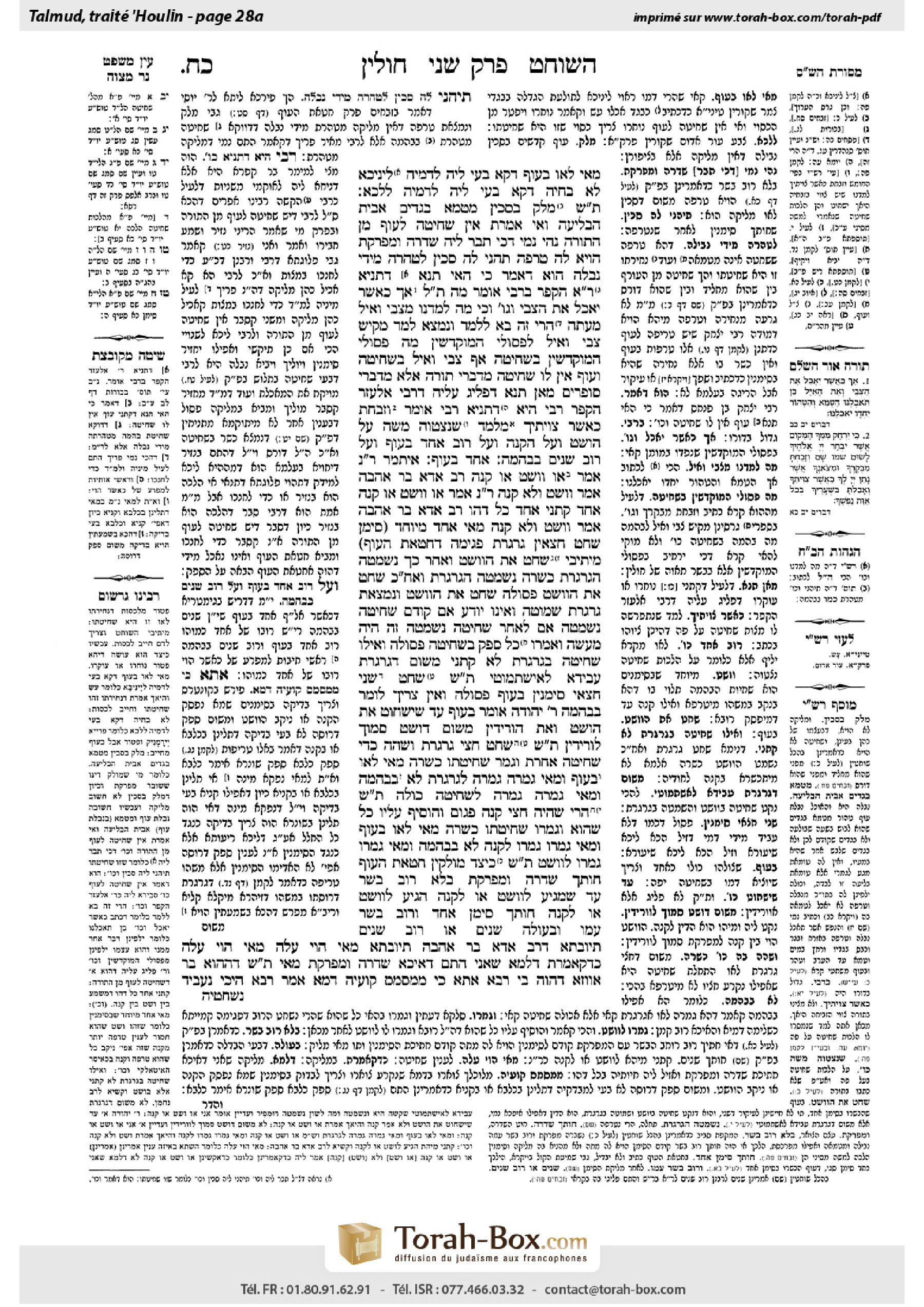
Chullin 28a: Talmud study for Daf Yomi
Study the Talmud for Daf Yomi with scanned pages, Hebrew text, English translations from Sefaria and AI-generated French translations.
Passage selection and English or AI-generated French translation are available where the scan has annotations. Daf Study is independent of Torah-Box and Sefaria.
Browse Chullin · חולין · All tractatesChullin 28a text and translations
This page of Chullin includes the Aramaic text, an English translation and an AI-generated French translation, alongside the scan above.
חולין כ״ח א · Aramaic and Hebrew text
מַאי לָאו בְּעוֹף, דְּקָא בָעֵי לֵיהּ לִדְמֵיהּ לְיָנִיכָא? לָא, בְּחַיָּה דְּקָא בָעֵי לֵיהּ לִדְמֵיהּ לְלַכָּא.
תָּא שְׁמַע: מָלַק בְּסַכִּין, מְטַמֵּא בְּגָדִים אַבֵּית הַבְּלִיעָה. וְאִי אָמְרַתְּ אֵין שְׁחִיטָה לָעוֹף מִן הַתּוֹרָה, נְהִי נָמֵי דְּכִי תָּבַר לֵיהּ שִׁדְרָה וּמַפְרֶקֶת הָוְיָא לַהּ טְרֵפָה, תַּהְנֵי לַהּ סַכִּין לְטַהֲרָהּ מִידֵּי נְבֵלָה!
הוּא דְּאָמַר כִּי הַאי תַּנָּא, דְּתַנְיָא: רַבִּי אֶלְעָזָר הַקַּפָּר בְּרַבִּי אוֹמֵר: מָה תַּלְמוּד לוֹמַר ״אַךְ כַּאֲשֶׁר יֵאָכֵל אֶת הַצְּבִי וְגוֹ׳״? וְכִי מָה לָמַדְנוּ מִצְּבִי וְאַיָּל מֵעַתָּה?
הֲרֵי זֶה בָּא לְלַמֵּד וְנִמְצָא לָמֵד, מַקִּישׁ צְבִי וְאַיָּל לִפְסוּלֵי הַמּוּקְדָּשִׁין: מָה פְּסוּלֵי הַמּוּקְדָּשִׁין בִּשְׁחִיטָה – אַף צְבִי וְאַיָּל בִּשְׁחִיטָה; וְעוֹף אֵין לוֹ שְׁחִיטָה מִדִּבְרֵי תוֹרָה, אֶלָּא מִדִּבְרֵי סוֹפְרִים.
מַאן תַּנָּא דִּפְלִיג עֲלֵיהּ דְּרַבִּי אֶלְעָזָר הַקַּפָּר? רַבִּי הִיא, דְּתַנְיָא: רַבִּי אוֹמֵר: ״וְזָבַחְתָּ … כַּאֲשֶׁר צִוִּיתִךָ״ – מְלַמֵּד שֶׁנִּצְטַוָּה מֹשֶׁה עַל הַוֶּושֶׁט וְעַל הַקָּנֶה, וְעַל רוֹב אֶחָד בָּעוֹף, וְעַל רוֹב שְׁנַיִם בִּבְהֵמָה.
אֶחָד בָּעוֹף אִיתְּמַר: רַב נַחְמָן אָמַר: אוֹ וֶושֶׁט אוֹ קָנֶה, רַב אַדָּא בַּר אַהֲבָה אָמַר: וֶושֶׁט וְלֹא קָנֶה. רַב נַחְמָן אָמַר: אוֹ וֶושֶׁט אוֹ קָנֶה – ״אֶחָד״ קָתָנֵי, ״אֶחָד״ כֹּל דְּהוּ. רַב אַדָּא בַּר אַהֲבָה אָמַר: וֶושֶׁט וְלֹא קָנֶה – מַאי ״אֶחָד״? מְיוּחָד.
(סִימָן: שָׁחַט, חֲצָאִין, גַּרְגֶּרֶת, פְּגִימָה, דְּחַטַּאת הָעוֹף.)
מֵיתִיבִי: שָׁחַט אֶת הַוֶּושֶׁט וְאַחַר כָּךְ נִשְׁמְטָה הַגַּרְגֶּרֶת – כְּשֵׁרָה, נִשְׁמְטָה הַגַּרְגֶּרֶת וְאַחַר כָּךְ שָׁחַט אֶת הַוֶּושֶׁט – פְּסוּלָה, שָׁחַט אֶת הַוֶּושֶׁט וְנִמְצֵאת גַּרְגֶּרֶת שְׁמוּטָה וְאֵינוֹ יוֹדֵעַ אִם קוֹדֶם שְׁחִיטָה נִשְׁמְטָה אִם לְאַחַר שְׁחִיטָה נִשְׁמְטָה – זֶה הָיָה מַעֲשֶׂה, וְאָמְרוּ: כׇּל סָפֵק בִּשְׁחִיטָה – פְּסוּלָה, וְאִילּוּ שְׁחִיטָה בְּגַרְגֶּרֶת לָא קָתָנֵי.
מִשּׁוּם דְּגַרְגֶּרֶת עֲבִידָא לְאִישְׁתְּמוֹטֵי.
תָּא שְׁמַע: שָׁחַט שְׁנֵי חֲצָאֵי סִימָנִין בְּעוֹף – פְּסוּלָה, וְאֵין צָרִיךְ לוֹמַר בִּבְהֵמָה. רַבִּי יְהוּדָה אוֹמֵר: בָּעוֹף – עַד שֶׁיִּשְׁחוֹט אֶת הַוֶּושֶׁט וְאֶת הַוְּרִידִין, מִשּׁוּם דְּוֶשֶׁט סָמוּךְ לִוְרִידִין.
תָּא שְׁמַע: שָׁחַט חֲצִי גַרְגֶּרֶת, וְשָׁהָה כְּדֵי שְׁחִיטָה אַחֶרֶת, וְגָמַר שְׁחִיטָתוֹ – כְּשֵׁרָה. מַאי לָאו בְּעוֹף, וּמַאי גְּמָרָהּ – גְּמָרָהּ לְגַרְגֶּרֶת? לָא, בִּבְהֵמָה, וּמַאי גְּמָרָהּ – גְּמָרָהּ לִשְׁחִיטָה כּוּלַּהּ.
תָּא שְׁמַע: הֲרֵי שֶׁהָיָה חֲצִי קָנֶה פָּגוּם, וְהוֹסִיף עָלָיו כׇּל שֶׁהוּא וּגְמָרוֹ – שְׁחִיטָתוֹ כְּשֵׁרָה. מַאי לָאו בְּעוֹף, וּמַאי גְּמָרוֹ – גְּמָרוֹ לְקָנֶה? לָא, בִּבְהֵמָה, וּמַאי גְּמָרוֹ – גְּמָרוֹ לְוֶושֶׁט.
תָּא שְׁמַע: כֵּיצַד מוֹלְקִין חַטַּאת הָעוֹף? חוֹתֵךְ שִׁדְרָה וּמַפְרֶקֶת בְּלֹא רוֹב בָּשָׂר עַד שֶׁמַּגִּיעַ לַוֶּושֶׁט אוֹ לַקָּנֶה; הִגִּיעַ לַוֶּושֶׁט אוֹ לַקָּנֶה – חוֹתֵךְ סִימָן אֶחָד וְרוֹב בָּשָׂר עִמּוֹ, וּבָעוֹלָה – שְׁנַיִם אוֹ רוֹב שְׁנַיִם. תְּיוּבְתָּא דְּרַב אַדָּא בַּר אַהֲבָה, תְּיוּבְתָּא.
מַאי הָוֵי עֲלַהּ? מַאי הָוֵי עֲלַהּ?! כִּדְקָאָמְרַתְּ, דִּלְמָא שָׁאנֵי הָתָם, דְּאִיכָּא שִׁדְרָה וּמַפְרֶקֶת.
מַאי? תָּא שְׁמַע: דְּהָהוּא בַּר אֲוָוזָא דַּהֲוָה בֵּי רָבָא, אֲתָא כִּי מְמַסְמַס קוֹעֵיהּ דְּמָא. אָמַר רָבָא: הֵיכִי נַעֲבֵיד?
Chullin 28a · English translation
What, is it not referring to a bird, as he requires its blood to remove a moth from his garments? If so, apparently birds require slaughter by Torah law, as, if that were not the case, then even if a bird were stabbed, covering of the blood would be required. The Gemara rejects that proof: No, the baraita is referring to an undomesticated animal, as he requires its blood to use as a red dye [lelakka] Therefore, no proof may be cited from this baraita that birds require slaughter by Torah law.
The Gemara cites proof from a mishna (Zevaḥim 68a): Come and hear: If one cut the nape of the neck of a sacrificial bird with a knife instead of pinching it with his fingernail, this bird carcass renders the garments of one who eats the bird ritually impure when the meat is in his throat. The Gemara explains the proof: And if you say that slaughter of a bird is not obligatory by Torah law, then although when cutting the bird from the nape, he breaks the spine and the neck bone with the knife before severing the gullet and windpipe, and it indeed becomes a tereifa and may not be eaten, cutting the simanim with the knife should be effective to purify it, i.e., to prevent it from assuming the status of an unslaughtered carcass. The fact that the garments of one who swallows the meat of the bird become ritually impure indicates that slaughter is the only method effective in permitting the consumption of a bird and for preventing it from assuming the status of an unslaughtered carcass.
The Gemara rejects that proof: Although it is clear from that mishna that slaughter of birds is obligatory by Torah law, Rabbi Yitzḥak ben Pineḥas states his opinion in accordance with the opinion of that tanna who holds that it is not obligatory by Torah law, as it is taught in a baraita that Rabbi Elazar HaKappar, the distinguished Sage, says: What is the meaning when the verse states: “However, as the gazelle and as the deer is eaten, so shall you eat of it” (Deuteronomy 12:22)? And what now have we derived from the gazelle and the deer with regard to disqualified consecrated animals?
These two undomesticated animals come in the verse to teach a halakha with regard to disqualified consecrated animals, and it is found that a halakha is derived from the case of disqualified consecrated animals in their regard. The Torah juxtaposes a gazelle and a deer to disqualified consecrated animals to teach: Just as disqualified consecrated animals are rendered fit for consumption through slaughter, so too, a gazelle and a deer are rendered fit for consumption only through slaughter. But for a bird, slaughter is not obligatory by Torah law; rather, the obligation is by rabbinic law.
The Gemara asks: Who is the tanna who disagrees with Rabbi Elazar HaKappar and holds that the slaughter of a bird is obligatory by Torah law? It is Rabbi Yehuda HaNasi, as it is taught in a baraita: Rabbi Yehuda HaNasi says: The Torah states: “And you shall slaughter of your herd and of your flock, which the Lord has given you, as I have commanded you” (Deuteronomy 12:21). This verse teaches that Moses was previously commanded about the halakhot of slaughter, even though they are not written explicitly in the Torah. He was commanded about cutting the gullet and about cutting the windpipe, and about the requirement to cut the majority of one siman for a bird, and the majority of two simanim for an animal.
§ The mishna teaches that in the case of one who cuts one siman in a bird, his slaughter is valid. It was stated that there is an amoraic dispute with regard to this matter. Rav Naḥman said: One may cut either the gullet or the windpipe. Rav Adda bar Ahava said: One must cut the gullet for the slaughter to be valid, but cutting the windpipe is not sufficient. The Gemara explains the formulation of the mishna according to the opinion of each amora. Rav Naḥman said: One may cut either the gullet or the windpipe. One siman is taught in the mishna, meaning that the slaughter is valid if he severs one, indicating that either siman is valid. Rav Adda bar Ahava said: One must cut the gullet for the slaughter to be valid, but cutting the windpipe is not sufficient. What is the meaning of: One, in the mishna? It means the special one, the gullet.
The Gemara provides a mnemonic for the proofs to be cited by the Gemara: Slaughter, halves, windpipe, deficiency, of a bird sin offering.
The Gemara raises an objection to the opinion of Rav Naḥman from a baraita: If one cut the bird’s gullet and thereafter the windpipe was displaced, the slaughter is valid. If the windpipe was displaced and thereafter he cut the gullet, the slaughter is not valid. With regard to a case where one cut the gullet and the windpipe was found displaced and he does not know if it was displaced prior to the slaughter or if it was displaced after the slaughter, that was an incident that transpired, and the Sages said: In any case of uncertainty with regard to slaughter, the slaughter is not valid. The baraita mentions only the case of cutting the gullet, while cutting the windpipe is not taught. The baraita supports the opinion of Rav Adda bar Ahava and is contrary to the opinion of Rav Naḥman.
The Gemara rejects that proof: The baraita mentions only the cutting of the gullet and displacement of the windpipe not because slaughter may be performed only by cutting the gullet. Rather, those scenarios were mentioned because the windpipe, unlike the gullet, is likely to be displaced.
The Gemara suggests: Come and hear a proof contrary to the opinion of Rav Naḥman from a baraita. If one cut two halves, one half of each of the simanim, in a bird, the slaughter is not valid, as the requirement is that a majority of one siman is cut; and needless to say the slaughter performed in that manner is not valid in the case of an animal, where the requirement is that a majority of both simanim are cut. Rabbi Yehuda says: In a bird the slaughter is not valid until he cuts the gullet and the veins; the veins must be cut so that the blood will drain from the body. The fact that Rabbi Yehuda mentions cutting only the gullet and not the windpipe indicates that slaughter is valid only when the gullet is cut. The Gemara rejects that proof: Rabbi Yehuda mentions only the gullet because the gullet is adjacent to the veins.
The Gemara suggests: Come and hear proof in support of the opinion of Rav Naḥman from a baraita. If one cut half the windpipe and interrupted the slaughter for an interval equivalent to the duration of the slaughter of another animal, and then completed his slaughter, the slaughter is valid and it is not invalidated due to an interrupted slaughter. What, is the baraita not referring to the slaughter of a bird? And what does the term: Completed it, mean in the baraita? Doesn’t it mean that he completed cutting the windpipe, which he had started cutting, indicating that with the cutting of the windpipe the slaughter is valid, in accordance with the opinion of Rav Naḥman as opposed to the opinion of Rav Adda bar Ahava? The Gemara rejects that proof: No, the baraita is referring to slaughter of an animal, for which both simanim must be cut. And what does the term: Completed it, mean in the baraita? It means that he completed the entire slaughter.
The Gemara suggests: Come and hear proof in support of the opinion of Rav Naḥman from a baraita: In a case where half of the windpipe was deficient, i.e., somewhat cut, prior to the slaughter and the slaughterer added to that deficiency an incision of any size, and completed it, his slaughter is valid. What, is it not referring to the slaughter of a bird? And what does the term: Completed it, mean in the baraita? Doesn’t it mean that he completed cutting the majority of the windpipe, indicating that cutting the windpipe renders the bird fit for consumption? The Gemara rejects that proof: No, the baraita is referring to slaughter of an animal, for which both simanim must be cut. And what does the term: Completed it, mean in the baraita? It means that he completed the entire slaughter by cutting the gullet.
The Gemara suggests: Come and hear proof in support of the opinion of Rav Naḥman from a baraita: How does one pinch the nape of the neck of a bird sin offering? Using his thumbnail, the priest cuts the spine and the neck bone, without cutting through the majority of the surrounding flesh until he reaches either the gullet or the windpipe. Once he reaches the gullet or the windpipe, he cuts one siman with his nail and a majority of the surrounding flesh with it. And in the case of a bird burnt offering, he cuts the two simanim or the majority of the two simanim. The Gemara concludes: The refutation of the opinion of Rav Adda bar Ahava from this baraita is indeed a conclusive refutation.
The Gemara asks in response: What halakhic conclusion was reached about the matter? It is as you said, that the opinion of Rav Adda bar Ahava was conclusively refuted. The Gemara says that there is not absolute proof from the baraita, as perhaps it is different there with regard to pinching, as in that case there is the spine and the neck bone that are cut initially, and therefore cutting the windpipe is sufficient. But in the case of slaughter of a non-sacred bird, perhaps only if one cuts the gullet the slaughter is valid.
The Gemara asks: What then is the halakha in the case of slaughter? The Gemara answers: Come and hear proof from the following incident, that there was a certain duck that was in the house of Rava, which came for slaughter with its neck filthy with blood and they did not know whether the blood was the result of its windpipe having been severed or its gullet having been perforated, in which cases the duck is a tereifa. Rava said: What should we do with regard to this duck?
Chullin 28a · Traduction française (IA)
Qu'est-ce que cela signifie, ne s'agit-il pas d'un oiseau, puisque l'on exige son sang pour éliminer un papillon de ses vêtements ? Si c'est le cas, il semble que les oiseaux nécessitent une immolation selon la loi juive, car, si ce n'était pas le cas, alors même si un oiseau était transpercé, la couverture du sang serait nécessaire. La Guemara rejette cette preuve : Non, la baraïta fait référence à un animal sauvage, puisque l'on exige son sang pour en faire un colorant rouge [lelakka]. Ainsi, aucune preuve ne peut être tirée de cette baraïta pour affirmer que l'immolation des oiseaux est obligatoire selon la loi juive.
La Guemara cite une preuve tirée d'une mitsva (Zevaḥim 68a) : Viens écouter : Si l'on coupe le cou d'un oiseau sacré avec un couteau au lieu de le pincer avec les ongles, le cadavre de l'oiseau rend rituellement impur celui qui mange la chair de l'oiseau lorsque la viande est dans sa gorge. La Guemara explique cette preuve : Et si l'on dit que l'immolation d'un oiseau n'est pas obligatoire selon la loi juive, alors même si l'on coupe l'oiseau au cou, on brise la colonne vertébrale et le cou avant de couper la gorge et la trachée, et l'oiseau devient un tereifa et ne peut être mangé, la coupe des simanim avec le couteau devrait être efficace pour le purifier, c'est-à-dire pour empêcher qu'il ne prenne le statut de cadavre non immolé. Le fait que les vêtements de celui qui avale la viande de l'oiseau deviennent rituellement impurs indique que l'immolation est la seule méthode efficace pour permettre la consommation d'un oiseau et pour empêcher qu'il ne prenne le statut de cadavre non immolé.
La Guemara rejette cette preuve : Bien que ce soit clair à partir de cette mitsva que l'immolation des oiseaux est obligatoire selon la loi juive, Rabbi Yitzḥak ben Pineḥas exprime son opinion conformément à celle du tanna qui considère que cela n'est pas obligatoire selon la loi juive, comme il est enseigné dans une baraïta que Rabbi Elazar HaKappar, le Sage distingué, dit : Quel est le sens de la phrase : « Cependant, comme le gazelle et comme le chevreau est mangé, ainsi tu dois le manger » (Deutéronome 12:22) ? Et qu'avons-nous tiré du gazelle et du chevreau concernant les animaux consacrés non conformes ?
Ces deux animaux sauvages figurent dans la parabole pour enseigner une halakha concernant les animaux consacrés non conformes, et on découvre qu'une halakha est tirée du cas des animaux consacrés non conformes à leur sujet. La Torah juxtapose le gazelle et le chevreau aux animaux consacrés non conformes pour enseigner : Comme les animaux consacrés non conformes sont rendus comestibles par l'immolation, de même le gazelle et le chevreau sont rendus comestibles uniquement par l'immolation. Cependant, pour un oiseau, l'immolation n'est pas obligatoire selon la loi juive ; plutôt, l'obligation est selon la loi rabbinique.
La Guemara pose la question : Qui est le tanna qui s'oppose à Rabbi Elazar HaKappar et qui considère que l'immolation d'un oiseau est obligatoire selon la loi juive ? C'est Rabbi Yehuda HaNasi, comme il est enseigné dans une baraïta : Rabbi Yehuda HaNasi dit : La Torah dit : « Et vous tuerez de votre troupeau et de votre bétail, qui le Seigneur vous a donné, comme je vous ai commandé » (Deutéronome 12:21). Cette verset enseigne que Moïse était précédemment commandé aux halakhot de l'immolation, même si elles ne sont pas explicitement écrites dans la Torah. Il était commandé à la coupe de la gorge et à la coupe de la trachée, ainsi qu'à la nécessité de couper la majorité d'un siman pour un oiseau, et la majorité de deux simanim pour un animal.
§ La mitsva enseigne que dans le cas d'une personne qui coupe un siman dans un oiseau, son immolation est valide. Il a été dit qu'il y a un débat entre les amoraim concernant cette question. Rav Naḥman dit : On peut couper soit la gorge soit la trachée. Rav Adda bar Ahava dit : On doit couper la gorge pour que l'immolation soit valide, mais couper la trachée n'est pas suffisant. La Guemara explique la formulation de la mitsva selon l'opinion de chaque amora. Rav Naḥman dit : On peut couper soit la gorge soit la trachée. Un siman est enseigné dans la mitsva, ce qui signifie que l'immolation est valide si l'on coupe l'un d'eux, indiquant que soit siman est valide. Rav Adda bar Ahava dit : On doit couper la gorge pour que l'immolation soit valide, mais couper la trachée n'est pas suffisant. Quel est le sens de : Un, dans la mitsva ? Cela signifie le spécial, la gorge.
La Guemara fournit un mnémonique pour les preuves à évoquer : Immolation, moitiés, trachée, insuffisance, d'un oiseau sacrifice expiatoire.
La Guemara soulève un objet contre l'opinion de Rav Naḥman à partir d'une baraïta : Si l'on a coupé la gorge de l'oiseau et ensuite la trachée a été déplacée, l'immolation est valide. Si la trachée a été déplacée et ensuite l'on a coupé la gorge, l'immolation n'est pas valide. Concernant le cas où l'on a coupé la gorge et la trachée a été trouvée déplacée et l'on ne sait pas si elle a été déplacée avant l'immolation ou après, cela a été un incident qui s'est produit, et les Sages ont dit : Dans tout cas d'incertitude concernant l'immolation, l'immolation n'est pas valide. La baraïta mentionne uniquement le cas de la coupe de la gorge, tandis que la coupe de la trachée n'est pas enseignée. La baraïta soutient l'opinion de Rav Adda bar Ahava et est contraire à l'opinion de Rav Naḥman.
La Guemara rejette cette preuve : La baraïta mentionne uniquement la section de la gorge et le déplacement de la trachée non pas parce que l'immolation peut être effectuée uniquement en sectionnant la gorge. Plutôt, ces scénarios ont été mentionnés parce que la trachée, contrairement à la gorge, est susceptible de se déplacer.
La Guemara suggère : Viens entendre une preuve contraire à l'opinion de Rav Naḥman d'une baraïta. Si l'on coupe deux moitiés, une moitié de chaque siman, dans un oiseau, la mise à mort n'est pas valide, car la condition est que la majorité d'un seul siman soit coupée ; et encore moins la mise à mort effectuée ainsi est valide dans le cas d'un animal, où la condition est que la majorité des deux simanim soit coupée. Rabbi Yehuda dit : Dans un oiseau, la mise à mort n'est pas valide jusqu'à ce qu'il coupe le gourgeon et les veines ; les veines doivent être coupées de sorte que le sang s'écoule du corps. Le fait que Rabbi Yehuda mentionne seulement le gourgeon et non la trachée indique que la mise à mort est valide uniquement lorsque le gourgeon est coupé. La Guemara rejette cette preuve : Rabbi Yehuda mentionne seulement le gourgeon car le gourgeon est adjacent aux veines.
La Guemara suggère : Viens entendre une preuve en faveur de l'opinion de Rav Naḥman d'une baraïta. Si l'on coupe la moitié de la trachée et qu'on interrompt la mise à mort pendant une durée équivalente à celle de la mise à mort d'un autre animal, puis qu'on termine sa mise à mort, la mise à mort est valide et n'est pas invalidée en raison d'une interruption. Qu'est-ce que la baraïta ne fait pas référence à la mise à mort d'un oiseau ? Et que signifie le terme : il l'a terminé, dans la baraïta ? N'indique-t-il pas qu'il a terminé de couper la trachée, qu'il avait commencé à couper, ce qui signifie que la coupure de la trachée rend la mise à mort valide, conformément à l'opinion de Rav Naḥman plutôt qu'à celle de Rav Adda bar Ahava ? La Guemara rejette cette preuve : Non, la baraïta fait référence à la mise à mort d'un animal, pour lequel les deux simanim doivent être coupés. Et que signifie le terme : il l'a terminé, dans la baraïta ? Cela signifie qu'il a terminé toute la mise à mort.
La Guemara suggère : Viens entendre une preuve en faveur de l'opinion de Rav Naḥman d'une baraïta : Dans un cas où la moitié de la trachée était insuffisante, c'est-à-dire quelque peu coupée, avant la mise à mort et que le boucher ajoute à cette insuffisance une incision de toute taille, et qu'il la termine, sa mise à mort est valide. Qu'est-ce que la baraïta ne fait pas référence à la mise à mort d'un oiseau ? Et que signifie le terme : il l'a terminé, dans la baraïta ? N'indique-t-il pas qu'il a terminé la coupure de la majorité de la trachée, ce qui signifie que la coupure de la trachée rend l'oiseau propre à la consommation ? La Guemara rejette cette preuve : Non, la baraïta fait référence à la mise à mort d'un animal, pour lequel les deux simanim doivent être coupés. Et que signifie le terme : il l'a terminé, dans la baraïta ? Cela signifie qu'il a terminé toute la mise à mort en coupant le gourgeon.
La Guemara suggère : Viens entendre une preuve en faveur de l'opinion de Rav Naḥman d'une baraïta : Comment serre-t-on le cou d'un oiseau sacrifice expiatoire ? Avec son ongle, le prêtre coupe la colonne vertébrale et l'os du cou, sans couper la majorité de la chair environnante jusqu'à ce qu'il atteigne soit le gourgeon soit la trachée. Une fois qu'il atteint le gourgeon ou la trachée, il coupe un siman avec son ongle et la majorité de la chair environnante avec. Et dans le cas d'un oiseau holocauste, il coupe les deux simanim ou la majorité des deux simanim. La Guemara conclut : La réfutation de l'opinion de Rav Adda bar Ahava à partir de cette baraïta est effectivement une réfutation concluante.
La Guemara pose la question en réponse : Quelle conclusion halakhique a-t-on tirée concernant l'affaire ? C'est ce que tu as dit, que l'opinion de Rav Adda bar Ahava a été concluamment réfutée. La Guemara dit qu'il n'y a pas de preuve absolue à partir de la baraïta, car peut-être c'est différent là concernant le serrement, car dans ce cas il y a la colonne vertébrale et l'os du cou qui sont coupés d'abord, et donc la coupure de la trachée suffit. Mais dans le cas de la mise à mort d'un oiseau non sacré, peut-être seulement si l'on coupe le gourgeon la mise à mort est valide.
La Guemara pose la question : Quel est alors la halakha dans le cas de la mise à mort ? La Guemara répond : Viens entendre une preuve à partir de l'incident suivant, qu'il y avait un canard qui était chez Rava, qui vint pour la mise à mort avec son cou sale de sang et ils ne savaient pas si le sang provenait de la trachée ayant été coupée ou du gourgeon ayant été perfore, dans lesquels cas le canard est un tereifa. Rava dit : Que devons-nous faire à propos de ce canard ?
Traduction française générée par IA à partir de l’édition anglaise de Sefaria. Vérifie toujours un passage avec le texte source.
Text from Sefaria: William Davidson Edition - Vocalized Aramaic (unknown); William Davidson Edition - English (CC BY NC).