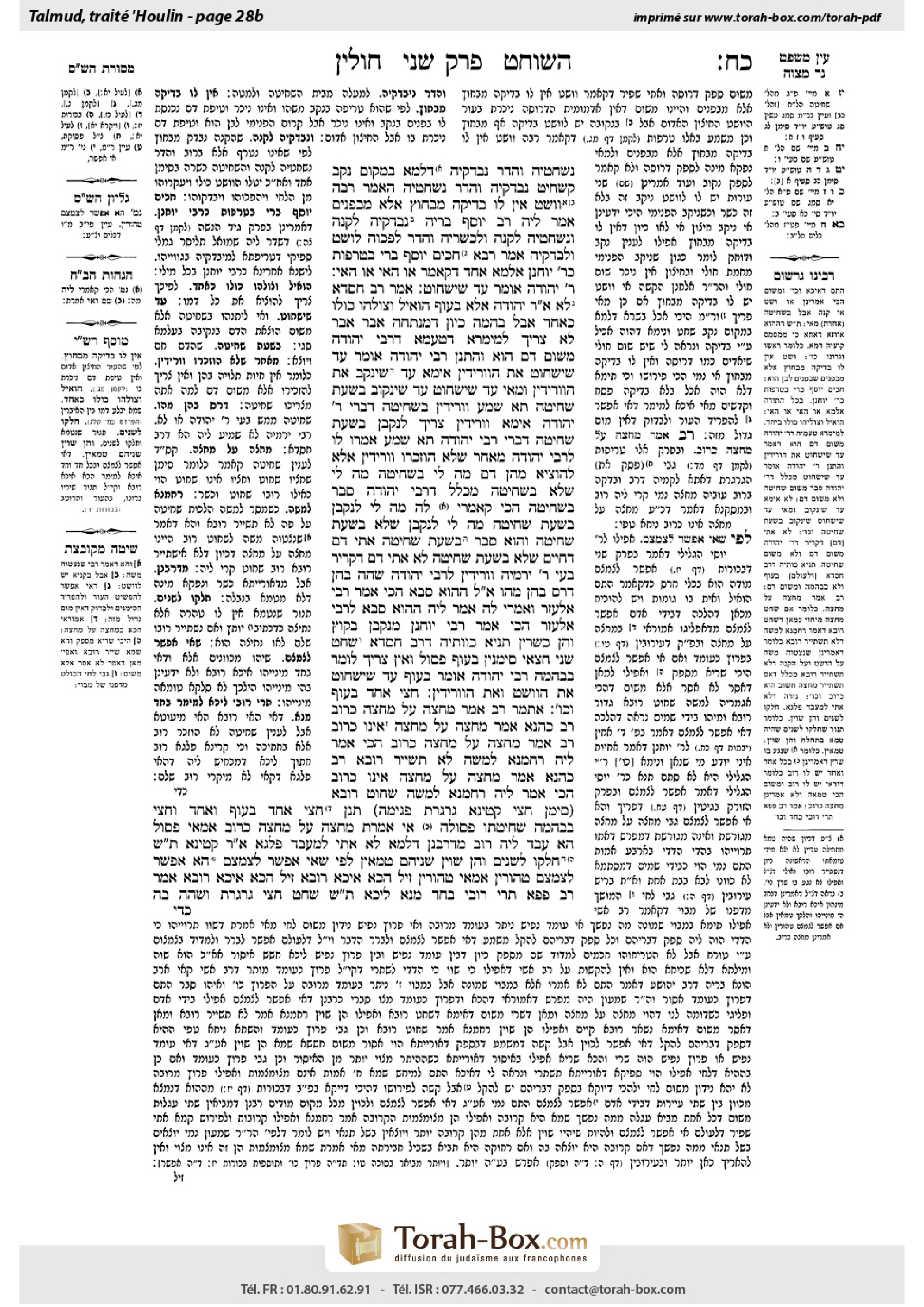
Chullin 28b: Talmud study for Daf Yomi
Study the Talmud for Daf Yomi with scanned pages, Hebrew text, English translations from Sefaria and AI-generated French translations.
Passage selection and English or AI-generated French translation are available where the scan has annotations. Daf Study is independent of Torah-Box and Sefaria.
Browse Chullin · חולין · All tractatesChullin 28b text and translations
This page of Chullin includes the Aramaic text, an English translation and an AI-generated French translation, alongside the scan above.
חולין כ״ח ב · Aramaic and Hebrew text
נִשְׁחֲטֵיהּ וַהֲדַר נִבְדְּקֵיהּ? דִּלְמָא בִּמְקוֹם נֶקֶב קָשָׁחֵיט! נִבְדְּקֵיהּ וַהֲדַר נִשְׁחֲטֵיהּ? הָאָמַר רַבָּה: וֶושֶׁט אֵין לוֹ בְּדִיקָה מִבַּחוּץ אֶלָּא מִבִּפְנִים!
אֲמַר לֵיהּ רַב יוֹסֵף בְּרֵיהּ: נִבְדְּקֵיהּ לְקָנֶה, וְנִשְׁחֲטֵיהּ לְקָנֶה וְלַכְשְׁרֵיהּ, וַהֲדַר לֵפְכֵוהּ לְוֶשֶׁט וְלִבְדְּקֵיהּ. אָמַר רָבָא: חַכִּים יוֹסֵף בְּרִי בִּטְרֵפוֹת כְּרַבִּי יוֹחָנָן. אַלְמָא אֶחָד דְּקָאָמַר – אוֹ הַאי אוֹ הַאי.
רַבִּי יְהוּדָה אוֹמֵר: עַד שֶׁיִּשְׁחוֹט. אָמַר רַב חִסְדָּא: לֹא אָמַר רַבִּי יְהוּדָה אֶלָּא בְּעוֹף, הוֹאִיל וְצוֹלֵהוּ כּוּלּוֹ כְּאֶחָד, אֲבָל בְּהֵמָה, כֵּיוָן דִּמְנַתְּחַהּ אֵבֶר אֵבֶר – לָא צְרִיךְ.
לְמֵימְרָא דְּטַעְמָא דְּרַבִּי יְהוּדָה מִשּׁוּם דָּם הוּא? וְהָתְנַן: רַבִּי יְהוּדָה אוֹמֵר: עַד שֶׁיִּשְׁחוֹט אֶת הַוְּורִידִין.
אֵימָא עַד שֶׁיְּנַקֵּב אֶת הַוְּורִידִין, וּמַאי ״עַד שֶׁיִּשְׁחוֹט״? עַד שֶׁיִּנְקוֹב בִּשְׁעַת שְׁחִיטָה.
תָּא שְׁמַע: וְורִידִין בִּשְׁחִיטָה, דִּבְרֵי רַבִּי יְהוּדָה. אֵימָא: וְורִידִין צָרִיךְ לְנַקְּבָן בִּשְׁעַת שְׁחִיטָה, דִּבְרֵי רַבִּי יְהוּדָה.
תָּא שְׁמַע: אָמְרוּ לוֹ לְרַבִּי יְהוּדָה, מֵאַחַר שֶׁלֹּא הוּזְכְּרוּ וְורִידִין אֶלָּא לְהוֹצִיא מֵהֶן דָּם, מָה לִי בִּשְׁחִיטָה, מָה לִי שֶׁלֹּא בִּשְׁחִיטָה? מִכְּלָל דְּרַבִּי יְהוּדָה סָבַר בִּשְׁחִיטָה.
הָכִי קָאָמְרִי לַהּ: מָה לִי לְנַקְּבָן בִּשְׁעַת שְׁחִיטָה, מָה לִי לְנַקְּבָן שֶׁלֹּא בִּשְׁעַת שְׁחִיטָה? וְהוּא סָבַר: בִּשְׁעַת שְׁחִיטָה אָתֵי דָּם דְּחָיֵים, שֶׁלֹּא בִּשְׁעַת שְׁחִיטָה לָא אָתֵי דָּם דְּקָרִיר.
בָּעֵי רַבִּי יִרְמְיָה: וְורִידִין לְרַבִּי יְהוּדָה, שָׁהָה בָּהֶן, דָּרַס בָּהֶן, מַהוּ?
אֲמַר לֵיהּ הָהוּא סָבָא: הָכִי אָמַר רַבִּי אֶלְעָזָר, וְאָמְרִי לַהּ: אֲמַר לֵיהּ הָהוּא סָבָא לְרַבִּי אֶלְעָזָר, הָכִי אָמַר רַבִּי יוֹחָנָן: מְנַקְּבָן בְּקוֹץ וְהֵן כְּשֵׁרִין.
תַּנְיָא כְּוָותֵיהּ דְּרַב חִסְדָּא: שָׁחַט שְׁנֵי חֲצָאֵי סִימָנִין בְּעוֹף – פָּסוּל, וְאֵין צָרִיךְ לוֹמַר בִּבְהֵמָה. רַבִּי יְהוּדָה אוֹמֵר: בְּעוֹף – עַד שֶׁיִּשְׁחוֹט אֶת הַוֶּושֶׁט וְאֶת הַוְּורִידִין.
חֲצִי אֶחָד בְּעוֹף וְכוּ׳. אִתְּמַר: רַב אָמַר: מֶחֱצָה עַל מֶחֱצָה כְּרוֹב, רַב כָּהֲנָא אָמַר: מֶחֱצָה עַל מֶחֱצָה אֵינוֹ כְּרוֹב.
רַב אָמַר: מֶחֱצָה עַל מֶחֱצָה כְּרוֹב, הָכִי אֲמַר לֵיהּ רַחֲמָנָא לְמֹשֶׁה: ״לָא תְּשַׁיַּיר רוּבָּא״. רַב כָּהֲנָא אָמַר: מֶחֱצָה עַל מֶחֱצָה אֵינוֹ כְּרוֹב, הָכִי אֲמַר לֵיהּ רַחֲמָנָא לְמֹשֶׁה: ״שְׁחוֹט רוּבָּא״.
(סִימָן: חֲצִי, קַטִּינָא, גַּרְגֶּרֶת, פְּגִימָה).
תְּנַן: חֲצִי אֶחָד בְּעוֹף, וְאֶחָד וַחֲצִי בַּבְּהֵמָה – שְׁחִיטָתוֹ פְּסוּלָה. אִי אָמְרַתְּ מֶחֱצָה עַל מֶחֱצָה כְּרוֹב, אַמַּאי פָּסוּל? הָא עֲבַד לֵיהּ רוֹב! מִדְּרַבָּנַן, דִּלְמָא לָא אָתֵי לְמֶעְבַּד פַּלְגָא.
אָמַר רַב קַטִּינָא, תָּא שְׁמַע: חֲלָקוֹ לִשְׁנַיִם וְהֵן שָׁוִין – שְׁנֵיהֶם טְמֵאִין, לְפִי שֶׁאִי אֶפְשָׁר לְצַמְצֵם.
הָא אֶפְשָׁר לְצַמְצֵם – טְהוֹרִין, אַמַּאי טְהוֹרִין? זִיל הָכָא אִיכָּא רוּבָּא, זִיל הָכָא אִיכָּא רוּבָּא!
אָמַר רַב פָּפָּא: תְּרֵי רוּבֵּי בְּחַד מָנָא לֵיכָּא.
תָּא שְׁמַע: שָׁחַט חֲצִי גַרְגֶּרֶת, וְשָׁהָה בָּהּ
Chullin 28b · English translation
If one suggests: Let us slaughter it and then we will examine it to determine whether its windpipe was severed or its gullet was perforated, that is difficult, because perhaps the slaughterer will slaughter the duck precisely in the place of the perforation and it will be impossible to determine whether the gullet was perforated before the slaughter. If one suggests: Let us slice open the hide and examine the simanim and then we will slaughter it, that is difficult, because didn’t Rabba say: The gullet has no possible examination from without, as its outer side is red, and a small perforation would be indiscernible, but only from within, as its inner side is white, and blood at the site of the perforation would be discerned?
Rav Yosef, son of Rava, said to him: Let us examine the windpipe, as it is possible to discern from without whether the majority of the windpipe was severed, and then cut the duck’s windpipe and thereby render it permitted, as cutting either of the two simanim suffices in a bird. And then let us turn the gullet inside out and examine its inner side to determine whether it was perforated and the duck is a tereifa. Rava said: My son Yosef is as wise in the halakhot of tereifot as Rabbi Yoḥanan. Apparently, one siman, which is taught in the mishna as being sufficient in the slaughter of a bird, means either this siman, the gullet, or that siman, the windpipe.
§ The mishna states: Rabbi Yehuda says: The slaughter is not valid until he cuts the veins in the neck. Rav Ḥisda said: Rav Yehuda said that one must cut the veins only in the slaughter of a bird, as one typically roasts it in its entirety as one whole entity; therefore, one must cut the veins to ensure that the blood drains. But with regard to the slaughter of an animal, since it is typically quartered into limbs, resulting in the blood draining more readily, one need not cut the veins.
The Gemara asks: Is that to say that the reason that Rabbi Yehuda requires cutting of the veins is due to the need to drain the blood? But didn’t we learn in the mishna: Rabbi Yehuda says: The slaughter is not valid until he cuts [sheyishḥot] the veins, indicating that the cutting of the veins is a component of the slaughter [sheḥita]?
The Gemara answers: Say that Rabbi Yehuda’s statement is until he punctures the veins. And what is the meaning of: Until he cuts? Until he punctures the veins at the moment of slaughter, when the blood flows.
The Gemara suggests: Come and hear proof rejecting this interpretation of Rabbi Yehuda’s statement from a baraita: The veins through slaughter, this is the statement of Rabbi Yehuda, which indicates that the cutting of the veins is a component of slaughter. The Gemara rejects that proof: Say that the correct reading of the baraita is: He must puncture the veins at the moment of slaughter; this is the statement of Rabbi Yehuda.
The Gemara suggests: Come and hear another proof from a baraita: The Rabbis said to Rabbi Yehuda: Since veins were mentioned only to drain blood from them, what difference is there to me whether one cuts them as a component of slaughter, and what difference is there to me whether one cuts them not as a component of slaughter? One can learn by inference from this baraita that Rabbi Yehuda holds that one cuts the veins as a component of slaughter.
The Gemara rejects this proof. This is what the Rabbis are saying to Rabbi Yehuda: What difference is there to me whether one punctures them at the moment of slaughter, and what difference is there to me whether one punctures them not at the moment of slaughter? One can puncture the veins after the slaughter. And Rabbi Yehuda holds that at the time of slaughter the blood emerges from the body quickly because the blood is warm; when it is not at the time of slaughter, the blood does not emerge from the body quickly because it is cool.
Rabbi Yirmeya raises a dilemma: In cutting the veins according to Rabbi Yehuda, if one interrupted the act in the midst of cutting them, or if he pressed the knife and cut them instead of drawing the knife back and forth, what is the halakha? Do these actions, which invalidate slaughter when cutting the simanim, also invalidate slaughter when performed in the cutting of the veins?
A certain elder said to him: This is what Rabbi Elazar said; and some say that a certain elder said to Rabbi Elazar that this is what Rabbi Yoḥanan said: He punctures the veins with a thorn and their cutting is valid. Cutting the veins is not a component of the slaughter.
The Gemara notes that it is taught in a baraita in accordance with the opinion of Rav Ḥisda that Rabbi Yehuda requires cutting of the veins only in the slaughter of birds, and not in the slaughter of animals. If one cut two halves, one half of each of the simanim, in a bird, the slaughter is not valid, and needless to say the slaughter performed in that manner is not valid in the case of an animal. Rabbi Yehuda says: In a bird the slaughter is not valid until he cuts the gullet and the veins.
§ The mishna teaches: If one cut half of one siman in a bird or one and a half simanim in an animal, his slaughter is not valid. It was stated that there is an amoraic dispute. Rav said: The halakhic status of a siman of which precisely half was cut and half remained uncut is like that of a siman of which the majority was cut. Rav Kahana said: The halakhic status of a siman of which precisely half was cut and half remained uncut is not like that of a siman of which the majority was cut.
The Gemara elaborates. Rav said: The halakhic status of a siman of which precisely half was cut and half remained uncut is like that of a siman of which the majority was cut, and this is what the Merciful One said to Moses: Do not leave the majority uncut. When cutting precisely half, the majority does not remain uncut. Rav Kahana said: The halakhic status of a siman of which precisely half was cut and half remained uncut is not like that of a siman of which the majority was cut, and this is what the Merciful One said to Moses: Cut the majority of the siman. Therefore, cutting precisely half is insufficient.
The Gemara provides a mnemonic for the proofs that it cites with regard to this dispute: Half, Ketina, windpipe, deficiency.
We learned in the mishna: If one cut half of one siman in a bird or one and a half simanim in an animal, his slaughter is not valid. The Gemara questions the opinion of Rav: If you say that the halakhic status of a siman of which precisely half was cut and half remained uncut is like that of a siman of which the majority was cut, why is his slaughter not valid? By cutting half, didn’t he perform the cutting of a majority of the siman? The Gemara rejects that proof: By rabbinic law, the slaughter is not valid, due to the concern that perhaps he will not come to perform cutting on even half of the siman.
Rav Ketina said: Come and hear proof contrary to Rav’s opinion from a baraita with regard to an impure earthenware vessel that is purified through being broken. If it is broken in two, the larger portion remains impure and the smaller portion is purified. If he divided it into two and they are seemingly equal halves, both are impure, because it is impossible to measure precisely in breaking an earthenware vessel and render both halves equal. Since it is impossible to determine which half is larger, both remain impure due to uncertainty.
The Gemara infers: But were it possible to measure precisely and divide it into equal halves, both would be pure. If, as Rav states, the halakhic status of half is like that of a majority, why are they pure? Go here, to one half of the vessel, and you will see that there is a majority and it should remain impure, and go there, to the other half, and you will see that there is a majority and it should remain impure.
Rav Pappa said in rejecting that proof: There are not two majorities in one vessel. Therefore, one cannot consider the halakhic status of half like that of a majority. By contrast, with regard to cutting the windpipe or gullet, the halakhic status of precisely half can be like that of a majority, as there is no other majority contradicting that status.
The Gemara suggests: Come and hear another proof contrary to Rav’s opinion from a baraita: If one cut half the windpipe and interrupted the slaughter
Chullin 28b · Traduction française (IA)
Si l'on propose : Faisons-le sacrifier et ensuite examinons-le pour déterminer si son trachée a été tranchée ou si son œsophage a été percé, cela est difficile, car peut-être le boucher sacrifiera le canard précisément au lieu du percement et il sera impossible de déterminer si l'œsophage avait été percé avant le sacrifice. Si l'on propose : Faisons-nous ouvrir la peau et examiner les signes et ensuite sacrifions le canard, cela est difficile, car n'a-t-on pas dit Rabba : L'œsophage ne peut être examiné d'extérieur, car son côté extérieur est rouge, et un petit percement serait indiscernable, mais seulement d'intérieur, car son côté intérieur est blanc, et le sang au site du percement serait discerné ?
Rav Yosef, fils de Rava, dit à lui : Examinons la trachée, car il est possible de discerner d'extérieur si la majorité de la trachée a été tranchée, et ensuite tranchons la trachée du canard et ainsi le rendons permis, car trancher l'un ou l'autre des signes suffit pour un oiseau. Et ensuite, tournons l'œsophage à l'intérieur et examinons son côté intérieur pour déterminer s'il avait été percé et le canard est un tereifa. Rava dit : Mon fils Yosef est aussi sage dans les halakhot des tereifot que Rabbi Yoḥanan. Apparemment, un seul signe, qui est enseigné dans la mitsva comme suffisant pour le sacrifice d'un oiseau, signifie soit ce signe, l'œsophage, soit celui-ci, la trachée.
§ La mitsva dit : Rabbi Yehuda dit : Le sacrifice n'est pas valide jusqu'à ce qu'il tranche les veines du cou. Rav Ḥisda dit : Rav Yehuda dit que l'on doit trancher les veines uniquement dans le sacrifice d'un oiseau, car on le fait généralement rôtir entier ; par conséquent, l'on doit trancher les veines pour assurer le drainage du sang. Mais concernant le sacrifice d'un animal, puisqu'il est généralement découpé en quartiers, ce qui permet un meilleur drainage du sang, l'on n'a pas besoin de trancher les veines.
La Guemara demande : Est-ce que cela signifie que la raison pour laquelle Rabbi Yehuda exige de trancher les veines est dû à la nécessité de vider le sang ? Mais n'avons-nous pas appris dans la mitsna : Rabbi Yehuda dit : Le sacrifice n'est pas valide jusqu'à ce qu'il tranche [sheyishḥot] les veines, indiquant que le tranchage des veines est un composant de la sheḥita ?
La Guemara répond : Disons que la déclaration de Rabbi Yehuda est jusqu'à ce qu'il perce les veines. Et que signifie : Jusqu'à ce qu'il tranche ? Jusqu'à ce qu'il perce les veines au moment du sacrifice, lorsque le sang coule.
La Guemara suggère : Viens écouter une preuve contredisant cette interprétation de la déclaration de Rabbi Yehuda, tirée d'une baraïta : Les veines par le sacrifice, c'est la déclaration de Rabbi Yehuda, ce qui indique que le tranchage des veines est un composant de la sheḥita. La Guemara rejette cette preuve : Dis que la bonne lecture de la baraïta est : Il doit percer les veines au moment du sacrifice ; c'est la déclaration de Rabbi Yehuda.
La Guemara suggère : Viens écouter une autre preuve tirée d'une baraïta : Les Rabbins dirent à Rabbi Yehuda : Puisque les veines ont été mentionnées uniquement pour faire écouler le sang d'elles, quelle différence y a-t-il pour moi que l'on tranche les veines comme composant du sacrifice, et quelle différence y a-t-il pour moi que l'on tranche les veines sans les considérer comme composant du sacrifice ? On peut apprendre par déduction à partir de cette baraïta que Rabbi Yehuda considère que l'on tranche les veines comme composant du sacrifice.
La Guemara rejette cette preuve. C'est ce que les Rabbins disent à Rabbi Yehuda : Quelle différence y a-t-il pour moi que l'on perce les veines au moment du sacrifice, et quelle différence y a-t-il pour moi que l'on perce les veines pas au moment du sacrifice ? On peut percer les veines après le sacrifice. Et Rabbi Yehuda considère que lors du sacrifice le sang sort rapidement du corps car le sang est chaud ; lorsqu'il n'est pas au moment du sacrifice, le sang ne sort pas rapidement du corps car il est froid.
Rabbi Yirmeya soulève un dilemme : Dans le tranchage des veines selon Rabbi Yehuda, si l'on interrompait l'acte au milieu du tranchage, ou si l'on pressait le couteau et tranchait les veines au lieu de les faire glisser, quelle est la halakha ? Ces actions, qui invalident le sacrifice lors du tranchage des signes, invalident-elles aussi le sacrifice lors du tranchage des veines ?
Un certain vieillard lui dit : C'est ce que Rabbi Elazar a dit ; et certains disent qu'un certain vieillard a dit à Rabbi Elazar que c'est ce que Rabbi Yoḥanan a dit : Il perce les veines avec un épine et leur tranchage est valide. Le tranchage des veines n'est pas un composant de la boucherie.
La Guemara note que cela est enseigné dans une baraïta selon l'opinion de Rav Ḥisda que Rabbi Yehuda exige le tranchage des veines uniquement dans la boucherie d'oiseaux, et non dans celle d'animaux. Si l'on tranchait deux moitiés, une moitié de chaque des signes, dans un oiseau, la boucherie n'est pas valide, et a fortiori la boucherie effectuée ainsi n'est pas valide dans le cas d'un animal. Rabbi Yehuda dit : Dans un oiseau la boucherie n'est pas valide jusqu'à ce qu'il tranche l'œsophage et les veines.
§ La mitsva enseigne : Si l'on trancha la moitié d'un signe dans un oiseau ou un et demi signes dans un animal, sa boucherie n'est pas valide. Il a été dit qu'il y a un débat entre les amoraïm. Rav dit : Le statut halakhique d'un signe dont la moitié fut tranchée et l'autre moitié restée intacte est comme celui d'un signe dont la majorité fut tranchée. Rav Kahana dit : Le statut halakhique d'un signe dont la moitié fut tranchée et l'autre moitié restée intacte n'est pas comme celui d'un signe dont la majorité fut tranchée.
La Guemara développe. Rav dit : Le statut halakhique d’un siman dont la moitié exacte a été coupée et l’autre moitié restée intacte est comme celui d’un siman dont la majorité a été coupée, et c’est ce que l’Éternel a dit à Moïse : Ne laisse pas la majorité intacte. Lorsqu’on coupe la moitié exacte, la majorité ne reste pas intacte. Rav Kahana dit : Le statut halakhique d’un siman dont la moitié exacte a été coupée et l’autre moitié restée intacte n’est pas comme celui d’un siman dont la majorité a été coupée, et c’est ce que l’Éternel a dit à Moïse : Coupe la majorité du siman. Par conséquent, couper la moitié exacte est insuffisant.
La Guemara propose un mnémonique pour les preuves qu’elle cite concernant ce débat : Moitié, Ketina, trachée, insuffisance.
Nous avons appris dans la mitsva : Si l’on a coupé la moitié d’un siman dans un oiseau ou un et demi simanim dans un animal, son sacrifice n’est pas valide. La Guemara questionne l’opinion de Rav : Si tu dis que le statut halakhique d’un siman dont la moitié exacte a été coupée et l’autre moitié restée intacte est comme celui d’un siman dont la majorité a été coupée, pourquoi son sacrifice n’est-il pas valide ? En coupant la moitié, n’a-t-il pas accompli la coupure de la majorité du siman ? La Guemara rejette cette preuve : Selon la loi rabbinique, le sacrifice n’est pas valide, en raison de la crainte qu’il ne vienne pas à accomplir la coupure sur même la moitié du siman.
Rav Ketina dit : Viens écouter une preuve contraire à l’opinion de Rav, tirée d’une baraïta concernant un récipient en terre impur qui est purifié par la rupture. Si on le brise en deux, la partie plus grande reste impure et la partie plus petite est purifiée. Si l’on a divisé en deux et qu’ils semblent être des moitiés égales, les deux restent impurs, car il est impossible de mesurer précisément lors de la rupture d’un récipient en terre et de rendre les deux moitiés égales. Puisque cela est impossible à déterminer, les deux restent impurs en raison de l’incertitude.
La Guemara déduit : Mais si cela était possible de mesurer précisément et de le diviser en deux moitiés égales, les deux seraient purs. Si, comme dit Rav, le statut halakhique de la moitié est comme celui de la majorité, pourquoi sont-ils purs ? Va ici, à une moitié du récipient, et tu verras qu’il y a une majorité et qu’il devrait rester impur, et va là, à l’autre moitié, et tu verras qu’il y a une majorité et qu’il devrait rester impur.
Rav Pappa dit en rejetant cette preuve : Il n’y a pas deux majorités dans un seul récipient. Par conséquent, on ne peut pas considérer le statut halakhique de la moitié comme celui de la majorité. En revanche, concernant la coupure de la trachée ou du gosier, le statut halakhique de la moitié exacte peut être comme celui de la majorité, car il n’y a pas d’autre majorité contredisant ce statut.
La Guemara suggère : Viens écouter une autre preuve contraire à l’opinion de Rav, tirée d’une baraïta : Si l’on a coupé la moitié de la trachée et interrompu la bain
Traduction française générée par IA à partir de l’édition anglaise de Sefaria. Vérifie toujours un passage avec le texte source.
Text from Sefaria: William Davidson Edition - Vocalized Aramaic (unknown); William Davidson Edition - English (CC BY NC).