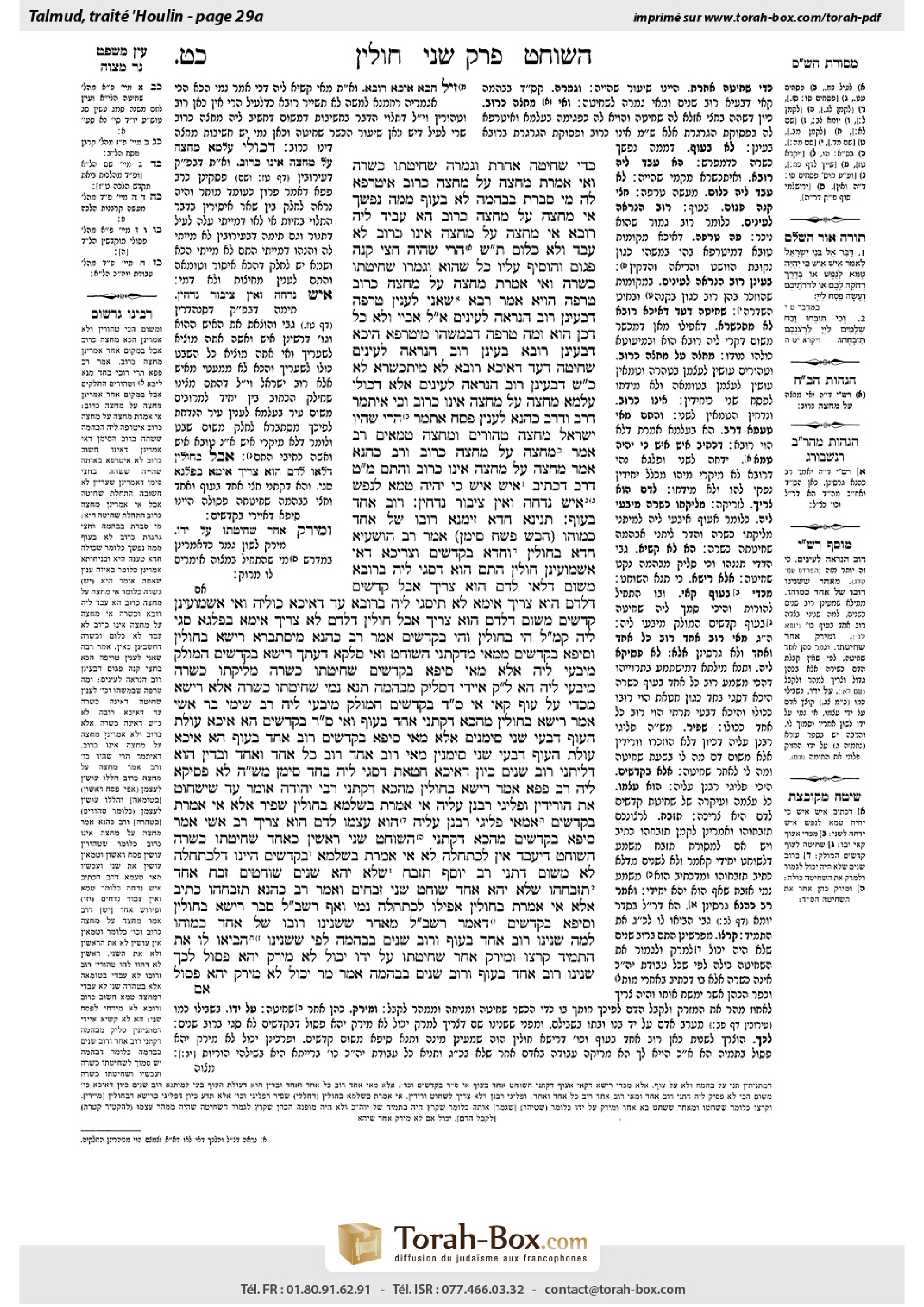
Chullin 29a: Talmud study for Daf Yomi
Study the Talmud for Daf Yomi with scanned pages, Hebrew text, English translations from Sefaria and AI-generated French translations.
Passage selection and English or AI-generated French translation are available where the scan has annotations. Daf Study is independent of Torah-Box and Sefaria.
Browse Chullin · חולין · All tractatesChullin 29a text and translations
This page of Chullin includes the Aramaic text, an English translation and an AI-generated French translation, alongside the scan above.
חולין כ״ט א · Aramaic and Hebrew text
כְּדֵי שְׁחִיטָה אַחֶרֶת וּגְמָרָהּ, שְׁחִיטָתוֹ כְּשֵׁרָה. וְאִי אָמְרַתְּ מֶחֱצָה עַל מֶחֱצָה כְּרוֹב, אִיטָּרְפָא לַהּ.
מִי סָבְרַתְּ בִּבְהֵמָה? לָא, בְּעוֹף! מִמָּה נַפְשָׁךְ: אִי מֶחֱצָה עַל מֶחֱצָה כְּרוֹב – הָא עָבֵיד לֵיהּ רוּבָּא, אִי מֶחֱצָה עַל מֶחֱצָה אֵינוֹ כְּרוֹב – לָא עֲבַד וְלֹא כְּלוּם.
תָּא שְׁמַע: הֲרֵי שֶׁהָיָה חֲצִי קָנֶה פָּגוּם, וְהוֹסִיף עָלָיו כׇּל שֶׁהוּא וּגְמָרוֹ – שְׁחִיטָתוֹ כְּשֵׁרָה, וְאִי אָמְרַתְּ מֶחֱצָה עַל מֶחֱצָה כְּרוֹב – טְרֵפָה הָוְיָא!
אָמַר רָבָא: שָׁאנֵי לְעִנְיַן טְרֵפָה, דְּבָעֵינַן רוֹב הַנִּרְאֶה לָעֵינַיִם.
אֲמַר לֵיהּ אַבָּיֵי: וְלָא כָּל דְּכֵן הוּא? וּמָה טְרֵפָה, דִּבְמַשֶּׁהוּ מִיטָּרְפָא, הֵיכָא דְּבָעֵינַן רוּבָּא – בָּעֵינַן רוֹב הַנִּרְאֶה לָעֵינַיִם; שְׁחִיטָה, דְּעַד דְּאִיכָּא רוּבָּא לָא מִיתַּכְשְׁרָא – לֹא כׇּל שֶׁכֵּן דְּבָעֵינַן רוֹב הַנִּרְאֶה לָעֵינַיִם?
אֶלָּא, דְּכוּלֵּי עָלְמָא מֶחֱצָה עַל מֶחֱצָה אֵינוֹ כְּרוֹב, וְכִי אִיתְּמַר דְּרַב וּדְרַב כָּהֲנָא – לְעִנְיַן פֶּסַח אִתְּמַר.
הֲרֵי שֶׁהָיוּ יִשְׂרָאֵל מֶחֱצָה טְהוֹרִים וּמֶחֱצָה טְמֵאִים – רַב אָמַר: מֶחֱצָה עַל מֶחֱצָה כְּרוֹב, וְרַב כָּהֲנָא אָמַר: מֶחֱצָה עַל מֶחֱצָה אֵינוֹ כְּרוֹב.
וְהָתָם מַאי טַעְמָא דְרַב, דִּכְתִיב ״אִישׁ אִישׁ כִּי יִהְיֶה טָמֵא לָנֶפֶשׁ״, אִישׁ נִדְחֶה, וְאֵין צִיבּוּר נִדְחִין.
רוֹב אֶחָד בָּעוֹף, תְּנֵינָא חֲדָא זִימְנָא: רוּבּוֹ שֶׁל אֶחָד כָּמוֹהוּ!
(הכ״ש פש״ח סִימָן).
אָמַר רַב הוֹשַׁעְיָא: חֲדָא בְּחוּלִּין וַחֲדָא בְּקָדָשִׁים, וּצְרִיכָא, דְּאִי אַשְׁמְעִינַן חוּלִּין – הָתָם הוּא דְּסַגִּי לֵיהּ בְּרוּבָּא, מִשּׁוּם דְּלָאו לְדָם הוּא צָרִיךְ, אֲבָל קָדָשִׁים דִּלְדָם הוּא צָרִיךְ – אֵימָא לָא תִּיסְגֵּי לֵיהּ בְּרוּבָּא עַד דְּאִיכָּא כּוּלֵּיהּ.
וְאִי אַשְׁמְעִינַן קָדָשִׁים, מִשּׁוּם דִּלְדָם הוּא צָרִיךְ, אֲבָל חוּלִּין דִּלְדָם לָא צְרִיךְ – אֵימָא בְּפַלְגָא סַגִּי לֵיהּ, קָא מַשְׁמַע לַן.
הֵי בְּחוּלִּין, וְהֵי בְּקָדָשִׁים?
אָמַר רַב כָּהֲנָא: מִיסְתַּבְּרָא רֵישָׁא בְּחוּלִּין וְסֵיפָא בְּקָדָשִׁים. מִמַּאי? מִדְּקָתָנֵי ״הַשּׁוֹחֵט״, וְאִי סָלְקָא דַעְתָּךְ רֵישָׁא בְּקָדָשִׁים, ״הַמּוֹלֵק״ מִיבְּעֵי לֵיהּ.
אֶלָּא מַאי, סֵיפָא בְּקָדָשִׁים? ״שְׁחִיטָתוֹ כְּשֵׁרָה״? ״מְלִיקָתוֹ כְּשֵׁרָה״ מִיבְּעֵי לֵיהּ! הָא לָא קַשְׁיָא, אַיְּידֵי דְּסָלֵיק מִבְּהֵמָה תְּנָא נָמֵי ״שְׁחִיטָתוֹ כְּשֵׁרָה״. אֶלָּא רֵישָׁא, מִכְּדֵי עַל עוֹף קָאֵי, אִי סָלְקָא דַעְתָּךְ בְּקָדָשִׁים – ״הַמּוֹלֵק״ מִיבְּעֵי לֵיהּ!
רַב שִׁימִי בַּר אָשֵׁי אָמַר: רֵישָׁא בְּחוּלִּין מֵהָכָא, דְּקָתָנֵי ״אֶחָד בְּעוֹף״, וְאִי סָלְקָא דַעְתָּךְ בְּקָדָשִׁים – הָא אִיכָּא עוֹלַת הָעוֹף דְּבָעֵי שְׁנֵי סִימָנִים!
אֶלָּא מַאי, סֵיפָא בְּקָדָשִׁים? רוֹב אֶחָד בְּעוֹף – הָא אִיכָּא עוֹלַת הָעוֹף דְּבָעֵי שְׁנֵי סִימָנִין! מַאי ״רוֹב אֶחָד״? רוֹב כׇּל אֶחָד וְאֶחָד. וּבְדִין הוּא דְּלִיתְנֵי רוֹב שְׁנַיִם, כֵּיוָן דְּאִיכָּא חַטָּאת דְּסַגִּי לֵיהּ בְּחַד סִימָן – מִשּׁוּם הָכִי לָא פְּסִיקָא לֵיהּ.
רַב פָּפָּא אָמַר: רֵישָׁא בְּחוּלִּין מֵהָכָא, דְּקָתָנֵי: רַבִּי יְהוּדָה אוֹמֵר: עַד שֶׁיִּשְׁחוֹט אֶת הַוְּרִידִין, וּפְלִיגִי רַבָּנַן עֲלֵיהּ. אִי אָמְרַתְּ בִּשְׁלָמָא בְּחוּלִּין – שַׁפִּיר, אֶלָּא אִי אָמְרַתְּ בְּקָדָשִׁים, אַמַּאי פְּלִיגִי רַבָּנַן עֲלֵיהּ? הוּא עַצְמוֹ לְדָם הוּא צָרִיךְ!
רַב אָשֵׁי אָמַר: סֵיפָא בְּקָדָשִׁים מֵהָכָא, דְּקָתָנֵי: הַשּׁוֹחֵט שְׁנֵי רָאשִׁין כְּאֶחָד – שְׁחִיטָתוֹ כְּשֵׁרָה. הַשּׁוֹחֵט – דִּיעֲבַד אִין, לְכַתְּחִלָּה לָא.
אִי אָמְרַתְּ בִּשְׁלָמָא בְּקָדָשִׁים – הַיְינוּ דִּלְכַתְּחִלָּה לָא, מִשּׁוּם דְּתָנֵי רַב יוֹסֵף: ״תִּזְבַּח״ – שֶׁלֹּא יְהֵא שְׁנַיִם שׁוֹחֲטִים זֶבַח אֶחָד, ״תִּזְבָּחֻהוּ״ – שֶׁלֹּא יְהֵא אֶחָד שׁוֹחֵט שְׁנֵי זְבָחִים.
וְאָמַר רַב כָּהֲנָא: ״תִּזְבָּחֵהוּ״ כְּתִיב, אֶלָּא אִי אָמְרַתְּ בְּחוּלִּין – אֲפִילּוּ לְכַתְּחִלָּה נָמֵי.
וְאַף רַבִּי שִׁמְעוֹן בֶּן לָקִישׁ סָבַר: רֵישָׁא בְּחוּלִּין, וְסֵיפָא בְּקָדָשִׁים, דְּאָמַר רַבִּי שִׁמְעוֹן בֶּן לָקִישׁ: מֵאַחַר שֶׁשָּׁנִינוּ ״רוּבּוֹ שֶׁל אֶחָד כָּמוֹהוּ״, לָמָּה שָׁנִינוּ ״רוֹב אֶחָד בְּעוֹף וְרוֹב שְׁנַיִם בִּבְהֵמָה״?
לְפִי שֶׁשָּׁנִינוּ: הֵבִיאוּ לוֹ אֶת הַתָּמִיד, קְרָצוֹ וּמֵירַק אַחֵר שְׁחִיטָתוֹ עַל יָדוֹ, יָכוֹל לֹא מֵירַק יְהֵא פָּסוּל? לְכָךְ שָׁנִינוּ: רוֹב אֶחָד בְּעוֹף וְרוֹב שְׁנַיִם בִּבְהֵמָה.
אָמַר מָר: יָכוֹל לֹא מֵירַק יְהֵא פָּסוּל?
Chullin 29a · English translation
for an interval equivalent to the duration of the slaughter of another animal, and then completed his slaughter, his slaughter is valid. But if you say the halakhic status of a siman of which precisely half was cut and half remained uncut is like that of the majority, then by cutting half the windpipe he rendered it a tereifa because it is as though the majority of the windpipe is severed.
The Gemara answers: Do you hold that this baraita is referring to the slaughter of an animal? No, it is referring to the slaughter of a bird, which requires the cutting of only one siman. Whichever way you look at it, the slaughter should be valid. If the halakhic status of a siman of which precisely half was cut and half remained uncut is like that of the majority, he has performed the cutting of the majority and the slaughter is valid. And if the halakhic status of a siman of which precisely half was cut and half remained uncut is not like that of the majority, then in cutting half the siman he did not perform any action that would render the animal a tereifa.
The Gemara suggests: Come and hear another proof contrary to Rav’s opinion from a baraita: In a case where half of the windpipe was deficient prior to the slaughter and the slaughterer added to that deficiency an incision of any size, and completed it, his slaughter is valid. And if you say that the halakhic status of a siman of which precisely half was cut and half remained uncut is like that of the majority, the animal is a tereifa, as half its windpipe was deficient before the slaughter.
Rava said: The matter of tereifa is different, as we require a majority that is clearly visible. If precisely half the windpipe is deficient it does not appear to be a majority. By contrast, with regard to slaughter, the status of half is like that of the majority.
Abaye said to Rava: And is it not derived through an a fortiori inference that all the more so, a conspicuous majority is required for slaughter? And just as with regard to tereifa, where the animal is rendered a tereifa by a deficiency of any size, e.g., by a minuscule perforation of the gullet, in cases where we require a majority, we require a majority that is clearly visible, with regard to slaughter, where until there is a majority of the simanim cut, the slaughter is not valid, all the more so is it not clear that we require a majority that is clearly visible?
Rather, the Gemara revises its understanding of the dispute between Rav and Rav Kahana. Everyone agrees that the halakhic status of a siman of which precisely half was cut and half remained uncut is not like that of a siman of which the majority was cut. And when the dispute of Rav and Rav Kahana was stated, it was stated with regard to the matter of the Paschal offering. If a majority of the Jewish people were ritually impure on the fourteenth of Nisan, the Paschal offering is sacrificed that day and eaten in a state of impurity. If only a minority of the Jewish people were impure, the ritually pure majority brings the Paschal offering on the fourteenth of Nisan, and the impure minority brings the Paschal offering on the second Pesaḥ one month later.
In a case where the Jewish people were equally divided on the fourteenth of Nisan, with half of them pure and half of them impure, Rav said: The halakha in the case where half the people were impure and half were pure is like that of a case where the majority was impure, and the entire people brings the Paschal offering in Nisan. And Rav Kahana said: The halakha in the case where half the people were impure and half were pure is not like that of a case where the majority was impure. Therefore, those who are pure bring the Paschal offering on the fourteenth of Nisan, and those who are impure bring the Paschal offering on the second Pesaḥ.
The Gemara asks: And there, with regard to the Paschal offering, what is the reason that Rav accords half the people the status of a majority? It is as it is written: “Any man who shall be impure by reason of a corpse…shall observe the Passover to the Lord. On the fourteenth day of the second month at evening they shall observe it” (Numbers 9:10–11), from which it is derived: A ritually impure person is deferred to observe the second Pesaḥ, but a ritually impure congregation is not deferred to observe the second Pesaḥ. The status of half the people is that of a congregation, not that of a collection of individuals.
§ The mishna teaches: If one cut the majority of one siman in a bird or the majority of two simanim in an animal, his slaughter is valid. The Gemara asks: We already learn this on another occasion, in the first clause of the mishna: The halakhic status of the majority of one siman is like that of the entire siman. Why is the redundancy necessary?
The Gemara provides a mnemonic for the names of the amora’im who participate in the discussion that ensues: Heh, Rav Hoshaya; kaf, Rabbi Kahana; shin, Rabbi Shimi; peh, Rav Pappa; shin, Rav Ashi; ḥet.
Rav Hoshaya said: One mention of the equivalence between majority and whole is referring to slaughter of non-sacred birds and animals and one is referring to slaughter of sacrificial birds and animals. And it is necessary for the tanna to teach both cases, as, if the tanna taught us only the case of slaughter of non-sacred birds and animals, one might think that it is there that one suffices with the majority of the siman, because he does not require the blood; he seeks merely to slaughter the animal. But in the case of sacrificial birds and animals, where he requires the blood for sprinkling on the altar, say that it will not suffice for him to cut the majority, and the slaughter is not valid until there is a cutting of the entire windpipe or gullet.
And if the tanna taught us only the case of slaughter of sacrificial birds and animals, one might think that one must cut a majority of the siman because he requires the blood for sprinkling on the altar; but with regard to the slaughter of non-sacred birds and animals, where he does not require the blood, say that cutting half the siman is sufficient, and there is no need to cut a majority. Therefore, the tanna teaches us the principle twice, once to teach that a majority suffices in the case of sacrificial animals, and once to teach that a majority is required in the case of non-sacred animals.
The Gemara asks which clause of the mishna is referring to cutting a majority of the simanim in non-sacred birds and animals, and which is referring to cutting a majority of the simanim in sacrificial birds and animals?
Rav Kahana said: It stands to reason that the first clause of the mishna is referring to the slaughter of non-sacred birds and animals and the latter clause is referring to the slaughter of sacrificial birds and animals. The Gemara asks: From where does Rav Kahana arrive at that conclusion? The Gemara answers: It is from the fact that the first clause of the mishna teaches: One who slaughters by cutting one siman in a bird and two simanim in an animal. And if it enters your mind that the first clause is referring to the case of sacrificial birds and animals, the tanna should have formulated it as: One who pinches the nape of the neck of a bird, as sacrificial birds are not slaughtered with a knife, but pinched with a fingernail.
The Gemara asks: Rather, what do you say? That the latter clause is referring to slaughter of sacrificial birds and animals? But the tanna teaches in the latter clause: If one cut the majority of one siman in a bird or the majority of two simanim in an animal, his slaughter is valid. If the reference is to sacrificial birds and animals, the tanna should have formulated it: His pinching is valid. The Gemara answers: That is not difficult; since the tanna concluded with mention of the slaughter of an animal, he also taught: His slaughter is valid, which is referring to the sacrificial animal. But in the first clause, since the tanna stands to begin with the case of a bird, if it enters your mind that the reference is to sacrificial birds, the tanna should have formulated it: One who pinches the nape of the neck of the bird.
Rav Shimi bar Ashi said that one arrives at the conclusion that the first clause is referring to slaughter of non-sacred birds and animals from here: As the tanna teaches: One who slaughters by cutting one siman in a bird. And if it enters your mind that the reference is to the slaughter of sacrificial birds, isn’t there the bird burnt offering, which requires that two simanim be cut?
The Gemara asks: Rather, what do you say? That the latter clause is referring to slaughter of sacrificial birds and animals? But the tanna teaches in the latter clause: If one cut the majority of one siman in a bird or the majority of two simanim in an animal, his slaughter is valid. If the reference is to sacrificial birds, isn’t there the bird burnt offering, which requires the pinching of two simanim? The Gemara answers: What is the meaning of: The majority of one siman? It means the majority of each and every one of the two. And by right the tanna should have taught: The majority of two. But since there is the bird sin offering, which suffices with the cutting of one siman, due to that reason the matter is not clear-cut for him. Therefore, the tanna formulated the halakha in a manner that could apply to one siman, i.e., in the case of a sin offering, and to two simanim, i.e., in the case of a burnt offering and of animal offerings.
Rav Pappa said that one arrives at the conclusion that the first clause is referring to slaughter of non-sacred birds and animals from here: As the tanna teaches that Rabbi Yehuda says: The slaughter is not valid until he cuts the veins in the neck. And the Rabbis disagree with him, and do not require that one cut the veins in the neck. Granted, if you say that the reference is to the slaughter of non-sacred birds, it works out well. But if you say that the reference is to the slaughter of sacrificial birds, why do the Rabbis disagree with him? He himself, i.e., the one slaughtering, requires the blood in order to sprinkle it on the altar, which would warrant cutting the veins.
Rav Ashi said that one arrives at the conclusion that the latter clause is referring to slaughter of sacrificial birds and animals from here: As the tanna teaches in the mishna (30b): One who slaughters by cutting two animals’ heads simultaneously, his slaughter is valid. The Gemara infers from the precise language of the mishna: One who slaughters, indicating that after the fact, yes, his slaughter is valid; but one may not slaughter two animals simultaneously ab initio.
Granted, if you say that the reference is to sacrificial birds or animals, this is the reason that one may not slaughter two animals simultaneously ab initio: It is due to that which Rav Yosef teaches in a baraita: “And when you sacrifice a peace offering to the Lord, you shall sacrifice it [tizbaḥuhu] that you may be accepted” (Leviticus 19:5). The term “tizbaḥuhu” can be divided into two terms: You shall sacrifice [tizbaḥ] and it [hu]. From the term “You shall sacrifice [tizbaḥ],” it is derived that there will not be two people slaughtering one offering. From the full term “You shall sacrifice it [tizbaḥuhu]” it is derived that one person may not slaughter two offerings simultaneously.
And Rav Kahana said, to explain the derivation of the first halakha in the baraita: Although the term “tizbaḥuhu” is vocalized in the plural, leading to the conclusion that two people may slaughter an animal together, nevertheless, because the word is written without a vav, the term tizbaḥehu is written, in the singular, indicating that two individuals may not slaughter the offering. But if you say that the reference is to the slaughter of non-sacred birds, it should be permitted even ab initio.
And Rabbi Shimon ben Lakish, too, holds that the first clause of the mishna is referring to the slaughter of non-sacred birds and animals and the latter clause is referring to the slaughter of sacrificial birds and animals, as Rabbi Shimon ben Lakish says: Since we learned in the mishna that the halakhic status of the majority of one siman is like that of the entire siman, why did we also need to learn later in the mishna: The majority of one siman in a bird or the majority of two simanim in an animal? The latter clause is obvious based on the principle articulated in the first clause.
Rabbi Shimon ben Lakish explains: Since we learned in a mishna (Yoma 31b): They brought him the sheep for the daily morning offering, and he slaughtered it [keratzo] by cutting most of the way through the gullet and the windpipe, and a different priest completed the slaughter on his behalf so that the High Priest could receive the blood in a vessel and proceed with the order of the Yom Kippur service, one might have thought that if the other priest did not complete the cutting of the two simanim, the slaughter would not be valid. Therefore, we learned in the mishna: If one cut the majority of one siman in a bird or the majority of two simanim in an animal, his slaughter is valid.
The Gemara analyzes the statement of Rabbi Shimon ben Lakish. The Master said: One might have thought that if the other priest did not complete the cutting of the two simanim, the slaughter would not be valid.
Chullin 29a · Traduction française (IA)
pour un intervalle équivalent à la durée de la mise à mort d'un autre animal, et ensuite acheva la mise à mort, sa mise à mort est valide. Mais si vous dites que le statut halakhique d'un siman dont la moitié a été coupée et la moitié restait intacte est comme celui de la majorité, alors en coupant la moitié du trachée, il a rendu l'animal tereifa, car cela équivaut à ce que la majorité du trachée soit séparée.
La Guemara répond : Est-ce que vous pensez que ce baraïta fait référence à la mise à mort d'un animal ? Non, il fait référence à la mise à mort d'un oiseau, qui exige la coupure d'un seul siman. Quel que soit le point de vue, la mise à mort devrait être valide. Si le statut halakhique d'un siman dont la moitié a été coupée et la moitié restait intacte est comme celui de la majorité, il a accompli la coupure de la majorité et la mise à mort est valide. Et si le statut halakhique d'un siman dont la moitié a été coupée et la moitié restait intacte n'est pas comme celui de la majorité, alors en coupant la moitié du siman, il n'a pas accompli d'action qui rendrait l'animal tereifa.
La Guemara suggère : Venez écouter une autre preuve contraire à l'opinion de Rav, tirée d'un baraïta : Dans un cas où la moitié du trachée était déficiente avant la mise à mort et le meurtrier ajoutait à cette déficience une incision de toute taille, et achevait la mise à mort, sa mise à mort est valide. Et si vous dites que le statut halakhique d'un siman dont la moitié a été coupée et la moitié restait intacte est comme celui de la majorité, l'animal est tereifa, car la moitié de son trachée était déficiente avant la mise à mort.
Rava dit : La question de la tereifa est différente, car nous exigeons une majorité qui est clairement visible. Si la moitié exacte du trachée est déficiente, cela ne semble pas être une majorité. En revanche, concernant la mise à mort, le statut de la moitié est comme celui de la majorité.
Abaye dit à Rava : Et n'est-ce pas déduit par une inférence a fortiori que, d'autant plus, une majorité évidente est requise pour la mise à mort ? Et tout comme, concernant la tereifa, où l'animal est rendu tereifa par une déficience de toute taille, par exemple par une perforation minuscule de l'œsophage, dans les cas où nous exigeons une majorité, nous exigeons une majorité clairement visible, concernant la mise à mort, où jusqu'à ce qu'il y ait une majorité des simanim coupés, la mise à mort n'est pas valide, d'autant plus est-il clair que nous exigeons une majorité clairement visible ?
Plutôt, la Guemara révise sa compréhension du débat entre Rav et Rav Kahana. Tout le monde convient que le statut halakhique d'un siman dont la moitié a été coupée et la moitié restait intacte n'est pas comme celui d'un siman dont la majorité a été coupée. Et lors que le débat de Rav et de Rav Kahana a été évoqué, il a été évoqué concernant la question de l'offrande pascal. Si la majorité du peuple juif était impure le quatorzième de Nisan, l'offrande pascal est sacrifiée ce jour-là et consommée dans un état d'impureté. Si seulement une minorité du peuple juif était impure, la majorité pure sacrifie l'offrande pascal le quatorzième de Nisan, et la minorité impure sacrifie l'offrande pascal le deuxième Pessa'h un mois plus tard.
Dans un cas où le peuple juif était également divisé le quatorzième de Nisan, avec la moitié d'entre eux pure et la moitié impure, Rav dit : La halakha dans le cas où la moitié du peuple était impure et la moitié pure est comme celle d'un cas où la majorité était impure, et l'ensemble du peuple sacrifie l'offrande pascal en Nisan. Et Rav Kahana dit : La halakha dans le cas où la moitié du peuple était impure et la moitié pure n'est pas comme celle d'un cas où la majorité était impure. Par conséquent, ceux qui sont purs sacrifient l'offrande pascal le quatorzième de Nisan, et ceux qui sont impurs sacrifient l'offrande pascal le deuxième Pessa'h.
La Guemara pose une question : Et là, concernant l'offrande pascal, quelle est la raison pour laquelle Rav accorde à la moitié du peuple le statut de la majorité ? C'est comme il est écrit : « Tout homme qui sera impur à cause d'un cadavre… observera le Pessah devant l'Éternel. Le quatorzième jour du deuxième mois à la nuit, ils observeront cela » (Nombres 9:10–11), d'où on déduit : Une personne impure rituellement est reportée pour observer le deuxième Pessah, mais une congrégation impure rituellement n'est pas reportée pour observer le deuxième Pessah. Le statut de la moitié du peuple est celui d'une congrégation, pas celui d'une collection d'individus.
§ La mishna enseigne : Si l'on a coupé la majorité d'un seul siman dans un oiseau ou la majorité de deux simanim dans un animal, sa mise à mort est valide. La Guemara pose une question : Nous avons déjà appris cela à une autre occasion, dans la première clause de la mishna : Le statut halakhique de la majorité d'un seul siman est comme celui de l'ensemble du siman. Pourquoi cette redondance est-elle nécessaire ?
La Guemara fournit un mnémonique pour les noms des amoraïm qui participent à la discussion qui suit : Heh, Rav Hoshaya ; kaf, Rabbi Kahana ; shin, Rabbi Shimi ; peh, Rav Pappa ; shin, Rav Ashi ; kheth.
Rav Hoshaya dit : Une mention de l'équivalence entre la majorité et l'ensemble fait référence à la mise à mort des oiseaux et des animaux non sacrés et une autre fait référence à la mise à mort des oiseaux et des animaux sacrés. Et il est nécessaire que le tanna enseigne les deux cas, car, si le tanna nous avait appris seulement le cas de la mise à mort des oiseaux et des animaux non sacrés, on pourrait penser que c'est là que suffit la majorité du siman, car il ne nécessite pas le sang ; il cherche simplement à sacrifier l'animal. Mais dans le cas des oiseaux et des animaux sacrés, où il exige le sang pour l'aspersion sur l'autel, disons que cela ne suffit pas à lui, et la mise à mort n'est pas valide jusqu'à ce qu'il y ait la coupure entière du trachée ou de l'œsophage.
Et si le tanna nous a appris seulement le cas de la bête sacrée et de l'oiseau sacré, on pourrait penser qu'on doit couper la majorité des simanim, car il a besoin du sang pour le verser sur l'autel ; mais concernant la bête non sacrée et l'oiseau non sacré, où il n'a pas besoin du sang, on dit que couper la moitié des simanim suffit, et qu'il n'est pas nécessaire de couper la majorité. Ainsi, le tanna nous enseigne le principe deux fois, une fois pour enseigner que la majorité suffit dans le cas des bêtes sacrées, et une fois pour enseigner que la majorité est requise dans le cas des bêtes non sacrées.
Le Guemara demande quelle clause de la mishna fait référence à la coupe de la majorité des simanim dans les oiseaux et bêtes non sacrés, et quelle clause fait référence à la coupe de la majorité des simanim dans les oiseaux et bêtes sacrés ?
Rav Kahana a dit : Il est logique que la première clause de la mishna fasse référence à la bête non sacrée et à l'oiseau non sacré, et la seconde clause à la bête sacrée et à l'oiseau sacré. Le Guemara demande : D'où Rav Kahana tire-t-il cette conclusion ? Le Guemara répond : C'est à partir du fait que la première clause de la mishna enseigne : Celui qui tue en coupant un siman dans un oiseau et deux simanim dans une bête. Et si vous pensez que la première clause fait référence au cas des oiseaux et bêtes sacrés, le tanna aurait dû formuler cela ainsi : Celui qui écrase le cou d'un oiseau, car les oiseaux sacrés ne sont pas tués avec un couteau, mais écrasés avec un ongle.
Le Guemara demande : Plutôt, que dites-vous ? Que la seconde clause fait référence à la bête sacrée et à l'oiseau sacré ? Mais le tanna enseigne dans la seconde clause : Si l'on coupe la majorité d'un siman dans un oiseau ou la majorité de deux simanim dans une bête, sa tue est valide. Si la référence est aux oiseaux et bêtes sacrés, le tanna aurait dû formuler cela ainsi : Son écrasement est valide. Le Guemara répond : Ce n'est pas difficile ; puisque le tanna conclut en mentionnant la tue d'une bête, il a aussi enseigné : Sa tue est valide, ce qui fait référence à la bête sacrée. Mais dans la première clause, puisque le tanna commence par le cas d'un oiseau, si vous pensez que la référence est aux oiseaux sacrés, le tanna aurait dû formuler cela ainsi : Celui qui écrase le cou de l'oiseau.
Rav Shimi bar Ashi a dit que l'on arrive à la conclusion que la première clause fait référence à la tue des oiseaux et bêtes non sacrés à partir de cela : Comme le tanna enseigne : Celui qui tue en coupant un siman dans un oiseau. Et si vous pensez que la référence est à la tue des oiseaux sacrés, n'y a-t-il pas l'oiseau holocauste, qui exige que deux simanim soient coupés ?
Le Guemara demande : Plutôt, que dites-vous ? Que la seconde clause fait référence à la tue des oiseaux et bêtes sacrés ? Mais le tanna enseigne dans la seconde clause : Si l'on coupe la majorité d'un siman dans un oiseau ou la majorité de deux simanim dans une bête, sa tue est valide. Si la référence est aux oiseaux sacrés, n'y a-t-il pas l'oiseau holocauste, qui exige l'écrasement de deux simanim ? Le Guemara répond : Quelle est la signification de : La majorité d'un siman ? Cela signifie la majorité de chaque et de chaque des deux. Et par droit, le tanna aurait dû enseigner : La majorité de deux. Mais puisque l'oiseau expiatoire suffit avec la coupe d'un siman, pour cette raison la chose n'est pas claire pour lui. Ainsi, le tanna a formulé la halakha de manière à s'appliquer à un siman, c'est-à-dire dans le cas de l'oiseau expiatoire, et à deux simanim, c'est-à-dire dans le cas de l'oiseau holocauste et de l'animal sacré.
Rav Pappa a dit que l'on arrive à la conclusion que la première clause fait référence à la tue des oiseaux et bêtes non sacrés à partir de cela : Comme le tanna enseigne que Rabbi Yehuda dit : La tue n'est pas valide jusqu'à ce qu'il coupe les veines du cou. Et les Rabbins s'opposent à lui, et n'exigent pas que l'on coupe les veines du cou. Admettons, si vous dites que la référence est à la tue des oiseaux non sacrés, cela s'aligne bien. Mais si vous dites que la référence est à la tue des oiseaux sacrés, pourquoi les Rabbins s'opposent-ils à lui ? Lui-même, c'est-à-dire celui qui tue, exige le sang pour le verser sur l'autel, ce qui justifierait la coupe des veines.
Rav Ashi a dit que l'on arrive à la conclusion que la seconde clause fait référence à la tue des oiseaux et bêtes sacrés à partir de cela : Comme le tanna enseigne dans la mishna (30b) : Celui qui tue en coupant simultanément les têtes de deux animaux, sa tue est valide. Le Guemara déduit de la formulation précise de la mishna : Celui qui tue, indiquant que après l'événement, oui, sa tue est valide ; mais on ne peut pas tuer deux animaux simultanément à l'origine.
Admettons, si vous dites que la référence est aux oiseaux ou bêtes sacrés, c'est la raison pour laquelle on ne peut pas tuer deux animaux simultanément à l'origine : C'est en raison de ce que Rav Yosef enseigne dans une baraïta : « Et quand tu sacrifies un holocauste à l'Éternel, tu le sacrifies [tizbaḥuhu] afin qu'il soit accepté » (Lévitique 19:5). Le terme « tizbaḥuhu » peut être divisé en deux termes : Tu sacrifies [tizbaḥ] et il [hu]. À partir du terme « Tu sacrifies [tizbaḥ] », on déduit que deux personnes ne peuvent pas sacrifier un même holocauste. À partir du terme complet « Tu sacrifies il [tizbaḥuhu] », on déduit qu'une seule personne ne peut pas sacrifier deux holocaustes simultanément.
Et Rav Kahana a dit, pour expliquer la dérivation de la première halakha dans la baraïta : Bien que le terme « tizbaḥuhu » soit vocalisé au pluriel, ce qui conduit à la conclusion que deux personnes peuvent sacrifier un animal ensemble, néanmoins, puisque le mot est écrit sans un vav, le terme « tizbaḥehu » est écrit au singulier, indiquant que deux individus ne peuvent pas sacrifier l'offrande. Mais si vous dites que la référence est à la tue des oiseaux non sacrés, cela devrait être permis même à l'origine.
Et Rabbi Shim'on ben Lakish également affirme que la première clause de la mitsna se réfère à la mise à mort des oiseaux et des animaux non sacrés, tandis que la seconde clause se réfère à la mise à mort des oiseaux et des animaux sacrés. Comme le dit Rabbi Shim'on ben Lakish : Puisque nous avons appris dans la mitsna que le statut halakhique de la majorité d'un siman est comme celui de l'ensemble du siman, pourquoi avons-nous également besoin d'apprendre plus tard dans la mitsna : la majorité d'un siman dans un oiseau ou la majorité de deux simanim dans un animal ? La seconde clause est évidente à partir du principe énoncé dans la première clause.
Rabbi Shim'on ben Lakish explique : Puisque nous avons appris dans une mitsna (Yoma 31b) : On apporta à lui le mouton pour l'offrande matinale, et il le tua [keratzo] en coupant la plupart du chemin à travers le gosier et la trachée, et un autre prêtre acheva la mise à mort à sa place afin que le grand prêtre puisse recevoir le sang dans un récipient et poursuivre l'ordre du service du Yom Kippour, on aurait pu penser que si le prêtre autre n'avait pas achevé le coup de ciseaux sur les deux simanim, la mise à mort ne serait pas valide. Ainsi, nous avons appris dans la mitsna : Si l'on coupe la majorité d'un siman dans un oiseau ou la majorité de deux simanim dans un animal, sa mise à mort est valide.
L'analyse du Guemara sur l'affirmation de Rabbi Shim'on ben Lakish. Le Maître dit : On aurait pu penser que si le prêtre autre n'avait pas achevé le coup de ciseaux sur les deux simanim, la mise à mort ne serait pas valide.
Traduction française générée par IA à partir de l’édition anglaise de Sefaria. Vérifie toujours un passage avec le texte source.
Text from Sefaria: William Davidson Edition - Vocalized Aramaic (unknown); William Davidson Edition - English (CC BY NC).