Chullin 29b: Talmud study for Daf Yomi
Study the Talmud for Daf Yomi with scanned pages, Hebrew text, English translations from Sefaria and AI-generated French translations.
Passage selection and English or AI-generated French translation are available where the scan has annotations. Daf Study is independent of Torah-Box and Sefaria.
Browse Chullin · חולין · All tractatesChullin 29b text and translations
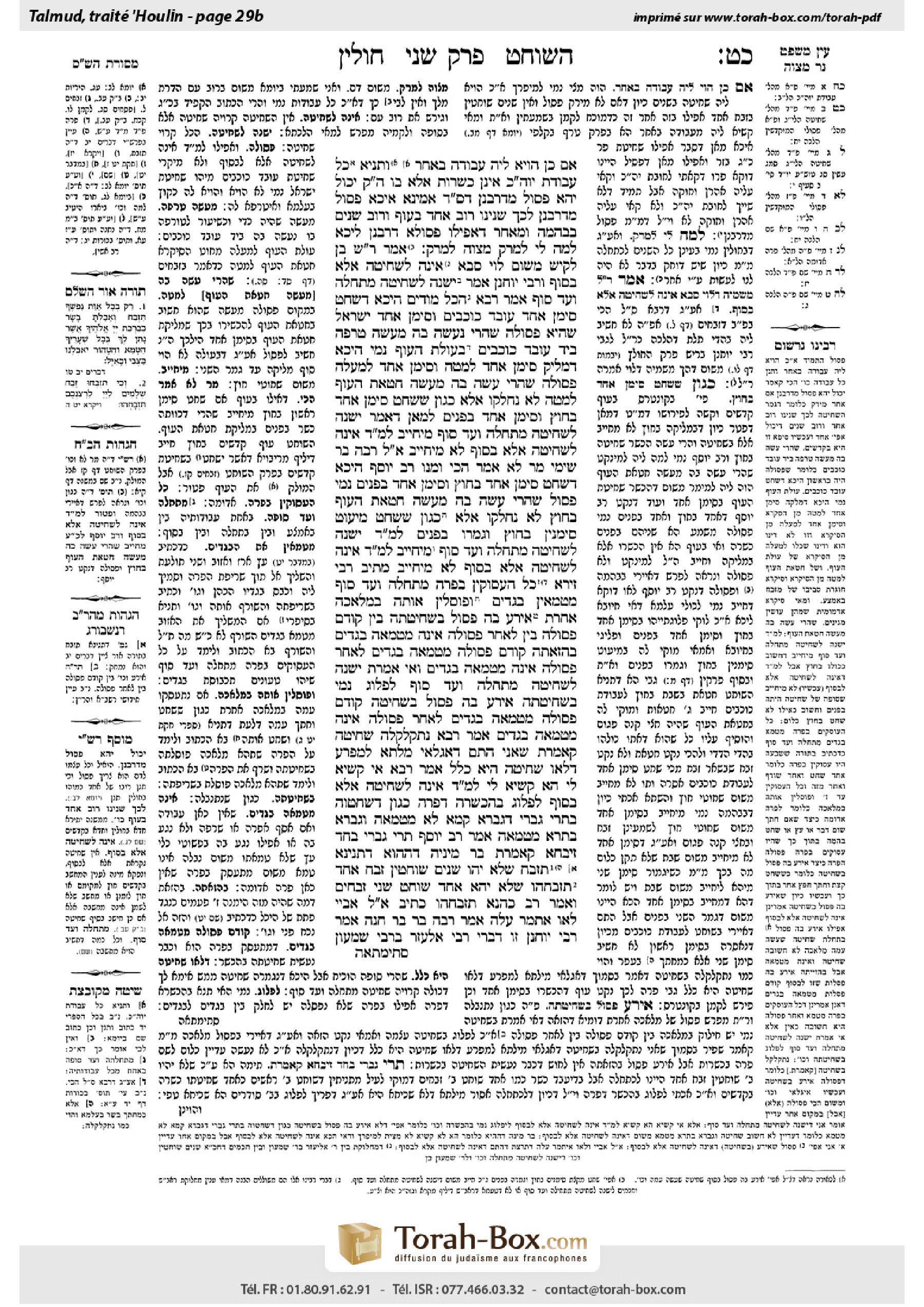
This page of Chullin includes the Aramaic text, an English translation and an AI-generated French translation, alongside the scan above.
חולין כ״ט ב · Aramaic and Hebrew text
אִם כֵּן הָוְיָא לֵיהּ עֲבוֹדָה בְּאַחֵר, וְתַנְיָא: כׇּל עֲבוֹדַת יוֹם הַכִּפּוּרִים אֵינָן כְּשֵׁרוֹת אֶלָּא בּוֹ.
הָכִי קָאָמַר: יָכוֹל יְהֵא פָּסוּל מִדְּרַבָּנַן, דְּסָלְקָא דַּעְתָּךְ אָמֵינָא אִיכָּא פָּסוּל מִדְּרַבָּנַן, לְכָךְ שָׁנִינוּ: ״רוֹב אֶחָד בְּעוֹף וְרוֹב שְׁנַיִם בַּבְּהֵמָה״, וּמֵאַחַר דַּאֲפִילּוּ פְּסוּלָא דְּרַבָּנַן לֵיכָּא, לְמָה לִי לְמָרֵק? מִצְוָה לְמָרֵק.
אָמַר רַבִּי שִׁמְעוֹן בֶּן לָקִישׁ מִשּׁוּם לֵוִי סָבָא: אֵינָהּ לִשְׁחִיטָה אֶלָּא בַּסּוֹף, וְרַבִּי יוֹחָנָן אָמַר: יֶשְׁנָהּ לִשְׁחִיטָה מִתְּחִלָּה וְעַד סוֹף.
אָמַר רָבָא: הַכֹּל מוֹדִים, הֵיכָא דְּשָׁחַט סִימָן אֶחָד גּוֹי, וְסִימָן אֶחָד יִשְׂרָאֵל – שֶׁהִיא פְּסוּלָה, שֶׁהֲרֵי נַעֲשֶׂה בָּהּ מַעֲשֵׂה טְרֵפָה בְּיַד גּוֹי.
בְּעוֹלַת הָעוֹף נָמֵי, הֵיכָא דְּמָלַק סִימָן אֶחָד לְמַטָּה וְסִימָן אֶחָד לְמַעְלָה – פְּסוּלָה, שֶׁהֲרֵי עָשָׂה בָּהּ מַעֲשֵׂה חַטַּאת הָעוֹף לְמַטָּה.
לֹא נֶחְלְקוּ אֶלָּא כְּגוֹן שֶׁשָּׁחַט סִימָן אֶחָד בַּחוּץ וְסִימָן אֶחָד בִּפְנִים, לְמַאן דְּאָמַר יֶשְׁנָהּ לִשְׁחִיטָה מִתְּחִלָּה וְעַד סוֹף – מִיחַיַּיב, לְמַאן דְּאָמַר אֵינָהּ לִשְׁחִיטָה אֶלָּא בַּסּוֹף – לָא מִיחַיַּיב.
אֲמַר לֵיהּ רַבָּה בַּר שִׁימִי: מָר לָא אָמַר הָכִי, וּמַנּוּ? רַב יוֹסֵף, הֵיכָא דְּשָׁחַט סִימָן אֶחָד בַּחוּץ וְסִימָן אֶחָד בִּפְנִים – נָמֵי פָּסוּל, שֶׁהֲרֵי עָשָׂה בָּהּ מַעֲשֵׂה חַטַּאת הָעוֹף בַּחוּץ.
לֹא נֶחְלְקוּ אֶלָּא כְּגוֹן שֶׁשָּׁחַט מִיעוּט סִימָנִין בַּחוּץ וּגְמָרוֹ בִּפְנִים, לְמַאן דְּאָמַר יֶשְׁנָהּ לִשְׁחִיטָה מִתְּחִלָּה וְעַד סוֹף – מִיחַיַּיב, לְמַאן דְּאָמַר אֵינָהּ לִשְׁחִיטָה אֶלָּא בַּסּוֹף – לָא מִיחַיַּיב.
מֵתִיב רַבִּי זֵירָא: כׇּל הָעֲסוּקִין בַּפָּרָה מִתְּחִלָּה וְעַד סוֹף – מְטַמְּאִין בְּגָדִים, וּפוֹסְלִין אוֹתָהּ בִּמְלָאכָה אַחֶרֶת.
אֵירַע בָּהּ פְּסוּל בִּשְׁחִיטָתָהּ, בֵּין קוֹדֶם פְּסוּלָהּ בֵּין לְאַחַר פְּסוּלָהּ – אֵינָהּ מְטַמְּאָה בְּגָדִים; בְּהַזָּאָתָהּ: קוֹדֶם פְּסוּלָהּ – מְטַמְּאָה בְּגָדִים, לְאַחַר פְּסוּלָהּ – אֵינָהּ מְטַמְּאָה בְּגָדִים.
וְאִי אָמְרַתְּ יֶשְׁנָהּ לִשְׁחִיטָה מִתְּחִלָּה וְעַד סוֹף, לִפְלוֹג נָמֵי בִּשְׁחִיטָתָהּ: אֵירַע בָּהּ פְּסוּל בִּשְׁחִיטָה – קוֹדֶם פְּסוּלָהּ מְטַמְּאָה בְּגָדִים, לְאַחַר פְּסוּלָהּ – אֵינָהּ מְטַמְּאָה בְּגָדִים!
אָמַר רָבָא: נִתְקַלְקְלָה שְׁחִיטָה קָאָמְרַתְּ? שָׁאנֵי הָתָם, דְּאִגַּלַּאי מִלְּתָא לְמַפְרֵעַ דְּלָאו שְׁחִיטָה הִיא כְּלָל.
אָמַר רָבָא: אִי קַשְׁיָא לִי הָא קַשְׁיָא לִי, לְמַאן דְּאָמַר אֵינָהּ לִשְׁחִיטָה אֶלָּא בַּסּוֹף, לִפְלוֹג בְּהֶכְשֵׁרַהּ דְּפָרָה, כְּגוֹן דְּשַׁחְטוּהָ בִּתְרֵי גַּבְרֵי, דְּגַבְרָא קַמָּא לָא מְטַמְּאָה, וְגַבְרָא בָּתְרָא מְטַמְּאָה!
אָמַר רַב יוֹסֵף: תְּרֵי גַּבְרֵי בְּחַד זִיבְחָא קָאָמְרַתְּ? בַּר מִינֵּיהּ דְּהָהוּא דִּתְנֵינָא: ״תִּזְבַּח״ – שֶׁלֹּא יְהוּ שְׁנַיִם שׁוֹחֲטִין זֶבַח אֶחָד, ״תִּזְבָּחֻהוּ״ – שֶׁלֹּא יְהֵא אֶחָד שׁוֹחֵט שְׁנֵי זְבָחִים.
וְאָמַר רַב כָּהֲנָא: ״תִּזְבָּחֵהוּ״ כְּתִיב.
אֲמַר לֵיהּ אַבָּיֵי: לָאו אִתְּמַר עֲלַהּ, אָמַר רַבָּה בַּר בַּר חָנָה אָמַר רַבִּי יוֹחָנָן: זוֹ דִּבְרֵי רַבִּי אֶלְעָזָר בְּרַבִּי שִׁמְעוֹן
Chullin 29b · English translation
How could that possibility enter one’s mind? If that is so, the completion of that slaughter is a Temple service performed by another on Yom Kippur. And it is taught in a baraita: The entire Yom Kippur Temple service is valid only if performed by the High Priest.
The Gemara answers that this is what Rabbi Shimon ben Lakish is saying: One might have thought that if the slaughter was not completed by the other priest it would be not valid by rabbinic law, as it might enter your mind to say that there is an invalidation by rabbinic law. Therefore, we learned in the mishna: The majority of one siman in a bird or the majority of two simanim in an animal. The Gemara asks: And since there is not even an invalidation by rabbinic law, why do I need the other priest to complete the cutting of the simanim? The Gemara answers: There is a mitzva to complete the slaughter ab initio to facilitate the free flow of the blood.
§ Rabbi Shimon ben Lakish says in the name of Levi the Elder: Halakhic slaughter is accomplished only at its conclusion. And Rabbi Yoḥanan says: Halakhic slaughter is accomplished from the beginning to the end of the act.
Rava said in establishing the parameters of the dispute between Rabbi Shimon ben Lakish and Rabbi Yoḥanan: Everyone concedes in a case where a gentile slaughtered, i.e., cut, one siman and a Jew slaughtered one siman, that the slaughter is not valid even if slaughter is accomplished only at its conclusion, as an action rendering the animal a tereifa was performed at the hand of a gentile. Since slaughter by a gentile is not valid, the gentile renders the animal a tereifa.
In the case of a bird burnt offering as well, where one siman was pinched by a priest below the red line marking half the height of the altar, in accordance with the procedure of the sin offering, and one siman was pinched above the red line, in accordance with the procedure of the burnt offering, the pinching is not valid, as the priest performed an action appropriate for a bird sin offering below the red line, disqualifying it from being sacrificed as a burnt offering.
Rabbi Shimon ben Lakish and Rabbi Yoḥanan disagree only in a case where an individual cut one siman outside the Temple courtyard and one siman inside the Temple courtyard. According to the one who says: Halakhic slaughter is accomplished from the beginning to the end of the act, i.e., Rabbi Yoḥanan, one who begins the slaughter outside the Temple courtyard is liable for slaughter of a sacrificial animal outside the courtyard. According to the one who says: Halakhic slaughter is accomplished only at its conclusion, i.e., Rabbi Shimon ben Lakish, one who does so is not liable, as the conclusion of the slaughter, which is the determining factor, is performed inside the Temple courtyard.
Rabba bar Shimi said to Rava: The Master did not say that this was the crux of the dispute between Rabbi Yoḥanan and Rabbi Shimon ben Lakish. And who is the Master? It is Rav Yosef, who says that in a case where one cut one siman outside the Temple courtyard and one siman inside the Temple courtyard, all agree that the slaughter is not valid and the priest is liable to receive punishment, because he performed an action appropriate for a bird sin offering outside the Temple courtyard.
They disagree only in a case where one slaughtered the minority of each of the simanim outside the Temple courtyard and completed the slaughter inside the Temple courtyard. According to the one who says: Halakhic slaughter is accomplished from the beginning to the end of the act, i.e., Rabbi Yoḥanan, one who begins the slaughter outside the Temple courtyard is liable for slaughter of a sacrificial animal outside the courtyard. According to the one who says: Halakhic slaughter is accomplished only at its conclusion, i.e., Rabbi Shimon ben Lakish, one who does so is not liable, as he concludes the slaughter in an appropriate place.
Rabbi Zeira raises an objection from a mishna (Para 4:4): Anyone who is engaged in any part of the rite of the red heifer continuously from beginning to end transmits ritual impurity to the garments that he is wearing. And they disqualify the red heifer for use in the rite if they perform any other labor while engaged in any part of the rite of the red heifer.
If a disqualification befell the heifer during its slaughter, with regard to all those engaged in the rite of the red heifer, whether they engaged in the rite before the heifer was disqualified or after the heifer was disqualified, the heifer does not render garments that they are wearing impure. Since its slaughter was not valid it is disqualified from being used as a red heifer and therefore does not impart impurity. If it became disqualified at the time of sprinkling the blood of the heifer toward the opening of the Temple, with regard to those who engaged in the rite of the red heifer before it was disqualified, the heifer renders the garments that they are wearing impure. By contrast, with regard to those who handled the animal after it was disqualified, the heifer does not render the garments that they are wearing impure.
Rabbi Zeira elaborates: And if you say that halakhic slaughter is accomplished from the beginning to the end of the act, let the mishna also distinguish between disqualification at the beginning and at the end of the slaughter: If it became disqualified during slaughter, with regard to one who engaged in any part of the rite before it became disqualified, the heifer renders garments that he is wearing impure, and with regard to one who engaged in any part of the rite after it became disqualified, the heifer does not render the garments that he is wearing impure.
Rava said: Are you saying that the discussion concerns a case where the slaughter was invalidated? There it is different, because the matter was revealed retroactively, i.e., it was revealed that it was not a valid slaughter at all. Since at no stage of the slaughter was it valid, the heifer does not render the garments impure at all.
Rava said: If any aspect of that mishna is difficult for me it is this that is difficult for me: According to the one who says: Halakhic slaughter is accomplished only at its conclusion, let the mishna distinguish between two individuals in the preparation of a fit red heifer, even when the heifer was not disqualified. Let the mishna teach a case where they slaughtered it with two men, as the heifer does not render the first man who slaughters impure, as the slaughter did not yet begin, and the heifer renders the latter man impure.
Rav Yosef said: Are you saying that the discussion concerns a case of two men slaughtering one offering? Raise difficulties except for that, as we learn in a baraita with regard to the verse: “And when you sacrifice a peace offering to the Lord, you shall sacrifice it [tizbaḥuhu] that you may be accepted” (Leviticus 19:5), that the term “tizbaḥuhu” can be divided into two terms: You shall sacrifice [tizbaḥ] and it [hu]. From the term “You shall sacrifice [tizbaḥ],” it is derived that there will not be two people slaughtering one offering. From the full term “You shall offer it [tizbaḥuhu],” it is derived that one person may not slaughter two offerings simultaneously.
And Rav Kahana said, to explain the derivation of the first halakha in the baraita: Although the term “tizbaḥuhu” is vocalized in the plural, leading to the conclusion that two people may slaughter an animal together, nevertheless, because the word is written without a vav, it emerges that the phrase “You shall sacrifice it [tizbaḥehu],” in the singular, is written, indicating that two individuals may not slaughter the offering.
Abaye said to Rav Yosef: Wasn’t it stated with regard to this halakha that Rabba bar bar Ḥana says that Rabbi Yoḥanan says: This is the statement of Rabbi Elazar, son of Rabbi Shimon,
Chullin 29b · Traduction française (IA)
Comment pourrait-on imaginer une telle possibilité ? Si c'est le cas, la fin de cette immolation constituerait un service du Temple accompli par un autre le Yom Kippur. Et il est enseigné dans une baraïta : Le service du Temple du Yom Kippur est valide uniquement s'il est accompli par le grand prêtre.
La Guemara répond que c'est ce que Rabbi Shimon ben Lakish affirme : On pourrait penser que si l'immolation n'a pas été achevée par le prêtre, elle ne serait pas valide selon la loi rabbinique, car cela pourrait entrer dans votre esprit de dire qu'il y a une invalidation par la loi rabbinique. Ainsi, nous avons appris dans la mitsna : La majorité d'un siman dans un oiseau ou la majorité de deux simanim dans un animal. La Guemara demande : Et puisque même une invalidation par la loi rabbinique n'existe pas, pourquoi ai-je besoin d'un autre prêtre pour achever la coupe des simanim ? La Guemara répond : Il y a une mitsva d'achever l'immolation dès le début afin de faciliter le libre cours du sang.
§ Rabbi Shimon ben Lakish dit au nom de Levi l'Aîné : L'immolation halakhique est accomplie uniquement à sa fin. Et Rabbi Yoḥanan dit : L'immolation halakhique est accomplie du début à la fin de l'acte.
Rava a dit en établissant les limites du débat entre Rabbi Shimon ben Lakish et Rabbi Yoḥanan : Tout le monde reconnaît dans le cas où un non-Juif a accompli l'immolation, c'est-à-dire a coupé un siman, et un Juif a coupé un siman, que l'immolation n'est pas valide même si l'immolation est accomplie uniquement à sa fin, car un acte qui rend l'animal tereifa a été accompli par un non-Juif. Puisque l'immolation par un non-Juif n'est pas valide, le non-Juif rend l'animal tereifa.
Dans le cas d'un oiseau holocauste également, où un siman a été pinçé par un prêtre en dessous de la ligne rouge marquant la moitié de la hauteur de l'autel, conformément à la procédure du sacrifice expiatoire, et un siman a été pinçé au-dessus de la ligne rouge, conformément à la procédure du holocauste, le pinçage n'est pas valide, car le prêtre a accompli un acte approprié à un oiseau sacrifice expiatoire en dessous de la ligne rouge, ce qui disqualifie ce dernier de pouvoir être sacrifié comme holocauste.
Rabbi Shimon ben Lakish et Rabbi Yoḥanan ne s'entendent que dans le cas où un individu a coupé un siman en dehors du courtyard du Temple et un siman à l'intérieur du courtyard du Temple. Selon celui qui dit : L'immolation halakhique est accomplie du début à la fin de l'acte, c'est-à-dire Rabbi Yoḥanan, celui qui commence l'immolation en dehors du courtyard du Temple est punissable pour avoir accompli l'immolation d'un animal sacré en dehors du courtyard. Selon celui qui dit : L'immolation halakhique est accomplie uniquement à sa fin, c'est-à-dire Rabbi Shimon ben Lakish, celui qui le fait n'est pas punissable, car la fin de l'immolation, qui est le facteur déterminant, est accomplie à l'intérieur du courtyard du Temple.
Rabba bar Shimi a dit à Rava : Le Maître n'a pas dit que c'était le point crucial du débat entre Rabbi Yoḥanan et Rabbi Shimon ben Lakish. Et qui est le Maître ? C'est Rav Yosef, qui dit que dans le cas où un individu a coupé un siman en dehors du courtyard du Temple et un siman à l'intérieur du courtyard du Temple, tous s'accordent sur le fait que l'immolation n'est pas valide et que le prêtre est punissable, car il a accompli un acte approprié à un sacrifice expiatoire d'oiseau en dehors du courtyard du Temple.
Ils ne s'entendent que dans le cas où l'immolation a été accomplie en dehors du courtyard du Temple pour la minorité de chaque siman et a été achevée à l'intérieur du courtyard du Temple. Selon celui qui dit : L'immolation halakhique est accomplie du début à la fin de l'acte, c'est-à-dire Rabbi Yoḥanan, celui qui commence l'immolation en dehors du courtyard du Temple est punissable pour avoir accompli l'immolation d'un animal sacré en dehors du courtyard. Selon celui qui dit : L'immolation halakhique est accomplie uniquement à sa fin, c'est-à-dire Rabbi Shimon ben Lakish, celui qui le fait n'est pas punissable, car il achève l'immolation dans un lieu approprié.
Rabbi Zeira soulève une objection à partir d'une mitsva (Para 4:4) : Quiconque est engagé dans toute partie de la cérémonie de la vache rousse de manière continue du début à la fin transmet une impureté rituelle aux vêtements qu'il porte. Et ils disqualifient la vache rousse pour l'usage de la cérémonie si, pendant toute partie de la cérémonie de la vache rousse, ils accomplissent un autre travail.
Si une disqualification a frappé la vache rousse pendant son immolation, concernant tous ceux engagés dans la cérémonie de la vache rousse, qu'ils aient participé à la cérémonie avant que la vache ne soit disqualifiée ou après, la vache ne rend pas les vêtements qu'ils portent impurs. Puisque son immolation n'était pas valide, elle est disqualifiée pour être utilisée comme vache rousse et donc ne transmet pas l'impureté. Si elle est devenue disqualifiée au moment de l'aspersion du sang de la vache rousse vers l'ouverture du Temple, concernant ceux qui ont participé à la cérémonie avant qu'elle ne soit disqualifiée, la vache rend les vêtements qu'ils portent impurs. En revanche, concernant ceux qui ont manipulé l'animal après qu'il ait été disqualifié, la vache ne rend pas les vêtements qu'ils portent impurs.
Rabbi Zeira développe : Et si vous dites que l'immolation halakhique est accomplie du début à la fin de l'acte, faites distinguer la disqualification au début et à la fin de l'immolation : Si elle est devenue disqualifiée pendant l'immolation, concernant celui qui a participé à toute partie de la cérémonie avant qu'elle ne devienne disqualifiée, la vache rend les vêtements qu'il porte impurs, et concernant celui qui a participé à toute partie de la cérémonie après qu'elle ait été disqualifiée, la vache ne rend pas les vêtements qu'il porte impurs.
Rava dit : Vous dites que la discussion porte sur un cas où l'immilation a été invalidée ? Il est différent, car la question a été révélée en arrière, c'est-à-dire qu'il a été révélé qu'il ne s'agissait pas d'une immilation valide. Puisque à aucun moment de l'immilation elle n'était valide, la vache ne rend les vêtements impurs du tout.
Rava dit : Si une quelconque des parties de cette mitsva me semble difficile, c’est celle-ci qui me semble difficile : Selon celui qui dit que la halakha de la césure est accomplie seulement à sa fin, faites distinguer la mitsva entre deux individus dans la préparation d’une vache rouge propre, même lorsque la vache n’était pas disqualifiée. Faites enseigner un cas où ils l’ont sacrifiée avec deux hommes, car la vache ne rend pas impur le premier homme qui sacrifie, car le sacrifice n’a pas encore commencé, et la vache rend impur l’homme qui sacrifie ensuite.
Rav Yosef dit : Vous dites donc que la discussion porte sur un cas de deux hommes sacrifiant un seul sacrifice ? Élevez des difficultés à l’exception de cela, car nous apprenons dans une baraïta concernant la parole : « Et quand vous offrirez un sacrifice de paix à l’Éternel, vous offrirez [tizbaḥuhu] afin qu’il soit accepté » (Lévitique 19:5), que le terme « tizbaḥuhu » peut être divisé en deux termes : « Vous offrirez [tizbaḥ] » et « il [hu] ». Du terme « Vous offrirez [tizbaḥ] », on déduit qu’il ne peut y avoir deux personnes sacrifiant un seul sacrifice. Du terme complet « Vous offrirez [tizbaḥuhu] », on déduit qu’une seule personne ne peut sacrifier deux sacrifices simultanément.
Et Rav Kahana dit, pour expliquer la dérivation de la première halakha dans la baraïta : Bien que le terme « tizbaḥuhu » soit vocalisé au pluriel, ce qui conduit à la conclusion que deux personnes peuvent sacrifier un animal ensemble, néanmoins, parce que le mot est écrit sans un vav, il ressort que la phrase « Vous offrirez [tizbaḥehu] », au singulier, est écrite, indiquant que deux individus ne peuvent pas sacrifier le sacrifice.
Abaye dit à Rav Yosef : N’a-t-il pas été dit concernant cette halakha que Rabba bar bar Ḥana dit que Rabbi Yoḥanan dit : C’est la déclaration de Rabbi Elazar, fils de Rabbi Shimon,
Traduction française générée par IA à partir de l’édition anglaise de Sefaria. Vérifie toujours un passage avec le texte source.
Text from Sefaria: William Davidson Edition - Vocalized Aramaic (unknown); William Davidson Edition - English (CC BY NC).