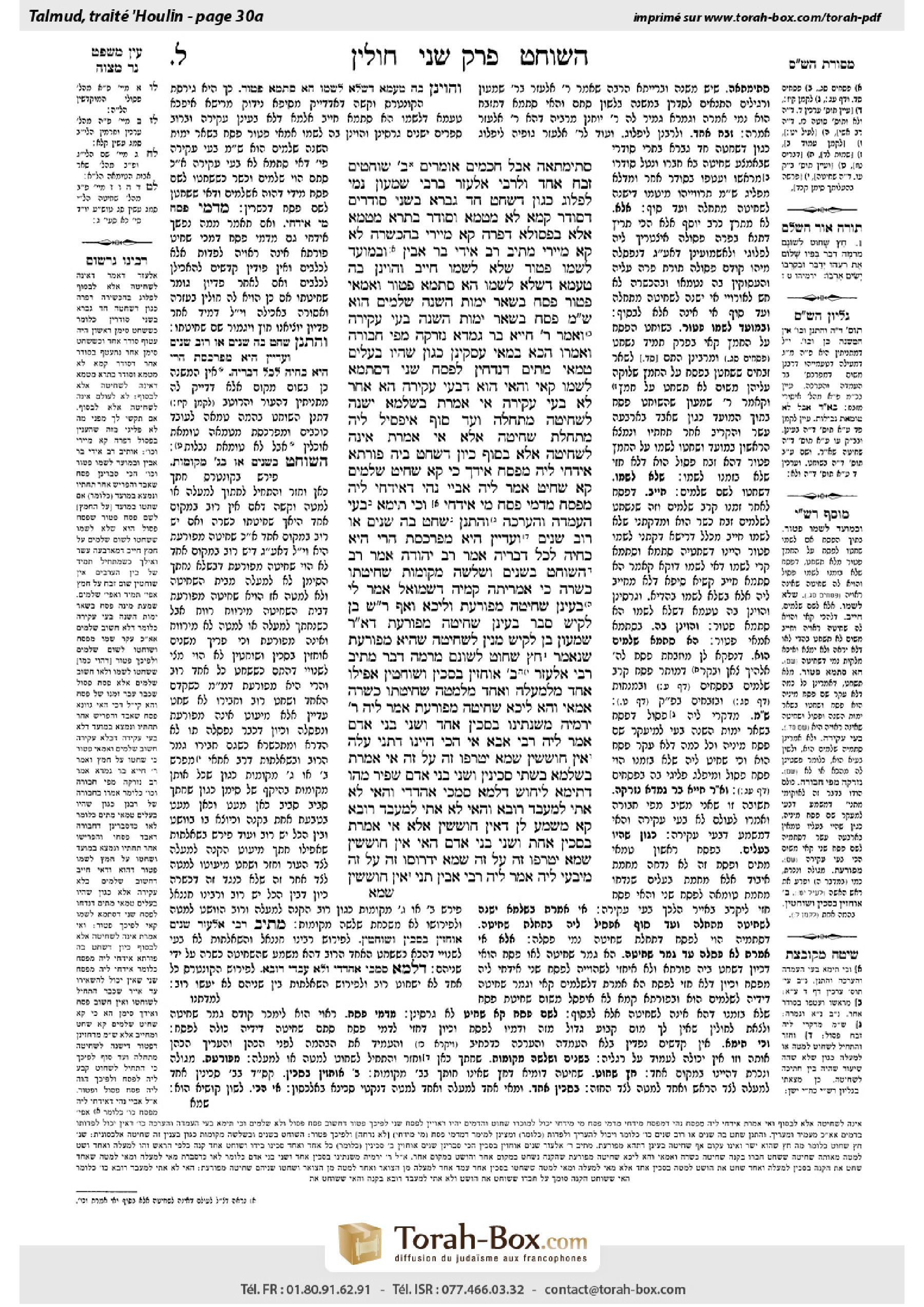
Chullin 30a: Talmud study for Daf Yomi
Study the Talmud for Daf Yomi with scanned pages, Hebrew text, English translations from Sefaria and AI-generated French translations.
Passage selection and English or AI-generated French translation are available where the scan has annotations. Daf Study is independent of Torah-Box and Sefaria.
Browse Chullin · חולין · All tractatesChullin 30a text and translations
This page of Chullin includes the Aramaic text, an English translation and an AI-generated French translation, alongside the scan above.
חולין ל׳ א · Aramaic and Hebrew text
סְתִימְתָּאָה, אֲבָל חֲכָמִים אוֹמְרִים שְׁנַיִם שׁוֹחֲטִים זֶבַח אֶחָד.
וּלְרַבִּי אֶלְעָזָר בְּרַבִּי שִׁמְעוֹן, נָמֵי לִפְלוֹג כְּגוֹן דִּשְׁחַט חַד גַּבְרָא בִּשְׁנֵי סוּדָרִים, דְּסוּדָר קַמָּא לָא מְטַמֵּא, וְסוּדָר בָּתְרָא מְטַמֵּא. אֶלָּא בִּפְסוּלָא דְּפָרָה קָא מַיְירֵי, בְּהֶכְשֵׁרַהּ לָא קָא מַיְירֵי.
מֵתִיב רַב אִידִי בַּר אָבִין: וּבַמּוֹעֵד לִשְׁמוֹ – פָּטוּר, שֶׁלֹּא לִשְׁמוֹ – חַיָּיב.
וְהָוֵינַן בָּהּ: טַעְמָא דְּשֶׁלֹּא לִשְׁמוֹ, הָא סְתָמָא – פָּטוּר.
וְאַמַּאי פָּטוּר? פֶּסַח בִּשְׁאָר יְמוֹת הַשָּׁנָה שְׁלָמִים הוּא! שְׁמַע מִינַּהּ: פֶּסַח בִּשְׁאָר יְמוֹת הַשָּׁנָה בָּעֵי עֲקִירָה.
וְאָמַר רַבִּי חִיָּיא בַּר גַּמָּדָא, נִזְרְקָה מִפִּי חֲבוּרָה וְאָמְרוּ: הָכָא בְּמַאי עָסְקִינַן? כְּגוֹן שֶׁהָיוּ בְּעָלִים טְמֵאֵי מֵתִים, דְּנִדְחִין לְפֶסַח שֵׁנִי, דִּסְתָמָא לִשְׁמוֹ קָאֵי, וְהַאי הוּא דְּבָעֵי עֲקִירָה, הָא אַחֵר לָא בָּעֵי עֲקִירָה.
אִי אָמְרַתְּ בִּשְׁלָמָא יֶשְׁנָהּ לִשְׁחִיטָה מִתְּחִלָּה וְעַד סוֹף – אִיפְּסִיל לֵיהּ מִתְּחִלַּת שְׁחִיטָה, אֶלָּא אִי אָמְרַתְּ אֵינָהּ לִשְׁחִיטָה אֶלָּא בַּסּוֹף – כֵּיוָן דִּשְׁחַט בֵּיהּ פּוּרְתָּא אִידְּחִי לֵיהּ מִפֶּסַח, אִידַּךְ כִּי קָא שָׁחֵיט שְׁלָמִים קָא שָׁחֵיט!
אֲמַר לֵיהּ אַבָּיֵי: נְהִי דְּאִידְּחִי לֵיהּ מִפֶּסַח, מִדְּמֵי פֶסַח מִי אִידְּחִי?
וְכִי תֵּימָא, בָּעֵי הַעֲמָדָה וְהַעֲרָכָה, וְהָתְנַן: שָׁחַט בָּהּ שְׁנַיִם אוֹ רוֹב שְׁנַיִם וַעֲדַיִין הִיא מְפַרְכֶּסֶת – הֲרֵי הִיא כְּחַיָּה לְכׇל דְּבָרֶיהָ.
אָמַר רַב יְהוּדָה אָמַר רַב: הַשּׁוֹחֵט בִּשְׁנַיִם וּשְׁלֹשָׁה מְקוֹמוֹת, שְׁחִיטָתוֹ כְּשֵׁרָה. כִּי אַמְרִיתַהּ קַמֵּיהּ דִּשְׁמוּאֵל, אָמַר לִי: בָּעֵינַן שְׁחִיטָה מְפוֹרַעַת, וְלֵיכָּא.
וְאַף רַבִּי שִׁמְעוֹן בֶּן לָקִישׁ סָבַר: בָּעֵינַן שְׁחִיטָה מְפוֹרַעַת, דְּאָמַר רַבִּי שִׁמְעוֹן בֶּן לָקִישׁ: מִנַּיִן לַשְּׁחִיטָה שֶׁהִיא מְפוֹרַעַת? שֶׁנֶּאֱמַר: ״חֵץ שָׁחוּט לְשׁוֹנָם מִרְמָה דִבֵּר״.
מֵתִיב רַבִּי אֶלְעָזָר: שְׁנַיִם אוֹחֲזִין בְּסַכִּין וְשׁוֹחֲטִין, אֲפִילּוּ אֶחָד מִלְּמַעְלָה וְאֶחָד מִלְּמַטָּה – שְׁחִיטָתוֹ כְּשֵׁרָה. אַמַּאי? וְהָא לֵיכָּא שְׁחִיטָה מְפוֹרַעַת!
אֲמַר לֵיהּ רַבִּי יִרְמְיָה: מִשְׁנָתֵינוּ בְּסַכִּין אֶחָד וּשְׁנֵי בְּנֵי אָדָם.
אֲמַר לֵיהּ רַבִּי אַבָּא: אִי הָכִי, הַיְינוּ דְּתָנֵי עֲלַהּ אֵין חוֹשְׁשִׁין שֶׁמָּא יִטְרְפוּ זֶה עַל זֶה? אִי אָמְרַתְּ בִּשְׁלָמָא בִּשְׁתֵּי סַכִּינִין וּשְׁנֵי בְּנֵי אָדָם – שַׁפִּיר, מַהוּ דְּתֵימָא לֵיחוּשׁ דִּלְמָא סָמְכִי אַהֲדָדֵי, וְהַאי לָא אָתֵי לְמֶעְבַּד רוּבָּא וְהַאי לָא אָתֵי לְמֶעְבַּד רוּבָּא, קָא מַשְׁמַע לַן דְּאֵין חוֹשְׁשִׁין.
אֶלָּא אִי אָמְרַתְּ בְּסַכִּין אַחַת וּשְׁנֵי בְּנֵי אָדָם, הַאי ״אֵין חוֹשְׁשִׁין שֶׁמָּא יִטְרְפוּ זֶה עַל זֶה״ – ״שֶׁמָּא יִדְרוֹסוּ זֶה עַל זֶה״ מִיבְּעֵי לֵיהּ.
אֲמַר לֵיהּ רַבִּי אָבִין, תְּנִי: אֵין חוֹשְׁשִׁין
Chullin 30a · English translation
which is cited unattributed, i.e., it is one of his many opinions that are cited in the Mishna and baraitot without attribution. But the Rabbis say: Two people may slaughter one offering. According to the Rabbis, Rava’s difficulty remains: Let the mishna teach a case where they slaughtered it with two men, as the heifer does not render the first man who slaughters impure, as the slaughter did not yet begin, and the heifer renders the latter man impure.
And according to the opinion of Rabbi Elazar, son of Rabbi Shimon, who holds that two people may not slaughter one offering, let the tanna of the mishna also distinguish and teach a case where one man slaughtered with two cloths on his head, starting the slaughter with one and replacing it with the other midway through the slaughter, as in that case, since halakhic slaughter is accomplished only at its conclusion, the first cloth is not rendered impure but the latter cloth is rendered impure. Rather, one must say that the tanna is speaking only in reference to cases involving the disqualification of the red heifer itself, but he is not speaking in reference to cases involving a fit red heifer, and no proof may be cited from here.
Rav Idi bar Avin raises an objection from a mishna (Pesaḥim 63a) to the opinion that halakhic slaughter is accomplished only at its conclusion. If one slaughters an animal for the sake of the Paschal offering on the fourteenth of Nisan after noon while he has leaven in his possession, he is flogged for violating the prohibition: “You shall not slaughter the blood of My sacrifice with leavened bread” (Exodus 23:18). If he slaughtered the animal not for the sake of the Paschal offering, he is exempt from receiving lashes. And if he slaughtered the animal during the festival of Passover for the sake of the Paschal offering with leaven in his possession, he is exempt, because it is a disqualified Paschal offering, as it was slaughtered beyond its appointed time. But if he slaughtered the animal during the Festival not for the sake of the Paschal offering, but rather as a peace offering, he is liable for slaughtering the animal with leaven in his possession.
And we discussed this matter: The reason he is liable is due to the fact that his intent was to slaughter it not for the sake of the Paschal offering, but had he slaughtered it with unspecified intent he would be exempt, because the offering would be disqualified. Unless he specifically intends otherwise, the animal retains its status as a Paschal offering and is disqualified when sacrificed beyond its appointed time.
The Gemara asks: And why is he exempt? Doesn’t a Paschal offering sacrificed during the rest of the days of the year assume the status of a peace offering, and doesn’t one who slaughters a peace offering during the time when it is prohibited to possess leaven with leaven in his possession also violate the prohibition? Conclude from it that a Paschal offering sacrificed during the rest of the days of the year requires explicit revocation of its status; otherwise, it does not assume the status of a peace offering and it remains a disqualified Paschal offering.
And Rabbi Ḥiyya bar Gamda said: A response emerged from the group of scholars that discussed this matter, and they said: What are we dealing with here? It is with a case where the owners of the Paschal offering were ritually impure on the fourteenth of Nisan with impurity imparted by a corpse. In that case, the Torah commands (Numbers 9:10–11) that since they were unable to sacrifice the Paschal offering at the appointed time, the fourteenth of Nisan, they were deferred to the second Pesaḥ, the fourteenth of Iyyar. Since presumably the owner plans to use his Paschal offering on the second Pesaḥ, its unspecified slaughter in the interim stands to be offered for the sake of the Paschal offering, and it is that Paschal offering that requires revocation of its status. But other situations of a Paschal offering that is slaughtered beyond its designated time do not require revocation of the animal’s status, and it assumes the status of a peace offering.
Returning to the matter at hand, if a Paschal offering that is designated for use on the second Pesaḥ is slaughtered on Passover while one has leaven in his possession, he is exempt from receiving lashes because it is a disqualified Paschal offering. Granted, if you say that halakhic slaughter is accomplished from the beginning to the end of the act, the offering is disqualified from the beginning of the slaughter as a Paschal offering slaughtered beyond its appointed time. Therefore, one is exempt from receiving lashes. But if you say that halakhic slaughter is accomplished only at its conclusion, why is one exempt if he slaughtered the animal with leaven in his possession? Once he began and cut a bit of the siman, it is rejected from its status as a Paschal offering and can no longer be offered on the second Pesaḥ. Therefore, when he slaughters the other, remaining, portion of the simanim without specification, it is a peace offering that he is slaughtering.
Abaye said to Rav Idi bar Avin: Even if you say that halakhic slaughter is accomplished only at its conclusion, although it was rejected from the possibility of being sacrificed on the second Pesaḥ, was it rejected from the possibility of being redeemed and from the possibility of the monetary value of a Paschal offering being used to purchase an animal to be sacrificed on the second Pesaḥ? As long as the slaughter is not yet complete, redemption of the animal remains possible. Therefore, unspecified slaughter at that time is for the sake of a Paschal offering and one should be exempt from receiving lashes.
And if you would say that in order to redeem a consecrated item one requires that the animal be placed standing before the priest and it requires valuation (see Leviticus 27:11–12), and once it is slaughtered it is unable to stand, but didn’t we learn in a baraita: If one slaughtered, i.e., cut, two simanim in the animal or a majority of two simanim, and the animal is still convulsing, its halakhic status is like a living animal in every respect, and it may be redeemed until the convulsing ceases?
§ Rav Yehuda said that Rav said: One who cuts a siman in two or three places on the neck, and together the cuts constitute the requisite measure of slaughter, his slaughter is valid. Rav Yehuda adds: When I stated this halakha before Shmuel he said to me: We require a clear and obvious slaughter and in the case of cuts in two or three places there is no obvious slaughter.
And Rabbi Shimon ben Lakish also holds that we require a clear and obvious slaughter, as Rabbi Shimon ben Lakish says: From where is it derived that slaughter must be clear and obvious? As it is stated: “Their tongue is a sharpened [shaḥut] arrow, it speaks deceit; one speaks peaceably to his neighbor with his mouth, but in his heart he lays wait for him” (Jeremiah 9:7). Just as an arrow clearly enters one part of the body, so too, the slaughter [sheḥita] must be clear and obvious.
Rabbi Elazar raises an objection from a mishna (30b): If two people are grasping a knife and slaughtering one animal, even if each is holding a knife and slaughtering one above and one below, with each one slaughtering at a different point in the neck, their slaughter is valid. But why is the slaughter valid according to the opinions of Shmuel and Rabbi Shimon ben Lakish? There is no clear and obvious slaughter, as each is cutting a different part of the neck.
Rabbi Yirmeya said to Rabbi Elazar: The mishna is referring to a case with one knife and two people, each holding one end of the knife, resulting in a single diagonal incision from above to below.
Rabbi Abba said to Rabbi Yirmeya: If so, is this what is taught in that regard in a baraita commenting on that mishna: One need not be concerned that perhaps each will render the animal a tereifa due to the other? Granted, if you say that the mishna is referring to a case of two knives and two people it works out well, lest you say: Let us be concerned that perhaps each will rely on the other that he will perform the slaughter properly, and neither will this one come to execute the cut on the majority of the simanim, nor will that one come to execute the cut on the majority of the simanim. Therefore, the tanna teaches us that one need not be concerned.
But if you say that the mishna is referring to a case of one knife and two people, that statement in the baraita should not have said: One need not be concerned that perhaps each will render the animal a tereifa due to the other; it should have said: One need not be concerned that because one is pulling in one direction and one is pulling in the other, perhaps each will cause the other to press the knife and thereby invalidate the slaughter.
Rabbi Avin said to him: Teach: One need not be concerned
Chullin 30a · Traduction française (IA)
qui est cité sans attribution, c'est-à-dire qu'il s'agit l'un de ses nombreux avis cités dans la Michna et les baraitot sans indication. Mais les Rabbins disent : deux personnes peuvent sacrifier un seul holocauste. Selon les Rabbins, la difficulté de Rava subsiste : faites que la Michna enseigne un cas où ils ont sacrifié ensemble deux hommes, car la bête ne rend impur le premier homme qui sacrifie pas, car le sacrifice n'avait pas encore commencé, et la bête rend impur le second homme.
Et selon l'opinion du Rabbi Elazar, fils du Rabbi Shimon, qui considère que deux personnes ne peuvent pas sacrifier un seul holocauste, faites que le tanna de la Michna distingue également et enseigne un cas où un seul homme sacrifiait avec deux tissus sur sa tête, commençant le sacrifice avec l'un et le remplaçant par l'autre au milieu du sacrifice, comme dans ce cas, puisque le sacrifice halakhique est accompli seulement à sa fin, le premier tissus n'est pas rendu impur mais le second l'est. Plutôt, il faut dire que le tanna parle uniquement en référence aux cas concernant l'invalidation de la bête rouge elle-même, mais il ne parle pas en référence aux cas concernant une bête rouge valide, et aucune preuve ne peut être citée à partir de là.
Rav Idi bar Avin soulève une objection contre l'opinion que la slaughtère halakhique est accomplie seulement à sa fin, selon une Michna (Pesaḥim 63a). Si l'on sacrifie un animal à l'intention du sacrifice pascal le quatorzième de Nisan après midi, tout en possédant du levain, il est battu pour avoir violé l'interdiction : « Vous ne sacrifierez pas le sang de mon sacrifice avec du levain » (Exode 23:18). Si l'on sacrifie l'animal sans l'intention du sacrifice pascal, il est exempt de recevoir des coups de fouet. Et si l'on sacrifie l'animal pendant la fête de Pessah à l'intention du sacrifice pascal avec du levain, il est exempt, car il s'agit d'un sacrifice pascal invalide, car il a été sacrifié en dehors de son moment déterminé. Mais si l'on sacrifie l'animal pendant la fête de Pessah sans l'intention du sacrifice pascal, mais plutôt comme un sacrifice de paix, il est puni pour avoir sacrifié l'animal avec du levain en possession.
Et nous avons discuté de cette question : la raison pour laquelle il est puni est que son intention était de sacrifier l'animal à l'intention du sacrifice pascal, mais s'il avait sacrifié l'animal avec une intention indéterminée, il serait exempt, car l'offrande serait invalide. À moins qu'il ne spécifie autre chose, l'animal conserve son statut de sacrifice pascal et est invalide lorsqu'il est sacrifié en dehors de son moment déterminé.
La Guemara pose la question : et pourquoi est-il exempt ? N'est-ce pas que le sacrifice pascal sacrifié pendant les autres jours de l'année assume le statut de sacrifice de paix, et n'est-ce pas que celui qui sacrifie un sacrifice de paix pendant la période où il est interdit de posséder du levain avec du levain en possession viole également l'interdiction ? Concluez-en que le sacrifice pascal sacrifié pendant les autres jours de l'année exige une révocation explicite de son statut ; autrement, il ne prend pas le statut de sacrifice de paix et reste un sacrifice pascal invalide.
Et Rabbi Ḥiyya bar Gamda a dit : une réponse est sortie du groupe de savants qui a discuté de cette question, et ils ont dit : De quoi sommes-nous en train de parler ? C'est d'un cas où les propriétaires du sacrifice pascal étaient impurs le quatorzième de Nisan avec une impureté transmise par un cadavre. Dans ce cas, la Torah commande (Nombres 9:10–11) que puisqu'ils n'ont pas pu sacrifier le sacrifice pascal à l'heure déterminée, le quatorzième de Nisan, ils sont reportés au second Pessaḥ, le quatorzième d'Iyyar. Puisque l'owner prévoit probablement d'utiliser son sacrifice pascal au second Pessaḥ, son sacrifice indéterminé pendant l'intervalle est destiné à être offert à l'intention du sacrifice pascal, et c'est ce sacrifice pascal qui exige une révocation de son statut. Mais d'autres cas de sacrifice pascal sacrifié en dehors de son moment déterminé ne nécessitent pas la révocation du statut de l'animal, et il prend le statut de sacrifice de paix.
En revenant à la question principale, si un sacrifice pascal désigné pour être utilisé au second Pessaḥ est sacrifié pendant Pessah alors que l'on possède du levain, il est exempt de recevoir des coups de fouet, car il s'agit d'un sacrifice pascal invalide. Admettons que vous disiez que le sacrifice halakhique est accompli du début à la fin de l'acte, le sacrifice est invalide dès le début du sacrifice comme un sacrifice pascal sacrifié en dehors de son moment déterminé. Ainsi, l'on est exempt de recevoir des coups de fouet. Mais si vous disiez que le sacrifice halakhique est accompli seulement à sa fin, pourquoi est-on exempt si l'on sacrifie l'animal avec du levain en possession ? Une fois qu'il a commencé et qu'il a coupé un peu du siman, il est rejeté de son statut de sacrifice pascal et ne peut plus être offert au second Pessaḥ. Ainsi, lorsqu'il sacrifie la partie restante du simanim sans spécification, c'est un sacrifice de paix qu'il sacrifie.
Abaye a dit à Rav Idi bar Avin : Même si vous disiez que le sacrifice halakhique est accompli seulement à sa fin, bien qu'il ait été rejeté de la possibilité d'être sacrifié au second Pessaḥ, n'était-il pas rejeté de la possibilité d'être racheté et de la possibilité que la valeur monétaire du sacrifice pascal soit utilisée pour acheter un animal à sacrifier au second Pessaḥ ? Tant que le sacrifice n'est pas encore complet, la rachat de l'animal reste possible. Ainsi, le sacrifice indéterminé à ce moment-là est à l'intention d'un sacrifice pascal et l'on devrait être exempt de recevoir des coups de fouet.
Et si vous disiez que pour racheter un objet consacré, il faut que l'animal soit placé debout devant le prêtre et qu'il faille l'évaluer (voir Lévitique 27:11–12), et que dès qu'il est sacrifié, il ne peut plus être debout, mais n'avons-nous pas appris dans une baraïta : Si l'on sacrifie, c'est-à-dire qu'on coupe, deux simanim dans l'animal ou la majorité de deux simanim, et l'animal est encore convulsif, son statut halakhique est comme un animal vivant en tous points, et il peut être racheté jusqu'à ce que les convulsions cesseront ?
§ Rav Yehuda a dit que Rav avait dit : Celui qui coupe un siman en deux ou trois endroits sur le cou, et ensemble les incisions constituent la mesure requise pour la boucherie, sa boucherie est valide. Rav Yehuda ajoute : Lorsque j'ai énoncé cette halakha devant Shmuel, il m'a dit : Nous exigeons une boucherie claire et évidente, et dans le cas de coupures en deux ou trois endroits, il n'y a pas de boucherie évidente.
Et Rabbi Shimon ben Lakish aussi considère que nous exigeons une boucherie claire et évidente, comme Rabbi Shimon ben Lakish dit : D'où est tiré que la boucherie doit être claire et évidente ? Comme il est dit : « Leur langue est une flèche aiguë [shaḥut], elle parle mensonge ; l'un parle paix à son prochain avec sa bouche, mais dans son cœur il attend pour le tuer » (Jérémie 9:7). Tout comme une flèche entre clairement dans une partie du corps, de même la boucherie [sheḥita] doit être claire et évidente.
Rabbi Elazar émet une objection à partir d'une mitsna (30b) : Si deux personnes tiennent un couteau et bouchent un animal, même si chacun tient un couteau et bouchent l'un au-dessus et l'autre en dessous, avec chacun bouchant à un point différent du cou, leur boucherie est valide. Mais pourquoi la boucherie est-elle valide selon les opinions de Shmuel et de Rabbi Shimon ben Lakish ? Il n'y a pas de boucherie claire et évidente, car chacun coupe une partie différente du cou.
Rabbi Yirmeya a dit à Rabbi Elazar : La mitsna fait référence à un cas avec un seul couteau et deux personnes, chacun tenant une extrémité du couteau, ce qui produit une seule incision diagonale du haut vers le bas.
Rabbi Abba a dit à Rabbi Yirmeya : Si c'est ainsi, est-ce que cela est enseigné dans ce sens dans une baraïta commentant cette mitsna : On n'a pas à craindre que l'un des deux rende l'animal tereifa à cause de l'autre ? En effet, si vous dites que la mitsna fait référence à un cas de deux couteaux et deux personnes, cela s'explique bien, de peur que vous disiez : Laissons-nous craindre que l'un puisse compter sur l'autre pour effectuer correctement la boucherie, et ni l'un ne viendra exécuter la coupure sur la majorité des simanim, ni l'autre ne viendra exécuter la coupure sur la majorité des simanim. Ainsi, le tanna nous enseigne que l'on n'a pas à craindre cela.
Mais si vous dites que la mitsna fait référence à un cas d'un seul couteau et de deux personnes, cette déclaration dans la baraïta ne devrait pas avoir dit : On n'a pas à craindre que l'un des deux rende l'animal tereifa à cause de l'autre ; elle aurait dû dire : On n'a pas à craindre que parce que l'un tire dans une direction et l'autre dans l'autre, peut-être l'un fera presser le couteau par l'autre et ainsi invalider la boucherie.
Rabbi Avin a dit à lui : Enseigne : Il n'est pas nécessaire de s'inquiéter
Traduction française générée par IA à partir de l’édition anglaise de Sefaria. Vérifie toujours un passage avec le texte source.
Text from Sefaria: William Davidson Edition - Vocalized Aramaic (unknown); William Davidson Edition - English (CC BY NC).