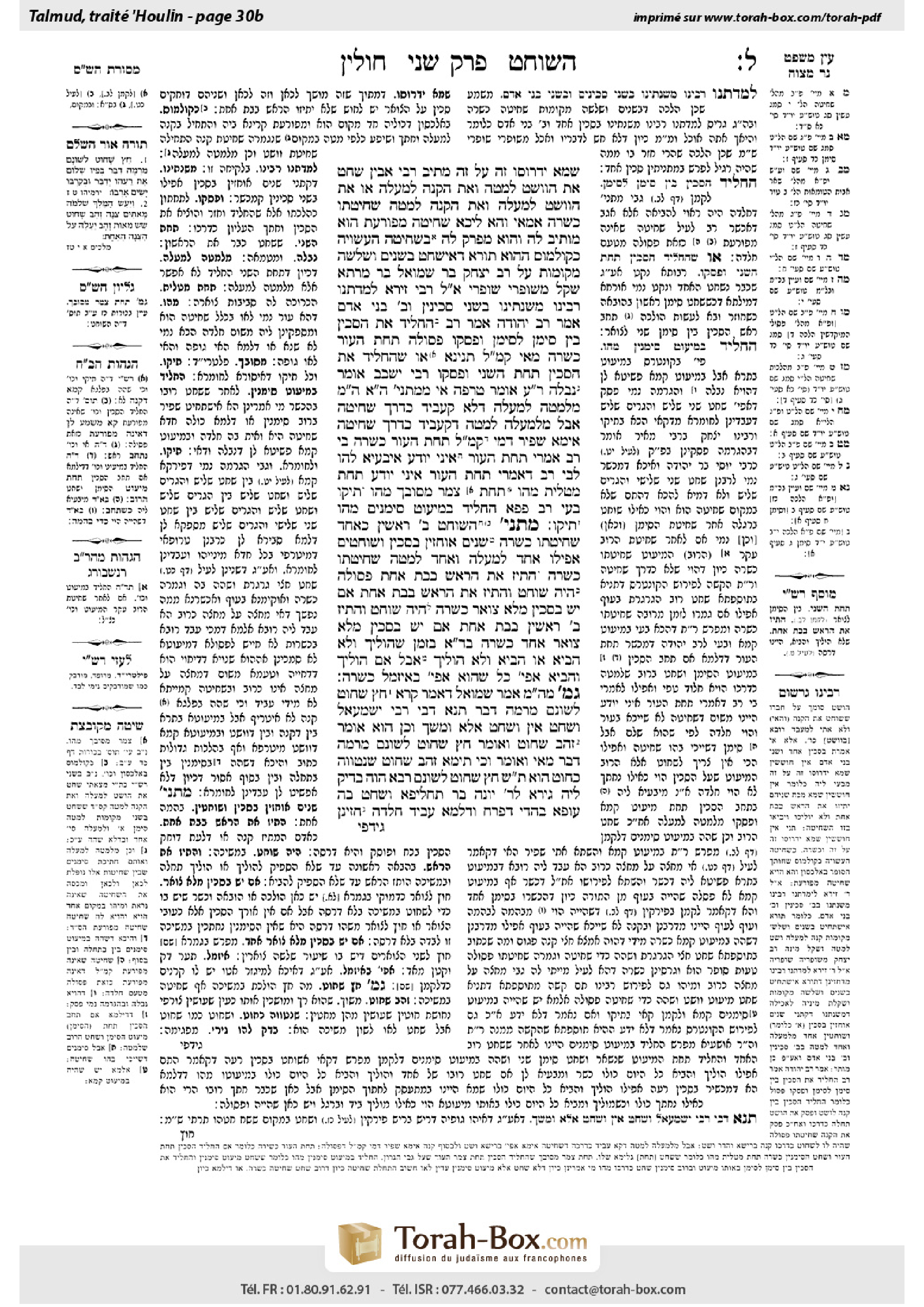
Chullin 30b: Talmud study for Daf Yomi
Study the Talmud for Daf Yomi with scanned pages, Hebrew text, English translations from Sefaria and AI-generated French translations.
Passage selection and English or AI-generated French translation are available where the scan has annotations. Daf Study is independent of Torah-Box and Sefaria.
Browse Chullin · חולין · All tractatesChullin 30b text and translations
This page of Chullin includes the Aramaic text, an English translation and an AI-generated French translation, alongside the scan above.
חולין ל׳ ב · Aramaic and Hebrew text
שֶׁמָּא יִדְרוֹסוּ זֶה עַל זֶה.
מֵתִיב רַבִּי אָבִין: שָׁחַט אֶת הַוֶּושֶׁט לְמַטָּה וְאֶת הַקָּנֶה לְמַעְלָה, אוֹ אֶת הַוֶּושֶׁט לְמַעְלָה וְאֶת הַקָּנֶה לְמַטָּה – שְׁחִיטָתוֹ כְּשֵׁרָה. אַמַּאי? וְהָא לֵיכָּא שְׁחִיטָה מְפוֹרַעַת!
הוּא מוֹתֵיב לַהּ, וְהוּא מְפָרֵק לַהּ: בִּשְׁחִיטָה הָעֲשׂוּיָה כְּקוּלְמוֹס.
הָהוּא תּוֹרָא דְּאִישְּׁחַט בִּשְׁנַיִם וּשְׁלֹשָׁה מְקוֹמוֹת, עָל רַב יִצְחָק בַּר שְׁמוּאֵל בַּר מָרְתָא שְׁקַל מִשׁוּפְרֵי שׁוּפְרֵי. אֲמַר לֵיהּ רַבִּי זֵירָא: לִמַּדְתָּנוּ רַבֵּינוּ מִשְׁנָתֵינוּ בִּשְׁנֵי סַכִּינִין וּשְׁנֵי בְּנֵי אָדָם.
אָמַר רַב יְהוּדָה אָמַר רַב: הֶחְלִיד אֶת הַסַּכִּין בֵּין סִימָן לְסִימָן וּפְסָקוֹ – פְּסוּלָה, תַּחַת הָעוֹר – כְּשֵׁרָה.
מַאי קָא מַשְׁמַע לַן? תְּנֵינָא: אוֹ שֶׁהֶחְלִיד אֶת הַסַּכִּין תַּחַת הַשֵּׁנִי וּפְסָקוֹ – רַבִּי יְשֵׁבָב אוֹמֵר: נְבֵלָה, רַבִּי עֲקִיבָא אוֹמֵר: טְרֵפָה.
אִי מִמַּתְנִיתִין, הֲוָה אָמֵינָא: הָנֵי מִילֵּי – מִלְּמַטָּה לְמַעְלָה, דְּלָא קָעָבֵיד כְּדֶרֶךְ שְׁחִיטָה, אֲבָל מִלְּמַעְלָה לְמַטָּה, דְּקָעָבֵיד כְּדֶרֶךְ שְׁחִיטָה – אֵימָא שַׁפִּיר דָּמֵי, קָא מַשְׁמַע לַן.
תַּחַת הָעוֹר – כְּשֵׁרָה, בֵּי רַב אָמְרִי: תַּחַת הָעוֹר – אֵינִי יוֹדֵעַ.
אִיבַּעְיָא לְהוּ: לְבֵי רַב, דְּאָמְרִי: תַּחַת הָעוֹר אֵינִי יוֹדֵעַ, תַּחַת מַטְלֵית מַהוּ? תַּחַת צֶמֶר מְסוּבָּךְ מַהוּ? תֵּיקוּ.
בָּעֵי רַב פָּפָּא: הֶחְלִיד בְּמִיעוּט סִימָנִים מַהוּ? תֵּיקוּ.
מַתְנִי׳ הַשּׁוֹחֵט שְׁנֵי רָאשִׁין כְּאֶחָד – שְׁחִיטָתוֹ כְּשֵׁרָה. שְׁנַיִם אוֹחֲזִין בְּסַכִּין וְשׁוֹחֲטִים, אֲפִילּוּ אֶחָד לְמַעְלָה וְאֶחָד לְמַטָּה – שְׁחִיטָתוֹ כְּשֵׁרָה. הִתִּיז אֶת הָרֹאשׁ בְּבַת אַחַת – פְּסוּלָה. הָיָה שׁוֹחֵט וְהִתִּיז אֶת הָרֹאשׁ בְּבַת אַחַת, אִם יֵשׁ בַּסַּכִּין מְלֹא צַוָּאר – כְּשֵׁרָה.
הָיָה שׁוֹחֵט וְהִתִּיז שְׁנֵי רָאשִׁין בְּבַת אַחַת, אִם יֵשׁ בַּסַּכִּין מְלֹא צַוָּאר אֶחָד – כְּשֵׁרָה. בַּמֶּה דְּבָרִים אֲמוּרִים? בִּזְמַן שֶׁהוֹלִיךְ וְלֹא הֵבִיא, אוֹ הֵבִיא וְלֹא הוֹלִיךְ, אֲבָל אִם הוֹלִיךְ וְהֵבִיא, אֲפִילּוּ כׇּל שֶׁהוּא, אֲפִילּוּ בְּאִיזְמֵל – כְּשֵׁרָה.
גְּמָ׳ מְנָהָנֵי מִילֵּי? אָמַר שְׁמוּאֵל, דְּאָמַר קְרָא: ״חֵץ שָׁחוּט לְשׁוֹנָם מִרְמָה דִבֵּר״.
תָּנָא דְּבֵי רַבִּי יִשְׁמָעֵאל: ״וְשָׁחַט״ – אֵין ״וְשָׁחַט״ אֶלָּא וּמָשַׁךְ, וְכֵן הוּא אוֹמֵר: ״זָהָב שָׁחוּט״, וְאוֹמֵר: ״חֵץ שָׁחוּט לְשׁוֹנָם מִרְמָה דִבֵּר״.
מַאי ״וְאוֹמֵר״? וְכִי תֵּימָא ״זָהָב שָׁחוּט״ שֶׁנִּטְוֶוה כְּחוּט הוּא, תָּא שְׁמַע: ״חֵץ שָׁחוּט לְשׁוֹנָם״.
רָבָא הֲוָה בָּדֵיק לֵיהּ גִּירָא לְרַבִּי יוֹנָה בַּר תַּחְלִיפָא, וְשָׁחַט בֵּהּ עוֹפָא בַּהֲדֵי דְּפָרַח. וְדִילְמָא עָבִיד חֲלָדָה? חֲזִינַן
Chullin 30b · English translation
that perhaps each will cause the other to press the knife.
Rabbi Avin raises an objection from a baraita: If one slaughtered, i.e., cut, the gullet below on the neck and the windpipe above on the neck, or cut the gullet above on the neck and the windpipe below on the neck, his slaughter is valid. Based on this, Rabbi Avin asks: Why is the slaughter valid? But in that case there is no clear and obvious slaughter.
He raises the objection and he resolves it. This baraita is not referring to cuts on two places on the neck; rather, it is referring to slaughter performed on a diagonal, like the point of a reed [kekulmos] fashioned into a writing utensil. The slaughterer begins cutting from the top of one siman and cuts diagonally downward so that when he reaches the second siman, the knife is lower down.
The Gemara relates: There was a certain bull that was slaughtered with cuts in two or three places in the simanim on its neck. Rav Yitzḥak bar Shmuel bar Marta entered the store and took a cut of meat from the highest quality parts of the animal, thereby demonstrating that the slaughter was valid. Rabbi Zeira said to him: Our rabbi, you have taught us through your actions that the mishna: If two people are grasping a knife and slaughtering one animal, even one above and one below, is referring even to a case of two knives and two people who are each cutting the simanim at a different part of the neck with their knives.
§ Rav Yehuda says that Rav says: If one concealed the knife in the neck between one siman and the other siman, i.e., he inserted the knife between the windpipe and the gullet, and he severed the gullet first and then removed the knife and cut the windpipe, the slaughter is not valid. If one concealed the knife beneath the hide of the neck and then he cut both simanim, the slaughter is valid.
The Gemara asks: What is Rav teaching us? We already learn this halakha explicitly in a mishna (32a): Or if one cut one siman and concealed the knife beneath the second siman and severed it, Rabbi Yeshevav says: The animal is an unslaughtered carcass and imparts ritual impurity through contact with it and carrying it. Rabbi Akiva says: The animal is a tereifa, and although eating it is prohibited, it does not transmit ritual impurity. Both agree that the slaughter is not valid in the sense that it does not permit the consumption of the meat of the animal.
The Gemara answers: If this halakha is learned from the mishna alone, I would say that this statement applies only in a case where one conceals the knife beneath the gullet and cuts it from below to above, i.e., from the nape to the front of the neck, because he did not perform the slaughter in the standard manner of slaughter. But if he cut the gullet from above to below, i.e., from the front of the neck to the nape, since he performed the slaughter in the standard manner of slaughter, say that the slaughter is valid. Therefore, Rav teaches us that with regard to any case where one conceals the knife during slaughter, his slaughter is not valid.
The Gemara proceeds to analyze the second part of that which Rav Yehuda says that Rav says: If one concealed the knife beneath the hide of the neck and then he cut both simanim in the standard manner the slaughter is valid. The school of Rav say that Rav says that in a case where one conceals the knife beneath the hide and cuts the simanim of the animal, I do not know whether the slaughter is valid, or whether it is not valid because he concealed the knife during the slaughter.
A dilemma was raised before the Sages: According to the opinion of the school of Rav, who say: Beneath the hide, I do not know, if one concealed the knife beneath a cloth that is around the animal’s neck, what is the halakha? If one concealed the knife beneath tangled wool on the neck of a sheep, what is the halakha? The Gemara concludes: These dilemmas shall stand unresolved.
Rav Pappa raises a dilemma: If one concealed the knife in cutting the minority of the simanim and cut the majority of the simanim in the standard manner, what is the halakha? The Gemara concludes: The dilemma shall stand unresolved.
MISHNA: With regard to one who slaughters by cutting two animals’ heads simultaneously, his slaughter is valid. If two people are grasping a knife and slaughtering one animal, even if each is holding a knife and slaughtering one above and one below, with each one slaughtering at a different point in the neck, their slaughter is valid. If one decapitated the animal in one motion and did not slaughter the animal in the standard manner of drawing the knife back and forth, the slaughter is not valid. In a case where one was in the process of slaughtering the animal in the standard manner and he decapitated the animal in one motion, if the length of the knife is equivalent to the breadth of the animal’s entire neck, the slaughter is valid.
If one was in the process of slaughtering two animals simultaneously, and he decapitated two heads in one motion, if the length of the knife is equivalent to the breadth of an entire neck of one of the animals, the slaughter is valid. In what case is this statement, that one must be concerned about the length of the knife, said? It is when one drew the knife back and did not draw it forth, or drew it forth and did not draw it back; but if he drew it back and forth, even if the knife was of any length, even if he slaughtered with a scalpel [be’izemel], the slaughter is valid.
GEMARA: The mishna stated: If one decapitated the animal in one motion, the slaughter is not valid. The Gemara asks: From where is this matter derived? Shmuel said: It is derived from a verse, as the verse states: “Their tongue is a sharpened [shaḥut] arrow, it speaks deceit” (Jeremiah 9:7). Just as an arrow is propelled by drawing back the bowstring, so too, slaughter [sheḥita] must be performed by drawing the knife across the animal’s neck and not by pressing the knife or striking the neck with the knife.
Likewise, the school of Rabbi Yishmael taught: The verse states: “And he shall slaughter [veshaḥat] the young bull before the Lord” (Leviticus 1:5). The term “veshaḥat” means nothing other than: And he shall draw the knife across the neck of the animal. And similarly, the verse states: “And King Solomon made two hundred targets of drawn [shaḥut] gold” (I Kings 10:16), meaning gold that is smoothed in the manner of goldsmiths. And the verse states: “Their tongue is a sharpened arrow, it speaks deceit” (Jeremiah 9:7).
The Gemara asks: What is the purpose of citing the additional verse introduced with the term: And the verse states? The Gemara answers: And if you would say that the term “drawn [shaḥut] gold” means that the gold was spun like soft thread [keḥut], come and hear: “Their tongue is a sharpened [shaḥut] arrow.” In this verse, shaḥut means drawn like the bowstring that propels an arrow, and is not a reference to thread.
The Gemara relates: Rava would examine the arrow for Rabbi Yona bar Taḥlifa to ensure that there were no notches in it. And Rava shot the arrow and slaughtered a bird with it as it was flying. The Gemara challenges: And perhaps when the arrow cut the bird’s neck it performed an inverted slaughter, with the arrow concealed in the neck, and cut the simanim from back to front. The Gemara responds: We see
Chullin 30b · Traduction française (IA)
que peut-être chacun poussera l'autre à presser le couteau.
Rabbi Avin émet un objet d'argumentation à partir d'une baraïta : Si l'on a immolé, c'est-à-dire coupé, la veine jugulaire en dessous du cou et la trachée au-dessus du cou, ou la veine jugulaire au-dessus du cou et la trachée en dessous du cou, son immolation est valide. Selon cela, Rabbi Avin demande : Pourquoi cette immolation est-elle valide ? Mais dans ce cas, il n'y a pas d'immolation claire et évidente.
Il émet l'objet d'argumentation et il le résout. Cette baraïta ne parle pas de coupures à deux endroits sur le cou ; elle parle plutôt d'une immolation effectuée en diagonale, comme la pointe d'un bâton [kekulmos] façonné en stylo. Le boucher commence à couper du haut d'un siman et coupe en diagonale vers le bas de sorte que lorsqu'il arrive au deuxième siman, le couteau est plus bas.
La Guemara rapporte : Il y avait un taureau qui avait été sacrifié avec des coupures à deux ou trois endroits sur les simanim de son cou. Rav Yitzḥak bar Shmuel bar Marta entra dans la boucherie et prit une portion de viande des parties les plus qualitatives de l'animal, démontrant ainsi que le sacrifice était valide. Rabbi Zeira dit à lui : Notre maître, vous nous avez appris par vos actions que la mitsva : Si deux personnes tiennent un couteau et sacrifient un animal, même l'un au-dessus et l'autre en dessous, fait référence même à un cas de deux couteaux et deux personnes qui coupent les simanim à des endroits différents du cou avec leurs couteaux.
§ Rav Yehuda dit que Rav dit : Si l'on a caché le couteau entre un siman et l'autre siman, c'est-à-dire qu'il a inséré le couteau entre la trachée et la veine jugulaire, et qu'il a d'abord coupé la veine jugulaire puis retiré le couteau et coupé la trachée, le sacrifice n'est pas valide. Si l'on a caché le couteau sous la peau du cou et qu'il a coupé les deux simanim, le sacrifice est valide.
La Guemara pose la question : Qu'est-ce que Rav nous apprend ? Nous avons déjà appris cette halakha explicitement dans une mitsva (32a) : Ou si l'on a coupé un siman et a caché le couteau sous le deuxième siman et l'a coupé, Rabbi Yeshevav dit : L'animal est un cadavre non sacrifié et transmet l'impureté rituelle par contact et par transport. Rabbi Akiva dit : L'animal est un tereifa, et bien que manger soit interdit, il ne transmet pas l'impureté rituelle. Les deux s'accordent sur le fait que le sacrifice n'est pas valide au sens où il ne permet pas la consommation de la viande de l'animal.
La Guemara répond : Si cette halakha est apprise uniquement à partir de la mitsva seule, je dirais que cette déclaration s'applique uniquement dans un cas où l'on a caché le couteau sous la veine jugulaire et l'a coupé du bas vers le haut, c'est-à-dire du cou à l'avant du cou, car il n'a pas effectué la bataille dans la manière standard de bataille. Mais si l'on a coupé la veine jugulaire du haut vers le bas, c'est-à-dire de l'avant du cou à la base du cou, puisque l'on a effectué la bataille dans la manière standard de bataille, disons que la bataille est valide. Ainsi, Rav nous apprend que concernant tout cas où l'on cache le couteau pendant la bataille, sa bataille n'est pas valide.
La Guemara poursuit son analyse de la deuxième partie de ce que Rav Yehuda dit que Rav dit : Si l'on a caché le couteau sous la peau du cou et qu'il a coupé les deux simanim dans la manière standard, la bataille est valide. La scolion de Rav dit que Rav dit que dans un cas où l'on a caché le couteau sous la peau et qu'il a coupé les simanim de l'animal, je ne sais pas si la bataille est valide, ou s'il n'est pas valide parce qu'il a caché le couteau pendant la bataille.
Un dilemme a été soulevé devant les Sages : Selon l'opinion de la scolion de Rav, qui dit : Sous la peau, je ne sais pas, si l'on a caché le couteau sous un tissu autour du cou de l'animal, quelle est la halakha ? Si l'on a caché le couteau sous des toiles entrelacées sur le cou d'une brebis, quelle est la halakha ? La Guemara conclut : Ces dilemmes restent sans solution.
Rav Pappa soulève un dilemme : Si l'on a caché le couteau en coupant la minorité des simanim et qu'on a coupé la majorité des simanim dans la manière standard, quelle est la halakha ? La Guemara conclut : Ce dilemme restera sans solution.
MICHNA : Concernant celui qui sacrifie en coupant simultanément les têtes de deux animaux, son sacrifice est valide. Si deux personnes tiennent un couteau et sacrifient un animal, même si chacun tient un couteau et sacrifie l'un au-dessus et l'autre en dessous, avec chacun sacrifiant à un point différent du cou, leur sacrifice est valide. Si l'on a décapité l'animal en un seul mouvement et n'a pas sacrifié l'animal dans la manière standard de faire glisser le couteau, le sacrifice n'est pas valide. Dans un cas où l'on était en train de sacrifier l'animal dans la manière standard et qu'on a décapité l'animal en un seul mouvement, si la longueur du couteau est équivalente à la largeur du cou entier de l'animal, le sacrifice est valide.
Si l'on était en train de sacrifier deux animaux simultanément et qu'on a décapité deux têtes en un seul mouvement, si la longueur du couteau est équivalente à la largeur du cou entier d'un des animaux, le sacrifice est valide. Dans quel cas cette déclaration, que l'on doit s'inquiéter de la longueur du couteau, est-elle dite ? C'est lorsque l'on a tiré le couteau en arrière sans le tirer vers l'avant, ou l'on a tiré le couteau vers l'avant sans le tirer en arrière ; mais si l'on a tiré le couteau en arrière et en avant, même si le couteau était de toute longueur, même si l'on sacrifiait avec un scalpel [be’izemel], le sacrifice est valide.
GUEMARA : La mitsva a dit : Si l'on découpe l'animal en un seul mouvement, le sacrifice n'est pas valide. La Guemara pose la question : D'où cette loi est-elle dérivée ? Shmuel a dit : Elle est dérivée d'un verset, car le verset dit : « Leur langue est une flèche aiguë [shaḥut], elle parle de la tromperie » (Jérémie 9:7). Tout comme une flèche est propulsée en tirant la corde du arc, de même, le sacrifice [sheḥita] doit être effectué en tirant le couteau sur le cou de l'animal et non en pressant le couteau ou en frappant le cou avec le couteau.
De même, la maison de Rabbi Yishmael enseignait : La Parashah dit : « Et il tuera [veshaḥat] le taureau jeune devant l'Éternel » (Lévitique 1:5). Le terme « veshachat » ne signifie rien d'autre que : Et il tranchera le couteau sur le cou de l'animal. De même, la Parashah dit : « Et le roi Salomon fit deux cents cibles de métal fondu [shaḥut] d'or » (I Rois 10:16), signifiant de l'or qui est poli selon la manière des orfèvres. Et la Parashah dit : « Leur langue est une flèche aiguë [shaḥut], elle parle mensonge » (Jérémie 9:7).
Le Guemara demande : Quel est le but de citer une autre Parashah introduite par le terme : « Et la Parashah dit » ? Le Guemara répond : Et si tu disais que le terme « métal fondu [shaḥut] d'or » signifie que l'or était tissé comme un fil doux [keḥut], viens écouter : « Leur langue est une flèche aiguë [shaḥut], elle parle mensonge. » Dans cette Parashah, le terme « shaḥut » signifie un métal fondu comme la corde d'arc qui propulse une flèche, et n'est pas une référence à un fil.
Le Guemara rapporte : Rava examinait la flèche pour Rabbi Yona bar Taḥlifa afin de s'assurer qu'il n'y avait pas de rainures dedans. Et Rava tirait la flèche et tuait un oiseau avec elle alors qu'elle volait. Le Guemara conteste : Et peut-être que lorsque la flèche a coupé le cou de l'oiseau, elle a accompli un meurtre inversé, avec la flèche cachée dans le cou, et a coupé les simanim du dos vers l'avant. Le Guemara répond : Nous voyons
Traduction française générée par IA à partir de l’édition anglaise de Sefaria. Vérifie toujours un passage avec le texte source.
Text from Sefaria: William Davidson Edition - Vocalized Aramaic (unknown); William Davidson Edition - English (CC BY NC).