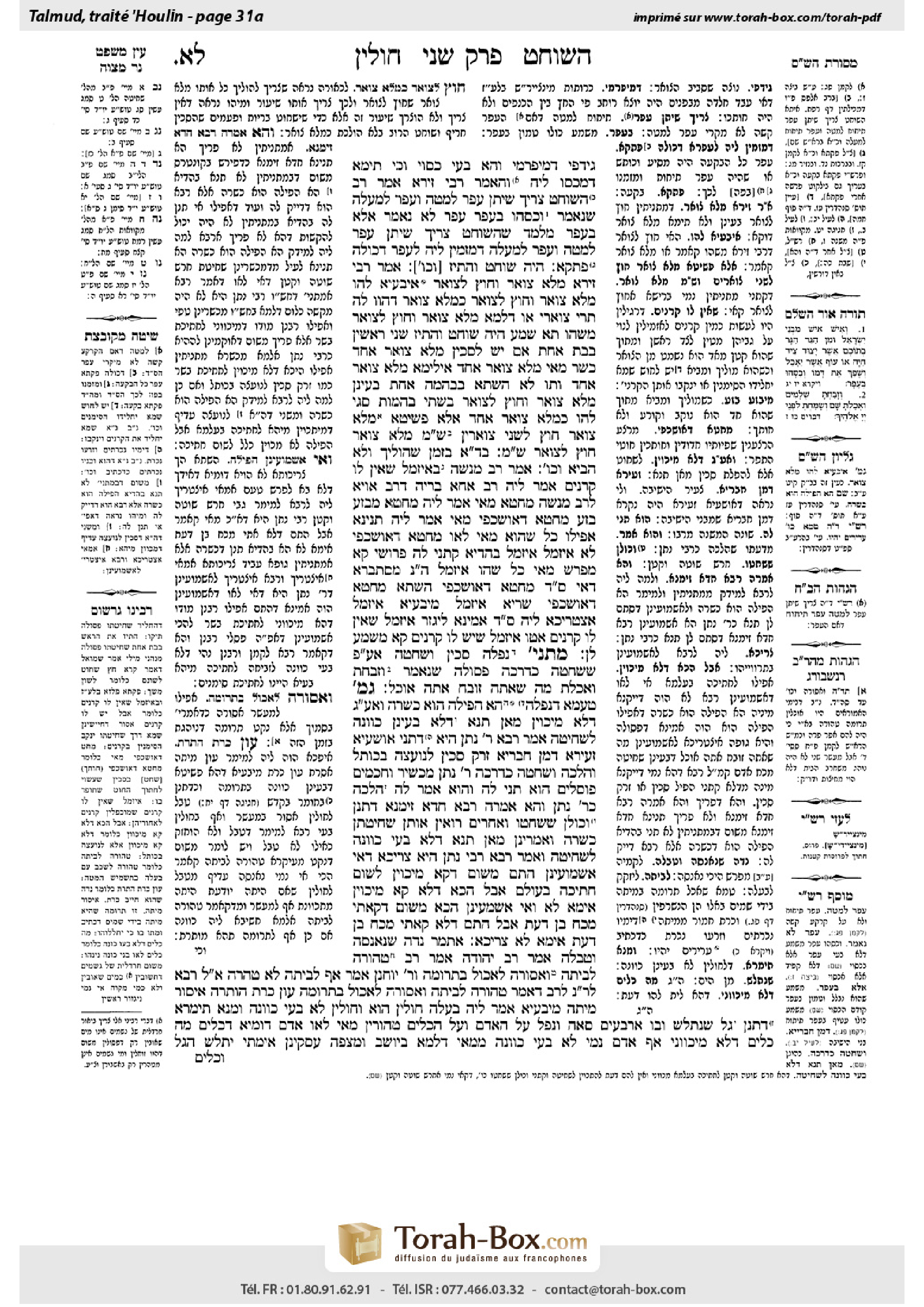
Chullin 31a: Talmud study for Daf Yomi
Study the Talmud for Daf Yomi with scanned pages, Hebrew text, English translations from Sefaria and AI-generated French translations.
Passage selection and English or AI-generated French translation are available where the scan has annotations. Daf Study is independent of Torah-Box and Sefaria.
Browse Chullin · חולין · All tractatesChullin 31a text and translations
This page of Chullin includes the Aramaic text, an English translation and an AI-generated French translation, alongside the scan above.
חולין ל״א א · Aramaic and Hebrew text
גִּידְפֵי דְּמִיפַּרְמִי.
וְהָא בָּעֵי כִּסּוּי, וְכִי תֵּימָא דִּמְכַסּוּ לֵיהּ, וְהָאָמַר רַבִּי זֵירָא אָמַר רַב: הַשּׁוֹחֵט צָרִיךְ שֶׁיִּתֵּן עָפָר לְמַטָּה וְעָפָר לְמַעְלָה, שֶׁנֶּאֱמַר: ״וְכִסָּהוּ בֶּעָפָר״, ״עָפָר״ לֹא נֶאֱמַר אֶלָּא ״בֶּעָפָר״, מְלַמֵּד שֶׁהַשּׁוֹחֵט צָרִיךְ שֶׁיִּתֵּן עָפָר לְמַטָּה וְעָפָר לְמַעְלָה!
דְּמַזְמֵין לֵיהּ לְעָפָר דְּכוּלַּהּ פִּתְקָא.
הָיָה שׁוֹחֵט וְהִתִּיז, אָמַר רַבִּי זֵירָא: מְלֹא צַוָּאר וְחוּץ לַצַּוָּאר.
אִיבַּעְיָא לְהוּ: מְלֹא צַוָּאר וְחוּץ לַצַּוָּאר כִּמְלֹא צַוָּאר, דַּהֲווֹ לַהּ תְּרֵי צַוָּארֵי, אוֹ דִלְמָא מָלֵא צַוָּאר וְחוּץ לַצַּוָּאר מַשֶּׁהוּ?
תָּא שְׁמַע: הָיָה שׁוֹחֵט וְהִתִּיז שְׁנֵי רָאשִׁין בְּבַת אַחַת, אִם יֵשׁ לַסַּכִּין מְלֹא צַוָּאר אֶחָד – כָּשֵׁר. מַאי מְלֹא צַוָּאר אֶחָד? אִילֵּימָא מְלֹא צַוָּאר אֶחָד וְתוּ לָא, הַשְׁתָּא בִּבְהֵמָה אַחַת בָּעֵינַן מְלֹא צַוָּאר וְחוּץ לַצַּוָּאר, בִּשְׁתֵּי בְּהֵמוֹת סַגִּי לְהוּ כִּמְלֹא צַוָּאר אֶחָד? אֶלָּא פְּשִׁיטָא מְלֹא צַוָּאר חוּץ לִשְׁנֵי צַוָּארִין.
שְׁמַע מִינַּהּ, מְלֹא צַוָּאר חוּץ לַצַּוָּאר, שְׁמַע מִינַּהּ.
בַּמֶּה דְּבָרִים אֲמוּרִים – בִּזְמַן שֶׁהוֹלִיךְ וְלֹא הֵבִיא וְכוּ׳. אָמַר רַב מְנַשֶּׁה: בְּאִיזְמֵל שֶׁאֵין לוֹ קַרְנַיִם.
אֲמַר לֵיהּ רַב אַחָא בְּרֵיהּ דְּרַב אַוְיָא לְרַב מְנַשֶּׁה: מַחְטָא מַאי? אֲמַר לֵיהּ: מַחְטָא מִבְזָע בָּזַע.
מַחְטָא דְּאוּשְׁכָּפֵי, מַאי? אֲמַר לֵיהּ: תְּנֵינָא ״אֲפִילּוּ כׇּל שֶׁהוּא״. מַאי לָאו מַחְטָא דְּאוּשְׁכָּפֵי? לָא, אִיזְמֵל. אִיזְמֵל בְּהֶדְיָא קָתָנֵי לַהּ! פָּרוֹשֵׁי קָא מְפָרֵשׁ: מַאי ״כׇּל שֶׁהוּ״ – אִיזְמֵל.
הָכִי נָמֵי מִסְתַּבְּרָא, דְּאִי סָלְקָא דַעְתָּךְ מַחְטָא דְּאוּשְׁכָּפֵי, הַשְׁתָּא מַחְטָא דְּאוּשְׁכָּפֵי שַׁרְיָא, אִיזְמֵל מִיבַּעְיָא? אִיזְמֵל אִצְטְרִיכָא לֵיהּ, סָלְקָא דַּעְתָּךְ אָמֵינָא: לִיגְזַר אִיזְמֵל שֶׁאֵין לוֹ קַרְנַיִם אַטּוּ אִיזְמֵל שֶׁיֵּשׁ לוֹ קַרְנַיִם, קָא מַשְׁמַע לַן.
מַתְנִי׳ נָפְלָה סַכִּין וְשָׁחֲטָה, אַף עַל פִּי שֶׁשָּׁחֲטָה כְּדַרְכָּהּ – פְּסוּלָה, שֶׁנֶּאֱמַר: ״וְזָבַחְתָּ … וְאָכַלְתָּ״, מַה שֶּׁאַתָּה זוֹבֵחַ אַתָּה אוֹכֵל.
גְּמָ׳ טַעְמָא דְּנָפְלָה, הָא הִפִּילָהּ הוּא – כְּשֵׁרָה, וְאַף עַל גַּב דְּלָא מִיכַּוֵּין.
מַאן תַּנָּא דְּלָא בָּעֵינַן כַּוָּונָה לִשְׁחִיטָה? אָמַר רָבָא: רַבִּי נָתָן הִיא, דְּתָנֵי אוֹשַׁעְיָא זְעֵירָא דְּמִן חַבְרַיָּא: זָרַק סַכִּין לְנוֹעֳצָהּ בַּכּוֹתֶל, וְהָלְכָה וְשָׁחֲטָה כְּדַרְכָּהּ – רַבִּי נָתָן מַכְשִׁיר, וַחֲכָמִים פּוֹסְלִים. הוּא תָּנֵי לַהּ, וְהוּא אָמַר לַהּ: הֲלָכָה כְּרַבִּי נָתָן.
וְהָא אַמְרַהּ רָבָא חֲדָא זִימְנָא, דִּתְנַן: וְכוּלָּן שֶׁשָּׁחֲטוּ וַאֲחֵרִים רוֹאִין אוֹתָן – שְׁחִיטָתָן כְּשֵׁרָה. וְאָמְרִינַן: מַאן תַּנָּא דְּלָא בָּעֵי כַּוָּונָה לִשְׁחִיטָה? וְאָמַר רָבָא: רַבִּי נָתָן הִיא.
צְרִיכָא, דְּאִי אַשְׁמְועִינַן הָתָם – מִשּׁוּם דְּקָא מִיכַּוֵּין לְשׁוּם חֲתִיכָה בְּעוֹלָם, אֲבָל הָכָא, דְּלָא קָא מִיכַּוֵּין – אֵימָא לָא.
וְאִי אַשְׁמְעִינַן הָכָא, מִשּׁוּם דְּקָאָתֵי מִכֹּחַ בֶּן דַּעַת, אֲבָל הָתָם דְּלָא קָאָתֵי מִכֹּחַ בֶּן דַּעַת – אֵימָא לָא, צְרִיכָא.
אִתְּמַר: נִדָּה שֶׁנֶּאֶנְסָה וְטָבְלָה, אָמַר רַב יְהוּדָה אָמַר רַב: טְהוֹרָה לְבֵיתָהּ, וַאֲסוּרָה לֶאֱכוֹל בִּתְרוּמָה. וְרַבִּי יוֹחָנָן אָמַר: אַף לְבֵיתָהּ לֹא טָהֲרָה.
אֲמַר לֵיהּ רָבָא לְרַב נַחְמָן, לְרַב דְּאָמַר: טְהוֹרָה לְבֵיתָהּ וַאֲסוּרָה לֶאֱכוֹל בִּתְרוּמָה – עֲוֹן כָּרֵת (הוּתְּרָה) [הִתַּרְתָּ], אִיסּוּר מִיתָה מִיבַּעְיָא?
אֲמַר לֵיהּ: בַּעְלָהּ חוּלִּין הוּא, וְחוּלִּין לָא בָּעֵי כַּוָּונָה. וּמְנָא תֵּימְרָא? דִּתְנַן: גַּל שֶׁנִּתְלַשׁ וּבוֹ אַרְבָּעִים סְאָה וְנָפַל עַל הָאָדָם וְעַל הַכֵּלִים – טְהוֹרִין. מַאי לָאו אָדָם דּוּמְיָא דְּכֵלִים? מָה כֵּלִים דְּלָא מִיכַּוְּונִי, אַף אָדָם נָמֵי לָא בָּעֵי כַּוָּונָה.
מִמַּאי? דִּלְמָא בְּיוֹשֵׁב וּמְצַפֶּה עָסְקִינַן, אֵימָתַי יִתָּלֵשׁ הַגַּל,
Chullin 31a · English translation
that the feathers at the front of the neck were unraveled by the arrow, a clear indication that slaughter was performed from the front of the neck.
The Gemara notes another difficulty encountered in the slaughter of a flying bird with an arrow. But doesn’t the bird’s blood require covering with earth? And if you would say that Rabbi Yona bar Taḥlifa covers the blood, but doesn’t Rabbi Zeira say that Rav says: In fulfilling the mitzva of covering the blood, one who slaughters an undomesticated animal or bird must place earth beneath the blood and earth above it, as it is stated: “He shall spill its blood, and cover it in earth” (Leviticus 17:13). It is not stated: Cover it with earth, but rather “in earth.” This teaches that one who slaughters must place earth beneath the blood and earth above the blood, so that the blood will be within the earth.
The Gemara answers that Rabbi Yona bar Taḥlifa would designate for himself the earth of the entire valley [patka] before shooting the arrow. That earth would serve as the layer of earth beneath the blood and he would proceed to cover the blood with another layer of earth.
§ The mishna teaches: In a case where one was in the process of slaughtering the animal in the standard manner and he decapitated the animal in one motion, if the length of the knife is equivalent to the breadth of the animal’s entire neck, the slaughter is valid. Rabbi Zeira says: The knife must be equivalent to the breadth of the animal’s entire neck and extend beyond the neck.
A dilemma was raised before the Sages: Did Rabbi Zeira mean: Equivalent to the breadth of the animal’s entire neck and extend beyond the neck by an amount equivalent to the breadth of the entire neck, in which case the length of the knife would equal the breadth of two necks? Or perhaps he meant: Equivalent to the breadth of the entire neck and beyond the neck by any amount?
The Gemara suggests: Come and hear proof to resolve the dilemma from the continuation of the mishna: If one was in the process of slaughtering two animals simultaneously, and he decapitated two heads in one motion, if the length of the knife is equivalent to the breadth of an entire neck of one of the animals the slaughter is valid. The Gemara asks: What is the meaning of the phrase: The breadth of an entire neck of one of the animals? If we say that it means the breadth of one entire neck and nothing more, that is difficult. Now, for the slaughter of one animal, we require that the knife be equivalent to the breadth of the animal’s entire neck and extend beyond the neck; for the slaughter of two animals, is it possible that a knife whose length is equivalent to the breadth of one animal’s entire neck would be sufficient? Rather, it is obvious that it means that the length of the knife must be equivalent to the breadth of one entire neck beyond the breadth of two necks.
The Gemara suggests: Learn from the mishna that Rabbi Zeira means that the length of the knife must be equivalent to the breadth of the animal’s entire neck and extend beyond the neck by the breadth of the entire neck. The Gemara concludes: Indeed, learn from it that this was Rabbi Zeira’s intent.
§ The mishna continues: In what case is this statement said? It is when one drew the knife back and did not draw it forth, or drew it forth and did not draw it back. But if he drew it back and forth, even if the knife was of any length, even if he slaughtered with a scalpel, the slaughter is valid. Rav Menashe said: This is the halakha in the case of a scalpel that does not have protrusions from the sides. If there are protrusions, since the scalpel is short, there is concern that the corners may perforate the simanim or enter between the simanim and invalidate the slaughter.
Rav Aḥa, son of Rav Avya, said to Rav Menashe: What is the halakha with regard to slaughter with a needle? Rav Menashe said to him: A needle pierces the simanim, as it perforates the neck instead of cutting it.
Rav Aḥa then asked Rav Menashe: What is the halakha with regard to slaughtering with a cobbler’s needle, which is flat and has sharp sides? Rav Menashe said to him: We already learn in the mishna: Even if the knife was of any length, the slaughter is valid. What, is it not referring to slaughter with a cobbler’s needle? The Gemara responds: No. The reference is to slaughtering with a scalpel, which is larger than a cobbler’s needle. The Gemara objects: The tanna teaches the case of a scalpel explicitly in the mishna. Therefore, the phrase in the mishna: A knife of any length, must be referring to an item smaller than a scalpel. The Gemara explains: The subsequent mention of the scalpel is explaining the phrase: Even if the knife was of any length. What is the knife of any length with which slaughter is valid? It is a scalpel.
This too stands to reason, as, if it enters your mind that the phrase: A knife of any length, is referring to a cobbler’s needle, now that it is permitted to slaughter with a cobbler’s needle, is it necessary for the tanna to teach that it is permitted to slaughter with a scalpel, which is larger than a cobbler’s needle? The Gemara rejects that reasoning: It is necessary for the mishna to teach both the case of a cobbler’s needle and the case of a scalpel, as it could enter your mind to say that it is prohibited to slaughter with a scalpel even though it is permitted to slaughter with a cobbler’s needle. The reasoning for this distinction would be: Let the Sages issue a decree prohibiting the use of a scalpel with no protrusions due to the prohibition against using a scalpel with protrusions. Therefore, the tanna teaches us that there is no decree and it is permitted to slaughter with a scalpel that has no protrusions.
MISHNA: If a knife fell and slaughtered an animal, although the knife slaughtered the animal in the standard manner, the slaughter is not valid, as it is stated: “And you shall slaughter…and you shall eat” (Deuteronomy 27:7), from which it is derived: That which you slaughter you may eat, and that which was slaughtered on its own, you may not eat.
GEMARA: The mishna teaches that if a knife fell and slaughtered an animal the slaughter is not valid. The Gemara notes: The reason the slaughter is not valid is that the knife fell. But by inference, if one dropped the knife the slaughter is valid, and that is the halakha even though when dropping the knife he did not intend to slaughter the animal.
The Gemara asks: Who is the tanna who holds that we do not require intent for slaughter? Rava said: It is Rabbi Natan, as Oshaya, the youngest of the company of Sages, taught a baraita: If one threw a knife to embed it in the wall and in the course of its flight the knife went and slaughtered an animal in its proper manner, Rabbi Natan deems the slaughter valid and the Rabbis deem the slaughter not valid. Oshaya teaches the baraita and he says about it: The halakha is in accordance with the opinion of Rabbi Natan that there is no need for intent to perform a valid act of slaughter.
The Gemara asks: But didn’t Rava already say it one time that the mishna is in accordance with the opinion of Rabbi Natan? As we learned in a mishna (2a): And with regard to any of them, a deaf-mute, an imbecile, or a minor, who slaughtered an animal and others see and supervise them, their slaughter is valid even though they are incapable of intent. And we said: Who is the tanna who holds that we do not require intent for slaughter? And Rava said: It is Rabbi Natan.
The Gemara answers: Both statements are necessary. As had Rava taught us his statement there with regard to a deaf-mute, an imbecile, and a minor, one would have thought that the slaughter is valid due to the fact that although the individual lacks intent to slaughter the animal, he intends his action for the sake of cutting in general. But here, with regard to throwing a knife at the wall, where he does not intend to cut at all, say no, the slaughter is not valid.
And had Rava taught us his statement here with regard to throwing the knife, one would have thought that the slaughter is valid is due to the fact that it comes due to the action of a mentally competent person. But there, with regard to slaughter by a deaf-mute, an imbecile, or a minor, where the slaughter does not come due to the action of a mentally competent person, say that the slaughter is not valid. Therefore, it is necessary for Rava to teach both cases.
§ The mishna is now cited as proof in an amoraic dispute. It was stated: With regard to a menstruating woman who, after the menstrual flow ended, was compelled against her will and immersed in a ritual bath, Rav Yehuda says that Rav says: She is ritually pure vis-à-vis her house, i.e., it is permitted for her to engage in intercourse with her husband, but it is prohibited for her to partake of teruma because the immersion is not considered valid for that purpose. And Rabbi Yoḥanan says: She was not purified even vis-à-vis her house.
Rava said to Rav Naḥman: According to the opinion of Rav, who says that she is ritually pure vis-à-vis her house but it is prohibited for her to partake of teruma, it is difficult. With regard to a transgression punishable by karet, i.e., intercourse with a menstruating woman, she was rendered permitted by immersion against her will; with regard to partaking of teruma, a prohibition punishable by death at the hand of Heaven, which is a lesser punishment, is it necessary to say that it is permitted for her through immersion against her will? Why then does Rav deem it prohibited for her to partake of teruma?
Rav Naḥman said to him: The halakhic status of her husband is non-sacred, and non-sacred items do not require intent for purification. And from where do you say so? It is as we learned in a mishna (Mikvaot 5:6): In the case of a wave that was detached from the sea, and in it were forty se’a of water, and that wave fell on an impure person or on impure vessels, they are ritually pure. What, is it not that a person is similar to vessels? Just as vessels do not intend to be purified and they are purified by the wave, so too, a person does not require intent in order to be purified.
The Gemara rejects that proof: From where is there proof that this is the meaning of the mishna? Perhaps we are dealing with the case of one who sits near the water and waits to determine when the wave will be detached, which is tantamount to having intent to immerse,
Chullin 31a · Traduction française (IA)
que les plumes du cou, situées devant, étaient dénouées par la flèche, une indication claire que l'abattage s'est effectué du côté du cou.
La Guemara note une autre difficulté rencontrée dans l'abattage d'un oiseau volant avec une flèche. Mais ne faut-il pas recouvrir le sang de l'oiseau avec de la terre ? Et si l'on dit que Rabbi Yona bar Taḥlifa recouvre le sang, mais ne dit-on pas que Rabbi Zeira affirme que Rav dit : Pour accomplir la mitsva de recouvrir le sang, celui qui abat un animal sauvage ou un oiseau doit placer de la terre sous le sang et de la terre au-dessus, comme il est dit : « Il versera son sang et le recouvrira en terre » (Lévitique 17:13). Il n'est pas dit : « Recouvre-le avec de la terre », mais plutôt « en terre ». Cela enseigne que celui qui abat doit placer de la terre sous le sang et de la terre au-dessus du sang, de sorte que le sang sera à l'intérieur de la terre.
La Guemara répond que Rabbi Yona bar Taḥlifa désignait pour lui-même la terre de tout le vallon [patka] avant de tirer la flèche. Cette terre servirait de couche de terre sous le sang, et il procéderait ensuite à recouvrir le sang d'une autre couche de terre.
§ La Michna enseigne : Dans le cas où l'on était en train d'abattre l'animal selon la méthode normale et qu'on a coupé la tête en un seul mouvement, si la longueur du couteau est égale à la largeur du cou entier de l'animal, l'abattage est valide. Rabbi Zeira dit : Le couteau doit être égal à la largeur du cou entier de l'animal et dépasser le cou.
Un dilemme a été soulevé devant les Sages : Rabbi Zeira voulait-il dire : Égal à la largeur du cou entier de l'animal et dépasser le cou d'une quantité égale à la largeur du cou entier, ce qui ferait que la longueur du couteau égale la largeur de deux coups ? Ou peut-être voulait-il dire : Égal à la largeur du cou entier et dépasser le cou d'une quantité quelconque ?
La Guemara suggère : Venez écouter une preuve pour résoudre ce dilemme à partir de la continuation de la Michna : Si l'on était en train d'abattre deux animaux simultanément et qu'on a coupé deux têtes en un seul mouvement, si la longueur du couteau est égale à la largeur du cou entier d'un des animaux, l'abattage est valide. La Guemara demande : Quelle est la signification de la phrase : La largeur du cou entier d'un des animaux ? Si l'on dit qu'il s'agit de la largeur d'un seul cou et rien de plus, cela est difficile. Maintenant, pour l'abattage d'un seul animal, nous exigeons que le couteau soit égal à la largeur du cou entier de l'animal et dépasser le cou ; pour l'abattage de deux animaux, est-il possible que le couteau dont la longueur est égale à la largeur du cou d'un seul animal suffise ? Plutôt, il est évident qu'il s'agit de dire que la longueur du couteau doit être égale à la largeur d'un seul cou au-delà de la largeur de deux coups.
La Guemara suggère : Apprenez de la Michna que Rabbi Zeira veut dire que la longueur du couteau doit être égale à la largeur du cou entier de l'animal et dépasser le cou de la largeur du cou entier. La Guemara conclut : En effet, apprenez-en que c'était l'intention de Rabbi Zeira.
§ La Michna continue : Dans quel cas cette déclaration est-elle dite ? C'est lorsque l'on a tiré le couteau en arrière sans le tirer en avant, ou l'on a tiré en avant sans le tirer en arrière. Mais si l'on a tiré en avant et en arrière, même si le couteau était de toute longueur, même si l'on a abattu avec un scalpel, l'abattage est valide. Rav Menashe dit : C'est la halakha dans le cas d'un scalpel qui n'a pas de protubérances aux côtés. Si les protubérances sont présentes, puisque le scalpel est court, il y a un doute que les angles puissent percer les simanim ou entrer entre les simanim et invalider l'abattage.
Rav Aḥa, fils de Rav Avya, a demandé à Rav Menashe : Quelle est la halakha concernant l'abattage avec une aiguille ? Rav Menashe a répondu à lui : Une aiguille perce les simanim, car elle perfore le cou au lieu de le couper.
Rav Aḥa demanda ensuite à Rav Menashe : Quelle est la halakha concernant l'abattage avec une aiguille de cordonnier, qui est plate et a des côtés tranchants ? Rav Menashe répondit à lui : Nous apprenons déjà dans la Michna : Même si le couteau était de toute longueur, l'abattage est valide. Qu'est-ce que cela ne signifie pas concernant l'abattage avec une aiguille de cordonnier ? La Guemara répond : Non. La référence est à l'abattage avec un scalpel, qui est plus grand qu'une aiguille de cordonnier. La Guemara s'oppose : Le tanna enseigne explicitement le cas du scalpel dans la Michna. Par conséquent, la phrase dans la Michna : Un couteau de toute longueur, doit se référer à un objet plus petit qu'un scalpel. La Guemara explique : La mention suivante du scalpel est une explication de la phrase : Même si le couteau était de toute longueur. Quel est le couteau de toute longueur avec lequel l'abattage est valide ? C'est un scalpel.
Cela aussi est logique, car, si cela entre dans votre esprit que la phrase : Un couteau de toute longueur, se réfère à une aiguille de cordonnier, maintenant que l'abattage avec une aiguille de cordonnier est permis, est-il nécessaire que le tanna enseigne que l'abattage avec un scalpel est permis, qui est plus grand qu'une aiguille de cordonnier ? La Guemara rejette cette raisonnement : Il est nécessaire que la Michna enseigne à la fois le cas d'une aiguille de cordonnier et celui d'un scalpel, car cela pourrait entrer dans votre esprit de dire qu'il est interdit d'abattre avec un scalpel même si l'abattage avec une aiguille de cordonnier est permis. La raison de cette distinction serait : Que les Sages émettent un décret interdisant l'utilisation d'un scalpel sans protubérances en raison de l'interdiction d'utiliser un scalpel avec des protubérances. Par conséquent, le tanna nous enseigne que le décret n'existe pas et que l'abattage avec un scalpel qui n'a pas de protubérances est permis.
MICHNA : Si un couteau tombe et tue un animal, même si le couteau a tué l'animal de la manière normale, la mise à mort n'est pas valide, car il est dit : « Et vous tuerez... et vous mangerez » (Deutéronome 27:7), d'où on déduit : Ce que vous tuerez, vous pouvez manger, et ce qui a été tué d'automatisme, vous ne pouvez pas manger.
GUEMARA : La mishna enseigne que si un couteau tombe et tue un animal, la mise à mort n'est pas valide. La Guemara note : La raison pour laquelle la mise à mort n'est pas valide est que le couteau est tombé. Mais par déduction, si l'on a lâché le couteau, la mise à mort est valide, et c'est la halakha même si lorsqu'on a lâché le couteau, on n'avait pas l'intention de tuer l'animal.
La Guemara pose la question : Qui est le tanna qui affirme que l'intention n'est pas requise pour la mise à mort ? Rava dit : C'est Rabbi Natan, car Oshaya, le plus jeune des compagnons des Sages, a enseigné une baraïta : Si l'on lance un couteau pour le fixer au mur et, pendant son vol, le couteau tue un animal de la manière appropriée, Rabbi Natan considère la mise à mort comme valide et les Rabbins la considèrent comme non valide. Oshaya enseigne cette baraïta et dit à son sujet : La halakha suit l'opinion de Rabbi Natan, selon laquelle il n'y a pas besoin d'intention pour accomplir une mise à mort valide.
La Guemara pose la question : Mais n'avait-il pas déjà dit Rava une fois que la Michna suit l'opinion de Rabbi Natan ? Comme nous avons appris dans une Michna (2a) : Et concernant tout cela, un sourd-muet, un imbécile ou un mineur, qui a tué un animal et d'autres l'ont vu et surveillé, leur mise à mort est valide même s'ils sont incapables d'intention. Et nous avons dit : Qui est le tanna qui affirme que l'intention n'est pas requise pour la mise à mort ? Et Rava a dit : C'est Rabbi Natan.
La Guemara répond : Les deux déclarations sont nécessaires. Car si Rava nous avait appris sa déclaration concernant le sourd-muet, l'imbécile et le mineur, on aurait pu penser que la mise à mort est valide en raison du fait que, bien que la personne manque d'intention de tuer l'animal, elle a l'intention de couper en général. Mais ici, concernant le lancer du couteau au mur, où il n'a pas l'intention de couper du tout, on dit non, la mise à mort n'est pas valide.
Et si Rava nous avait appris sa déclaration concernant le lancer du couteau, on aurait pu penser que la mise à mort est valide en raison de l'action d'une personne rationnelle. Mais là, concernant la mise à mort par un sourd-muet, un imbécile ou un mineur, où la mise à mort ne vient pas de l'action d'une personne rationnelle, on dit que la mise à mort n'est pas valide. Par conséquent, il est nécessaire que Rava enseigne les deux cas.
§ La mishna est maintenant citée comme preuve d'un débat entre les amoraïm. Il a été dit : Concernant une femme en état de ménstruation, qui, après la fin du flux, a été contrainte contre sa volonté à se baigner rituellement, Rav Yehuda dit que Rav dit : Elle est pure vis-à-vis de sa maison, c'est-à-dire qu'il est permis qu'elle ait des relations sexuelles avec son mari, mais il est interdit qu'elle parte prenant la terouma, car la baignade n'est pas considérée comme valide à cet effet. Et Rabbi Yoḥanan dit : Elle n'a pas été purifiée même vis-à-vis de sa maison.
Rava a dit à Rav Naḥman : Selon l'opinion de Rav, qui dit qu'elle est pure vis-à-vis de sa maison mais qu'il est interdit qu'elle parte prenant la terouma, c'est difficile. Concernant une transgression punie par karet, c'est-à-dire les relations sexuelles avec une femme en état de ménstruation, elle a été rendue permise par la baignade contre sa volonté ; concernant la prise de terouma, une interdiction punie par la mort à la main du Ciel, qui est une punition moindre, est-il nécessaire de dire qu'elle est permise pour elle par la baignade contre sa volonté ? Pourquoi alors Rav considère-t-il qu'il est interdit qu'elle parte prenant la terouma ?
Rav Naḥman a dit à lui : Le statut halakhique de son mari est non sacré, et les objets non sacrés n'exigent pas d'intention pour la purification. Et d'où dis-tu cela ? Comme nous avons appris dans une mishna (Mikvaot 5:6) : Dans le cas d'une vague détachée de la mer, et dans laquelle il y avait quarante se'ot d'eau, et que cette vague est tombée sur une personne impure ou sur des vases impurs, ils sont rituellement purs. Qu'est-ce que cela signifie ? N'est-ce pas que la personne est semblable aux vases ? Comme les vases ne nécessitent pas d'intention pour être purifiés et sont purifiés par la vague, de même la personne n'a pas besoin d'intention pour être purifiée.
La Guemara rejette cette preuve : D'où vient la preuve que c'est la signification de la mishna ? Peut-être que nous sommes en présence du cas d'une personne qui s'assoit près de l'eau et attend pour déterminer quand la vague sera détachée, ce qui équivaut à avoir l'intention d'immerger,
Traduction française générée par IA à partir de l’édition anglaise de Sefaria. Vérifie toujours un passage avec le texte source.
Text from Sefaria: William Davidson Edition - Vocalized Aramaic (unknown); William Davidson Edition - English (CC BY NC).