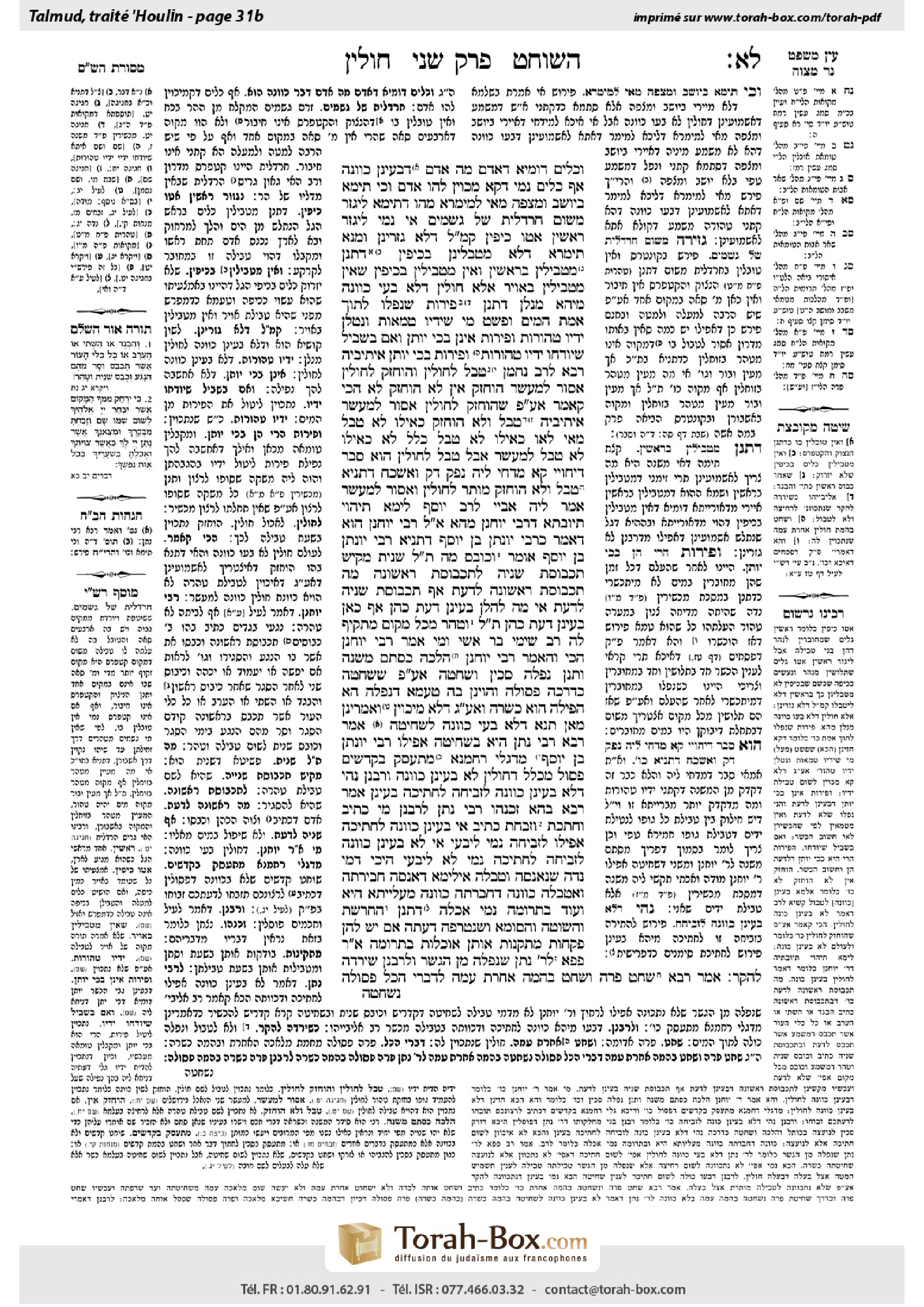
Chullin 31b: Talmud study for Daf Yomi
Study the Talmud for Daf Yomi with scanned pages, Hebrew text, English translations from Sefaria and AI-generated French translations.
Passage selection and English or AI-generated French translation are available where the scan has annotations. Daf Study is independent of Torah-Box and Sefaria.
Browse Chullin · חולין · All tractatesChullin 31b text and translations
This page of Chullin includes the Aramaic text, an English translation and an AI-generated French translation, alongside the scan above.
חולין ל״א ב · Aramaic and Hebrew text
וְכֵלִים דּוּמְיָא דְּאָדָם, מָה אָדָם דְּבָעֵינַן כַּוָּונָה, אַף כֵּלִים נָמֵי דְּקָא מְכַוֵּין לְהוּ אָדָם!
וְכִי תֵּימָא, בְּיוֹשֵׁב וּמְצַפֶּה, מַאי לְמֵימְרָא?
מַהוּ דְּתֵימָא: לִיגְזַר מִשּׁוּם חַרְדָּלִית שֶׁל גְּשָׁמִים, אִי נָמֵי לִיגְזַר רָאשִׁין אַטּוּ כִּיפִּין, קָא מַשְׁמַע לַן דְּלָא גָּזְרִינַן!
וּמְנָא תֵּימְרָא דְּלָא מַטְבְּלִינַן בְּכִיפִּין? דִּתְנַן: מַטְבִּילִין בְּרָאשִׁין, וְאֵין מַטְבִּילִין בְּכִיפִּין, שֶׁאֵין מַטְבִּילִין בָּאֲוִיר.
אֶלָּא חוּלִּין דְּלָא בָּעֵי כַּוָּונָה מִיהָא מְנָלַן? דִּתְנַן: פֵּירוֹת שֶׁנָּפְלוּ לְתוֹךְ אַמַּת הַמַּיִם, וּפָשַׁט מִי שֶׁיָּדָיו טְמֵאוֹת וּנְטָלָן – יָדָיו טְהוֹרוֹת, וּפֵירוֹת אֵינָן בְּ״כִי יוּתַּן״.
וְאִם בִּשְׁבִיל שֶׁיּוּדְחוּ יָדָיו – טְהוֹרוֹת, וּפֵירוֹת בְּ״כִי יוּתַּן״.
אֵיתִיבֵיהּ רָבָא לְרַב נַחְמָן: טָבַל לְחוּלִּין וְהוּחְזַק לְחוּלִּין – אָסוּר לְמַעֲשֵׂר. הוּחְזַק – אִין, לֹא הוּחְזַק – לָא.
הָכִי קָאָמַר: אַף עַל פִּי שֶׁהוּחְזַק לְחוּלִּין – אָסוּר לְמַעֲשֵׂר.
אֵיתִיבֵיהּ: טָבַל וְלֹא הוּחְזַק – כְּאִילּוּ לֹא טָבַל. מַאי לָאו: כְּאִילּוּ לֹא טָבַל כְּלָל?
לָא, כְּאִילּוּ לֹא טָבַל לְמַעֲשֵׂר, אֲבָל טָבַל לְחוּלִּין. הוּא סָבַר: דַּיחוֹיֵי קָא מְדַחֵי לֵיהּ. נְפַק דָּק וְאַשְׁכַּח, דְּתַנְיָא: טָבַל וְלֹא הוּחְזַק – מוּתָּר לַחוּלִּין וְאָסוּר לַמַּעֲשֵׂר.
אֲמַר לֵיהּ אַבָּיֵי לְרַב יוֹסֵף: לֵימָא תֶּיהְוֵי תְּיוּבְתָּא דְּרַבִּי יוֹחָנָן מֵהָא?
אֲמַר לֵיהּ: רַבִּי יוֹחָנָן הוּא דְּאָמַר כְּרַבִּי יוֹנָתָן בֶּן יוֹסֵף.
דְּתַנְיָא: רַבִּי יוֹנָתָן בֶּן יוֹסֵף אוֹמֵר: ״וְכוּבַּס״, מָה תַּלְמוּד לוֹמַר ״שֵׁנִית״? מַקִּישׁ תִּכְבּוֹסֶת שְׁנִיָּה לְתִכְבּוֹסֶת רִאשׁוֹנָה: מָה תִּכְבּוֹסֶת רִאשׁוֹנָה לְדַעַת, אַף תִּכְבּוֹסֶת שְׁנִיָּה לְדַעַת.
אִי מָה לְהַלָּן בָּעֵינַן דַּעַת כֹּהֵן, אַף כָּאן בָּעֵינַן דַּעַת כֹּהֵן? תַּלְמוּד לוֹמַר: ״וְטָהֵר״, מִכׇּל מָקוֹם.
מַתְקֵיף לַהּ רַב שִׁימִי בַּר אָשֵׁי: וּמִי אָמַר רַבִּי יוֹחָנָן הָכִי? וְהָאָמַר רַבִּי יוֹחָנָן: הֲלָכָה כִּסְתַם מִשְׁנָה.
וּתְנַן: נָפְלָה סַכִּין וְשָׁחֲטָה, אַף עַל פִּי שֶׁשָּׁחֲטָה כְּדַרְכָּהּ – פְּסוּלָה. וְהָוֵינַן בָּהּ: טַעְמָא דְּנָפְלָה, הָא הִפִּילָהּ הוּא – כְּשֵׁרָה, וְאַף עַל גַּב דְּלָא מִיכַּוֵּין. וְאָמְרִינַן: מַאן תַּנָּא דְּלָא בָּעֵי כַּוָּונָה לִשְׁחִיטָה? אָמַר רָבָא: רַבִּי נָתָן הִיא.
בִּשְׁחִיטָה, אֲפִילּוּ רַבִּי יוֹנָתָן בֶּן יוֹסֵף [מוֹדֵי], מִדְּגַלִּי רַחֲמָנָא מִתְעַסֵּק בְּקָדָשִׁים פָּסוּל – מִכְּלָל דְּחוּלִּין לָא בָּעֵינַן כַּוָּונָה.
וְרַבָּנַן, נְהִי דְּלָא בָּעֵינַן כַּוָּונָה לִזְבִיחָה, לַחֲתִיכָה בָּעֵינַן.
אָמַר רָבָא: בְּהָא זְכָנְהוּ רַבִּי נָתָן לְרַבָּנַן, מִי כְּתִיב ״וְחָתַכְתָּ״? ״וְזָבַחְתָּ״ כְּתִיב, אִי בָּעֵינַן כַּוָּונָה לַחֲתִיכָה – אֲפִילּוּ לִזְבִיחָה נָמֵי לִיבְעֵי, אִי לָא בָּעֵינַן כַּוָּונָה לִזְבִיחָה – לַחֲתִיכָה נָמֵי לָא לִיבְעֵי.
הֵיכִי דָּמֵי נִדָּה שֶׁנֶּאֶנְסָה וְטָבְלָה? אִילֵימָא דְּאַנְסַהּ חֲבִירְתַּהּ וְאַטְבְּלַהּ, כַּוָּונָה דַּחֲבִרְתַּהּ כַּוָּונָה מְעַלַּיְיתָא הִיא.
וְעוֹד, בִּתְרוּמָה נָמֵי אָכְלָה, דִּתְנַן: הַחֵרֶשֶׁת, וְהַשּׁוֹטָה, וְהַסּוֹמָא, וְשֶׁנִּטְרְפָה דַּעְתָּהּ, אִם יֵשׁ לָהֶן פִּקְּחוֹת מְתַקְּנוֹת אוֹתָן – אוֹכְלוֹת בִּתְרוּמָה.
אָמַר רַב פָּפָּא: לְרַבִּי נָתָן, שֶׁנָּפְלָה מִן הַגֶּשֶׁר, וּלְרַבָּנַן, שֶׁיָּרְדָה לְהָקֵר.
אָמַר רָבָא: שָׁחַט פָּרָה וְשָׁחַט בְּהֵמָה אַחֶרֶת עִמָּהּ, לְדִבְרֵי הַכֹּל פְּסוּלָה.
Chullin 31b · English translation
and vessels are similar to a person: Just as for a person, we require his intent for purification, so too for vessels, they are purified only in a case where a person intends for them to be purified.
And if you would say: If the mishna is referring to the case of one who sits and waits to determine when the wave will be detached, what is the purpose of stating this halakha? It is obvious and introduces no novel element.
The Gemara responds that there is a novel element in this halakha. Lest you say: Let us issue a decree that a detached wave does not effect purification due to the concern that otherwise, one would receive the mistaken impression that one is purified in a cascade [ḥardalit] of rainwater containing forty se’a. The halakha is that rainwater purifies only when pooled in one place. Alternatively, let us issue a decree that the edges of the waves, which are in contact with the ground, are ineffective in purifying people and vessels standing on the ground due to the concern that otherwise one would receive the mistaken impression that vessels are purified even if one pushes them upward into the arc of the waves while the water remains airborne. Therefore, the tanna teaches us that we do not issue either of those decrees.
And from where do you say that we do not immerse in the arcs of waves? As we learned in a baraita: One may immerse in the edges of waves, but one may not immerse in their arcs, as one may not immerse in air. Immersion may be performed only on the ground.
The Gemara again asks: But in any event, from where do we derive that non-sacred items do not require intent? The Gemara answers: It is as we learned in a mishna (Makhshirin 4:7): Produce becomes susceptible to ritual impurity only if it is dampened by one of seven liquids and its owner was amenable to its dampening. This is derived from the verse: “But when water is placed on the seed, and some of their carcass shall fall on it, it is impure to you” (Leviticus 11:38). If produce fell into a stream, and one whose hands were ritually impure extended his hands and took the produce from the water channel, his hands are ritually pure through immersion in the stream, and this produce is not in the category of: “But when water is placed.” The produce is not susceptible to ritual impurity because the owner did not intend that his hands become wet.
But if he placed his hands into the stream so that his hands would be rinsed and purified, his hands are ritually pure, and the produce is in the category of: “But when water is placed.” Since he was amenable to the dampening of his hands, the water on his hands renders the produce susceptible to ritual impurity. From the first case in the mishna it is clear that his hands are purified even though his intent was not to immerse them in the water.
Rava raised an objection to Rav Naḥman from a mishna (Ḥagiga 18b): If one immersed for the purpose of eating non-sacred food and assumed the presumptive status of ritual purity for non-sacred food, it is prohibited for him to partake of second-tithe produce. The Gemara infers: If one assumed the presumptive status of ritual purity with regard to non-sacred food, yes, it is permitted for him to eat non-sacred food; if he did not assume the presumptive status, he may not eat non-sacred food. This indicates that even when immersing in order to partake of non-sacred food, one must intend to assume the presumptive status of ritual purity.
Rav Naḥman rejects the proof from the mishna and says that no intent is required to assume the presumptive status of ritual purity in order to eat non-sacred food. Rather, this is what the mishna is saying: Although he assumes the presumptive status of ritual purity for non-sacred food, it is prohibited for him to partake of second-tithe produce.
Rava raised an objection to Rav Naḥman from that same mishna: If one immersed without intent to assume the presumptive status of ritual purity, it is as though he did not immerse. What, is the meaning of the mishna not that it is as though he did not immerse at all?
Rav Naḥman rejects that proof as well. No, it means that if he immersed without intent it is as though he did not immerse to partake of second-tithe produce, but in that case, he immersed for non-sacred food, for which no intent is necessary. The Gemara comments: Rava believed that Rav Naḥman was merely putting him off with his claim that the formulation of the mishna does not conclusively support his objection; he believed that Rav Naḥman was not stating the real meaning of the mishna. Rava then went out, examined the sources, and discovered that it is taught in a baraita explicitly in accordance with the opinion of Rav Naḥman: If one immersed and had no intent to assume the presumptive status of ritual purity, it is permitted for him to eat non-sacred food, but it is prohibited for him to partake of second-tithe produce.
Abaye said to Rav Yosef: Let us say that there will be a conclusive refutation of the opinion of Rabbi Yoḥanan from this baraita. This baraita states that immersion without intent is effective for non-sacred items, while Rabbi Yoḥanan said (31a) that if a woman who is impure due to menstruation immerses without intent she is forbidden to her husband, who is non-sacred.
Rav Yosef said to him: Indeed, the baraita is contrary to his opinion, but Rabbi Yoḥanan is saying his opinion in accordance with the opinion of Rabbi Yonatan ben Yosef.
As it is taught in a baraita with regard to the verse dealing with the purification of a leprous garment, which must be laundered, quarantined for a week, and then immersed in a ritual bath: “And the garment…that you shall wash and the leprosy departed from them, and it shall be washed a second time and shall be pure” (Leviticus 13:58). Rabbi Yonatan ben Yosef says: It would have been sufficient for the verse to simply state: And it shall be washed and shall be pure. For what purpose does the verse state: “A second time”? The Torah juxtaposes the second washing, the immersion, with the first washing, the laundering. Just as the first washing is performed with intent, as it is written: “And the priest shall command that they wash the garment that has the leprous mark, and he shall quarantine it seven days more” (Leviticus 13:54), so too, the second washing, the immersion in a ritual bath, must be performed with intent.
If so, based on the same juxtaposition, perhaps derive: Just as there, with regard to the first washing, we require the intent of a priest, who commands to wash the garment, so too here, with regard to the second washing, we require the intent of a priest. Therefore, the verse states: “And shall be pure” (Leviticus 13:58), indicating that there is purity in any case where there is intent, even without a command from a priest. In the opinion of Rabbi Yonatan ben Yosef, even the immersion of the non-sacred garment must be performed with intent. Rav Yosef states that Rabbi Yoḥanan bases his statement on Rabbi Yonatan ben Yosef’s opinion.
Rav Shimi bar Ashi objects to the association of the statement of Rabbi Yoḥanan with the opinion of Rabbi Yonatan ben Yosef: Did Rabbi Yoḥanan say that immersion of a non-sacred garment requires intent? But doesn’t Rabbi Yoḥanan say that the halakha is in accordance with an unattributed mishna?
And we learned in the mishna: If a knife fell and slaughtered an animal, although the knife slaughtered the animal in the standard manner, the slaughter is not valid. And we discussed it: The reason the slaughter is not valid is that the knife fell. But by inference, if one dropped the knife the slaughter is valid, and that is the ruling even though when dropping the knife he did not intend to slaughter the animal. And we say: Who is the tanna who holds that we do not require intent for slaughter? Rava said: It is Rabbi Natan. Based on his principle that the halakha is in accordance with an unattributed mishna, Rabbi Yoḥanan should rule in accordance with the opinion of Rabbi Natan cited in the unattributed mishna, and not in accordance with the opinion of Rabbi Yonatan ben Yosef.
The Gemara answers: With regard to slaughter, even Rabbi Yonatan ben Yosef concedes that intent is not necessary. He learns this from the fact that the Merciful One revealed that if one acts unawares in performing the slaughter of sacrificial animals, with no intent to slaughter, the offering is disqualified. This is derived (13a) from the verse: “You shall slaughter it to your will” (Leviticus 19:5). By inference, conclude that with regard to the slaughter of non-sacred animals we do not require intent.
While on this subject the Gemara clarifies: And the Rabbis who disagree with Rabbi Natan and hold that slaughter of non-sacred animals requires intent would say: Although we do not require intent to slaughter non-sacred animals, we require intent to cut the neck of the animal. Throwing the knife down is not sufficient.
Rava said that it was with this contention that Rabbi Natan overcame the Rabbis: He said: Is it written with regard to the slaughter of non-sacred animals: And you shall cut? It is written: “And you shall slaughter” (Deuteronomy 12:21). The Torah does not distinguish between cutting and slaughtering; if we require intent for cutting, we should require intent even for slaughtering. Conversely, if we do not require intent for slaughtering, we should also not require intent for cutting.
The Gemara revisits the matter of immersion without intent. What are the circumstances of a menstruating woman who, after the menstrual flow ended, was compelled against her will and immersed in a ritual bath? If we say that another woman compelled her and immersed her in a ritual bath, the immersion should be valid even according to the opinion of Rabbi Yoḥanan, as the intent of another woman is full-fledged intent.
And furthermore, in that case the immersion enables her to partake of teruma as well, as we learned in a mishna (Nidda 13b): In the case of a woman who is a deaf-mute, or an imbecile, or blind, or who went insane, and is therefore unable to examine herself reliably, if one of these women has a competent friend, that friend prepares her by examining her and immersing them in a ritual bath. And on that basis the incompetent woman may partake of teruma.
Rav Pappa said: According to Rabbi Natan, who does not require intent for the slaughter of non-sacred animals, immersion against her will that renders it permitted for a woman to engage in intercourse with her husband is in a case where she fell from a bridge into a river, with no intent at all. According to the Rabbis, who require intent to cut for slaughter to be valid and intent to enter the water for immersion to be valid, it is referring to a case where she descended into the water to cool herself, with no thought of purification.
The Gemara continues its discussion of the dispute between Rabbi Natan and the Rabbis. Rava said: If one slaughtered a red heifer and in the same action slaughtered another animal together with it, everyone agrees that the red heifer is disqualified.
Chullin 31b · Traduction française (IA)
et les vases sont semblables à une personne : tout comme pour une personne, nous exigeons son intention pour la purification, de même les vases sont purifiés uniquement dans le cas où une personne a l'intention de les purifier.
et si l'on dit : si la Michna fait référence au cas d'une personne qui s'assoit et attend pour déterminer quand la vague se détachera, à quoi sert-il de mentionner cette halakha ? c'est évident et ne présente aucun élément nouveau.
la Guemara répond que cette halakha présente un élément nouveau. de peur que l'on ne dise : faisons une déclaration selon laquelle une vague détachée ne produit pas la purification en raison de la crainte que sinon, on puisse avoir une impression erronée que l'on est purifié dans une cascade d'eau de pluie contenant quarante se'ah. la halakha est que l'eau de pluie purifie uniquement quand elle est réunie en un seul lieu. alternativement, faisons une déclaration selon laquelle les bords des vagues, qui sont en contact avec le sol, sont inefficaces pour la purification des personnes et des vases qui sont sur le sol en raison de la crainte que sinon, on puisse avoir une impression erronée que les vases sont purifiés même si l'on les pousse vers le haut dans l'arc des vagues pendant que l'eau reste en l'air. ainsi, le tanna nous enseigne que nous ne faisons pas l'une ou l'autre de ces déclarations.
Et d'où dit-on que l'on ne plonge pas dans les arcs des vagues ? Comme nous avons appris dans une baraïta : On peut plonger dans les bords des vagues, mais on ne peut pas plonger dans leurs arcs, car on ne plonge pas dans l'air. La plongée peut être effectuée uniquement sur le sol.
La Guemara pose à nouveau une question : Mais en tout cas, d'où dérive-t-on que les objets non sacrés n'exigent pas d'intention ? La Guemara répond : C'est comme nous avons appris dans une Michna (Makhshirin 4:7) : Les produits deviennent sujets à l'impureté rituelle uniquement s'ils sont mouillés par l'un des sept liquides et leur propriétaire était favorable à leur mouillement. Cela est dérivé du verset : « Mais quand de l'eau est versée sur la semence, et que quelque partie de leur carcasse tombe dessus, cela est impur pour vous » (Lévitique 11:38). Si un produit tombe dans un cours d'eau, et qu'une personne dont les mains sont impures rituellement étend ses mains et prend le produit du canal d'eau, ses mains sont purifiées par la plongée dans le cours d'eau, et ce produit n'est pas dans la catégorie de : « Mais quand de l'eau est versée. » Le produit n'est pas sujet à l'impureté rituelle car le propriétaire n'avait pas l'intention que ses mains deviennent humides.
Mais si l'on plonge ses mains dans le cours d'eau de sorte que ses mains soient rincées et purifiées, ses mains sont purifiées rituellement, et le produit est dans la catégorie de : « Mais quand de l'eau est versée. » Puisque l'on était favorable au mouillement de ses mains, l'eau sur ses mains rend le produit sujet à l'impureté rituelle. Du premier cas de la Michna, il est clair que ses mains sont purifiées même si son intention n'était pas de les plonger dans l'eau.
Rava a soulevé une objection contre Rav Naḥman à partir d'une Michna (Ḥagiga 18b) : Si l'on s'est plongé pour manger des aliments non sacrés et a assumé le statut présomptif de pureté rituelle pour les aliments non sacrés, il est interdit de manger les fruits de la deuxième tithe. La Guemara infère : Si l'on a assumé le statut présomptif de pureté rituelle concernant les aliments non sacrés, oui, il est permis de manger des aliments non sacrés ; si l'on n'a pas assumé le statut présomptif, on ne peut pas manger des aliments non sacrés. Cela indique que même lors de la plongée pour manger des aliments non sacrés, l'intention d'assumer le statut présomptif de pureté rituelle est nécessaire.
Rav Naḥman rejette la preuve tirée de la Michna et dit que l'intention n'est pas nécessaire pour assumer le statut présomptif de pureté rituelle afin de manger des aliments non sacrés. Plutôt, c'est ce que la Michna dit : Bien qu'il assume le statut présomptif de pureté rituelle pour les aliments non sacrés, il est interdit de manger les fruits de la deuxième tithe.
Rava a soulevé une objection contre Rav Naḥman à partir de la même Michna : Si l'on s'est plongé sans intention d'assumer le statut présomptif de pureté rituelle, c'est comme si l'on n'avait pas plongé. Qu'est-ce que cela signifie que la Michna ne dit pas que c'est comme si l'on n'avait pas plongé du tout ?
Rav Naḥman rejette cette preuve également. Non, cela signifie que si l'on s'est plongé sans intention, c'est comme si l'on n'avait pas plongé pour manger les fruits de la deuxième tithe, mais dans ce cas, l'on s'est plongé pour les aliments non sacrés, pour lesquels l'intention n'est pas nécessaire. La Guemara commente : Rava croyait que Rav Naḥman était simplement le mettre en déroute avec son affirmation que la formulation de la Michna ne soutient pas clairement son objection ; il croyait que Rav Naḥman ne disait pas la vraie signification de la Michna. Rava est alors sorti, a examiné les sources, et a découvert que cela est enseigné dans une baraïta explicitement selon l'opinion de Rav Naḥman : Si l'on s'est plongé sans intention d'assumer le statut présomptif de pureté rituelle, il est permis de manger des aliments non sacrés, mais il est interdit de manger les fruits de la deuxième tithe.
Abaye a dit à Rav Yosef : Disons que cela fournira une réfutation conclusive de l'opinion de Rabbi Yoḥanan à partir de cette baraïta. Cette baraïta dit que la plongée sans intention est efficace pour les objets non sacrés, tandis que Rabbi Yoḥanan a dit (31a) que si une femme impure à cause de ses règles s'immerge sans intention, elle est interdite à son mari, qui est non sacré.
Rav Yosef a dit à lui : En effet, la baraïta est contraire à son opinion, mais Rabbi Yoḥanan dit son opinion selon l'opinion de Rabbi Yonatan ben Yosef.
Comme il est enseigné dans une baraïta concernant la paracha traitant de la purification d'un vêtement souffrant de tumeur, qui doit être lavé, isolé pendant une semaine et ensuite immergé dans un mikvé : « Et le vêtement… que tu laveras et la tumeur s'en ira, et il sera lavé une seconde fois et sera pur » (Lévitique 13:58). Rabbi Yonatan ben Yosef dit : Il aurait suffi que la paracha ait simplement dit : « Et il sera lavé et sera pur ». À quel but la paracha mentionne-t-elle « une seconde fois » ? La Torah juxtapose le second lavage, l'immersion, avec le premier lavage, le lavage. Tout comme le premier lavage est effectué avec l'intention, comme il est écrit : « Et le prêtre commandera qu'on lave le vêtement marqué de tumeur, et il le séquillera sept jours de plus » (Lévitique 13:54), de même, le second lavage, l'immersion dans le mikvé, doit être effectué avec l'intention.
Si c'est ainsi, en vertu de la même juxtaposition, peut-on déduire : Tout comme là, concernant le premier lavage, nous exigeons l'intention du prêtre, qui commande de laver le vêtement, de même ici, concernant le second lavage, nous exigeons l'intention du prêtre. Ainsi, la paracha dit : « Et sera pur » (Lévitique 13:58), indiquant qu'il y a pureté dans tout cas où il y a intention, même sans ordre du prêtre. Selon l'opinion de Rabbi Yonatan ben Yosef, même l'immersion d'un vêtement non sacré doit être effectuée avec intention. Rav Yosef dit que Rabbi Yoḥanan base son opinion sur celle de Rabbi Yonatan ben Yosef.
Rav Shimi bar Ashi s'oppose à l'association de l'opinion de Rabbi Yoḥanan avec celle de Rabbi Yonatan ben Yosef : Rabbi Yoḥanan a-t-il dit que l'immersion d'un vêtement non sacré exige l'intention ? Mais ne dit-il pas que la halakha suit une mishna non attribuée ?
Et nous avons appris dans la michna : Si un couteau tombe et tue un animal, bien que le couteau ait tué l'animal de manière normale, la tue n'est pas valide. Et nous avons discuté cela : La raison pour laquelle la tue n'est pas valide est que le couteau est tombé. Mais par déduction, si l'on a fait tomber le couteau, la tue est valide, et c'est la décision même si lors de la chute du couteau on n'avait pas l'intention de tuer l'animal. Et nous disons : Qui est le tanna qui considère que l'intention n'est pas nécessaire pour la tue ? Rava dit : C'est Rabbi Natan. Sur la base de son principe que la halakha suit une michna non attribuée, Rabbi Yoḥanan devrait décider selon l'opinion de Rabbi Natan cité dans la michna non attribuée, et non selon celle de Rabbi Yonatan ben Yosef.
La Guemara répond : Concernant la tue, même Rabbi Yonatan ben Yosef reconnaît que l'intention n'est pas nécessaire. Il en tire la conclusion à partir du fait que l'Éternel a révélé que si l'on agit sans intention lors de la tue des animaux sacrés, sans intention de tuer, l'offrande est disqualifiée. Cela est déduit (13a) de la paracha : « Tu tueras selon ton désir » (Lévitique 19:5). Par déduction, on conclut que concernant la tue des animaux non sacrés, on n'exige pas l'intention.
Tout en discutant ce sujet, la Guemara clarifie : Et les Rabbins qui s'opposent à Rabbi Natan et qui considèrent que la tue des animaux non sacrés exige l'intention diraient : Bien que nous n'exigions pas l'intention pour la tue des animaux non sacrés, nous exigeons l'intention pour couper le cou de l'animal. Lancer le couteau est insuffisant.
Rava dit que c'est avec cette contestation que Rabbi Natan a vaincu les Rabbins : Il dit : Est-il écrit concernant la tue des animaux non sacrés : « Et tu tues » (Dix-neufième chapitre de Deutéronome 12:21) ? La Torah ne distingue pas entre couper et tuer ; si nous exigeons l'intention pour couper, nous devrions exigeons l'intention même pour tuer. À l'inverse, si nous n'exigeons pas l'intention pour tuer, nous devrions aussi ne pas exiger l'intention pour couper.
La Guemara reprend la question de l'immersion sans intention. Quelles sont les circonstances d'une femme en cours de menstruation qui, après la fin du flux, a été contrainte contre sa volonté et s'est immergée dans un mikvé ? Si nous disons qu'une autre femme l'a contrainte et l'a immergée dans un mikvé, l'immersion devrait être valide même selon l'opinion de Rabbi Yoḥanan, car l'intention d'une autre femme est une intention complète.
Et de plus, dans ce cas, l'immersion permet à la femme de consommer la terouma, comme nous avons appris dans une mishna (Nidda 13b) : Dans le cas d'une femme sourde, ou d'une imbécile, ou aveugle, ou devenue folle, et donc incapable d'examiner correctement, si l'une de ces femmes a un ami compétent, ce dernier l'examine et l'immerge dans un mikvé. Et sur cette base, la femme incapable peut consommer la terouma.
Rav Pappa dit : Selon Rabbi Natan, qui ne nécessite pas l'intention pour la tue des animaux non sacrés, l'immersion contre sa volonté qui rend permis à une femme de s'unir à son mari est dans le cas où elle est tombée d'un pont dans un fleuve, sans intention du tout. Selon les Rabbins, qui exigent l'intention pour couper pour que la tue soit valide et l'intention d'entrer dans l'eau pour que l'immersion soit valide, cela fait référence à un cas où elle est descendue dans l'eau pour se rafraîchir, sans penser à la purification.
La Guemara continue sa discussion du débat entre Rabbi Natan et les Rabbins. Rava dit : Si l'on a sacrifié une bête rouge et, dans la même action, a sacrifié un autre animal avec elle, tout le monde convient que la bête rouge est disqualifiée.
Traduction française générée par IA à partir de l’édition anglaise de Sefaria. Vérifie toujours un passage avec le texte source.
Text from Sefaria: William Davidson Edition - Vocalized Aramaic (unknown); William Davidson Edition - English (CC BY NC).