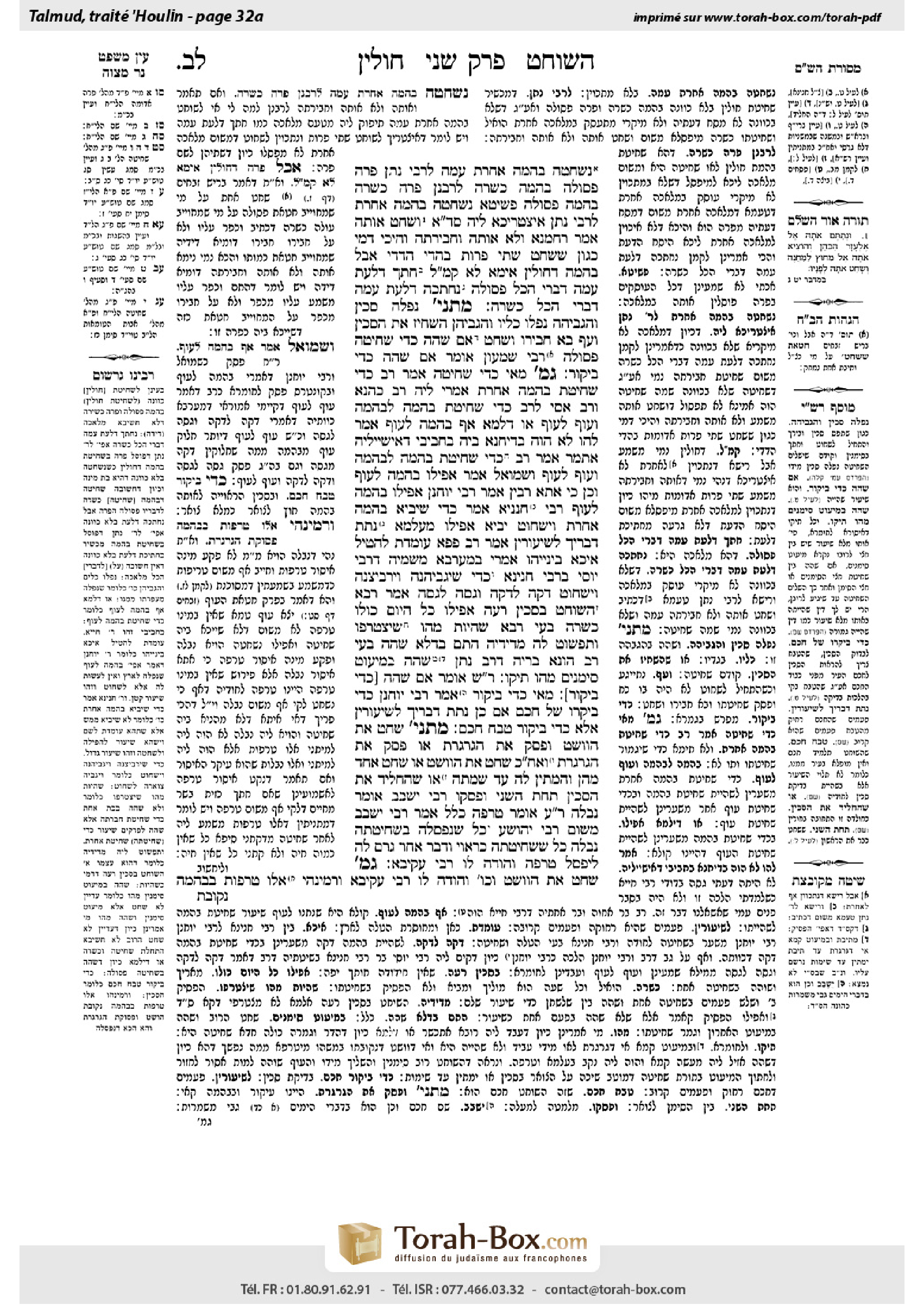
Chullin 32a: Talmud study for Daf Yomi
Study the Talmud for Daf Yomi with scanned pages, Hebrew text, English translations from Sefaria and AI-generated French translations.
Passage selection and English or AI-generated French translation are available where the scan has annotations. Daf Study is independent of Torah-Box and Sefaria.
Browse Chullin · חולין · All tractatesChullin 32a text and translations
This page of Chullin includes the Aramaic text, an English translation and an AI-generated French translation, alongside the scan above.
חולין ל״ב א · Aramaic and Hebrew text
נִשְׁחֲטָה בְּהֵמָה אַחֶרֶת עִמָּהּ, לְרַבִּי נָתָן – פָּרָה פְּסוּלָה בְּהֵמָה כְּשֵׁרָה, לְרַבָּנַן – פָּרָה כְּשֵׁרָה בְּהֵמָה פְּסוּלָה.
פְּשִׁיטָא! נִשְׁחֲטָה בְּהֵמָה אַחֶרֶת לְרַבִּי נָתָן אִיצְטְרִיכָא לֵיהּ, סָלְקָא דַּעְתָּךְ אָמֵינָא: ״וְשָׁחַט אוֹתָהּ״ אָמַר רַחֲמָנָא, וְלֹא אוֹתָהּ וַחֲבֶירְתָּהּ, וְהֵיכִי דָּמֵי – כְּגוֹן שֶׁשָּׁחַט שְׁתֵּי פָּרוֹת בַּהֲדֵי הֲדָדֵי, אֲבָל בְּהֵמָה דְּחוּלִּין אֵימָא לָא, קָא מַשְׁמַע לַן.
חָתַךְ דַּלַּעַת עִמָּהּ – דִּבְרֵי הַכֹּל פְּסוּלָה, נֶחְתְּכָה דַּלַּעַת עִמָּהּ – דִּבְרֵי הַכֹּל כְּשֵׁרָה.
מַתְנִי׳ נָפְלָה סַכִּין וְהִגְבִּיהָהּ, נָפְלוּ כֵּלָיו וְהִגְבִּיהָן, הִשְׁחִיז אֶת הַסַּכִּין וְעָף, בָּא חֲבֵירוֹ וְשָׁחַט, אִם שָׁהָה כְּדֵי שְׁחִיטָה – פְּסוּלָה. רַבִּי שִׁמְעוֹן אוֹמֵר: אִם שָׁהָה כְּדֵי בִיקּוּר.
גְּמָ׳ מַאי כְּדֵי שְׁחִיטָה? אָמַר רַב: כְּדֵי שְׁחִיטַת בְּהֵמָה אַחֶרֶת.
אָמְרִי לֵיהּ רַב כָּהֲנָא וְרַב אַסִּי לְרַב: כְּדֵי שְׁחִיטַת בְּהֵמָה לִבְהֵמָה, וְעוֹף לְעוֹף, אוֹ דִלְמָא אַף בְּהֵמָה לְעוֹף?
אֲמַר לְהוּ: לָא הֲוָה בְּדִיחְנָא בֵּיהּ בְּחַבִּיבִי, דֶּאֱישַׁיְּילֵיהּ.
אִתְּמַר: אָמַר רַב: כְּדֵי שְׁחִיטַת בְּהֵמָה לִבְהֵמָה, וְעוֹף לְעוֹף, וּשְׁמוּאֵל אָמַר: אֲפִילּוּ בְּהֵמָה לְעוֹף, וְכֵן כִּי אֲתָא רָבִין אָמַר רַבִּי יוֹחָנָן: אֲפִילּוּ בְּהֵמָה לְעוֹף.
רַבִּי חֲנַנְיָא אָמַר: כְּדֵי שֶׁיָּבִיא בְּהֵמָה אַחֶרֶת וְיִשְׁחוֹט. יָבִיא אֲפִילּוּ מֵעָלְמָא? נָתַתָּ דְּבָרֶיךָ לְשִׁיעוּרִין!
אָמַר רַב פָּפָּא: עוֹמֶדֶת לְהַטִּיל אִיכָּא בֵּינַיְיהוּ.
אָמְרִי בְּמַעְרְבָא מִשְּׁמֵיהּ דְּרַבִּי יוֹסֵי בְּרַבִּי חֲנִינָא: כְּדֵי שֶׁיַּגְבִּיהֶנָּה וְיַרְבִּיצֶנָּה וְיִשְׁחוֹט, דַּקָּה לְדַקָּה וְגַסָּה לְגַסָּה.
אָמַר רָבָא: הַשּׁוֹחֵט בְּסַכִּין רָעָה, אֲפִילּוּ כׇּל הַיּוֹם כּוּלּוֹ – כְּשֵׁרָה.
בָּעֵי רָבָא: שְׁהִיּוֹת, מַהוּ שֶׁיִּצְטָרְפוּ?
וְתִפְשׁוֹט לַהּ מִדִּידֵיהּ! הָתָם בִּדְלָא שְׁהָה.
בָּעֵי רַב הוּנָא בְּרֵיהּ דְּרַב נָתָן: שָׁהָה בְּמִיעוּט סִימָנִין, מַהוּ? תֵּיקוּ.
רַבִּי שִׁמְעוֹן אוֹמֵר: אִם שָׁהָה [כְּדֵי בִיקּוּר]. מַאי כְּדֵי בִיקּוּר? אָמַר רַבִּי יוֹחָנָן: כְּדֵי בִּיקֻּרוֹ שֶׁל חָכָם. אִם כֵּן, נָתַתָּ דְּבָרֶיךָ לְשִׁיעוּרִין! אֶלָּא, כְּדֵי בִּיקּוּר טַבָּח חָכָם.
מַתְנִי׳ שָׁחַט אֶת הַוֶּושֶׁט, וּפָסַק אֶת הַגַּרְגֶּרֶת, אוֹ פָסַק אֶת הַגַּרְגֶּרֶת וְאַחַר כָּךְ שָׁחַט אֶת הַוֶּושֶׁט, אוֹ שָׁחַט אֶחָד מֵהֶן וְהִמְתִּין לָהּ עַד שֶׁמֵּתָה, אוֹ שֶׁהֶחְלִיד אֶת הַסַּכִּין תַּחַת הַשֵּׁנִי וּפְסָקוֹ – רַבִּי יְשֵׁבָב אוֹמֵר: נְבֵלָה, רַבִּי עֲקִיבָא אוֹמֵר: טְרֵפָה.
כְּלָל אָמַר רַבִּי יְשֵׁבָב מִשּׁוּם רַבִּי יְהוֹשֻׁעַ: כֹּל שֶׁנִּפְסְלָה בִּשְׁחִיטָתָהּ – נְבֵלָה, כֹּל שֶׁשְּׁחִיטָתָהּ כָּרָאוּי וְדָבָר אַחֵר גָּרַם לָהּ לִיפָּסֵל – טְרֵפָה, וְהוֹדָה לוֹ רַבִּי עֲקִיבָא.
גְּמָ׳ שָׁחַט אֶת הַוֶּושֶׁט וְכוּ׳. וְהוֹדָה לוֹ רַבִּי עֲקִיבָא. וּרְמִינְהִי: אֵלּוּ טְרֵפוֹת בַּבְּהֵמָה
Chullin 32a · English translation
But if another animal was inadvertently slaughtered together with the red heifer in the same action, according to Rabbi Natan, who holds that the slaughter of non-sacred animals without intent is valid, the red heifer is disqualified, because an additional labor was performed with its slaughter, and the other animal is fit for consumption, as its slaughter was valid. According to the Rabbis, who hold that slaughter of non-sacred animals without intent is not considered slaughter, the red heifer is fit for use in the purification rite because no other labor was performed with its slaughter, and the other animal is unfit for consumption.
The Gemara asks: That is obvious; why did Rava have to teach that? The Gemara answers: It was necessary for Rava to teach the halakha according to the opinion of Rabbi Natan in the case where another animal was inadvertently slaughtered in the same action with the red heifer. It may enter your mind to say: The Merciful One states with regard to the slaughter of the red heifer: “And you shall give it to Elazar the priest…and he shall slaughter it before him” (Numbers 19:3), from which it is inferred: One may slaughter it, but not it and another animal simultaneously. And what are the circumstances of that prohibition? It is a case where one slaughtered two red heifers at the same time. But in a case where one slaughtered a red heifer together with a non-sacred animal, say no, that it does not disqualify the red heifer. Therefore, Rava teaches us that even slaughter with a non-sacred animal disqualifies the red heifer.
Rava adds: If one slaughtered a red heifer and in the same action cut a gourd together with it, everyone agrees that the red heifer is disqualified. If one slaughtered a red heifer and a gourd was inadvertently cut together with it in the same action, everyone agrees that the red heifer is fit for use in the purification rite, as that is not labor that disqualifies a red heifer and it is also not excluded by the derivation from the verse “And he shall slaughter it.”
MISHNA: If, when one was in the middle of slaughtering an animal, the knife fell and he lifted it and then completed the slaughter, or if his garments fell and he lifted them and then completed the slaughter, or if he had honed the knife and grew weary before completing the slaughter and another came and slaughtered the animal, if he interrupted the slaughter in one of these ways or in a different way for an interval equivalent to the duration of an act of slaughter, the slaughter is not valid. Rabbi Shimon says: The slaughter is not valid if he interrupted the slaughter for an interval equivalent to the duration of an examination.
GEMARA: The Gemara asks: What is the meaning of an interval equivalent to the duration of an act of slaughter? Rav said: It means an interval equivalent to the duration of an act of slaughter of another animal, not the duration required to complete the act of slaughter that was interrupted.
Rav Kahana and Rav Asi said to Rav: Is the interruption that invalidates the slaughter an interval equivalent to the duration of an act of slaughter of another animal for an animal, i.e., in a case where an animal was being slaughtered, and an interval equivalent to the duration of an act of slaughter of another bird for a bird? Or perhaps it is an interval equivalent to the duration of an act of slaughter of an animal even for a bird, and if the interruption is any shorter it does not invalidate the slaughter?
Rav said to them: When we studied this topic I did not feel sufficiently intimate with my beloved uncle, Rabbi Ḥiyya, such that I could ask him that question. Rav was able only to transmit that which he heard from Rabbi Ḥiyya, but was unable to resolve their dilemma.
It was stated that there is an amoraic dispute with regard to this matter. Rav said: An interval equivalent to the duration of an act of slaughter of another animal for an animal, and an interval equivalent to the duration of an act of slaughter of another bird for a bird. And Shmuel said: An interval equivalent to the duration of an act of slaughter of an animal even for a bird. And likewise, when Ravin came from Eretz Yisrael to Babylonia he said that Rabbi Yoḥanan said: An interval equivalent to the duration of an act of slaughter of an animal even for a bird.
Rabbi Ḥananya said: An interval equivalent to the period in which one can bring another animal and slaughter it. The Gemara asks: Does that mean the time in which one can bring an animal even from anywhere else, regardless of the distance? Occasionally, there is no animal available in close proximity. If so, you have rendered your statement subject to circumstances; it does not apply uniformly to all cases.
Rav Pappa said: The practical difference between the opinion of Rabbi Ḥananya and that of the other Sages is in a case where there is an animal standing before the slaughterer and it is necessary to cast it to the ground in order to slaughter it. Even Rabbi Ḥananya disregards the time required to bring the animal from elsewhere. But Rabbi Ḥananya holds that the slaughter is invalidated only if the interruption lasts an interval equivalent to the duration of the act of casting the animal to the ground and slaughtering it. The Rabbis invalidate the slaughter even if an interval has elapsed that is equivalent to the duration of the act of slaughtering the animal, without casting it to the ground.
The Gemara cites an additional opinion with regard to the duration of the interruption that invalidates slaughter. They said in the West, Eretz Yisrael, in the name of Rabbi Yosei, son of Rabbi Ḥanina: The duration of the interruption that invalidates slaughter is equivalent to the period in which he can lift the animal from the ground and then lay it back on the ground and slaughter it. The interval is calculated based on the size of the animal in question. The duration of the interruption that invalidates slaughter of a small animal is equivalent to the period necessary to lift, lay down, and slaughter a small animal. And the duration of the interruption that invalidates slaughter of a large animal is equivalent to the period necessary to lift, lay down, and slaughter a large animal.
§ Rava said: In the case of one who slaughters with a blunt knife, even if the completion of the slaughter lasts the entire day, the slaughter is valid provided there is no interruption in the midst of the slaughter.
Rava raises a dilemma: If there were several short interruptions during a single act of slaughter, what is the halakha in terms of whether they join together to invalidate the slaughter if the sum of the durations of all the interruptions is greater than the maximum permitted interruption?
The Gemara challenges: And let Rava resolve the dilemma from his own statement, as he permitted an act of slaughter that lasts the entire day, during which there were presumably brief interruptions throughout. Apparently, the interruptions do not join together. The Gemara responds: There, Rava was referring to a case where there was no interruption, as the slaughterer drew the knife back and forth throughout.
Rav Huna, son of Rav Natan, raises a dilemma: If one cut the majority of the simanim and then interrupted the slaughter before proceeding to cut the minority of the simanim, what is the halakha? The Gemara answers: The dilemma shall stand unresolved.
§ The mishna teaches that Rabbi Shimon says: The slaughter is not valid if he interrupted the slaughter for an interval equivalent to the duration of an examination. The Gemara asks: What is an interval equivalent to the duration of an examination? Rabbi Yoḥanan said: It is an interval equivalent to the duration of an examination of the knife by a Sage prior to the slaughter of the animal. The Gemara objects: If so, you have rendered your statement subject to circumstances, as sometimes the Sage is near and sometimes the Sage is far, and the time required for examination varies accordingly. The Gemara responds: Rather, the reference is to an interval equivalent to the duration of an examination performed by a slaughterer who is a Sage. In that case, travel time is not factored in; only the time of the examination itself is considered, and this does not vary.
MISHNA: If one cut the gullet in the standard manner of slaughter with a back-and-forth movement, and he severed the windpipe not in the standard manner, or if one severed the windpipe and thereafter cut the gullet, or if one cut one of the simanim and waited until the animal died, or if one cut one siman and concealed the knife beneath the second siman and severed it from below, Rabbi Yeshevav says: The animal is an unslaughtered carcass and imparts ritual impurity through contact with it and carrying it. Rabbi Akiva says: The animal is a tereifa, and although eating it is prohibited, it does not transmit ritual impurity.
Rabbi Yeshevav stated a principle in the name of Rabbi Yehoshua: Any animal that was rendered unfit during its slaughter because the slaughter was not performed properly is an unslaughtered carcass; any animal whose slaughter was performed properly and another matter caused it to become unfit is a tereifa. And Rabbi Akiva conceded to his opinion.
GEMARA: The mishna teaches: If one cut the gullet…and Rabbi Akiva conceded to his opinion. And the Gemara raises a contradiction from a mishna at the beginning of the next chapter (42a): These wounds constitute tereifot in an animal:
Chullin 32a · Traduction française (IA)
Mais si un autre animal a été accidentellement tué avec la vache rouge dans la même action, selon Rabbi Natan, qui considère que la mise à mort d'animaux non sacrés sans intention est valide, la vache rouge est inéligible, car un autre travail a été accompli avec sa mise à mort, et l'autre animal est propre à la consommation, car sa mise à mort était valide. Selon les Rabbins, qui considèrent que la mise à mort d'animaux non sacrés sans intention n'est pas considérée comme une mise à mort, la vache rouge est éligible pour l'usage dans le rite de purification, car aucun autre travail n'a été accompli avec sa mise à mort, et l'autre animal n'est pas propre à la consommation.
La Guemara demande : Cela est évident ; pourquoi Rava a-t-il dû enseigner cela ? La Guemara répond : Il était nécessaire que Rava enseigne la halakha selon l'opinion de Rabbi Natan dans le cas où un autre animal a été accidentellement tué dans la même action que la vache rouge. Il peut entrer en vous l'idée de dire : L'Éternel dit concernant la mise à mort de la vache rouge : « Et tu lui donneras à Eléazar le prêtre, et il le sacrifiera devant lui » (Nombres 19:3), d'où on déduit : On peut la sacrifier, mais pas elle et un autre animal en même temps. Et quels sont les circonstances de cette interdiction ? C'est le cas où on a sacrifié deux vaches rouges en même temps. Mais dans le cas où on a sacrifié une vache rouge avec un animal non sacré, disons non, cela ne rend pas la vache rouge inéligible. Ainsi, Rava nous enseigne que même la mise à mort avec un animal non sacré rend la vache rouge inéligible.
Rava ajoute : Si on a immolé une vache rouge et qu'en même temps on a coupé un citron avec elle, tout le monde convient que la vache rouge est inéligible. Si on a immolé une vache rouge et qu'un citron a été accidentellement coupé avec elle en même temps, tout le monde convient que la vache rouge est éligible pour l'usage dans le rite de purification, car cela n'est pas un travail qui rend inéligible une vache rouge et cela n'est pas exclu par la dérivation du verset « Et il le sacrifiera ».
MICHNA : Si, lorsqu'on était en plein immolation d'un animal, le couteau est tombé et qu'on l'a soulevé puis a terminé l'immolation, ou si ses vêtements sont tombés et qu'on les a soulevés puis a terminé l'immolation, ou si on avait affûté le couteau et s'était fatigué avant d'avoir terminé l'immolation et qu'un autre est venu immoler l'animal, si on a interrompu l'immolation de l'une de ces manières ou d'une autre manière pendant un intervalle équivalent à la durée d'un acte d'immolation, l'immolation n'est pas valide. Rabbi Shimon dit : L'immolation n'est pas valide si on a interrompu l'immolation pendant un intervalle équivalent à la durée d'une inspection.
GUEMARA : La Guemara demande : Qu'entend-on par un intervalle équivalent à la durée d'un acte d'immolation ? Rav dit : Cela signifie un intervalle équivalent à la durée d'un acte d'immolation d'un autre animal, pas la durée nécessaire pour terminer l'acte d'immolation interrompu.
Rav Kahana et Rav Asi dirent à Rav : L'interruption qui annule la boucherie est-elle un intervalle équivalent à la durée d'un acte de boucherie d'un autre animal pour un animal, c'est-à-dire dans le cas où un animal était en train d'être bouché, et un intervalle équivalent à la durée d'un acte de boucherie d'un autre oiseau pour un oiseau ? Ou peut-être est-ce un intervalle équivalent à la durée d'un acte de boucherie d'un animal même pour un oiseau, et si l'interruption est plus courte, cela ne rend pas la boucherie invalide ?
Rav dit à eux : Quand nous avons étudié ce sujet, je n'ai pas ressenti suffisamment de familiarité avec mon cher oncle, Rabbi Ḥiyya, pour pouvoir poser cette question. Rav n'avait que la transmission de ce qu'il avait entendu de Rabbi Ḥiyya, mais n'avait pas la capacité de résoudre leur dilemme.
Il a été dit qu'il y a un débat entre les amoraïm concernant cette question. Rav dit : Un intervalle équivalent à la durée d'un acte de boucherie d'un autre animal pour un animal, et un intervalle équivalent à la durée d'un acte de boucherie d'un autre oiseau pour un oiseau. Et Shmuel dit : Un intervalle équivalent à la durée d'un acte de boucherie d'un animal même pour un oiseau. De même, lorsque Rabin est venu de la Terre d'Israël en Babylone, il a dit que Rabbi Yoḥanan a dit : Un intervalle équivalent à la durée d'un acte de boucherie d'un animal même pour un oiseau.
Rabbi Ḥananya dit : Un intervalle équivalent à la période pendant laquelle on peut apporter un autre animal et le sacrifier. La Guemara demande : Cela signifie-t-il le temps pendant lequel on peut apporter un animal même d'ailleurs, indépendamment de la distance ? Parfois, il n'y a pas d'animal disponible à proximité. Si c'est le cas, vous avez rendu votre déclaration conditionnelle ; elle ne s'applique pas uniformément à tous les cas.
Rav Pappa dit : La différence pratique entre l'opinion de Rabbi Ḥananya et celle des autres Sages est dans le cas où un animal est debout devant le sacrificateur et qu'il est nécessaire de le jeter au sol pour le sacrifier. Même Rabbi Ḥananya néglige le temps requis pour apporter l'animal d'ailleurs. Rabbi Ḥananya considère que le sacrifice est invalidé uniquement si l'interruption dure un intervalle équivalent à la durée de l'acte de jeter l'animal au sol et de le sacrifier. Les Rabbins invalident le sacrifice même si un intervalle s'est écoulé équivalent à la durée de l'acte de sacrifier l'animal sans le jeter au sol.
La Guemara cite un autre avis concernant la durée de l'interruption qui annule la boucherie. Ils dirent à l'Ouest, en Terre d'Israël, en nom de Rabbi Yosei, fils de Rabbi Ḥanina : La durée de l'interruption qui annule la boucherie est équivalente à la période pendant laquelle il peut soulever l'animal du sol et le reposer sur le sol pour le boucher. La durée est calculée en fonction de la taille de l'animal en question. La durée de l'interruption qui annule la boucherie d'un petit animal est équivalente à la période nécessaire pour soulever, poser et boucher un petit animal. Et la durée de l'interruption qui annule la boucherie d'un grand animal est équivalente à la période nécessaire pour soulever, poser et boucher un grand animal.
§ Rava dit : Dans le cas d'une boucherie avec un couteau tranchant, même si la fin de la boucherie dure toute la journée, la boucherie est valide à condition qu'il n'y ait pas d'interruption pendant la boucherie.
Rava soulève un dilemme : Si l'on avait plusieurs interruptions brèves pendant une seule boucherie, quelle est la halakha en termes de savoir si elles s'additionnent pour annuler la boucherie si la somme des durées des interruptions est supérieure à l'interruption maximale autorisée ?
La Guemara conteste : Et laissez Rava résoudre ce dilemme à partir de sa propre déclaration, car il a permis une boucherie qui dure toute la journée, pendant laquelle il y avait probablement des interruptions brèves. Apparemment, les interruptions ne s'additionnent pas. La Guemara répond : Là, Rava faisait référence à un cas où il n'y avait pas d'interruption, car le boucher faisait glisser le couteau tout au long.
Rav Huna, fils de Rav Natan, soulève un dilemme : Si l'on a coupé la majorité des simanim et puis a interrompu la boucherie avant de procéder à la coupe de la minorité des simanim, quelle est la halakha ? La Guemara répond : Le dilemme restera sans réponse.
§ La mitsna enseigne que Rabbi Shimon dit : La boucherie n'est pas valide si l'on a interrompu la boucherie pendant une durée équivalente à celle d'une inspection. La Guemara demande : Quelle est la durée équivalente à celle d'une inspection ? Rabbi Yoḥanan dit : C'est une durée équivalente à celle d'une inspection du couteau par un Sage avant la boucherie de l'animal. La Guemara s'oppose : Si c'est ainsi, vous avez rendu votre déclaration conditionnelle, car parfois le Sage est proche et parfois il est loin, et le temps nécessaire à l'inspection varie en conséquence. La Guemara répond : En revanche, la référence est à une durée équivalente à celle d'une inspection effectuée par un boucher qui est un Sage. Dans ce cas, le temps de trajet n'est pas pris en compte ; seul le temps de l'inspection elle-même est considéré, et cela ne varie pas.
MICHNA : Si l'on a coupé le gosier selon la méthode standard de boucherie avec un mouvement de va-et-vient, et qu'on a coupé le trachée sans la méthode standard, ou si l'on a coupé le trachée et ensuite coupé le gosier, ou si l'on a coupé l'un des simanim et attendu que l'animal meure, ou si l'on a coupé l'un des simanim et a caché le couteau sous le deuxième siman et l'a coupé depuis le bas, Rabbi Yeshevav dit : L'animal est un cadavre non bouché et transmet l'impureté rituelle par contact et par transport. Rabbi Akiva dit : L'animal est un tereifa, et bien que manger soit interdit, il ne transmet pas l'impureté rituelle.
Rabbi Yeshevav a énoncé un principe en nom de Rabbi Yéhoshua : Tout animal qui a été rendu inutilisable pendant sa boucherie à cause d'une boucherie inappropriée est un cadavre non bouché ; tout animal dont la boucherie a été effectuée correctement et une autre cause l'a rendu inutilisable est un tereifa. Et Rabbi Akiva a admis son opinion.
GUEMARA : La mitsna enseigne : Si l'on a coupé le gosier… et Rabbi Akiva a admis son opinion. Et la Guemara soulève une contradiction à partir d'une mitsna au début du prochain chapitre (42a) : Ces plaies constituent des tereifot dans un animal :
Traduction française générée par IA à partir de l’édition anglaise de Sefaria. Vérifie toujours un passage avec le texte source.
Text from Sefaria: William Davidson Edition - Vocalized Aramaic (unknown); William Davidson Edition - English (CC BY NC).