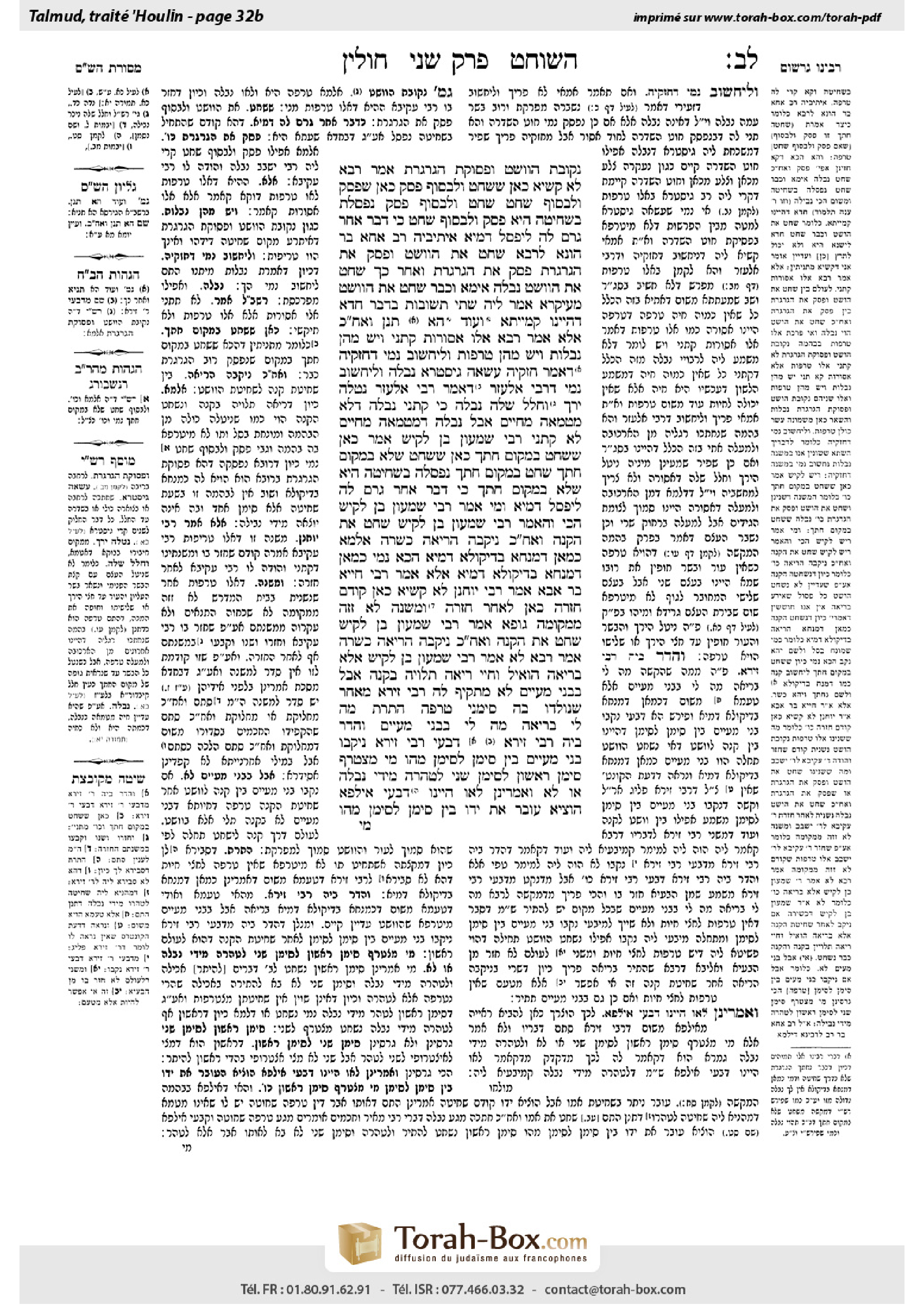
Chullin 32b: Talmud study for Daf Yomi
Study the Talmud for Daf Yomi with scanned pages, Hebrew text, English translations from Sefaria and AI-generated French translations.
Passage selection and English or AI-generated French translation are available where the scan has annotations. Daf Study is independent of Torah-Box and Sefaria.
Browse Chullin · חולין · All tractatesChullin 32b text and translations
This page of Chullin includes the Aramaic text, an English translation and an AI-generated French translation, alongside the scan above.
חולין ל״ב ב · Aramaic and Hebrew text
נְקוּבַת הַוֶּושֶׁט וּפְסוּקַת הַגַּרְגֶּרֶת!
אָמַר רָבָא: לָא קַשְׁיָא, כָּאן שֶׁשָּׁחַט וּלְבַסּוֹף פָּסַק, כָּאן שֶׁפָּסַק וּלְבַסּוֹף שָׁחַט. שָׁחַט וּלְבַסּוֹף פָּסַק – נִפְסֶלֶת בִּשְׁחִיטָה הִיא, פָּסַק וּלְבַסּוֹף שָׁחַט – כִּי דָּבָר אַחֵר גָּרַם לָהּ לִיפָּסֵל דָּמְיָא.
אֵיתִיבֵיהּ רַב אַחָא בַּר הוּנָא לְרָבָא: שָׁחַט אֶת הַוֶּושֶׁט וּפָסַק אֶת הַגַּרְגֶּרֶת, פָּסַק אֶת הַגַּרְגֶּרֶת וְאַחַר כָּךְ שָׁחַט אֶת הַוֶּושֶׁט – נְבֵלָה!
אֵימָא: וּכְבָר שָׁחַט אֶת הַוֶּושֶׁט מֵעִיקָּרָא.
אֲמַר לֵיהּ: שְׁתֵּי תְּשׁוּבוֹת בַּדָּבָר, חֲדָא דְּהַיְינוּ קַמַּיְיתָא, וְעוֹד הָא תְּנַן ״וְאַחַר כָּךְ״!
אֶלָּא אָמַר רָבָא: אֵלּוּ אֲסוּרוֹת קָתָנֵי, וְיֵשׁ מֵהֶן נְבֵלוֹת, וְיֵשׁ מֵהֶן טְרֵפוֹת.
וְלִיחְשׁוֹב נָמֵי דְּחִזְקִיָּה, דְּאָמַר חִזְקִיָּה: עֲשָׂאָהּ גִּיסְטְרָא – נְבֵלָה, וְלִיחְשׁוֹב נָמֵי דְּרַבִּי אֶלְעָזָר, דְּאָמַר רַבִּי אֶלְעָזָר: נִטְּלָה יָרֵךְ וְחָלָל שֶׁלָּהּ – נְבֵלָה.
כִּי קָתָנֵי נְבֵלָה, דְּלָא מְטַמְּאָה מֵחַיִּים, אֲבָל נְבֵלָה דִּמְטַמְּאָה מֵחַיִּים – לָא קָתָנֵי.
רַבִּי שִׁמְעוֹן בֶּן לָקִישׁ אָמַר: כָּאן – שֶׁשָּׁחַט בִּמְקוֹם חֲתָךְ, כָּאן – שֶׁשָּׁחַט שֶׁלֹּא בִּמְקוֹם חֲתָךְ. שָׁחַט בִּמְקוֹם חֲתָךְ – נִפְסְלָה בִּשְׁחִיטָה הִיא, שֶׁלֹּא בִּמְקוֹם חֲתָךְ – כִּי דָּבָר אַחֵר גָּרַם לָהּ לִיפָּסֵל דָּמְיָא.
וּמִי אָמַר רַבִּי שִׁמְעוֹן בֶּן לָקִישׁ הָכִי? וְהָאָמַר רַבִּי שִׁמְעוֹן בֶּן לָקִישׁ: שָׁחַט אֶת הַקָּנֶה וְאַחַר כָּךְ נִיקְּבָה הָרֵיאָה כְּשֵׁרָה! אַלְמָא כְּמַאן דְּמַנְּחָא בְּדִיקּוּלָא דָּמְיָא, הָכָא נָמֵי כְּמַאן דְּמַנְּחָא בְּדִיקּוּלָא דָּמְיָא.
אֶלָּא אָמַר רַבִּי חִיָּיא בַּר אַבָּא אָמַר רַבִּי יוֹחָנָן: לָא קַשְׁיָא, כָּאן קוֹדֶם חֲזָרָה, כָּאן לְאַחַר חֲזָרָה, וּמִשְׁנָה לֹא זָזָה מִמְּקוֹמָהּ.
גּוּפָא, אָמַר רַבִּי שִׁמְעוֹן בֶּן לָקִישׁ: שָׁחַט אֶת הַקָּנֶה וְאַחַר כָּךְ נִיקְּבָה הָרֵיאָה – כְּשֵׁרָה. אָמַר רָבָא: לָא אָמַר רַבִּי שִׁמְעוֹן בֶּן לָקִישׁ אֶלָּא בְּרֵיאָה, הוֹאִיל וְחַיֵּי רֵיאָה תְּלוּיִן בַּקָּנֶה, אֲבָל בִּבְנֵי מֵעַיִים – לָא.
מַתְקֵיף לַהּ רַבִּי זֵירָא: מֵאַחַר שֶׁנּוֹלְדוּ בָּהּ סִימָנֵי טְרֵפָה הִתַּרְתָּ, מָה לִי בְּרֵיאָה, מָה לִי בִּבְנֵי מֵעַיִים!
וַהֲדַר בֵּיהּ רַבִּי זֵירָא, דְּבָעֵי רַבִּי זֵירָא: נִיקְּבוּ בְּנֵי מֵעַיִים בֵּין סִימָן לְסִימָן, מַהוּ? מִי מִצְטָרֵף סִימָן רִאשׁוֹן לְסִימָן שֵׁנִי לְטַהֲרָהּ מִידֵי נְבֵלָה, אוֹ לָא?
וְאָמְרִינַן: לָאו הַיְינוּ דְּבָעֵי אִילְפָא: הוֹצִיא עוּבָּר אֶת יָדוֹ בֵּין סִימָן לְסִימָן, מַהוּ?
Chullin 32b · English translation
An animal that has a perforated gullet, where the perforation goes through the wall of the gullet, or one with a severed windpipe. According to this mishna, the severed windpipe renders the animal a tereifa and not an unslaughtered carcass. If Rabbi Akiva reconsidered his opinion and conceded to Rabbi Yeshevav, in accordance with the opinion of which tanna is that mishna?
Rava said: This is not difficult. Here, the mishna is referring to a case where one cut the gullet and ultimately severed the windpipe not in the standard manner. There, the mishna in the next chapter is referring to a case where he severed the windpipe not in the standard manner, and ultimately cut the gullet. If he cut the gullet and ultimately severed the windpipe, the animal was rendered unfit during its slaughter; therefore, it assumes the status of an unslaughtered carcass, according to the principle of Rabbi Yeshevav. But if he severed the windpipe and ultimately cut the gullet, it is as though another matter caused the animal to become unfit; therefore, it assumes the status of a tereifa.
Rav Aḥa bar Huna raised an objection to Rava from a baraita: If one cut the gullet and then severed the windpipe, or if one severed the windpipe and cut the gullet thereafter, the animal is an unslaughtered carcass. Apparently, contrary to Rava’s statement, the order is irrelevant, and even if the windpipe is severed first, the animal assumes the status of an unslaughtered carcass.
Rava said: Say that the latter case in the baraita means not that he cut the gullet thereafter; rather, it is a case where one severed the windpipe and had already cut the gullet at the outset.
Rav Aḥa bar Huna said to him: There are two refutations of the statement, i.e., of your attempt to answer the difficulty from the baraita: One is that if the second case in the baraita is one where he initially cut the gullet, then that is identical to the first case in the baraita. And furthermore, didn’t we learn explicitly in the baraita: Or if one severed the windpipe and cut the gullet thereafter, the animal is an unslaughtered carcass?
Rather, Rava said: The use of the term: Tereifot, in the mishna in the next chapter is not to the exclusion of unslaughtered carcasses; rather, the tanna teaches that term in a general sense, meaning: These wounds serve to render an animal forbidden; and there are some of them that are unslaughtered carcasses, e.g., an animal with a severed windpipe, and there are some of them that are tereifot.
The Gemara objects to that interpretation: If the mishna is listing those circumstances that render the animal an unslaughtered carcass, let the tanna consider the circumstance of Ḥizkiyya as well, as Ḥizkiyya says: If one rendered the animal like a shard by cutting it into two widthwise, its halakhic status is that of an unslaughtered carcass even while it is convulsing before its death. And let the tanna consider the circumstance of Rabbi Elazar as well, as Rabbi Elazar said: If the thigh, the hind leg of the animal, was removed and its recess is obvious (see 21a), it is an unslaughtered carcass.
The Gemara explains: When the mishna teaches the case of an unslaughtered carcass, it is a case where the animal does not assume that status and imparts impurity while alive. But the tanna does not teach the case of an unslaughtered carcass where the animal assumes that status and imparts impurity while alive, e.g., the cases of Ḥizkiyya and Rabbi Elazar.
Rabbi Shimon ben Lakish resolved the apparent contradiction between the mishna here and the mishna on 42a, and said: Here, the tanna is referring to a case where one cut the gullet in the same place as the initial cut in the windpipe. There, on 42a, the tanna is referring to a case where he cut the gullet not in the same place as the initial cut in the windpipe. The reason for the distinction is that if one cut the gullet in the same place as the initial cut in the windpipe, it is an animal that was rendered unfit during its slaughter and it assumes the status of an unslaughtered carcass. By contrast, if he cut the gullet not in the same place as the initial cut in the windpipe it is like a case where another matter caused the animal to become unfit. Therefore, cutting the gullet renders it a tereifa and prevents it from imparting ritual impurity.
The Gemara asks: And did Rabbi Shimon ben Lakish say this, that slaughter can be effective to prevent impurity after the windpipe was severed? But doesn’t Rabbi Shimon ben Lakish say: If one cut the windpipe and the lung was perforated thereafter before he cut the gullet, the animal is fit for consumption? Apparently, after cutting the windpipe, the status of the lungs, whose existence is dependent upon the windpipe, is like that of an item that is placed in a basket; they are irrelevant to the determination of the animal’s status. Here too, when the windpipe is severed at the beginning of the slaughter the windpipe should be considered like an item that is placed in a basket in the sense that the animal is considered to have only one siman, the gullet, and cutting of one siman does not affect the animal’s status.
Rather, Rabbi Ḥiyya bar Abba said that Rabbi Yoḥanan said: The apparent contradiction is not difficult. There (42a), where it is stated that an animal with a severed windpipe is a tereifa, the mishna presents the opinion of Rabbi Akiva before retraction of his opinion. Here, the mishna presents the opinion of Rabbi Akiva after retraction of his opinion. And even though Rabbi Akiva retracted his opinion, a mishna does not move from its place. Once this version of the mishna was learned in the study hall, it remained valuable, even though it is no longer current.
§ The Gemara discusses the matter itself that was cited previously. Rabbi Shimon ben Lakish says: If one cut the windpipe and the lung was perforated thereafter before he cut the gullet, the animal is fit for consumption. Rava said: Rabbi Shimon ben Lakish states this principle only with regard to a lung, since the function of the lung is dependent upon the windpipe. Once the windpipe is severed it is as though the lungs were removed from the animal. But with regard to innards that were perforated after the windpipe was cut but before the slaughter was completed, no, the animal becomes a tereifa, because the function of the innards is not dependent on the windpipe.
Rabbi Zeira objects to Rava’s distinction. Since when signs of being a tereifa developed in the animal after the slaughter began, you permitted the animal and deemed the slaughter valid, what difference is there to me if the perforation was in the lung, and what difference is there to me if the perforation was in the innards? In either case, the animal should not be deemed a tereifa if the signs developed once the slaughter began.
But Rabbi Zeira retracted his objection, as Rabbi Zeira raises a dilemma: If the innards were perforated between the cutting of the first siman and the second siman what is the halakha? Does the first siman join together with the second siman to purify the animal from the impurity of an unslaughtered carcass or not?
And we say: Isn’t this the dilemma that Ilfa raises: If a fetus extended its foreleg outside the womb while the mother was being slaughtered, between the cutting of the first siman, the windpipe, and the second siman, the gullet, thereby causing the foreleg to have the status of a tereifa, what is the halakha?
Chullin 32b · Traduction française (IA)
Un animal dont le gosier est percé, de telle sorte que la perforation traverse la paroi du gosier, ou un animal dont le trachée est tranché. Selon cette mitsva, le tranchage du trachée rend l'animal tereifa et non un cadavre non sacrifié. Si Rabbi Akiva a réexaminé son opinion et a cédé à Rabbi Yeshevav, selon l'opinion de quel tanna est-ce que cette mitsva ?
Rava dit : Ce n'est pas difficile. Ici, la mitsva fait référence à un cas où l'on a tranché le gosier et finalement tranché le trachée non dans la manière normale. Là, la mitsva du chapitre suivant fait référence à un cas où l'on a tranché le trachée non dans la manière normale et finalement tranché le gosier. Si l'on a tranché le gosier et finalement tranché le trachée, l'animal a été rendu non conforme durant son sacrifice ; donc, il assume le statut de cadavre non sacrifié, selon le principe de Rabbi Yeshevav. Mais si l'on a tranché le trachée et finalement tranché le gosier, c'est comme si une autre cause avait rendu l'animal non conforme ; donc, il assume le statut de tereifa.
Rav Aḥa bar Huna a soulevé un objet contre Rava à partir d'une baraïta : Si l'on a tranché le gosier et ensuite tranché le trachée, ou si l'on a tranché le trachée et tranché le gosier ensuite, l'animal est un cadavre non sacrifié. Apparemment, contrairement à l'affirmation de Rava, l'ordre est indifférent, et même si le trachée est tranché en premier, l'animal assume le statut de cadavre non sacrifié.
Rava dit : Dites que le cas ultérieur dans la baraïta ne signifie pas qu'on a tranché le gosier ensuite ; plutôt, il s'agit d'un cas où l'on a tranché le trachée et avait déjà tranché le gosier au départ.
Rav Aḥa bar Huna a dit à lui : Il y a deux réfutations de l'affirmation, c'est-à-dire de votre tentative de répondre à la difficulté à partir de la baraïta : Une est que si le second cas dans la baraïta est un cas où l'on a tranché le gosier au départ, alors cela est identique au premier cas dans la baraïta. Et de plus, n'avons-nous pas appris explicitement dans la baraïta : Ou si l'on a tranché le trachée et tranché le gosier ensuite, l'animal est un cadavre non sacrifié ?
Plutôt, Rava dit : L'usage du terme : tereifot, dans la mitsva du chapitre suivant n'exclut pas les cadavres non sacrifiés ; plutôt, le tanna enseigne ce terme de manière générale, signifiant : Ces blessures servent à rendre l'animal interdit ; et il y a parmi elles des cadavres non sacrifiés, par exemple, un animal avec un trachée tranché, et il y a parmi elles des tereifot.
La Guemara s'oppose à cette interprétation : Si la mitsva liste les circonstances qui rendent l'animal un cadavre non sacrifié, que le tanna considère aussi la circonstance de Ḥizkiyya, car Ḥizkiyya dit : Si l'on a rendu l'animal comme un fragment en le coupant en deux par la largeur, son statut halakhique est celui d'un cadavre non sacrifié même pendant qu'il convulse avant sa mort. Et que le tanna considère aussi la circonstance de Rabbi Elazar, car Rabbi Elazar dit : Si la cuisse, la patte arrière de l'animal, a été retirée et son recoin est évident (voir 21a), c'est un cadavre non sacrifié.
La Guemara explique : Quand la mitsva enseigne le cas du cadavre non sacrifié, il s'agit d'un cas où l'animal ne prend pas ce statut et ne transmet pas l'impureté pendant qu'il est vivant. Mais le tanna ne parle pas du cas du cadavre non sacrifié où l'animal prend ce statut et transmet l'impureté pendant qu'il est vivant, par exemple, les cas de Ḥizkiyya et de Rabbi Elazar.
Rabbi Shimon ben Lakish a résolu la contradiction apparente entre la mitsva ici et la mitsva sur 42a, et a dit : Ici, le tanna fait référence à un cas où l'on a tranché le gosier au même endroit que la coupure initiale du trachée. Là, sur 42a, le tanna fait référence à un cas où l'on a tranché le gosier sans être au même endroit que la coupure initiale du trachée. La raison de la distinction est que si l'on a tranché le gosier au même endroit que la coupure initiale du trachée, c'est un animal qui a été rendu non conforme durant son sacrifice et il assume le statut de cadavre non sacrifié. À l'inverse, si l'on a tranché le gosier sans être au même endroit que la coupure initiale du trachée, c'est comme un cas où une autre cause a rendu l'animal non conforme. Donc, le tranchage du gosier rend l'animal tereifa et empêche l'animal de transmettre l'impureté rituelle.
La Guemara pose la question : Et Rabbi Shimon ben Lakish a-t-il dit cela, que la mise à mort peut être efficace pour empêcher l'impureté après que le trachée ait été tranché ? Mais n'a-t-il pas dit Rabbi Shimon ben Lakish : Si l'on a tranché le trachée et que le poumon a été perforé ensuite avant de trancher le gosier, l'animal est propre à la consommation ? Apparemment, après avoir tranché le trachée, le statut des poumons, dont l'existence dépend du trachée, est comme celui d'un objet placé dans un panier ; ils sont sans importance pour la détermination du statut de l'animal. Ici aussi, quand le trachée est tranché au début de la mise à mort, le trachée devrait être considéré comme un objet placé dans un panier, dans le sens où l'animal est considéré comme ayant seulement un siman, le gosier, et le tranchage d'un siman ne modifie pas le statut de l'animal.
Plutôt, Rabbi Ḥiyya bar Abba a dit que Rabbi Yoḥanan a dit : La contradiction apparente n'est pas difficile. Là (42a), où il est dit qu'un animal avec un trachée tranché est un tereifa, la mitsna présente l'opinion de Rabbi Akiva avant son retrait. Ici, la mitsna présente l'opinion de Rabbi Akiva après son retrait. Et même si Rabbi Akiva a retraité son opinion, une mitsna ne change pas de place. Une fois que cette version de la mitsna a été apprise dans la salle de étude, elle reste précieuse, même si elle n'est plus en usage.
§ La Guemara discute la question elle-même qui avait été citée précédemment. Rabbi Shimon ben Lakish dit : Si l'on coupe la trachée et que le poumon est perforé ensuite avant de couper la gorge, l'animal est propre à la consommation. Rava dit : Rabbi Shimon ben Lakish énonce ce principe uniquement concernant le poumon, car la fonction du poumon dépend de la trachée. Une fois que la trachée est tranchée, cela équivaut à ce que les poumons soient retirés de l'animal. Mais concernant les viscères perforés après que la trachée ait été coupée mais avant que la bête ne soit achevée de mourir, non, l'animal devient un tereifa, car la fonction des viscères ne dépend pas de la trachée.
Rabbi Zeira s'oppose à la distinction de Rava. Puisque, lorsque des signes d'être tereifa se sont développés dans l'animal après le début de la bête, vous avez permis l'animal et considéré la bête comme valide, quelle différence y a-t-il pour moi si la perforation était dans le poumon, et quelle différence y a-t-il pour moi si la perforation était dans les viscères ? Dans les deux cas, l'animal ne devrait pas être considéré comme tereifa si les signes se sont développés une fois que la bête a commencé.
Mais Rabbi Zeira a retiré son objection, car Rabbi Zeira énonce un dilemme : Si les viscères ont été perforés entre la coupe du premier siman et la coupe du deuxième siman, quelle est la halakha ? Le premier siman s'unira-t-il avec le deuxième siman pour purifier l'animal de l'impureté du cadavre non sacrifié ou non ?
Et nous disons : N'est-ce pas ce dilemme que soulève Ilfa : Si un fœtus a étendu son avant-bras en dehors du ventre pendant que la mère était tuée, entre la coupe du premier siman, la trachée, et le deuxième siman, la gorge, ce qui a fait que l'avant-bras ait le statut de tereifa, quelle est la halakha ?
Traduction française générée par IA à partir de l’édition anglaise de Sefaria. Vérifie toujours un passage avec le texte source.
Text from Sefaria: William Davidson Edition - Vocalized Aramaic (unknown); William Davidson Edition - English (CC BY NC).